SAINT FERMIN
THE FESTIVAL
• The festival of Saint Fermin in the city of Pamplona is a
very famous celebration held annually from 6 July, when
the opening of the party is marked by setting off the
chupinazo, to midnight 14 July, with the singing of
the Pobre de Mí.
• The most famous event is the encierro, or the running of
the bulls, which happens from July 7th to July 14th.
• It is known locally as Sanfermines and it is held in
honour of Saint Fermin, the co-patron of Navarre.
• It has become probably the most internationally
renowned festival in Spain.
ORIGINS
• Combination of two medieval events:
1. Commercial fairs were held at the beginning of the
summer. As cattle merchants came into town with their
animals, eventually bullfighting came to be organized
as a part of the tradition.
2. On the other hand religious ceremonies honoring the
saint were held on October 10. In 1591 they were
transferred to the 7th of July to take place at the same
time as the fair; when Pamplona's weather is better.
• This is considered to be the beginning of
the Sanfermines.
MODERNS TIMES
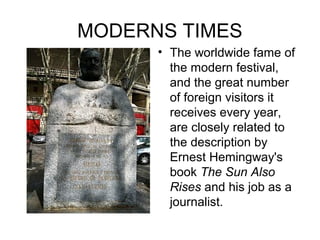
• The worldwide fame of
the modern festival,
and the great number
of foreign visitors it
receives every year,
are closely related to
the description by
Ernest Hemingway's
book The Sun Also
Rises and his job as a
journalist.
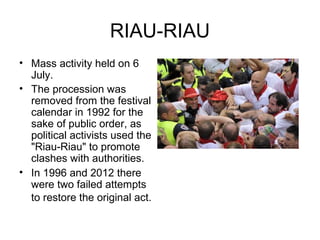
RIAU-RIAU
• Mass activity held on 6
July.
• The procession was
removed from the festival
calendar in 1992 for the
sake of public order, as
political activists used the
"Riau-Riau" to promote
clashes with authorities.
• In 1996 and 2012 there
were two failed attempts
to restore the original act.
SAINT FERMIN PROCESSION
• On July 7, thousands of dancers and street
entertainers, and different political and religious
authorities including the city mayor accompany
the 15th-century statue of Saint Fermin.
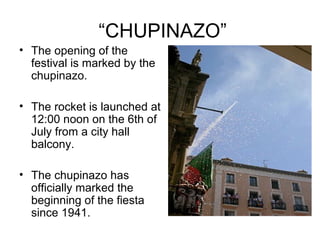
“CHUPINAZO”
• The opening of the
festival is marked by the
chupinazo.
• The rocket is launched at
12:00 noon on the 6th of
July from a city hall
balcony.
• The chupinazo has
officially marked the
beginning of the fiesta
since 1941.
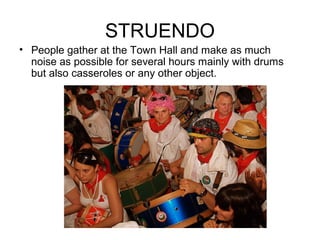
STRUENDO
• People gather at the Town Hall and make as much
noise as possible for several hours mainly with drums
but also casseroles or any other object.
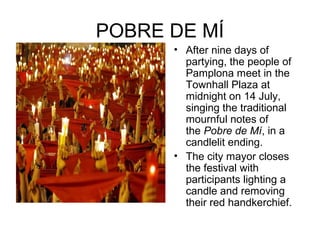
POBRE DE MÍ
• After nine days of
partying, the people of
Pamplona meet in the
Townhall Plaza at
midnight on 14 July,
singing the traditional
mournful notes of
the Pobre de Mí, in a
candlelit ending.
• The city mayor closes
the festival with
participants lighting a
candle and removing
their red handkerchief.
Running of the bulls
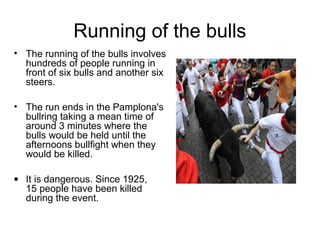
• The running of the bulls involves
hundreds of people running in
front of six bulls and another six
steers.
• The run ends in the Pamplona's
bullring taking a mean time of
around 3 minutes where the
bulls would be held until the
afternoons bullfight when they
would be killed.
• It is dangerous. Since 1925,
15 people have been killed
during the event.
GIANTS AND BIG-HEADS PARADE
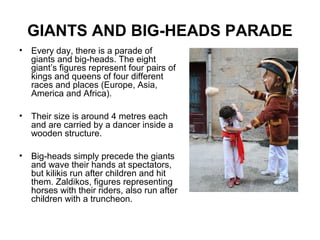
• Every day, there is a parade of
giants and big-heads. The eight
giant’s figures represent four pairs of
kings and queens of four different
races and places (Europe, Asia,
America and Africa).
• Their size is around 4 metres each
and are carried by a dancer inside a
wooden structure.
• Big-heads simply precede the giants
and wave their hands at spectators,
but kilikis run after children and hit
them. Zaldikos, figures representing
horses with their riders, also run after
children with a truncheon.
FIREWORKS
• Every night a firework spectacle is held at
the citadel park. Fireworks spectacles
have been known to occur in Sanfermin as
far back as 1595.
• Since the year 2000 an international
fireworks contest is held. Thousands of
people watch them seated on the grass
around the citadel.
THE END

Saint Fermin

  • 1.
  • 2.
    THE FESTIVAL • Thefestival of Saint Fermin in the city of Pamplona is a very famous celebration held annually from 6 July, when the opening of the party is marked by setting off the chupinazo, to midnight 14 July, with the singing of the Pobre de Mí. • The most famous event is the encierro, or the running of the bulls, which happens from July 7th to July 14th. • It is known locally as Sanfermines and it is held in honour of Saint Fermin, the co-patron of Navarre. • It has become probably the most internationally renowned festival in Spain.
  • 3.
    ORIGINS • Combination oftwo medieval events: 1. Commercial fairs were held at the beginning of the summer. As cattle merchants came into town with their animals, eventually bullfighting came to be organized as a part of the tradition. 2. On the other hand religious ceremonies honoring the saint were held on October 10. In 1591 they were transferred to the 7th of July to take place at the same time as the fair; when Pamplona's weather is better. • This is considered to be the beginning of the Sanfermines.
  • 4.
    MODERNS TIMES • Theworldwide fame of the modern festival, and the great number of foreign visitors it receives every year, are closely related to the description by Ernest Hemingway's book The Sun Also Rises and his job as a journalist.
  • 5.
    RIAU-RIAU • Mass activityheld on 6 July. • The procession was removed from the festival calendar in 1992 for the sake of public order, as political activists used the "Riau-Riau" to promote clashes with authorities. • In 1996 and 2012 there were two failed attempts to restore the original act.
  • 6.
    SAINT FERMIN PROCESSION •On July 7, thousands of dancers and street entertainers, and different political and religious authorities including the city mayor accompany the 15th-century statue of Saint Fermin.
  • 7.
    “CHUPINAZO” • The openingof the festival is marked by the chupinazo. • The rocket is launched at 12:00 noon on the 6th of July from a city hall balcony. • The chupinazo has officially marked the beginning of the fiesta since 1941.
  • 8.
    STRUENDO • People gatherat the Town Hall and make as much noise as possible for several hours mainly with drums but also casseroles or any other object.
  • 9.
    POBRE DE MÍ •After nine days of partying, the people of Pamplona meet in the Townhall Plaza at midnight on 14 July, singing the traditional mournful notes of the Pobre de Mí, in a candlelit ending. • The city mayor closes the festival with participants lighting a candle and removing their red handkerchief.
  • 10.
    Running of thebulls • The running of the bulls involves hundreds of people running in front of six bulls and another six steers. • The run ends in the Pamplona's bullring taking a mean time of around 3 minutes where the bulls would be held until the afternoons bullfight when they would be killed. • It is dangerous. Since 1925, 15 people have been killed during the event.
  • 11.
    GIANTS AND BIG-HEADSPARADE • Every day, there is a parade of giants and big-heads. The eight giant’s figures represent four pairs of kings and queens of four different races and places (Europe, Asia, America and Africa). • Their size is around 4 metres each and are carried by a dancer inside a wooden structure. • Big-heads simply precede the giants and wave their hands at spectators, but kilikis run after children and hit them. Zaldikos, figures representing horses with their riders, also run after children with a truncheon.
  • 12.
    FIREWORKS • Every nighta firework spectacle is held at the citadel park. Fireworks spectacles have been known to occur in Sanfermin as far back as 1595. • Since the year 2000 an international fireworks contest is held. Thousands of people watch them seated on the grass around the citadel.
  • 13.