CARNIVALS
AROUND THE
   WORLD
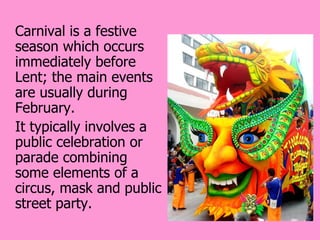
Carnival is a festive
season which occurs
immediately before
Lent; the main events
are usually during
February.
It typically involves a
public celebration or
parade combining
some elements of a
circus, mask and public
street party.
People often dress up or masquerade
during the celebrations, which mark an
overturning of daily life.
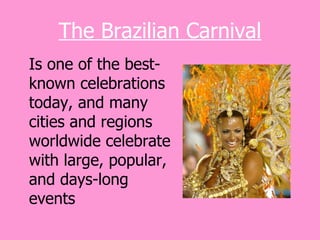
The Brazilian Carnival
Is one of the best-
known celebrations
today, and many
cities and regions
worldwide celebrate
with large, popular,
and days-long
events
Salvador has large Carnival celebrations,
including the Axé, typical Bahia music. A
truck with giant speakers and a platform
where musicians play songs of local
genres such as Axé music, Samba-
reggae and Arrocha, is driven with the
following crowd both dancing and singing.
The Carnival in Brazil is a big part of the
Brazilian Culture, and it is sometimes
referred to by the Brazilians as the
"Greatest Show on Earth".


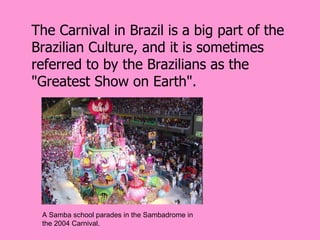
 A Samba school parades in the Sambadrome in
 the 2004 Carnival.
The Carnival of Rio de Janeiro is the
 biggest Carnival in the world, and the
 biggest popular party on the planet,
 according to the Guinness Book of World
 Records 2010. The Rio de Janeiro Carnival is
 also considered the world's most famous.
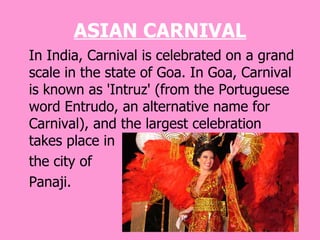
"Baianas" from the
                                    Imperatriz Leopoldinense
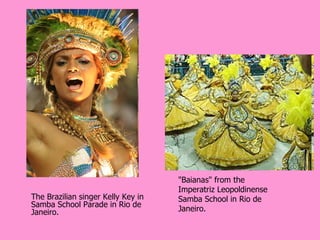
The Brazilian singer Kelly Key in   Samba School in Rio de
Samba School Parade in Rio de
Janeiro.                            Janeiro.
ASIAN CARNIVAL
In India, Carnival is celebrated on a grand
scale in the state of Goa. In Goa, Carnival
is known as 'Intruz' (from the Portuguese
word Entrudo, an alternative name for
Carnival), and the largest celebration
takes place in
the city of
Panaji.
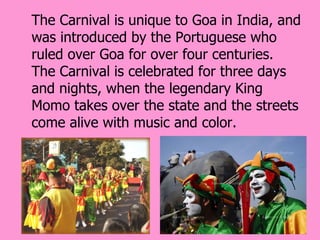
The Carnival is unique to Goa in India, and
was introduced by the Portuguese who
ruled over Goa for over four centuries.
The Carnival is celebrated for three days
and nights, when the legendary King
Momo takes over the state and the streets
come alive with music and color.
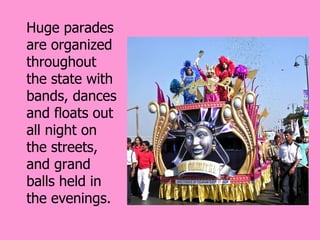
Huge parades
are organized
throughout
the state with
bands, dances
and floats out
all night on
the streets,
and grand
balls held in
the evenings.
EUROPEAN CARNIVAL
The most famous Croatian Carnival is
the Rijeka Carnival, during which the
mayor of Rijeka hands over the keys to
the city to the Carnival master and the
spirit of the Carnival takes
over completely.
The festival includes several different
events, culminating on the final Sunday in
a masked procession including participants
from many different countries. (A similar
procession for children takes place on the
previous day.)
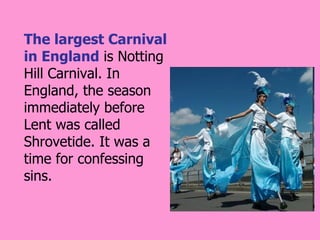
The largest Carnival
in England is Notting
Hill Carnival. In
England, the season
immediately before
Lent was called
Shrovetide. It was a
time for confessing
sins.
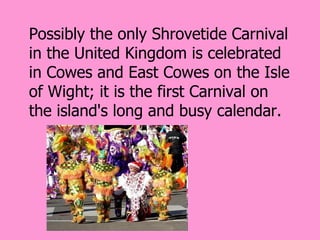
Possibly the only Shrovetide Carnival
in the United Kingdom is celebrated
in Cowes and East Cowes on the Isle
of Wight; it is the first Carnival on
the island's long and busy calendar.
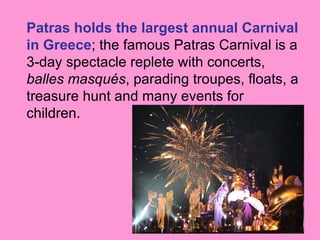
Patras holds the largest annual Carnival
in Greece; the famous Patras Carnival is a
3-day spectacle replete with concerts,
balles masqués, parading troupes, floats, a
treasure hunt and many events for
children.
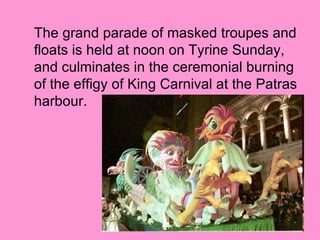
The grand parade of masked troupes and
floats is held at noon on Tyrine Sunday,
and culminates in the ceremonial burning
of the effigy of King Carnival at the Patras
harbour.
In Italy, the Carnival in Venice was first
recorded in 1268. The subversive nature
of the festival is reflected in Italy's many
laws over the past several centuries
attempting to restrict celebrations and the
wearing of masks, a central feature of the
Carnival.
Carnival celebrations in Venice were
halted for many years after the city fell
under Austrian control in 1798, but were
revived in the late 20th century.
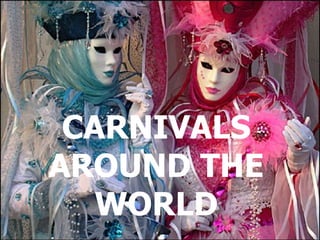
This Venetian tradition is most famous for
its distinctive
masks
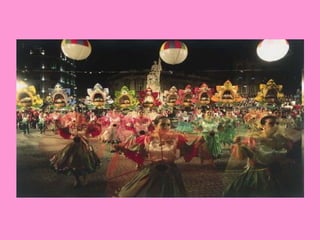
In Lisbon, Portugal's largest city, Carnival
is a more cosmopolitan affair. Parades,
dances and festivities throughout the week
feature famous stars from Portugal and
Brazil. The Loures Carnival is a highlight of
Lisbon's festivities which celebrates the
country's folk traditions, including the
"enterro do bacalhau" or burial of the cod,
which symbolizes the end of Carnival and
the festivities.
SPAIN
In Cádiz       the costumes worn are often related to
recent news. The feeling of this Carnival is the sharp
criticism, the funny play on words and the imagination in
the costumes, more than the glamorous dressings. It is
traditional to paint the face with lipstick as a humble
substitute of a mask.
The most famous groups are the chirigotas, choirs and
comparsas. The chirigotas are well known witty, satiric
popular groups who sing about politics, new times and
household topics, wearing the same costume, which they
train for the whole year.
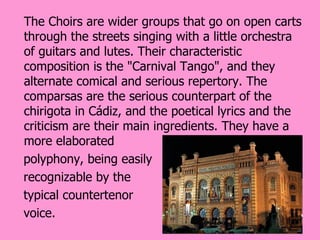
The Choirs are wider groups that go on open carts
through the streets singing with a little orchestra
of guitars and lutes. Their characteristic
composition is the "Carnival Tango", and they
alternate comical and serious repertory. The
comparsas are the serious counterpart of the
chirigota in Cádiz, and the poetical lyrics and the
criticism are their main ingredients. They have a
more elaborated
polyphony, being easily
recognizable by the
typical countertenor
voice.
The Santa Cruz and Las Palmas is together with the
Carnival of Cadiz, the most important festival for Spanish
tourism and Spain's largest Carnival. In 1980 it was
declared a Festival Tourist International Interest, by the
Secretariat of State for the Tourism. Carnival of Santa
Cruz de Tenerife now aspires to become a World Heritage
Site. This declaration by UNESCO will, occur, further
promoting international had Santa Cruz de Tenerife, being
the first Carnival of Spain to obtain this recognition, for its
permanent in time and it would reach the five continents
through UNESCO.
In 1987 went to the "Carnival Chicharrero"
Cuban singer Celia Cruz with orchestra Billo's
Caracas Boys, attended by 250,000 people, was
registered in the Guinness of Records as the
largest gathering of people in an outdoor plaza
to attend a concert, a record she holds today.
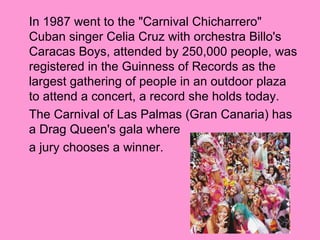
The Carnival of Las Palmas (Gran Canaria) has
a Drag Queen's gala where
a jury chooses a winner.
Project done by:
•   Maria Dolores Montilla Castillo
•   Ana Isabel Perez Roldan
•   Maria Jesus Merida Siles
•   Belen Serrano Navarro

Carnival All Around the World

  • 1.
  • 2.
    Carnival is afestive season which occurs immediately before Lent; the main events are usually during February. It typically involves a public celebration or parade combining some elements of a circus, mask and public street party.
  • 3.
    People often dressup or masquerade during the celebrations, which mark an overturning of daily life.
  • 4.
    The Brazilian Carnival Isone of the best- known celebrations today, and many cities and regions worldwide celebrate with large, popular, and days-long events
  • 5.
    Salvador has largeCarnival celebrations, including the Axé, typical Bahia music. A truck with giant speakers and a platform where musicians play songs of local genres such as Axé music, Samba- reggae and Arrocha, is driven with the following crowd both dancing and singing.
  • 6.
    The Carnival inBrazil is a big part of the Brazilian Culture, and it is sometimes referred to by the Brazilians as the "Greatest Show on Earth". A Samba school parades in the Sambadrome in the 2004 Carnival.
  • 8.
    The Carnival ofRio de Janeiro is the biggest Carnival in the world, and the biggest popular party on the planet, according to the Guinness Book of World Records 2010. The Rio de Janeiro Carnival is also considered the world's most famous.
  • 9.
    "Baianas" from the Imperatriz Leopoldinense The Brazilian singer Kelly Key in Samba School in Rio de Samba School Parade in Rio de Janeiro. Janeiro.
  • 10.
    ASIAN CARNIVAL In India,Carnival is celebrated on a grand scale in the state of Goa. In Goa, Carnival is known as 'Intruz' (from the Portuguese word Entrudo, an alternative name for Carnival), and the largest celebration takes place in the city of Panaji.
  • 11.
    The Carnival isunique to Goa in India, and was introduced by the Portuguese who ruled over Goa for over four centuries. The Carnival is celebrated for three days and nights, when the legendary King Momo takes over the state and the streets come alive with music and color.
  • 12.
    Huge parades are organized throughout thestate with bands, dances and floats out all night on the streets, and grand balls held in the evenings.
  • 13.
    EUROPEAN CARNIVAL The mostfamous Croatian Carnival is the Rijeka Carnival, during which the mayor of Rijeka hands over the keys to the city to the Carnival master and the spirit of the Carnival takes over completely.
  • 14.
    The festival includesseveral different events, culminating on the final Sunday in a masked procession including participants from many different countries. (A similar procession for children takes place on the previous day.)
  • 15.
    The largest Carnival inEngland is Notting Hill Carnival. In England, the season immediately before Lent was called Shrovetide. It was a time for confessing sins.
  • 16.
    Possibly the onlyShrovetide Carnival in the United Kingdom is celebrated in Cowes and East Cowes on the Isle of Wight; it is the first Carnival on the island's long and busy calendar.
  • 17.
    Patras holds thelargest annual Carnival in Greece; the famous Patras Carnival is a 3-day spectacle replete with concerts, balles masqués, parading troupes, floats, a treasure hunt and many events for children.
  • 18.
    The grand paradeof masked troupes and floats is held at noon on Tyrine Sunday, and culminates in the ceremonial burning of the effigy of King Carnival at the Patras harbour.
  • 19.
    In Italy, theCarnival in Venice was first recorded in 1268. The subversive nature of the festival is reflected in Italy's many laws over the past several centuries attempting to restrict celebrations and the wearing of masks, a central feature of the Carnival.
  • 20.
    Carnival celebrations inVenice were halted for many years after the city fell under Austrian control in 1798, but were revived in the late 20th century. This Venetian tradition is most famous for its distinctive masks
  • 21.
    In Lisbon, Portugal'slargest city, Carnival is a more cosmopolitan affair. Parades, dances and festivities throughout the week feature famous stars from Portugal and Brazil. The Loures Carnival is a highlight of Lisbon's festivities which celebrates the country's folk traditions, including the "enterro do bacalhau" or burial of the cod, which symbolizes the end of Carnival and the festivities.
  • 23.
    SPAIN In Cádiz the costumes worn are often related to recent news. The feeling of this Carnival is the sharp criticism, the funny play on words and the imagination in the costumes, more than the glamorous dressings. It is traditional to paint the face with lipstick as a humble substitute of a mask. The most famous groups are the chirigotas, choirs and comparsas. The chirigotas are well known witty, satiric popular groups who sing about politics, new times and household topics, wearing the same costume, which they train for the whole year.
  • 25.
    The Choirs arewider groups that go on open carts through the streets singing with a little orchestra of guitars and lutes. Their characteristic composition is the "Carnival Tango", and they alternate comical and serious repertory. The comparsas are the serious counterpart of the chirigota in Cádiz, and the poetical lyrics and the criticism are their main ingredients. They have a more elaborated polyphony, being easily recognizable by the typical countertenor voice.
  • 26.
    The Santa Cruzand Las Palmas is together with the Carnival of Cadiz, the most important festival for Spanish tourism and Spain's largest Carnival. In 1980 it was declared a Festival Tourist International Interest, by the Secretariat of State for the Tourism. Carnival of Santa Cruz de Tenerife now aspires to become a World Heritage Site. This declaration by UNESCO will, occur, further promoting international had Santa Cruz de Tenerife, being the first Carnival of Spain to obtain this recognition, for its permanent in time and it would reach the five continents through UNESCO.
  • 27.
    In 1987 wentto the "Carnival Chicharrero" Cuban singer Celia Cruz with orchestra Billo's Caracas Boys, attended by 250,000 people, was registered in the Guinness of Records as the largest gathering of people in an outdoor plaza to attend a concert, a record she holds today. The Carnival of Las Palmas (Gran Canaria) has a Drag Queen's gala where a jury chooses a winner.
  • 28.
    Project done by: • Maria Dolores Montilla Castillo • Ana Isabel Perez Roldan • Maria Jesus Merida Siles • Belen Serrano Navarro