Utilizing Electronic Health Information Technology to Conduct HIV/AIDS Clinical Pharmacology and Implementation Research: Introductory ModuleSamuel Gavi, MSc – AITRP  Fellow, UZCharles C. Maponga PharmD, AITRP Co-Principal Investigator, UZCara Felton, PharmD –  AITRP Mentor, UBFarzia Sayidine- AITRP Research  Support, UBPulkit Bhuptani PharmD -  Research Student, UB Kathleen M. Tooley , MSEd- AITRP Program Administrator, UBRobin DiFrancesco, MBA – AITRP Mentor, UBGene D. Morse, PharmD – AITRP Principal Investigator, UB1University at Buffalo/University of Zimbabwe AIDS International Training And Research ProgramA Collaboration of the University at Buffalo, University of Zimbabwe, NYS Center of Excellence in Bioinformatics and Life Sciences, and the Institute for Healthcare Informatics
IntroductionGoal:To become familiar with applications of electronic Health Information Technology (eHIT) in HIV/AIDS, TB and other infectious disease researchThis module will explore the following:Overview of electronic health information technologyAdvantages and disadvantages of using electronic health information technologySpecialized fields of application of health information technologyApplications of eHIT in HIV/AIDS therapeutics research and implementation science in clinical practice2
Overview of Electronic Health Information Technology3
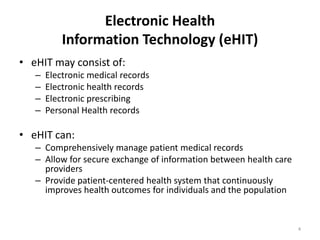
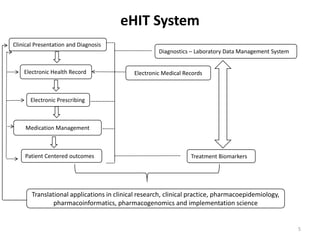
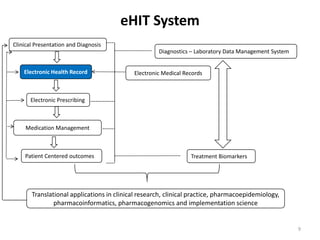
Electronic Health Information Technology (eHIT)eHIT may consist of:Electronic medical recordsElectronic health recordsElectronic prescribingPersonal Health recordseHIT can:Comprehensively manage patient medical records Allow for secure exchange of information between health care providersProvide patient-centered health system that continuously improves health outcomes for individuals and the population4
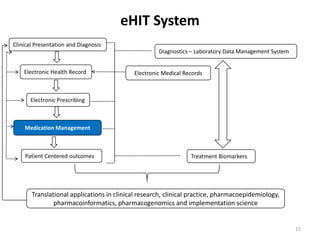
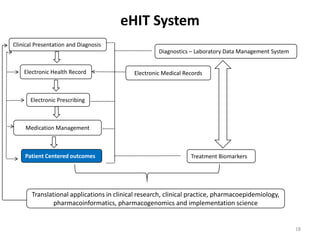
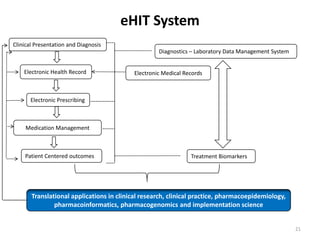
eHIT System 5Clinical Presentation and Diagnosis Diagnostics – Laboratory Data Management SystemElectronic Health RecordElectronic Medical RecordsElectronic PrescribingMedication ManagementPatient Centered outcomesTreatment Biomarkers       Translational applications in clinical research, clinical practice, pharmacoepidemiology, pharmacoinformatics, pharmacogenomics and implementation science
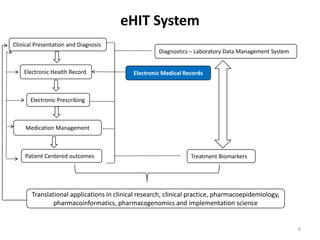
eHIT System 6Clinical Presentation and Diagnosis Diagnostics – Laboratory Data Management SystemElectronic Health RecordElectronic Medical RecordsElectronic PrescribingMedication ManagementPatient Centered outcomesTreatment Biomarkers       Translational applications in clinical research, clinical practice, pharmacoepidemiology, pharmacoinformatics, pharmacogenomics and implementation science
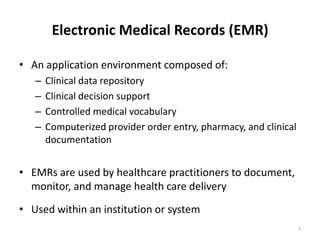
Electronic Medical Records (EMR)An application environment composed of:Clinical data repositoryClinical decision supportControlled medical vocabularyComputerized provider order entry, pharmacy, and clinical documentationEMRs are used by healthcare practitioners to document, monitor, and manage health care delivery Used within an institution or system7
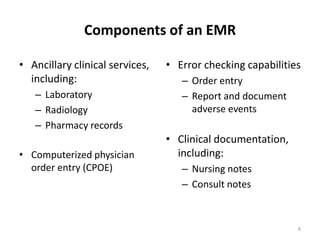
Components of an EMRAncillary clinical services, including:LaboratoryRadiologyPharmacy recordsComputerized physician order entry (CPOE)Error checking capabilitiesOrder entryReport and document adverse eventsClinical documentation, including:Nursing notesConsult notes8
eHIT System 9Clinical Presentation and Diagnosis Diagnostics – Laboratory Data Management SystemElectronic Health RecordElectronic Medical RecordsElectronic PrescribingMedication ManagementPatient Centered outcomesTreatment Biomarkers       Translational applications in clinical research, clinical practice, pharmacoepidemiology, pharmacoinformatics, pharmacogenomics and implementation science
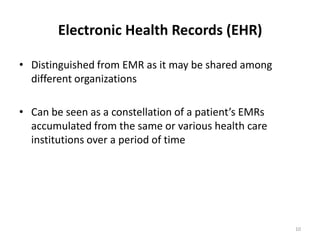
Electronic Health Records (EHR)Distinguished from EMR as it may be shared among different organizationsCan be seen as a constellation of a patient’s EMRs accumulated from the same or various health care institutions over a period of time10
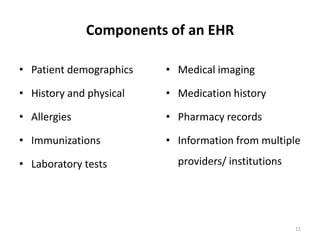
Components of an EHRPatient demographics History and physicalAllergies ImmunizationsLaboratory testsMedical imagingMedication history Pharmacy recordsInformation from multiple providers/ institutions11
eHIT System 12Clinical Presentation and Diagnosis Diagnostics – Laboratory Data Management SystemElectronic Health RecordElectronic Medical RecordsElectronic PrescribingMedication ManagementPatient Centered outcomesTreatment Biomarkers       Translational applications in clinical research, clinical practice, pharmacoepidemiology, pharmacoinformatics, pharmacogenomics and implementation science
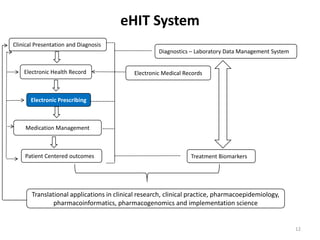
Electronic PrescribingePrescribing is the process whereby an authorized health care prescriber generates a computer-based prescription and transmits it electronically to a pharmacyComputer to computerePrescribing is not:Computer to faxComputer-generated paper prescriptionThis system can be integrated into an EMR ePrescribing can also be used for research protocols13
Types of ePrescribing Systems Stand-alone system: Simpler and cheaper to install as compared to a complete EMR packageIntegrated system: Consists of an electronic prescribing module integrated into an EMR systemContains all pertinent medical information within one comprehensive system   14
eHIT System 15Clinical Presentation and Diagnosis Diagnostics – Laboratory Data Management SystemElectronic Health RecordElectronic Medical RecordsElectronic PrescribingMedication ManagementPatient Centered outcomesTreatment Biomarkers       Translational applications in clinical research, clinical practice, pharmacoepidemiology, pharmacoinformatics, pharmacogenomics and implementation science
Using eHIT for Medication ManagementManagement of HIV/AIDS and co-infections presents medication complexities Ex. Interactions, adverse events, increased dosing frequency and pill burdeneHIT can be used to identify precautionary and prohibited medications during screening and protocol implementationInnovative programming within EHRs could allow for calculating the impact of medication complexities on ARV treatment outcomes16
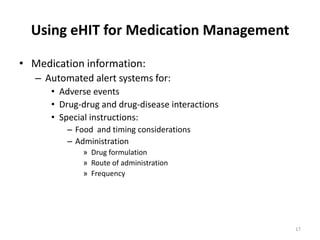
Using eHIT for Medication ManagementMedication information: Automated alert systems for:Adverse eventsDrug-drug and drug-disease interactionsSpecial instructions:Food  and timing considerationsAdministrationDrug formulation Route of administrationFrequency17
eHIT System 18Clinical Presentation and Diagnosis Diagnostics – Laboratory Data Management SystemElectronic Health RecordElectronic Medical RecordsElectronic PrescribingMedication ManagementPatient Centered outcomesTreatment Biomarkers       Translational applications in clinical research, clinical practice, pharmacoepidemiology, pharmacoinformatics, pharmacogenomics and implementation science
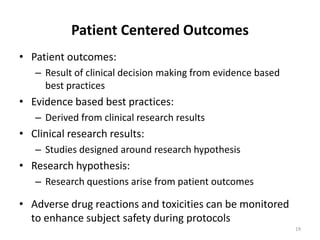
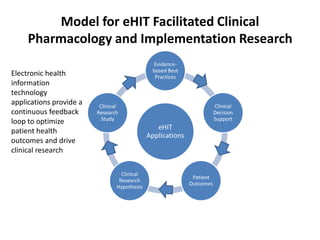
Patient Centered OutcomesPatient outcomes:Result of clinical decision making from evidence based best practicesEvidence based best practices: Derived from clinical research resultsClinical research results:Studies designed around research hypothesisResearch hypothesis:Research questions arise from patient outcomesAdverse drug reactions and toxicities can be monitored to enhance subject safety during protocols19
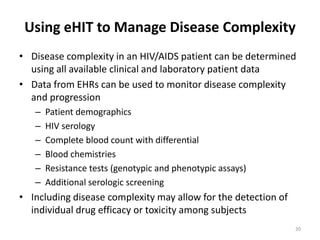
Using eHIT to Manage Disease ComplexityDisease complexity in an HIV/AIDS patient can be determined using all available clinical and laboratory patient dataData from EHRs can be used to monitor disease complexity and progressionPatient demographics	HIV serologyComplete blood count with differentialBlood chemistriesResistance tests (genotypic and phenotypic assays)Additional serologic screeningIncluding disease complexity may allow for the detection of individual drug efficacy or toxicity among subjects20
eHIT System 21Clinical Presentation and Diagnosis Diagnostics – Laboratory Data Management SystemElectronic Health RecordElectronic Medical RecordsElectronic PrescribingMedication ManagementPatient Centered outcomesTreatment Biomarkers       Translational applications in clinical research, clinical practice, pharmacoepidemiology, pharmacoinformatics, pharmacogenomics and implementation science
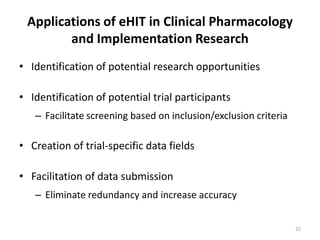
Applications of eHIT in Clinical Pharmacology and Implementation ResearchIdentification of potential research opportunitiesIdentification of potential trial participantsFacilitate screening based on inclusion/exclusion criteriaCreation of trial-specific data fieldsFacilitation of data submission Eliminate redundancy and increase accuracy22
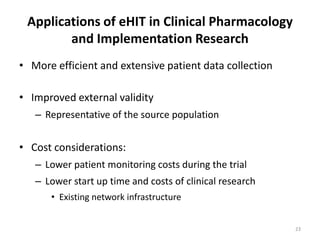
Applications of eHIT in Clinical Pharmacology and Implementation ResearchMore efficient and extensive patient data collectionImproved external validity Representative of the source population Cost considerations:Lower patient monitoring costs during the trialLower start up time and costs of clinical researchExisting network infrastructure23
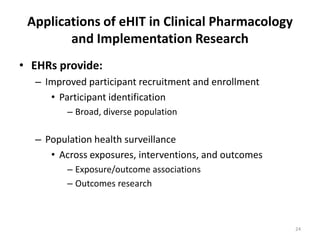
Applications of eHIT in Clinical Pharmacology and Implementation ResearchEHRs provide:Improved participant recruitment and enrollmentParticipant identificationBroad, diverse populationPopulation health surveillanceAcross exposures, interventions, and outcomesExposure/outcome associationsOutcomes research24
EHR Data in Clinical Pharmacology and Implementation Research Engage more people in researchMore robust informationEnable access to advanced treatmentReduce errors in dataCollective data across trialsEfficient data collectionEliminate redundancy in data collectionSafety reporting – real time dataFacilitate sharing of informationImprove communication between partnering organizations25
EHR Data in Clinical Pharmacology and Implementation ResearchHow data are collected/generatedStrengthen provider/investigator relationshipPatient inputConsider health literacy, access to careDifferent purposes for data collection/generation26
EHR Data in Clinical Pharmacology and Implementation ResearchQuality of data collectionWhat to collectWhere to collect How to collect When to collect Why to collect27
Data Collection - Case Report Forms Official data-reporting document used in clinical trialsCollects protocol-required informationCRFs allow for:Standardization of information Sharing of data among investigatorsEHR data may be used to pre-populate CRFsEliminate transcription errorsEliminate redundancy in data collection28
EHR Data in Clinical Pharmacology and Implementation ResearchExchange of dataEncourage sharing of dataResponsible use of data by all participating organizationsEncourage standardization of dataCollection, storage, retrieval, and analysis 29
Additional Considerations Regarding eHIT SystemsSecurity of patient data:Different levels of access for different usersCompatibility:Multiple institutions using different eHIT systemsRegulatory bodies:Issues concerning security, sharing, and use of patient data Data requirements:Differing requirements between the EHR and a clinical trial30
eHIT in HIV/AIDS Treatment and ResearchUse of eHIT systems has the potential to improve HIV/AIDS treatment by:Increasing adherence to treatment regimensMinimizing patients lost to follow-upSupporting clinical decisions  Minimizing medication errors (interactions, duplications, additive adverse events)31
Information Technology Used in HIV Treatment and ResearchInformation technology can be used for effective management of HIV, TB, and other infectious diseasesNetworked computersSmall basic databases using Microsoft Excel or Access for large databasesInternet-based databases Laboratory data management systemsUse of portable electronic devices in medication management32
Electronic health information technology  applications provide a continuous feedback loop to optimize patient health outcomes and drive clinical researchModel for eHIT Facilitated Clinical Pharmacology and Implementation Research
Supplemental Reading MaterialsFDA guidelines for drug developmentHIPAA and clinical researchJohnson George et al developed the Medication Regimen Complexity Index, a useful tool that can be useful for patients on ARV therapy to determine impact of medication complexities on treatment outcomes CollenDilorio et al tested the antiretroviral medication complexity index (AMCI) to assess the psychometric properties of the AMCI34
AcknowledgmentsNational Institutes of Health Fogarty International Center 1D43TW007991-01A2National Institutes of Health, Fogarty International Center 3D43TW007991-01A2S1We would like to acknowledge Ms. Amal Harb and Mr. Francesco Lliguicota for their informatics assistance on this project.  We would also like to acknowledge the Adherence Pharmacology Unit at the Erie County Medical Center for their clinical mentorship to AITRP fellows.35
References1. Farrokh A. Components of EHR. In.2. Hersh W. Health Care Information Technology: Progress and Barriers. Journal of American Medical Association 2004;292(18):2273-2274.3. Hersh W. Electronic health records facilitate development of disease registries and more. Clin J Am Soc Nephrol 2011;6(1):5-6.4. Hersh W. Adding Value to the Electronic Health Record Through Secondary Use of Data for Quality Assurance, Research, and Surveillance. The American Journal of Managed Care 2007;13(6):277-278.5. Hillestad R, Bigelow J, Bower A, et al. Can electronic medical record systems transform health care? Potential health benefits, savings, and costs. Health Aff (Millwood) 2005;24(5):1103-17.6. Kuo GM, Mullen PD, McQueen A, Swank PR, Rogers JC. Cross-sectional comparison of electronic and paper medical records on medication counseling in primary care clinics: a Southern Primary-Care Urban Research Network (SPUR-Net) study. J Am Board Fam Med 2007;20(2):164-73.7. Otero P, Gonzalez Bernaldo de Quiros F, Hersh W. Competencies for a well-trained biomedical and health informatics workforce. Methods Inf Med 2010;49(3):297-8.8. Taylor R, Bower A, Girosi F, Bigelow J, Fonkych K, Hillestad R. Promoting health information technology: is there a case for more-aggressive government action? Health Aff (Millwood) 2005;24(5):1234-45.9. Thomas Handler RH, Jane Metzger, Marc Overhage, Sheryl Taylor, Charlene Underwood, . HIMSS Electronic Health Record Definitional Model Version 1.0. In: EHR Definition, Attributes and Essential Requirements Version 1.0; 2003.10. Martin S, Wolters PL, Calabrese SK, et al. The Antiretroviral Regimen Complexity Index. A novel method of quantifying regimen complexity. J Acquir Immune DeficSyndr 2007;45(5):535-44.11. Farris KD, Kelly MW, Tryon J. Clock drawing test and medication complexity index as indicators of medication management capacity: a pilot study. J Am Pharm Assoc (Wash) 2003;43(1):78-81.12. DiIorio C, McDonnell M, McCarty F, Yeager K. Initial testing of the Antiretroviral Medication Complexity Index. J Assoc Nurses AIDS Care 2006;17(1):26-36.13. Chaudhry B, Wang J, Wu S, et al. Systematic review: impact of health information technology on quality, efficiency, and costs of medical care. Ann Intern Med 2006;144(10):742-52.14. Bernstam EV, Hersh WR, Sim I, et al. Unintended consequences of health information technology: a need for biomedical informatics. J Biomed Inform 2010;43(5):828-30.15. Benjamin DM. Reducing medication errors and increasing patient safety: case studies in clinical pharmacology. J ClinPharmacol 2003;43(7):768-83.16. Kahn, MG. (2006). Integrating Electronic Health Records and Clinical Trials, An Examination of Pragmatic Issues [Powerpoint]. Retrieved from ESI: www.esi-bethesda.com/ncrrworkshops/clinicalresearch/pdf/MichaelKahnPaper.pdf.17. Ensuring the Inclusion of Clinical Research in the National Health Information Network (2006) http://www.fastercures.org/index.cfm/OurPrograms/PatientsHelpingDoctors/Nationwide_Health_Information_Network_%28NHIN%2936

AITRP eHIT 101 tutorial

  • 1.
    Utilizing Electronic HealthInformation Technology to Conduct HIV/AIDS Clinical Pharmacology and Implementation Research: Introductory ModuleSamuel Gavi, MSc – AITRP Fellow, UZCharles C. Maponga PharmD, AITRP Co-Principal Investigator, UZCara Felton, PharmD – AITRP Mentor, UBFarzia Sayidine- AITRP Research Support, UBPulkit Bhuptani PharmD - Research Student, UB Kathleen M. Tooley , MSEd- AITRP Program Administrator, UBRobin DiFrancesco, MBA – AITRP Mentor, UBGene D. Morse, PharmD – AITRP Principal Investigator, UB1University at Buffalo/University of Zimbabwe AIDS International Training And Research ProgramA Collaboration of the University at Buffalo, University of Zimbabwe, NYS Center of Excellence in Bioinformatics and Life Sciences, and the Institute for Healthcare Informatics
  • 2.
    IntroductionGoal:To become familiarwith applications of electronic Health Information Technology (eHIT) in HIV/AIDS, TB and other infectious disease researchThis module will explore the following:Overview of electronic health information technologyAdvantages and disadvantages of using electronic health information technologySpecialized fields of application of health information technologyApplications of eHIT in HIV/AIDS therapeutics research and implementation science in clinical practice2
  • 3.
    Overview of ElectronicHealth Information Technology3
  • 4.
    Electronic Health InformationTechnology (eHIT)eHIT may consist of:Electronic medical recordsElectronic health recordsElectronic prescribingPersonal Health recordseHIT can:Comprehensively manage patient medical records Allow for secure exchange of information between health care providersProvide patient-centered health system that continuously improves health outcomes for individuals and the population4
  • 5.
    eHIT System 5ClinicalPresentation and Diagnosis Diagnostics – Laboratory Data Management SystemElectronic Health RecordElectronic Medical RecordsElectronic PrescribingMedication ManagementPatient Centered outcomesTreatment Biomarkers Translational applications in clinical research, clinical practice, pharmacoepidemiology, pharmacoinformatics, pharmacogenomics and implementation science
  • 6.
    eHIT System 6ClinicalPresentation and Diagnosis Diagnostics – Laboratory Data Management SystemElectronic Health RecordElectronic Medical RecordsElectronic PrescribingMedication ManagementPatient Centered outcomesTreatment Biomarkers Translational applications in clinical research, clinical practice, pharmacoepidemiology, pharmacoinformatics, pharmacogenomics and implementation science
  • 7.
    Electronic Medical Records(EMR)An application environment composed of:Clinical data repositoryClinical decision supportControlled medical vocabularyComputerized provider order entry, pharmacy, and clinical documentationEMRs are used by healthcare practitioners to document, monitor, and manage health care delivery Used within an institution or system7
  • 8.
    Components of anEMRAncillary clinical services, including:LaboratoryRadiologyPharmacy recordsComputerized physician order entry (CPOE)Error checking capabilitiesOrder entryReport and document adverse eventsClinical documentation, including:Nursing notesConsult notes8
  • 9.
    eHIT System 9ClinicalPresentation and Diagnosis Diagnostics – Laboratory Data Management SystemElectronic Health RecordElectronic Medical RecordsElectronic PrescribingMedication ManagementPatient Centered outcomesTreatment Biomarkers Translational applications in clinical research, clinical practice, pharmacoepidemiology, pharmacoinformatics, pharmacogenomics and implementation science
  • 10.
    Electronic Health Records(EHR)Distinguished from EMR as it may be shared among different organizationsCan be seen as a constellation of a patient’s EMRs accumulated from the same or various health care institutions over a period of time10
  • 11.
    Components of anEHRPatient demographics History and physicalAllergies ImmunizationsLaboratory testsMedical imagingMedication history Pharmacy recordsInformation from multiple providers/ institutions11
  • 12.
    eHIT System 12ClinicalPresentation and Diagnosis Diagnostics – Laboratory Data Management SystemElectronic Health RecordElectronic Medical RecordsElectronic PrescribingMedication ManagementPatient Centered outcomesTreatment Biomarkers Translational applications in clinical research, clinical practice, pharmacoepidemiology, pharmacoinformatics, pharmacogenomics and implementation science
  • 13.
    Electronic PrescribingePrescribing isthe process whereby an authorized health care prescriber generates a computer-based prescription and transmits it electronically to a pharmacyComputer to computerePrescribing is not:Computer to faxComputer-generated paper prescriptionThis system can be integrated into an EMR ePrescribing can also be used for research protocols13
  • 14.
    Types of ePrescribingSystems Stand-alone system: Simpler and cheaper to install as compared to a complete EMR packageIntegrated system: Consists of an electronic prescribing module integrated into an EMR systemContains all pertinent medical information within one comprehensive system 14
  • 15.
    eHIT System 15ClinicalPresentation and Diagnosis Diagnostics – Laboratory Data Management SystemElectronic Health RecordElectronic Medical RecordsElectronic PrescribingMedication ManagementPatient Centered outcomesTreatment Biomarkers Translational applications in clinical research, clinical practice, pharmacoepidemiology, pharmacoinformatics, pharmacogenomics and implementation science
  • 16.
    Using eHIT forMedication ManagementManagement of HIV/AIDS and co-infections presents medication complexities Ex. Interactions, adverse events, increased dosing frequency and pill burdeneHIT can be used to identify precautionary and prohibited medications during screening and protocol implementationInnovative programming within EHRs could allow for calculating the impact of medication complexities on ARV treatment outcomes16
  • 17.
    Using eHIT forMedication ManagementMedication information: Automated alert systems for:Adverse eventsDrug-drug and drug-disease interactionsSpecial instructions:Food and timing considerationsAdministrationDrug formulation Route of administrationFrequency17
  • 18.
    eHIT System 18ClinicalPresentation and Diagnosis Diagnostics – Laboratory Data Management SystemElectronic Health RecordElectronic Medical RecordsElectronic PrescribingMedication ManagementPatient Centered outcomesTreatment Biomarkers Translational applications in clinical research, clinical practice, pharmacoepidemiology, pharmacoinformatics, pharmacogenomics and implementation science
  • 19.
    Patient Centered OutcomesPatientoutcomes:Result of clinical decision making from evidence based best practicesEvidence based best practices: Derived from clinical research resultsClinical research results:Studies designed around research hypothesisResearch hypothesis:Research questions arise from patient outcomesAdverse drug reactions and toxicities can be monitored to enhance subject safety during protocols19
  • 20.
    Using eHIT toManage Disease ComplexityDisease complexity in an HIV/AIDS patient can be determined using all available clinical and laboratory patient dataData from EHRs can be used to monitor disease complexity and progressionPatient demographics HIV serologyComplete blood count with differentialBlood chemistriesResistance tests (genotypic and phenotypic assays)Additional serologic screeningIncluding disease complexity may allow for the detection of individual drug efficacy or toxicity among subjects20
  • 21.
    eHIT System 21ClinicalPresentation and Diagnosis Diagnostics – Laboratory Data Management SystemElectronic Health RecordElectronic Medical RecordsElectronic PrescribingMedication ManagementPatient Centered outcomesTreatment Biomarkers Translational applications in clinical research, clinical practice, pharmacoepidemiology, pharmacoinformatics, pharmacogenomics and implementation science
  • 22.
    Applications of eHITin Clinical Pharmacology and Implementation ResearchIdentification of potential research opportunitiesIdentification of potential trial participantsFacilitate screening based on inclusion/exclusion criteriaCreation of trial-specific data fieldsFacilitation of data submission Eliminate redundancy and increase accuracy22
  • 23.
    Applications of eHITin Clinical Pharmacology and Implementation ResearchMore efficient and extensive patient data collectionImproved external validity Representative of the source population Cost considerations:Lower patient monitoring costs during the trialLower start up time and costs of clinical researchExisting network infrastructure23
  • 24.
    Applications of eHITin Clinical Pharmacology and Implementation ResearchEHRs provide:Improved participant recruitment and enrollmentParticipant identificationBroad, diverse populationPopulation health surveillanceAcross exposures, interventions, and outcomesExposure/outcome associationsOutcomes research24
  • 25.
    EHR Data inClinical Pharmacology and Implementation Research Engage more people in researchMore robust informationEnable access to advanced treatmentReduce errors in dataCollective data across trialsEfficient data collectionEliminate redundancy in data collectionSafety reporting – real time dataFacilitate sharing of informationImprove communication between partnering organizations25
  • 26.
    EHR Data inClinical Pharmacology and Implementation ResearchHow data are collected/generatedStrengthen provider/investigator relationshipPatient inputConsider health literacy, access to careDifferent purposes for data collection/generation26
  • 27.
    EHR Data inClinical Pharmacology and Implementation ResearchQuality of data collectionWhat to collectWhere to collect How to collect When to collect Why to collect27
  • 28.
    Data Collection -Case Report Forms Official data-reporting document used in clinical trialsCollects protocol-required informationCRFs allow for:Standardization of information Sharing of data among investigatorsEHR data may be used to pre-populate CRFsEliminate transcription errorsEliminate redundancy in data collection28
  • 29.
    EHR Data inClinical Pharmacology and Implementation ResearchExchange of dataEncourage sharing of dataResponsible use of data by all participating organizationsEncourage standardization of dataCollection, storage, retrieval, and analysis 29
  • 30.
    Additional Considerations RegardingeHIT SystemsSecurity of patient data:Different levels of access for different usersCompatibility:Multiple institutions using different eHIT systemsRegulatory bodies:Issues concerning security, sharing, and use of patient data Data requirements:Differing requirements between the EHR and a clinical trial30
  • 31.
    eHIT in HIV/AIDSTreatment and ResearchUse of eHIT systems has the potential to improve HIV/AIDS treatment by:Increasing adherence to treatment regimensMinimizing patients lost to follow-upSupporting clinical decisions Minimizing medication errors (interactions, duplications, additive adverse events)31
  • 32.
    Information Technology Usedin HIV Treatment and ResearchInformation technology can be used for effective management of HIV, TB, and other infectious diseasesNetworked computersSmall basic databases using Microsoft Excel or Access for large databasesInternet-based databases Laboratory data management systemsUse of portable electronic devices in medication management32
  • 33.
    Electronic health informationtechnology applications provide a continuous feedback loop to optimize patient health outcomes and drive clinical researchModel for eHIT Facilitated Clinical Pharmacology and Implementation Research
  • 34.
    Supplemental Reading MaterialsFDAguidelines for drug developmentHIPAA and clinical researchJohnson George et al developed the Medication Regimen Complexity Index, a useful tool that can be useful for patients on ARV therapy to determine impact of medication complexities on treatment outcomes CollenDilorio et al tested the antiretroviral medication complexity index (AMCI) to assess the psychometric properties of the AMCI34
  • 35.
    AcknowledgmentsNational Institutes ofHealth Fogarty International Center 1D43TW007991-01A2National Institutes of Health, Fogarty International Center 3D43TW007991-01A2S1We would like to acknowledge Ms. Amal Harb and Mr. Francesco Lliguicota for their informatics assistance on this project. We would also like to acknowledge the Adherence Pharmacology Unit at the Erie County Medical Center for their clinical mentorship to AITRP fellows.35
  • 36.
    References1. Farrokh A.Components of EHR. In.2. Hersh W. Health Care Information Technology: Progress and Barriers. Journal of American Medical Association 2004;292(18):2273-2274.3. Hersh W. Electronic health records facilitate development of disease registries and more. Clin J Am Soc Nephrol 2011;6(1):5-6.4. Hersh W. Adding Value to the Electronic Health Record Through Secondary Use of Data for Quality Assurance, Research, and Surveillance. The American Journal of Managed Care 2007;13(6):277-278.5. Hillestad R, Bigelow J, Bower A, et al. Can electronic medical record systems transform health care? Potential health benefits, savings, and costs. Health Aff (Millwood) 2005;24(5):1103-17.6. Kuo GM, Mullen PD, McQueen A, Swank PR, Rogers JC. Cross-sectional comparison of electronic and paper medical records on medication counseling in primary care clinics: a Southern Primary-Care Urban Research Network (SPUR-Net) study. J Am Board Fam Med 2007;20(2):164-73.7. Otero P, Gonzalez Bernaldo de Quiros F, Hersh W. Competencies for a well-trained biomedical and health informatics workforce. Methods Inf Med 2010;49(3):297-8.8. Taylor R, Bower A, Girosi F, Bigelow J, Fonkych K, Hillestad R. Promoting health information technology: is there a case for more-aggressive government action? Health Aff (Millwood) 2005;24(5):1234-45.9. Thomas Handler RH, Jane Metzger, Marc Overhage, Sheryl Taylor, Charlene Underwood, . HIMSS Electronic Health Record Definitional Model Version 1.0. In: EHR Definition, Attributes and Essential Requirements Version 1.0; 2003.10. Martin S, Wolters PL, Calabrese SK, et al. The Antiretroviral Regimen Complexity Index. A novel method of quantifying regimen complexity. J Acquir Immune DeficSyndr 2007;45(5):535-44.11. Farris KD, Kelly MW, Tryon J. Clock drawing test and medication complexity index as indicators of medication management capacity: a pilot study. J Am Pharm Assoc (Wash) 2003;43(1):78-81.12. DiIorio C, McDonnell M, McCarty F, Yeager K. Initial testing of the Antiretroviral Medication Complexity Index. J Assoc Nurses AIDS Care 2006;17(1):26-36.13. Chaudhry B, Wang J, Wu S, et al. Systematic review: impact of health information technology on quality, efficiency, and costs of medical care. Ann Intern Med 2006;144(10):742-52.14. Bernstam EV, Hersh WR, Sim I, et al. Unintended consequences of health information technology: a need for biomedical informatics. J Biomed Inform 2010;43(5):828-30.15. Benjamin DM. Reducing medication errors and increasing patient safety: case studies in clinical pharmacology. J ClinPharmacol 2003;43(7):768-83.16. Kahn, MG. (2006). Integrating Electronic Health Records and Clinical Trials, An Examination of Pragmatic Issues [Powerpoint]. Retrieved from ESI: www.esi-bethesda.com/ncrrworkshops/clinicalresearch/pdf/MichaelKahnPaper.pdf.17. Ensuring the Inclusion of Clinical Research in the National Health Information Network (2006) http://www.fastercures.org/index.cfm/OurPrograms/PatientsHelpingDoctors/Nationwide_Health_Information_Network_%28NHIN%2936

Editor's Notes

  • #14 Incorporate research lingo
  • #35 Effects on treatment outcome? On treatment adherence?