Safety at workplace
Safety start with you
WORKPLACE SAFETY TIPS
Safety at workplace
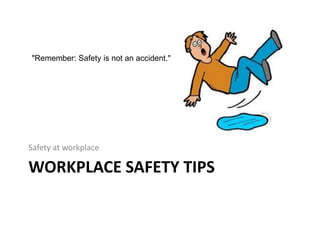
"Remember: Safety is not an accident."
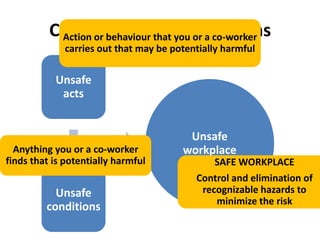
Common Safety Definitions
Unsafe
acts
Unsafe
conditions
Unsafe
workplace
SAFE WORKPLACE
Control and elimination of
recognizable hazards to
minimize the risk
Action or behaviour that you or a co-worker
carries out that may be potentially harmful
Anything you or a co-worker
finds that is potentially harmful
Common Safety Definitions
Example
• You work at nursery and you purposely or un-purposely
leave a bottle of toxic cleaning solution out where children
can find it then you have just committed an unsafe act.
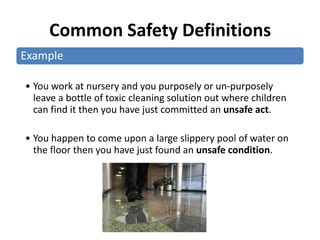
• You happen to come upon a large slippery pool of water on
the floor then you have just found an unsafe condition.
Common Safety Issues
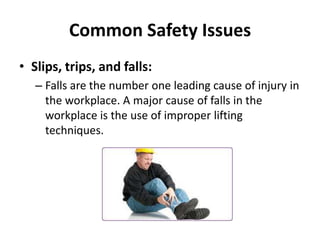
• Slips, trips, and falls:
– Falls are the number one leading cause of injury in
the workplace. A major cause of falls in the
workplace is the use of improper lifting
techniques.
Common Safety Issues
• Slips, trips, and falls:
– Proper Lifting Tips
• Assess the situation and plan the lift.
• Make sure you have nonskid shoes and firm footing.
• Bend your knees, tighten your stomach, and keep your
back straight.
• Make sure you have a good grip on the item or person
you're lifting.
• Lift smoothly. A smooth lift means that you avoid
twisting your body, point your feet in the direction you
want to go, and push if possible rather than pull.
Common Safety Issues
• Fire safety:
– The best safety advice related to fire safety is to
stay calm. You can't help yourself or a co-worker if
you lose control during an emergency.
– Move to designated Assembly point.
– Use a fire extinguisher.
Common Safety Issues
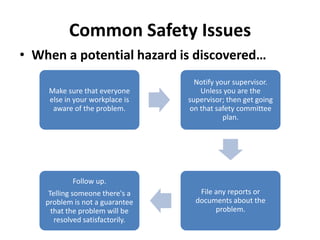
• When a potential hazard is discovered…
Make sure that everyone
else in your workplace is
aware of the problem.
Notify your supervisor.
Unless you are the
supervisor; then get going
on that safety committee
plan.
File any reports or
documents about the
problem.
Follow up.
Telling someone there's a
problem is not a guarantee
that the problem will be
resolved satisfactorily.
SAFETY IN THE OFFICE
Safety at workplace
Safety In The Office
Keep the walkway
clear.
Look before you
sit.
Don’t read while
walking.
Don’t carry
anything higher
than your eye
level.
Do not run, relax.
Refrain from
putting anything
atop cabinets.
Use the stairway
handrails.
Use the elevator
whenever
necessary.
Watch where you
step.
Don’t eat at your
workstation and in
front of your
computer.
WORKSHOP SAFETY RULES
Safety at workplace
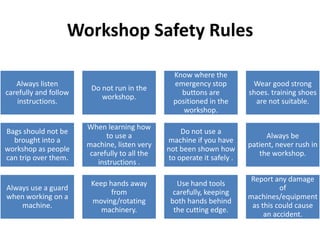
Workshop Safety Rules
Always listen
carefully and follow
instructions.
Do not run in the
workshop.
Know where the
emergency stop
buttons are
positioned in the
workshop.
Wear good strong
shoes. training shoes
are not suitable.
Bags should not be
brought into a
workshop as people
can trip over them.
When learning how
to use a
machine, listen very
carefully to all the
instructions .
Do not use a
machine if you have
not been shown how
to operate it safely .
Always be
patient, never rush in
the workshop.
Always use a guard
when working on a
machine.
Keep hands away
from
moving/rotating
machinery.
Use hand tools
carefully, keeping
both hands behind
the cutting edge.
Report any damage
of
machines/equipment
as this could cause
an accident.
BASIC PRINCIPLES OF THE SYSTEM
OF SAFETY SIGNS
Safety at workplace
Traffic Light
are signalling devices positioned at road
intersections, pedestrian crossings and
other locations to control competing flows
of traffic.
Red: Do not cross
Green: Cross
Flashing Green:
indicate the end of
a green cycle
before the light
changes to a
yellow
Yellow: Continue to cross only if unable to stop safely.
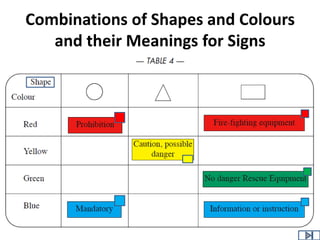
Combinations of Shapes and Colours
and their Meanings for Signs
Geometrical Form and Meaning of
Safety Signs
Yellow/Black Danger Identification
safetyatworkplace.pdf

safetyatworkplace.pdf

  • 1.
  • 2.
    WORKPLACE SAFETY TIPS Safetyat workplace "Remember: Safety is not an accident."
  • 3.
    Common Safety Definitions Unsafe acts Unsafe conditions Unsafe workplace SAFEWORKPLACE Control and elimination of recognizable hazards to minimize the risk Action or behaviour that you or a co-worker carries out that may be potentially harmful Anything you or a co-worker finds that is potentially harmful
  • 4.
    Common Safety Definitions Example •You work at nursery and you purposely or un-purposely leave a bottle of toxic cleaning solution out where children can find it then you have just committed an unsafe act. • You happen to come upon a large slippery pool of water on the floor then you have just found an unsafe condition.
  • 5.
    Common Safety Issues •Slips, trips, and falls: – Falls are the number one leading cause of injury in the workplace. A major cause of falls in the workplace is the use of improper lifting techniques.
  • 7.
    Common Safety Issues •Slips, trips, and falls: – Proper Lifting Tips • Assess the situation and plan the lift. • Make sure you have nonskid shoes and firm footing. • Bend your knees, tighten your stomach, and keep your back straight. • Make sure you have a good grip on the item or person you're lifting. • Lift smoothly. A smooth lift means that you avoid twisting your body, point your feet in the direction you want to go, and push if possible rather than pull.
  • 8.
    Common Safety Issues •Fire safety: – The best safety advice related to fire safety is to stay calm. You can't help yourself or a co-worker if you lose control during an emergency. – Move to designated Assembly point. – Use a fire extinguisher.
  • 10.
    Common Safety Issues •When a potential hazard is discovered… Make sure that everyone else in your workplace is aware of the problem. Notify your supervisor. Unless you are the supervisor; then get going on that safety committee plan. File any reports or documents about the problem. Follow up. Telling someone there's a problem is not a guarantee that the problem will be resolved satisfactorily.
  • 11.
    SAFETY IN THEOFFICE Safety at workplace
  • 12.
    Safety In TheOffice Keep the walkway clear. Look before you sit. Don’t read while walking. Don’t carry anything higher than your eye level. Do not run, relax. Refrain from putting anything atop cabinets. Use the stairway handrails. Use the elevator whenever necessary. Watch where you step. Don’t eat at your workstation and in front of your computer.
  • 14.
  • 15.
    Workshop Safety Rules Alwayslisten carefully and follow instructions. Do not run in the workshop. Know where the emergency stop buttons are positioned in the workshop. Wear good strong shoes. training shoes are not suitable. Bags should not be brought into a workshop as people can trip over them. When learning how to use a machine, listen very carefully to all the instructions . Do not use a machine if you have not been shown how to operate it safely . Always be patient, never rush in the workshop. Always use a guard when working on a machine. Keep hands away from moving/rotating machinery. Use hand tools carefully, keeping both hands behind the cutting edge. Report any damage of machines/equipment as this could cause an accident.
  • 16.
    BASIC PRINCIPLES OFTHE SYSTEM OF SAFETY SIGNS Safety at workplace
  • 17.
    Traffic Light are signallingdevices positioned at road intersections, pedestrian crossings and other locations to control competing flows of traffic. Red: Do not cross Green: Cross Flashing Green: indicate the end of a green cycle before the light changes to a yellow Yellow: Continue to cross only if unable to stop safely.
  • 18.
    Combinations of Shapesand Colours and their Meanings for Signs
  • 19.
    Geometrical Form andMeaning of Safety Signs
  • 26.