Lesson 8 for May 25, 2019
Adopted from www.fustero.es
www.gmahktanjungpinang.org
“Behold, children are a heritage from the Lord, the fruit of
the womb is a reward” (Psalms 127:3).
SPECIAL CASES
Not having children
Single fathers and mothers
EDUCATING YOUR CHILDREN
The principles of education
The goal of education
When the goal is not reached
A responsible parenthood
involves educating your
children, so they can
eventually become citizens
of Heaven.
Just after creating Adam and Eve, God
encouraged them to become parents: “Then
God blessed them, and God said to them, “Be
fruitful and multiply; fill the earth and
subdue it.” (Genesis 1:28).
A baby is usually raised by a caring father
and a caring mother. However, that's not
possible in some cases.
NOT HAVING
CHILDREN
“Now Isaac pleaded with the Lord for his wife,
because she was barren; and the Lord granted
his plea, and Rebekah his wife conceived.”
(Genesis 25:21)
There are several cases in the Bible of women
who ardently wanted to have children but
couldn't; for example: Rebekah, Rachel and
Hannah. God heard their prayers (Gn. 30:1; 1S.
1:27).
Abraham and Sarah, and Zechariah and
Elizabeth are examples of couples who gave up
on having children. However, God gave them
the gift of a child (Gn. 21:2; Lk. 1:13).
God hears your prayers, although He doesn't
always answer them the way you expect.
Some couples decide not to have children. Others prefer
to adopt children and give them a better future.
We must be sensitive to the pain of those who want to
become parents but cannot.
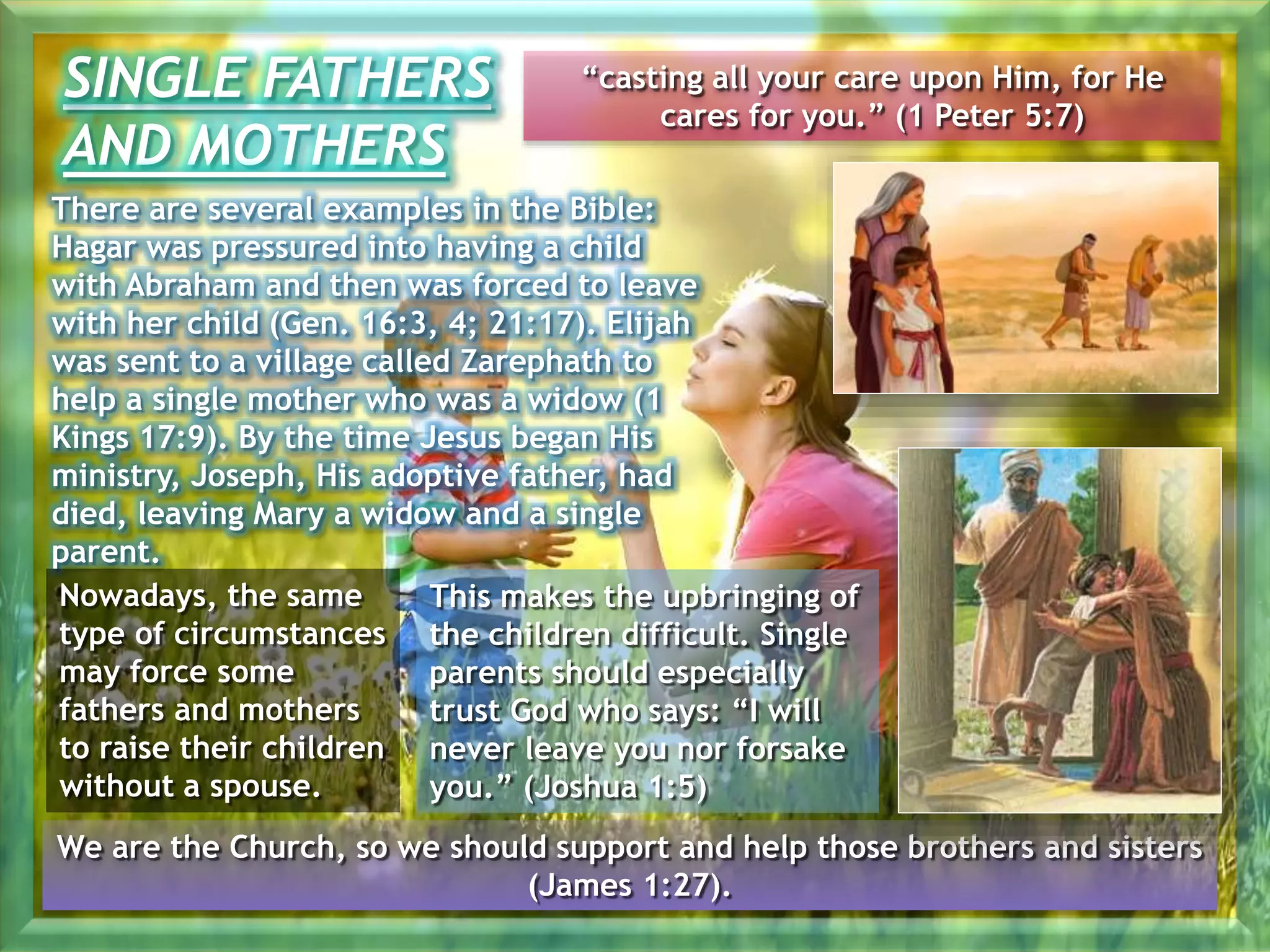
There are several examples in the Bible:
Hagar was pressured into having a child
with Abraham and then was forced to leave
with her child (Gen. 16:3, 4; 21:17). Elijah
was sent to a village called Zarephath to
help a single mother who was a widow (1
Kings 17:9). By the time Jesus began His
ministry, Joseph, His adoptive father, had
died, leaving Mary a widow and a single
parent.
This makes the upbringing of
the children difficult. Single
parents should especially
trust God who says: “I will
never leave you nor forsake
you.” (Joshua 1:5)
Nowadays, the same
type of circumstances
may force some
fathers and mothers
to raise their children
without a spouse.
We are the Church, so we should support and help those brothers and sisters
(James 1:27).
SINGLE FATHERS
AND MOTHERS
“casting all your care upon Him, for He
cares for you.” (1 Peter 5:7)
Every child is different: birth
order, character, genre, and
so on. Therefore, every
parent needs God's wisdom
to educate their children.
Acknowledge
God (v. 4)
Love God with
all their heart,
mind and spirit
(v. 5)
Treasure His
Word (v. 6)
Share Him with
their children
(v. 7)
THE PRINCIPLES
OF EDUCATION
“These commandments that I give you today
are to be on your hearts. Impress them on
your children. Talk about them when you sit
at home and when you walk along the road,
when you lie down and when
you get up.” (Deuteronomy 6:6-7)
The principles of education are listed in
Deuteronomy 6:4-9. Following those
principles is key to raising responsible adults
and citizens of God's Kingdom. Parents
should:
How can you apply those
principles? By doing the
following:
Impressing /
Talking (v. 7)
Formal instruction: Studying the Bible in
specific moments (e.g. family worship)
Informal instruction: Teaching lessons
from the daily life
Tying / Writing
(v. 8-9)
Connecting the truth to your actions
(hand) and thoughts (forehead)
The truth should be visible in both your
public (doorframe) and private (gate)
life
THE PRINCIPLES
OF EDUCATION
“These commandments that I give you today
are to be on your hearts. Impress them on
your children. Talk about them when you sit
at home and when you walk along the road,
when you lie down and when you get up.”
(Deuteronomy 6:6-7)
THE GOAL OF EDUCATION
“For I have known him, in order that he may command his
children and his household after him, that they keep the way of
the Lord, to do righteousness and justice.” (Genesis 18:19a)
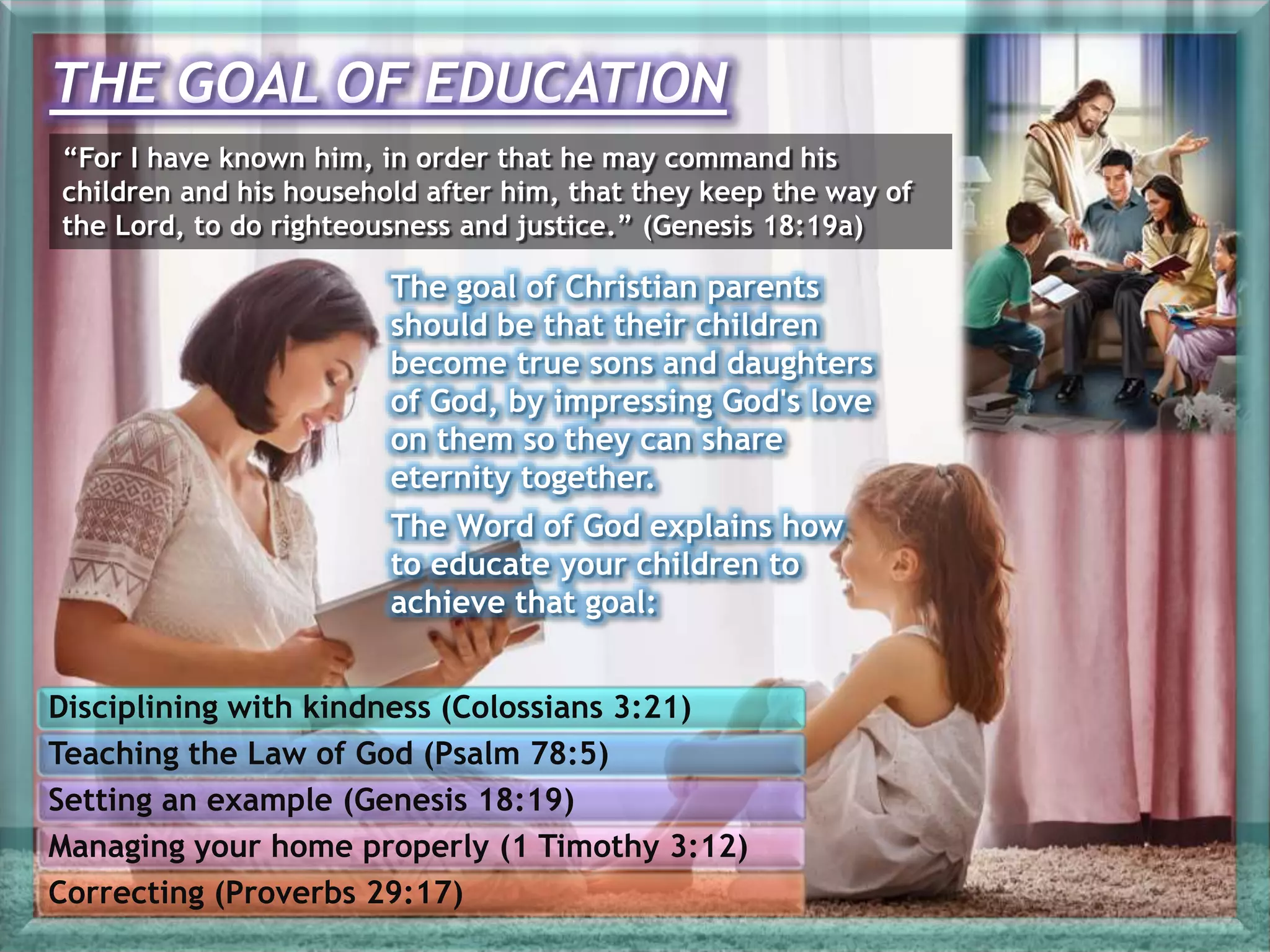
The goal of Christian parents
should be that their children
become true sons and daughters
of God, by impressing God's love
on them so they can share
eternity together.
The Word of God explains how
to educate your children to
achieve that goal:
Disciplining with kindness (Colossians 3:21)
Teaching the Law of God (Psalm 78:5)
Setting an example (Genesis 18:19)
Managing your home properly (1 Timothy 3:12)
Correcting (Proverbs 29:17)
THE GOAL OF EDUCATION
The Bible contains examples of parents who faithfully raised their children, and
examples of parents who showed favoritism, lack of correction or evident sins which
made the education of their children difficult. Let's learn from the following examples.
Isaac (Genesis 25:28)
Eli (1 Samuel 3:13)
Samuel (1 Samuel 8:3)
David (1 Kings 1:6)
Manasseh (2 Kings 21:6)
Enoch (Genesis 5:21-27)
Job (Job 1:5)
Isaiah (Isaiah 8:18)
Mordecai (Esther 2:7)
Eunice (2 Timothy 1:5)
When a child abandons the faith and rejects
the principles their parents taught them, who
is to be blamed?
It's easy to accuse the fathers of not
upbringing their children properly.
However, their child may have made
the wrong decisions although their
parents did everything correctly.
Children have minds of their own and
are ultimately responsible to God for
their actions. Being a good parent is
our choice; how our children turn out
is theirs.
When a child rebels, their
parents must remain together
and set clear limits.
We need fervent prayer, love
and patience. Be always by their
side as they fight against God.
Remember how God loves them.
WHEN THE GOAL IS NOT
REACHED
“Train up a child in the way he should go, And
when he is old he will not depart from it.”
(Proverbs 22:6)
E.G.W. (The Review And Herald, "Words to Parents", January 29, 1901)

Sabbath school lesson 8, 2nd quarter 2019

  • 1.
    Lesson 8 forMay 25, 2019 Adopted from www.fustero.es www.gmahktanjungpinang.org “Behold, children are a heritage from the Lord, the fruit of the womb is a reward” (Psalms 127:3).
  • 2.
    SPECIAL CASES Not havingchildren Single fathers and mothers EDUCATING YOUR CHILDREN The principles of education The goal of education When the goal is not reached A responsible parenthood involves educating your children, so they can eventually become citizens of Heaven. Just after creating Adam and Eve, God encouraged them to become parents: “Then God blessed them, and God said to them, “Be fruitful and multiply; fill the earth and subdue it.” (Genesis 1:28). A baby is usually raised by a caring father and a caring mother. However, that's not possible in some cases.
  • 3.
    NOT HAVING CHILDREN “Now Isaacpleaded with the Lord for his wife, because she was barren; and the Lord granted his plea, and Rebekah his wife conceived.” (Genesis 25:21) There are several cases in the Bible of women who ardently wanted to have children but couldn't; for example: Rebekah, Rachel and Hannah. God heard their prayers (Gn. 30:1; 1S. 1:27). Abraham and Sarah, and Zechariah and Elizabeth are examples of couples who gave up on having children. However, God gave them the gift of a child (Gn. 21:2; Lk. 1:13). God hears your prayers, although He doesn't always answer them the way you expect. Some couples decide not to have children. Others prefer to adopt children and give them a better future. We must be sensitive to the pain of those who want to become parents but cannot.
  • 4.
    There are severalexamples in the Bible: Hagar was pressured into having a child with Abraham and then was forced to leave with her child (Gen. 16:3, 4; 21:17). Elijah was sent to a village called Zarephath to help a single mother who was a widow (1 Kings 17:9). By the time Jesus began His ministry, Joseph, His adoptive father, had died, leaving Mary a widow and a single parent. This makes the upbringing of the children difficult. Single parents should especially trust God who says: “I will never leave you nor forsake you.” (Joshua 1:5) Nowadays, the same type of circumstances may force some fathers and mothers to raise their children without a spouse. We are the Church, so we should support and help those brothers and sisters (James 1:27). SINGLE FATHERS AND MOTHERS “casting all your care upon Him, for He cares for you.” (1 Peter 5:7)
  • 5.
    Every child isdifferent: birth order, character, genre, and so on. Therefore, every parent needs God's wisdom to educate their children. Acknowledge God (v. 4) Love God with all their heart, mind and spirit (v. 5) Treasure His Word (v. 6) Share Him with their children (v. 7) THE PRINCIPLES OF EDUCATION “These commandments that I give you today are to be on your hearts. Impress them on your children. Talk about them when you sit at home and when you walk along the road, when you lie down and when you get up.” (Deuteronomy 6:6-7) The principles of education are listed in Deuteronomy 6:4-9. Following those principles is key to raising responsible adults and citizens of God's Kingdom. Parents should:
  • 6.
    How can youapply those principles? By doing the following: Impressing / Talking (v. 7) Formal instruction: Studying the Bible in specific moments (e.g. family worship) Informal instruction: Teaching lessons from the daily life Tying / Writing (v. 8-9) Connecting the truth to your actions (hand) and thoughts (forehead) The truth should be visible in both your public (doorframe) and private (gate) life THE PRINCIPLES OF EDUCATION “These commandments that I give you today are to be on your hearts. Impress them on your children. Talk about them when you sit at home and when you walk along the road, when you lie down and when you get up.” (Deuteronomy 6:6-7)
  • 7.
    THE GOAL OFEDUCATION “For I have known him, in order that he may command his children and his household after him, that they keep the way of the Lord, to do righteousness and justice.” (Genesis 18:19a) The goal of Christian parents should be that their children become true sons and daughters of God, by impressing God's love on them so they can share eternity together. The Word of God explains how to educate your children to achieve that goal: Disciplining with kindness (Colossians 3:21) Teaching the Law of God (Psalm 78:5) Setting an example (Genesis 18:19) Managing your home properly (1 Timothy 3:12) Correcting (Proverbs 29:17)
  • 8.
    THE GOAL OFEDUCATION The Bible contains examples of parents who faithfully raised their children, and examples of parents who showed favoritism, lack of correction or evident sins which made the education of their children difficult. Let's learn from the following examples. Isaac (Genesis 25:28) Eli (1 Samuel 3:13) Samuel (1 Samuel 8:3) David (1 Kings 1:6) Manasseh (2 Kings 21:6) Enoch (Genesis 5:21-27) Job (Job 1:5) Isaiah (Isaiah 8:18) Mordecai (Esther 2:7) Eunice (2 Timothy 1:5)
  • 9.
    When a childabandons the faith and rejects the principles their parents taught them, who is to be blamed? It's easy to accuse the fathers of not upbringing their children properly. However, their child may have made the wrong decisions although their parents did everything correctly. Children have minds of their own and are ultimately responsible to God for their actions. Being a good parent is our choice; how our children turn out is theirs. When a child rebels, their parents must remain together and set clear limits. We need fervent prayer, love and patience. Be always by their side as they fight against God. Remember how God loves them. WHEN THE GOAL IS NOT REACHED “Train up a child in the way he should go, And when he is old he will not depart from it.” (Proverbs 22:6)
  • 10.
    E.G.W. (The ReviewAnd Herald, "Words to Parents", January 29, 1901)