Introduction
What is it SaaS?
What is it SaaS?
Software as a service (SaaS), sometimes
referred to as "software on demand," is
software that is 100% deployed over the
internet.
What is it SaaS?
Software-as-a-Service (SaaS) is the
application layer of the cloud computing
model.
Cloud computing
• Cloud computing is a general term for the
delivery of hosted services over the internet.
• Cloud computing enables companies to
consume a computer resource, such as a virtual
machine (VMs), storage or an application, as a
utility -- just like electricity -- rather than having
to build and maintain computing infrastructures
in house.
Cloud Computing
Software as a Service
Software as a service: Pricing can be based on features,
storage capacity or on a per-user basis. Vendors
include Salesforce.com, NetSuite and Microsoft
Dynamics.
 Microsoft’s Office Web Apps.
 Dropbox.
 Google Drive.
Infrastructure as a Service
• Infrastructure as a service: Customers pay on a per-
use basis, typically by the hour, week or month.
Some cloud providers also charge based on the amount
of virtual machine (VM) space used.
• This model does not require users to deploy in-house
hardware and software.
• IaaS vendors include IBM, HP, Microsoft and Amazon
Web Services.
Platform as a Service
Platform as a service (PaaS): Can be priced per application/user
or gigabyte of memory consumed per hour.
PaaS vendors include Google, Oracle Public Cloud and Windows
Azure.
Comparison
Non SaaS SaaS
Profits Initial sale +
maintenance
continuous
Subscription
Sales focus / Success Close the deal,
License Revenue
Provide a value
Cost High, CapEx Low ,OpEx
Maintenance Customer Provider
Configuration
requirement
Low High, Critical
Saas advantages
• Access to unlimited Computing and storage
resources, made available and paid for only
as needed (Pay as you go).
• Decreasing cost.
• Increasing in control over the vendor
relationship.
• Focus on application and not on
infrastructure.
SaaS Testing
“The average enterprise IT department
devotes up to 50 percent of its entire
technology infrastructure to development
and test, with up to 90 percent of the
available test infrastructure remaining
idle”.
IBM Research
“Testing The Cloud”
• Testing applications which are in cloud or
migrating to cloud.
• Test the performance, reliability & security
of applications
SaaS Security Testing
 Test application security.
 Test network.
 communication security , Backup and storage policies, Controlled
access to sites and servers.
 Test for possible attacks.
 Test roles and privileges in multi-tenant environment.
 Test all the upgrades to detect broken security.
 Test data security / integrity among multiple tenants.
Conclusion
• Customers buy each month – keep them happy.
• SaaS is only a delivering model, customers will not switch to SaaS if
it is not better than traditional systems.
• Save time on support, maintenance, and upgrade, etc.
• Pay more attention to accessibility, security, deployments. The way
you earn reputation.
• Don’t buy cloud-based test solution just because you are testing
SaaS. In most cases, traditional test solutions work just fine and
save your 30% –50% cost.
What is DBaaS?
What is DBaaS?
• Database as a Service (DBaaS) is an
architectural and operational approach
enabling DBAs to deliver database
functionality as a service to internal and/or
external customers.
Why DBaaS?
• Optimization.
• Multiple Development.
• DBaaS supports flexibility and not impacted by:
o Resource Limitations
o Time Sensitive Projects
o Hardware limitations/budgets
Customers are dealing with:
• Application of a specific database.
• Massive growth in overall stored data.
• Increasing velocity of change in application layer.
• Challenges in supporting new technologies.
DBaaS providers solve most of these challenges for users.
Why Do Customers Want DBaaS?
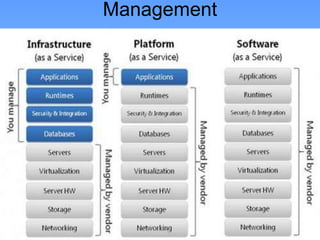
Management
Спасибо за внимание

Saas & DBaas

  • 1.
  • 2.
    What is itSaaS? Software as a service (SaaS), sometimes referred to as "software on demand," is software that is 100% deployed over the internet.
  • 3.
    What is itSaaS? Software-as-a-Service (SaaS) is the application layer of the cloud computing model.
  • 4.
    Cloud computing • Cloudcomputing is a general term for the delivery of hosted services over the internet. • Cloud computing enables companies to consume a computer resource, such as a virtual machine (VMs), storage or an application, as a utility -- just like electricity -- rather than having to build and maintain computing infrastructures in house.
  • 5.
  • 7.
    Software as aService Software as a service: Pricing can be based on features, storage capacity or on a per-user basis. Vendors include Salesforce.com, NetSuite and Microsoft Dynamics.  Microsoft’s Office Web Apps.  Dropbox.  Google Drive.
  • 8.
    Infrastructure as aService • Infrastructure as a service: Customers pay on a per- use basis, typically by the hour, week or month. Some cloud providers also charge based on the amount of virtual machine (VM) space used. • This model does not require users to deploy in-house hardware and software. • IaaS vendors include IBM, HP, Microsoft and Amazon Web Services.
  • 9.
    Platform as aService Platform as a service (PaaS): Can be priced per application/user or gigabyte of memory consumed per hour. PaaS vendors include Google, Oracle Public Cloud and Windows Azure.
  • 10.
    Comparison Non SaaS SaaS ProfitsInitial sale + maintenance continuous Subscription Sales focus / Success Close the deal, License Revenue Provide a value Cost High, CapEx Low ,OpEx Maintenance Customer Provider Configuration requirement Low High, Critical
  • 11.
    Saas advantages • Accessto unlimited Computing and storage resources, made available and paid for only as needed (Pay as you go). • Decreasing cost. • Increasing in control over the vendor relationship. • Focus on application and not on infrastructure.
  • 12.
    SaaS Testing “The averageenterprise IT department devotes up to 50 percent of its entire technology infrastructure to development and test, with up to 90 percent of the available test infrastructure remaining idle”. IBM Research
  • 13.
    “Testing The Cloud” •Testing applications which are in cloud or migrating to cloud. • Test the performance, reliability & security of applications
  • 14.
    SaaS Security Testing Test application security.  Test network.  communication security , Backup and storage policies, Controlled access to sites and servers.  Test for possible attacks.  Test roles and privileges in multi-tenant environment.  Test all the upgrades to detect broken security.  Test data security / integrity among multiple tenants.
  • 15.
    Conclusion • Customers buyeach month – keep them happy. • SaaS is only a delivering model, customers will not switch to SaaS if it is not better than traditional systems. • Save time on support, maintenance, and upgrade, etc. • Pay more attention to accessibility, security, deployments. The way you earn reputation. • Don’t buy cloud-based test solution just because you are testing SaaS. In most cases, traditional test solutions work just fine and save your 30% –50% cost.
  • 16.
  • 17.
    What is DBaaS? •Database as a Service (DBaaS) is an architectural and operational approach enabling DBAs to deliver database functionality as a service to internal and/or external customers.
  • 18.
    Why DBaaS? • Optimization. •Multiple Development. • DBaaS supports flexibility and not impacted by: o Resource Limitations o Time Sensitive Projects o Hardware limitations/budgets
  • 20.
    Customers are dealingwith: • Application of a specific database. • Massive growth in overall stored data. • Increasing velocity of change in application layer. • Challenges in supporting new technologies. DBaaS providers solve most of these challenges for users. Why Do Customers Want DBaaS?
  • 21.
  • 22.