Software Architecture:
September Assignment


  Ingmar Dasseville - s0198801
ADD
ADD1
●   Driver: Alarm Handling (P1)
        –   High Priority
        –   High impact on the system
●   Tactics:
        –   Scheduling: Ideal to make optimal use of
             the system according to the time
             constraints
        –   Reduce Computation Overhead: too little
             control
        –   Concurrency: improve throughput
ADD1: Alarm Handling
ADD2
●   Driver: Pricing (M1)
        –   High Priority
        –   Higher impact than Av1 (database is
             already existent, pricing isn't)
●   Tactics:
        –   Semantic Coherence: create central point
             for pricing as localize the changes
        –   Use an Intermediary: a component
             connecting the bill sender and the data,
             so ripple effects are avoided
        –   Adherence to Protocol: the changes are
             too large for one protocol to cover
ADD2: Pricing
Final Architecture
●   Context
●   Component
●   Deployment
Context Diagram
Top Level Component Diagram
Lower Level: Trame Database
Deployment Diagram
Scenarios
New Measurement Trame
Anomaly Detection
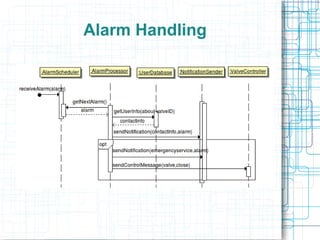
Alarm Handling
Cloud based Fraud Detection
●   No non-functional requirements
●   Special case of Anomaly Detection
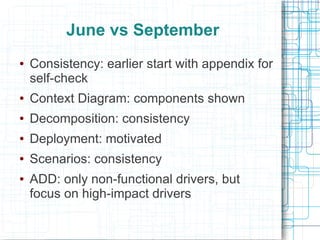
June vs September
●   Consistency: earlier start with appendix for
    self-check
●   Context Diagram: components shown
●   Decomposition: consistency
●   Deployment: motivated
●   Scenarios: consistency
●   ADD: only non-functional drivers, but
    focus on high-impact drivers

Sa presentatie