The emerging use of COIN (Community of Interest) networks to manage compliance reporting within the supply chainPresented at the 17th Australian HACCP Conference and 5th SQF International ConferenceAugust 2010Melbourne, AustraliaNigel Dalton-Brown, iCiX Asia
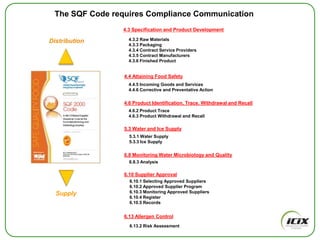
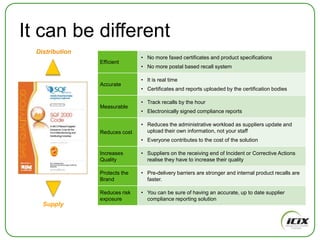
The SQF Code requires Compliance Communication4.3 Specification and Product Development4.3.2 Raw Materials4.3.3 Packaging4.3.4 Contract Service Providers4.3.5 Contract Manufacturers4.3.6 Finished ProductDistribution4.4 Attaining Food Safety4.4.5 Incoming Goods and Services4.4.6 Corrective and Preventative Action4.6 Product Identification, Trace, Withdrawal and Recall4.6.2 Product Trace4.6.3 Product Withdrawal and Recall5.3 Water and Ice Supply5.3.1 Water Supply5.3.3 Ice Supply6.8 Monitoring Water Microbiology and Quality6.8.3 Analysis6.10 Supplier Approval6.10.1 Selecting Approved Suppliers6.10.2 Approved Supplier Program6.10.3 Monitoring Approved Suppliers6.10.4 Register6.10.5 RecordsSupply6.13 Allergen Control6.13.2 Risk Assessment
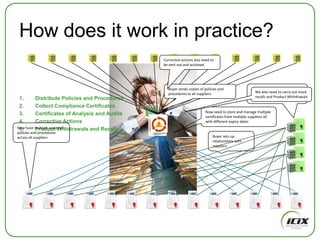
How does it work in practice?Corrective actions also need to be sent out and actionedAlso need to collect Certificates of Analysis  from Laboratories and testing housesBuyer sends copies of policies and procedures to all suppliersWe also need to carry out mock recalls and Product WithdrawalsDistribute Policies and ProceduresCollect Compliance CertificatesCertificates of Analysis and AuditsCorrective ActionsProduct Withdrawals and RecallsNow need to store and manage multiple certificates from multiple suppliers all with different expiry datesNow have multiple copies of policies and procedures across all suppliersBuyer sets up relationships with suppliers
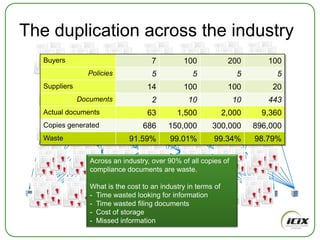
The duplication across the industryAcross an industry, over 90% of all copies of compliance documents are waste.What is the cost to an industry in terms of Time wasted looking for information
Time wasted filing documents
Cost of storage
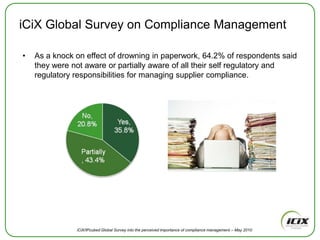
Missed informationiCiX Global Survey on Compliance ManagementAs a knock on effect of drowning in paperwork, 64.2% of respondents said they were not aware or partially aware of all their self regulatory and regulatory responsibilities for managing supplier compliance. iCiX/IPcubed Global Survey into the perceived importance of compliance management – May 2010
Some open responses from our global surveyA number of respondents expressed concern that Supplier Compliance Management was not getting the attention it deserved.....Supplier Compliance is an issue that is at times neglected when minor issue are ignored. However it is the minor issue that eventually contribute to major fallout'sTotally ignored till it is too late.As part of the contract commencement, we request the required docs/certs before the contract is signed. Where we are not so good, is managing the document expiry during the life of the contract.My company does not have a central repository for tracking contracts let alone compliance. Each department is allowed to manage or not manage as they deem appropriateA real time system would be very helpful but cost is a constant constraintiCiX/IPcubed Global Survey into the perceived importance of compliance management – May 2010
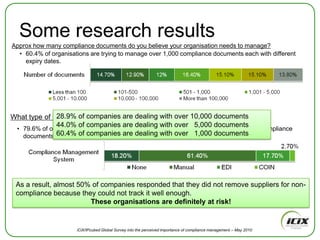
Some research resultsWhat type of system do you use to manage your suppliers compliance?79.6% of organisation have no system or a manual system for managing thousands of compliance documents Approx how many compliance documents do you believe your organisation needs to manage?60.4% of organisations are trying to manage over 1,000 compliance documents each with different expiry dates.  28.9% of companies are dealing with over 10,000 documents44.0% of companies are dealing with over   5,000 documents60.4% of companies are dealing with over   1,000 documentsAs a result, almost 50% of companies responded that they did not remove suppliers for non-compliance because they could not track it well enough.  These organisations are definitely at risk!iCiX/IPcubed Global Survey into the perceived importance of compliance management – May 2010
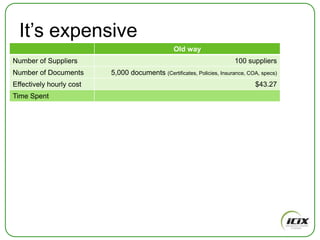
It’s expensive
And it’s expensiveIn 2003 Food Standards ANZ reported example recall costsMajor retailer conducting national recall of 17,680 cartons of frozen processed chicken: press advertisements 	$51,521stock costs	 $75,709cost of recovery	 $119,425labour costs 	$4,000other associated costs 	$7,217 Total cost of recall 	$257,872FSANZ did not account for consequential loss such asLoss of revenueDamage to brandData from Food Standards ANZ, 2003
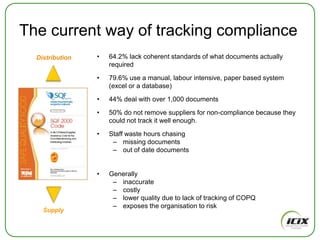
The current way of tracking complianceDistribution64.2% lack coherent standards of what documents actually required79.6% use a manual, labour intensive, paper based system (excel or a database)44% deal with over 1,000 documents50% do not remove suppliers for non-compliance because they could not track it well enough. Staff waste hours chasingmissing documentsout of date documentsGenerallyinaccuratecostlylower quality due to lack of tracking of COPQexposes the organisation to riskSupply
A day in the life of....“It’s a  mind numbing,  soul destroying, never ending task”
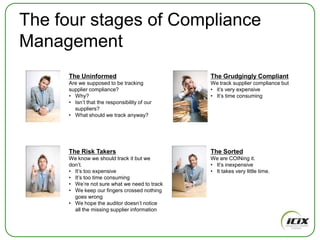
The four stages of Compliance ManagementThe UninformedAre we supposed to be tracking supplier compliance?Why?
Isn’t that the responsibility of our suppliers?
What should we track anyway?The Grudgingly CompliantWe track supplier compliance butit’s very expensive
It’s time consumingThe Risk TakersWe know we should track it but we don’t.  It’s too expensive
It’s too time consuming
We’re not sure what we need to track
We keep our fingers crossed nothing goes wrong
We hope the auditor doesn’t notice all the missing supplier informationThe SortedWe are COINing it.It’s inexpensive
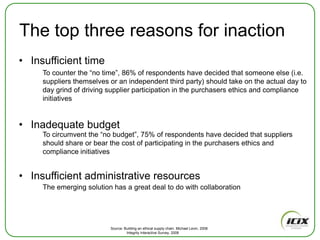
It takes very little time.The top three reasons for inactionInsufficient timeInadequate budgetInsufficient administrative resourcesTo counter the “no time”, 86% of respondents have decided that someone else (i.e. suppliers themselves or an independent third party) should take on the actual day to day grind of driving supplier participation in the purchasers ethics and compliance initiativesTo circumvent the “no budget”, 75% of respondents have decided that suppliers should share or bear the cost of participating in the purchasers ethics and compliance initiativesThe emerging solution has a great deal to do with collaborationSource: Building an ethical supply chain. Michael Levin, 2008                Integrity Interactive Survey, 2008
Community of Interest (COIN) networksCOINing It
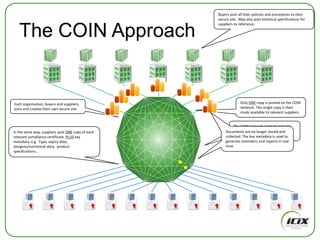
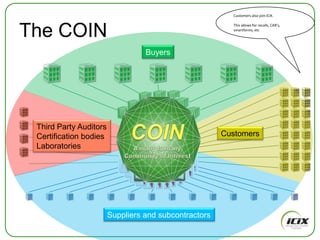
The COIN ApproachBuyers post all their policies and procedures to their secure site.  May also post technical specifications for suppliers to reference.Only ONE copy is posted on the COIN network. This single copy is then made available to relevant suppliersEach organisation, buyers and suppliers, joins and creates their own secure siteThe COIN network exists to provide many-to-many connections between trading partnersDocuments are no longer stored and collected. The key metadata is used to generate reminders and reports in real time.In the same way, suppliers post ONE copy of each relevant compliance certificate, PLUS key metadata, e.g.  Type, expiry date, alergens/nutritional data,  product specifications...
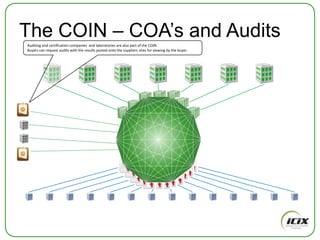
The COIN – COA’s and AuditsAuditing and certification companies  and laboratories are also part of the COIN.Buyers can request audits with the results posted onto the suppliers sites for viewing by the buyer.
The COIN - RecallCustomers also join iCiX.This allows for recalls, CAR’s, smartforms, etcBuyersCOINA many to many Community of InterestThird Party AuditorsCertification bodiesLaboratoriesCustomersSuppliers and subcontractors
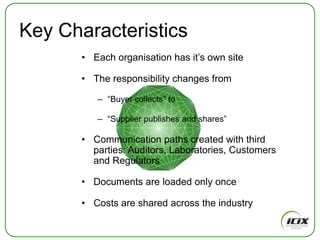
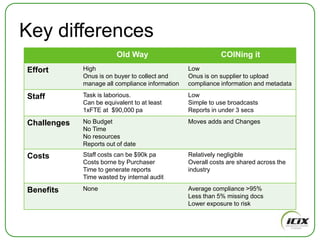
Key CharacteristicsEach organisation has it’s own siteThe responsibility changes from “Buyer collects” to “Supplier publishes and shares”Communication paths created with third parties: Auditors, Laboratories, Customers and RegulatorsDocuments are loaded only onceCosts are shared across the industry
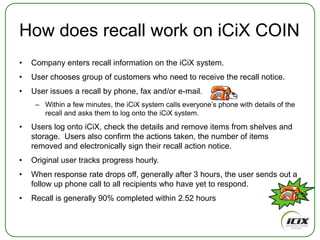
Follow on benefits of COIN networksReal time reports with high confidenceBroadcast  messages to suppliersProduct Recall/Withdrawl in hours not days or monthsCorrective action requests with COPQ claimsPDF online forms for compliance related work
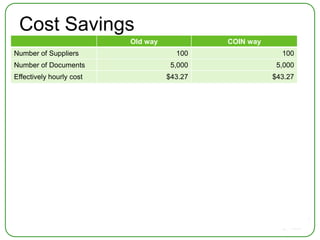
Cost Savings
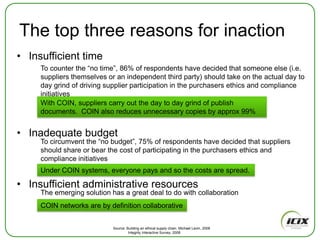
The top three reasons for inactionInsufficient timeInadequate budgetInsufficient administrative resourcesTo counter the “no time”, 86% of respondents have decided that someone else (i.e. suppliers themselves or an independent third party) should take on the actual day to day grind of driving supplier participation in the purchasers ethics and compliance initiativesWith COIN, suppliers carry out the day to day grind of publish documents.  COIN also reduces unnecessary copies by approx 99% To circumvent the “no budget”, 75% of respondents have decided that suppliers should share or bear the cost of participating in the purchasers ethics and compliance initiativesUnder COIN systems, everyone pays and so the costs are spread.The emerging solution has a great deal to do with collaborationCOIN networks are by definition collaborativeSource: Building an ethical supply chain. Michael Levin, 2008               Integrity Interactive Survey, 2008
Analysis
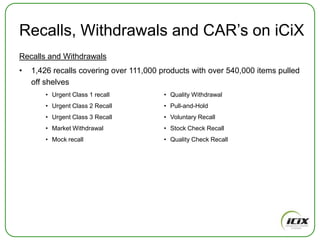
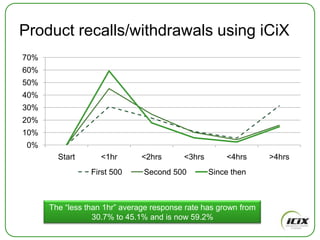
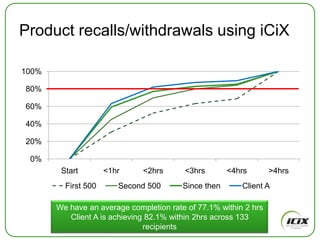
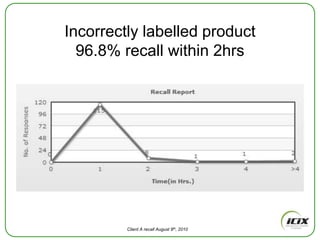
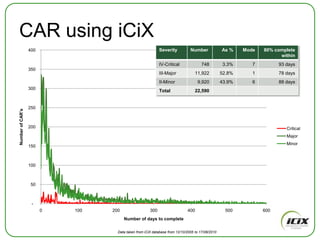
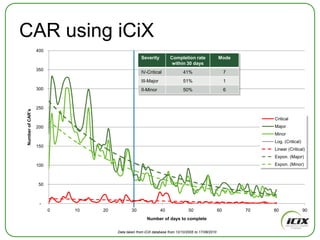
Recalls, Withdrawals and CAR’s on iCiXRecalls and Withdrawals1,426 recalls covering over 111,000 products with over 540,000 items pulled off shelvesCorrective Action Requests (CARs)22,950 CAR’s from 12 October, 2005IV-Critical	748III-Major	11,922II-Minor	9,920Urgent Class 1 recall
Urgent Class 2 Recall

The Emerging Use of Community of Interest Networks to Manage Compliance within the Supply Chain

  • 1.
    The emerging useof COIN (Community of Interest) networks to manage compliance reporting within the supply chainPresented at the 17th Australian HACCP Conference and 5th SQF International ConferenceAugust 2010Melbourne, AustraliaNigel Dalton-Brown, iCiX Asia
  • 2.
    The SQF Coderequires Compliance Communication4.3 Specification and Product Development4.3.2 Raw Materials4.3.3 Packaging4.3.4 Contract Service Providers4.3.5 Contract Manufacturers4.3.6 Finished ProductDistribution4.4 Attaining Food Safety4.4.5 Incoming Goods and Services4.4.6 Corrective and Preventative Action4.6 Product Identification, Trace, Withdrawal and Recall4.6.2 Product Trace4.6.3 Product Withdrawal and Recall5.3 Water and Ice Supply5.3.1 Water Supply5.3.3 Ice Supply6.8 Monitoring Water Microbiology and Quality6.8.3 Analysis6.10 Supplier Approval6.10.1 Selecting Approved Suppliers6.10.2 Approved Supplier Program6.10.3 Monitoring Approved Suppliers6.10.4 Register6.10.5 RecordsSupply6.13 Allergen Control6.13.2 Risk Assessment
  • 3.
    How does itwork in practice?Corrective actions also need to be sent out and actionedAlso need to collect Certificates of Analysis from Laboratories and testing housesBuyer sends copies of policies and procedures to all suppliersWe also need to carry out mock recalls and Product WithdrawalsDistribute Policies and ProceduresCollect Compliance CertificatesCertificates of Analysis and AuditsCorrective ActionsProduct Withdrawals and RecallsNow need to store and manage multiple certificates from multiple suppliers all with different expiry datesNow have multiple copies of policies and procedures across all suppliersBuyer sets up relationships with suppliers
  • 4.
    The duplication acrossthe industryAcross an industry, over 90% of all copies of compliance documents are waste.What is the cost to an industry in terms of Time wasted looking for information
  • 5.
  • 6.
  • 7.
    Missed informationiCiX GlobalSurvey on Compliance ManagementAs a knock on effect of drowning in paperwork, 64.2% of respondents said they were not aware or partially aware of all their self regulatory and regulatory responsibilities for managing supplier compliance. iCiX/IPcubed Global Survey into the perceived importance of compliance management – May 2010
  • 8.
    Some open responsesfrom our global surveyA number of respondents expressed concern that Supplier Compliance Management was not getting the attention it deserved.....Supplier Compliance is an issue that is at times neglected when minor issue are ignored. However it is the minor issue that eventually contribute to major fallout'sTotally ignored till it is too late.As part of the contract commencement, we request the required docs/certs before the contract is signed. Where we are not so good, is managing the document expiry during the life of the contract.My company does not have a central repository for tracking contracts let alone compliance. Each department is allowed to manage or not manage as they deem appropriateA real time system would be very helpful but cost is a constant constraintiCiX/IPcubed Global Survey into the perceived importance of compliance management – May 2010
  • 9.
    Some research resultsWhattype of system do you use to manage your suppliers compliance?79.6% of organisation have no system or a manual system for managing thousands of compliance documents Approx how many compliance documents do you believe your organisation needs to manage?60.4% of organisations are trying to manage over 1,000 compliance documents each with different expiry dates. 28.9% of companies are dealing with over 10,000 documents44.0% of companies are dealing with over 5,000 documents60.4% of companies are dealing with over 1,000 documentsAs a result, almost 50% of companies responded that they did not remove suppliers for non-compliance because they could not track it well enough. These organisations are definitely at risk!iCiX/IPcubed Global Survey into the perceived importance of compliance management – May 2010
  • 10.
  • 11.
    And it’s expensiveIn2003 Food Standards ANZ reported example recall costsMajor retailer conducting national recall of 17,680 cartons of frozen processed chicken: press advertisements $51,521stock costs $75,709cost of recovery $119,425labour costs $4,000other associated costs $7,217 Total cost of recall $257,872FSANZ did not account for consequential loss such asLoss of revenueDamage to brandData from Food Standards ANZ, 2003
  • 12.
    The current wayof tracking complianceDistribution64.2% lack coherent standards of what documents actually required79.6% use a manual, labour intensive, paper based system (excel or a database)44% deal with over 1,000 documents50% do not remove suppliers for non-compliance because they could not track it well enough. Staff waste hours chasingmissing documentsout of date documentsGenerallyinaccuratecostlylower quality due to lack of tracking of COPQexposes the organisation to riskSupply
  • 13.
    A day inthe life of....“It’s a mind numbing, soul destroying, never ending task”
  • 14.
    The four stagesof Compliance ManagementThe UninformedAre we supposed to be tracking supplier compliance?Why?
  • 15.
    Isn’t that theresponsibility of our suppliers?
  • 16.
    What should wetrack anyway?The Grudgingly CompliantWe track supplier compliance butit’s very expensive
  • 17.
    It’s time consumingTheRisk TakersWe know we should track it but we don’t. It’s too expensive
  • 18.
  • 19.
    We’re not surewhat we need to track
  • 20.
    We keep ourfingers crossed nothing goes wrong
  • 21.
    We hope theauditor doesn’t notice all the missing supplier informationThe SortedWe are COINing it.It’s inexpensive
  • 22.
    It takes verylittle time.The top three reasons for inactionInsufficient timeInadequate budgetInsufficient administrative resourcesTo counter the “no time”, 86% of respondents have decided that someone else (i.e. suppliers themselves or an independent third party) should take on the actual day to day grind of driving supplier participation in the purchasers ethics and compliance initiativesTo circumvent the “no budget”, 75% of respondents have decided that suppliers should share or bear the cost of participating in the purchasers ethics and compliance initiativesThe emerging solution has a great deal to do with collaborationSource: Building an ethical supply chain. Michael Levin, 2008 Integrity Interactive Survey, 2008
  • 23.
    Community of Interest(COIN) networksCOINing It
  • 24.
    The COIN ApproachBuyerspost all their policies and procedures to their secure site. May also post technical specifications for suppliers to reference.Only ONE copy is posted on the COIN network. This single copy is then made available to relevant suppliersEach organisation, buyers and suppliers, joins and creates their own secure siteThe COIN network exists to provide many-to-many connections between trading partnersDocuments are no longer stored and collected. The key metadata is used to generate reminders and reports in real time.In the same way, suppliers post ONE copy of each relevant compliance certificate, PLUS key metadata, e.g. Type, expiry date, alergens/nutritional data, product specifications...
  • 25.
    The COIN –COA’s and AuditsAuditing and certification companies and laboratories are also part of the COIN.Buyers can request audits with the results posted onto the suppliers sites for viewing by the buyer.
  • 26.
    The COIN -RecallCustomers also join iCiX.This allows for recalls, CAR’s, smartforms, etcBuyersCOINA many to many Community of InterestThird Party AuditorsCertification bodiesLaboratoriesCustomersSuppliers and subcontractors
  • 27.
    Key CharacteristicsEach organisationhas it’s own siteThe responsibility changes from “Buyer collects” to “Supplier publishes and shares”Communication paths created with third parties: Auditors, Laboratories, Customers and RegulatorsDocuments are loaded only onceCosts are shared across the industry
  • 28.
    Follow on benefitsof COIN networksReal time reports with high confidenceBroadcast messages to suppliersProduct Recall/Withdrawl in hours not days or monthsCorrective action requests with COPQ claimsPDF online forms for compliance related work
  • 29.
  • 30.
    The top threereasons for inactionInsufficient timeInadequate budgetInsufficient administrative resourcesTo counter the “no time”, 86% of respondents have decided that someone else (i.e. suppliers themselves or an independent third party) should take on the actual day to day grind of driving supplier participation in the purchasers ethics and compliance initiativesWith COIN, suppliers carry out the day to day grind of publish documents. COIN also reduces unnecessary copies by approx 99% To circumvent the “no budget”, 75% of respondents have decided that suppliers should share or bear the cost of participating in the purchasers ethics and compliance initiativesUnder COIN systems, everyone pays and so the costs are spread.The emerging solution has a great deal to do with collaborationCOIN networks are by definition collaborativeSource: Building an ethical supply chain. Michael Levin, 2008 Integrity Interactive Survey, 2008
  • 31.
  • 32.
    Recalls, Withdrawals andCAR’s on iCiXRecalls and Withdrawals1,426 recalls covering over 111,000 products with over 540,000 items pulled off shelvesCorrective Action Requests (CARs)22,950 CAR’s from 12 October, 2005IV-Critical 748III-Major 11,922II-Minor 9,920Urgent Class 1 recall
  • 33.

Editor's Notes

  • #9 Effective hourly cost based on annual salary of $60k with 1.5 uplift to account for sick days, leave, PC heating.... etc.
  • #13 Anecdotal evidence of talking a large number of clients and prospects gives me the following four types of
  • #14 Research has shown that organisations and individuals fail to comply for various resaons cost of regulatory compliance insufficient resources and expertise to address compliance requirements lack of knowledge of requirements or even indifferenceFrom a 2008 survey by Integrity InteractiveTo counter the “no time”, 86% of respondents have decided that someone else (i.e. Suppliers themselves or and independent third party) should take on the actual day to day grind of driving supplier participation in the purchasers ethics and compliance initiativesTo circumvent the “no budget”, 75% of respondents have decided that suppliers should share or bear the cost of participating in the purchasers ethics and compliance initiatives
  • #19 From a 2008 survey by Integrity InteractiveTo counter the “no time”, 86% of respondents have decided that someone else (i.e. Suppliers themselves or and independent third party) should take on the actual day to day grind of driving supplier participation in the purchasers ethics and compliance initiativesTo circumvent the “no budget”, 75% of respondents have decided that suppliers should share or bear the cost of participating in the purchasers ethics and compliance initiatives
  • #21 Effective hourly cost based on annual salary of $60k with 1.5 uplift to account for sick days, leave, PC heating.... etc.
  • #22 Research has shown that organisations and individuals fail to comply for various resaons cost of regulatory compliance insufficient resources and expertise to address compliance requirements lack of knowledge of requirements or even indifferenceOur recetn survey, 64.2% of respondants said they were Partially or not fully aware of their regulatory responsibilities for managing supplier compliance