The following is intended to outline our general
product direction. It is intended for information
purposes only, and may not be incorporated into any
contract. It is not a commitment to deliver any
material, code, or functionality, and should not be
relied upon in making purchasing decisions.
The development, release, and timing of any
features or functionality described for Oracle’s
products remains at the sole discretion of Oracle.


                                                      1
<Insert Picture Here>


Creating RESTful Web Services using JAX-RS
Ludovic Champenois
Architect GlassFish – NetBeans - Eclipse
Agenda


• REST and JAX-RS      <Insert Picture Here>

• Deployment Options
• Demo
• Status
• Q&A


                                          3
REST is an Architectural Style


• Set of constraints you apply to the architecture of a
 distributed system to induce desirable properties


                                                          4
RESTful Web Services


• Application of REST architectural style to services
 that utilize Web standards:

• URIs, HTTP, MIME, HTML, XML, Atom, RDF, ...


                                                        5
Java API for RESTful Web Services (JAX-RS)


• Standard annotation-driven API that aims to help
  developers build RESTful Web services in Java™
• JSR 311
• Part of Java EE 6 now


                                                     6
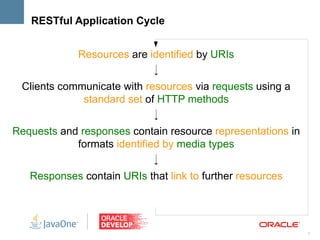
RESTful Application Cycle


            Resources are identified by URIs
                             ↓
 Clients communicate with resources via requests using a
              standard set of HTTP methods
                             ↓
Requests and responses contain resource representations in
            formats identified by media types
                             ↓
   Responses contain URIs that link to further resources


                                                             7
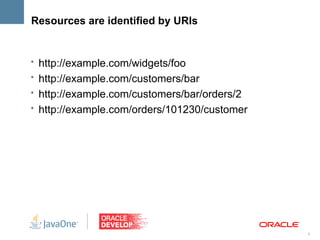
Resources are identified by URIs


• http://example.com/widgets/foo
• http://example.com/customers/bar
• http://example.com/customers/bar/orders/2
• http://example.com/orders/101230/customer


                                              8
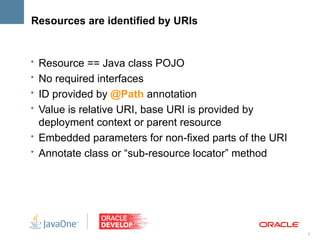
Resources are identified by URIs


• Resource == Java class POJO
• No required interfaces
• ID provided by @Path annotation
• Value is relative URI, base URI is provided by
  deployment context or parent resource
• Embedded parameters for non-fixed parts of the URI
• Annotate class or “sub-resource locator” method


                                                       9
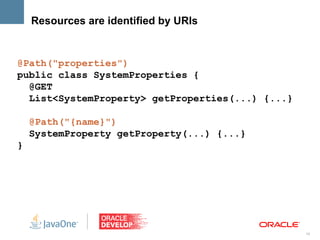
Resources are identified by URIs


@Path("properties")
public class SystemProperties {
  @GET
  List<SystemProperty> getProperties(...) {...}

    @Path("{name}")
    SystemProperty getProperty(...) {...}
}


                                                  10
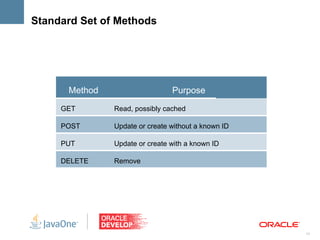
Standard Set of Methods


      Method                    Purpose

     GET       Read, possibly cached

     POST      Update or create without a known ID

     PUT       Update or create with a known ID

     DELETE    Remove


                                                     11
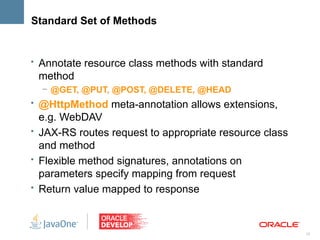
Standard Set of Methods


• Annotate resource class methods with standard
 method
  – @GET, @PUT, @POST, @DELETE, @HEAD
• @HttpMethod meta-annotation allows extensions,
  e.g. WebDAV
• JAX-RS routes request to appropriate resource class
  and method
• Flexible method signatures, annotations on
  parameters specify mapping from request
• Return value mapped to response


                                                        12
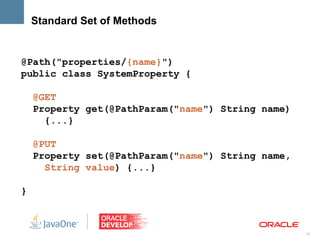
Standard Set of Methods


@Path("properties/{name}")
public class SystemProperty {

    @GET
    Property get(@PathParam("name") String name)
      {...}

    @PUT
    Property set(@PathParam("name") String name,
      String value) {...}

}


                                                   13
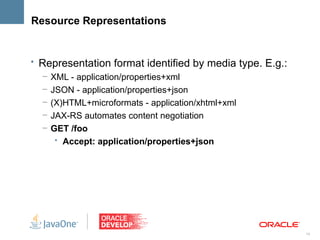
Resource Representations


• Representation format identified by media type. E.g.:
   – XML - application/properties+xml
   – JSON - application/properties+json
   – (X)HTML+microformats - application/xhtml+xml
   – JAX-RS automates content negotiation
   – GET /foo
      • Accept: application/properties+json


                                                          14
Resource Representations
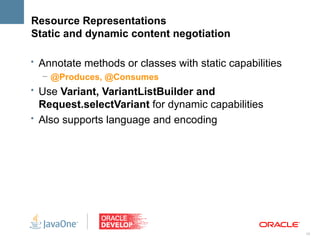
Static and dynamic content negotiation

• Annotate methods or classes with static capabilities
   – @Produces, @Consumes
• Use Variant, VariantListBuilder and
  Request.selectVariant for dynamic capabilities
• Also supports language and encoding


                                                         15
Resource Representations


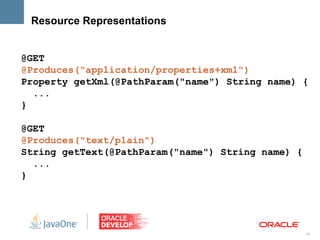
@GET
@Produces("application/properties+xml")
Property getXml(@PathParam("name") String name) {
  ...
}

@GET
@Produces("text/plain")
String getText(@PathParam("name") String name) {
  ...
}


                                                   16
Responses Contain Links


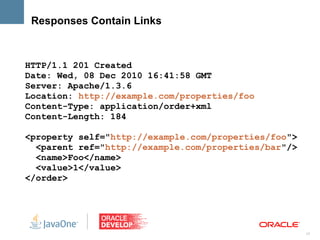
HTTP/1.1 201 Created
Date: Wed, 08 Dec 2010 16:41:58 GMT
Server: Apache/1.3.6
Location: http://example.com/properties/foo
Content-Type: application/order+xml
Content-Length: 184

<property self="http://example.com/properties/foo">
  <parent ref="http://example.com/properties/bar"/>
  <name>Foo</name>
  <value>1</value>
</order>


                                                      17
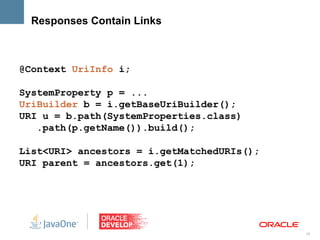
Responses Contain Links


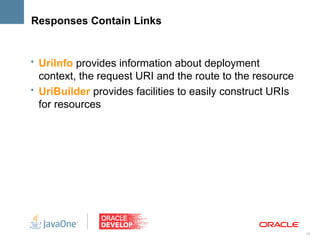
• UriInfo provides information about deployment
  context, the request URI and the route to the resource
• UriBuilder provides facilities to easily construct URIs
  for resources


                                                            18
Responses Contain Links


@Context UriInfo i;

SystemProperty p = ...
UriBuilder b = i.getBaseUriBuilder();
URI u = b.path(SystemProperties.class)
   .path(p.getName()).build();

List<URI> ancestors = i.getMatchedURIs();
URI parent = ancestors.get(1);


                                            19
Agenda


• REST and JAX-RS      <Insert Picture Here>

• Deployment Options
• Demo
• Status
• Q&A


                                         20
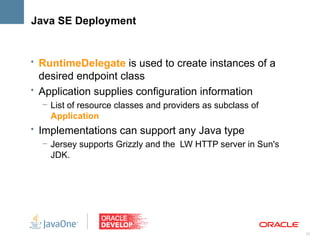
Java SE Deployment


• RuntimeDelegate is used to create instances of a
  desired endpoint class
• Application supplies configuration information
  – List of resource classes and providers as subclass of
    Application
• Implementations can support any Java type
   – Jersey supports Grizzly and the LW HTTP server in Sun's
     JDK.


                                                               21
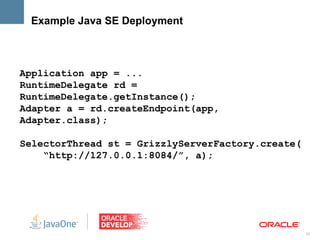
Example Java SE Deployment


Application app = ...
RuntimeDelegate rd =
RuntimeDelegate.getInstance();
Adapter a = rd.createEndpoint(app,
Adapter.class);

SelectorThread st = GrizzlyServerFactory.create(
    “http://127.0.0.1:8084/”, a);


                                                   22
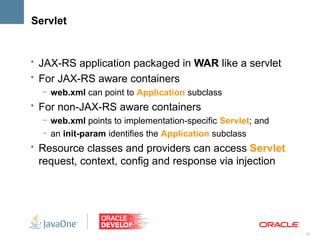
Servlet


• JAX-RS application packaged in WAR like a servlet
• For JAX-RS aware containers
  – web.xml can point to Application subclass
• For non-JAX-RS aware containers
   – web.xml points to implementation-specific Servlet; and
   – an init-param identifies the Application subclass
• Resource classes and providers can access Servlet
 request, context, config and response via injection


                                                              23
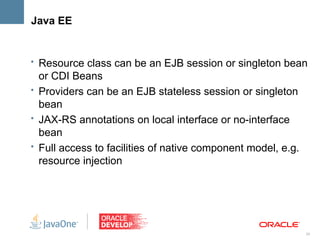
Java EE


• Resource class can be an EJB session or singleton bean
  or CDI Beans
• Providers can be an EJB stateless session or singleton
  bean
• JAX-RS annotations on local interface or no-interface
  bean
• Full access to facilities of native component model, e.g.
  resource injection


                                                              24
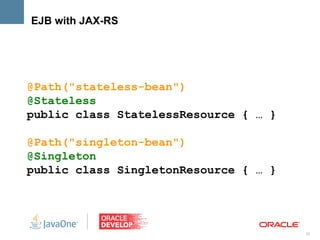
EJB with JAX-RS


@Path("stateless-bean")
@Stateless
public class StatelessResource { … }

@Path("singleton-bean")
@Singleton
public class SingletonResource { … }


                                       25
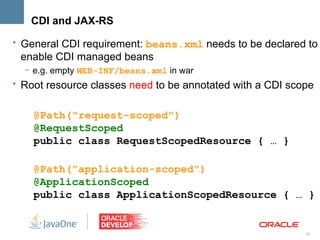
CDI and JAX-RS
• General CDI requirement: beans.xml needs to be declared to
 enable CDI managed beans
  – e.g. empty WEB-INF/beans.xml in war
• Root resource classes need to be annotated with a CDI scope


    @Path("request-scoped")
    @RequestScoped
    public class RequestScopedResource { … }

    @Path("application-scoped")
    @ApplicationScoped
    public class ApplicationScopedResource { … }


                                                           26
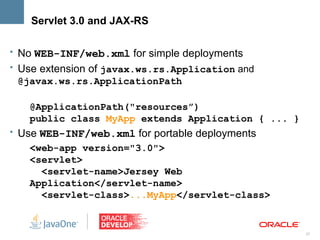
Servlet 3.0 and JAX-RS

• No WEB-INF/web.xml for simple deployments
• Use extension of javax.ws.rs.Application and
 @javax.ws.rs.ApplicationPath

   @ApplicationPath("resources”)
   public class MyApp extends Application { ... }
• Use WEB-INF/web.xml for portable deployments
   <web-app version="3.0">
   <servlet>
     <servlet-name>Jersey Web
   Application</servlet-name>
     <servlet-class>...MyApp</servlet-class>


                                                    27
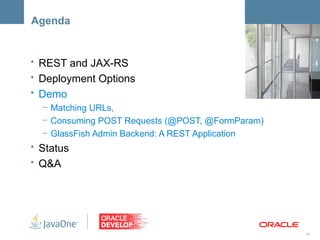
Agenda


• REST and JAX-RS                            <Insert Picture Here>

• Deployment Options
• Demo
   – Matching URLs,
   – Consuming POST Requests (@POST, @FormParam)
   – GlassFish Admin Backend: A REST Application
• Status
• Q&A


                                                               28
Agenda


• REST and JAX-RS      <Insert Picture Here>

• Deployment Options
• Demo
• Status
• Q&A


                                         29
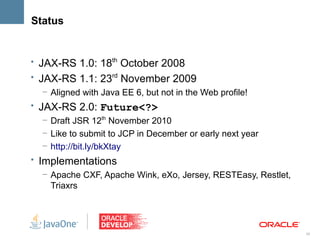
Status


• JAX-RS 1.0: 18th October 2008
• JAX-RS 1.1: 23rd November 2009
   – Aligned with Java EE 6, but not in the Web profile!
• JAX-RS 2.0: Future<?>
   – Draft JSR 12th November 2010
   – Like to submit to JCP in December or early next year
   – http://bit.ly/bkXtay
• Implementations
   – Apache CXF, Apache Wink, eXo, Jersey, RESTEasy, Restlet,
     Triaxrs


                                                                30
Agenda


• REST and JAX-RS      <Insert Picture Here>

• Deployment Options
• Demo
• Status
• Q&A


                                         31

JAX-RS Creating RESTFul services

  • 1.
    The following isintended to outline our general product direction. It is intended for information purposes only, and may not be incorporated into any contract. It is not a commitment to deliver any material, code, or functionality, and should not be relied upon in making purchasing decisions. The development, release, and timing of any features or functionality described for Oracle’s products remains at the sole discretion of Oracle. 1
  • 2.
    <Insert Picture Here> CreatingRESTful Web Services using JAX-RS Ludovic Champenois Architect GlassFish – NetBeans - Eclipse
  • 3.
    Agenda • REST andJAX-RS <Insert Picture Here> • Deployment Options • Demo • Status • Q&A 3
  • 4.
    REST is anArchitectural Style • Set of constraints you apply to the architecture of a distributed system to induce desirable properties 4
  • 5.
    RESTful Web Services •Application of REST architectural style to services that utilize Web standards: • URIs, HTTP, MIME, HTML, XML, Atom, RDF, ... 5
  • 6.
    Java API forRESTful Web Services (JAX-RS) • Standard annotation-driven API that aims to help developers build RESTful Web services in Java™ • JSR 311 • Part of Java EE 6 now 6
  • 7.
    RESTful Application Cycle Resources are identified by URIs ↓ Clients communicate with resources via requests using a standard set of HTTP methods ↓ Requests and responses contain resource representations in formats identified by media types ↓ Responses contain URIs that link to further resources 7
  • 8.
    Resources are identifiedby URIs • http://example.com/widgets/foo • http://example.com/customers/bar • http://example.com/customers/bar/orders/2 • http://example.com/orders/101230/customer 8
  • 9.
    Resources are identifiedby URIs • Resource == Java class POJO • No required interfaces • ID provided by @Path annotation • Value is relative URI, base URI is provided by deployment context or parent resource • Embedded parameters for non-fixed parts of the URI • Annotate class or “sub-resource locator” method 9
  • 10.
    Resources are identifiedby URIs @Path("properties") public class SystemProperties { @GET List<SystemProperty> getProperties(...) {...} @Path("{name}") SystemProperty getProperty(...) {...} } 10
  • 11.
    Standard Set ofMethods Method Purpose GET Read, possibly cached POST Update or create without a known ID PUT Update or create with a known ID DELETE Remove 11
  • 12.
    Standard Set ofMethods • Annotate resource class methods with standard method – @GET, @PUT, @POST, @DELETE, @HEAD • @HttpMethod meta-annotation allows extensions, e.g. WebDAV • JAX-RS routes request to appropriate resource class and method • Flexible method signatures, annotations on parameters specify mapping from request • Return value mapped to response 12
  • 13.
    Standard Set ofMethods @Path("properties/{name}") public class SystemProperty { @GET Property get(@PathParam("name") String name) {...} @PUT Property set(@PathParam("name") String name, String value) {...} } 13
  • 14.
    Resource Representations • Representationformat identified by media type. E.g.: – XML - application/properties+xml – JSON - application/properties+json – (X)HTML+microformats - application/xhtml+xml – JAX-RS automates content negotiation – GET /foo • Accept: application/properties+json 14
  • 15.
    Resource Representations Static anddynamic content negotiation • Annotate methods or classes with static capabilities – @Produces, @Consumes • Use Variant, VariantListBuilder and Request.selectVariant for dynamic capabilities • Also supports language and encoding 15
  • 16.
    Resource Representations @GET @Produces("application/properties+xml") Property getXml(@PathParam("name")String name) { ... } @GET @Produces("text/plain") String getText(@PathParam("name") String name) { ... } 16
  • 17.
    Responses Contain Links HTTP/1.1201 Created Date: Wed, 08 Dec 2010 16:41:58 GMT Server: Apache/1.3.6 Location: http://example.com/properties/foo Content-Type: application/order+xml Content-Length: 184 <property self="http://example.com/properties/foo"> <parent ref="http://example.com/properties/bar"/> <name>Foo</name> <value>1</value> </order> 17
  • 18.
    Responses Contain Links •UriInfo provides information about deployment context, the request URI and the route to the resource • UriBuilder provides facilities to easily construct URIs for resources 18
  • 19.
    Responses Contain Links @ContextUriInfo i; SystemProperty p = ... UriBuilder b = i.getBaseUriBuilder(); URI u = b.path(SystemProperties.class) .path(p.getName()).build(); List<URI> ancestors = i.getMatchedURIs(); URI parent = ancestors.get(1); 19
  • 20.
    Agenda • REST andJAX-RS <Insert Picture Here> • Deployment Options • Demo • Status • Q&A 20
  • 21.
    Java SE Deployment •RuntimeDelegate is used to create instances of a desired endpoint class • Application supplies configuration information – List of resource classes and providers as subclass of Application • Implementations can support any Java type – Jersey supports Grizzly and the LW HTTP server in Sun's JDK. 21
  • 22.
    Example Java SEDeployment Application app = ... RuntimeDelegate rd = RuntimeDelegate.getInstance(); Adapter a = rd.createEndpoint(app, Adapter.class); SelectorThread st = GrizzlyServerFactory.create( “http://127.0.0.1:8084/”, a); 22
  • 23.
    Servlet • JAX-RS applicationpackaged in WAR like a servlet • For JAX-RS aware containers – web.xml can point to Application subclass • For non-JAX-RS aware containers – web.xml points to implementation-specific Servlet; and – an init-param identifies the Application subclass • Resource classes and providers can access Servlet request, context, config and response via injection 23
  • 24.
    Java EE • Resourceclass can be an EJB session or singleton bean or CDI Beans • Providers can be an EJB stateless session or singleton bean • JAX-RS annotations on local interface or no-interface bean • Full access to facilities of native component model, e.g. resource injection 24
  • 25.
    EJB with JAX-RS @Path("stateless-bean") @Stateless publicclass StatelessResource { … } @Path("singleton-bean") @Singleton public class SingletonResource { … } 25
  • 26.
    CDI and JAX-RS •General CDI requirement: beans.xml needs to be declared to enable CDI managed beans – e.g. empty WEB-INF/beans.xml in war • Root resource classes need to be annotated with a CDI scope @Path("request-scoped") @RequestScoped public class RequestScopedResource { … } @Path("application-scoped") @ApplicationScoped public class ApplicationScopedResource { … } 26
  • 27.
    Servlet 3.0 andJAX-RS • No WEB-INF/web.xml for simple deployments • Use extension of javax.ws.rs.Application and @javax.ws.rs.ApplicationPath @ApplicationPath("resources”) public class MyApp extends Application { ... } • Use WEB-INF/web.xml for portable deployments <web-app version="3.0"> <servlet> <servlet-name>Jersey Web Application</servlet-name> <servlet-class>...MyApp</servlet-class> 27
  • 28.
    Agenda • REST andJAX-RS <Insert Picture Here> • Deployment Options • Demo – Matching URLs, – Consuming POST Requests (@POST, @FormParam) – GlassFish Admin Backend: A REST Application • Status • Q&A 28
  • 29.
    Agenda • REST andJAX-RS <Insert Picture Here> • Deployment Options • Demo • Status • Q&A 29
  • 30.
    Status • JAX-RS 1.0:18th October 2008 • JAX-RS 1.1: 23rd November 2009 – Aligned with Java EE 6, but not in the Web profile! • JAX-RS 2.0: Future<?> – Draft JSR 12th November 2010 – Like to submit to JCP in December or early next year – http://bit.ly/bkXtay • Implementations – Apache CXF, Apache Wink, eXo, Jersey, RESTEasy, Restlet, Triaxrs 30
  • 31.
    Agenda • REST andJAX-RS <Insert Picture Here> • Deployment Options • Demo • Status • Q&A 31