The “Fundamentals” of Accreditation Quality Assurance in Educational Programs Lyle D. Feisel Chair, IEEE Com. on Global Accreditation Activities Dean Emeritus of Engineering, SUNY Binghamton ENGINEERING ACCREDITATION AROUND THE WORLD   Lima, Peru 3 – 5 December, 2005
Outline IEEE, EAB, APC, and CGAA What is accreditation The goals of accreditation Forms of accreditation agencies Some general characteristics Factors that may be considered The big question International considerations Summary
The Institute of Electrical and Electronics Engineers Formed in 1963 from two predecessor organizations About 350,000 members US in origin, now global in scope About 1/3 of members are non-US
From the IEEE Constitution Sec. 2. Its purposes are:  (a) scientific and educational, directed toward the advancement of the theory and practice of electrical engineering, electronics, radio and the allied branches of engineering and the related arts and sciences ... …  (b) professional, directed toward the advancement of the standing of the members of the professions it serves
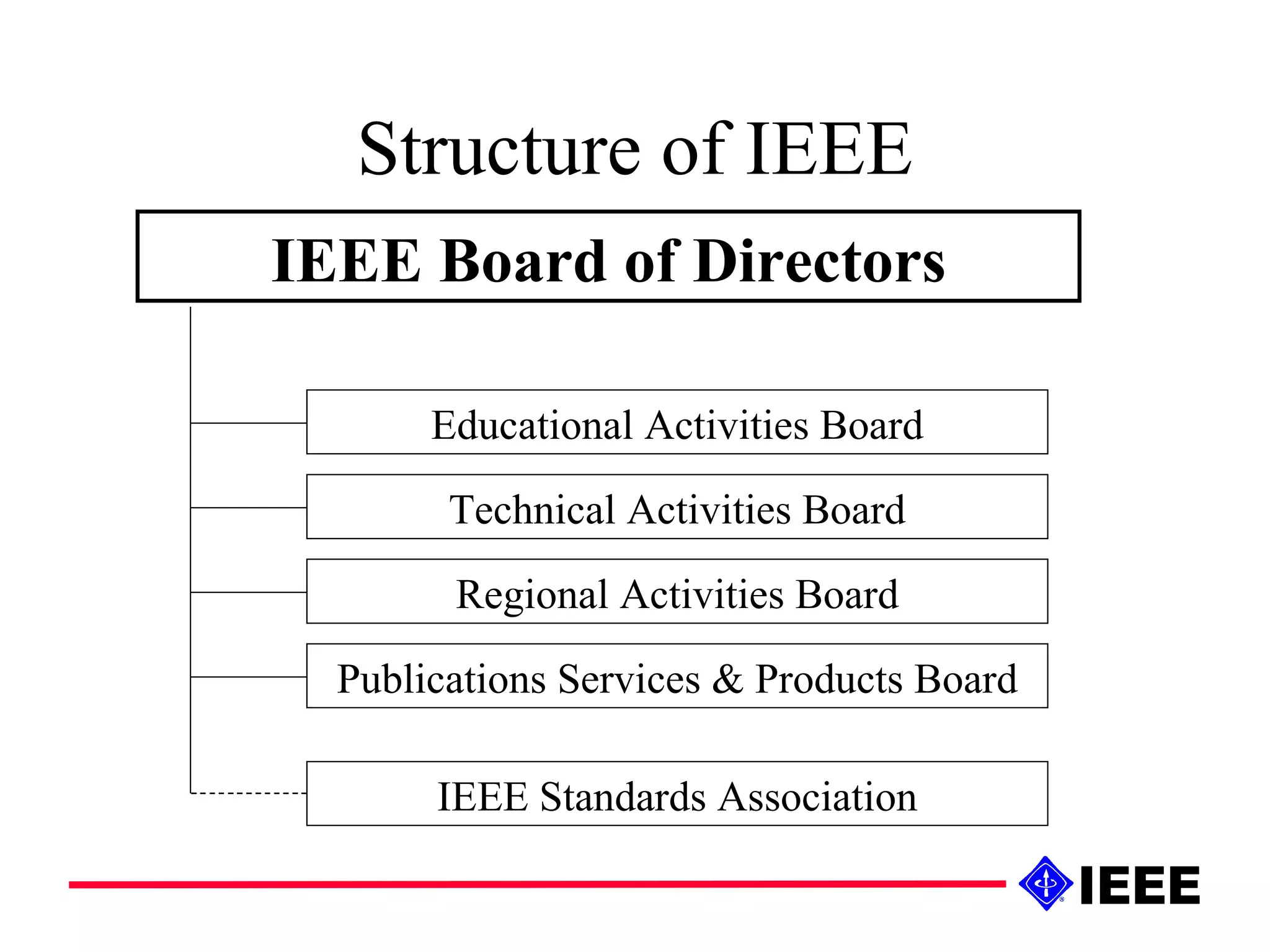
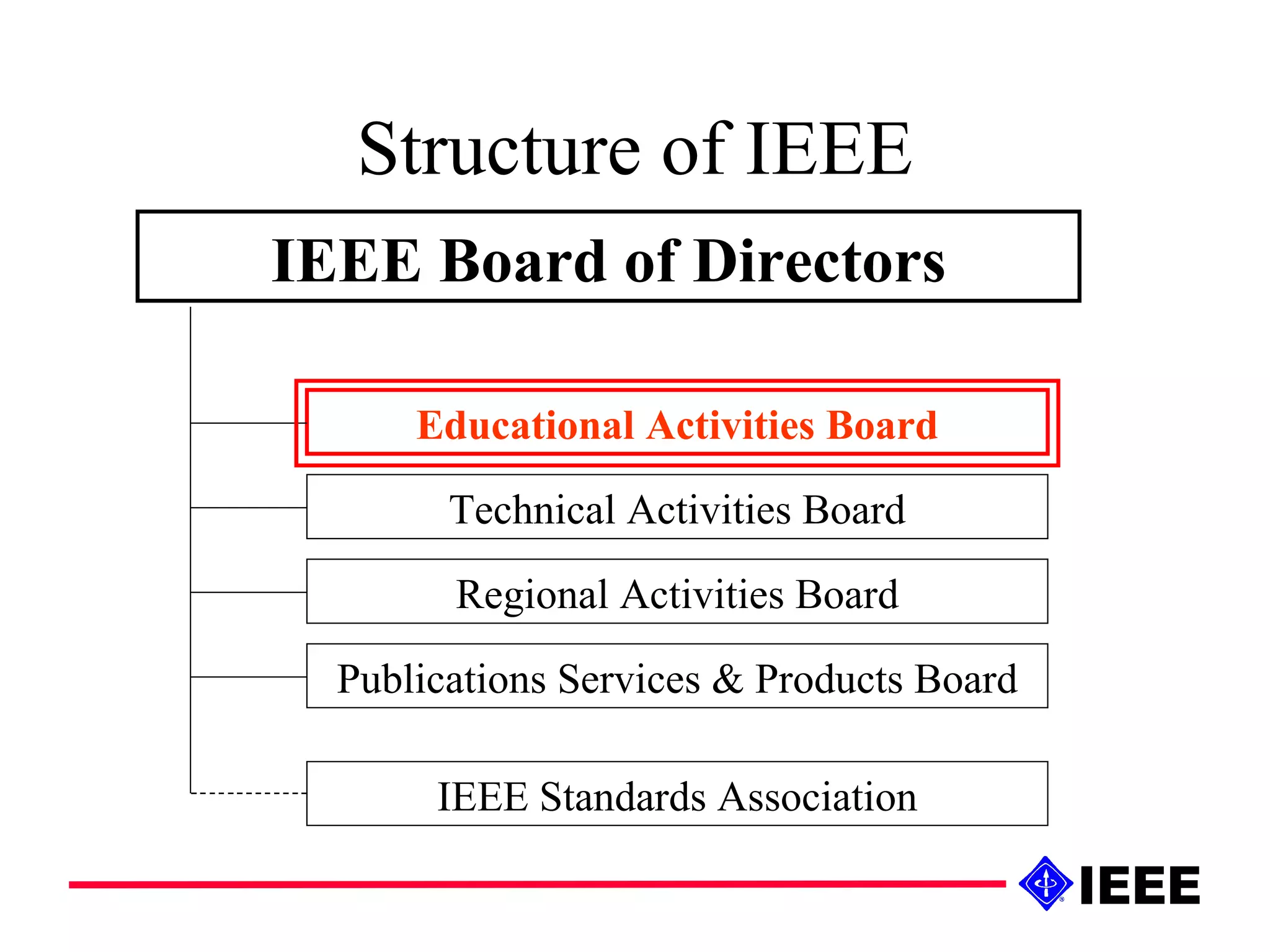
Structure of IEEE IEEE Board of Directors Technical Activities Board Regional Activities Board Educational Activities Board Publications Services & Products Board IEEE Standards Association
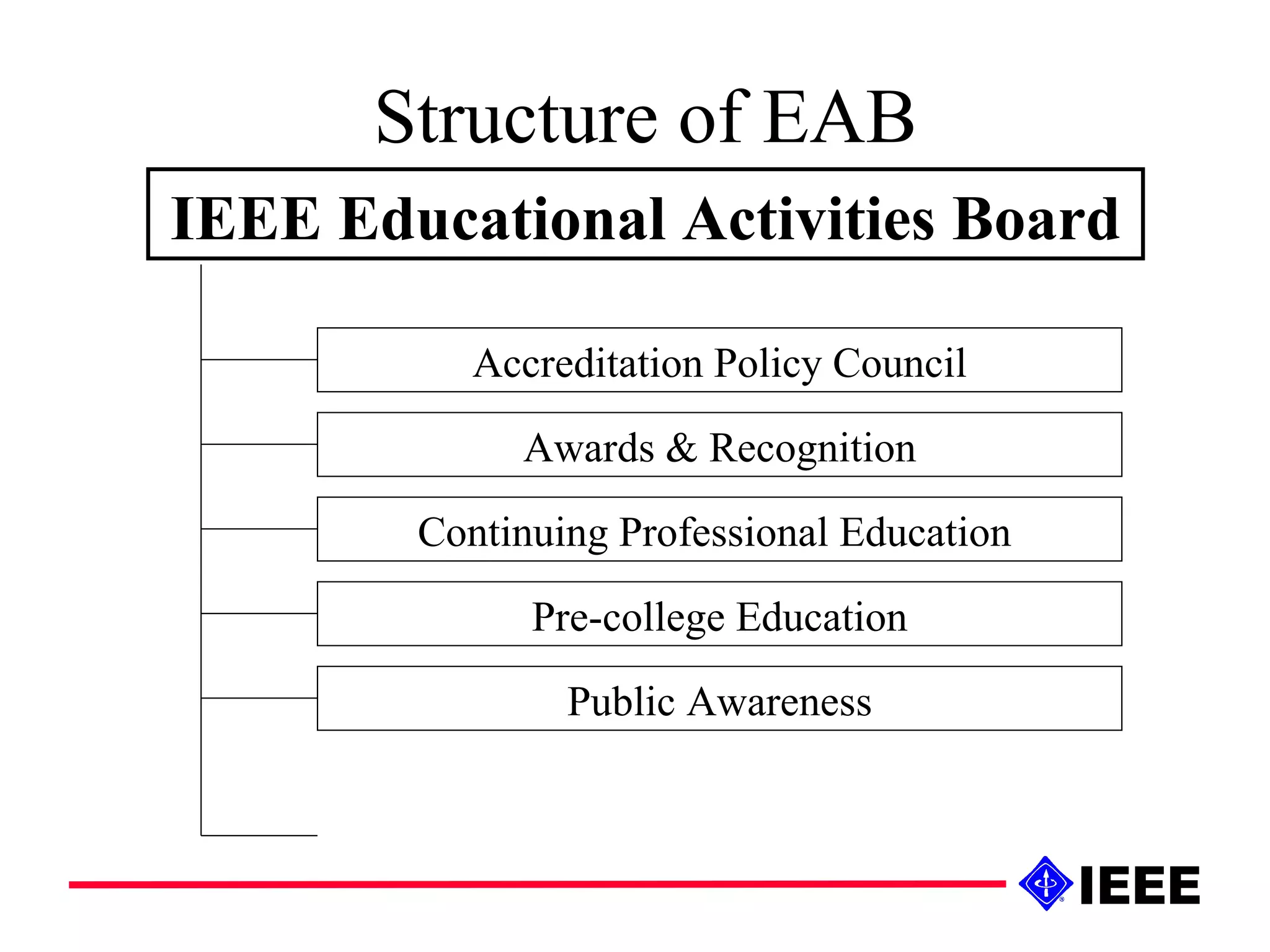
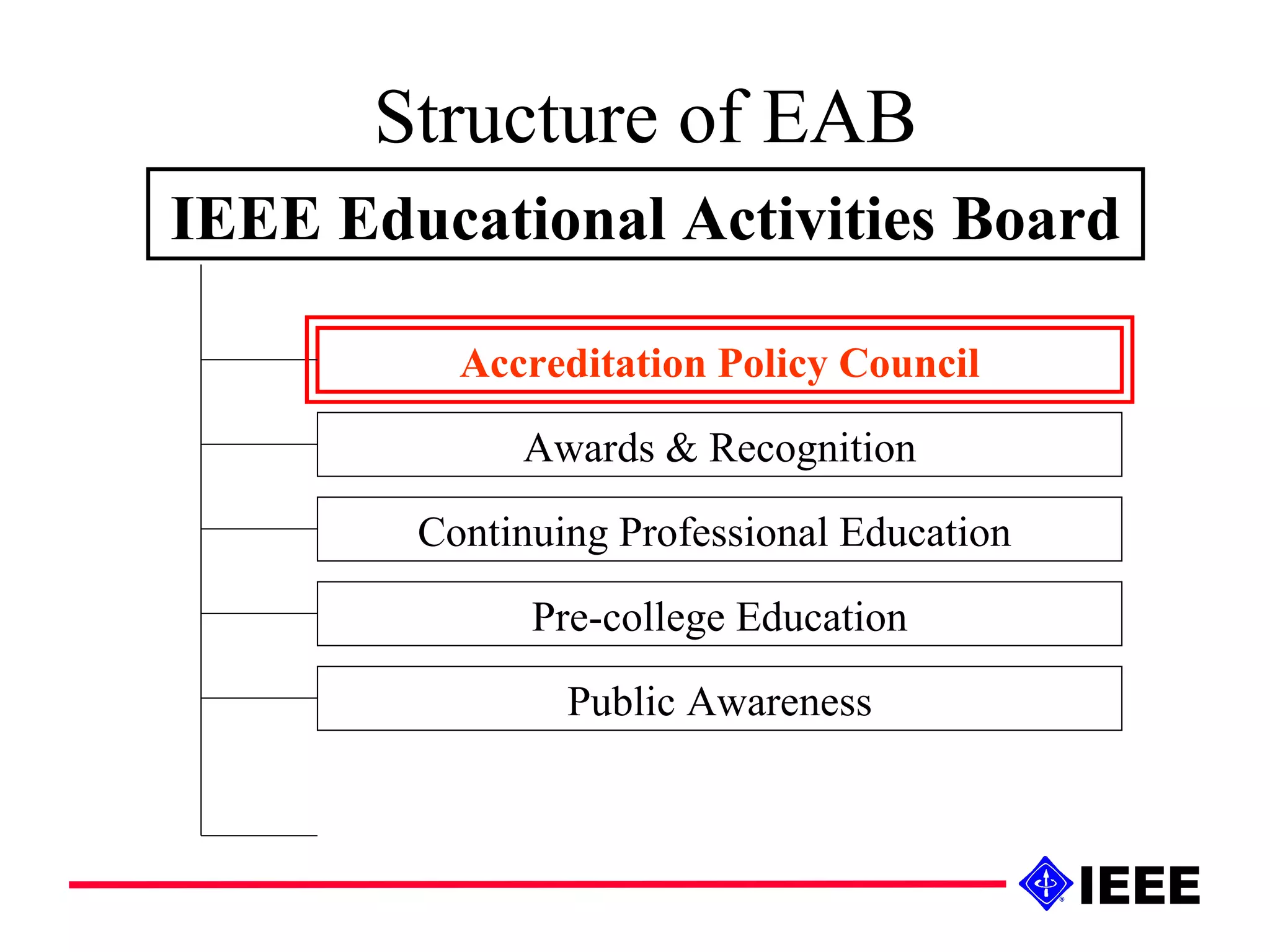
Structure of EAB IEEE Educational Activities Board Awards & Recognition Continuing Professional Education  Pre-college Education Public Awareness Accreditation Policy Council
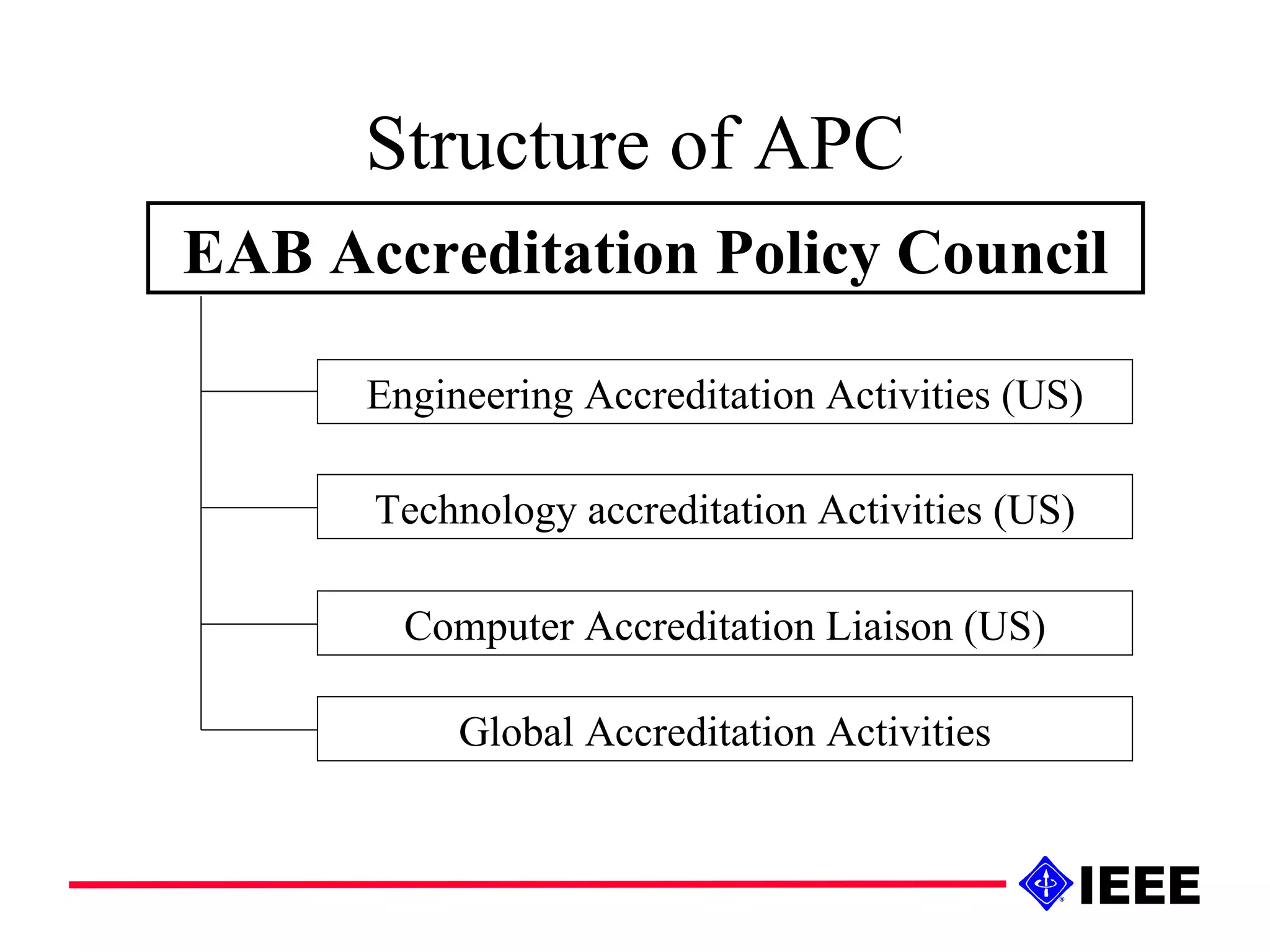
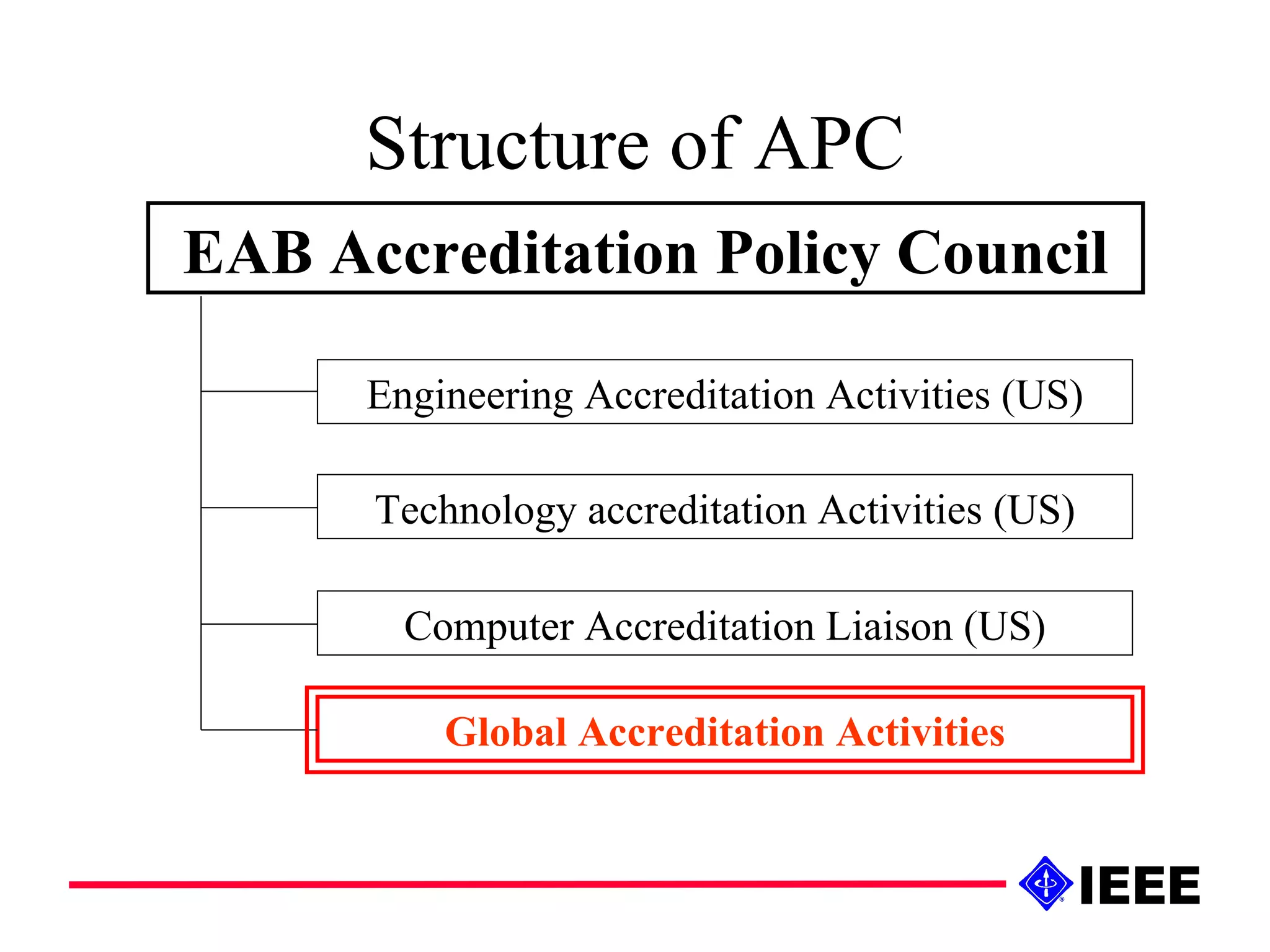
Structure of APC EAB Accreditation Policy Council Engineering Accreditation Activities (US) Technology accreditation Activities (US) Global Accreditation Activities Computer Accreditation Liaison (US)
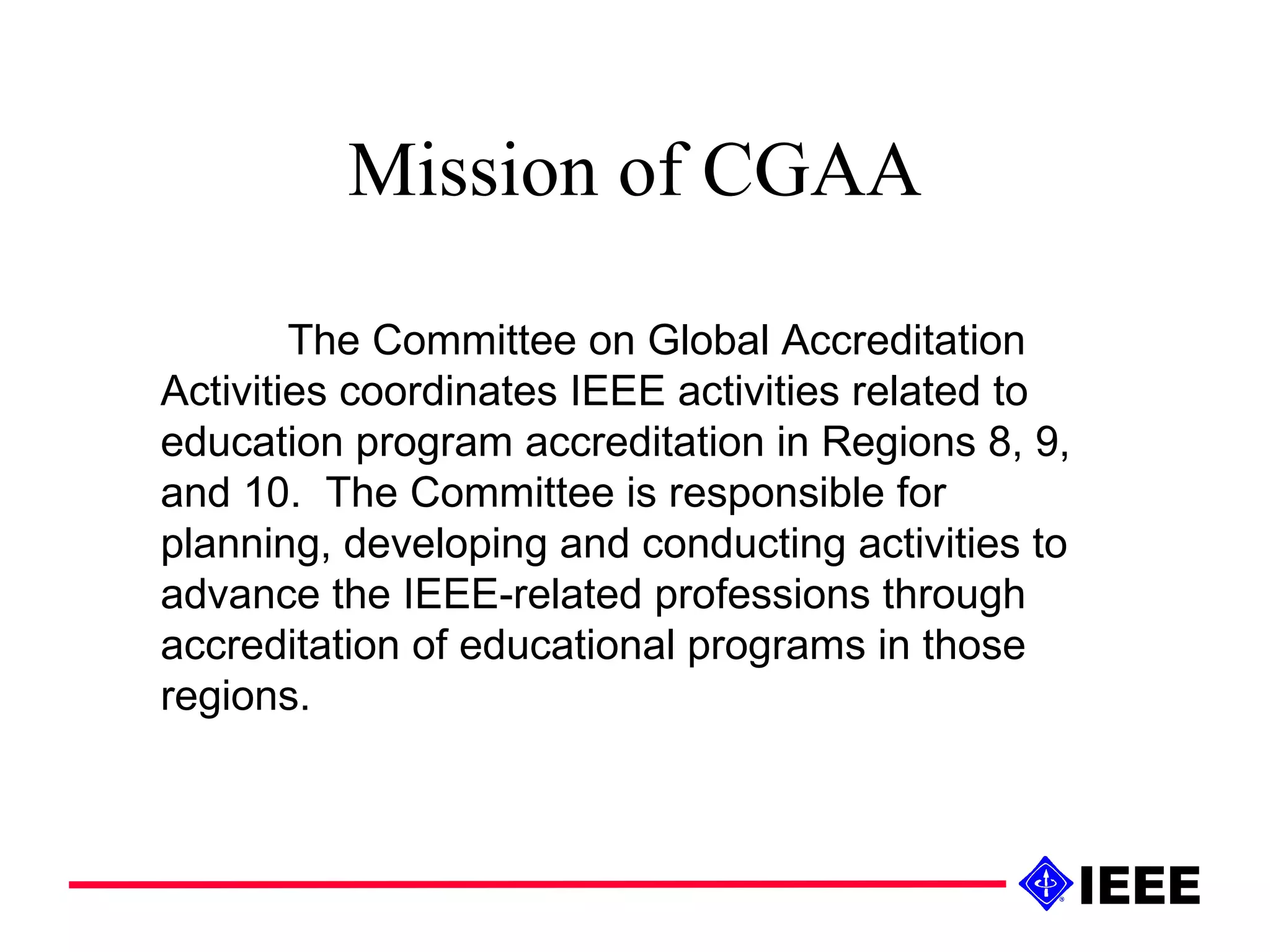
Mission of CGAA The Committee on Global Accreditation Activities coordinates IEEE activities related to education program accreditation in Regions 8, 9, and 10.  The Committee is responsible for planning, developing and conducting activities to advance the IEEE-related professions through accreditation of educational programs in those regions.
The “Fundamentals” of Accreditation
First, what IS accreditation? External recognition of quality Varies from country to country Of value to: Prospective students Graduates Prospective employers Graduate schools Licensing agencies Governments
The Goal of Program Accreditation To assure that graduates are qualified to practice engineering
Some Unfortunate Misuses of Accreditation To control the universities To serve the faculty To limit enrollments To control competition
“ Accreditation” is sometimes called… Certification Registration Approval Or …..?
Accreditation can be… Voluntary Required Coerced
Characteristics of Accreditation External Agency Standards (criteria) Evaluation Recognition Maintenance Generally Go or No Go Generally within borders
Kinds of Accreditation Agencies Government Peer (other colleges) Professional A combination Private agency
Factors that  may  be considered Curriculum Faculty Students Facilities Administration External constituencies Success of graduates Faculty salaries Staff support Faculty workload Demand for graduates Quality improvement Meets objectives
An Important Question Level of specificity What level of detail should be included in the accreditation criteria?
Levels of Curricular Specificity Educational goal Abilities of graduates Overall curriculum Courses Course content An Example
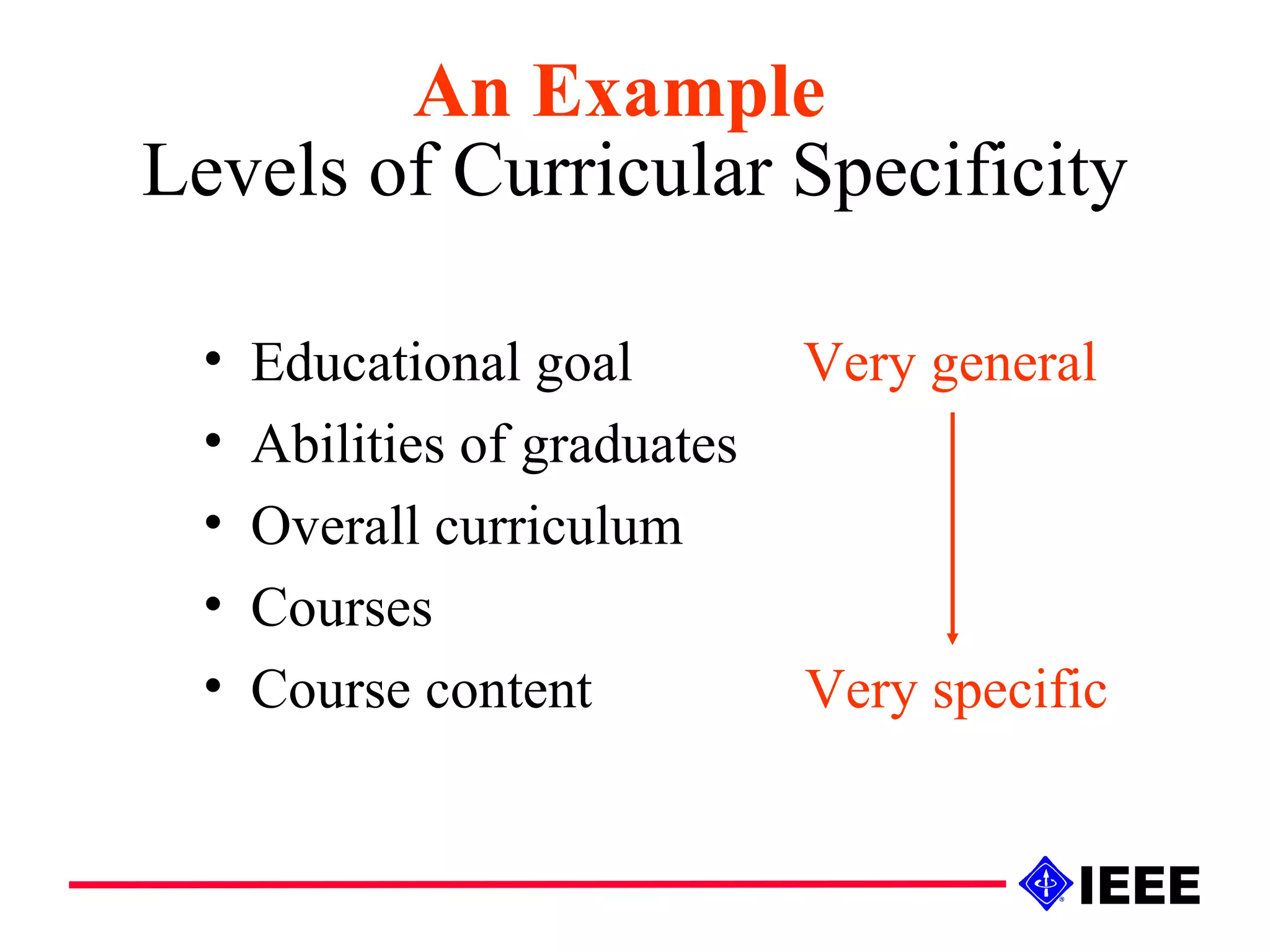
Levels of Curricular Specificity Educational goal  Very general Abilities of graduates Overall curriculum Courses Course content  Very specific An Example
Levels of Curricular Specificity Educational goal Abilities of graduates Overall curriculum Courses Course content
Specified Educational Goal The program must provide an educational experience that prepares its graduates to enter the practice of engineering An Example
Levels of Curricular Specificity Educational goal Abilities of graduates Overall curriculum Courses Course content
Specified Abilities of Graduates At the completion of the educational program, the graduate must be able to: Define and solve engineering problems Analyze the effects of their solutions on the environment and society Use computers and other modern tools Defend the practices of the government Etc., etc., etc. An Example
Levels of Curricular Specificity Educational goal Abilities of graduates Overall curriculum Courses Course content
Specified Overall Curriculum The program must provide instruction in the following areas: One semester - mathematics One semester – basic science Two semesters – engineering science One semester – engineering design One semester – humanities and social sciences One semester – industrial experience One semester – religion An Example
Levels of Curricular Specificity Educational goal Abilities of graduates Overall curriculum Courses Course content
Specified Courses The mathematics portion of the curriculum must include the following: One course in analytic geometry Two  courses in calculus One course in vector calculus One course in ordinary differential equations One course in partial differential equations One course in probability and statistics An Example
Levels of Curricular Specificity Educational goal Abilities of graduates Overall curriculum Courses Course content
Specified Course Content The first course in electric circuits shall cover the following topics: 2 lectures – Ohm’s Law 1 lecture – matrix mathematics 3 lectures – loop equations 3 lectures – node equations Etc., etc., etc. An Example
Factors that  may  be considered Curriculum Faculty Students Facilities Administration External constituencies Success of graduates Faculty salaries Staff support Faculty workload Demand for graduates Quality improvement Meets objectives
The Big Question If a program is judged to be doing well in all or most of these factors,  therefore we may conclude that its graduates are qualified to practice engineering. Is this true?
International Considerations Global community has led to increased mobility of engineers and students How can credentials and quality of education be assessed and certified?
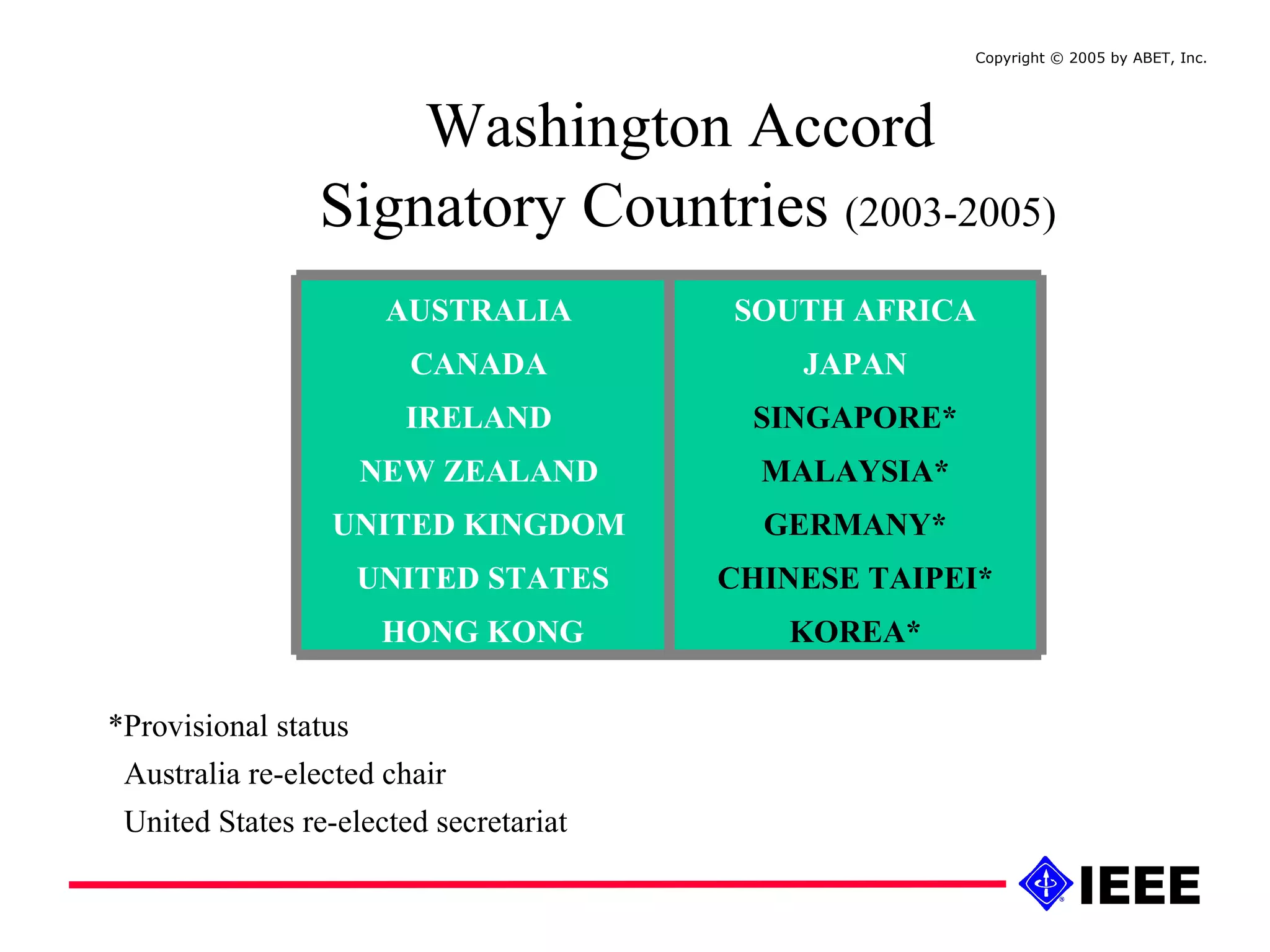
Different Approaches to International Recognition Accredit programs in other countries IEE (NOT IEEE) yes, ABET no Certify “Substantial Equivalency” ABET yes, others ??? Agree to mutual recognition Washington Accord Western Hemisphere Initiative EUR-ACE
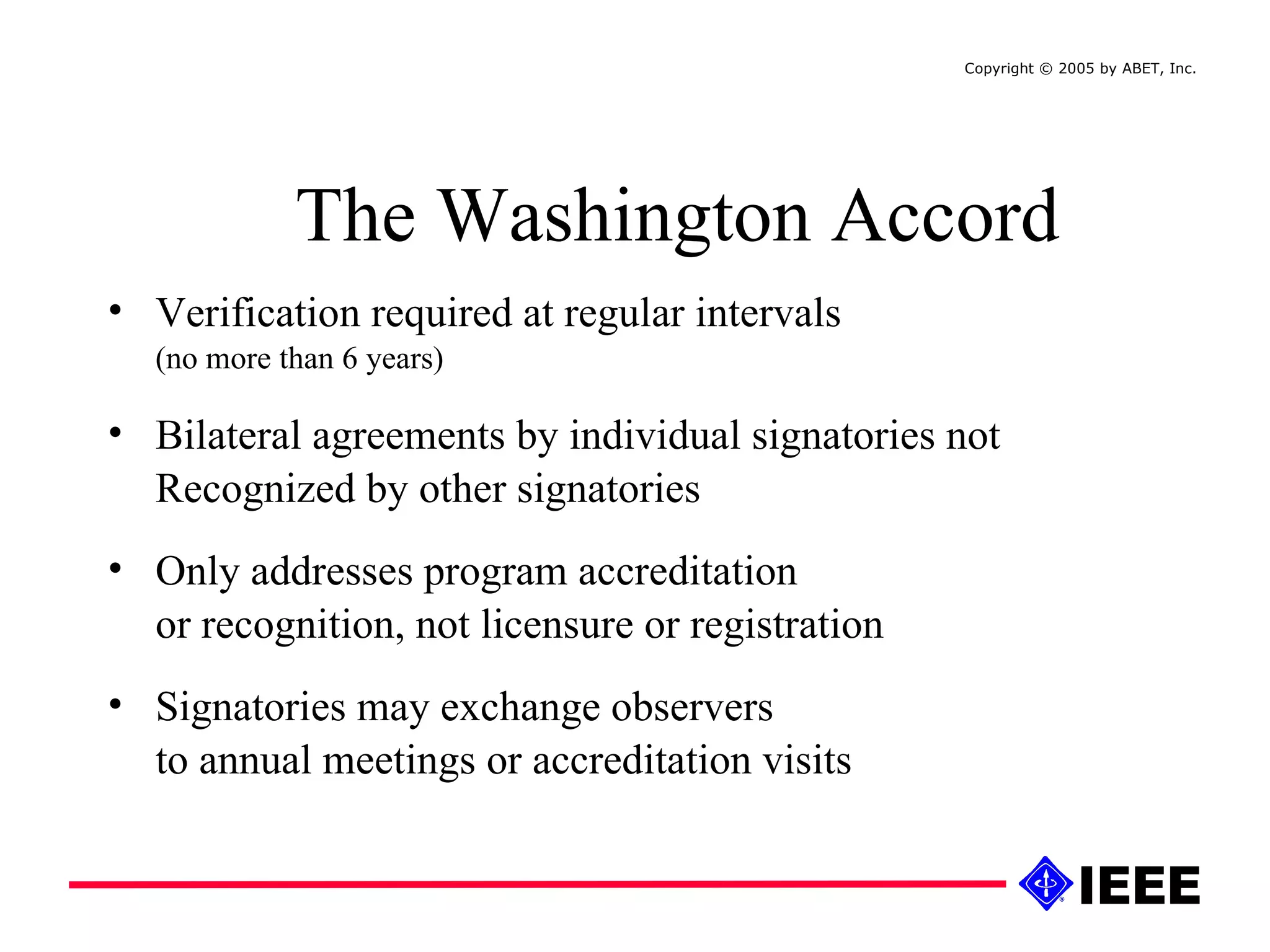
*Provisional status Australia re-elected chair United States re-elected secretariat   Washington Accord  Signatory Countries  (2003-2005) Copyright © 2005 by ABET, Inc.  SOUTH AFRICA JAPAN SINGAPORE* MALAYSIA* GERMANY* CHINESE TAIPEI* KOREA* AUSTRALIA  CANADA  IRELAND  NEW ZEALAND  UNITED KINGDOM  UNITED STATES HONG KONG
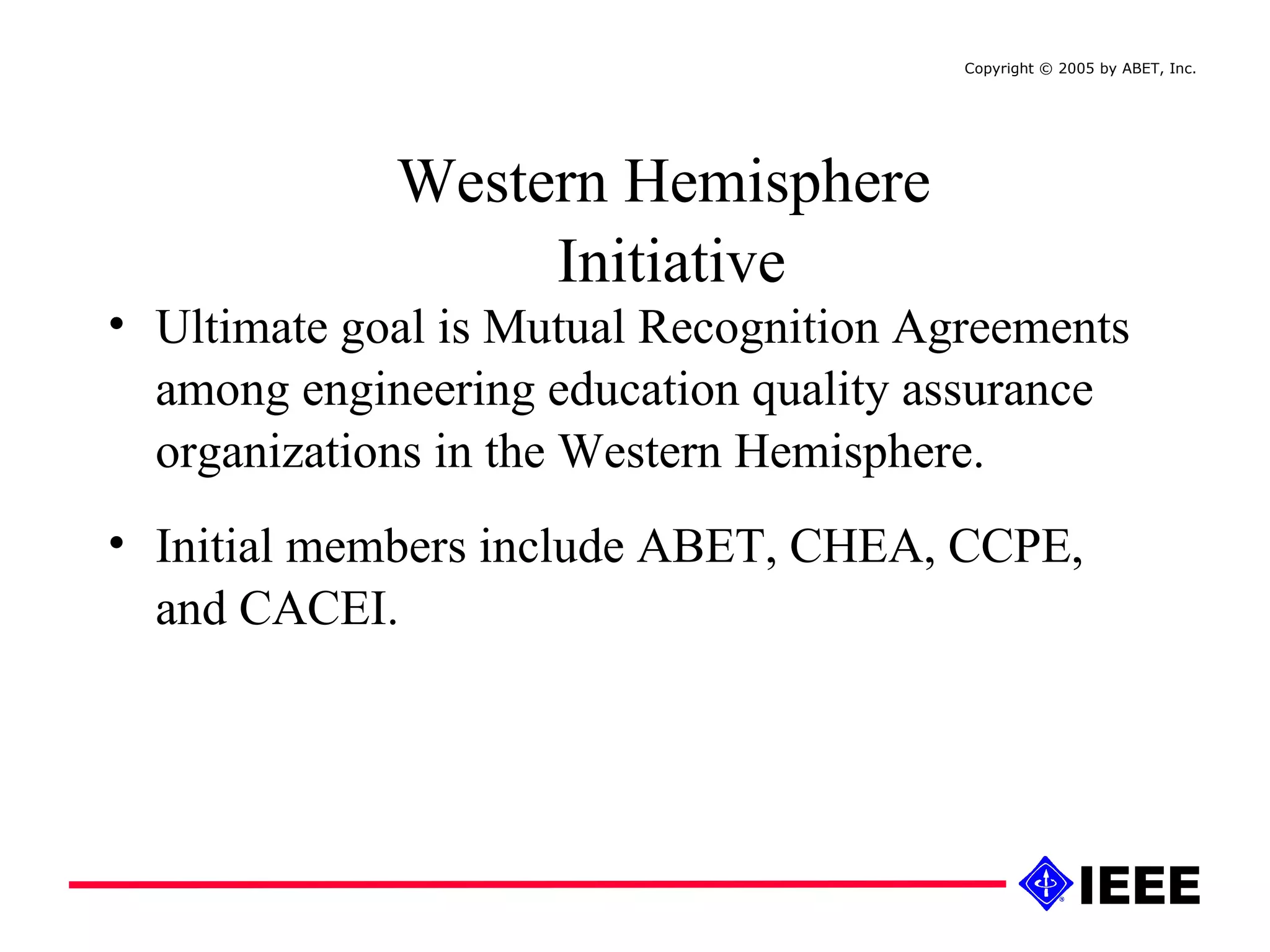
Verification required at regular intervals  (no more than 6 years)  Bilateral agreements by individual signatories not Recognized by other signatories Only addresses program accreditation  or recognition, not licensure or registration Signatories may exchange observers  to annual meetings or accreditation visits  The Washington Accord Copyright © 2005 by ABET, Inc.
Ultimate goal is Mutual Recognition Agreements among engineering education quality assurance organizations in the Western Hemisphere. Initial members include ABET, CHEA, CCPE, and CACEI. Western Hemisphere  Initiative Copyright © 2005 by ABET, Inc.
Summary Voluntary, required or coerced Government, peer, professional or combination Criteria - general to specific May serve Government University Faculty Students Profession International considerations
The “Fundamentals” of Accreditation Quality Assurance in Educational Programs Lyle D. Feisel Chair, IEEE Com. on Global Accreditation Activities ENGINEERING ACCREDITATION AROUND THE WORLD   Lima, Peru 3 – 5 December, 2005 [email_address]

S1 feisel fundamentalsof-accred

  • 1.
    The “Fundamentals” ofAccreditation Quality Assurance in Educational Programs Lyle D. Feisel Chair, IEEE Com. on Global Accreditation Activities Dean Emeritus of Engineering, SUNY Binghamton ENGINEERING ACCREDITATION AROUND THE WORLD Lima, Peru 3 – 5 December, 2005
  • 2.
    Outline IEEE, EAB,APC, and CGAA What is accreditation The goals of accreditation Forms of accreditation agencies Some general characteristics Factors that may be considered The big question International considerations Summary
  • 3.
    The Institute ofElectrical and Electronics Engineers Formed in 1963 from two predecessor organizations About 350,000 members US in origin, now global in scope About 1/3 of members are non-US
  • 4.
    From the IEEEConstitution Sec. 2. Its purposes are: (a) scientific and educational, directed toward the advancement of the theory and practice of electrical engineering, electronics, radio and the allied branches of engineering and the related arts and sciences ... … (b) professional, directed toward the advancement of the standing of the members of the professions it serves
  • 5.
    Structure of IEEEIEEE Board of Directors Technical Activities Board Regional Activities Board Educational Activities Board Publications Services & Products Board IEEE Standards Association
  • 6.
    Structure of IEEEIEEE Board of Directors Technical Activities Board Regional Activities Board Educational Activities Board Publications Services & Products Board IEEE Standards Association
  • 7.
    Structure of EABIEEE Educational Activities Board Awards & Recognition Continuing Professional Education Pre-college Education Public Awareness Accreditation Policy Council
  • 8.
    Structure of EABIEEE Educational Activities Board Awards & Recognition Continuing Professional Education Pre-college Education Public Awareness Accreditation Policy Council
  • 9.
    Structure of APCEAB Accreditation Policy Council Engineering Accreditation Activities (US) Technology accreditation Activities (US) Global Accreditation Activities Computer Accreditation Liaison (US)
  • 10.
    Structure of APCEAB Accreditation Policy Council Engineering Accreditation Activities (US) Technology accreditation Activities (US) Global Accreditation Activities Computer Accreditation Liaison (US)
  • 11.
    Mission of CGAAThe Committee on Global Accreditation Activities coordinates IEEE activities related to education program accreditation in Regions 8, 9, and 10. The Committee is responsible for planning, developing and conducting activities to advance the IEEE-related professions through accreditation of educational programs in those regions.
  • 12.
  • 13.
    First, what ISaccreditation? External recognition of quality Varies from country to country Of value to: Prospective students Graduates Prospective employers Graduate schools Licensing agencies Governments
  • 14.
    The Goal ofProgram Accreditation To assure that graduates are qualified to practice engineering
  • 15.
    Some Unfortunate Misusesof Accreditation To control the universities To serve the faculty To limit enrollments To control competition
  • 16.
    “ Accreditation” issometimes called… Certification Registration Approval Or …..?
  • 17.
    Accreditation can be…Voluntary Required Coerced
  • 18.
    Characteristics of AccreditationExternal Agency Standards (criteria) Evaluation Recognition Maintenance Generally Go or No Go Generally within borders
  • 19.
    Kinds of AccreditationAgencies Government Peer (other colleges) Professional A combination Private agency
  • 20.
    Factors that may be considered Curriculum Faculty Students Facilities Administration External constituencies Success of graduates Faculty salaries Staff support Faculty workload Demand for graduates Quality improvement Meets objectives
  • 21.
    An Important QuestionLevel of specificity What level of detail should be included in the accreditation criteria?
  • 22.
    Levels of CurricularSpecificity Educational goal Abilities of graduates Overall curriculum Courses Course content An Example
  • 23.
    Levels of CurricularSpecificity Educational goal Very general Abilities of graduates Overall curriculum Courses Course content Very specific An Example
  • 24.
    Levels of CurricularSpecificity Educational goal Abilities of graduates Overall curriculum Courses Course content
  • 25.
    Specified Educational GoalThe program must provide an educational experience that prepares its graduates to enter the practice of engineering An Example
  • 26.
    Levels of CurricularSpecificity Educational goal Abilities of graduates Overall curriculum Courses Course content
  • 27.
    Specified Abilities ofGraduates At the completion of the educational program, the graduate must be able to: Define and solve engineering problems Analyze the effects of their solutions on the environment and society Use computers and other modern tools Defend the practices of the government Etc., etc., etc. An Example
  • 28.
    Levels of CurricularSpecificity Educational goal Abilities of graduates Overall curriculum Courses Course content
  • 29.
    Specified Overall CurriculumThe program must provide instruction in the following areas: One semester - mathematics One semester – basic science Two semesters – engineering science One semester – engineering design One semester – humanities and social sciences One semester – industrial experience One semester – religion An Example
  • 30.
    Levels of CurricularSpecificity Educational goal Abilities of graduates Overall curriculum Courses Course content
  • 31.
    Specified Courses Themathematics portion of the curriculum must include the following: One course in analytic geometry Two courses in calculus One course in vector calculus One course in ordinary differential equations One course in partial differential equations One course in probability and statistics An Example
  • 32.
    Levels of CurricularSpecificity Educational goal Abilities of graduates Overall curriculum Courses Course content
  • 33.
    Specified Course ContentThe first course in electric circuits shall cover the following topics: 2 lectures – Ohm’s Law 1 lecture – matrix mathematics 3 lectures – loop equations 3 lectures – node equations Etc., etc., etc. An Example
  • 34.
    Factors that may be considered Curriculum Faculty Students Facilities Administration External constituencies Success of graduates Faculty salaries Staff support Faculty workload Demand for graduates Quality improvement Meets objectives
  • 35.
    The Big QuestionIf a program is judged to be doing well in all or most of these factors, therefore we may conclude that its graduates are qualified to practice engineering. Is this true?
  • 36.
    International Considerations Globalcommunity has led to increased mobility of engineers and students How can credentials and quality of education be assessed and certified?
  • 37.
    Different Approaches toInternational Recognition Accredit programs in other countries IEE (NOT IEEE) yes, ABET no Certify “Substantial Equivalency” ABET yes, others ??? Agree to mutual recognition Washington Accord Western Hemisphere Initiative EUR-ACE
  • 38.
    *Provisional status Australiare-elected chair United States re-elected secretariat Washington Accord Signatory Countries (2003-2005) Copyright © 2005 by ABET, Inc. SOUTH AFRICA JAPAN SINGAPORE* MALAYSIA* GERMANY* CHINESE TAIPEI* KOREA* AUSTRALIA CANADA IRELAND NEW ZEALAND UNITED KINGDOM UNITED STATES HONG KONG
  • 39.
    Verification required atregular intervals (no more than 6 years) Bilateral agreements by individual signatories not Recognized by other signatories Only addresses program accreditation or recognition, not licensure or registration Signatories may exchange observers to annual meetings or accreditation visits The Washington Accord Copyright © 2005 by ABET, Inc.
  • 40.
    Ultimate goal isMutual Recognition Agreements among engineering education quality assurance organizations in the Western Hemisphere. Initial members include ABET, CHEA, CCPE, and CACEI. Western Hemisphere Initiative Copyright © 2005 by ABET, Inc.
  • 41.
    Summary Voluntary, requiredor coerced Government, peer, professional or combination Criteria - general to specific May serve Government University Faculty Students Profession International considerations
  • 42.
    The “Fundamentals” ofAccreditation Quality Assurance in Educational Programs Lyle D. Feisel Chair, IEEE Com. on Global Accreditation Activities ENGINEERING ACCREDITATION AROUND THE WORLD Lima, Peru 3 – 5 December, 2005 [email_address]

Editor's Notes

  • #2 It is perhaps a bit ambitious to say that I will cover the “fundamentals” of accreditation since I doubt if we can get many people to agree on what those fundamentals are. What I really want to do is to present some terminology and establish some parameters by which accreditation systems may be described.
  • #3 Before I start on the accreditation presentation, I want to spend a few minutes telling you about IEEE. Some of you are not members and I thought you should know a little more about your host.
  • #14 Discuss each of the interested parties in some detail as to why they are interested and how they are affected by accreditation But mostly, it is of value to society because the fundamental goal of accreditation is
  • #15 Accreditation can serve many purposes and not all of those purposes are as meritorious as others. Everyone can agree that a “good” goal of accreditation is to make sure that students are well educated. Some people, however, have had other goals for accreditation.
  • #18 In the US, engineering accreditation is ostensibly voluntary In New York State, it is required. In the US, in reality, it is coerced since no one dare be without it. An unaccredited program is ineligible for a number of government programs and other benefits. Graduates are at a disadvantage in entering graduate schools. Many companies will not hire graduates of an unaccredited program. Some states require an accredited engineering degree for registration.
  • #22 In writing criteria, one of the most important questions is how specific to make them.
  • #35 Criteria for each of these may be written at any level of specificity. Both extremes have their champions. In general, a compromise will prevail