Accreditation & Outcome
Based Approach
Prof Megat Johari Megat Mohd Noor
UTM QRIM@KL & MJIIT
Lahore/Faisalabad/Jamshoro, Pakistan
September 2016
Introduction
3
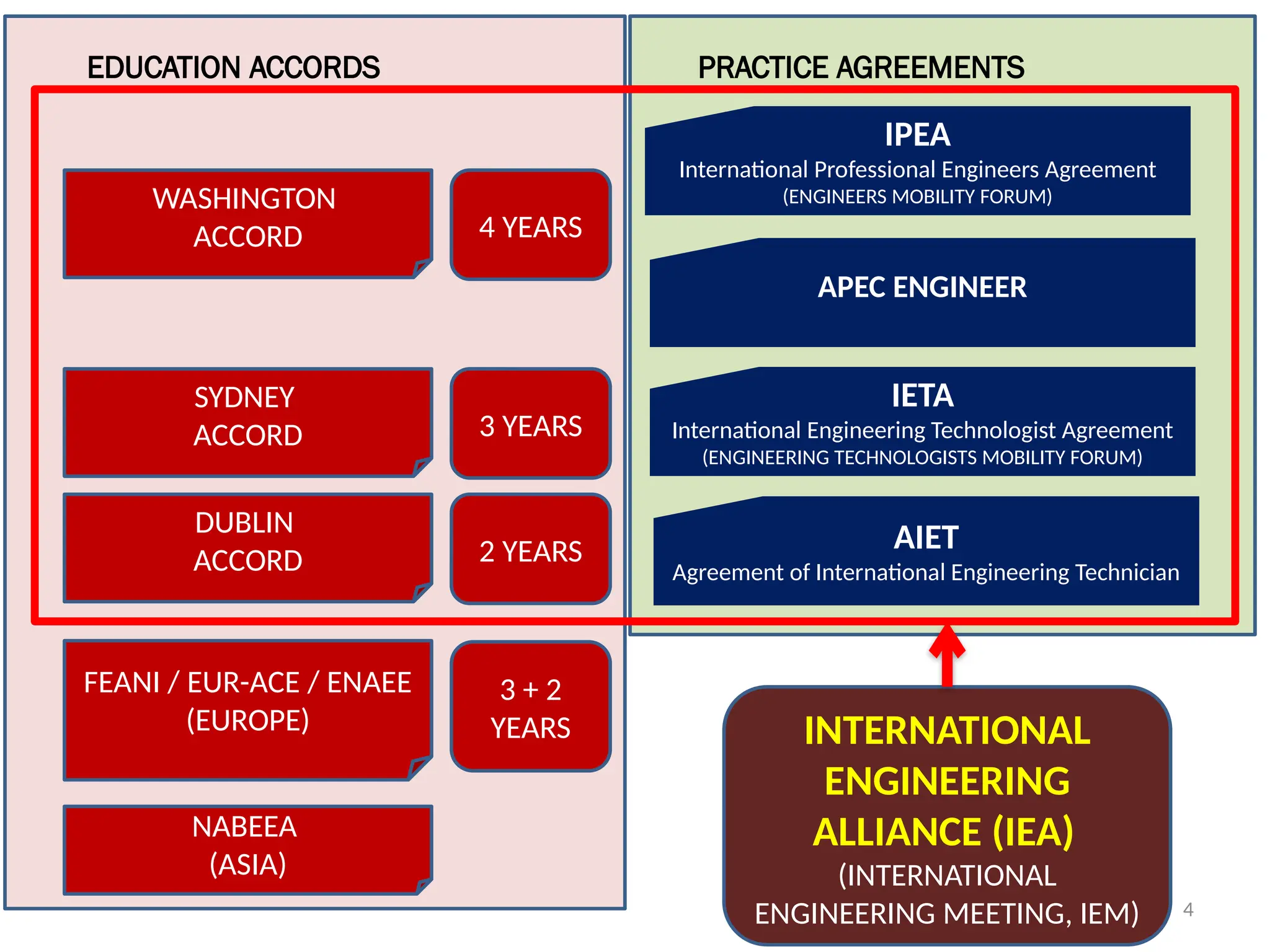
We are joining the Mutual Recognition Train
(MRT) !
4
WASHINGTON
ACCORD
SYDNEY
ACCORD
DUBLIN
ACCORD
4 YEARS
3 YEARS
2 YEARS
IPEA
International Professional Engineers Agreement
(ENGINEERS MOBILITY FORUM)
APEC ENGINEER
FEANI / EUR-ACE / ENAEE
(EUROPE)
3 + 2
YEARS
NABEEA
(ASIA)
EDUCATION ACCORDS PRACTICE AGREEMENTS
IETA
International Engineering Technologist Agreement
(ENGINEERING TECHNOLOGISTS MOBILITY FORUM)
INTERNATIONAL
ENGINEERING
ALLIANCE (IEA)
(INTERNATIONAL
ENGINEERING MEETING, IEM)
AIET
Agreement of International Engineering Technician
5
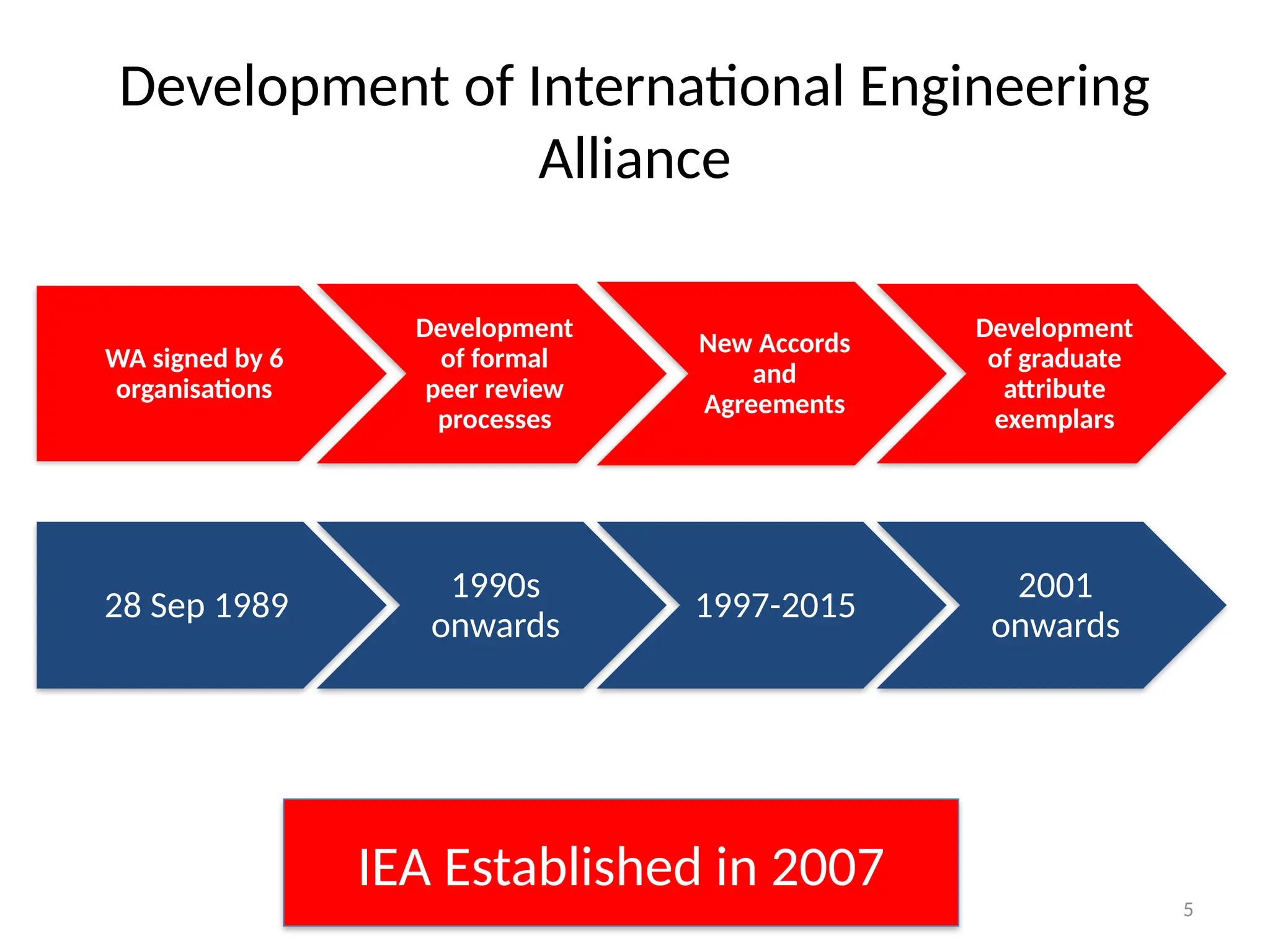
Development of International Engineering
Alliance
WA signed by 6
organisations
Development
of formal
peer review
processes
New Accords
and
Agreements
Development
of graduate
attribute
exemplars
28 Sep 1989
1990s
onwards
1997-2015
2001
onwards
IEA Established in 2007
6
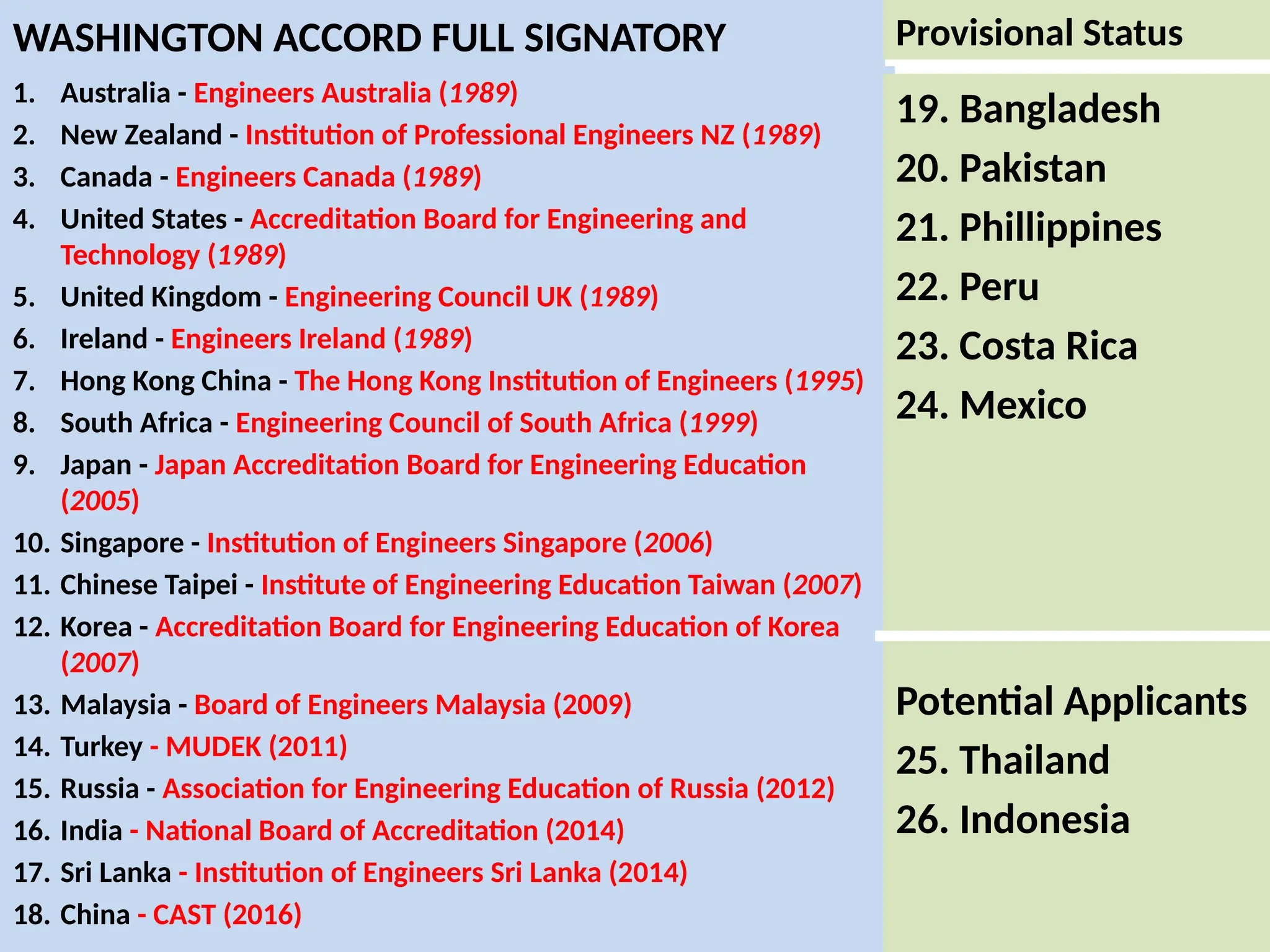
WASHINGTON ACCORD FULL SIGNATORY
1. Australia - Engineers Australia (1989)
2. New Zealand - Institution of Professional Engineers NZ (1989)
3. Canada - Engineers Canada (1989)
4. United States - Accreditation Board for Engineering and
Technology (1989)
5. United Kingdom - Engineering Council UK (1989)
6. Ireland - Engineers Ireland (1989)
7. Hong Kong China - The Hong Kong Institution of Engineers (1995)
8. South Africa - Engineering Council of South Africa (1999)
9. Japan - Japan Accreditation Board for Engineering Education
(2005)
10. Singapore - Institution of Engineers Singapore (2006)
11. Chinese Taipei - Institute of Engineering Education Taiwan (2007)
12. Korea - Accreditation Board for Engineering Education of Korea
(2007)
13. Malaysia - Board of Engineers Malaysia (2009)
14. Turkey - MUDEK (2011)
15. Russia - Association for Engineering Education of Russia (2012)
16. India - National Board of Accreditation (2014)
17. Sri Lanka - Institution of Engineers Sri Lanka (2014)
18. China - CAST (2016)
Provisional Status
19. Bangladesh
20. Pakistan
21. Phillippines
22. Peru
23. Costa Rica
24. Mexico
Potential Applicants
25. Thailand
26. Indonesia
7
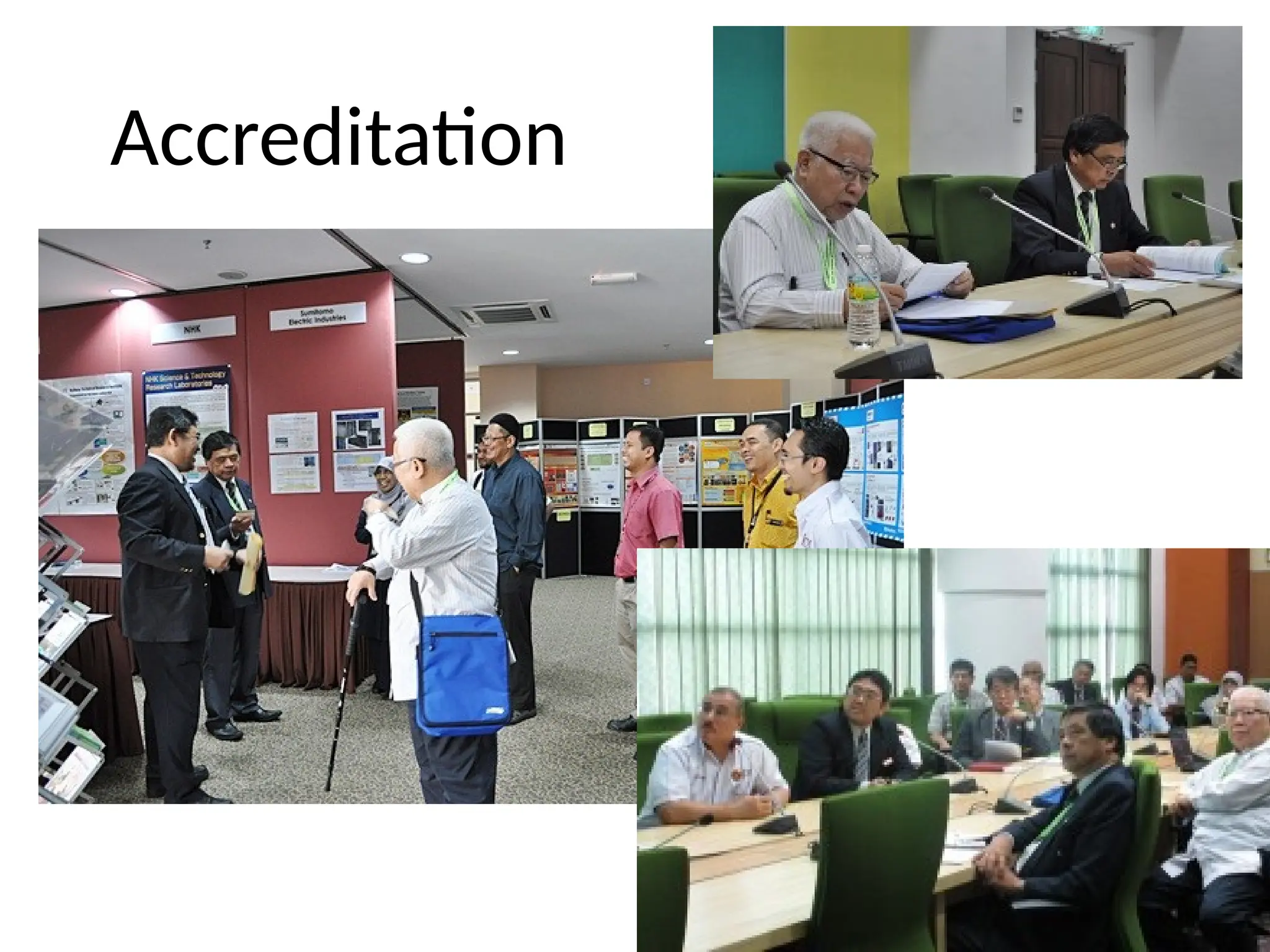
Accreditation
8
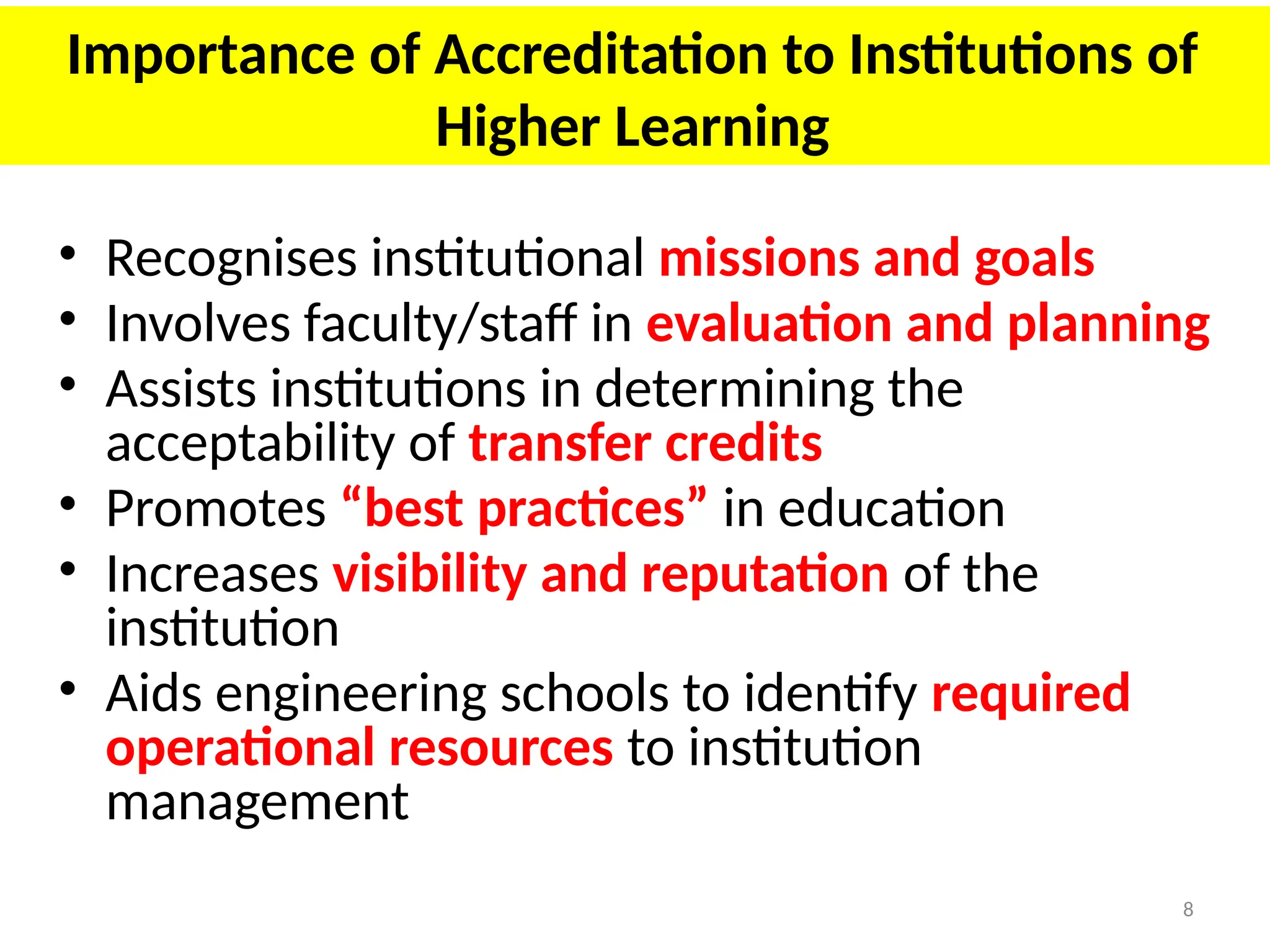
Importance of Accreditation to Institutions of
Higher Learning
• Recognises institutional missions and goals
• Involves faculty/staff in evaluation and planning
• Assists institutions in determining the
acceptability of transfer credits
• Promotes “best practices” in education
• Increases visibility and reputation of the
institution
• Aids engineering schools to identify required
operational resources to institution
management
9
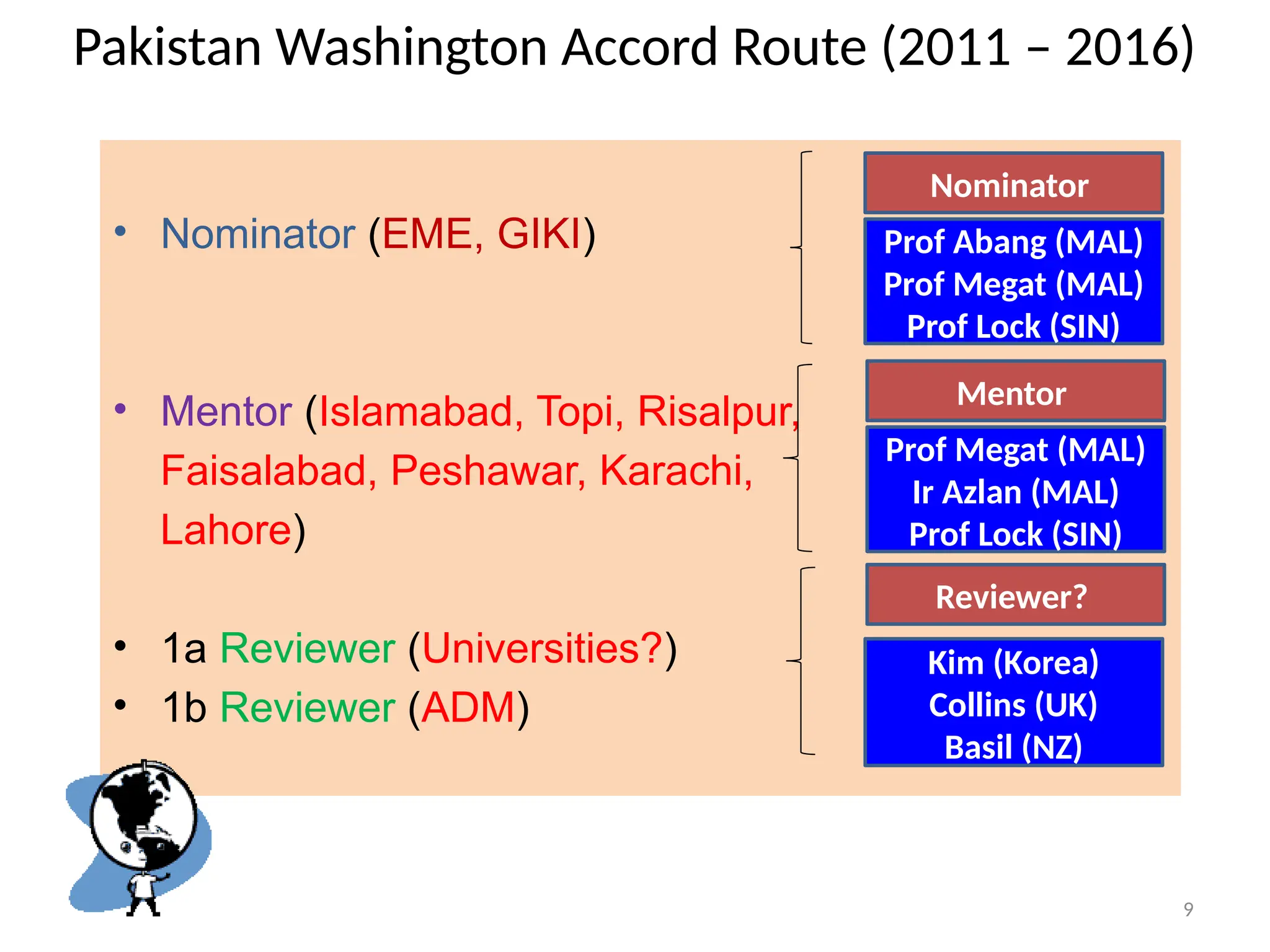
Pakistan Washington Accord Route (2011 – 2016)
• Nominator (EME, GIKI)
• Mentor (Islamabad, Topi, Risalpur,
Faisalabad, Peshawar, Karachi,
Lahore)
• 1a Reviewer (Universities?)
• 1b Reviewer (ADM)
Prof Abang (MAL)
Prof Megat (MAL)
Prof Lock (SIN)
Kim (Korea)
Collins (UK)
Basil (NZ)
Nominator
Mentor
Prof Megat (MAL)
Ir Azlan (MAL)
Prof Lock (SIN)
Reviewer?
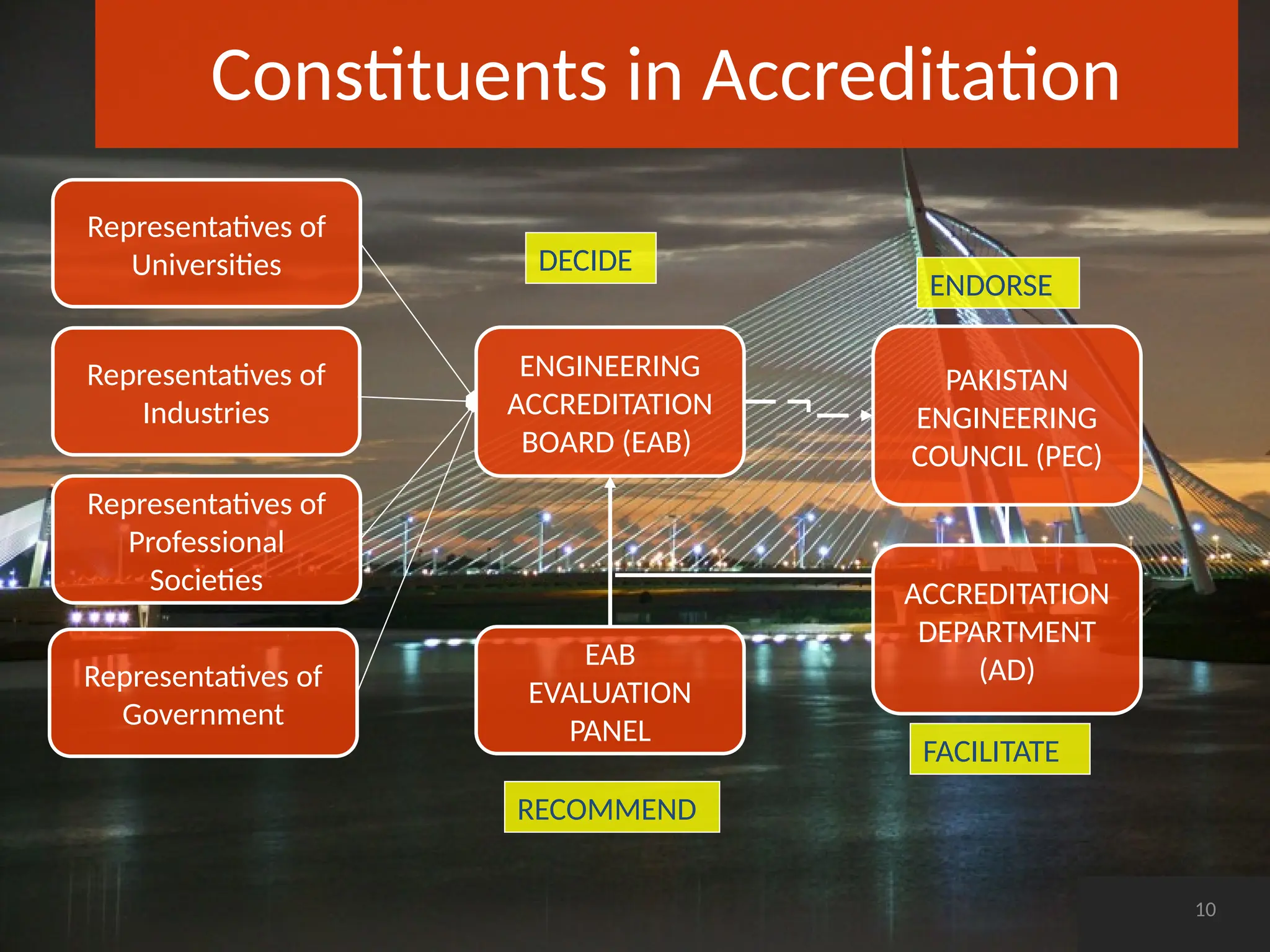
DECIDE
ENGINEERING
ACCREDITATION
BOARD (EAB)
Representatives of
Professional
Societies
Representatives of
Universities
Representatives of
Industries
Constituents in Accreditation
PAKISTAN
ENGINEERING
COUNCIL (PEC)
ACCREDITATION
DEPARTMENT
(AD)
EAB
EVALUATION
PANEL
ENDORSE
FACILITATE
RECOMMEND
Representatives of
Government
10
11
EAB Manual
• From input based to outcome based
20.. 2014
12
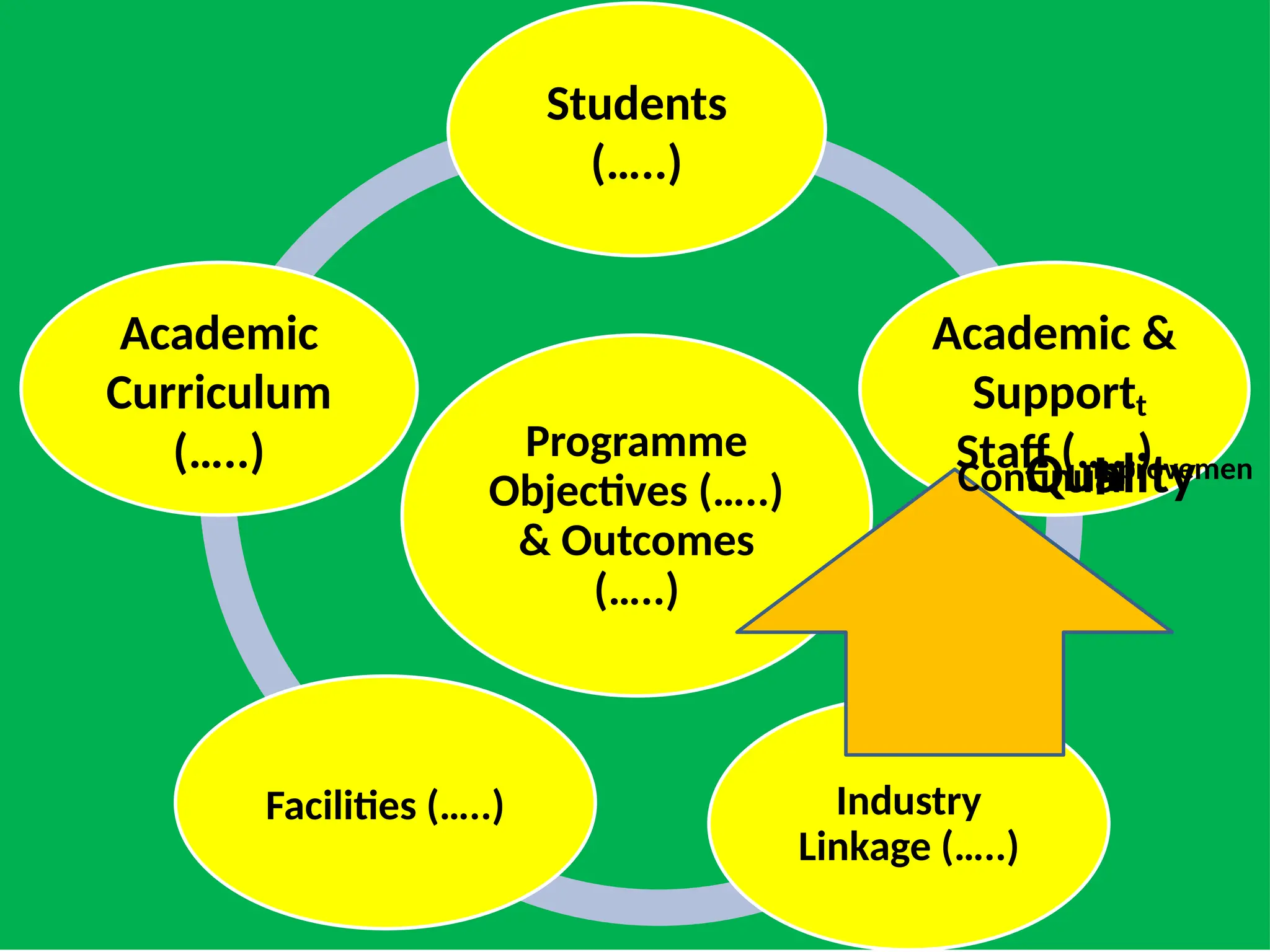
Programme
Objectives (…..)
& Outcomes
(…..)
Students
(…..)
Academic &
Support
Staff (…..)
Industry
Linkage (…..)
Facilities (…..)
Academic
Curriculum
(…..) Continual
Quality
I
mprovemen
t
13
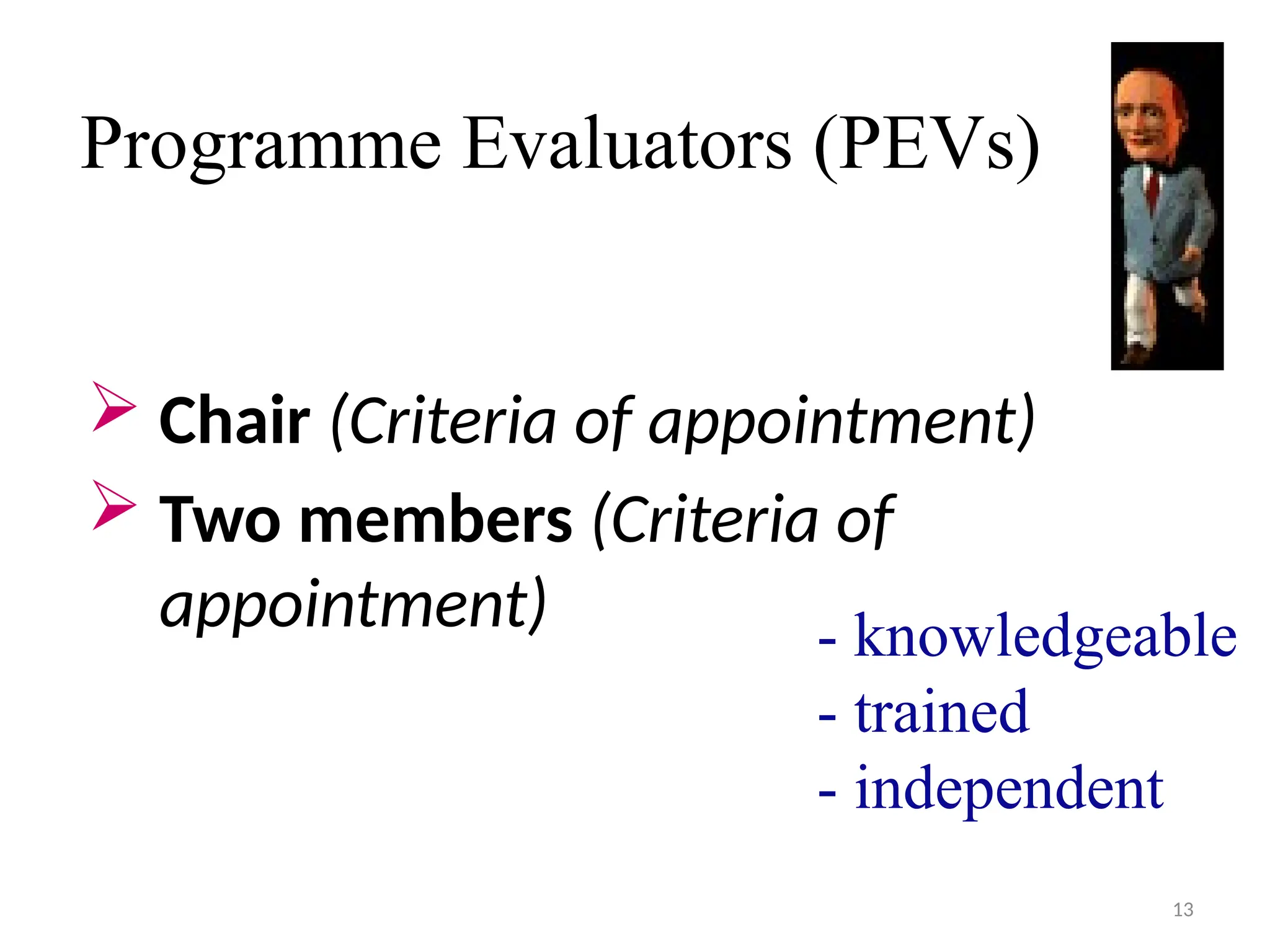
Programme Evaluators (PEVs)
 Chair (Criteria of appointment)
 Two members (Criteria of
appointment)
one member with extensive academic
experience and one member with
extensive industrial experience
- knowledgeable
- trained
- independent
Challenges
• Paradigm Shift – Outcome & Quality
• Maintain Fundamentals while Encourage
Inclusion of Latest Technology Advancement in
the Curriculum
• Allow Academic Innovation and Creativity
• Avoid Side-tracked
• Variety of Modes of Delivery
15
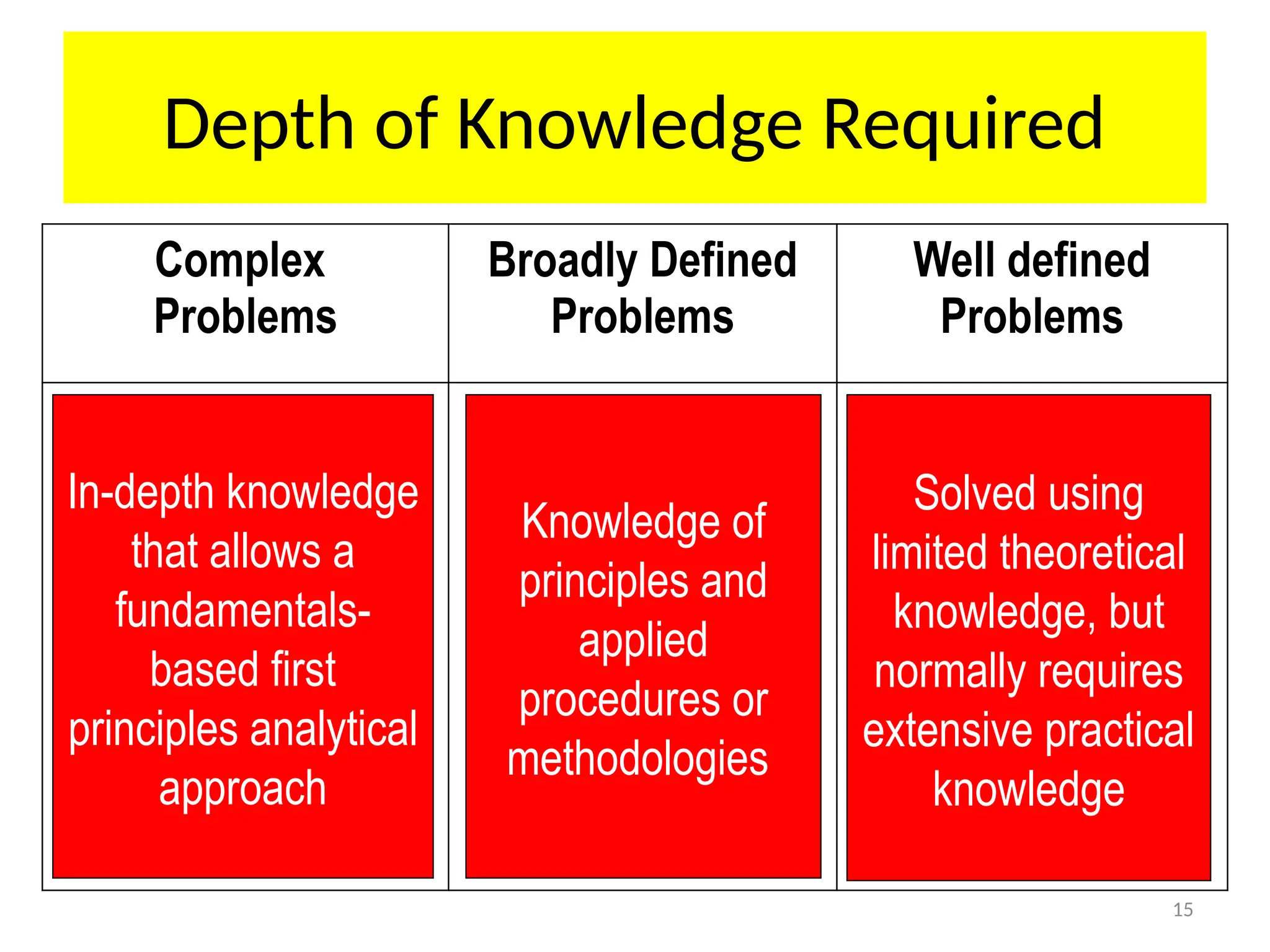
Complex
Problems
Broadly Defined
Problems
Well defined
Problems
Solved using
limited theoretical
knowledge, but
normally requires
extensive practical
knowledge
Knowledge of
principles and
applied
procedures or
methodologies
In-depth knowledge
that allows a
fundamentals-
based first
principles analytical
approach
Depth of Knowledge Required
16
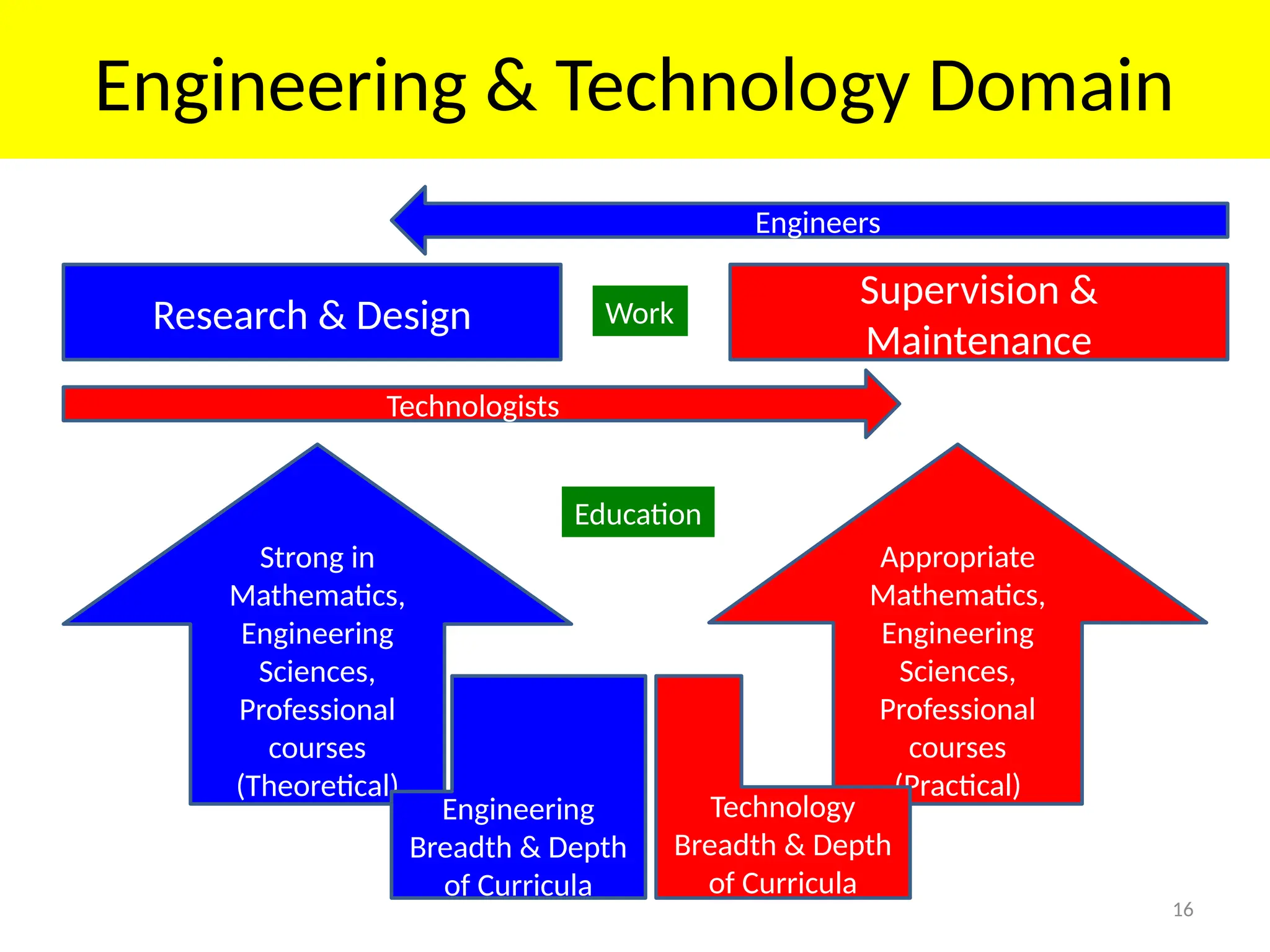
Engineering & Technology Domain
Engineers
Technologists
Research & Design
Supervision &
Maintenance
Strong in
Mathematics,
Engineering
Sciences,
Professional
courses
(Theoretical)
Appropriate
Mathematics,
Engineering
Sciences,
Professional
courses
(Practical)
Education
Work
Engineering
Breadth & Depth
of Curricula
Technology
Breadth & Depth
of Curricula
17
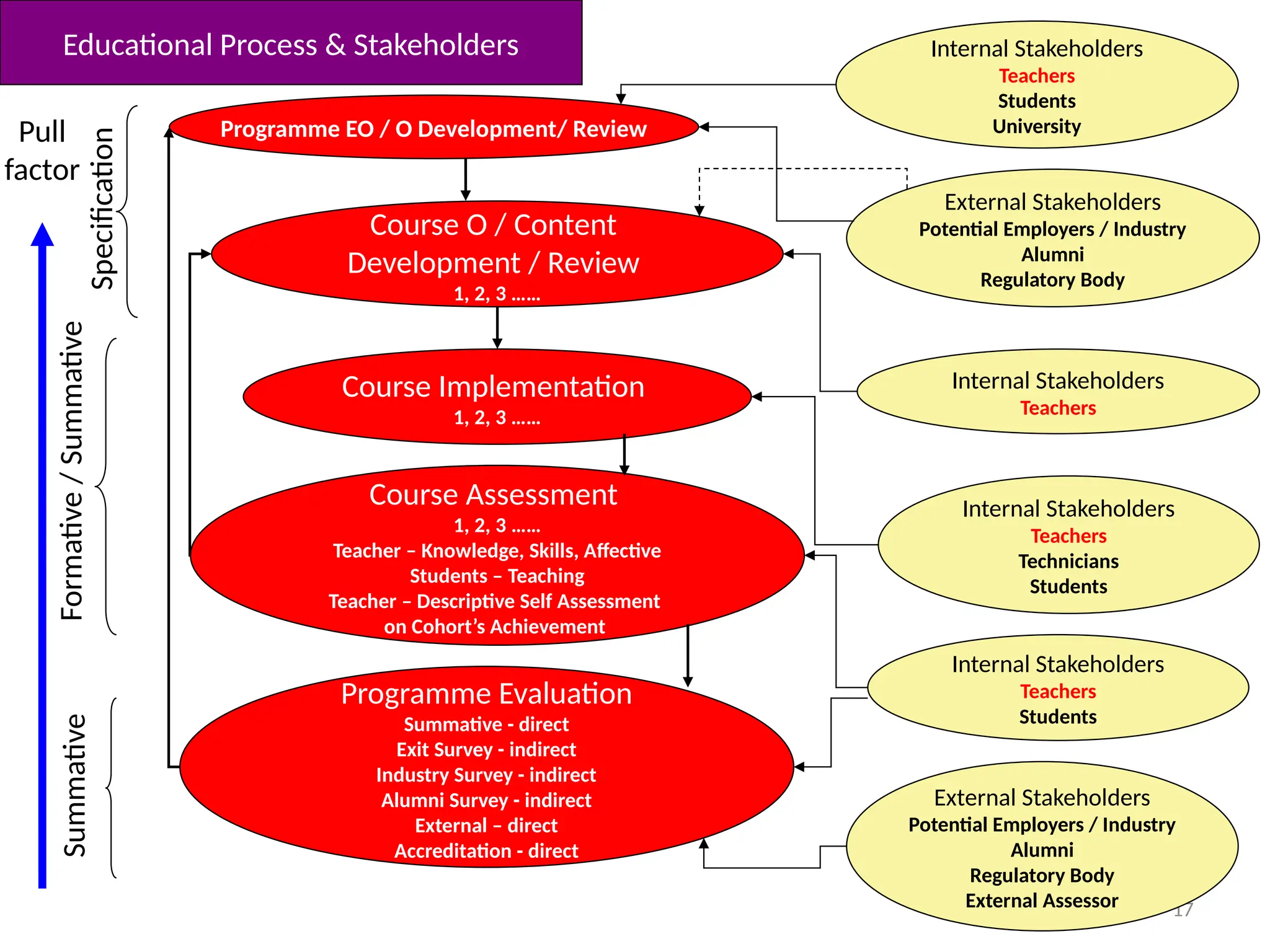
Programme EO / O Development/ Review
Internal Stakeholders
Teachers
Students
University
External Stakeholders
Potential Employers / Industry
Alumni
Regulatory Body
Course O / Content
Development / Review
1, 2, 3 ……
Course Implementation
1, 2, 3 ……
Course Assessment
1, 2, 3 ……
Teacher – Knowledge, Skills, Affective
Students – Teaching
Teacher – Descriptive Self Assessment
on Cohort’s Achievement
Programme Evaluation
Summative - direct
Exit Survey - indirect
Industry Survey - indirect
Alumni Survey - indirect
External – direct
Accreditation - direct
Educational Process & Stakeholders
Pull
factor
Internal Stakeholders
Teachers
Technicians
Students
Internal Stakeholders
Teachers
Students
External Stakeholders
Potential Employers / Industry
Alumni
Regulatory Body
External Assessor
Summative
Formative
/
Summative
Internal Stakeholders
Teachers
Specification
18
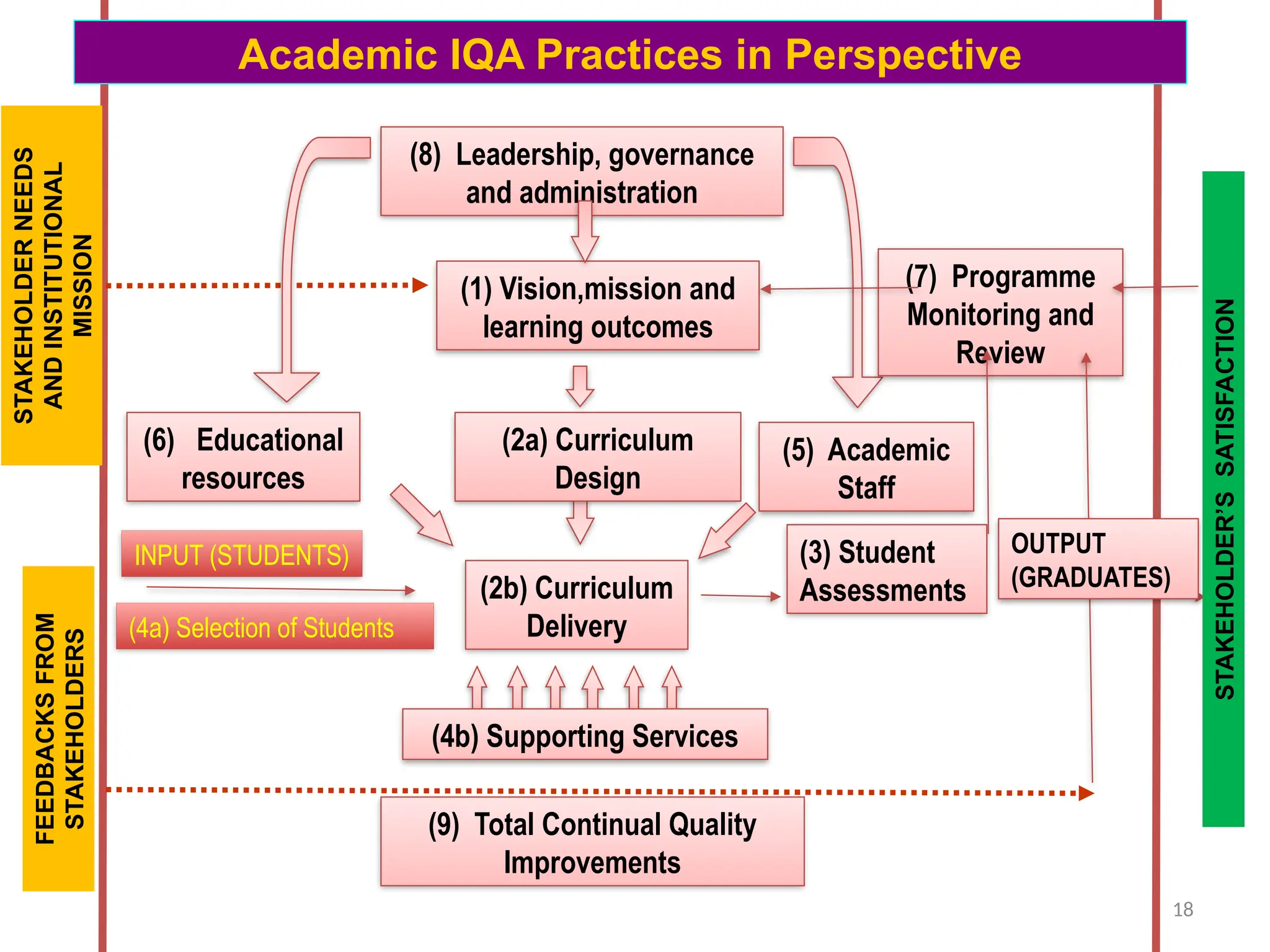
(8) Leadership, governance
and administration
(6) Educational
resources
(1) Vision,mission and
learning outcomes
(5) Academic
Staff
(2a) Curriculum
Design
(2b) Curriculum
Delivery
INPUT (STUDENTS)
(4a) Selection of Students
(4b) Supporting Services
(7) Programme
Monitoring and
Review
(3) Student
Assessments
(9) Total Continual Quality
Improvements
OUTPUT
(GRADUATES)
STAKEHOLDER
NEEDS
AND
INSTITUTIONAL
MISSION
FEEDBACKS
FROM
STAKEHOLDERS
STAKEHOLDER’S
SATISFACTION
Academic IQA Practices in Perspective
19
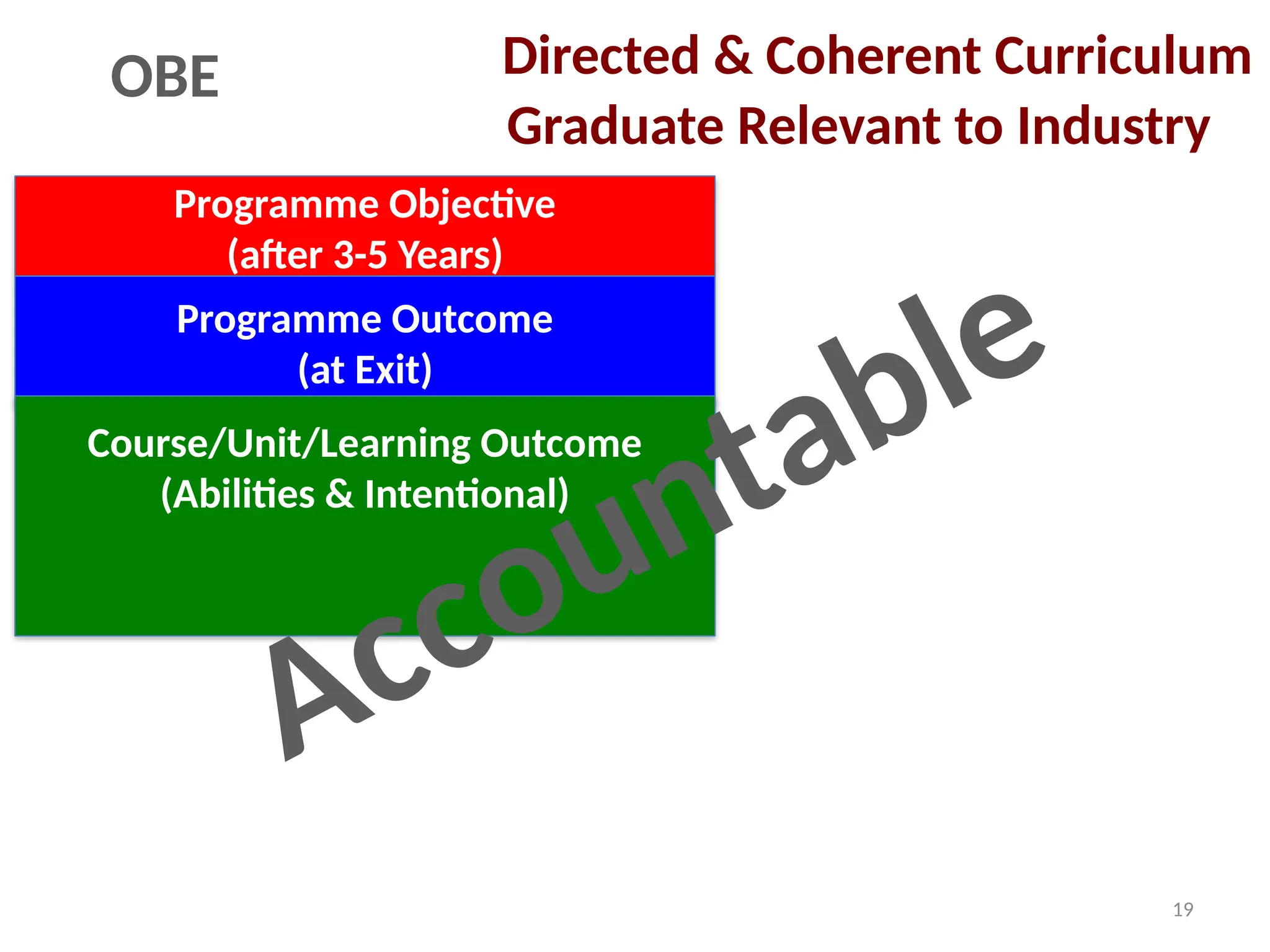
OBE
Programme Objective
(after 3-5 Years)
Programme Outcome
(at Exit)
Course/Unit/Learning Outcome
(Abilities & Intentional)
Directed & Coherent Curriculum
Graduate Relevant to Industry
Accountable
20
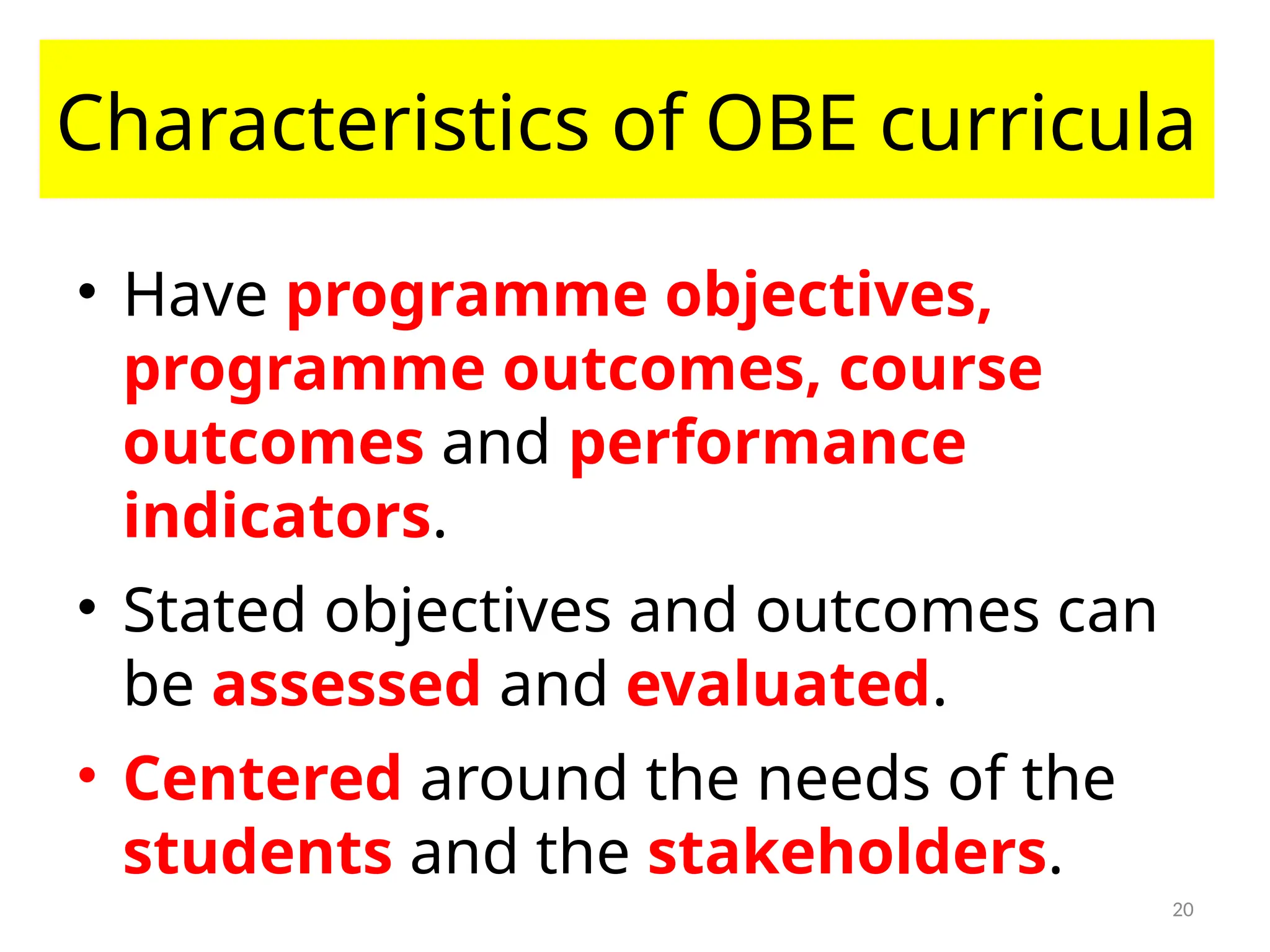
Characteristics of OBE curricula
• Have programme objectives,
programme outcomes, course
outcomes and performance
indicators.
• Stated objectives and outcomes can
be assessed and evaluated.
• Centered around the needs of the
students and the stakeholders.
21
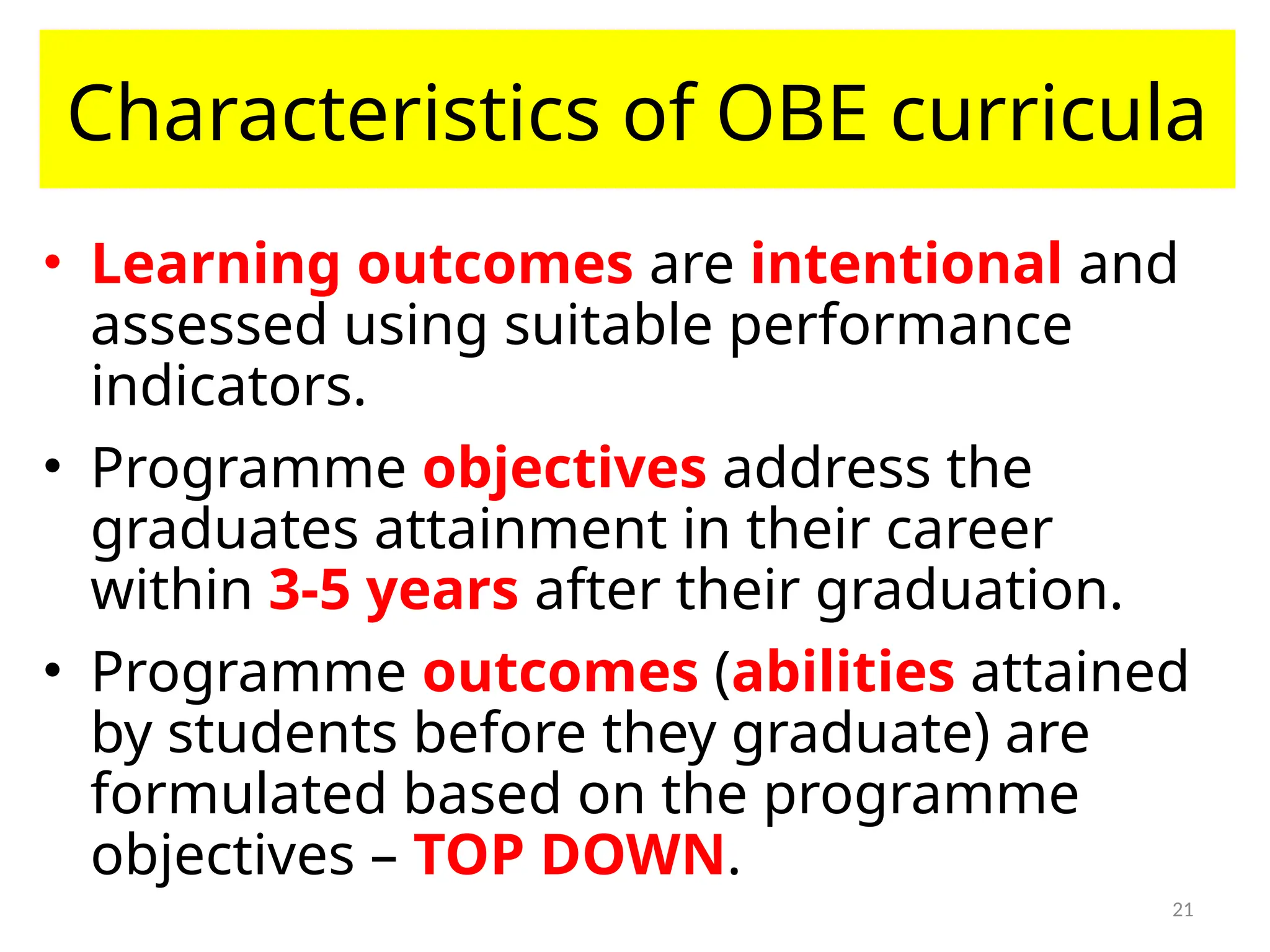
Characteristics of OBE curricula
• Learning outcomes are intentional and
assessed using suitable performance
indicators.
• Programme objectives address the
graduates attainment in their career
within 3-5 years after their graduation.
• Programme outcomes (abilities attained
by students before they graduate) are
formulated based on the programme
objectives – TOP DOWN.
22
Characteristics of OBE curricula
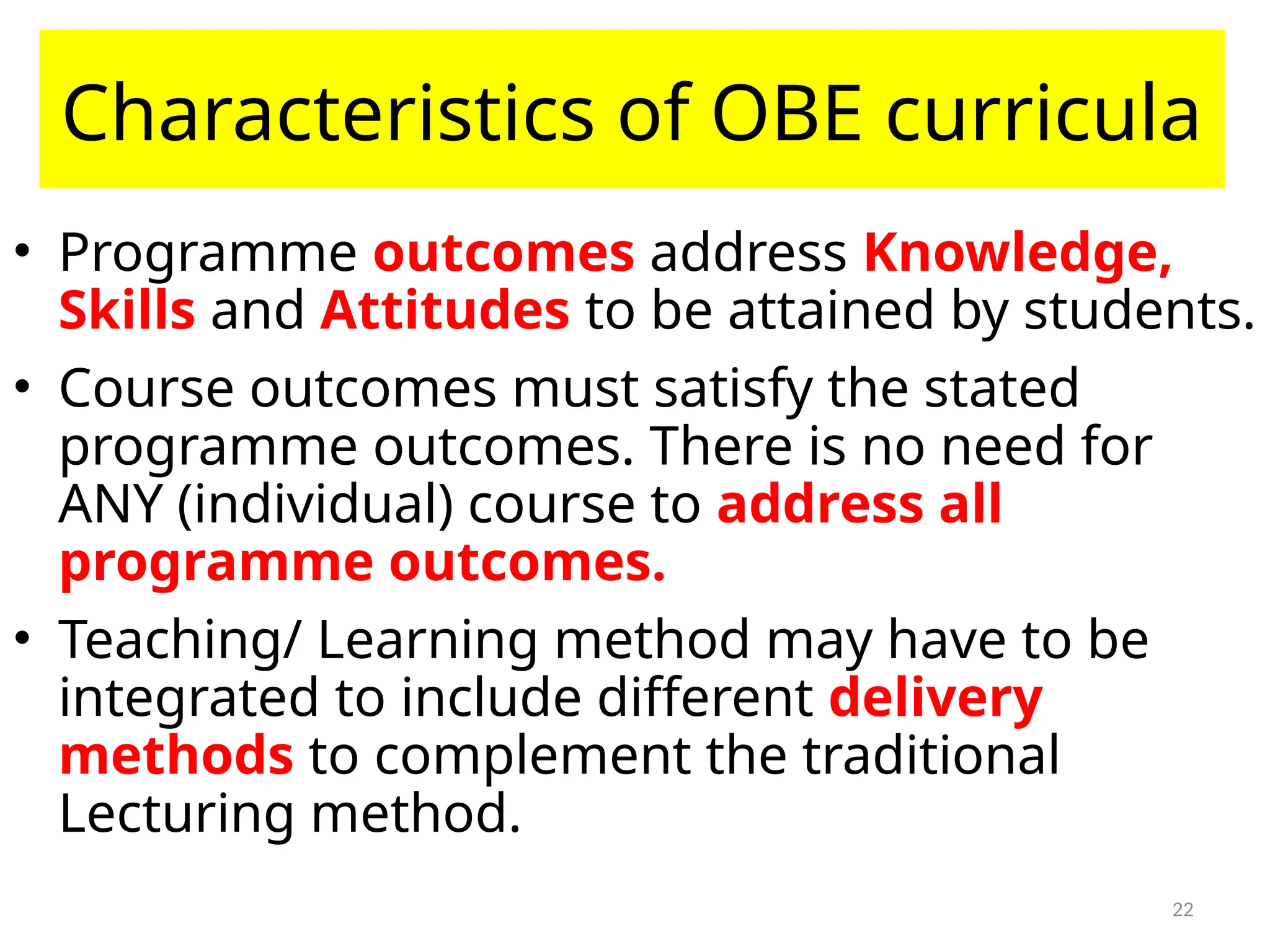
• Programme outcomes address Knowledge,
Skills and Attitudes to be attained by students.
• Course outcomes must satisfy the stated
programme outcomes. There is no need for
ANY (individual) course to address all
programme outcomes.
• Teaching/ Learning method may have to be
integrated to include different delivery
methods to complement the traditional
Lecturing method.
23
OBE in a nut shell
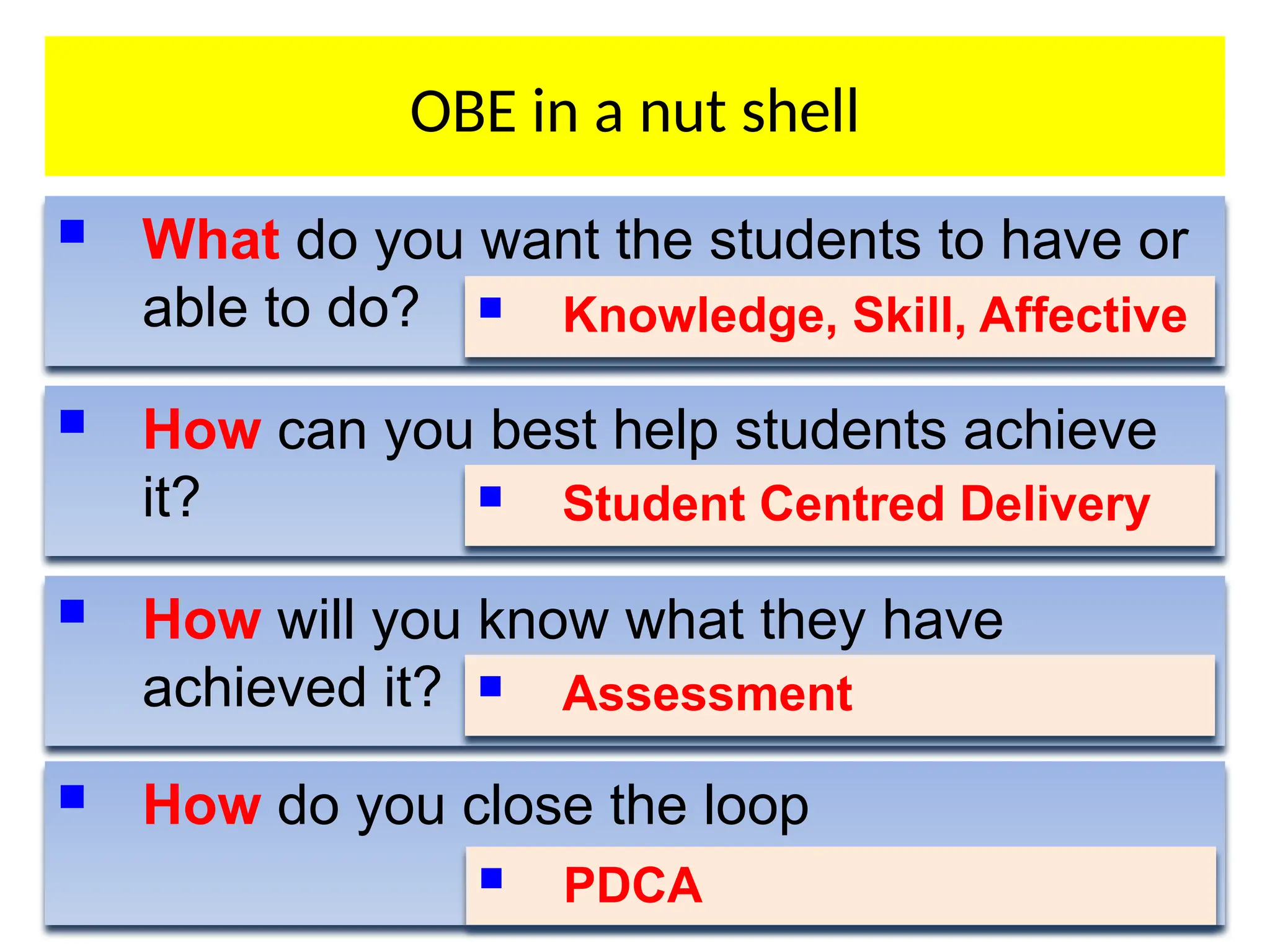
 What do you want the students to have or
able to do?
 How can you best help students achieve
it?
 How will you know what they have
achieved it?
 How do you close the loop
 Knowledge, Skill, Affective
 PDCA
 Student Centred Delivery
 Assessment
24
Plan, Do, Check & Act (PDCA)
25
Strategy of OBE
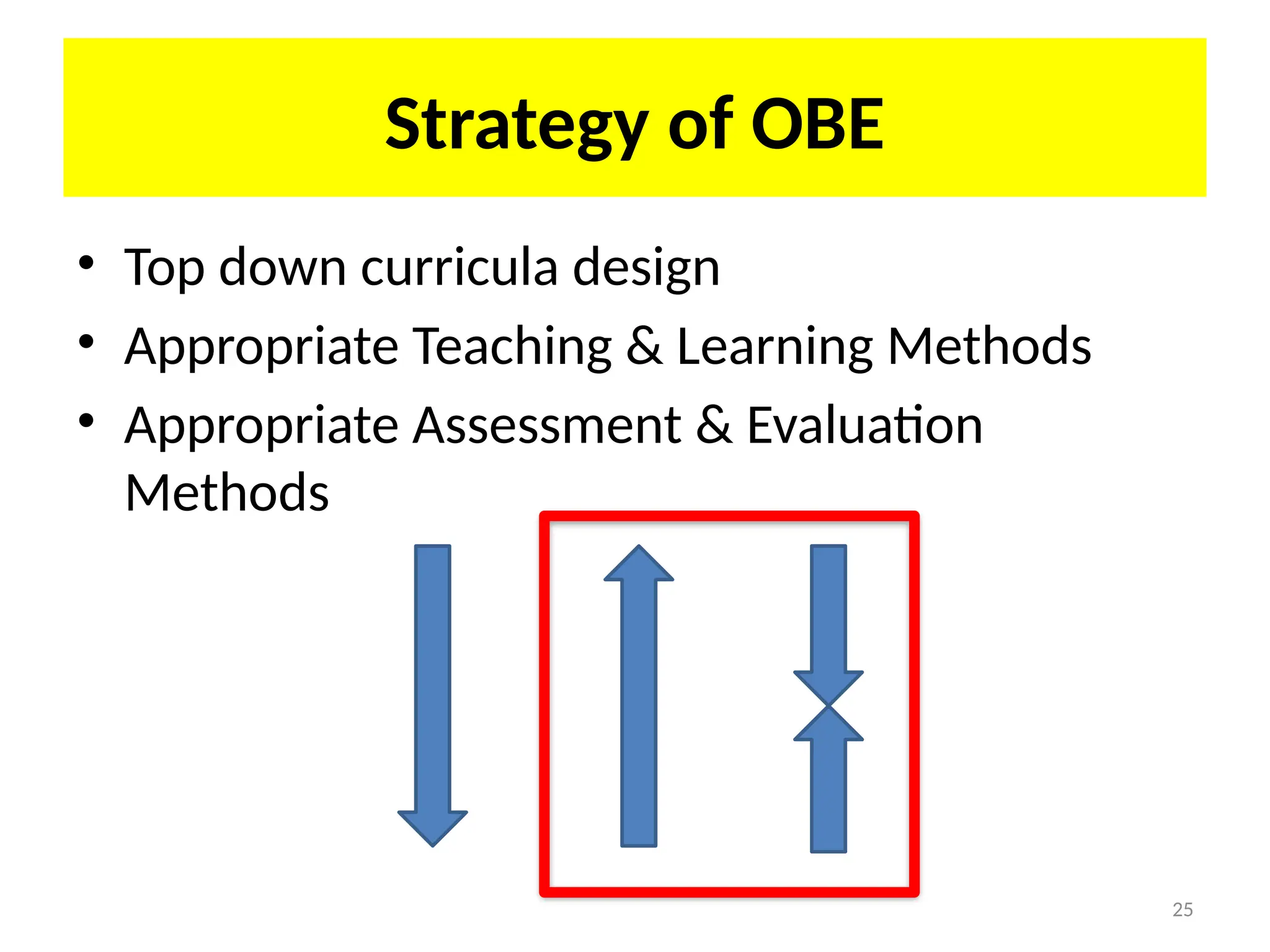
• Top down curricula design
• Appropriate Teaching & Learning Methods
• Appropriate Assessment & Evaluation
Methods
26
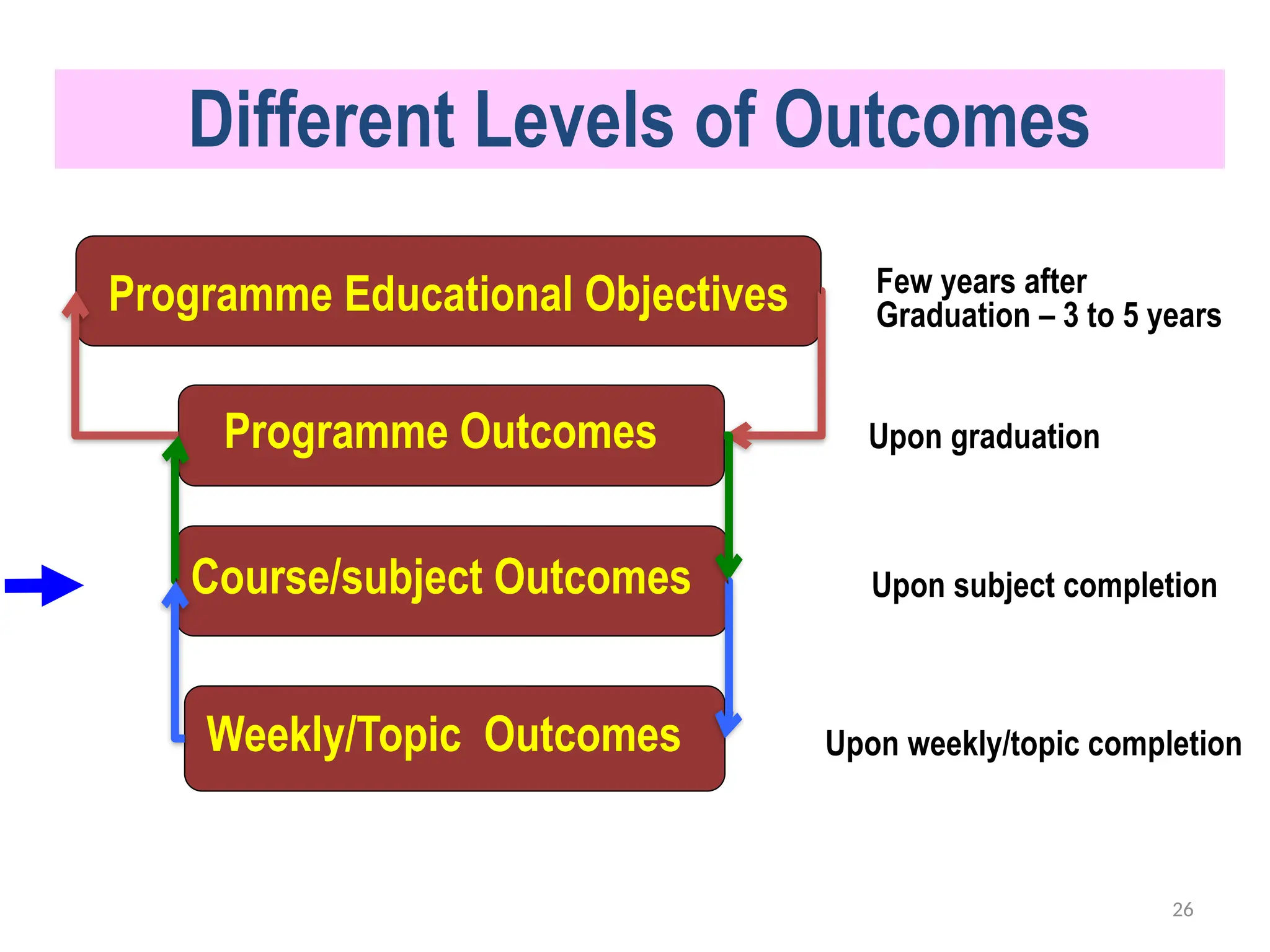
Different Levels of Outcomes
Programme Educational Objectives
Programme Outcomes
Course/subject Outcomes
Weekly/Topic Outcomes
Upon graduation
Upon subject completion
Upon weekly/topic completion
Few years after
Graduation – 3 to 5 years
Accreditation
28
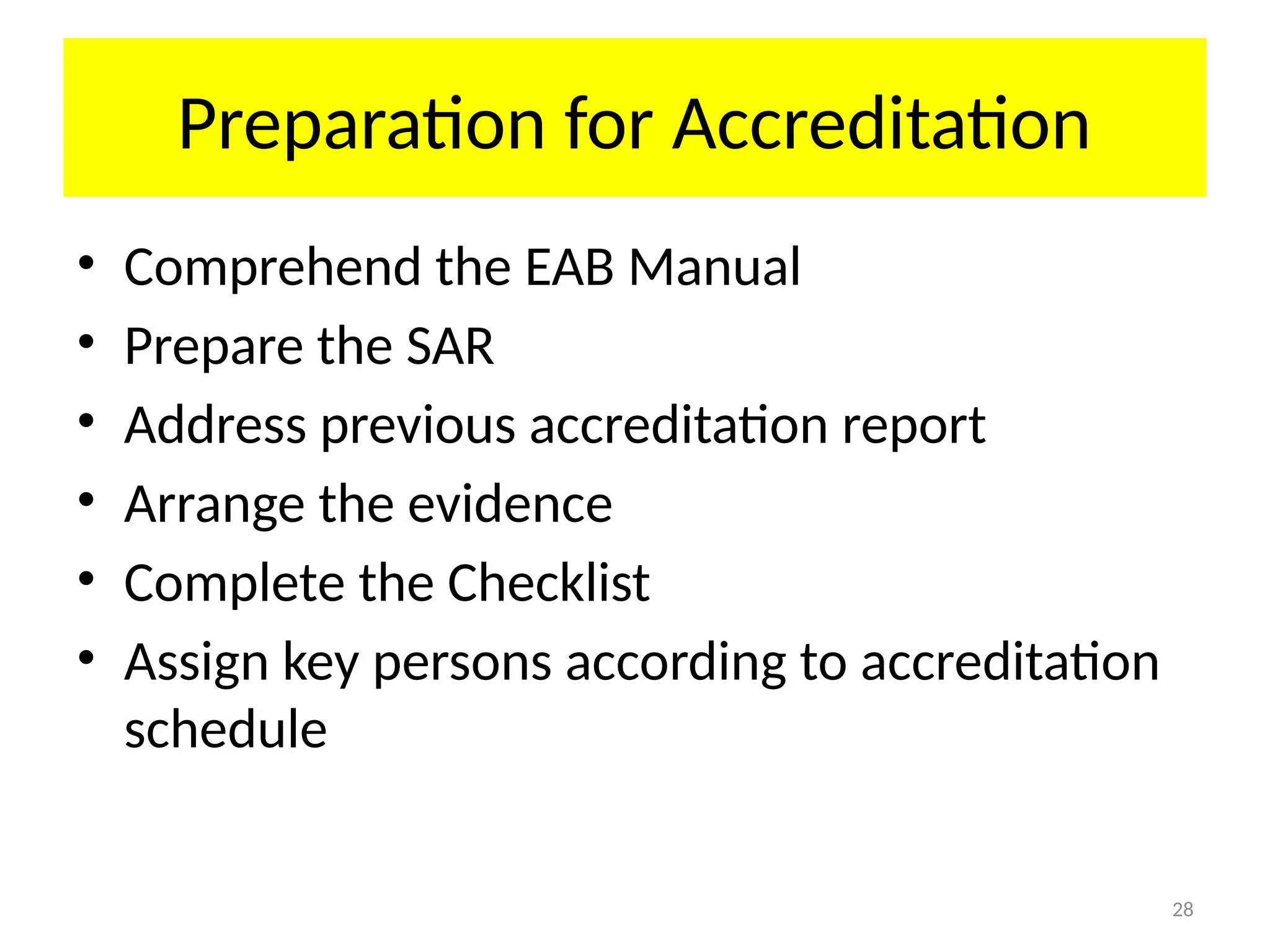
Preparation for Accreditation
• Comprehend the EAB Manual
• Prepare the SAR
• Address previous accreditation report
• Arrange the evidence
• Complete the Checklist
• Assign key persons according to accreditation
schedule
29
SAR & Evidence
30
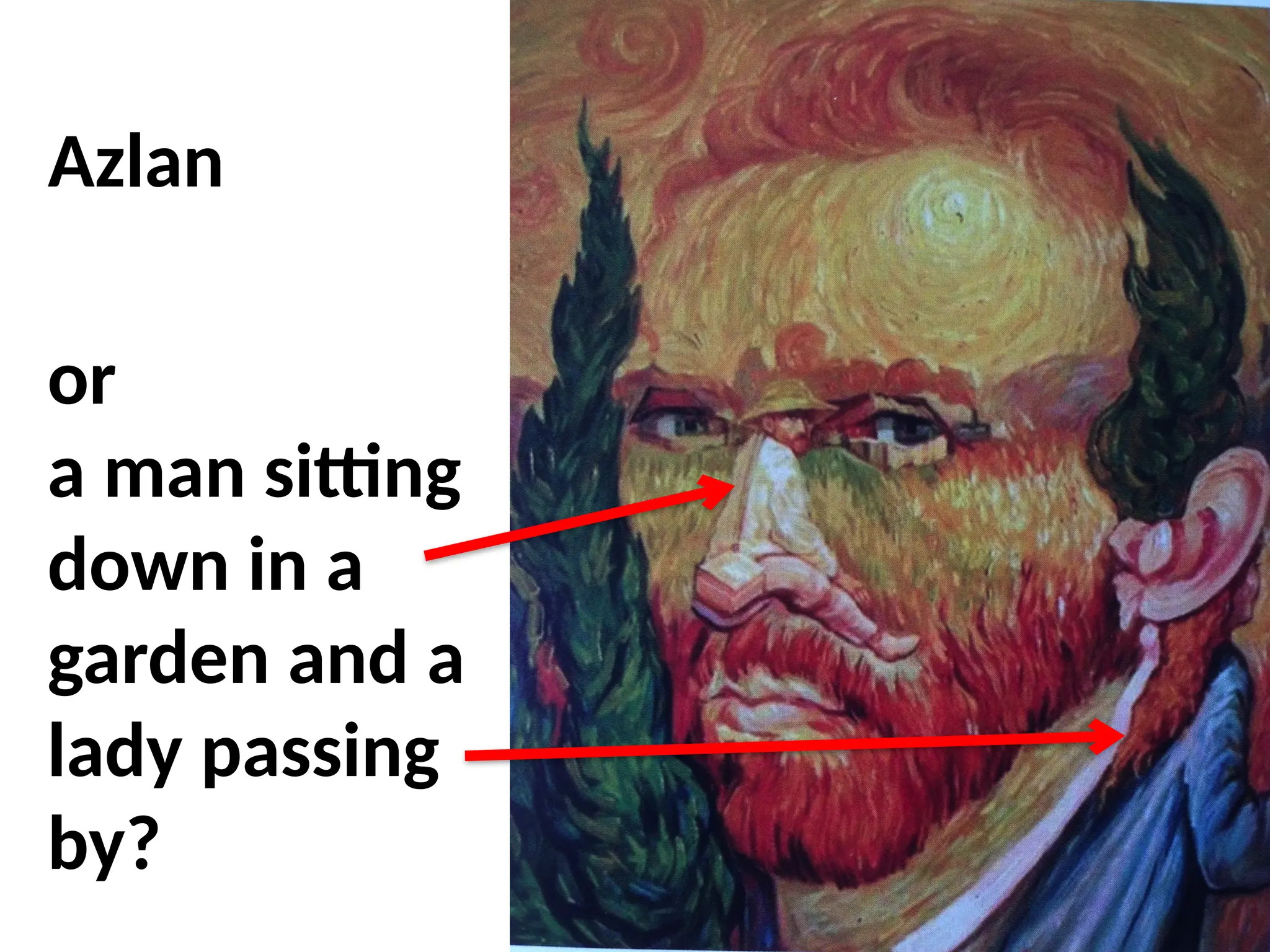
Azlan
or
a man sitting
down in a
garden and a
lady passing
by?
Issues from
• Approval Report
• First Year Visit Report
• External Examiner’s Report
• Stakeholders’ Recommendations
• Recent Accreditation Visit
EVIDENCE BASED
Documents & Records
Interviews
Observations
CQI
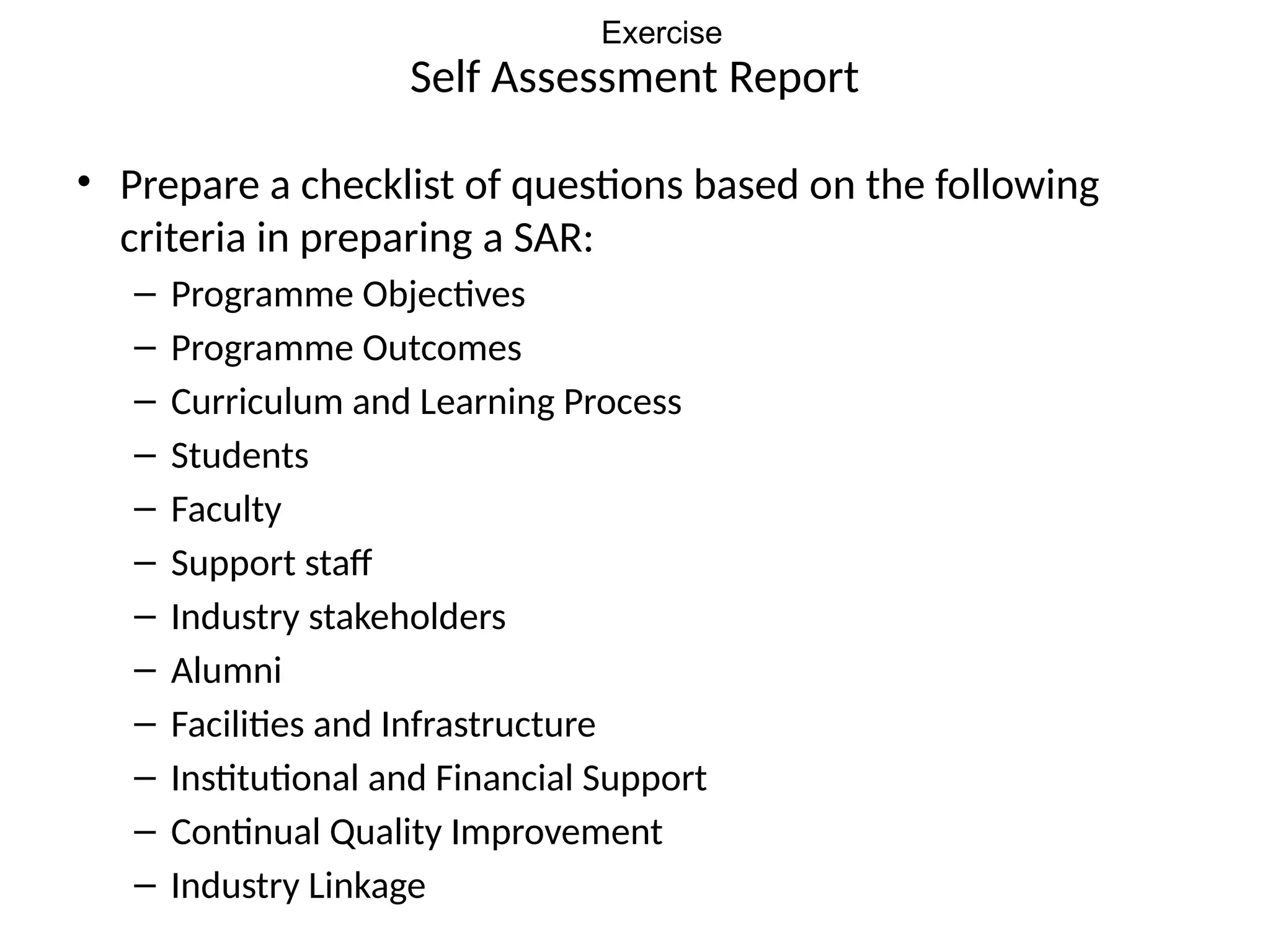
Self Assessment Report
• Prepare a checklist of questions based on the following
criteria in preparing a SAR:
– Programme Objectives
– Programme Outcomes
– Curriculum and Learning Process
– Students
– Faculty
– Support staff
– Industry stakeholders
– Alumni
– Facilities and Infrastructure
– Institutional and Financial Support
– Continual Quality Improvement
– Industry Linkage
Exercise
Industrial Linkage
Using the Clause 9 of the PEC Manual, evaluate
the relevant part of the submitted SAR.
Exercise
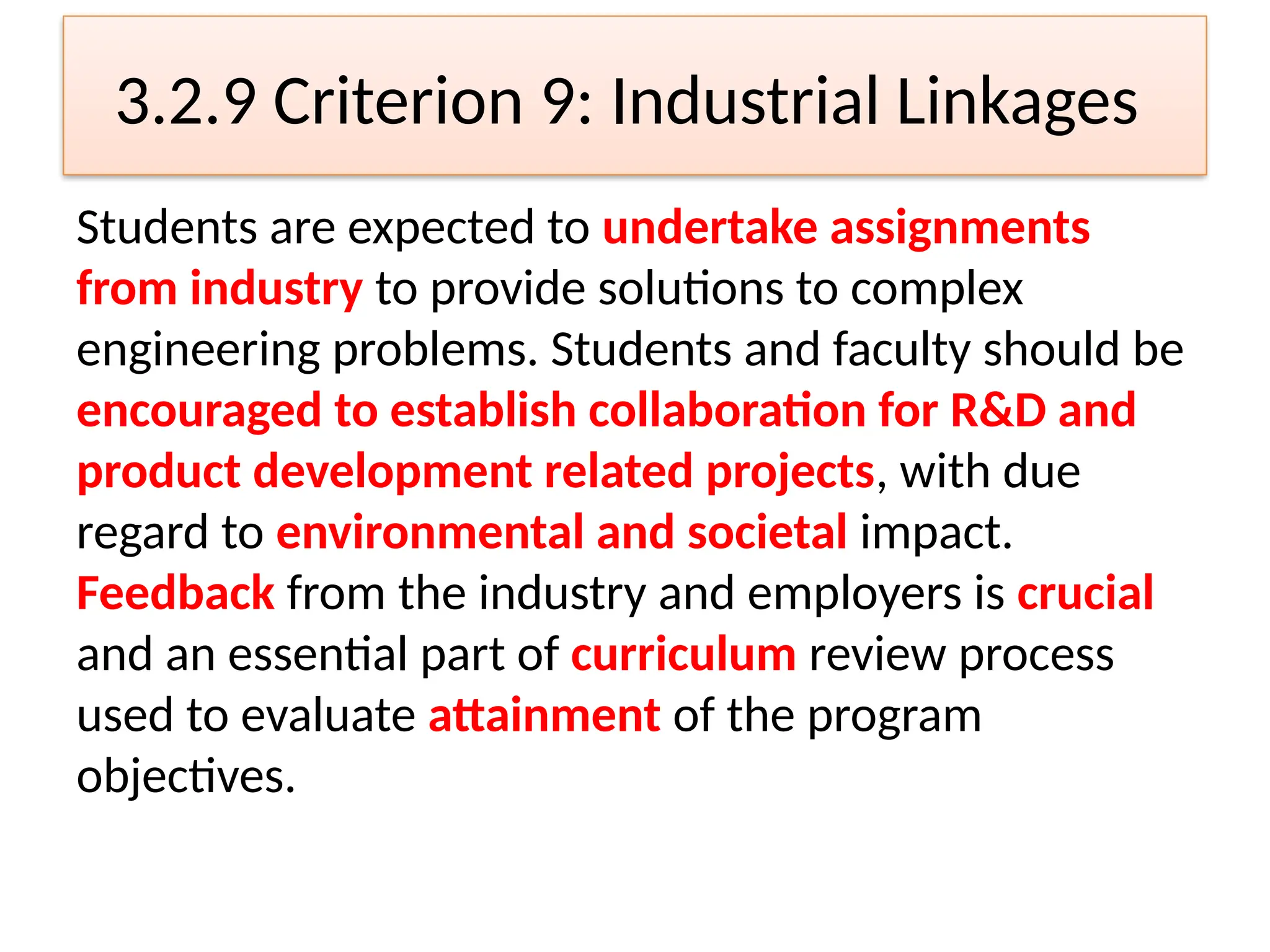
3.2.9 Criterion 9: Industrial Linkages
Students are expected to undertake assignments
from industry to provide solutions to complex
engineering problems. Students and faculty should be
encouraged to establish collaboration for R&D and
product development related projects, with due
regard to environmental and societal impact.
Feedback from the industry and employers is crucial
and an essential part of curriculum review process
used to evaluate attainment of the program
objectives.
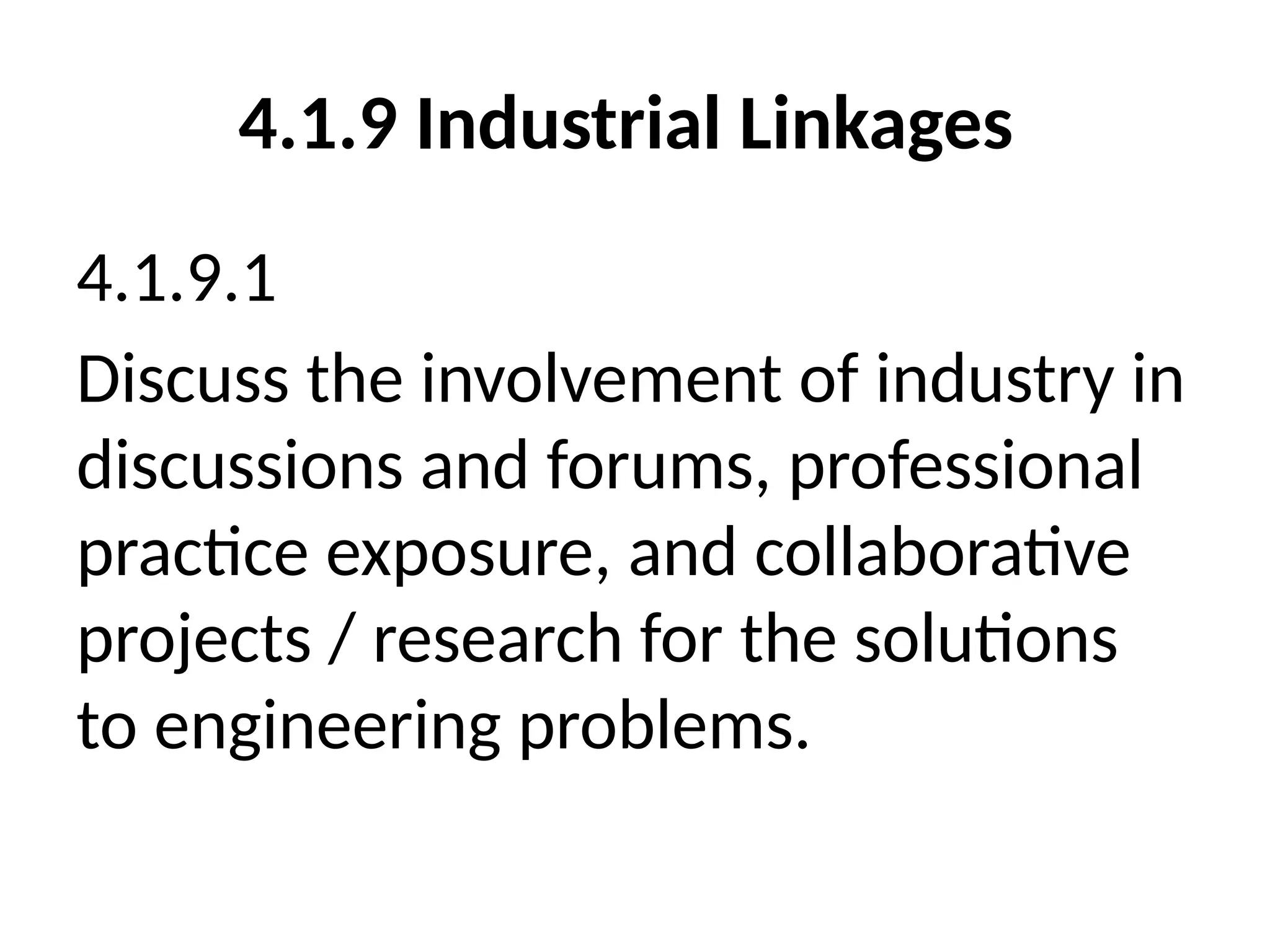
4.1.9 Industrial Linkages
4.1.9.1
Discuss the involvement of industry in
discussions and forums, professional
practice exposure, and collaborative
projects / research for the solutions
to engineering problems.
36
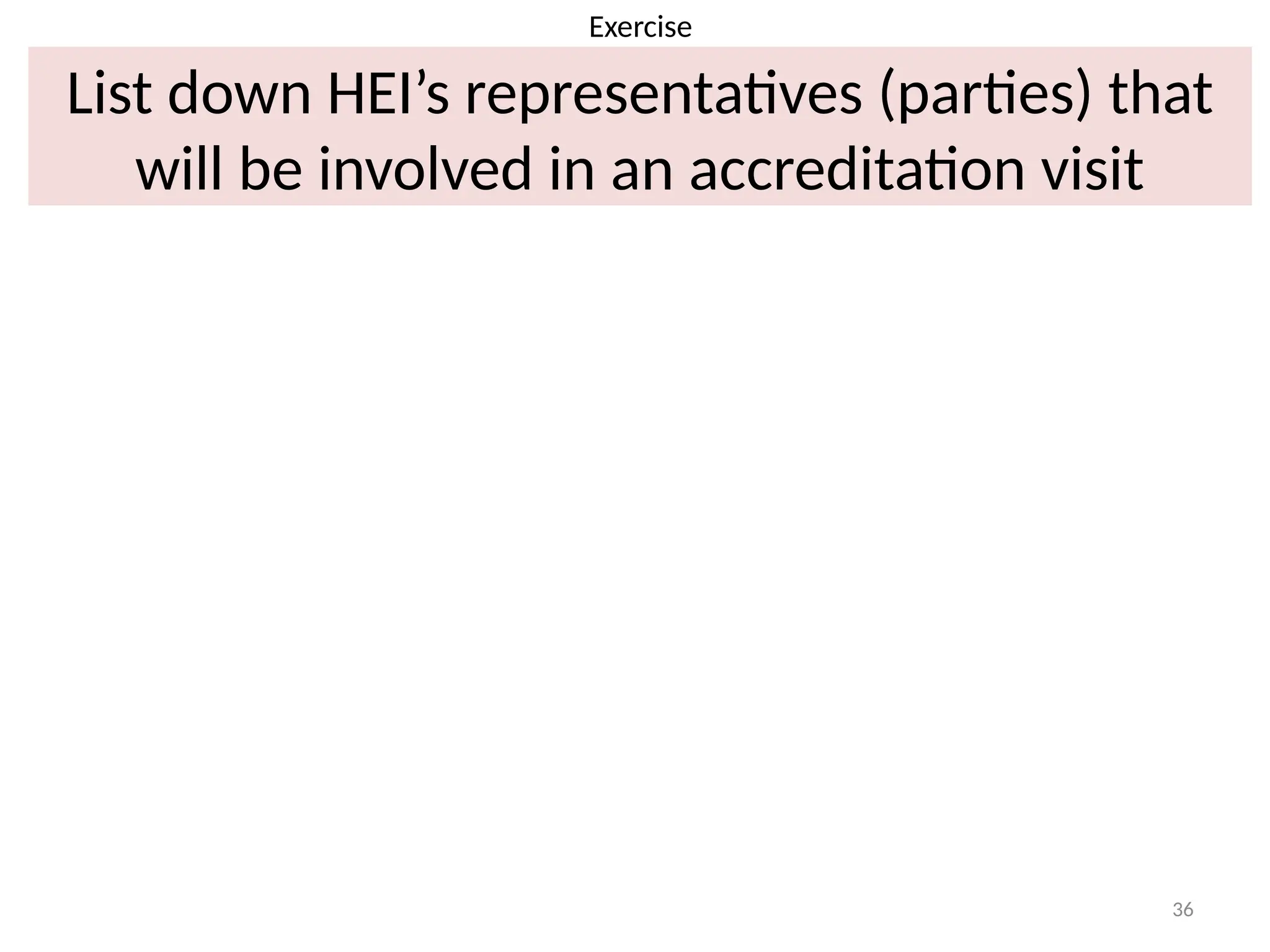
List down HEI’s representatives (parties) that
will be involved in an accreditation visit
Exercise
37
Item/Criteria List down the involved parties
Accreditation Planning
Opening Meeting
Programme Educational Objectives
(……)
Programme Outcomes (…….)
Curriculum (…….)
Students (……)
Academic & Support Staff (……)
Facilities (……)
Quality Management System (……)
Exit Meeting
Exercise
38
• Sensible questioning
• Check records
• Observing processes
• Analyse inputs and outputs
• Organised using tables, matrices,
flowcharts and checklists
PROGRAMME EVALUATOR’S APPROACHES
39
What are the six typical words that Programme
Evaluators (PEVs) would usually begin with,
when questioning?
Quiz
Programme Evaluators’ (PEVs’) Best friend –
40
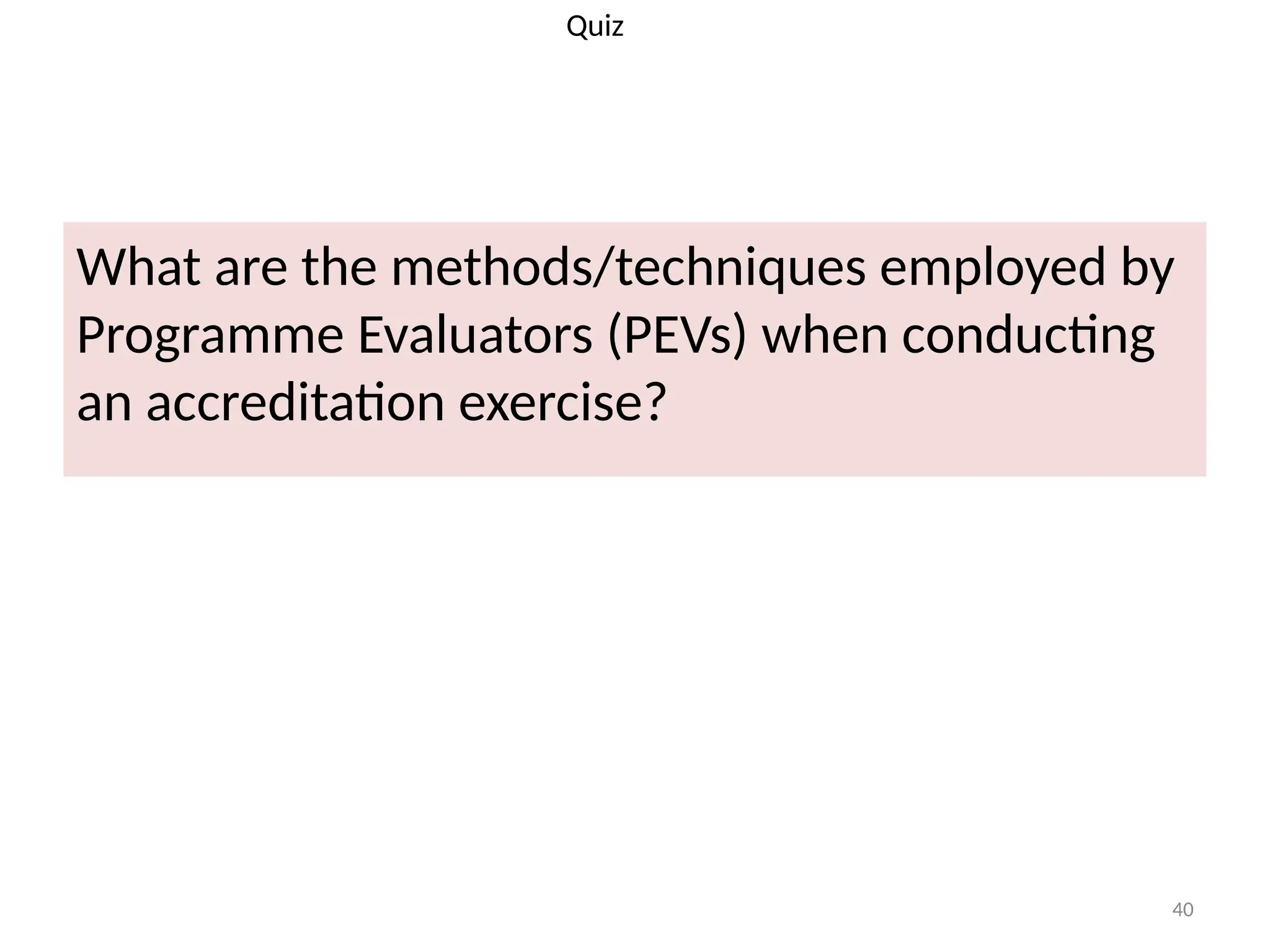
What are the methods/techniques employed by
Programme Evaluators (PEVs) when conducting
an accreditation exercise?
Quiz
41
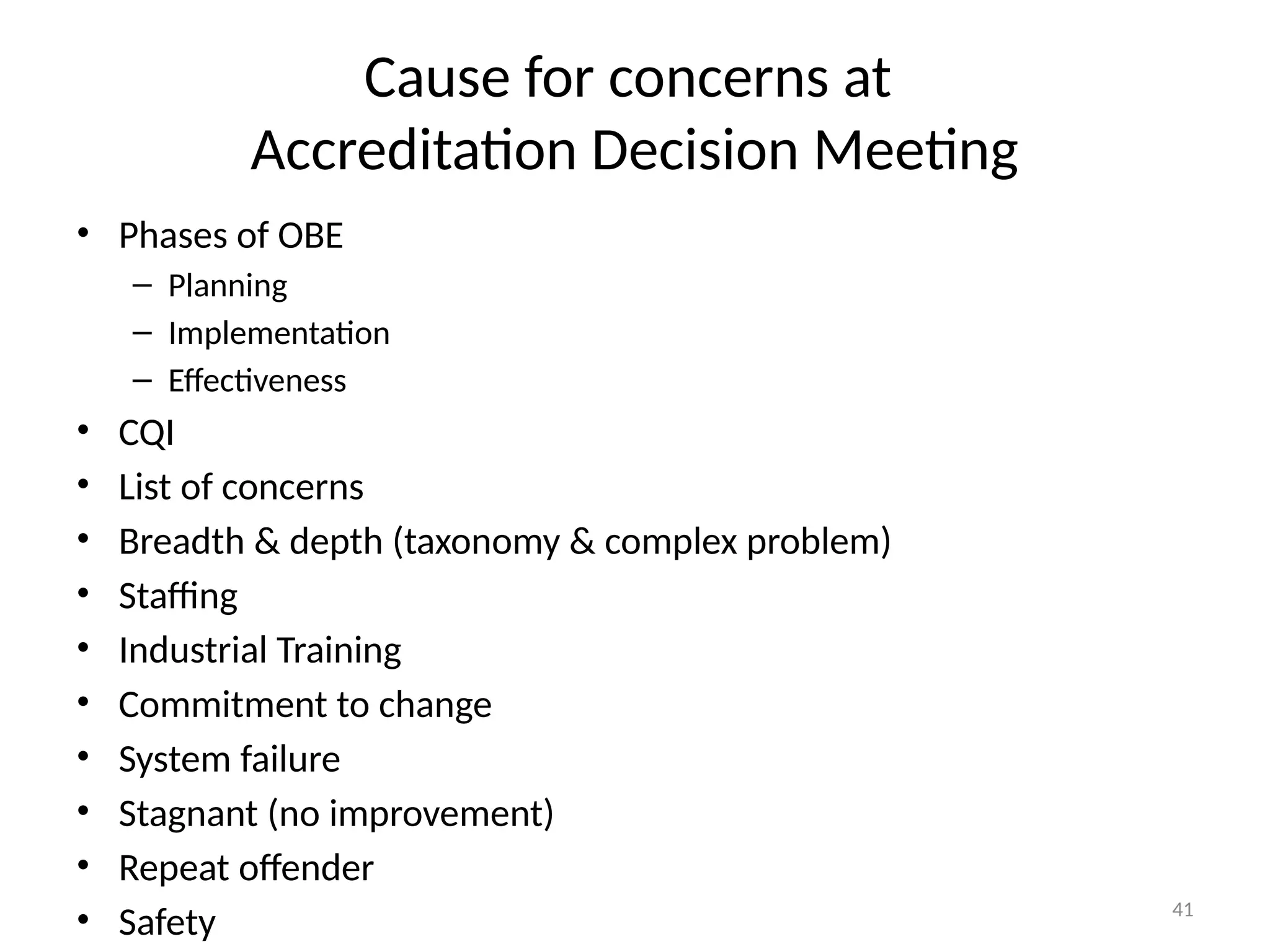
Cause for concerns at
Accreditation Decision Meeting
• Phases of OBE
– Planning
– Implementation
– Effectiveness
• CQI
• List of concerns
• Breadth & depth (taxonomy & complex problem)
• Staffing
• Industrial Training
• Commitment to change
• System failure
• Stagnant (no improvement)
• Repeat offender
• Safety
42
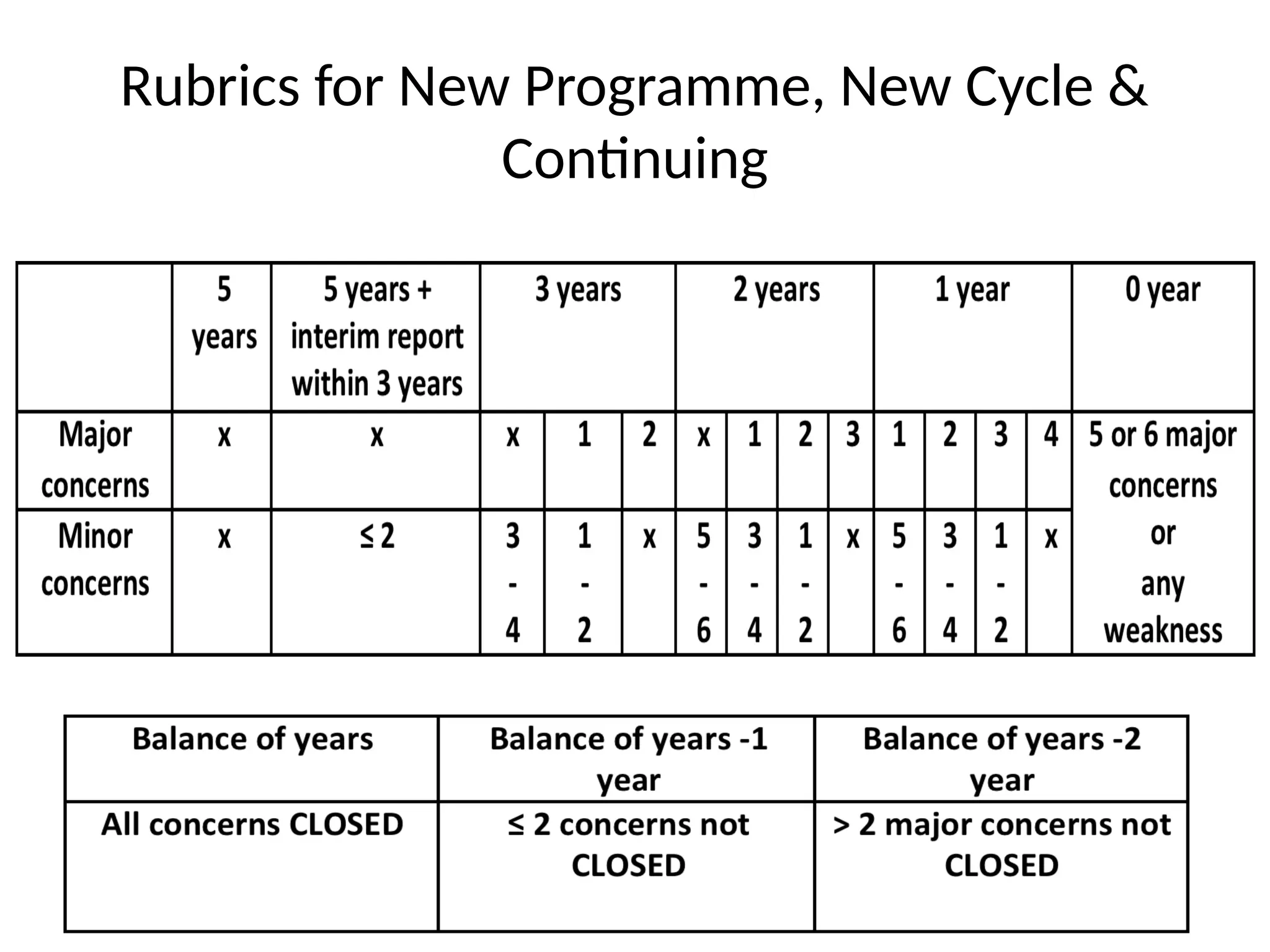
Rubrics for New Programme, New Cycle &
Continuing
43
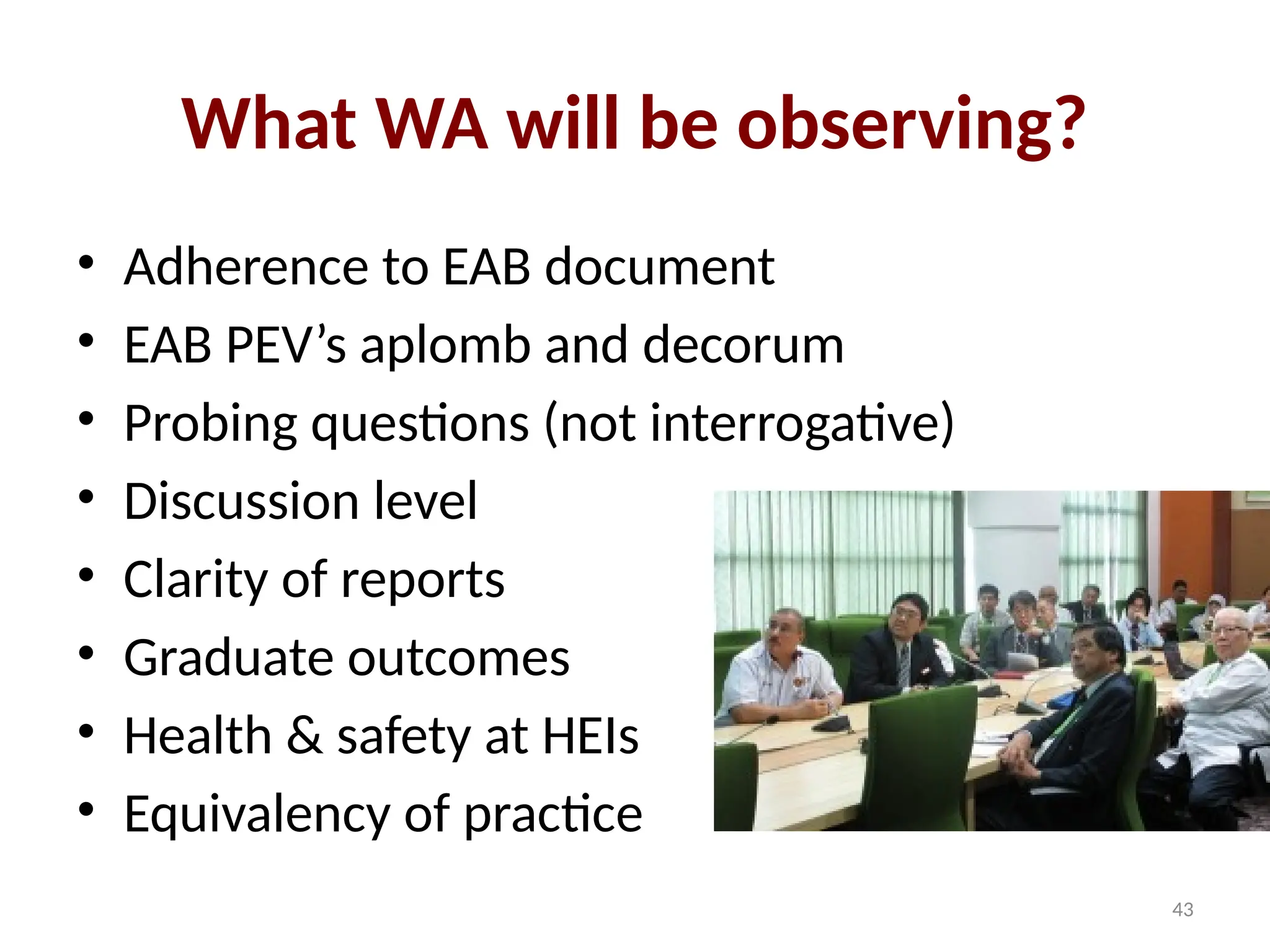
What WA will be observing?
• Adherence to EAB document
• EAB PEV’s aplomb and decorum
• Probing questions (not interrogative)
• Discussion level
• Clarity of reports
• Graduate outcomes
• Health & safety at HEIs
• Equivalency of practice
44
Opening Meeting
You are the Dean/HoD with three programmes
to be evaluated; Mechanical Engineering, Civil
Engineering and Electrical Engineering, for the
third cycle. Prepare a list of talk points to
address the Programme Evaluators (PEVs) at the
Opening Meeting.
Exercise
45
• Welcome Evaluation Team
• Introduce team members
• Corrective & Preventive
Actions from previous
accreditation
• Short presentation on
Faculty/Dept/Prog strengths
• Fill up with the latest (within
a specified timeframe) if any
OPENING MEETING
10 minutes
46
PEC Manual 2014
Programme Educational Objectives
Exercise
List down potential stakeholders
• Major
• Minor
48
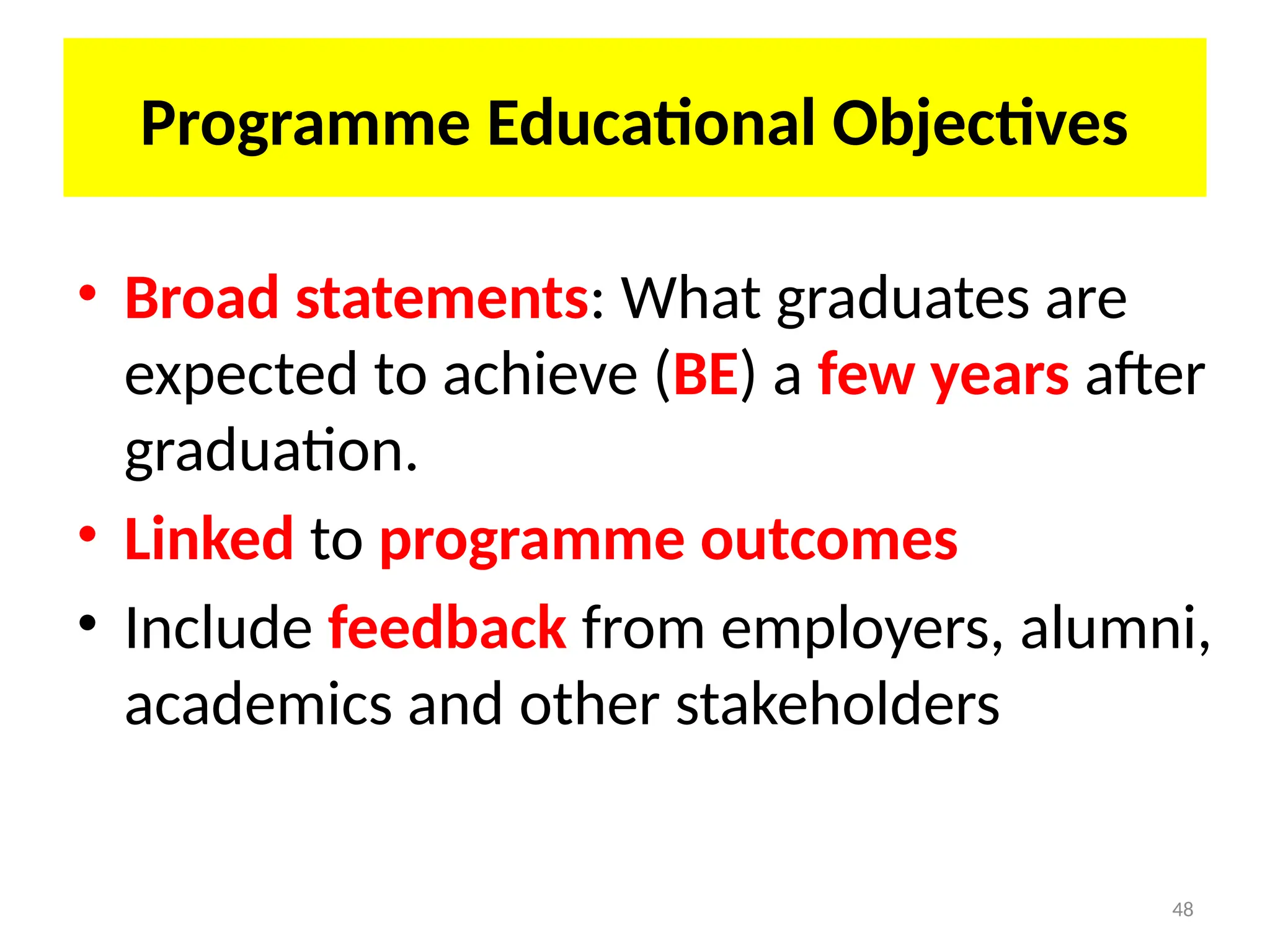
Programme Educational Objectives
• Broad statements: What graduates are
expected to achieve (BE) a few years after
graduation.
• Linked to programme outcomes
• Include feedback from employers, alumni,
academics and other stakeholders
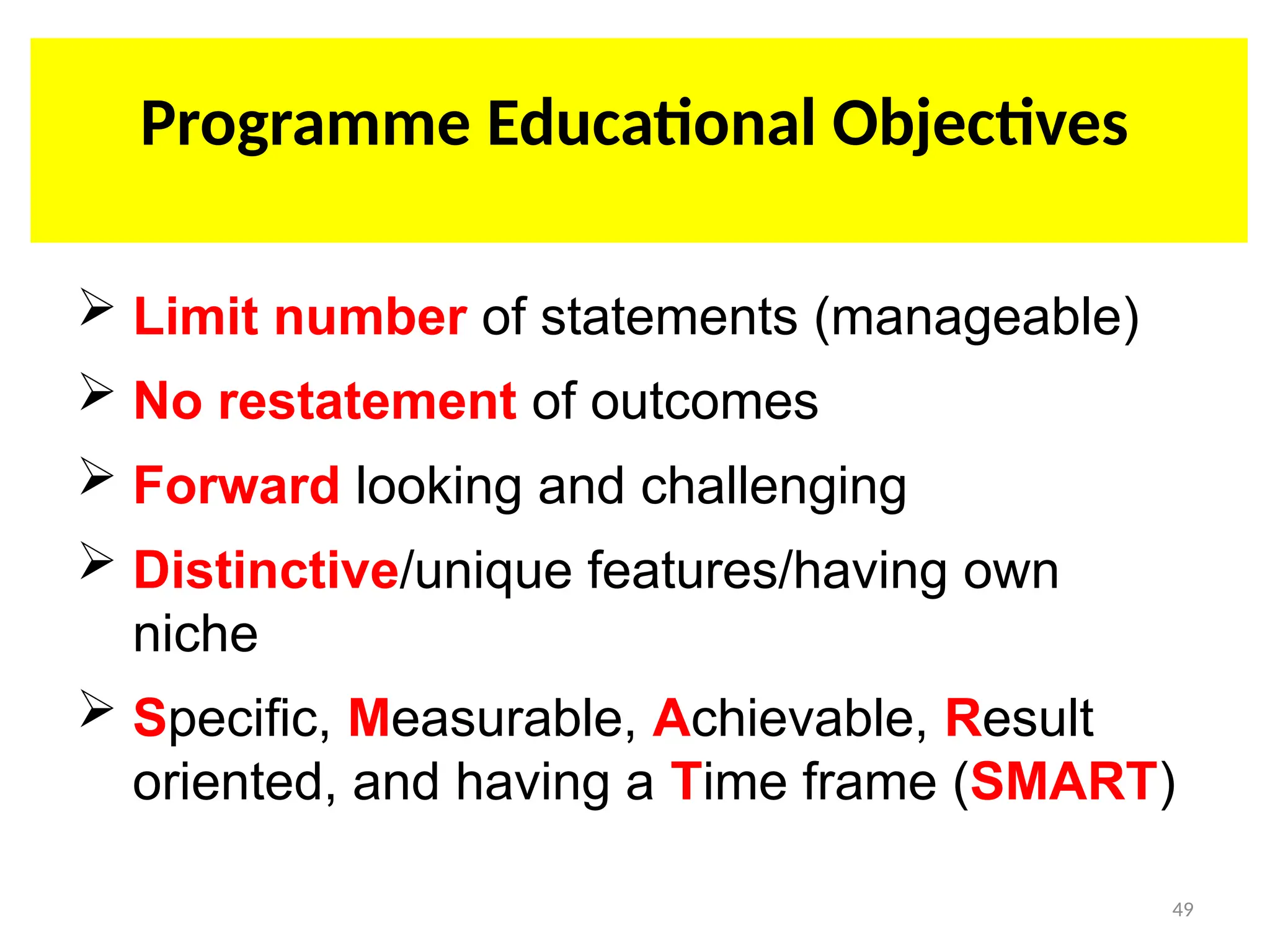
PROGRAM EDUCATIONAL OBJECTIVE (PEO)
 Limit number of statements (manageable)
 No restatement of outcomes
 Forward looking and challenging
 Distinctive/unique features/having own
niche
 Specific, Measurable, Achievable, Result
oriented, and having a Time frame (SMART)
Programme Educational Objectives
49
50
Write down your evaluation on the following
PEO statements
Exercise
51
Write down your evaluation on the following
PEO statements
Exercise
52
PEC Manual 2012
Programme Outcomes
53
Programme Outcomes (PO)
What the graduates are expected to know and
able to perform or attain by the time of
graduation (skills, knowledge and
behaviour/attitude)
Need to distribute the outcomes throughout the
programme, and not one/two courses only addressing a
particular outcome
There must be a clear linkage between
Programme Objective and Outcomes
54
Programme Outcomes
• Discuss on HEI’s possible approaches or
methods to demonstrate implementation of
the 12 programme outcomes
• Discuss on the possible models to show
attainment of the 12 programme outcomes
Exercise
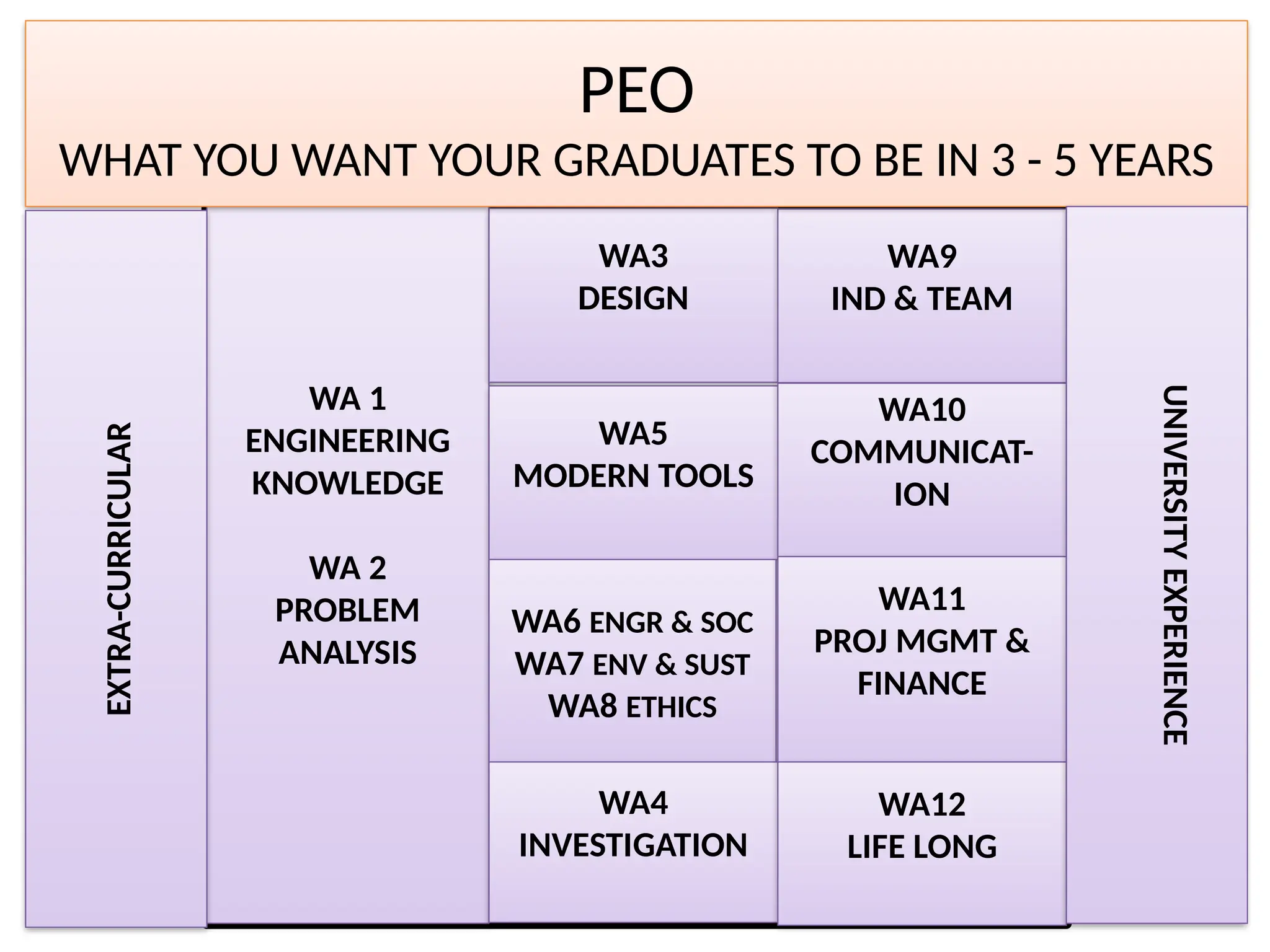
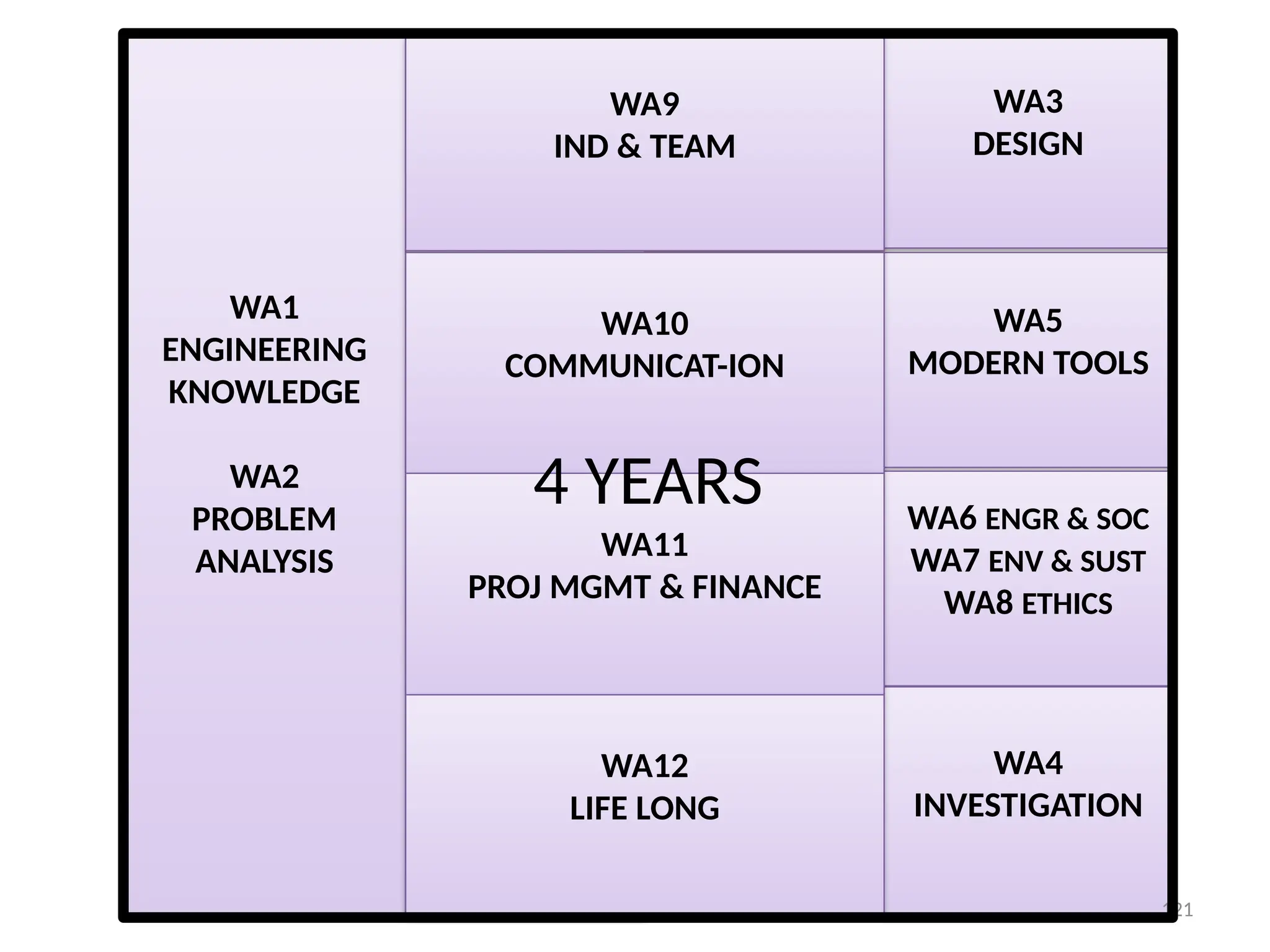
4 YEARS
WA 1
ENGINEERING
KNOWLEDGE
WA 2
PROBLEM
ANALYSIS
WA3
DESIGN
WA5
MODERN TOOLS
WA6 ENGR & SOC
WA7 ENV & SUST
WA8 ETHICS
WA4
INVESTIGATION
WA9
IND & TEAM
WA10
COMMUNICAT-
ION
WA11
PROJ MGMT &
FINANCE
WA12
LIFE LONG
PEO
WHAT YOU WANT YOUR GRADUATES TO BE IN 3 - 5 YEARS
EXTRA-CURRICULAR
UNIVERSITY
EXPERIENCE
57
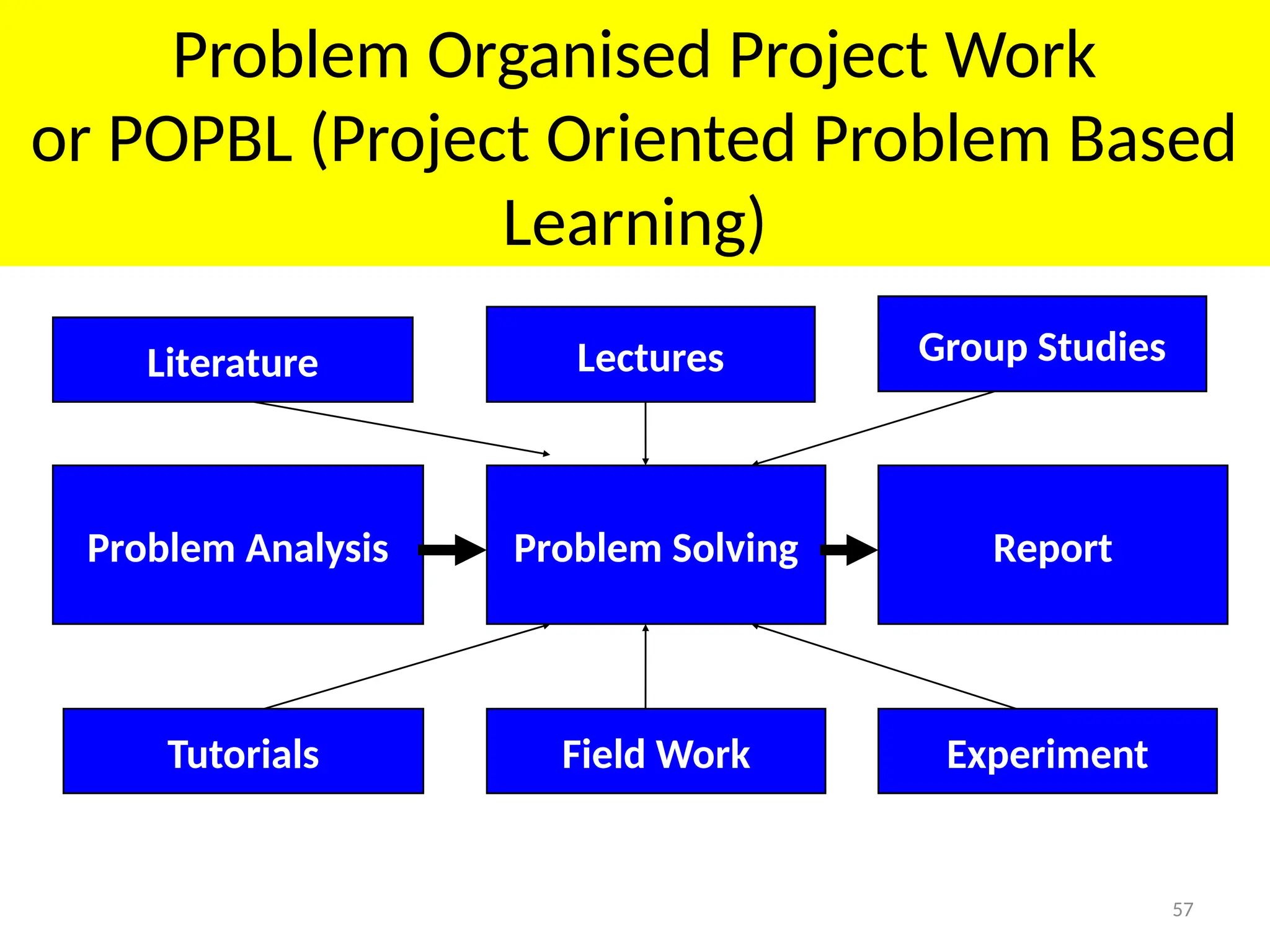
Problem Organised Project Work
or POPBL (Project Oriented Problem Based
Learning)
Problem Analysis Problem Solving Report
Literature Lectures Group Studies
Tutorials Field Work Experiment
58
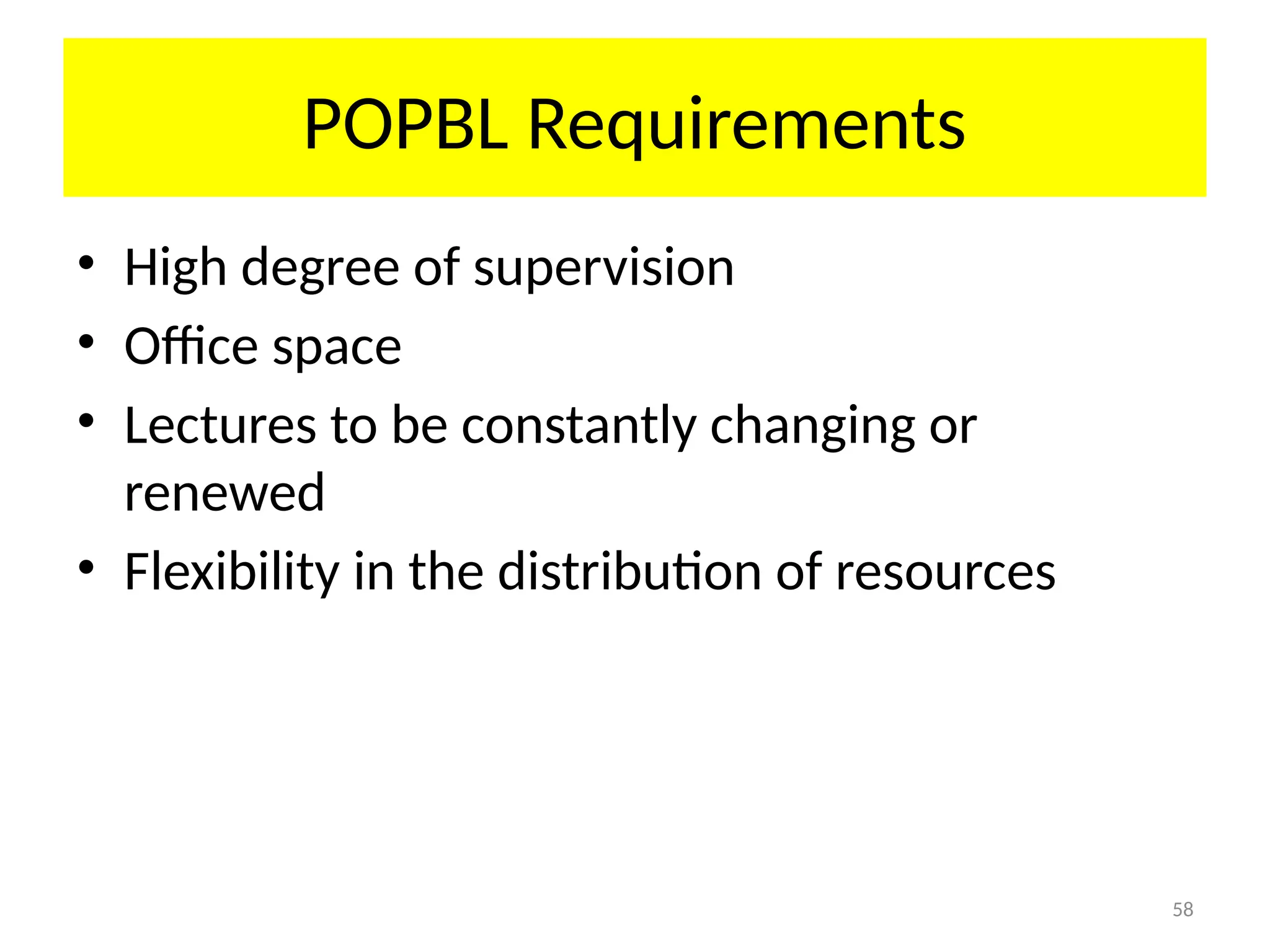
POPBL Requirements
• High degree of supervision
• Office space
• Lectures to be constantly changing or
renewed
• Flexibility in the distribution of resources
59
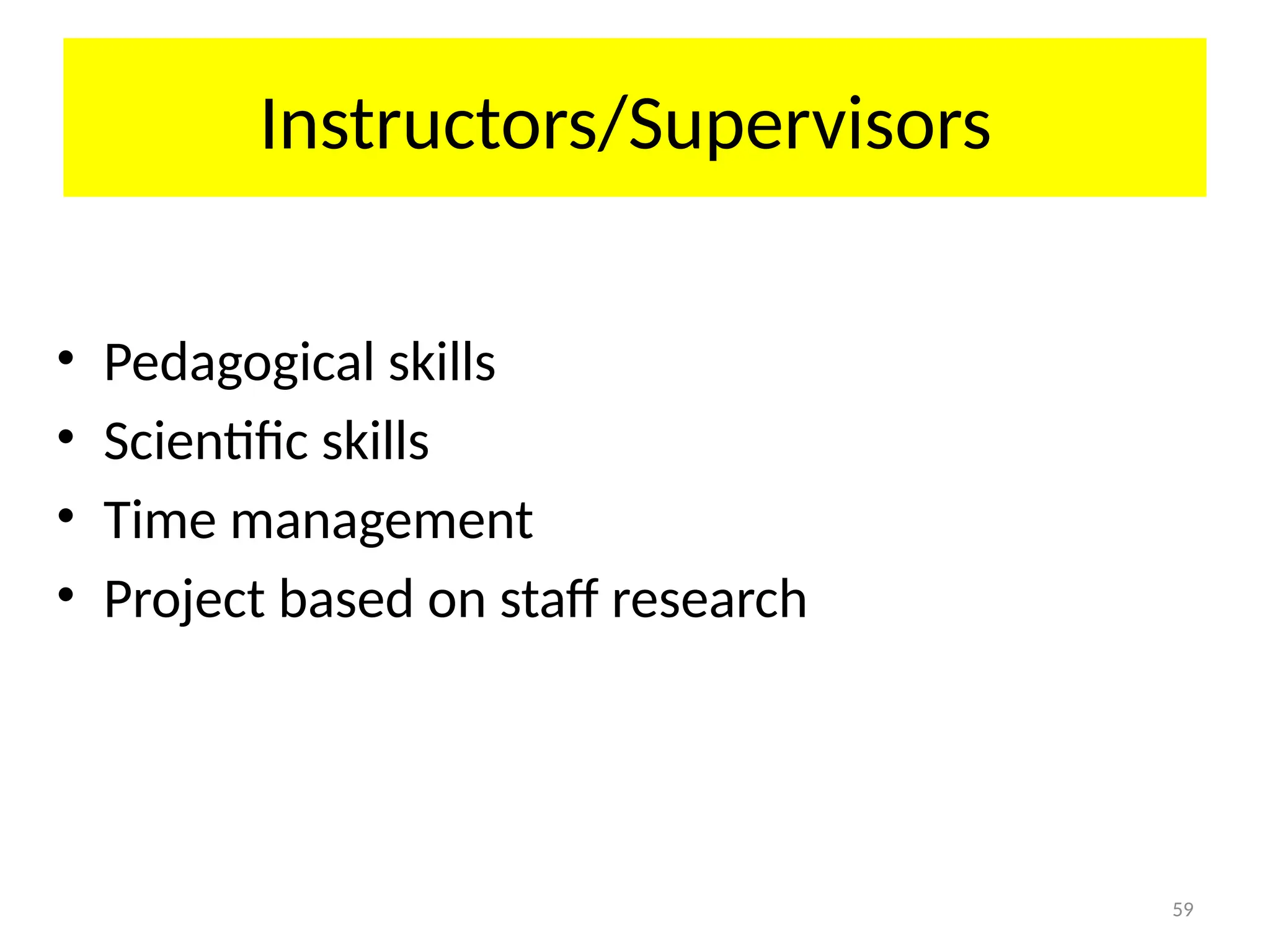
Instructors/Supervisors
• Pedagogical skills
• Scientific skills
• Time management
• Project based on staff research
60
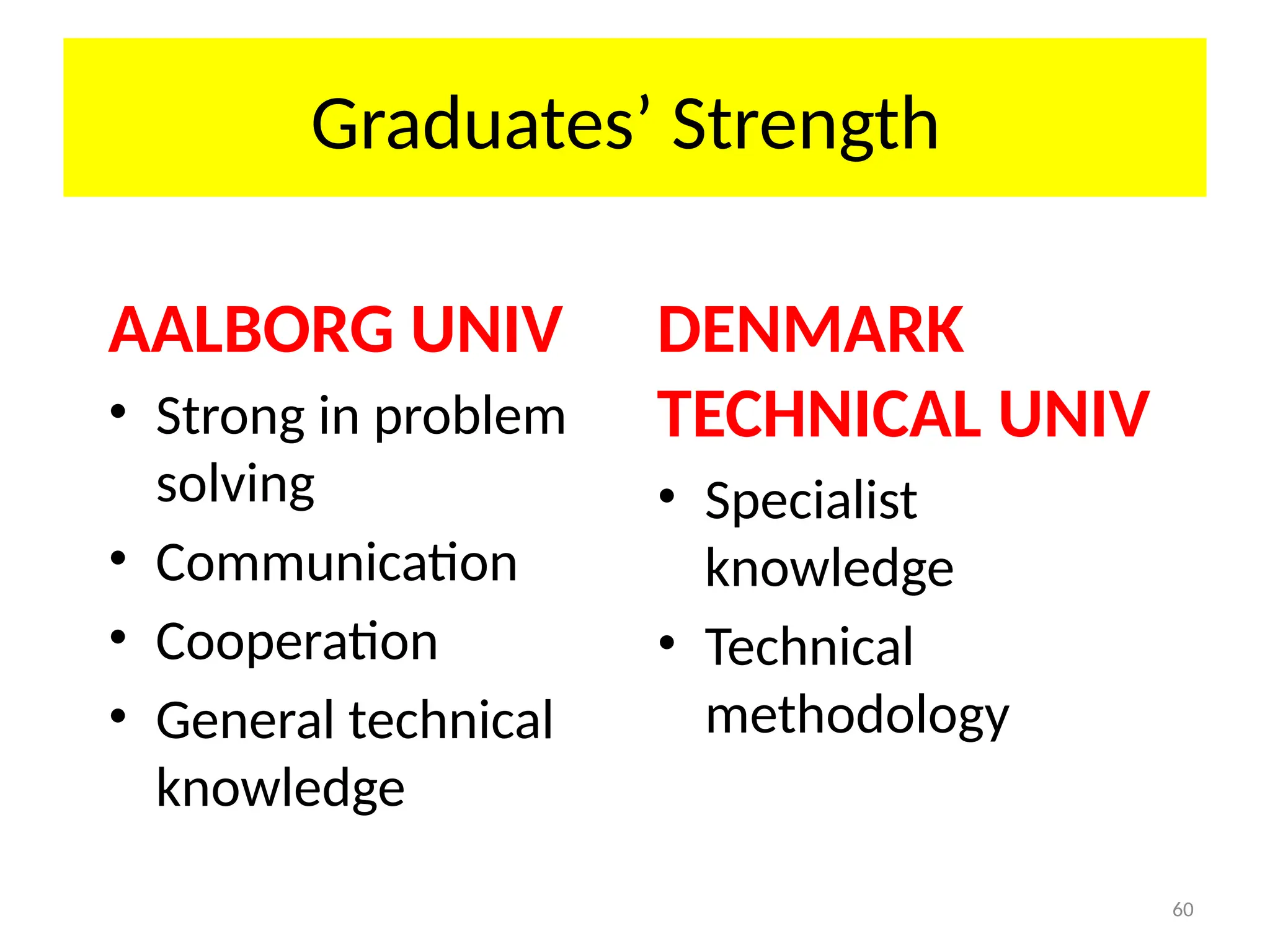
Graduates’ Strength
AALBORG UNIV
• Strong in problem
solving
• Communication
• Cooperation
• General technical
knowledge
DENMARK
TECHNICAL UNIV
• Specialist
knowledge
• Technical
methodology
61
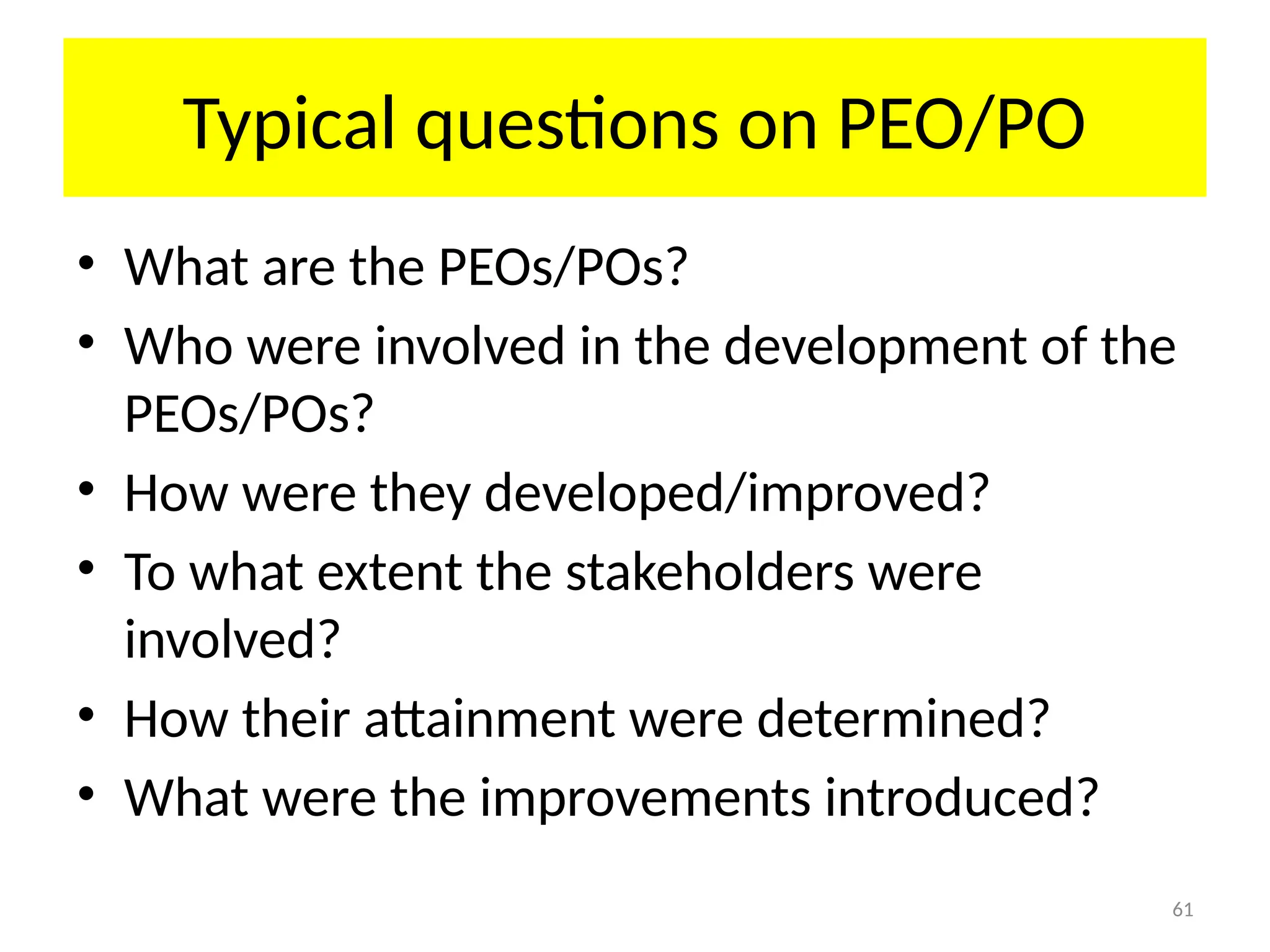
Typical questions on PEO/PO
• What are the PEOs/POs?
• Who were involved in the development of the
PEOs/POs?
• How were they developed/improved?
• To what extent the stakeholders were
involved?
• How their attainment were determined?
• What were the improvements introduced?
62
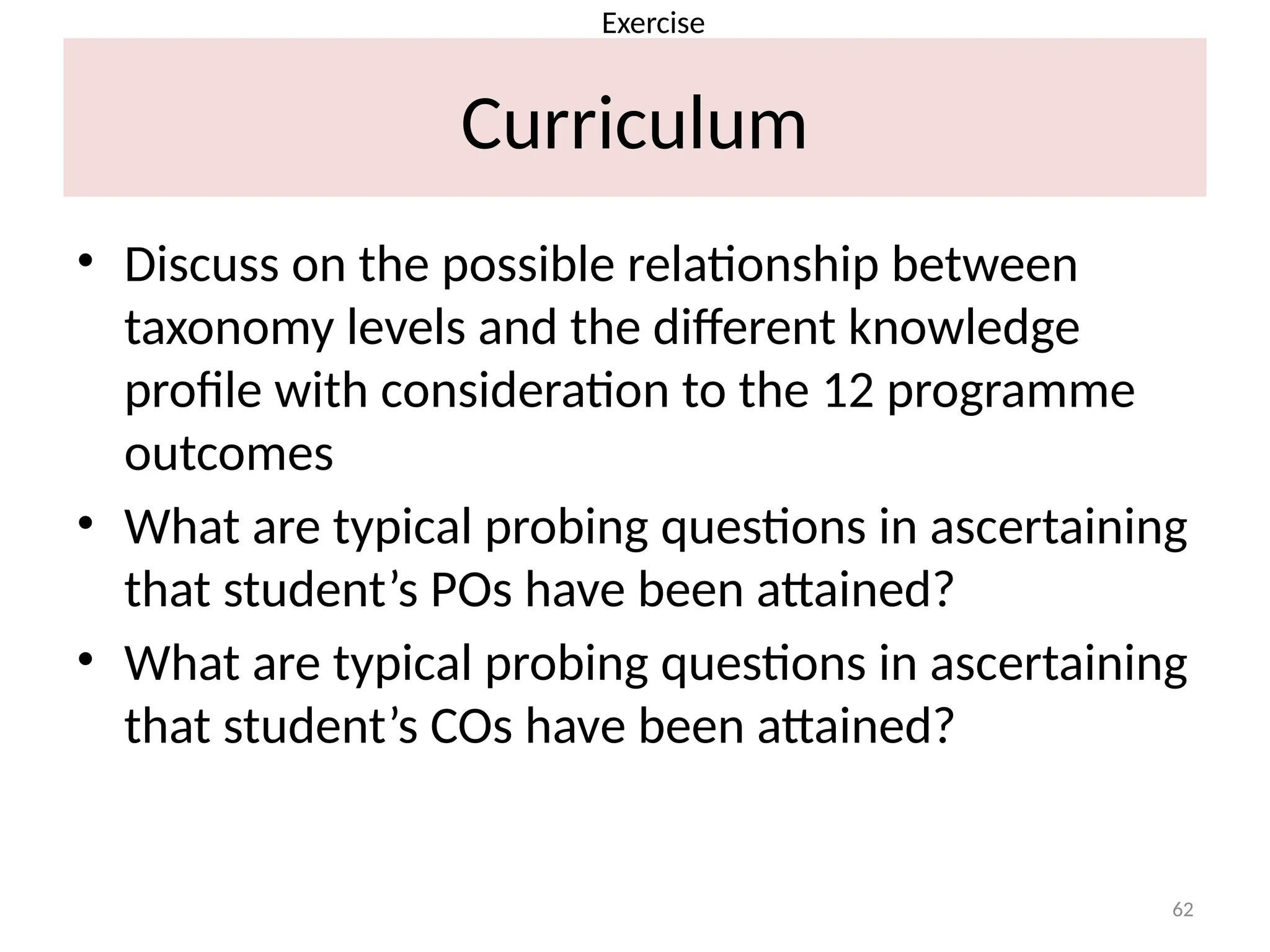
Curriculum
• Discuss on the possible relationship between
taxonomy levels and the different knowledge
profile with consideration to the 12 programme
outcomes
• What are typical probing questions in ascertaining
that student’s POs have been attained?
• What are typical probing questions in ascertaining
that student’s COs have been attained?
Exercise
63
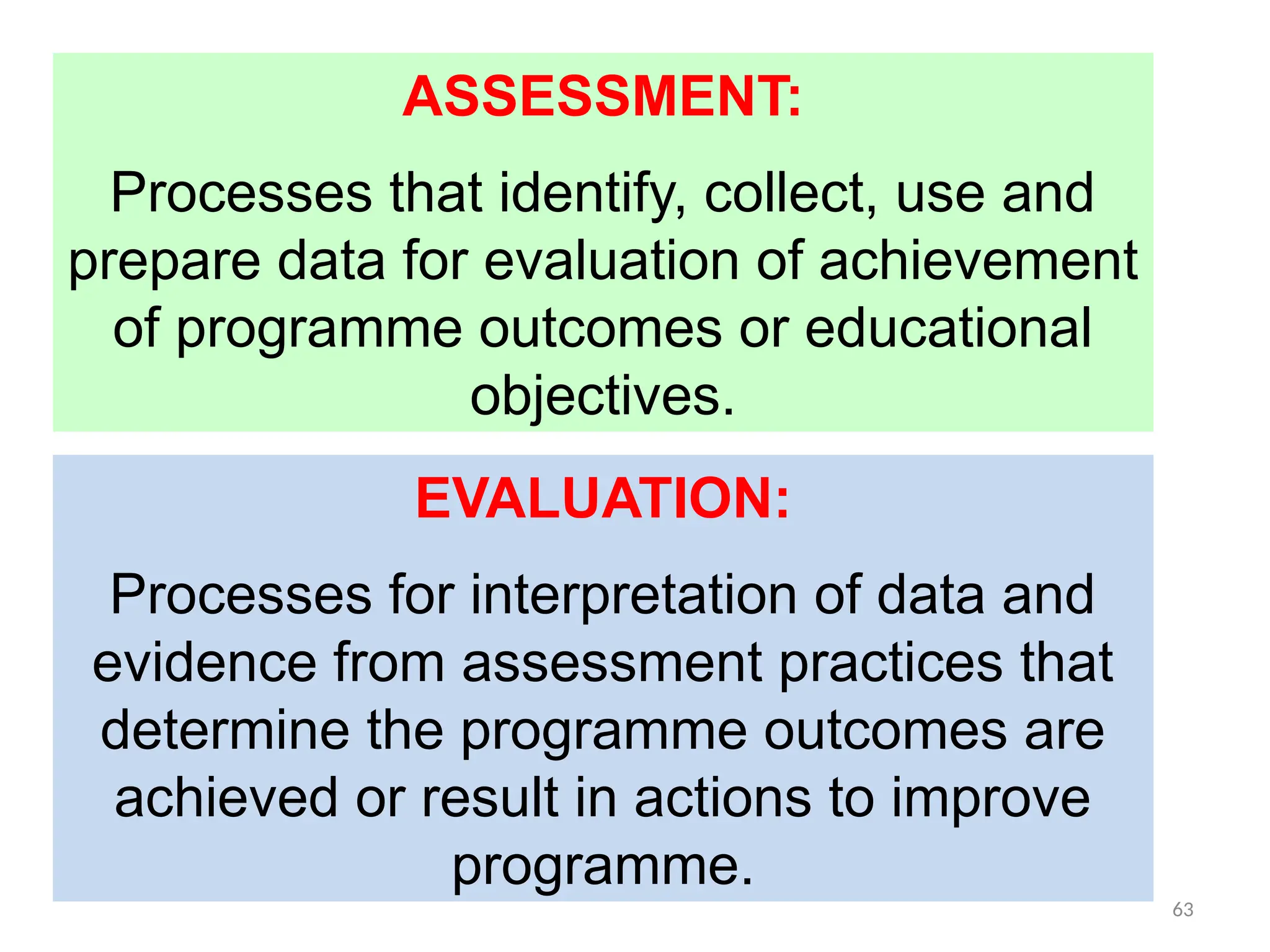
ASSESSMENT:
Processes that identify, collect, use and
prepare data for evaluation of achievement
of programme outcomes or educational
objectives.
EVALUATION:
Processes for interpretation of data and
evidence from assessment practices that
determine the programme outcomes are
achieved or result in actions to improve
programme.
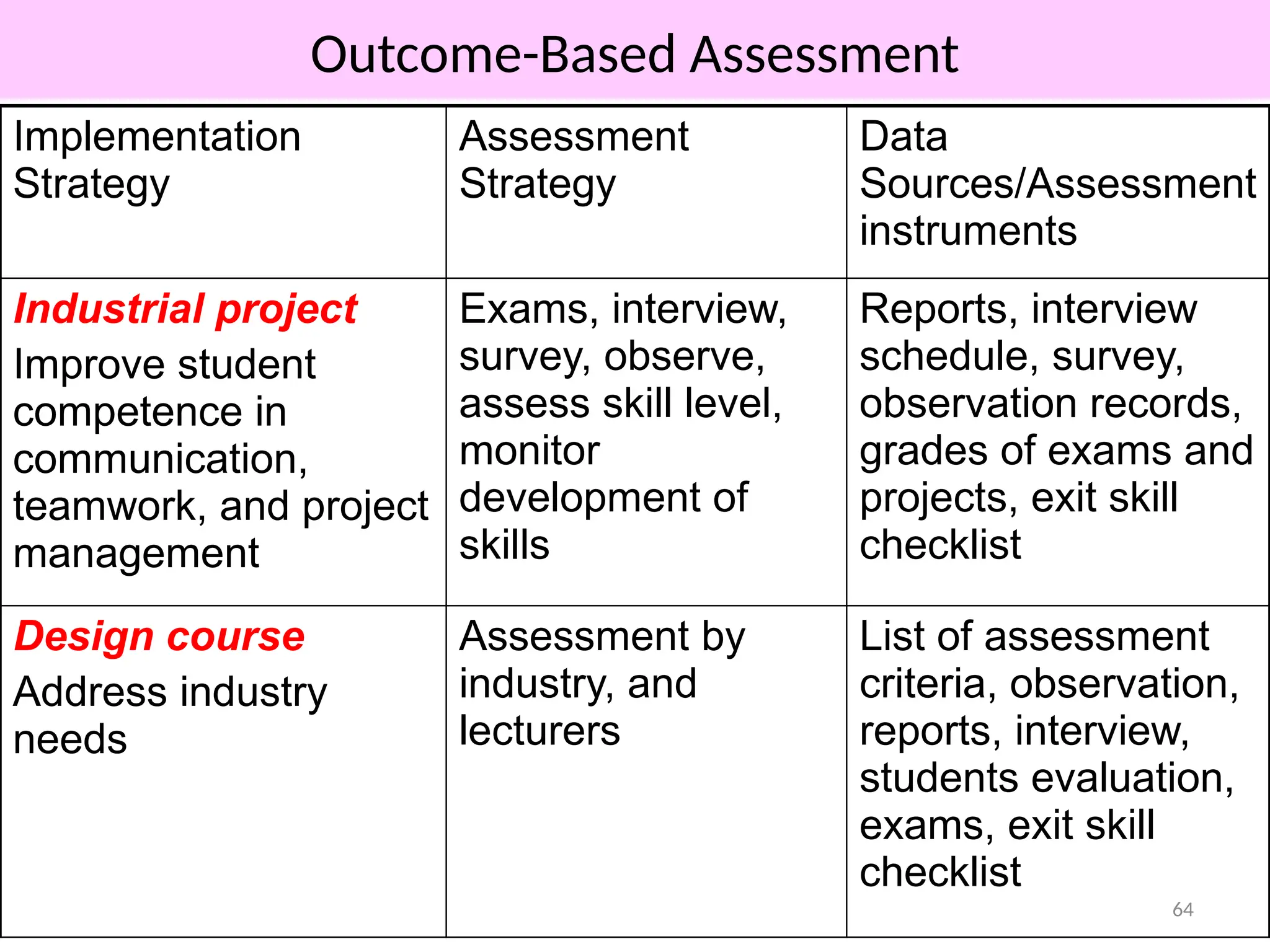
Outcome-Based Assessment
Implementation
Strategy
Assessment
Strategy
Data
Sources/Assessment
instruments
Industrial project
Improve student
competence in
communication,
teamwork, and project
management
Exams, interview,
survey, observe,
assess skill level,
monitor
development of
skills
Reports, interview
schedule, survey,
observation records,
grades of exams and
projects, exit skill
checklist
Design course
Address industry
needs
Assessment by
industry, and
lecturers
List of assessment
criteria, observation,
reports, interview,
students evaluation,
exams, exit skill
checklist
64
65
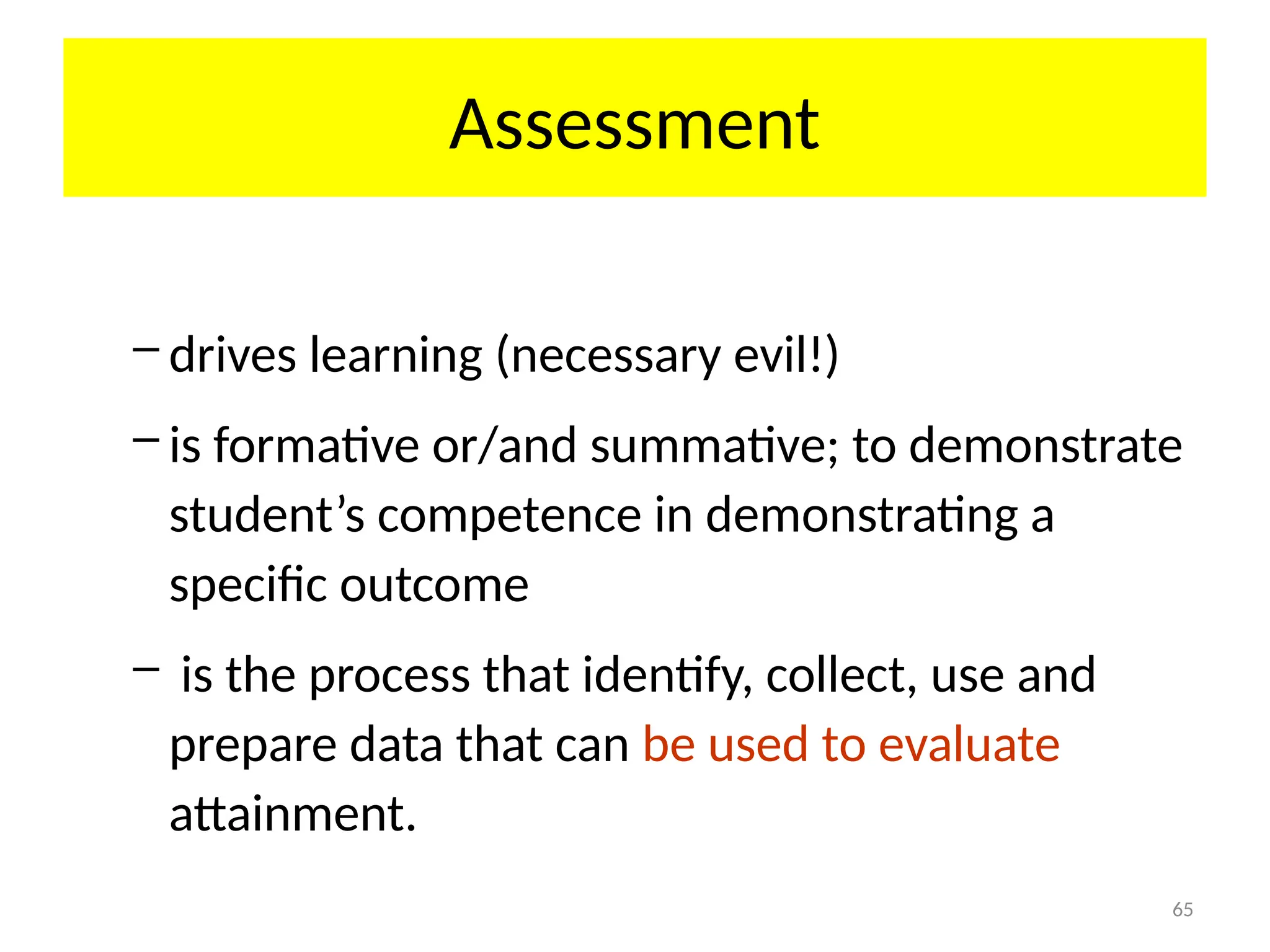
Assessment
– drives learning (necessary evil!)
– is formative or/and summative; to demonstrate
student’s competence in demonstrating a
specific outcome
– is the process that identify, collect, use and
prepare data that can be used to evaluate
attainment.
66
Assessment
• Do not assess those that have not
been taught
67
What Assessment?
• Assessing Student/Cohort (Course Outcome)
• Assessing Student/Cohort & Faculty
(Programme Outcome)
68
Assessment Process
–Anecdotal vs. measured results
–Reliance on course grades only
–Over-reliance on indirect assessment
(survey)
69
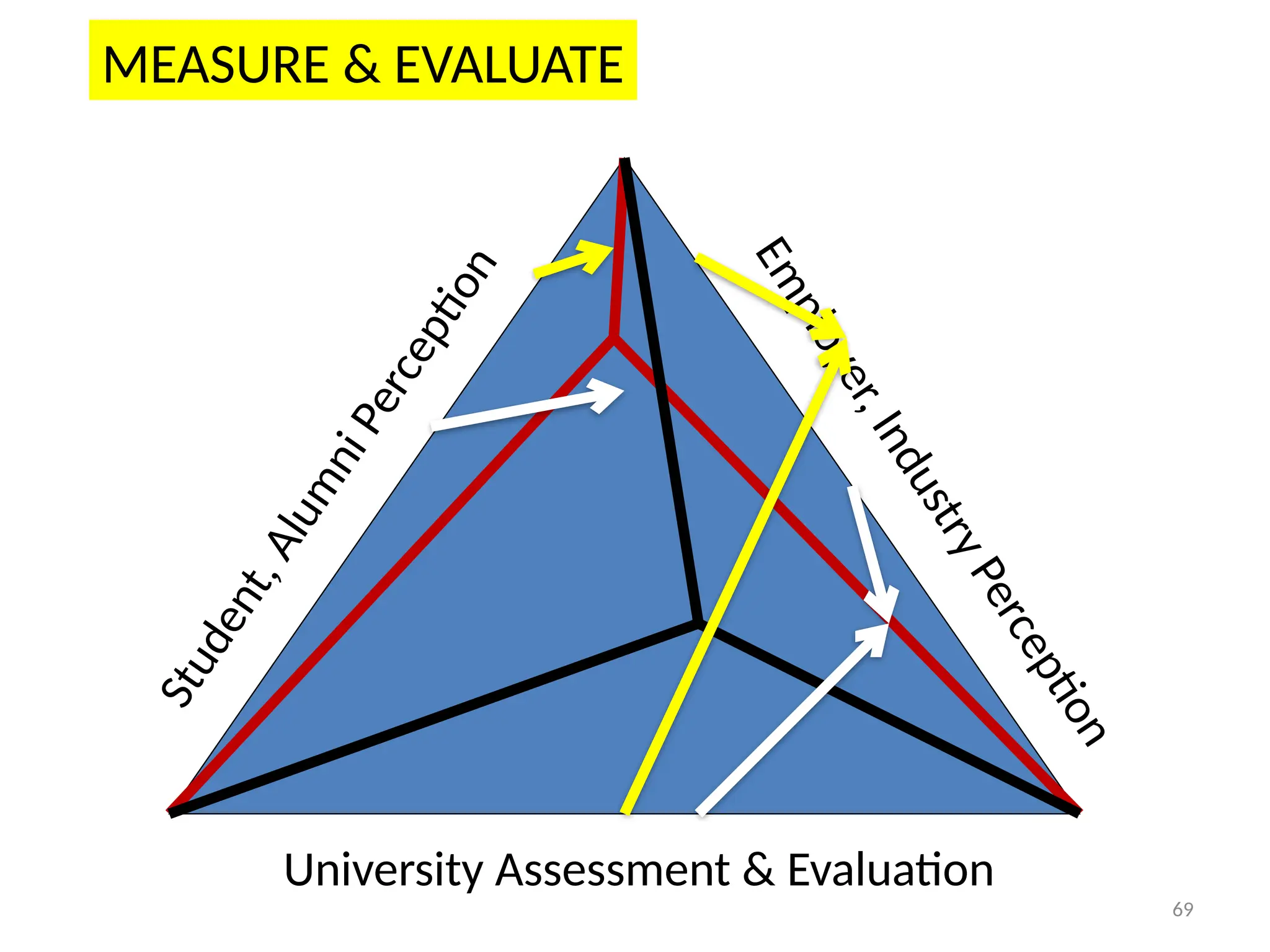
University Assessment & Evaluation
S
t
u
d
e
n
t
,
A
l
u
m
n
i
P
e
r
c
e
p
ti
o
n
E
m
p
l
o
y
e
r
,
I
n
d
u
s
t
r
y
P
e
r
c
e
p
ti
o
n
MEASURE & EVALUATE
70
How will you know what they
have achieved it?
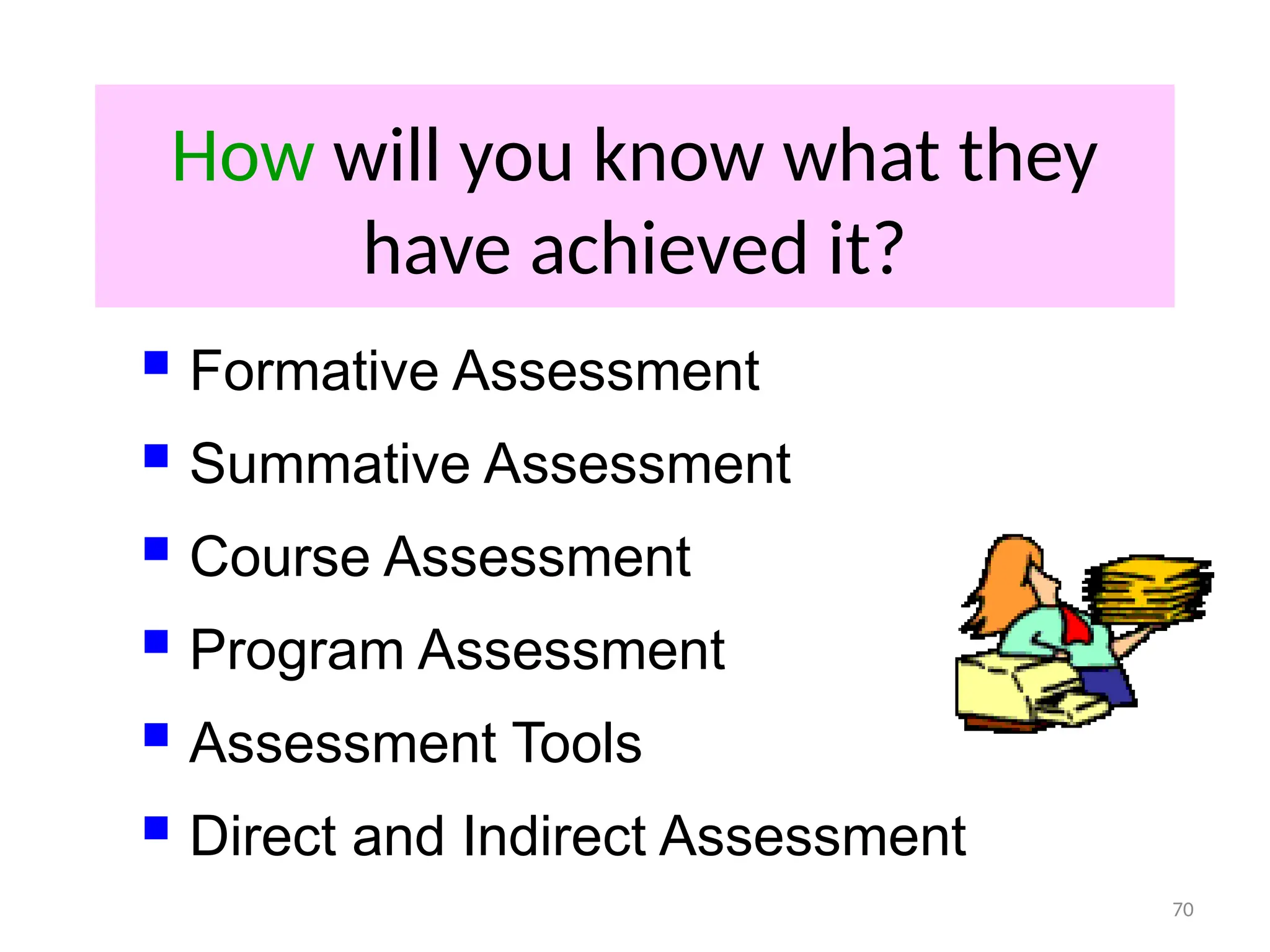
 Formative Assessment
 Summative Assessment
 Course Assessment
 Program Assessment
 Assessment Tools
 Direct and Indirect Assessment
71
How do you close the loop ?
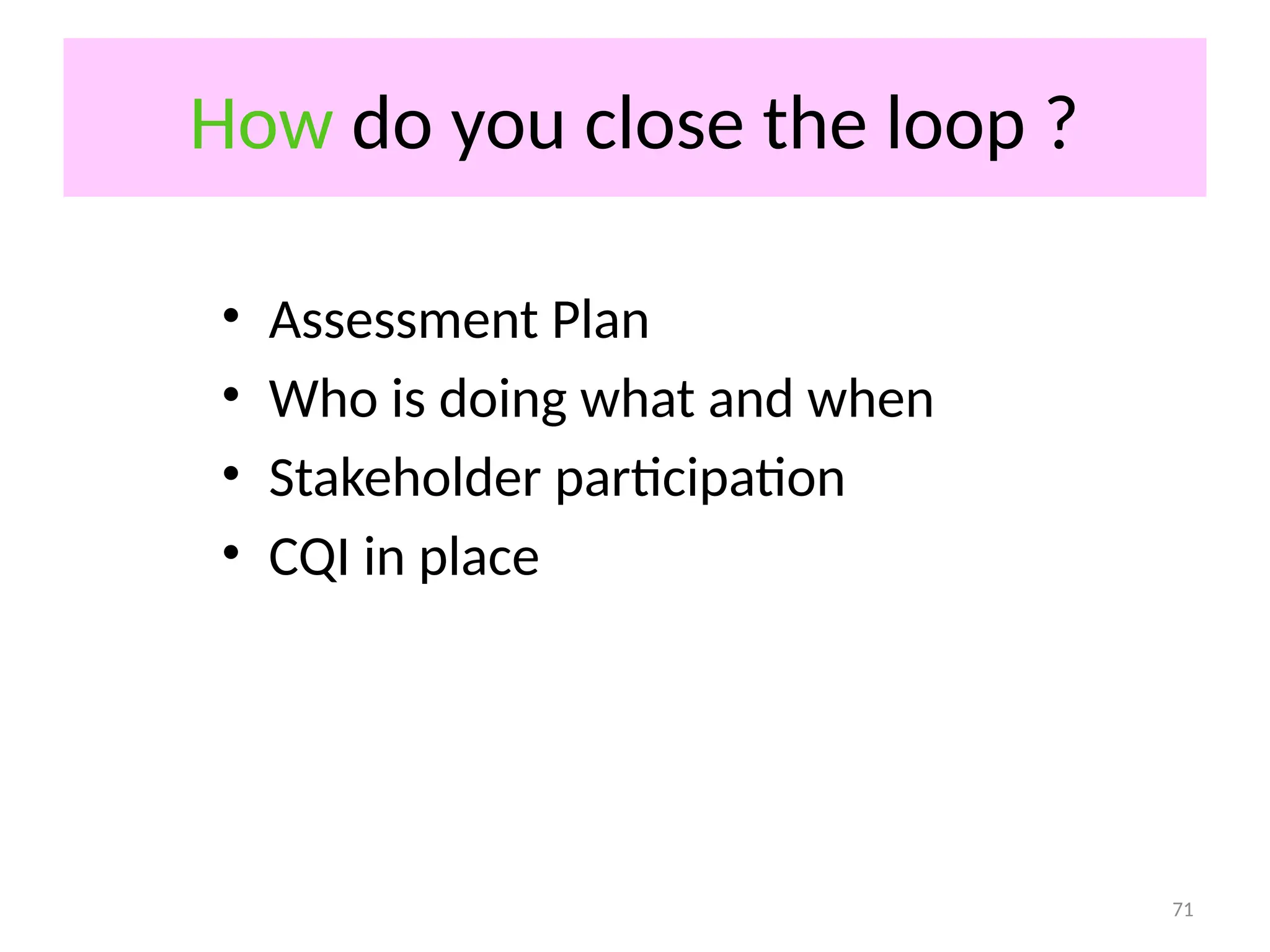
• Assessment Plan
• Who is doing what and when
• Stakeholder participation
• CQI in place
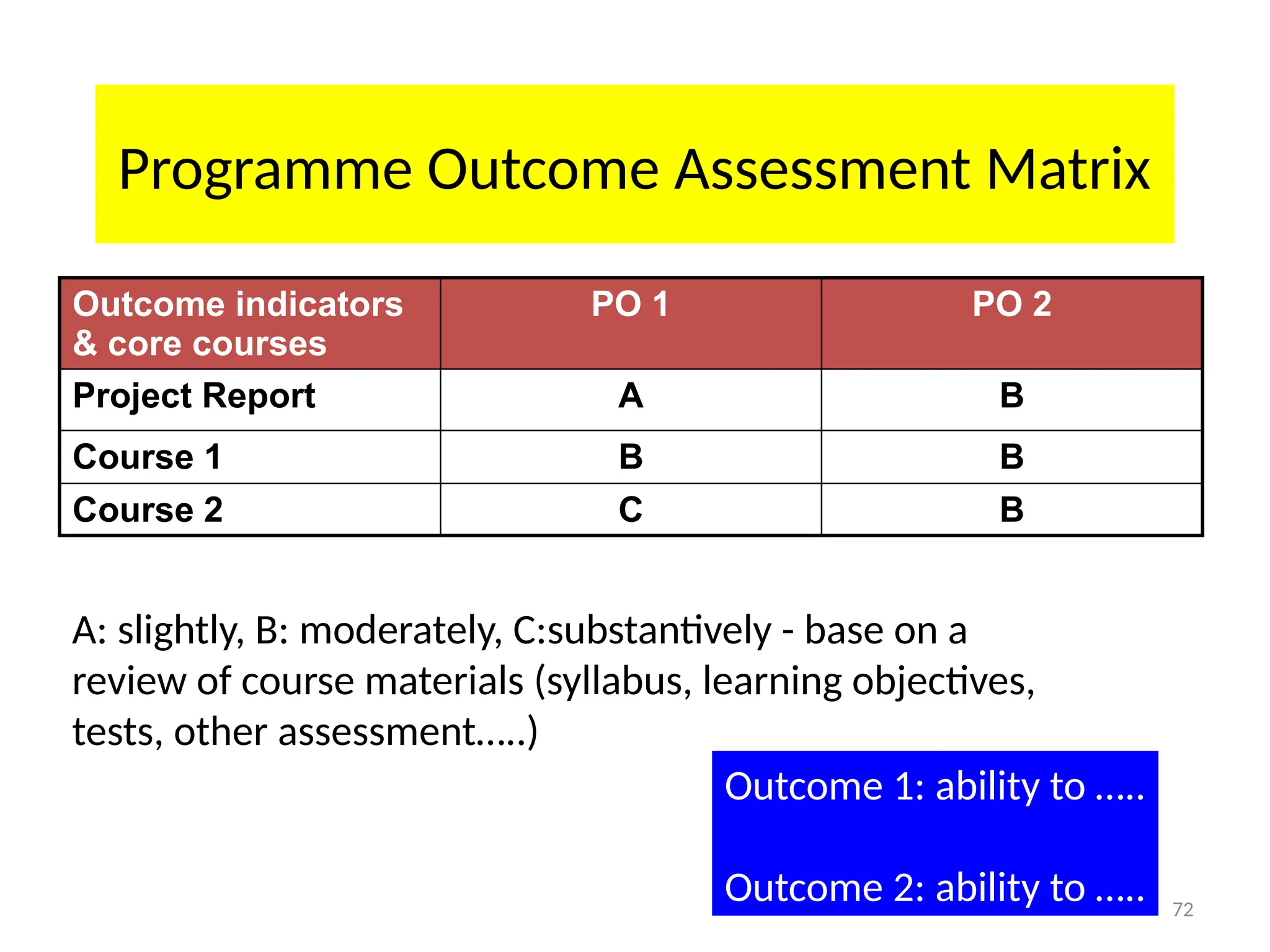
Programme Outcome Assessment Matrix
Outcome indicators
& core courses
PO 1 PO 2
Project Report A B
Course 1 B B
Course 2 C B
A: slightly, B: moderately, C:substantively - base on a
review of course materials (syllabus, learning objectives,
tests, other assessment…..)
Outcome 1: ability to …..
Outcome 2: ability to ….. 72
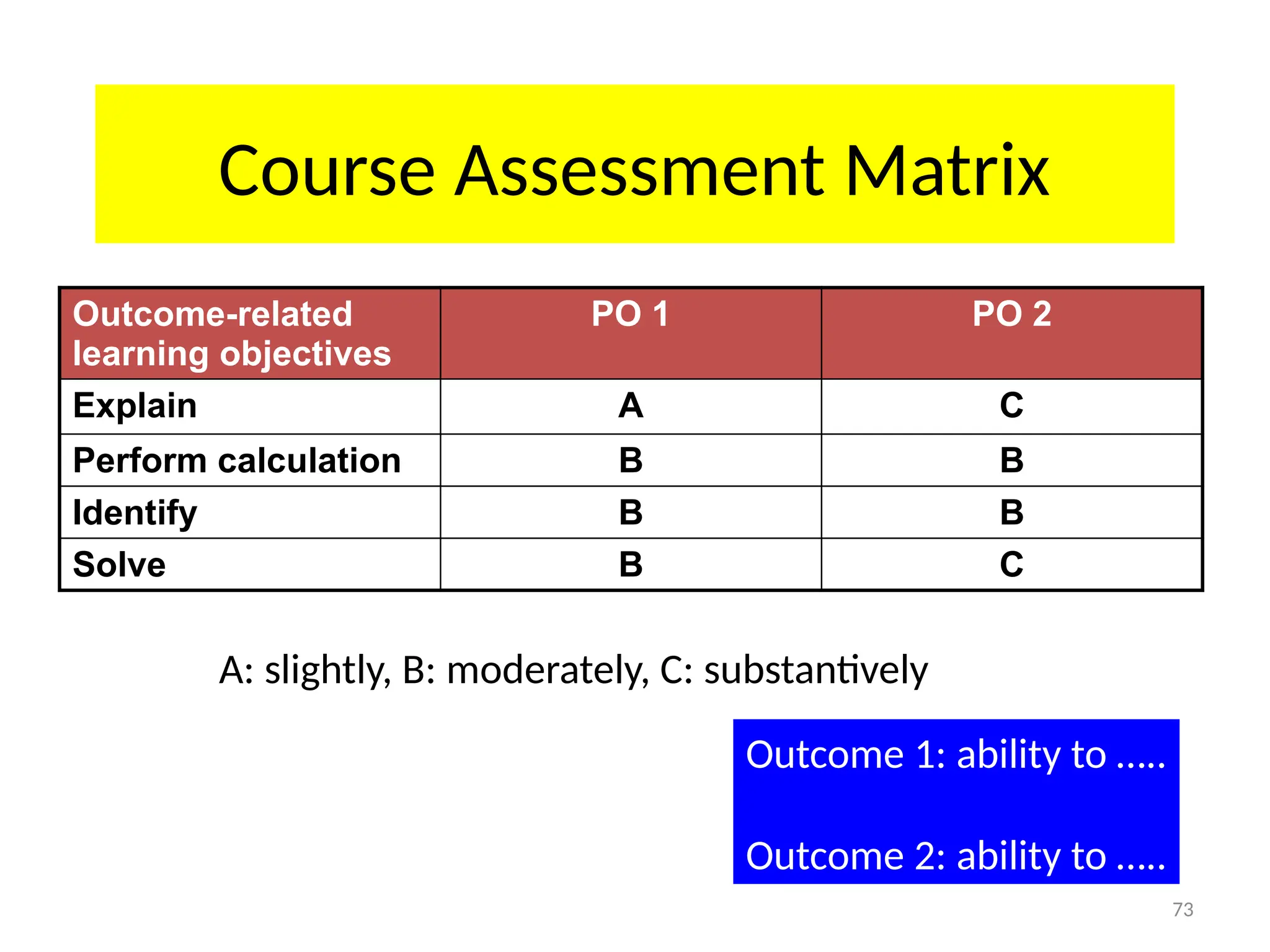
Course Assessment Matrix
Outcome-related
learning objectives
PO 1 PO 2
Explain A C
Perform calculation B B
Identify B B
Solve B C
A: slightly, B: moderately, C: substantively
Outcome 1: ability to …..
Outcome 2: ability to …..
73
74
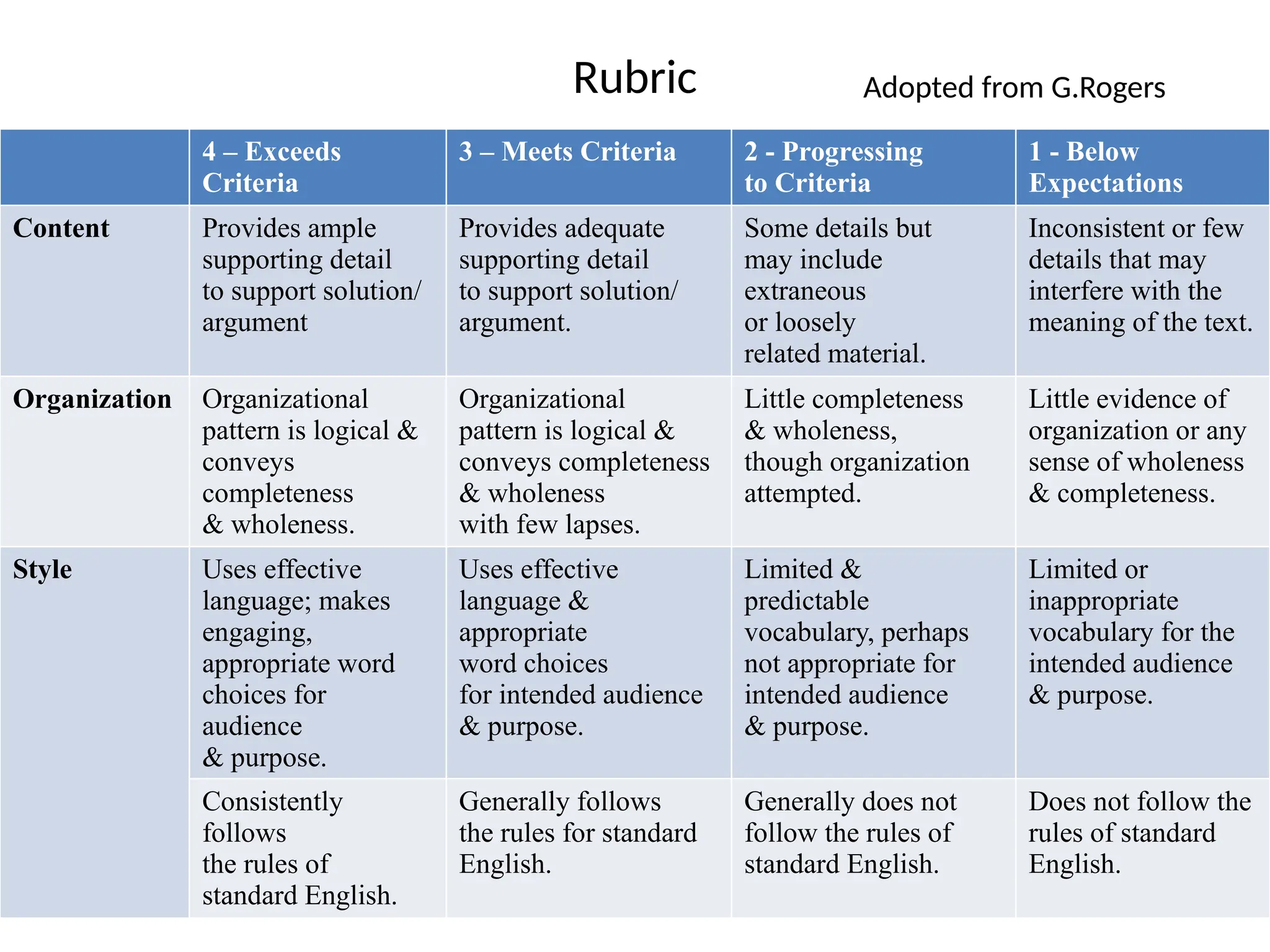
Rubric
4 – Exceeds
Criteria
3 – Meets Criteria 2 - Progressing
to Criteria
1 - Below
Expectations
Content Provides ample
supporting detail
to support solution/
argument
Provides adequate
supporting detail
to support solution/
argument.
Some details but
may include
extraneous
or loosely
related material.
Inconsistent or few
details that may
interfere with the
meaning of the text.
Organization Organizational
pattern is logical &
conveys
completeness
& wholeness.
Organizational
pattern is logical &
conveys completeness
& wholeness
with few lapses.
Little completeness
& wholeness,
though organization
attempted.
Little evidence of
organization or any
sense of wholeness
& completeness.
Style Uses effective
language; makes
engaging,
appropriate word
choices for
audience
& purpose.
Uses effective
language &
appropriate
word choices
for intended audience
& purpose.
Limited &
predictable
vocabulary, perhaps
not appropriate for
intended audience
& purpose.
Limited or
inappropriate
vocabulary for the
intended audience
& purpose.
Consistently
follows
the rules of
standard English.
Generally follows
the rules for standard
English.
Generally does not
follow the rules of
standard English.
Does not follow the
rules of standard
English.
Adopted from G.Rogers
75
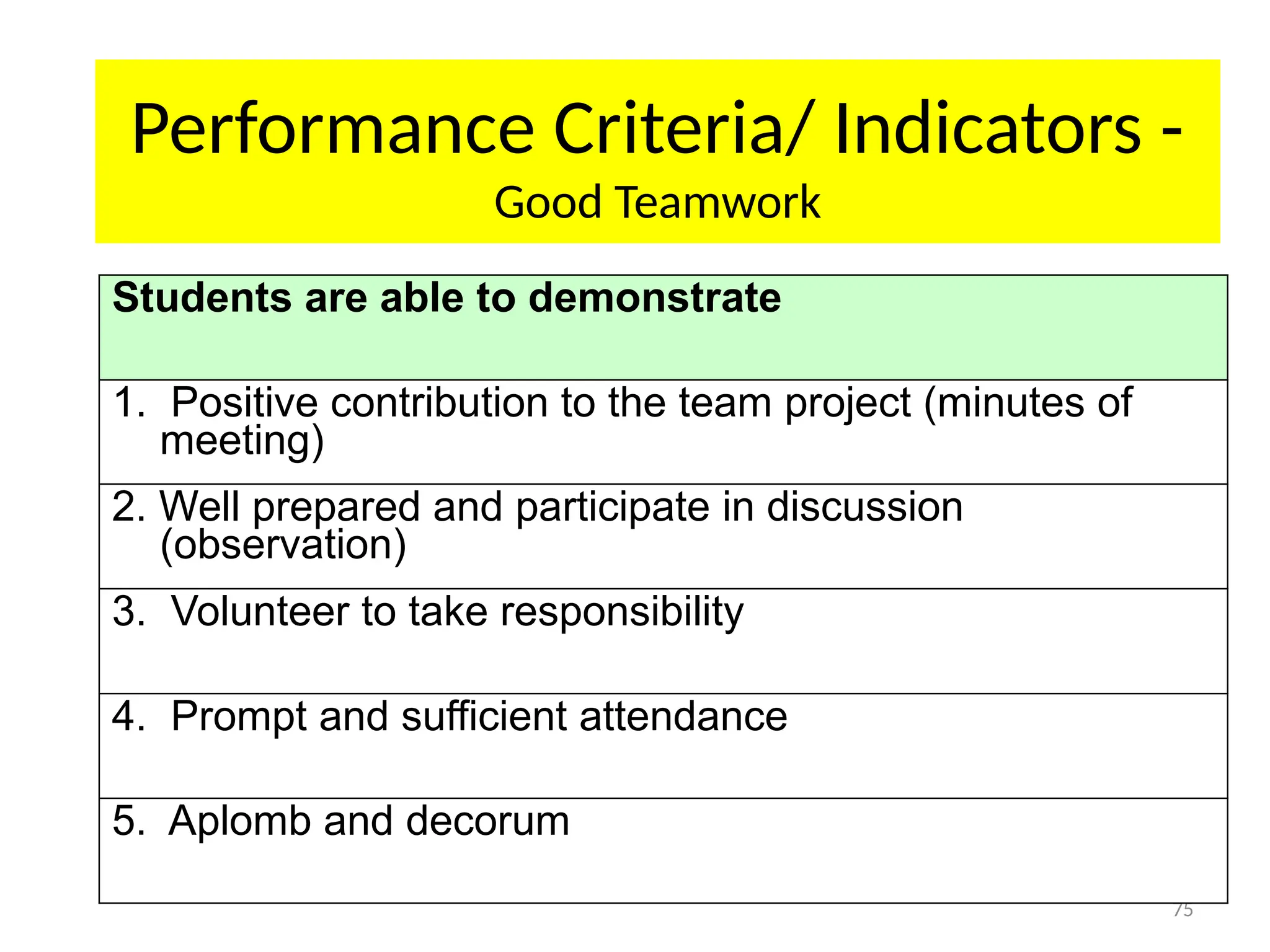
Performance Criteria/ Indicators -
Good Teamwork
Students are able to demonstrate
1. Positive contribution to the team project (minutes of
meeting)
2. Well prepared and participate in discussion
(observation)
3. Volunteer to take responsibility
4. Prompt and sufficient attendance
5. Aplomb and decorum
76
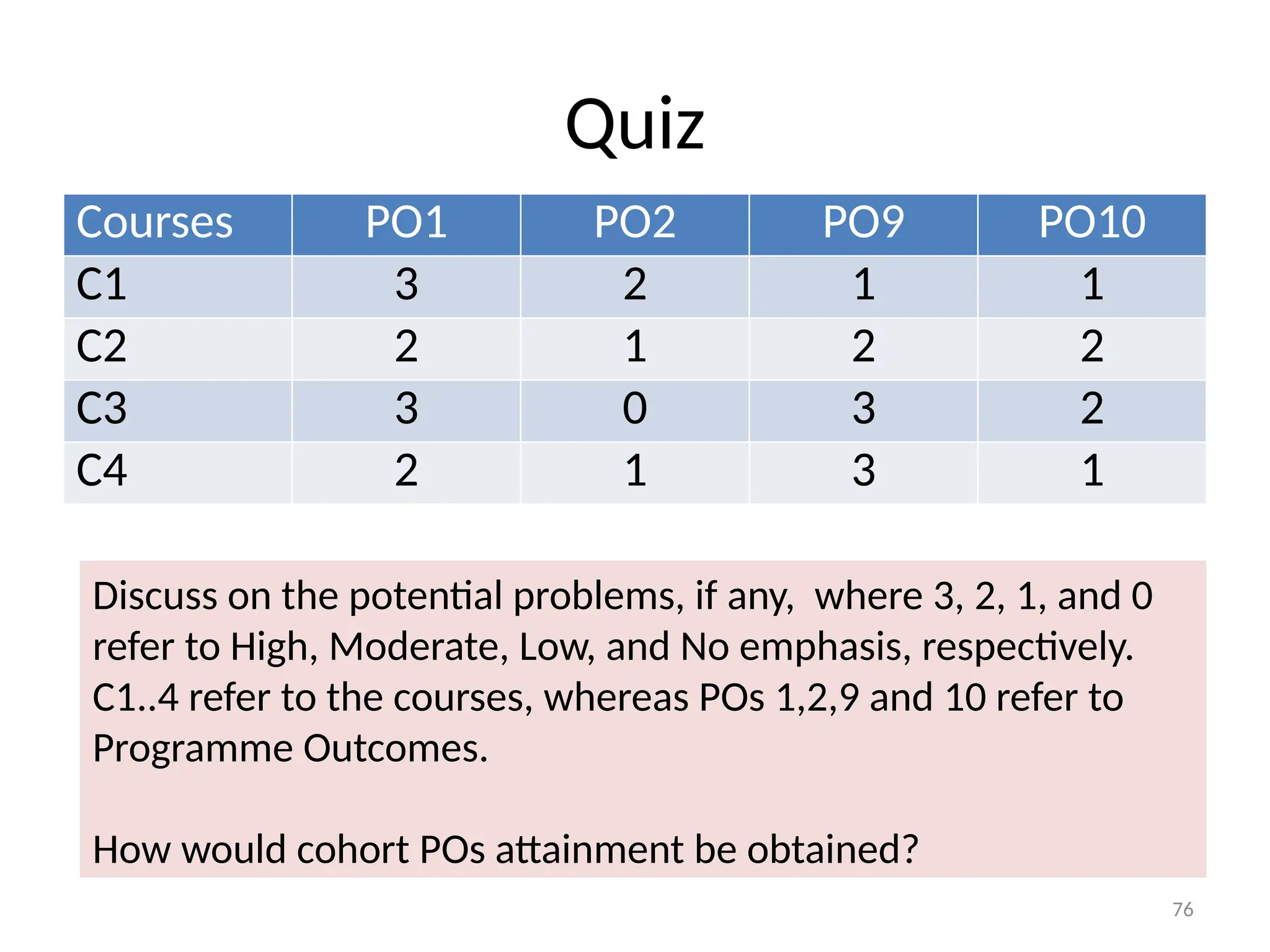
Quiz
Courses PO1 PO2 PO9 PO10
C1 3 2 1 1
C2 2 1 2 2
C3 3 0 3 2
C4 2 1 3 1
Discuss on the potential problems, if any, where 3, 2, 1, and 0
refer to High, Moderate, Low, and No emphasis, respectively.
C1..4 refer to the courses, whereas POs 1,2,9 and 10 refer to
Programme Outcomes.
How would cohort POs attainment be obtained?
77
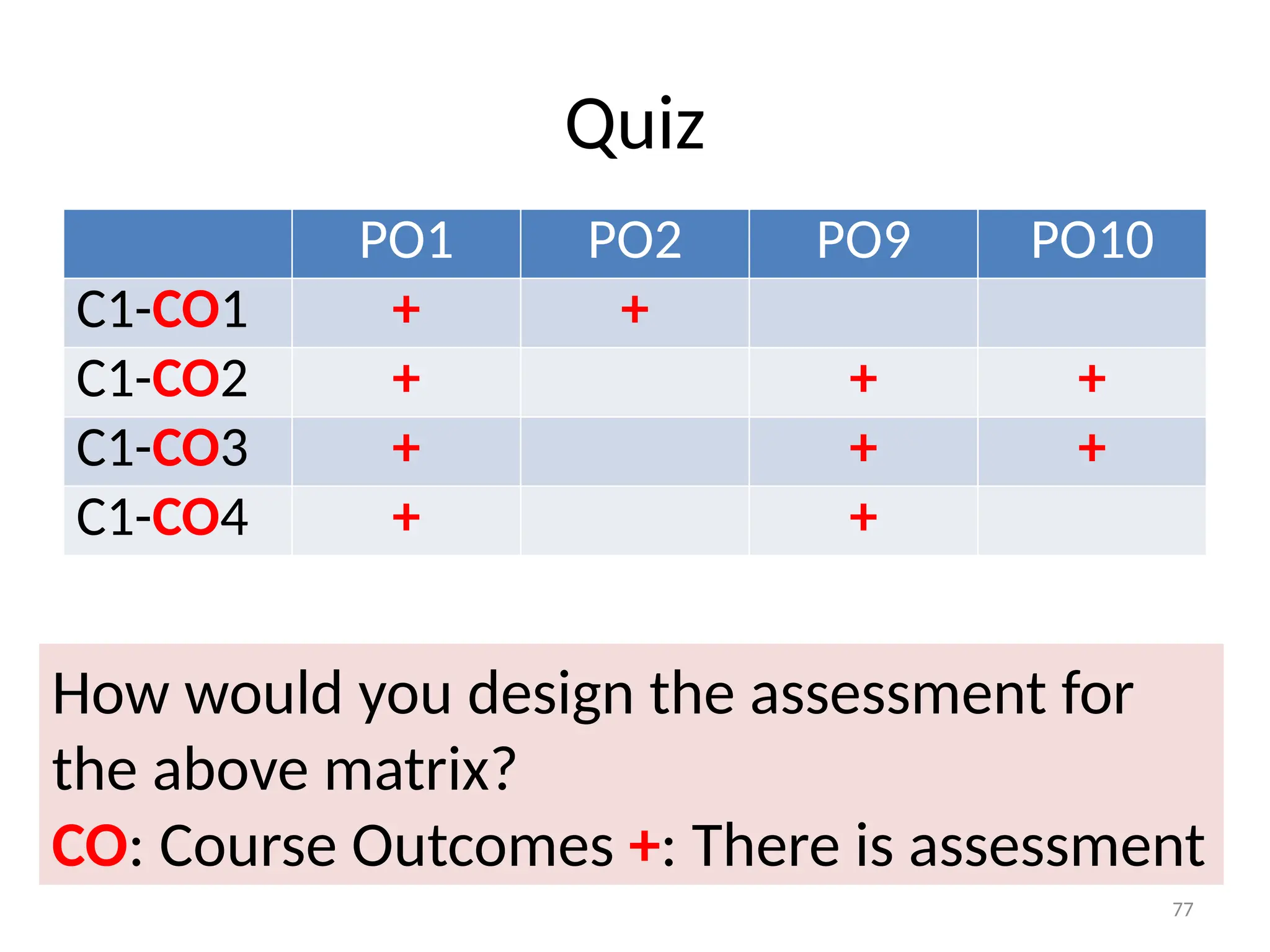
Quiz
PO1 PO2 PO9 PO10
C1-CO1 + +
C1-CO2 + + +
C1-CO3 + + +
C1-CO4 + +
How would you design the assessment for
the above matrix?
CO: Course Outcomes +: There is assessment
78
Quiz
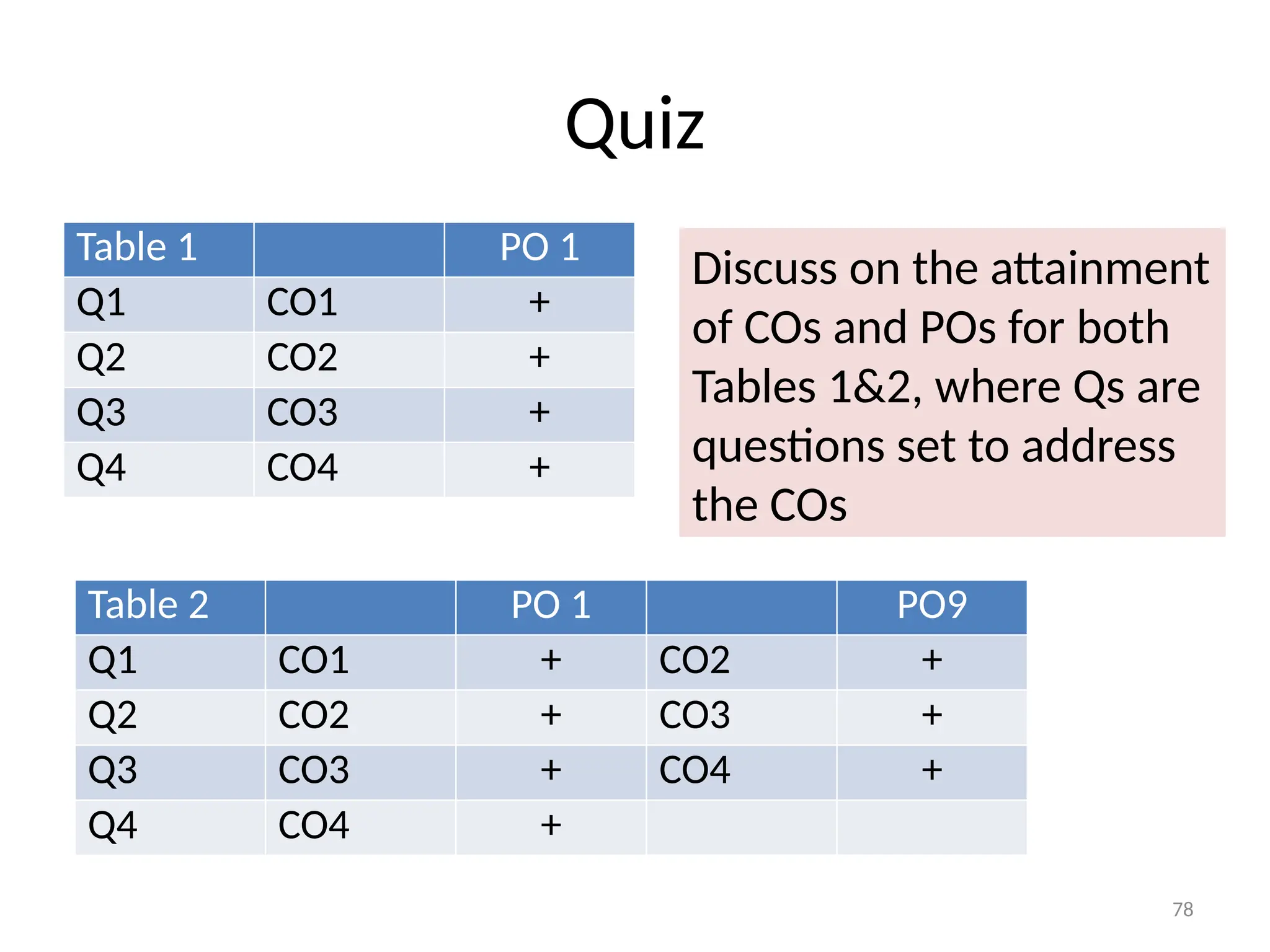
Table 1 PO 1
Q1 CO1 +
Q2 CO2 +
Q3 CO3 +
Q4 CO4 +
Table 2 PO 1 PO9
Q1 CO1 + CO2 +
Q2 CO2 + CO3 +
Q3 CO3 + CO4 +
Q4 CO4 +
Discuss on the attainment
of COs and POs for both
Tables 1&2, where Qs are
questions set to address
the COs
79
Quiz
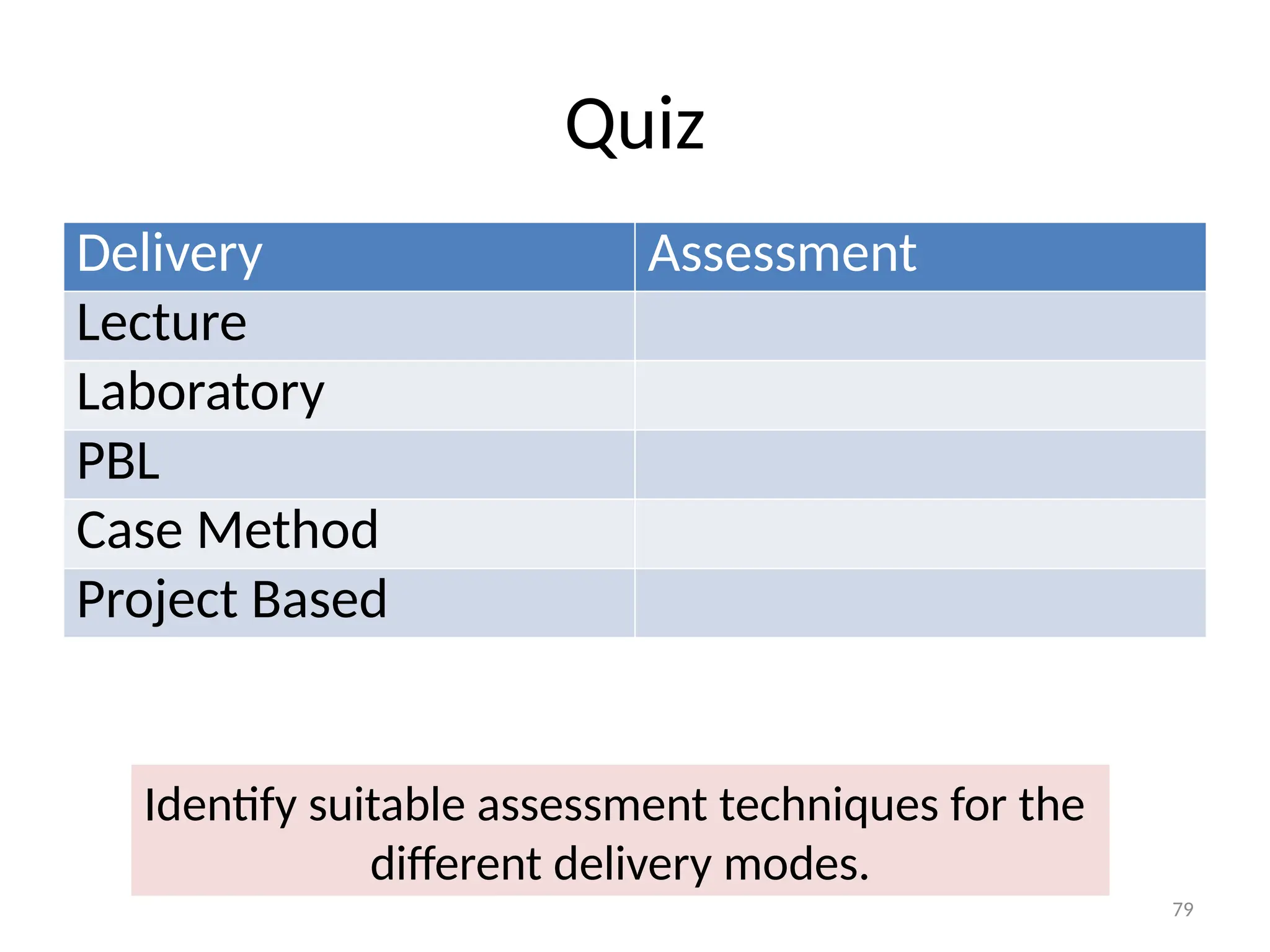
Delivery Assessment
Lecture
Laboratory
PBL
Case Method
Project Based
Identify suitable assessment techniques for the
different delivery modes.
80
Lessons learnt from accreditation activities
related to assessment
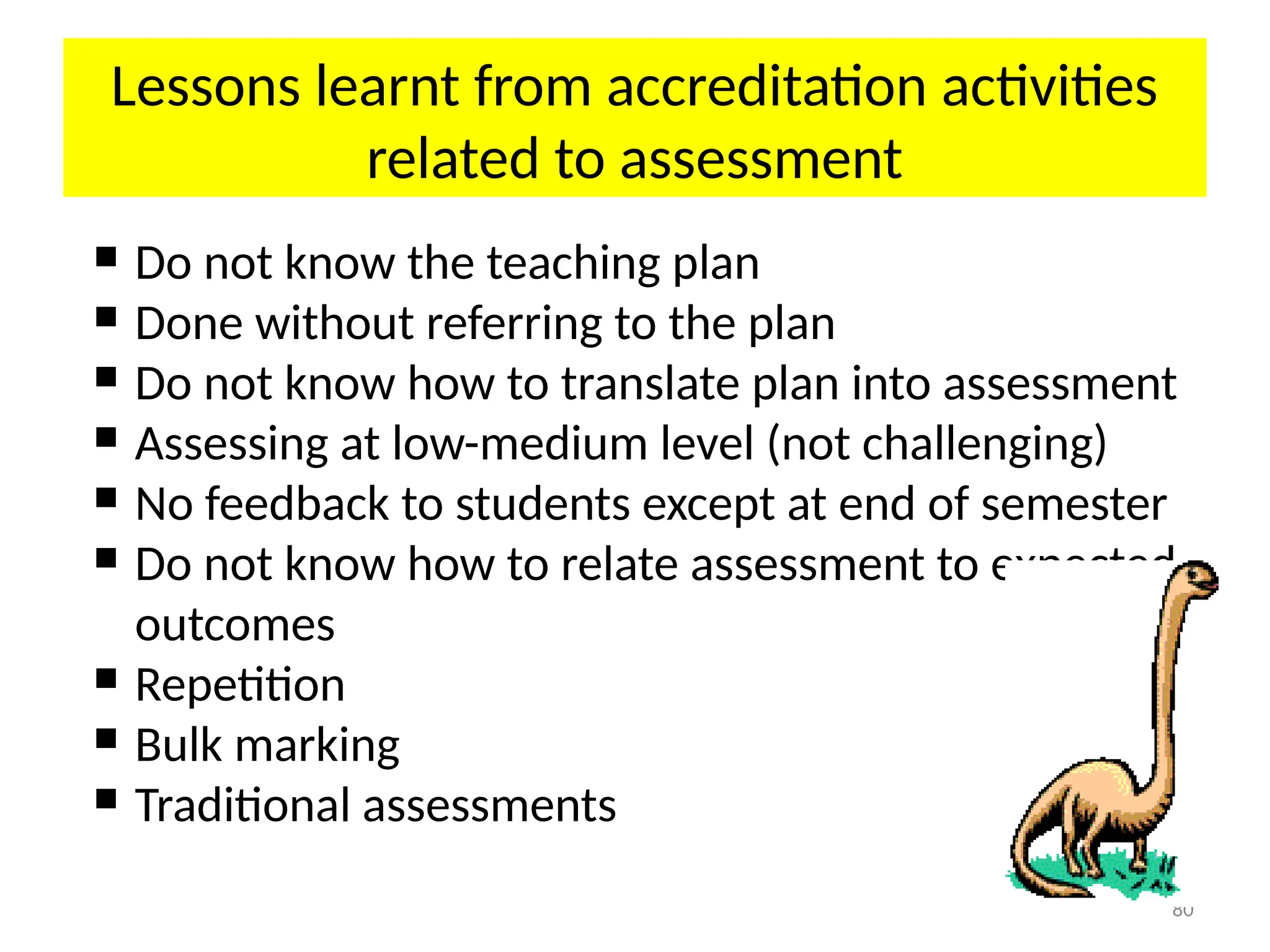
 Do not know the teaching plan
 Done without referring to the plan
 Do not know how to translate plan into assessment
 Assessing at low-medium level (not challenging)
 No feedback to students except at end of semester
 Do not know how to relate assessment to expected
outcomes
 Repetition
 Bulk marking
 Traditional assessments
81
Big Picture
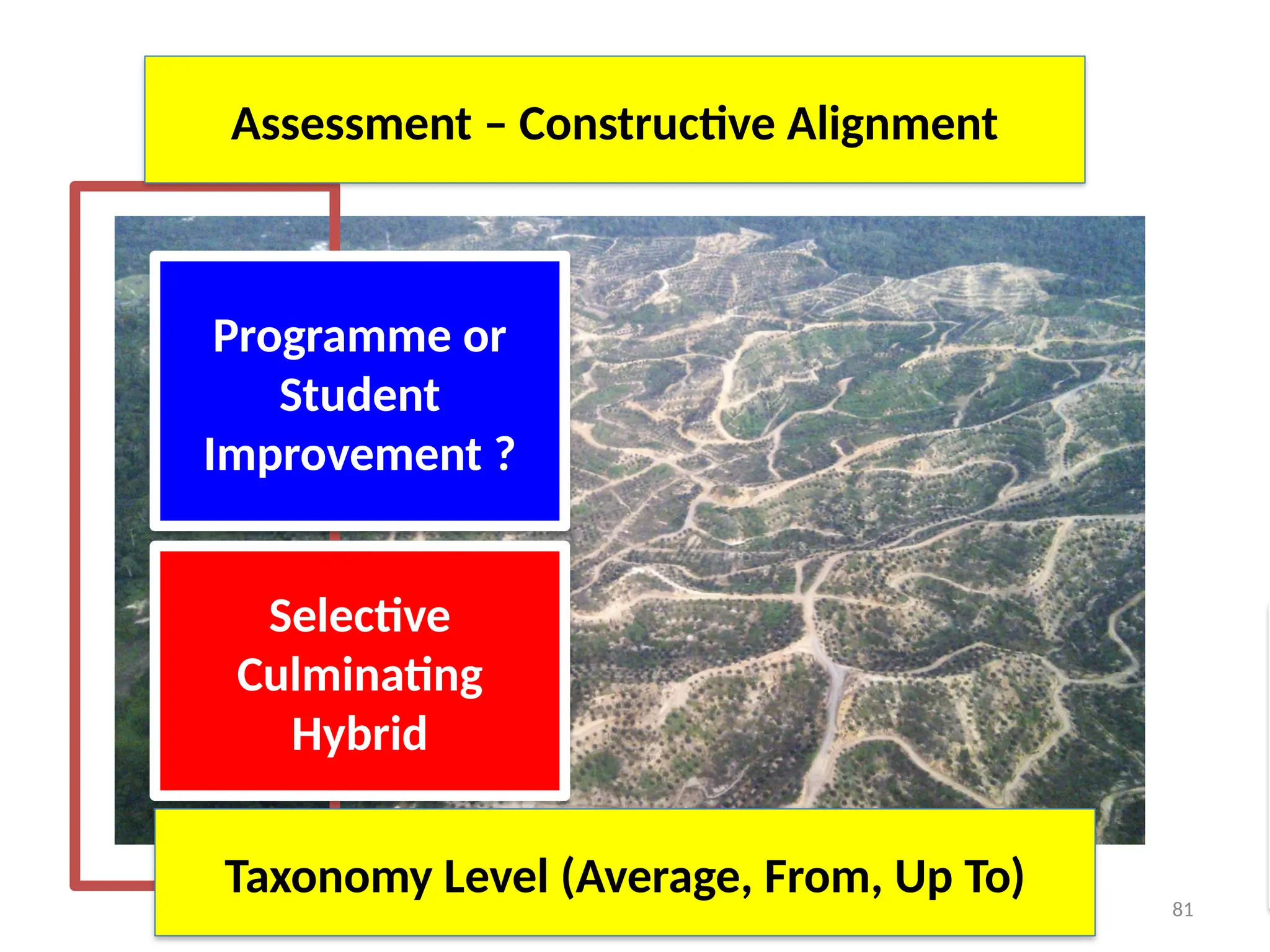
Programme or
Student
Improvement ?
Selective
Culminating
Hybrid
Taxonomy Level (Average, From, Up To)
Assessment – Constructive Alignment
82
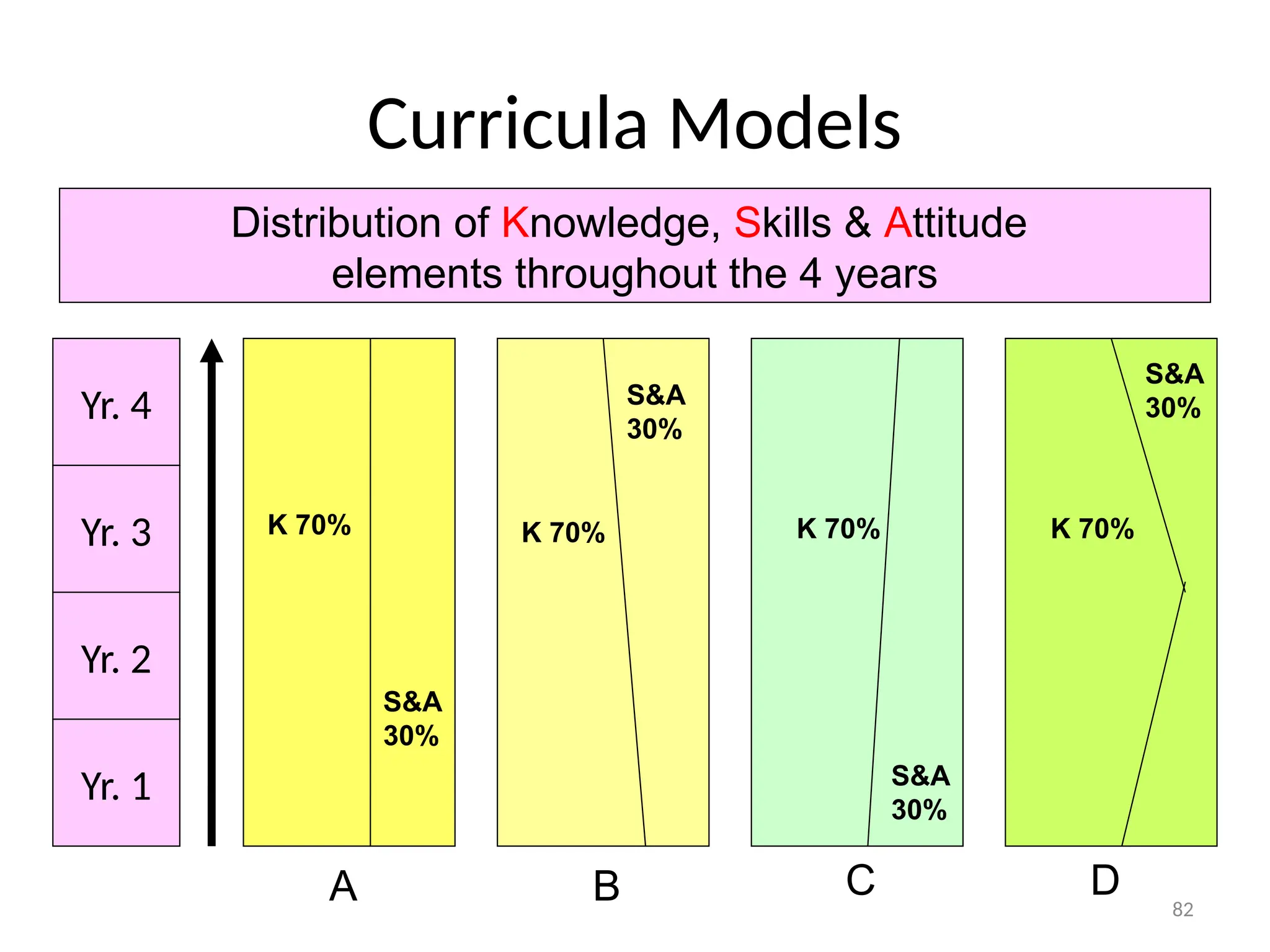
Curricula Models
Yr. 1
Yr. 4
Yr. 3
Yr. 2
K 70%
S&A
30%
K 70% K 70% K 70%
S&A
30%
S&A
30%
S&A
30%
Distribution of Knowledge, Skills & Attitude
elements throughout the 4 years
A B C D
83
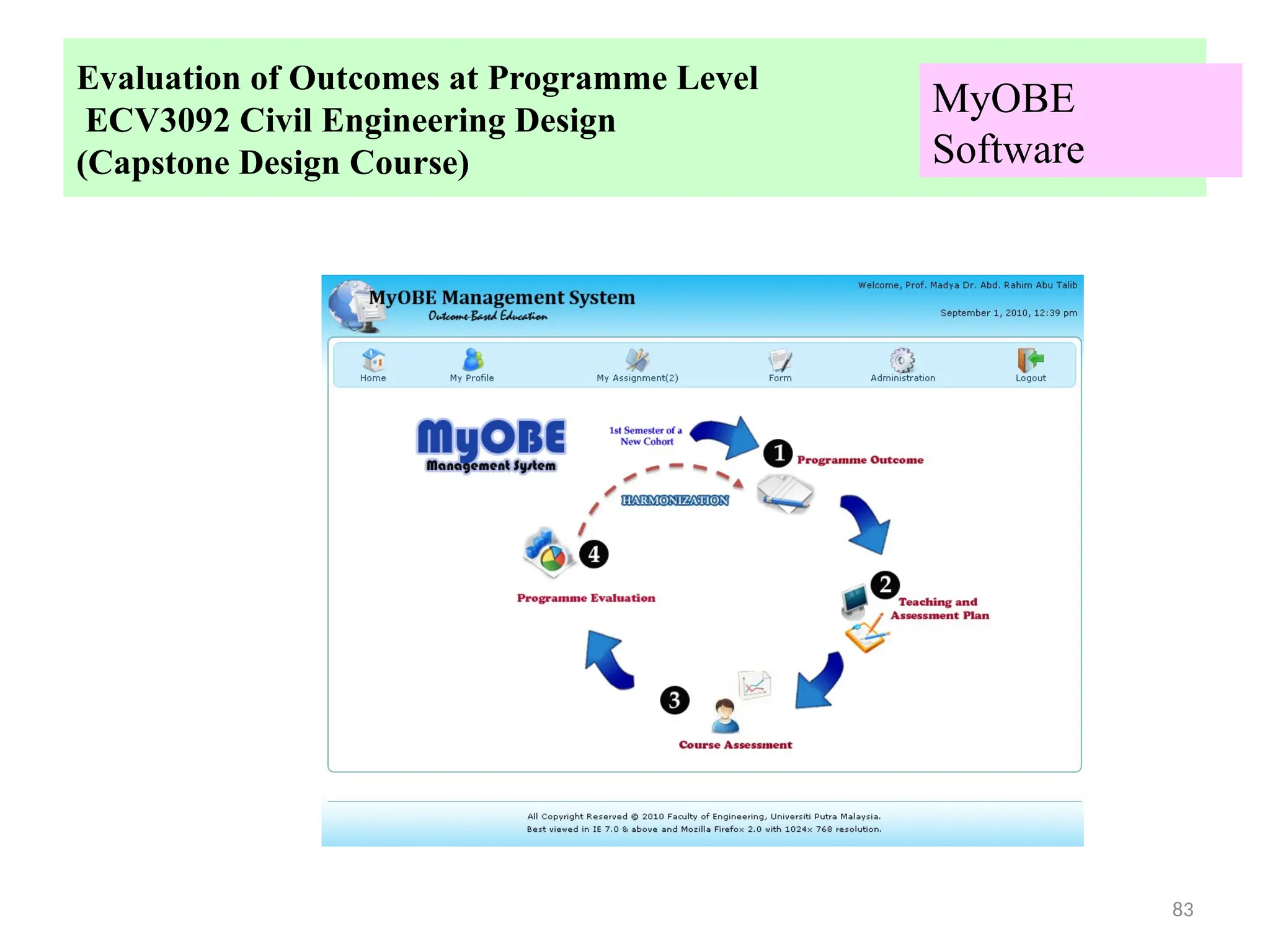
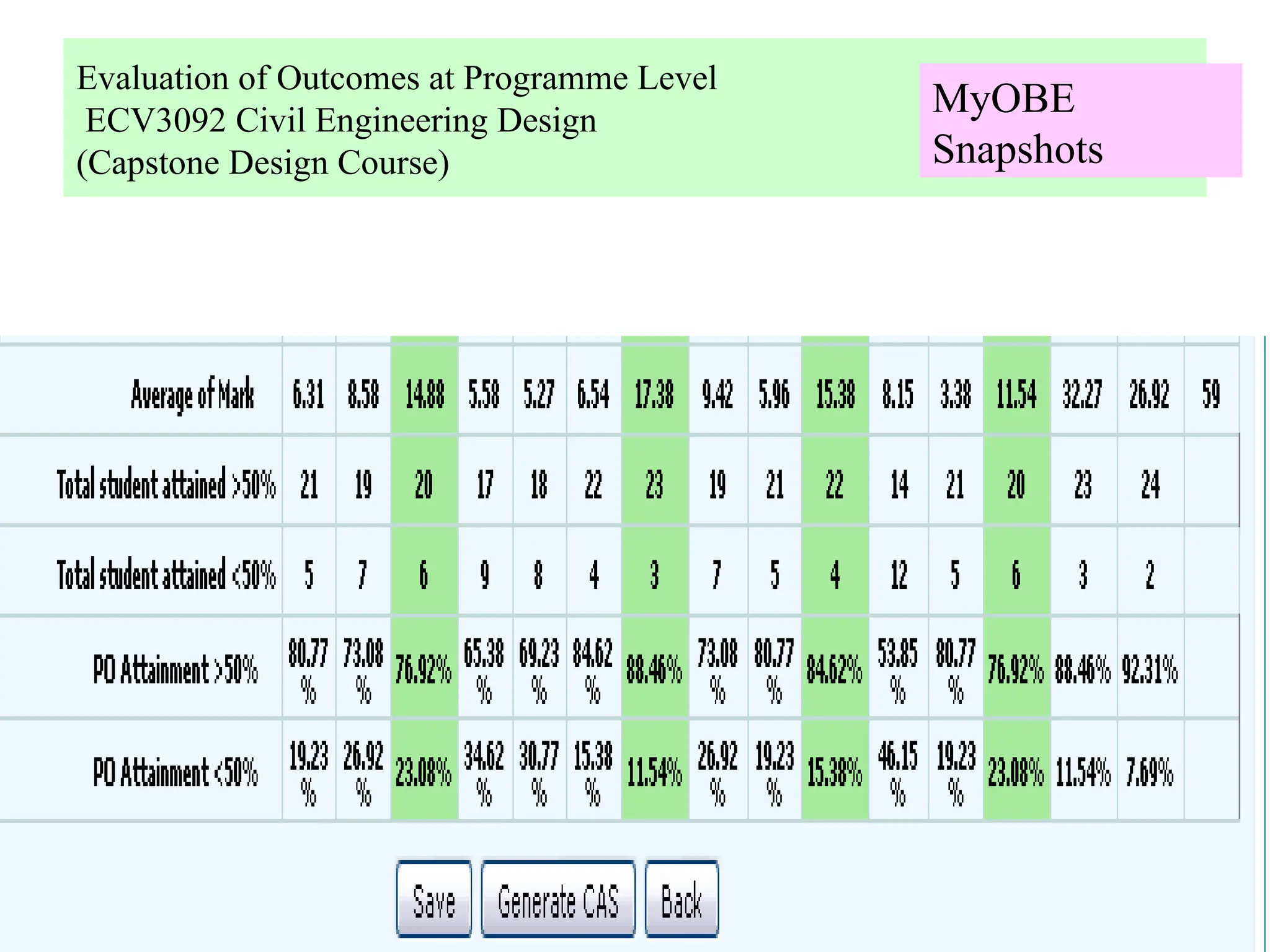
Evaluation of Outcomes at Programme Level
ECV3092 Civil Engineering Design
(Capstone Design Course)
MyOBE
Software
84
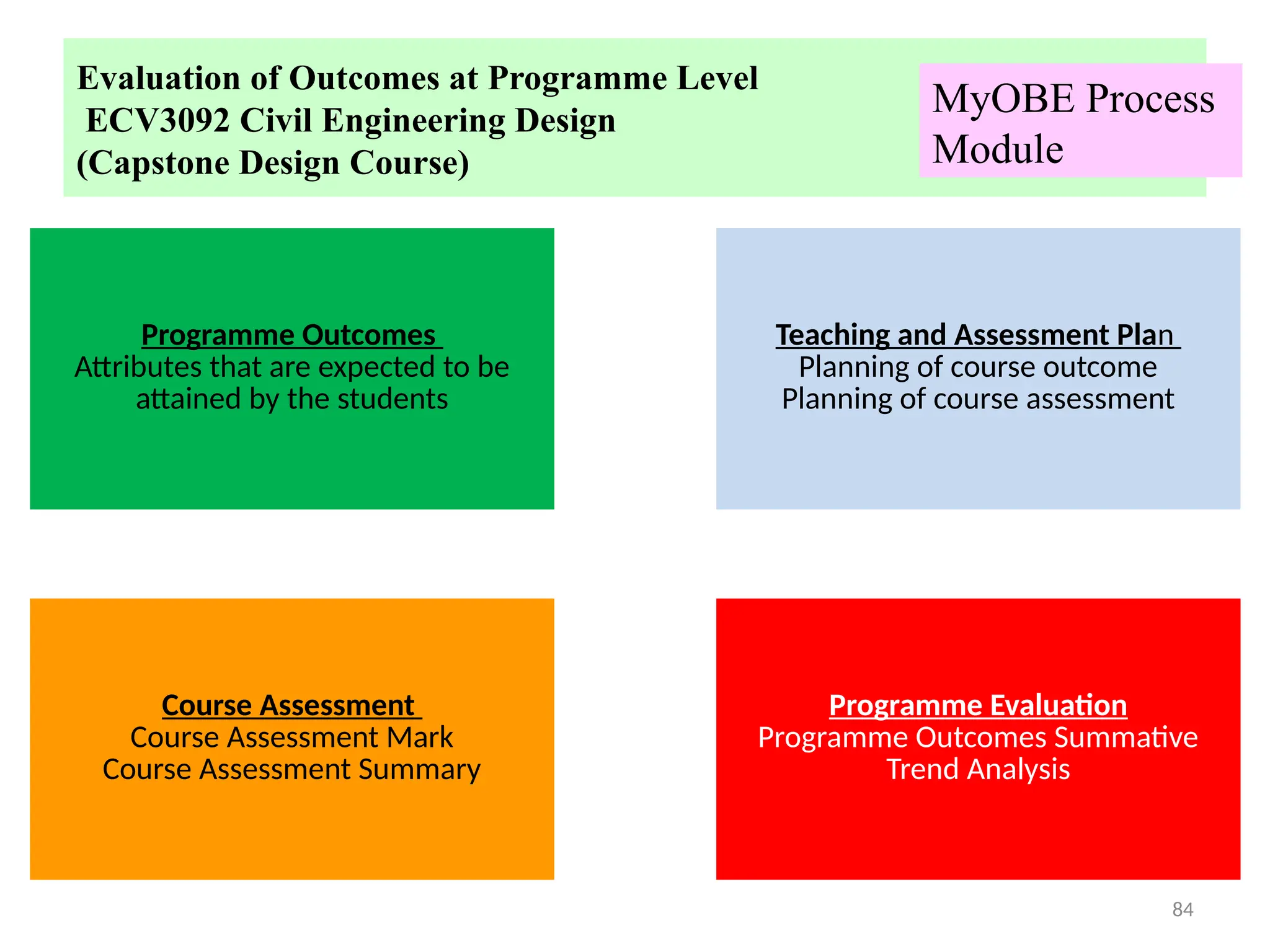
Evaluation of Outcomes at Programme Level
ECV3092 Civil Engineering Design
(Capstone Design Course)
MyOBE Process
Module
Programme Outcomes
Attributes that are expected to be
attained by the students
Teaching and Assessment Plan
Planning of course outcome
Planning of course assessment
Course Assessment
Course Assessment Mark
Course Assessment Summary
Programme Evaluation
Programme Outcomes Summative
Trend Analysis
85
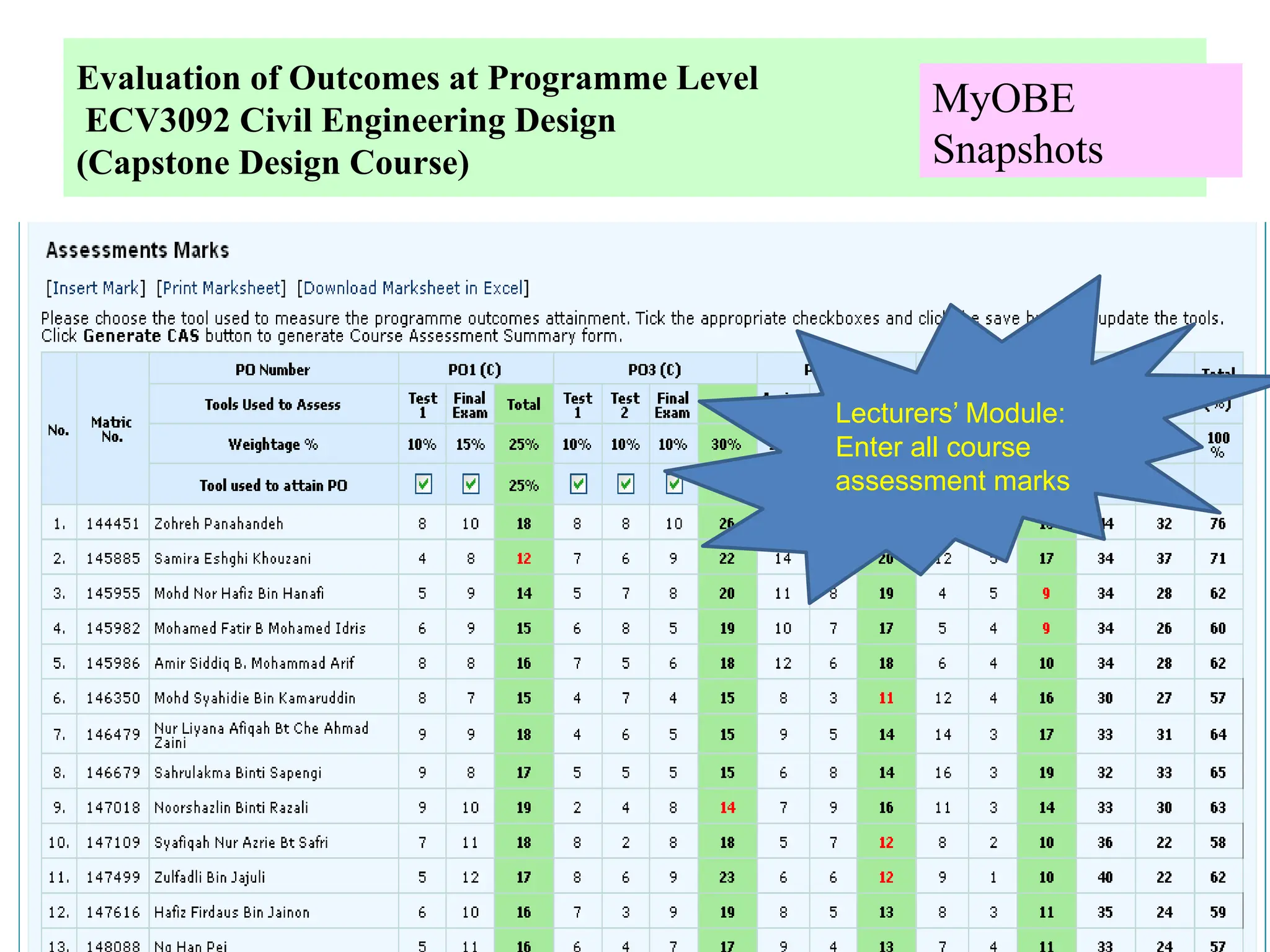
Evaluation of Outcomes at Programme Level
ECV3092 Civil Engineering Design
(Capstone Design Course)
MyOBE
Snapshots
Lecturers’ Module:
Enter all course
assessment marks
86
Evaluation of Outcomes at Programme Level
ECV3092 Civil Engineering Design
(Capstone Design Course)
MyOBE
Snapshots
87
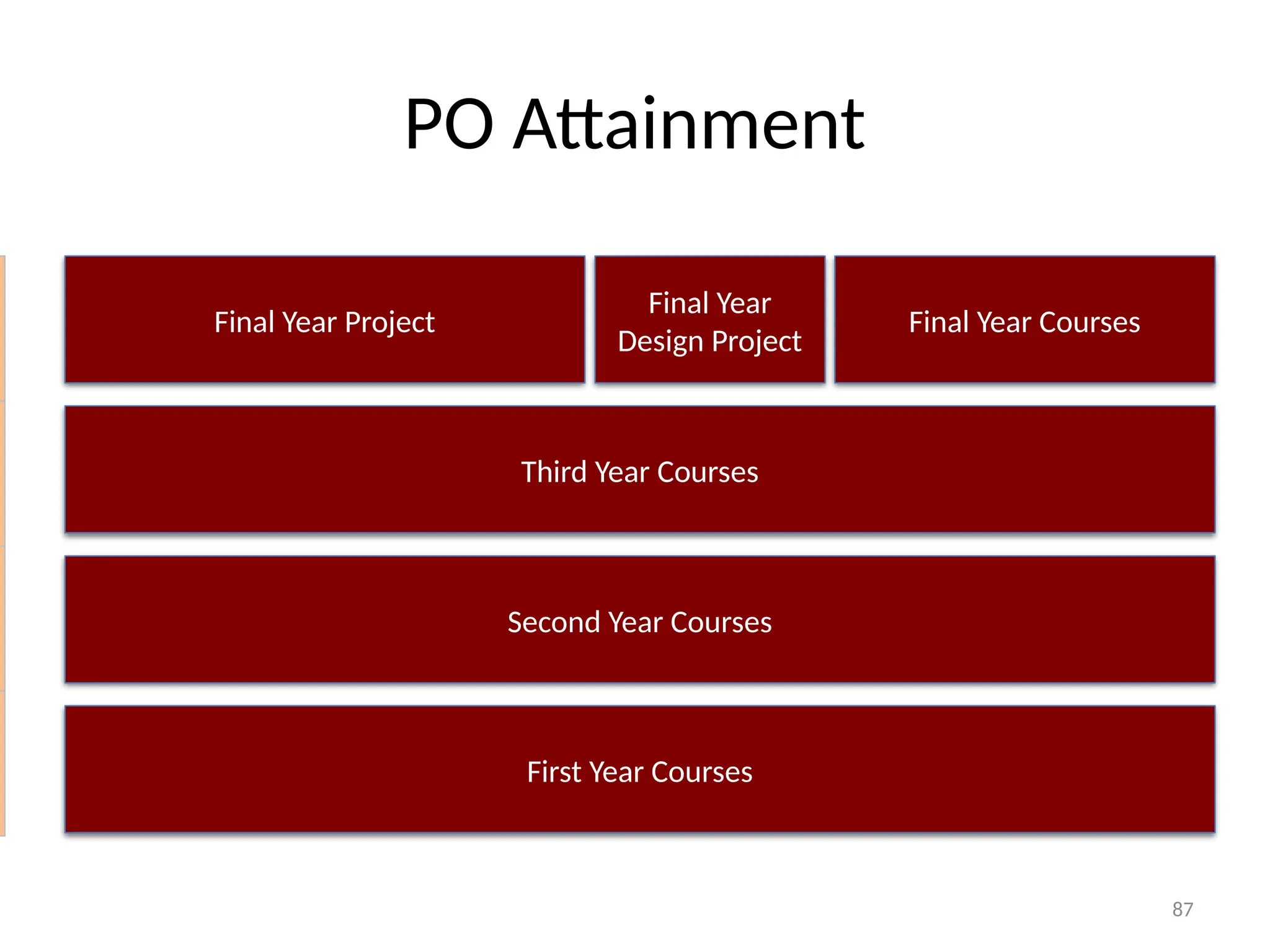
Final Year
Design Project
Final Year Courses
Third Year Courses
Second Year Courses
First Year Courses
Final Year Project
PO Attainment
Final Year Project
Final Year
Design Project
Final Year Courses
Third Year Courses
Second Year Courses
First Year Courses
88
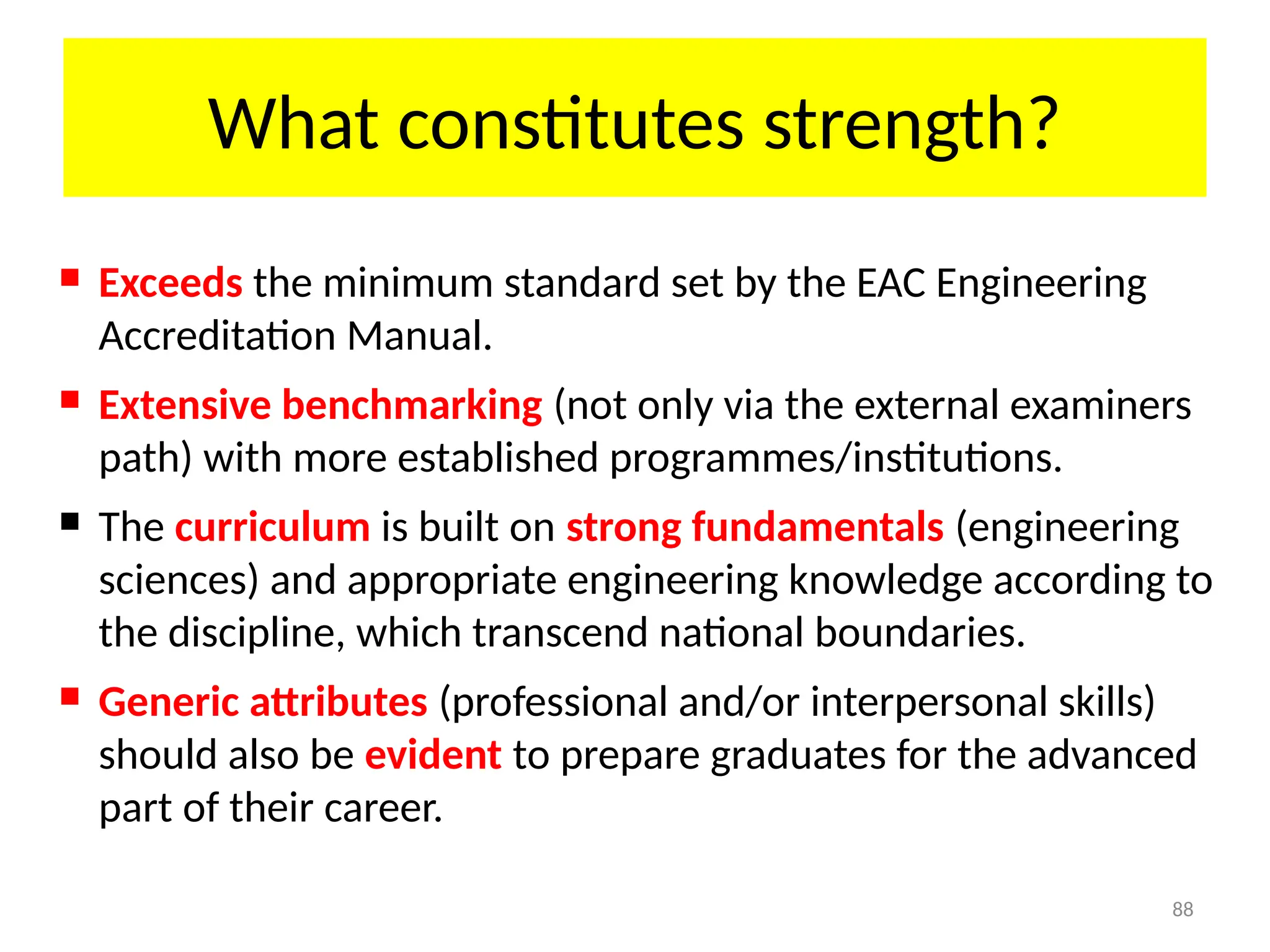
What constitutes strength?
 Exceeds the minimum standard set by the EAC Engineering
Accreditation Manual.
 Extensive benchmarking (not only via the external examiners
path) with more established programmes/institutions.
 The curriculum is built on strong fundamentals (engineering
sciences) and appropriate engineering knowledge according to
the discipline, which transcend national boundaries.
 Generic attributes (professional and/or interpersonal skills)
should also be evident to prepare graduates for the advanced
part of their career.
89
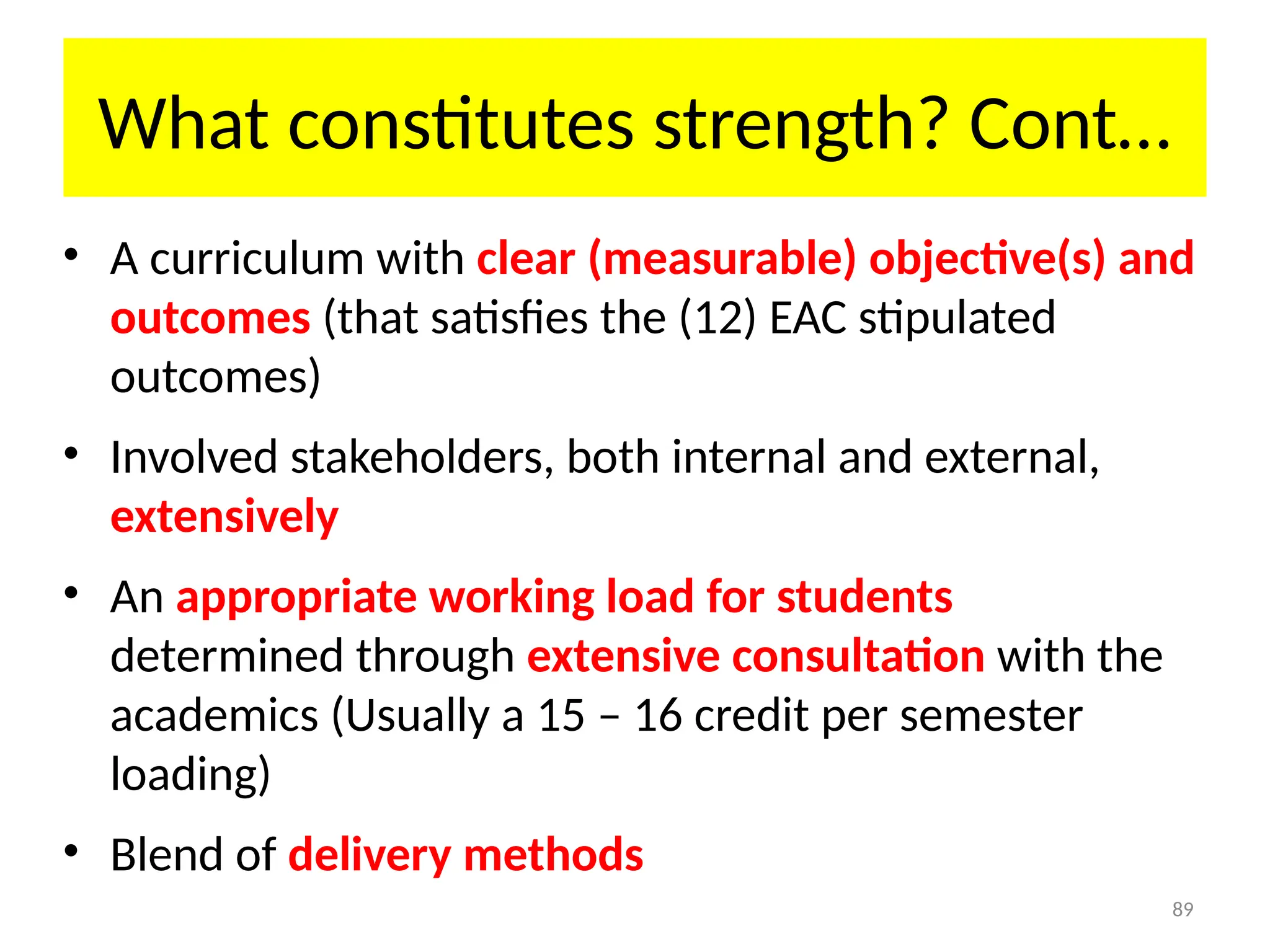
What constitutes strength? Cont…
• A curriculum with clear (measurable) objective(s) and
outcomes (that satisfies the (12) EAC stipulated
outcomes)
• Involved stakeholders, both internal and external,
extensively
• An appropriate working load for students
determined through extensive consultation with the
academics (Usually a 15 – 16 credit per semester
loading)
• Blend of delivery methods
90
What constitutes strength? Cont…
 Programme challenges students to achieve greater
heights than just satisfying the minimum standard
 Attain competency in the open-ended project
based and problem oriented courses
 Majority of the staff has PhD qualification and the
number available indicates a low staff-student
ratio (that enables greater contact with students)
 The academic staffs also conduct research that
permeates/contributes to teaching and learning.
91
What constitutes strength? Cont…
• Over and above Industrial Training (extensive &
distributed professional exposure) that does not
compromise on the cognitive domain
• Ergonomics is taken seriously by the institution to reduce
occupational hazard
• Safety culture
• Show that they have the plan and the completion of the
quality cycles is widespread
• Monitoring of the QMS also indicates strength.
92
What constitutes strength? Cont…
• Students’ ability to give opinion and articulate
with substance
• Students are clear of their goals upon graduation
and highly motivated during their course of study
(“constructive criticisms”)
• Widespread involvement of students in co-
curricular activities (not forced as part of
curriculum nor limited to small group of
students).
93
What constitutes strength? Cont…
• Academic staff with Professional Engineer
status
• Academic staff are actively participating in
professional activities (not merely members)
• Design courses are taught by experienced
academics (with consultancy experience or
professional engineers).
94
What constitutes strength? Cont…
• Up to date facilities are made available and
they exceed the recommended student-
equipment ratio appropriate to the relevant
discipline.
• Extensive electronics publications for life long
learning, project based courses and the final
year project
Taxonomy & Course Outcome
• Knowledge (list)
• Comprehension (explain)
• Application (calculate, solve, determine)
• Analysis (classify, predict, model,derived)
• Synthesis (design, improve)
• Evaluation (judge, select, critique)
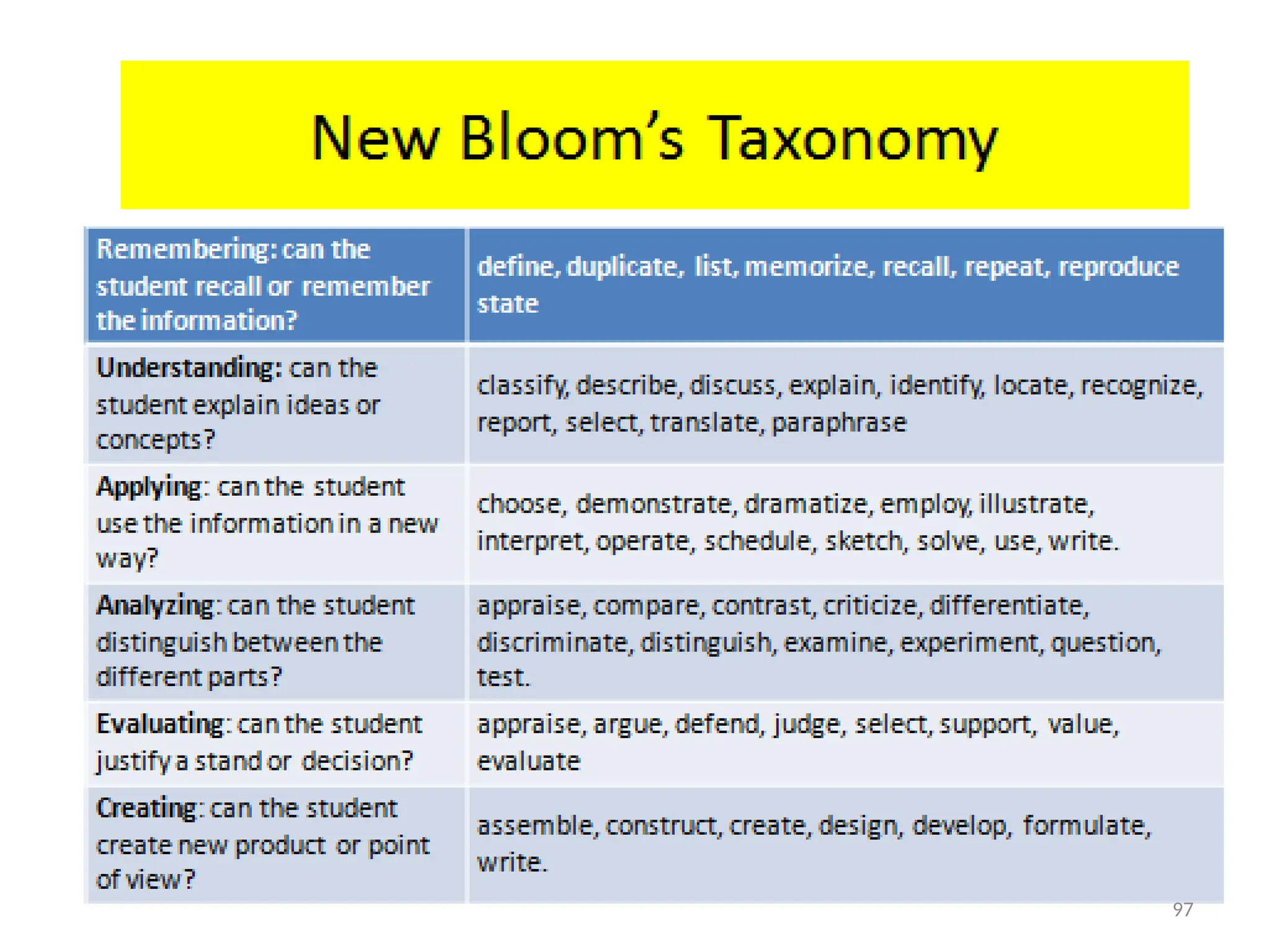
Bloom’s Taxonomy
96
97
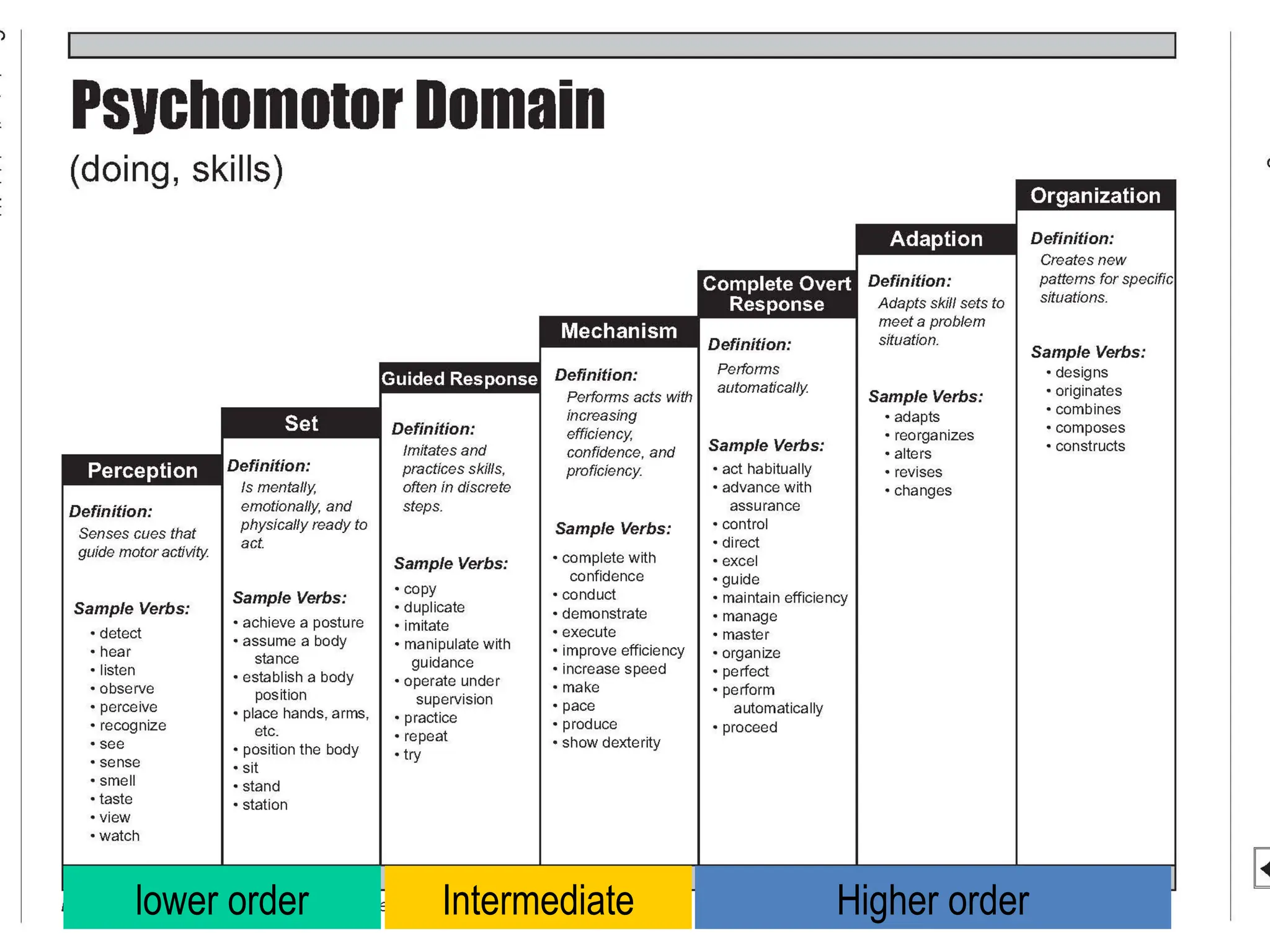
98
Higher order
lower order Intermediate
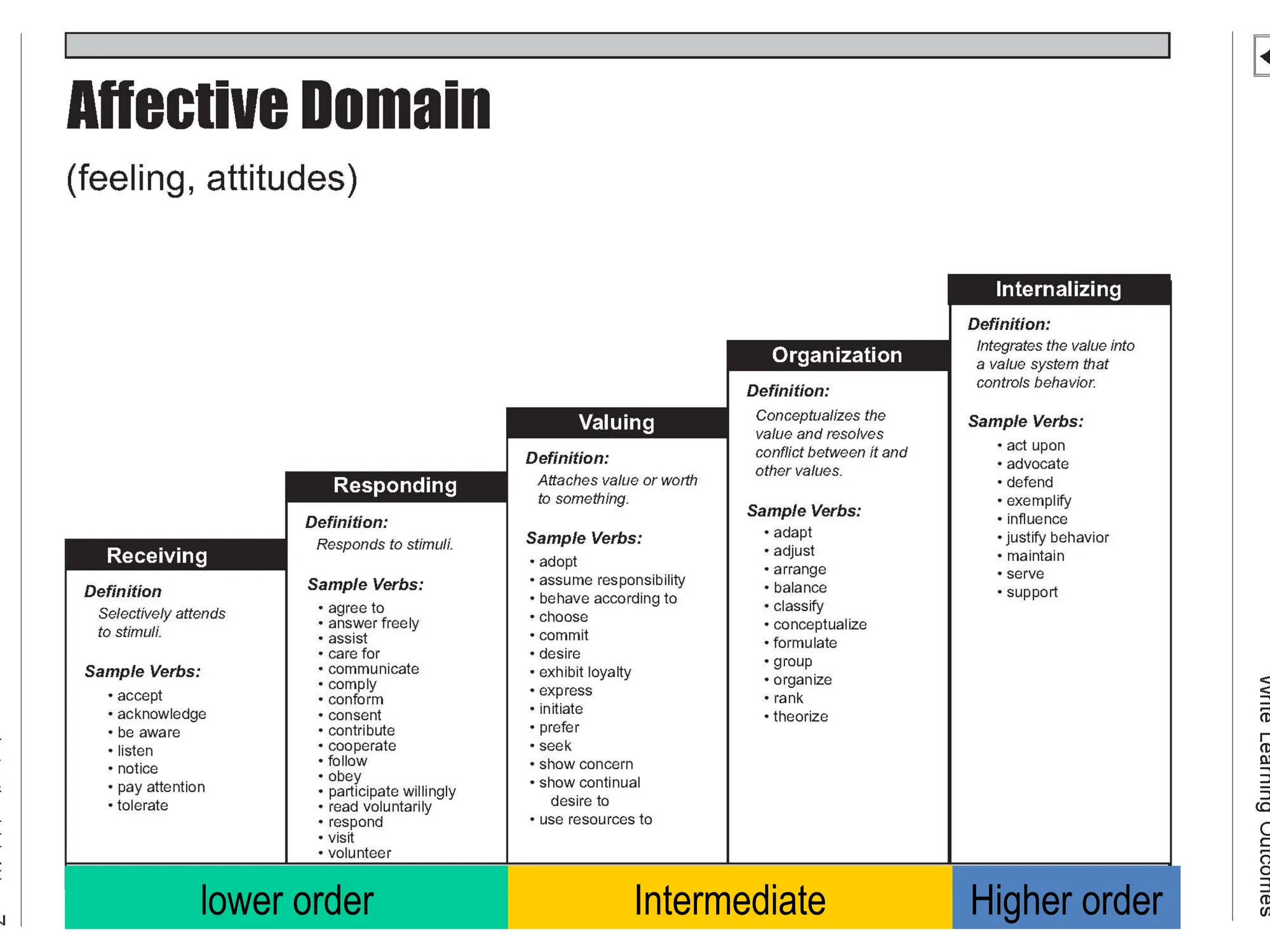
99
Higher order
lower order Intermediate
Why are course outcomes important?
• Define the type and depth of learning students are
expected to achieve
• Provide an objective benchmark for formative,
summative, and prior learning assessment
• Clearly communicate expectations to learners
• Clearly communicate graduates’ skills to the
stakeholders
• Define coherent units of learning that can be further
subdivided or modularized for classroom or for other
delivery modes.
• Guide and organize the instructor and the learner.
100
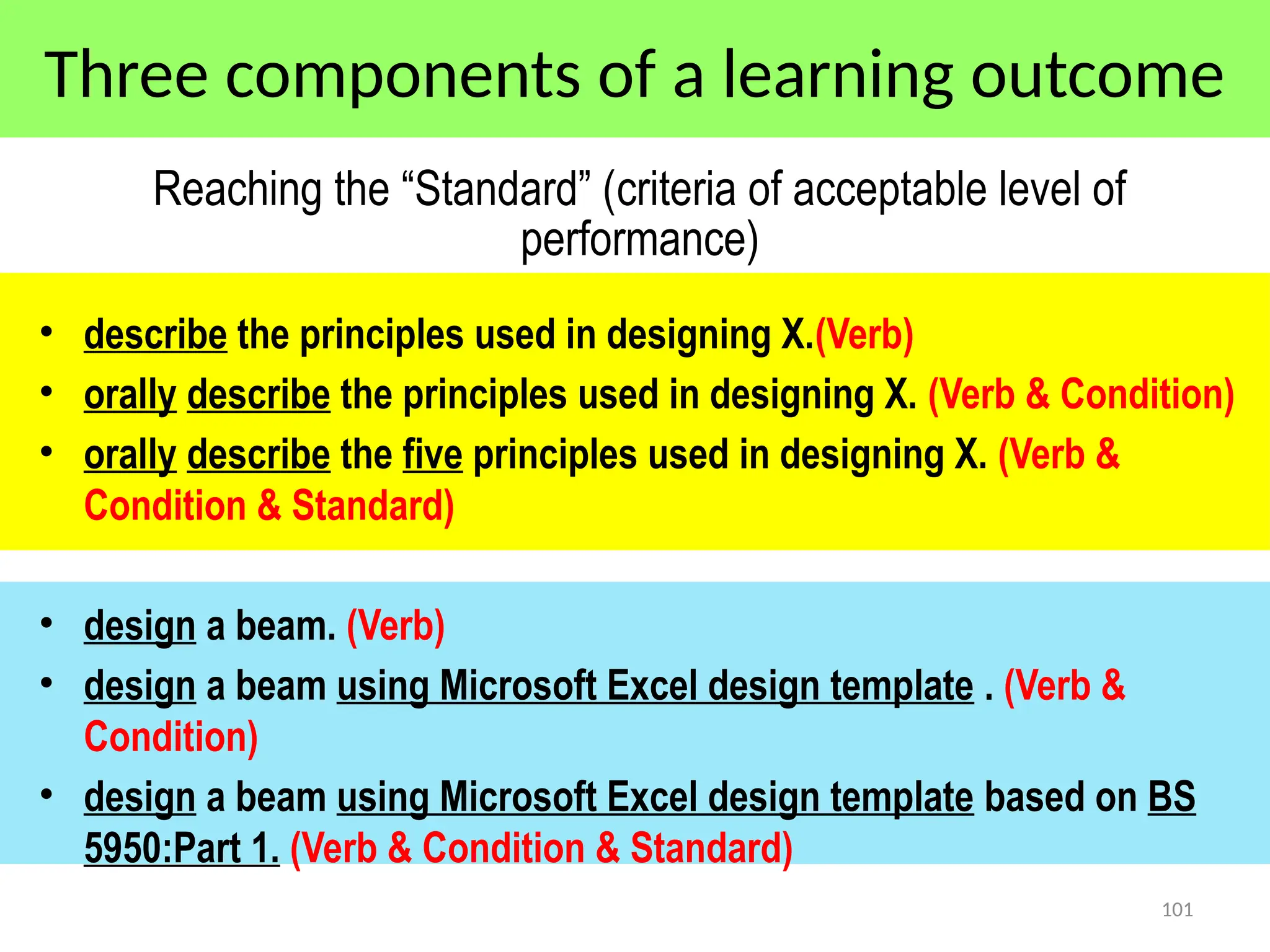
Three components of a learning outcome
Reaching the “Standard” (criteria of acceptable level of
performance)
• describe the principles used in designing X.(Verb)
• orally describe the principles used in designing X. (Verb & Condition)
• orally describe the five principles used in designing X. (Verb &
Condition & Standard)
• design a beam. (Verb)
• design a beam using Microsoft Excel design template . (Verb &
Condition)
• design a beam using Microsoft Excel design template based on BS
5950:Part 1. (Verb & Condition & Standard)
101
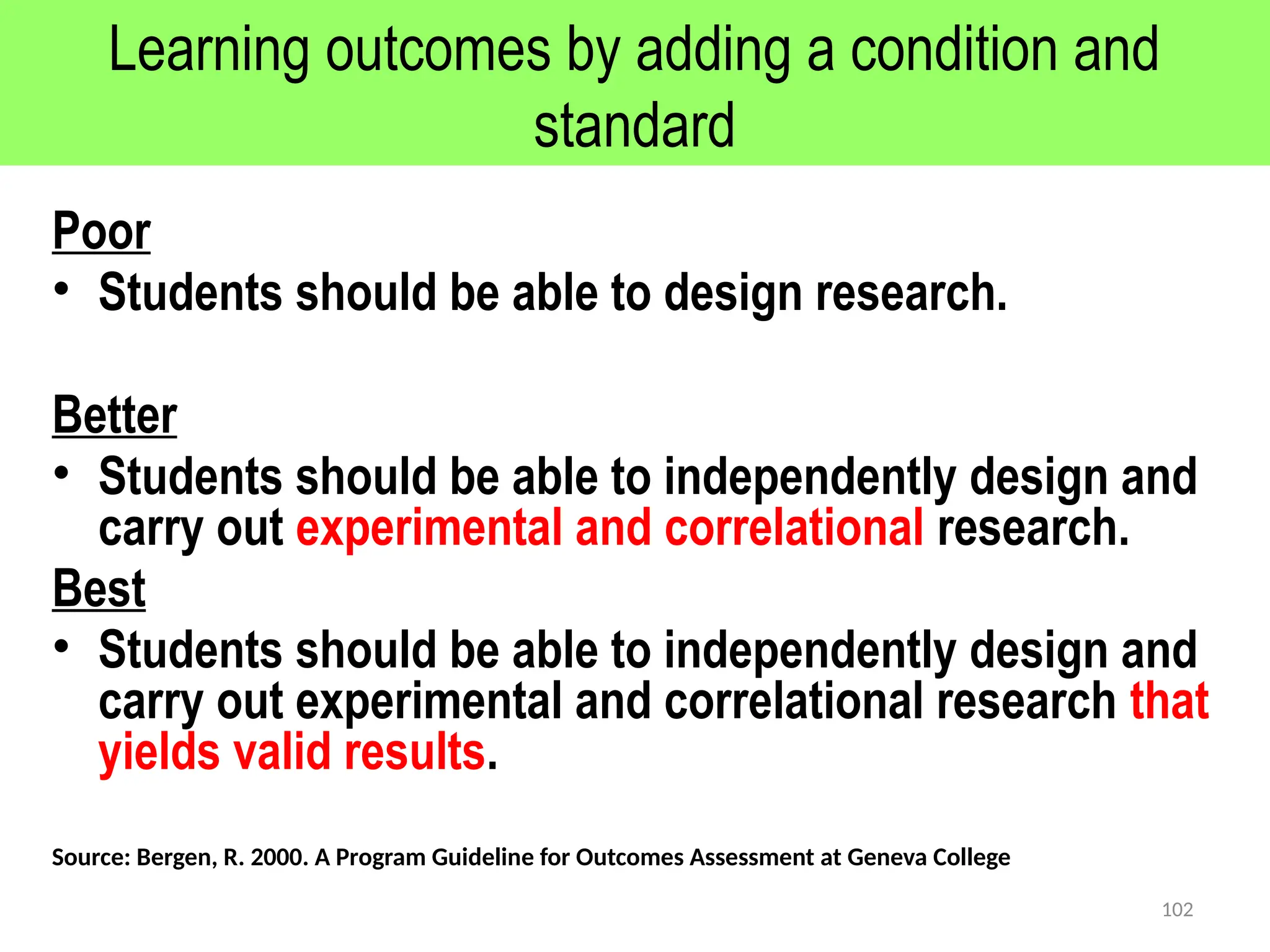
Learning outcomes by adding a condition and
standard
Poor
• Students should be able to design research.
Better
• Students should be able to independently design and
carry out experimental and correlational research.
Best
• Students should be able to independently design and
carry out experimental and correlational research that
yields valid results.
Source: Bergen, R. 2000. A Program Guideline for Outcomes Assessment at Geneva College
102
WA Knowledge Profile (WK)
103
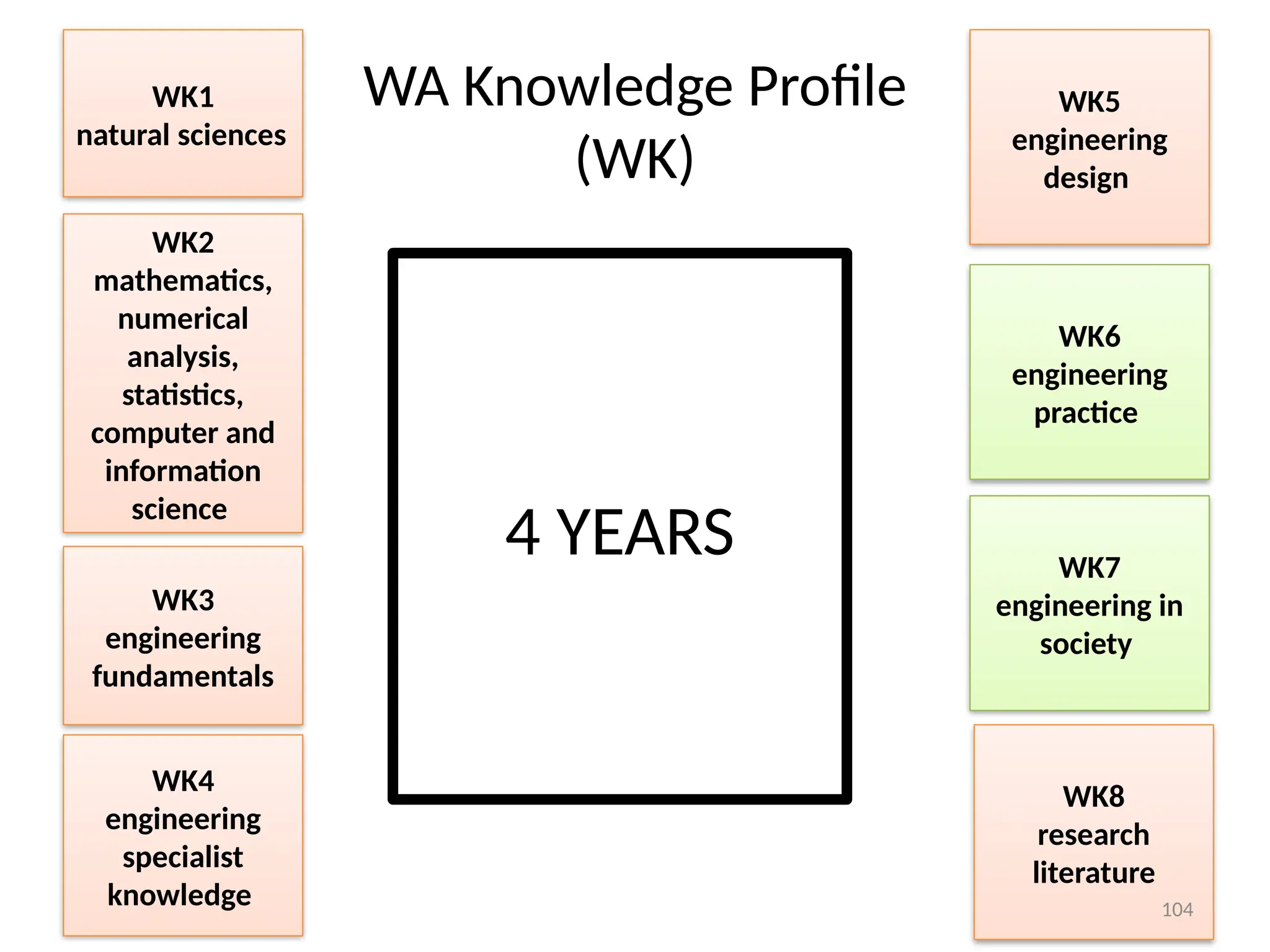
WA Knowledge Profile
(WK)
4 YEARS
WK1
natural sciences
WK3
engineering
fundamentals
WK2
mathematics,
numerical
analysis,
statistics,
computer and
information
science
WK4
engineering
specialist
knowledge
WK5
engineering
design
WK6
engineering
practice
WK8
research
literature
WK7
engineering in
society
104
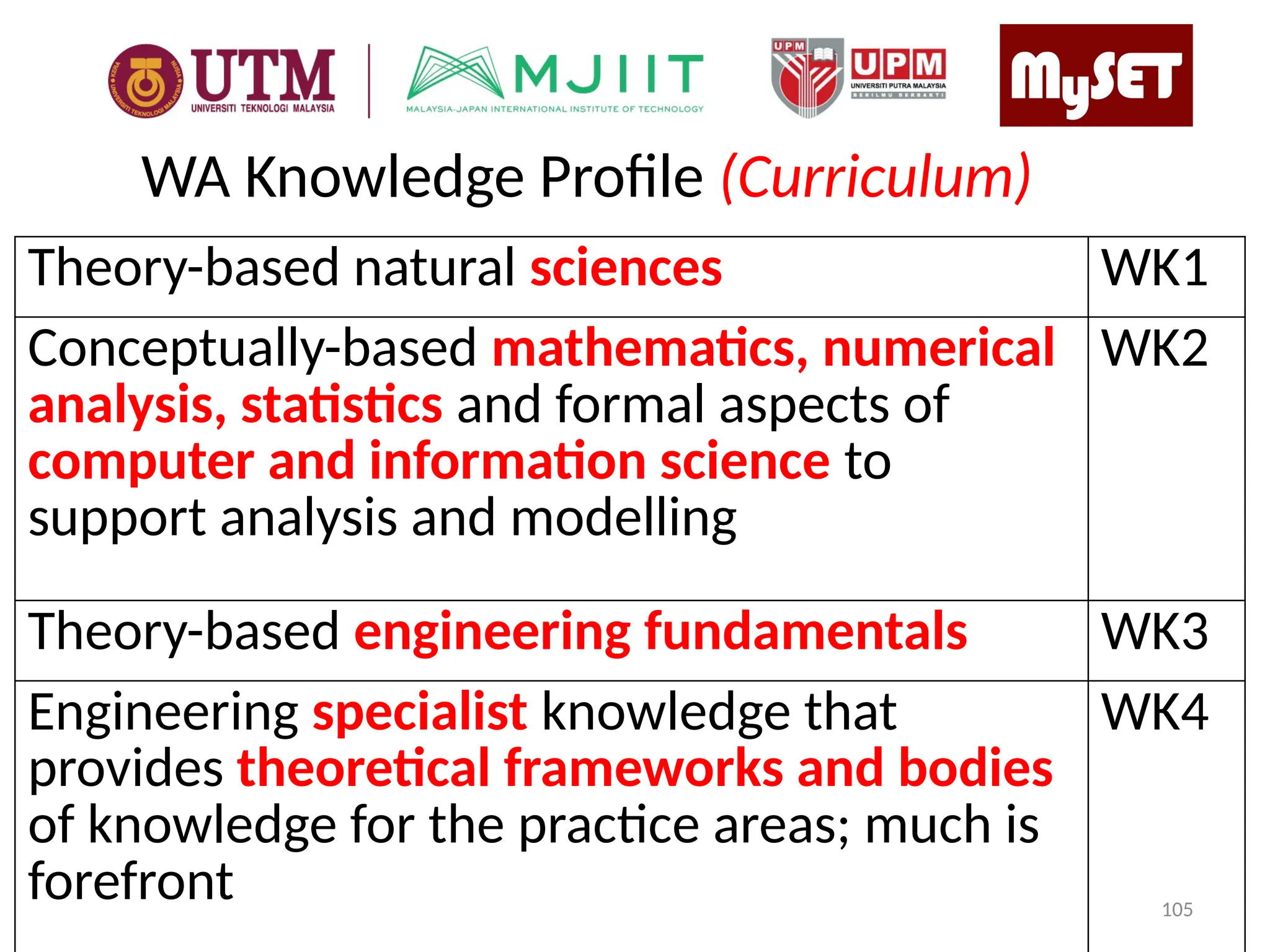
Theory-based natural sciences WK1
Conceptually-based mathematics, numerical
analysis, statistics and formal aspects of
computer and information science to
support analysis and modelling
WK2
Theory-based engineering fundamentals WK3
Engineering specialist knowledge that
provides theoretical frameworks and bodies
of knowledge for the practice areas; much is
forefront
WK4
WA Knowledge Profile (Curriculum)
105
WA Knowledge Profile
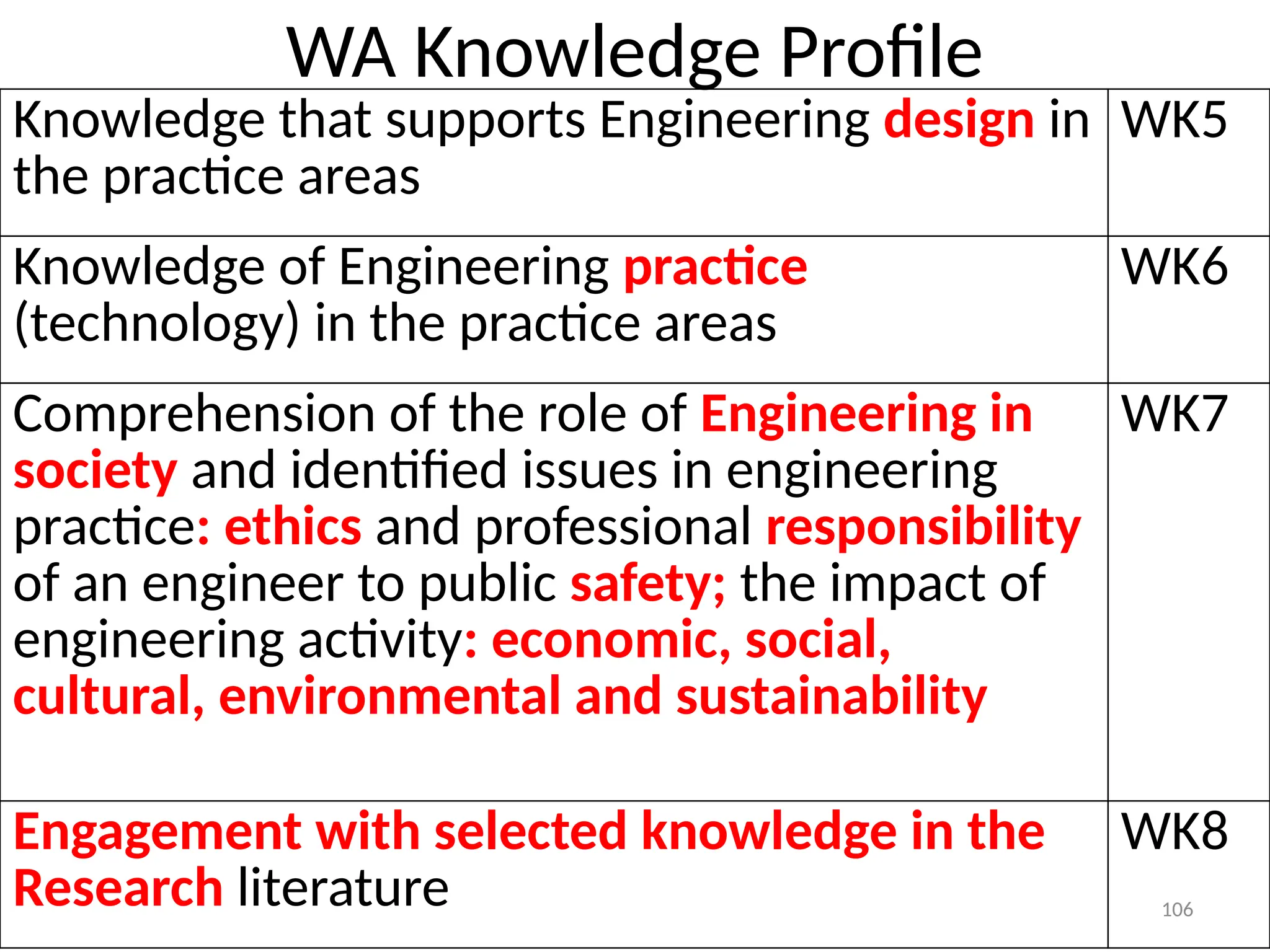
Knowledge that supports Engineering design in
the practice areas
WK5
Knowledge of Engineering practice
(technology) in the practice areas
WK6
Comprehension of the role of Engineering in
society and identified issues in engineering
practice: ethics and professional responsibility
of an engineer to public safety; the impact of
engineering activity: economic, social,
cultural, environmental and sustainability
WK7
Engagement with selected knowledge in the
Research literature
WK8
106
WA Programme Outcome or
Graduate Attributes (WA)
107
108
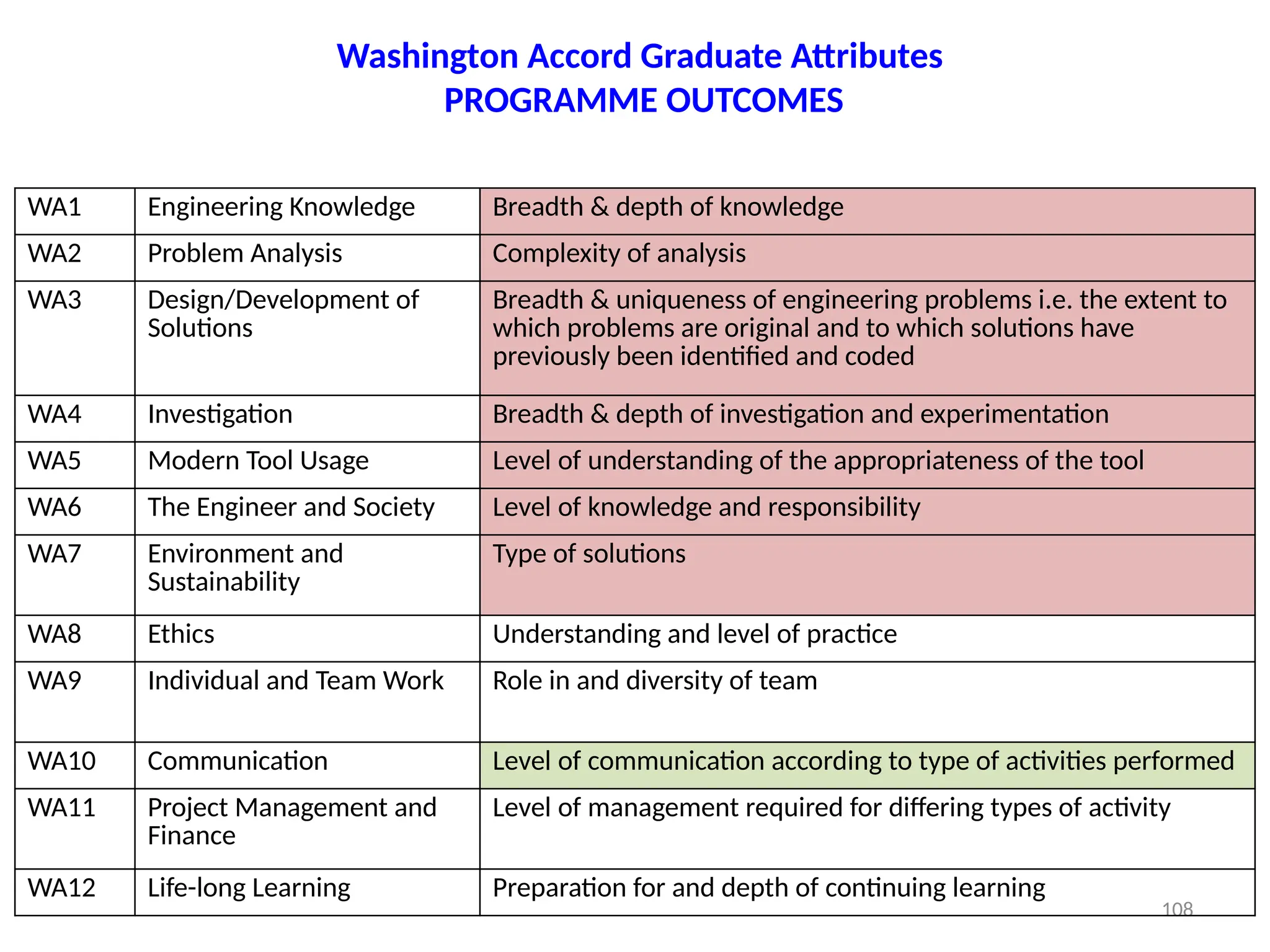
Washington Accord Graduate Attributes
PROGRAMME OUTCOMES
WA1 Engineering Knowledge Breadth & depth of knowledge
WA2 Problem Analysis Complexity of analysis
WA3 Design/Development of
Solutions
Breadth & uniqueness of engineering problems i.e. the extent to
which problems are original and to which solutions have
previously been identified and coded
WA4 Investigation Breadth & depth of investigation and experimentation
WA5 Modern Tool Usage Level of understanding of the appropriateness of the tool
WA6 The Engineer and Society Level of knowledge and responsibility
WA7 Environment and
Sustainability
Type of solutions
WA8 Ethics Understanding and level of practice
WA9 Individual and Team Work Role in and diversity of team
WA10 Communication Level of communication according to type of activities performed
WA11 Project Management and
Finance
Level of management required for differing types of activity
WA12 Life-long Learning Preparation for and depth of continuing learning
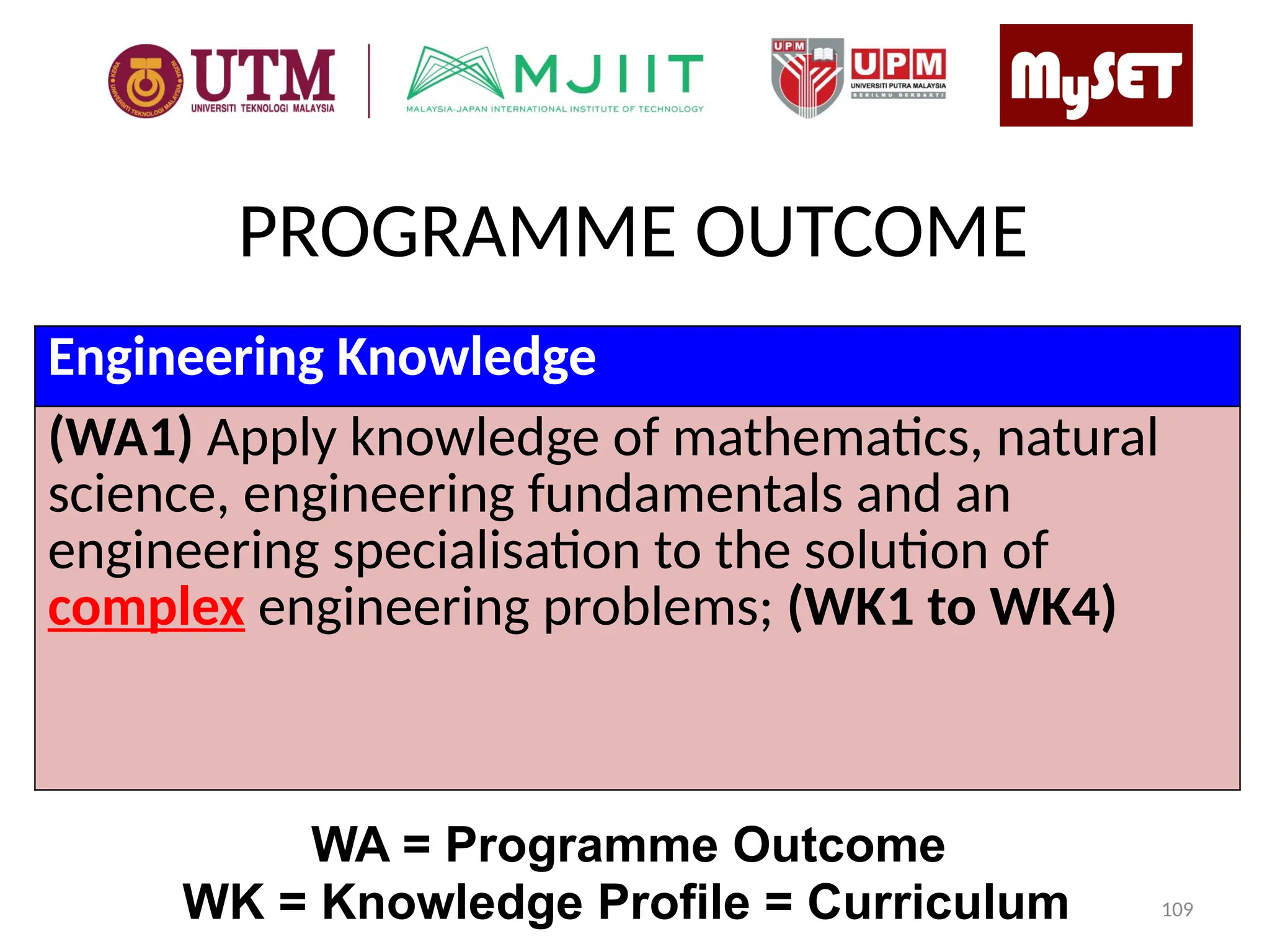
Engineering Knowledge
(WA1) Apply knowledge of mathematics, natural
science, engineering fundamentals and an
engineering specialisation to the solution of
complex engineering problems; (WK1 to WK4)
PROGRAMME OUTCOME
WK = Knowledge Profile = Curriculum
WA = Programme Outcome
109
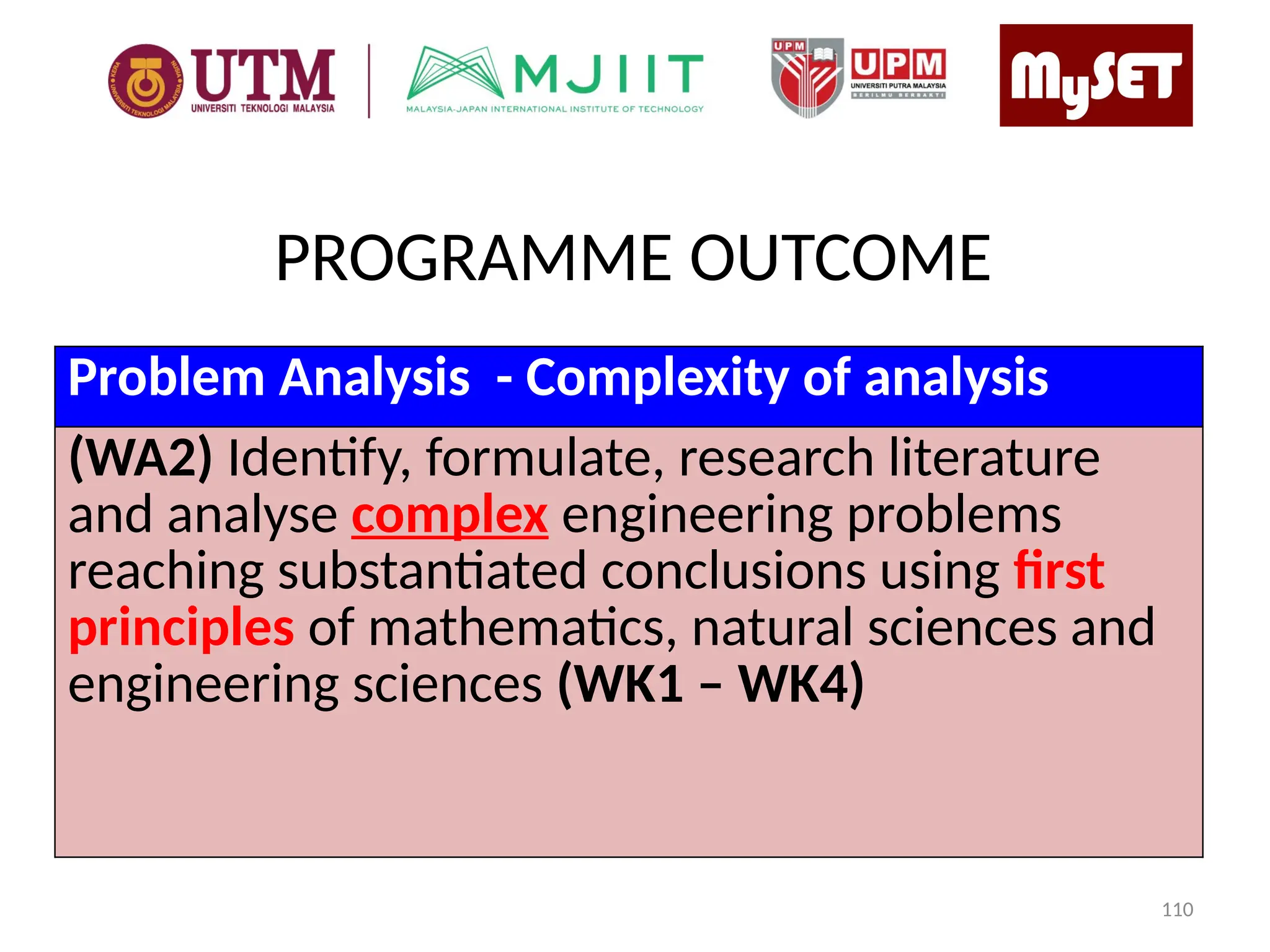
Problem Analysis - Complexity of analysis
(WA2) Identify, formulate, research literature
and analyse complex engineering problems
reaching substantiated conclusions using first
principles of mathematics, natural sciences and
engineering sciences (WK1 – WK4)
PROGRAMME OUTCOME
110
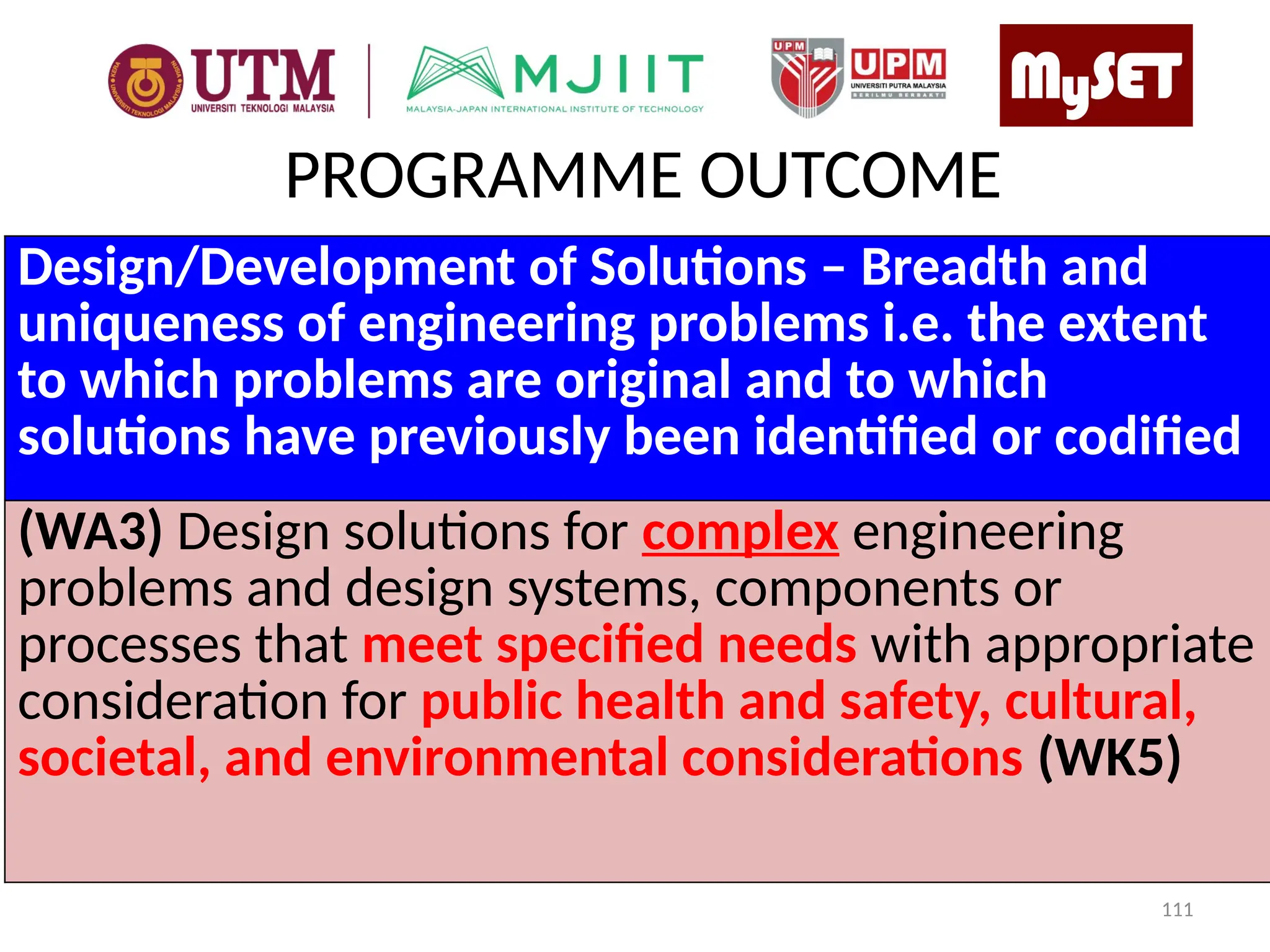
Design/Development of Solutions – Breadth and
uniqueness of engineering problems i.e. the extent
to which problems are original and to which
solutions have previously been identified or codified
(WA3) Design solutions for complex engineering
problems and design systems, components or
processes that meet specified needs with appropriate
consideration for public health and safety, cultural,
societal, and environmental considerations (WK5)
PROGRAMME OUTCOME
111
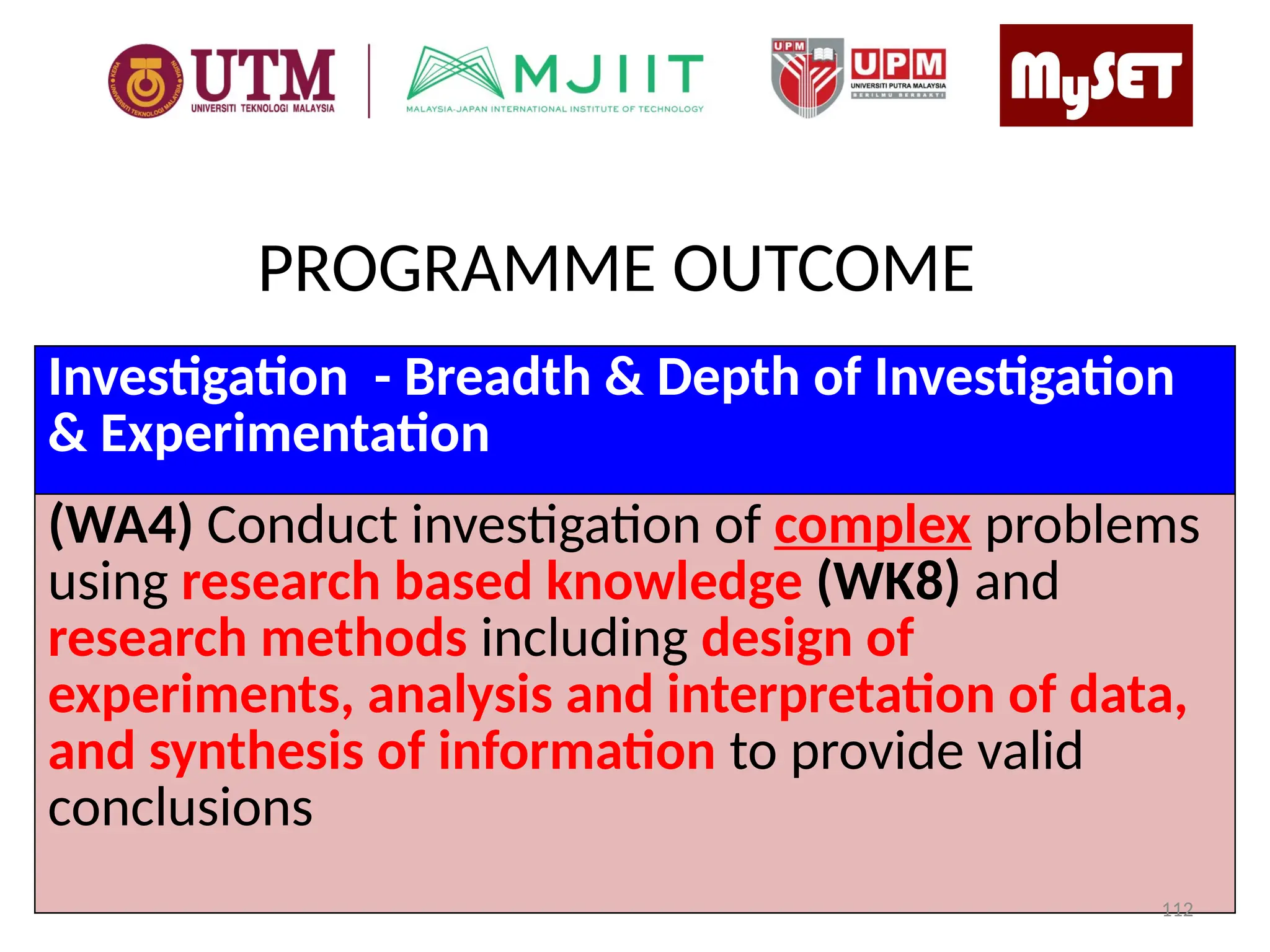
Investigation - Breadth & Depth of Investigation
& Experimentation
(WA4) Conduct investigation of complex problems
using research based knowledge (WK8) and
research methods including design of
experiments, analysis and interpretation of data,
and synthesis of information to provide valid
conclusions
PROGRAMME OUTCOME
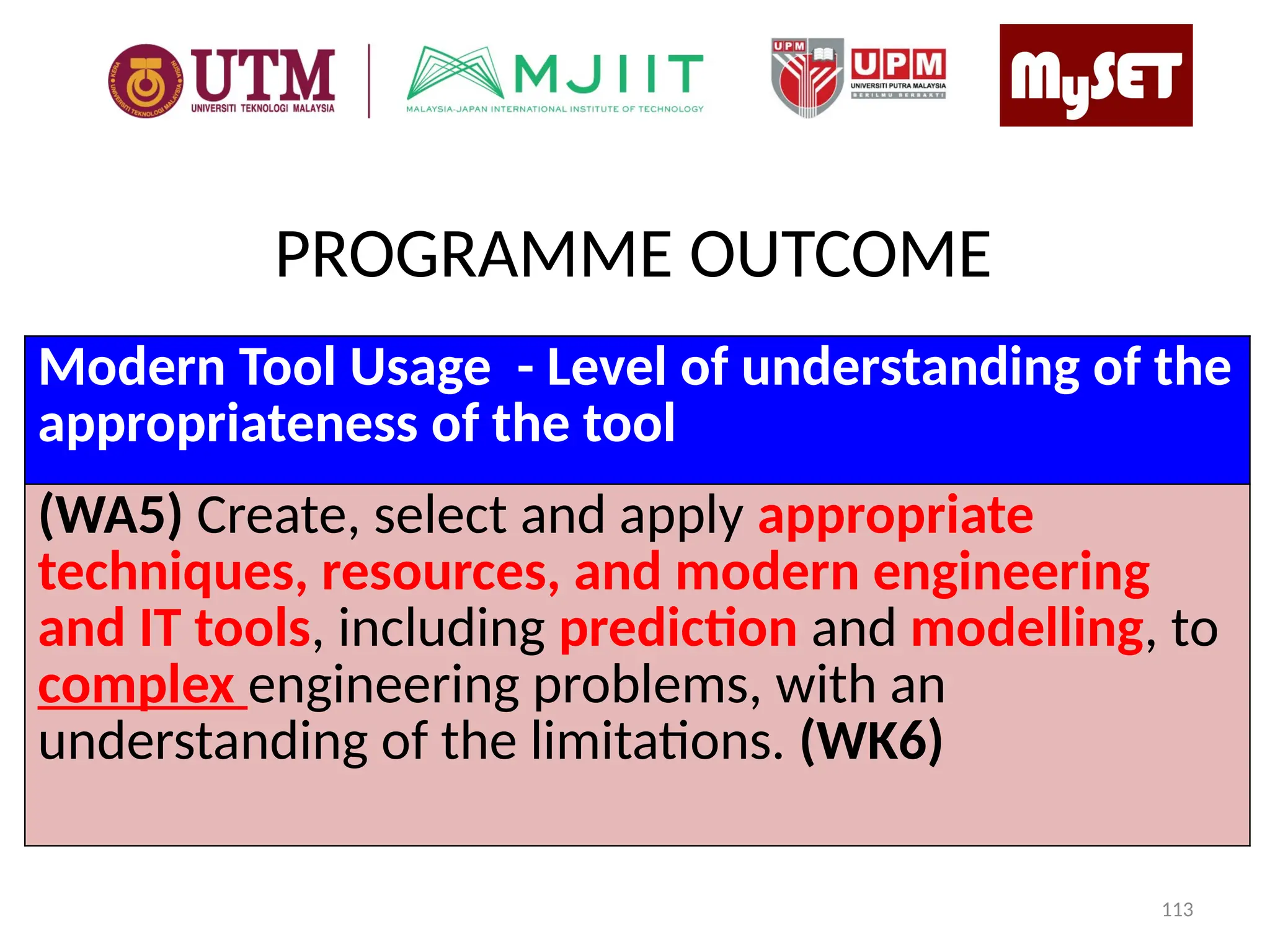
112
Modern Tool Usage - Level of understanding of the
appropriateness of the tool
(WA5) Create, select and apply appropriate
techniques, resources, and modern engineering
and IT tools, including prediction and modelling, to
complex engineering problems, with an
understanding of the limitations. (WK6)
PROGRAMME OUTCOME
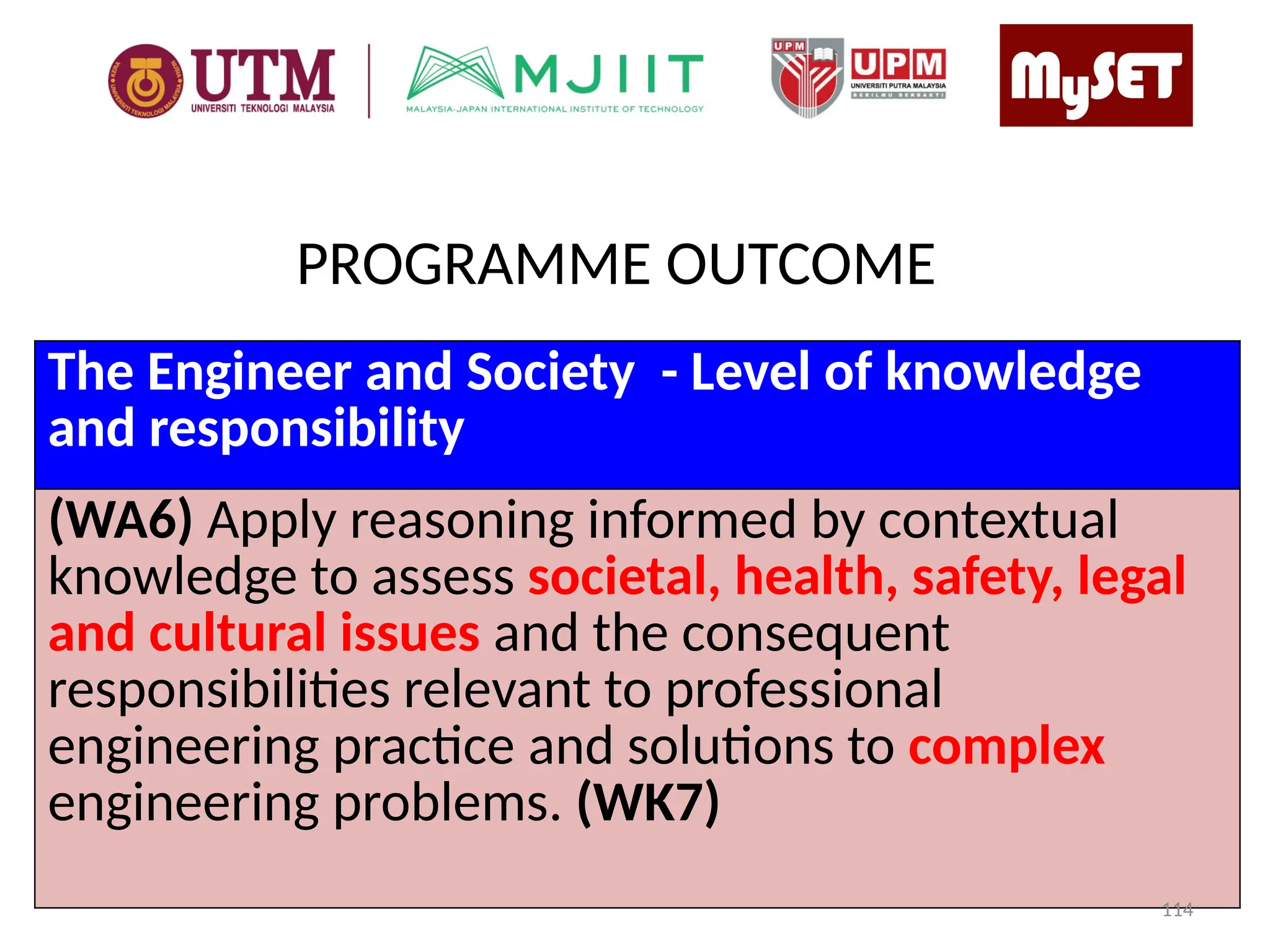
113
The Engineer and Society - Level of knowledge
and responsibility
(WA6) Apply reasoning informed by contextual
knowledge to assess societal, health, safety, legal
and cultural issues and the consequent
responsibilities relevant to professional
engineering practice and solutions to complex
engineering problems. (WK7)
PROGRAMME OUTCOME
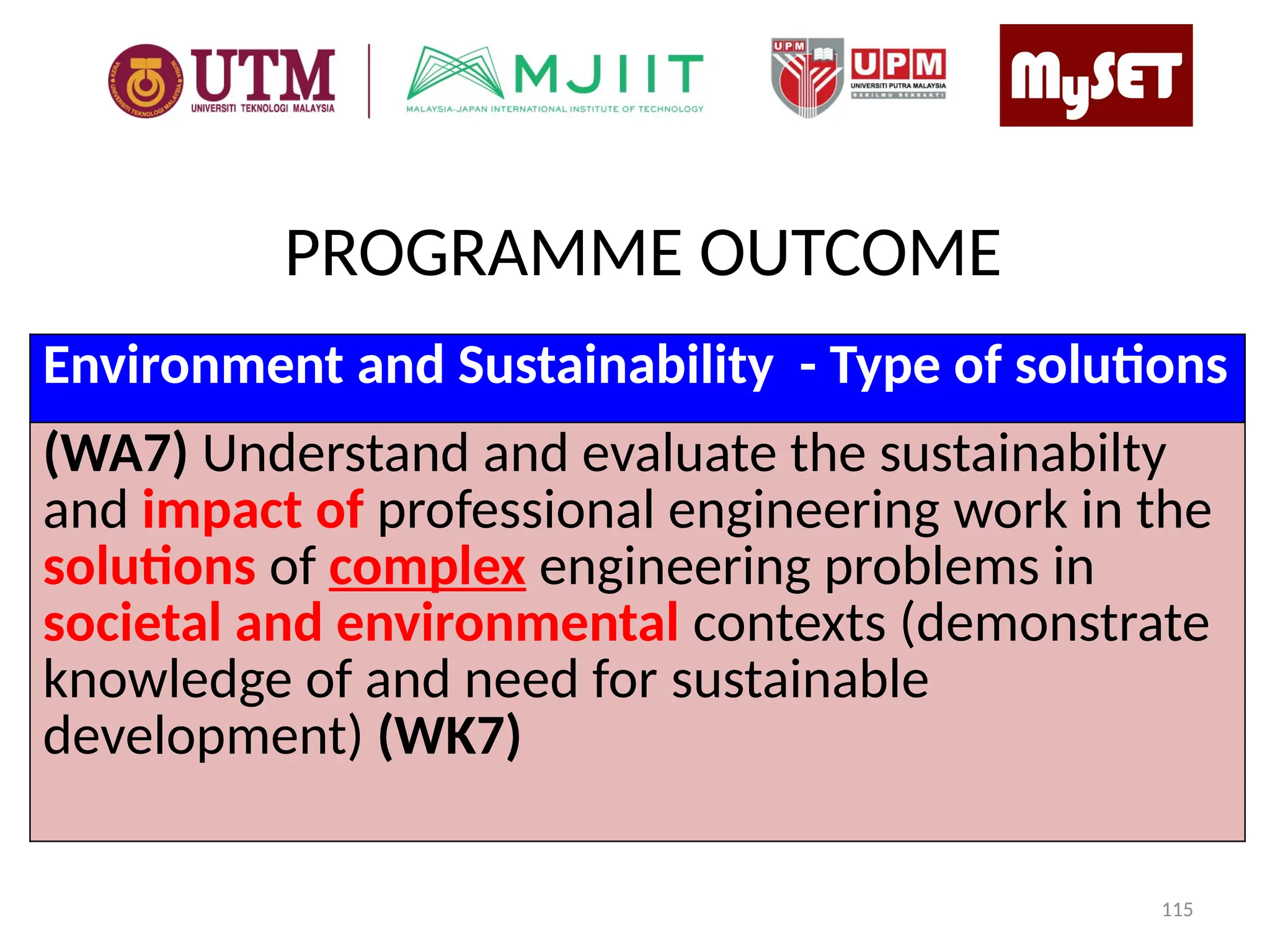
114
Environment and Sustainability - Type of solutions
(WA7) Understand and evaluate the sustainabilty
and impact of professional engineering work in the
solutions of complex engineering problems in
societal and environmental contexts (demonstrate
knowledge of and need for sustainable
development) (WK7)
PROGRAMME OUTCOME
115
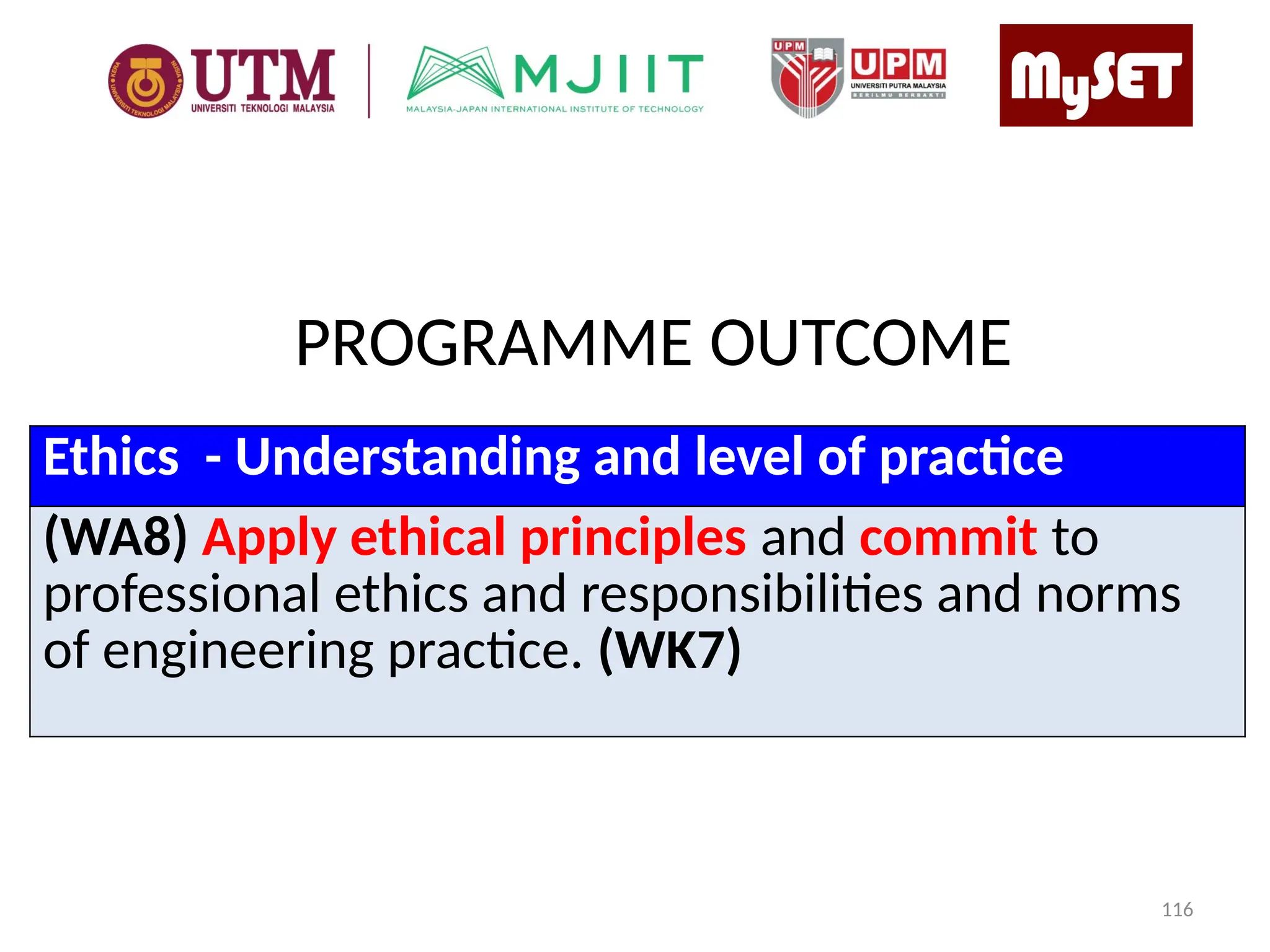
PROGRAMME OUTCOME
Ethics - Understanding and level of practice
(WA8) Apply ethical principles and commit to
professional ethics and responsibilities and norms
of engineering practice. (WK7)
116
PROGRAMME OUTCOME
Individual and Team Work – Role in and diversity
of team
(WA9) Function effectively as an individual, and as
a member or leader in diverse teams and in multi-
disciplinary settings
117
Communication – Level of communication
according to type of activities performed
(WA10) Communicate effectively on complex
engineering activities with the engineering
community and with society at large, such as being
able to comprehend and write effective reports
and design documentation, make effective
presentations, and give and receive clear
instructions
PROGRAMME OUTCOME
118
PROGRAMME OUTCOME
Project Management and Finance – Level of
management required for differing types of
activity
(WA11) Demonstrate knowledge and
understanding of engineering and management
principles and economic decision-making and
apply these to one’s own work, as a member and
leader in a team, to manage projects and in
multidisciplinary environments
119
PROGRAMME OUTCOME
Life-long Learning – Preparation for and depth of
continuing learning
(WA12) Recognise the need for, and have the
preparation and ability to engage in independent
and life-long learning in the broadest context of
technological change
120
WK1
natural sciences
WK2
mathematics,
numerical
analysis,
statistics,
computer and
information
science
WK3
engineering
fundamentals
WK4
engineering
specialist
knowledge
WK5
engineering
design
WK6
engineering
practice
WK7
engineering in
society
WK8
research
literature
WA1
ENGINEERING
KNOWLEDGE
WA2
PROBLEM
ANALYSIS
WA3
DESIGN
WA5
MODERN TOOLS
WA6 ENGR & SOC
WA7 ENV & SUST
WA8 ETHICS
WA4
INVESTIGATION
WA9
IND & TEAM
WA10
COMMUNICAT-ION
WA11
PROJ MGMT & FINANCE
WA12
LIFE LONG
121
4 YEARS
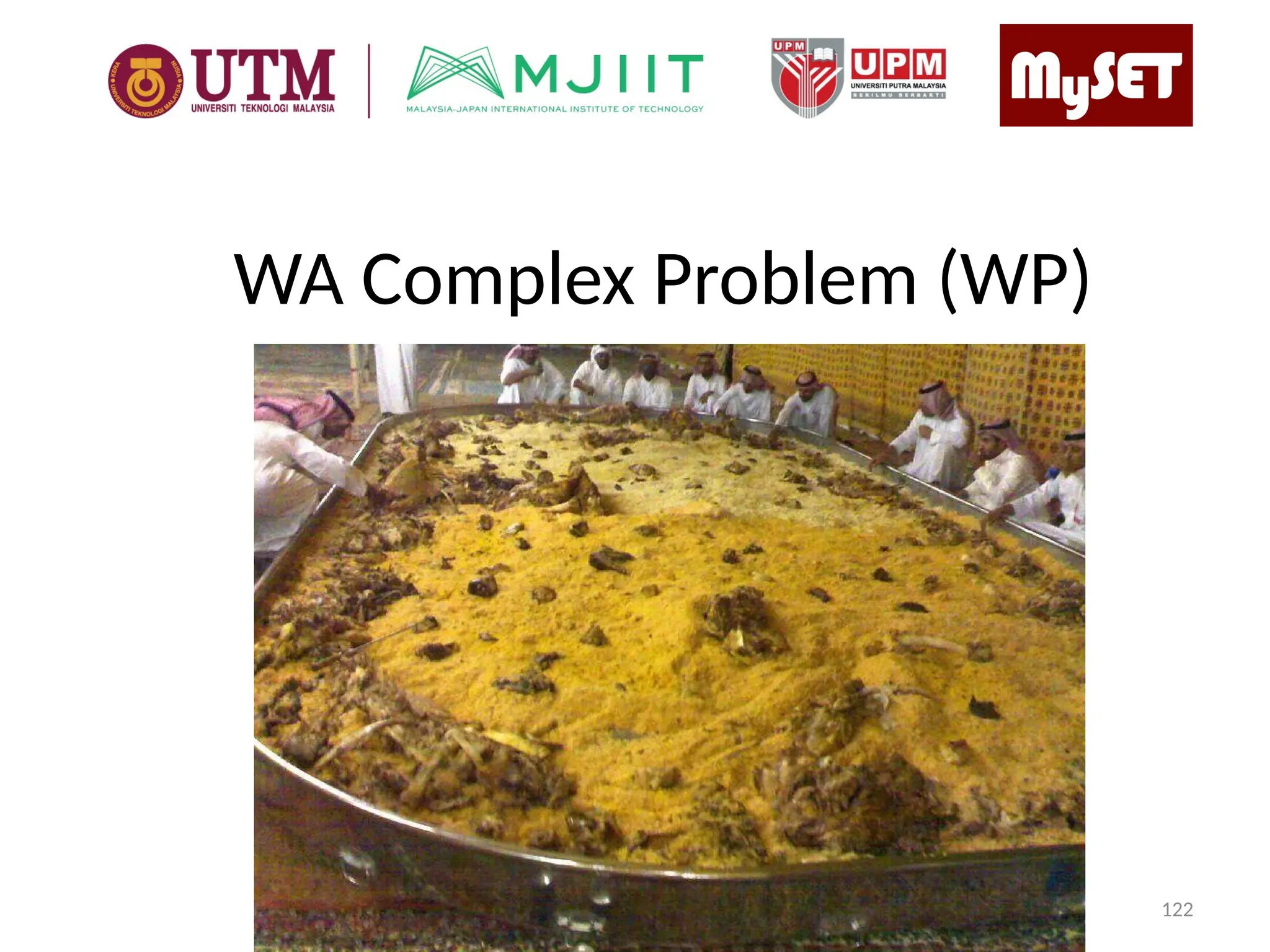
WA Complex Problem (WP)
122
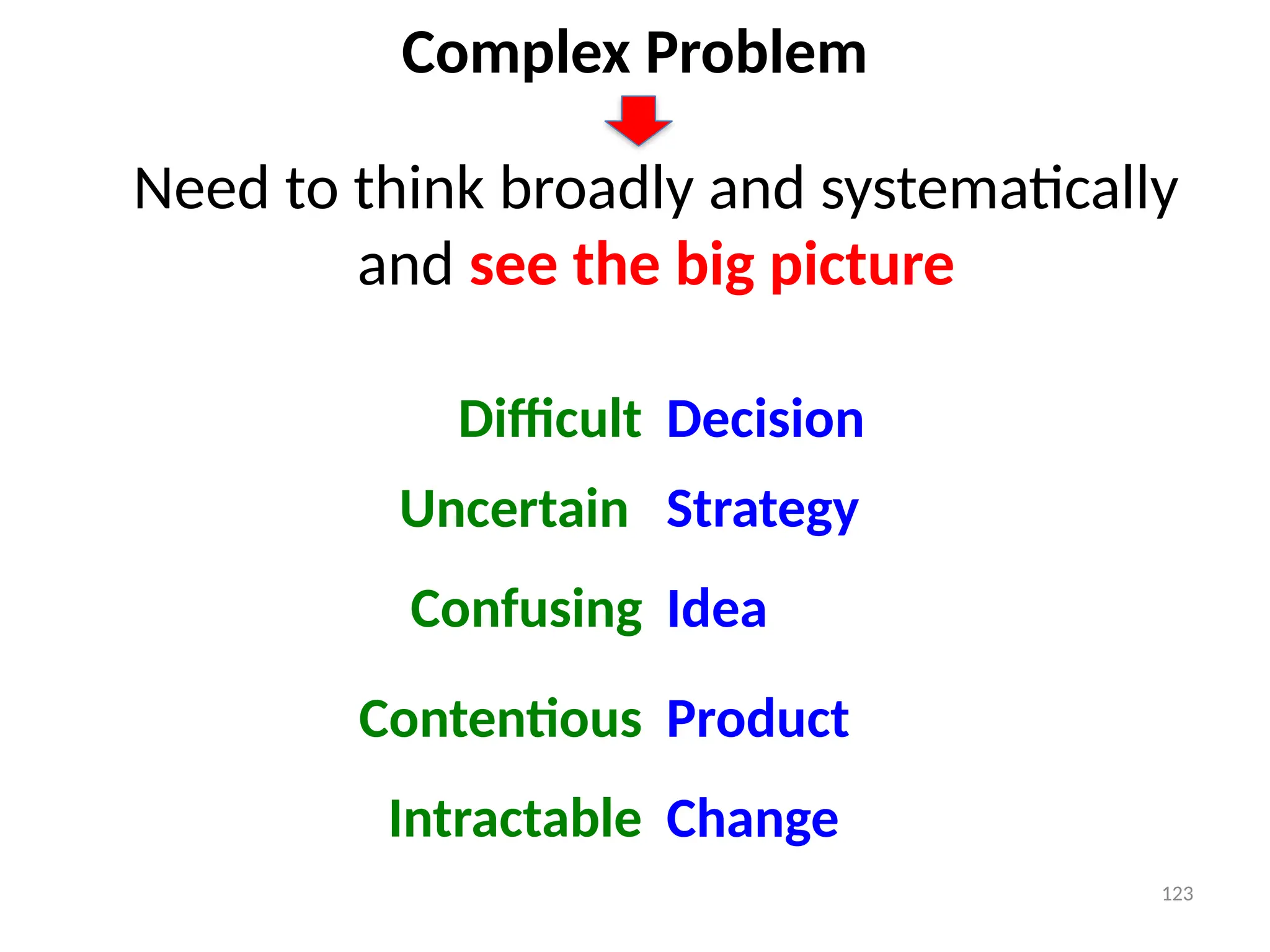
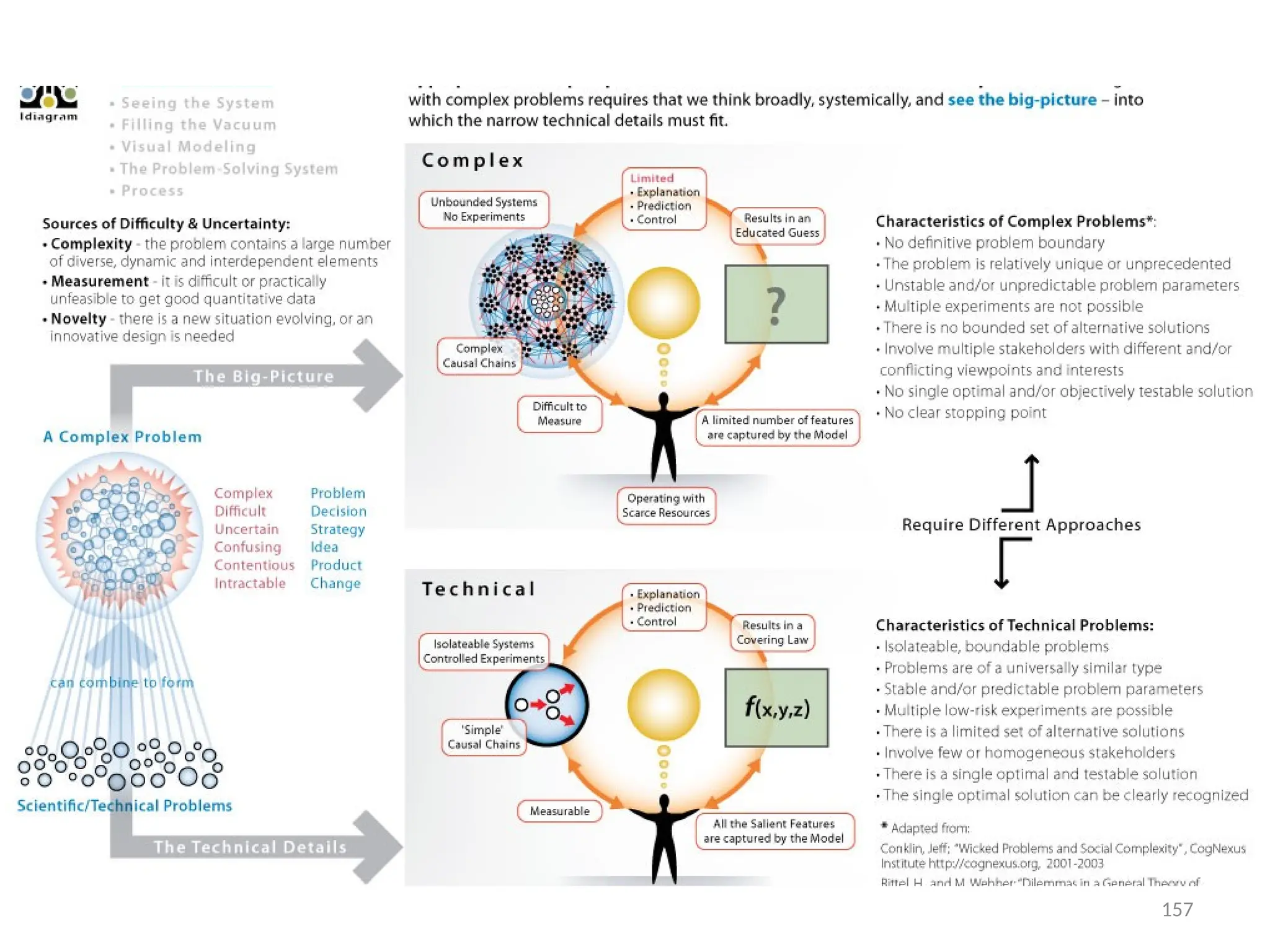
Complex Problem
Uncertain
Change
Difficult
Confusing
Intractable
Contentious
Decision
Strategy
Idea
Product
Need to think broadly and systematically
and see the big picture
123
Difficulty & Uncertainty
• Complexity – the problem contains a large
number of diverse, dynamic and
interdependent elements
• Measurement – it is difficult or practically
unfeasible to get good qualitative data
• Novelty – there is a new solution evolving
or an innovative design is needed
124
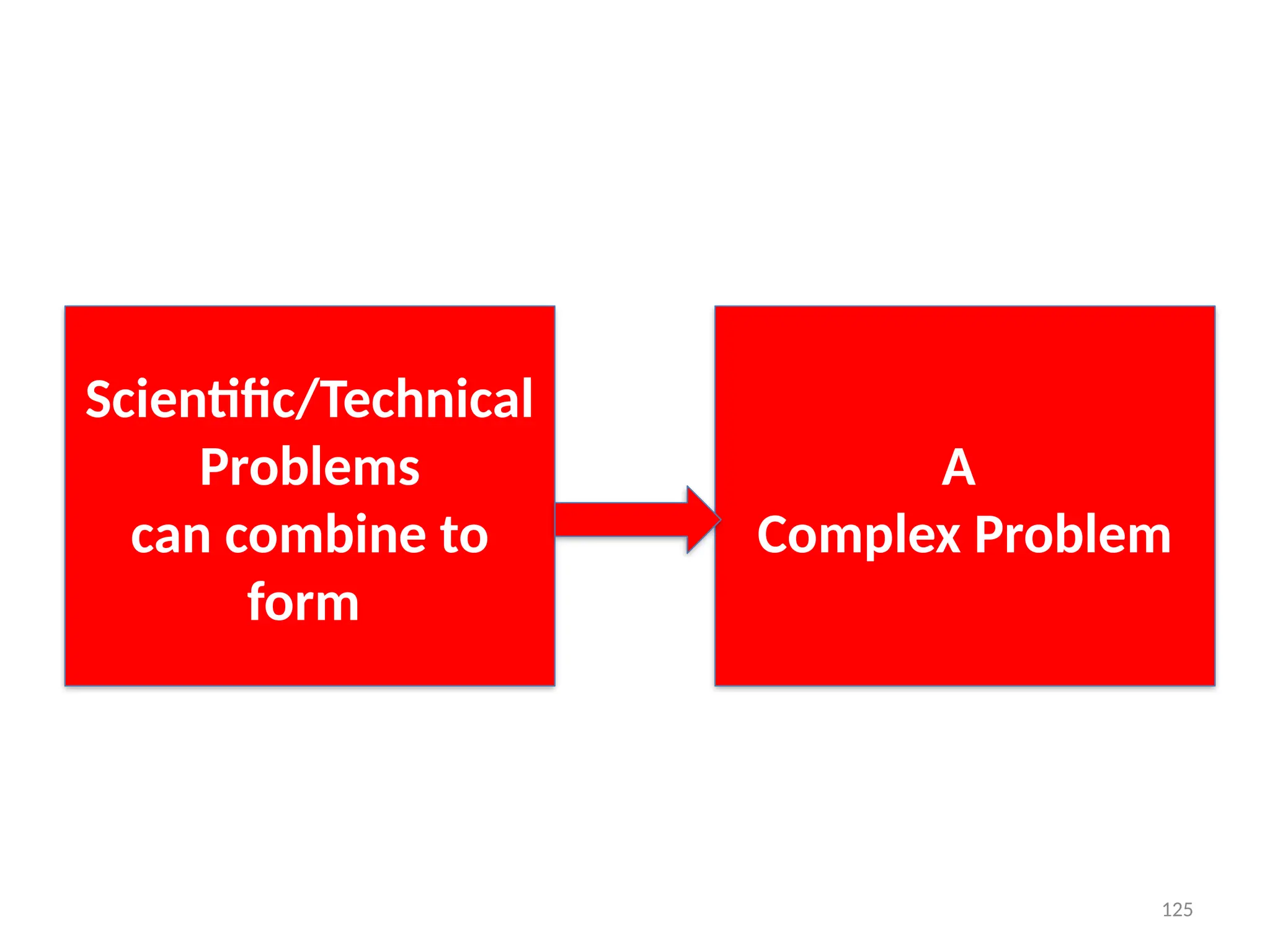
Scientific/Technical
Problems
can combine to
form
A
Complex Problem
125
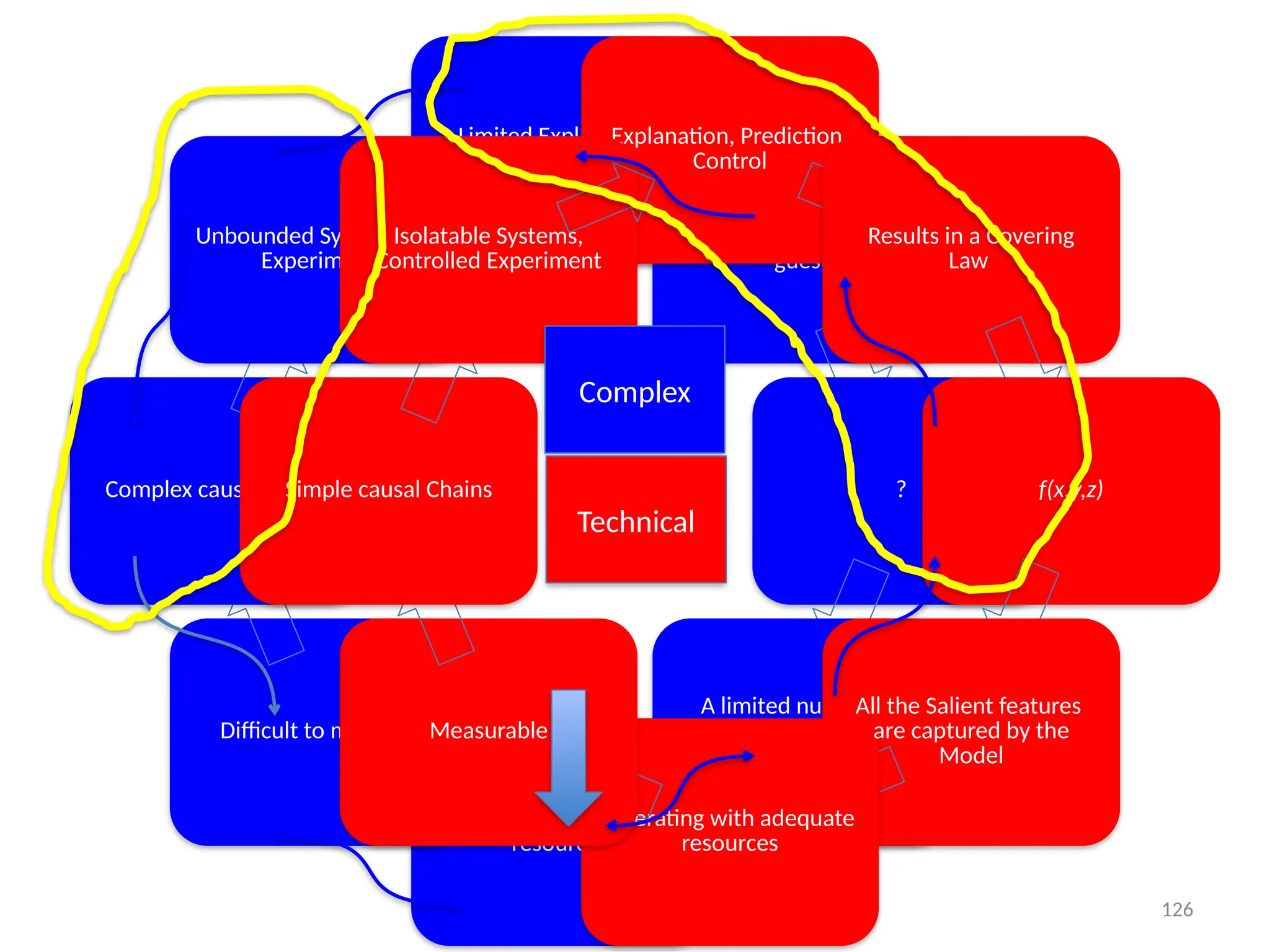
Limited Explanation,
Prediction, Control
Results in an educated
guest
?
A limited number of
features are captured by
the Model
Operating with scare
resources
Difficult to measure
Complex causal Chains
Unbounded Systems, No
Experiment
Explanation, Prediction,
Control
Results in a Covering
Law
f(x,y,z)
All the Salient features
are captured by the
Model
Operating with adequate
resources
Measurable
Simple causal Chains
Isolatable Systems,
Controlled Experiment
Complex
Technical
126
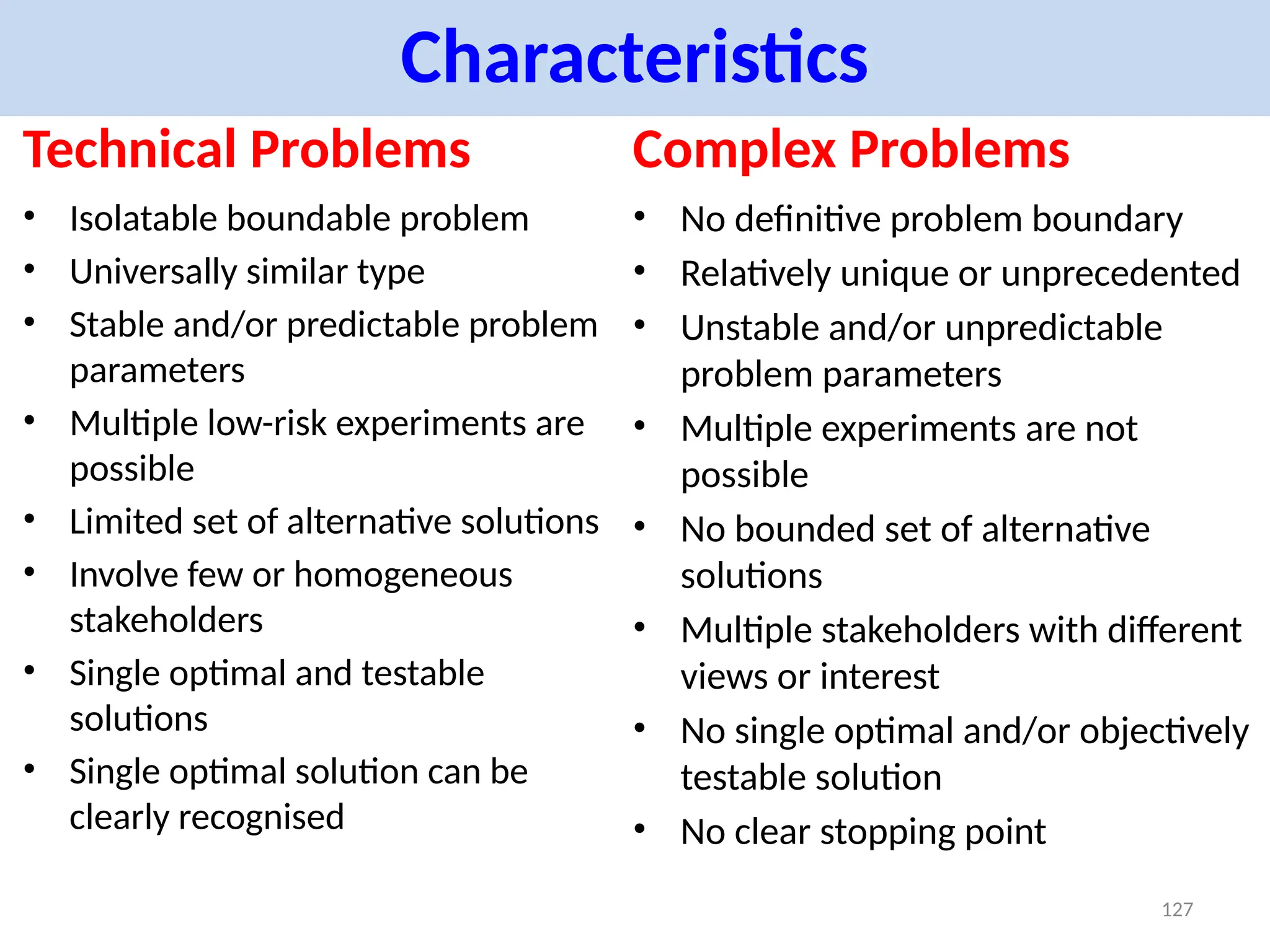
Characteristics
Complex Problems
• No definitive problem boundary
• Relatively unique or unprecedented
• Unstable and/or unpredictable
problem parameters
• Multiple experiments are not
possible
• No bounded set of alternative
solutions
• Multiple stakeholders with different
views or interest
• No single optimal and/or objectively
testable solution
• No clear stopping point
Technical Problems
• Isolatable boundable problem
• Universally similar type
• Stable and/or predictable problem
parameters
• Multiple low-risk experiments are
possible
• Limited set of alternative solutions
• Involve few or homogeneous
stakeholders
• Single optimal and testable
solutions
• Single optimal solution can be
clearly recognised
127
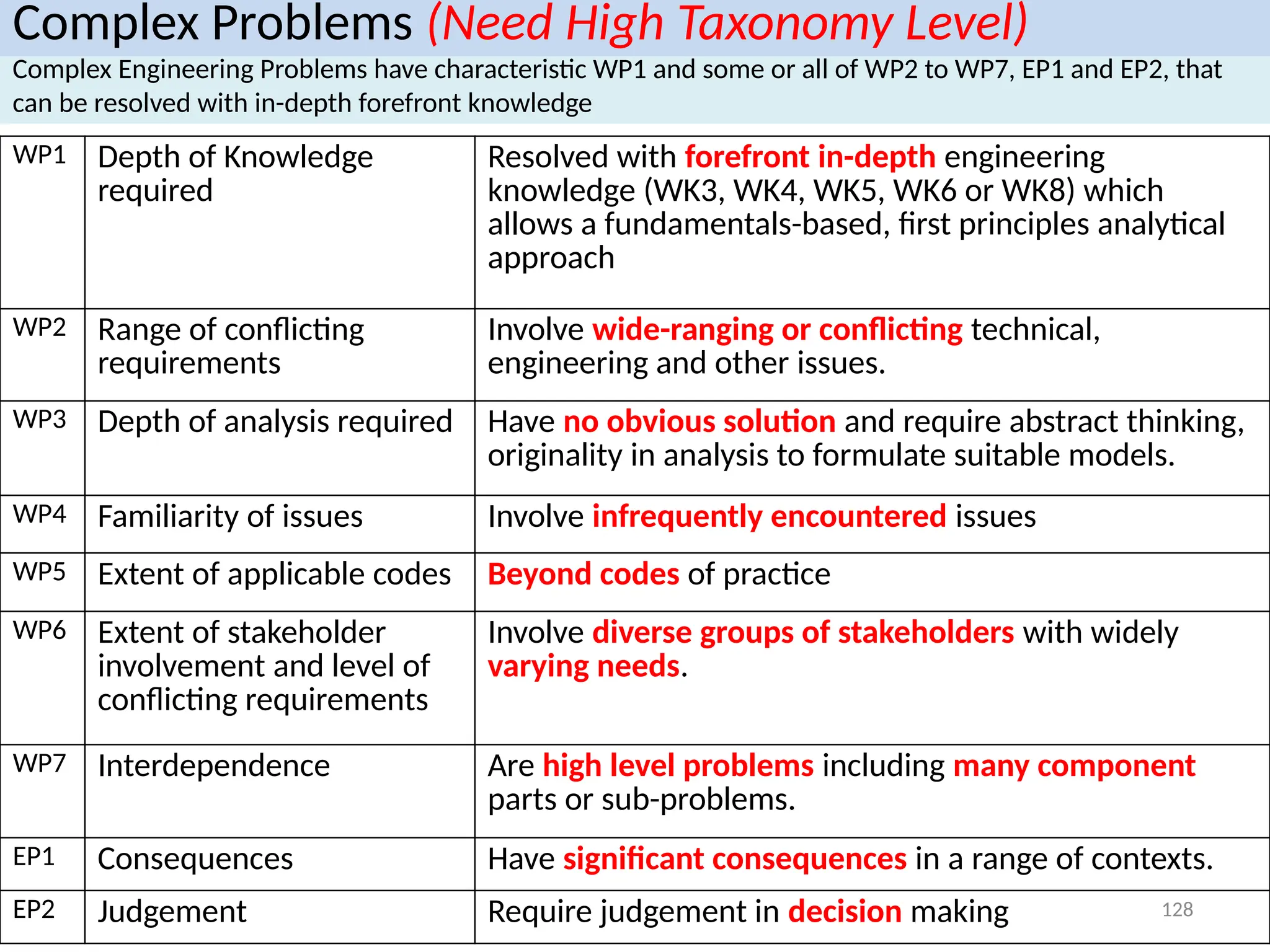
WP1 Depth of Knowledge
required
Resolved with forefront in-depth engineering
knowledge (WK3, WK4, WK5, WK6 or WK8) which
allows a fundamentals-based, first principles analytical
approach
WP2 Range of conflicting
requirements
Involve wide-ranging or conflicting technical,
engineering and other issues.
WP3 Depth of analysis required Have no obvious solution and require abstract thinking,
originality in analysis to formulate suitable models.
WP4 Familiarity of issues Involve infrequently encountered issues
WP5 Extent of applicable codes Beyond codes of practice
WP6 Extent of stakeholder
involvement and level of
conflicting requirements
Involve diverse groups of stakeholders with widely
varying needs.
WP7 Interdependence Are high level problems including many component
parts or sub-problems.
EP1 Consequences Have significant consequences in a range of contexts.
EP2 Judgement Require judgement in decision making
Complex Engineering Problems have characteristic WP1 and some or all of WP2 to WP7, EP1 and EP2, that
can be resolved with in-depth forefront knowledge
Complex Problems (Need High Taxonomy Level)
128
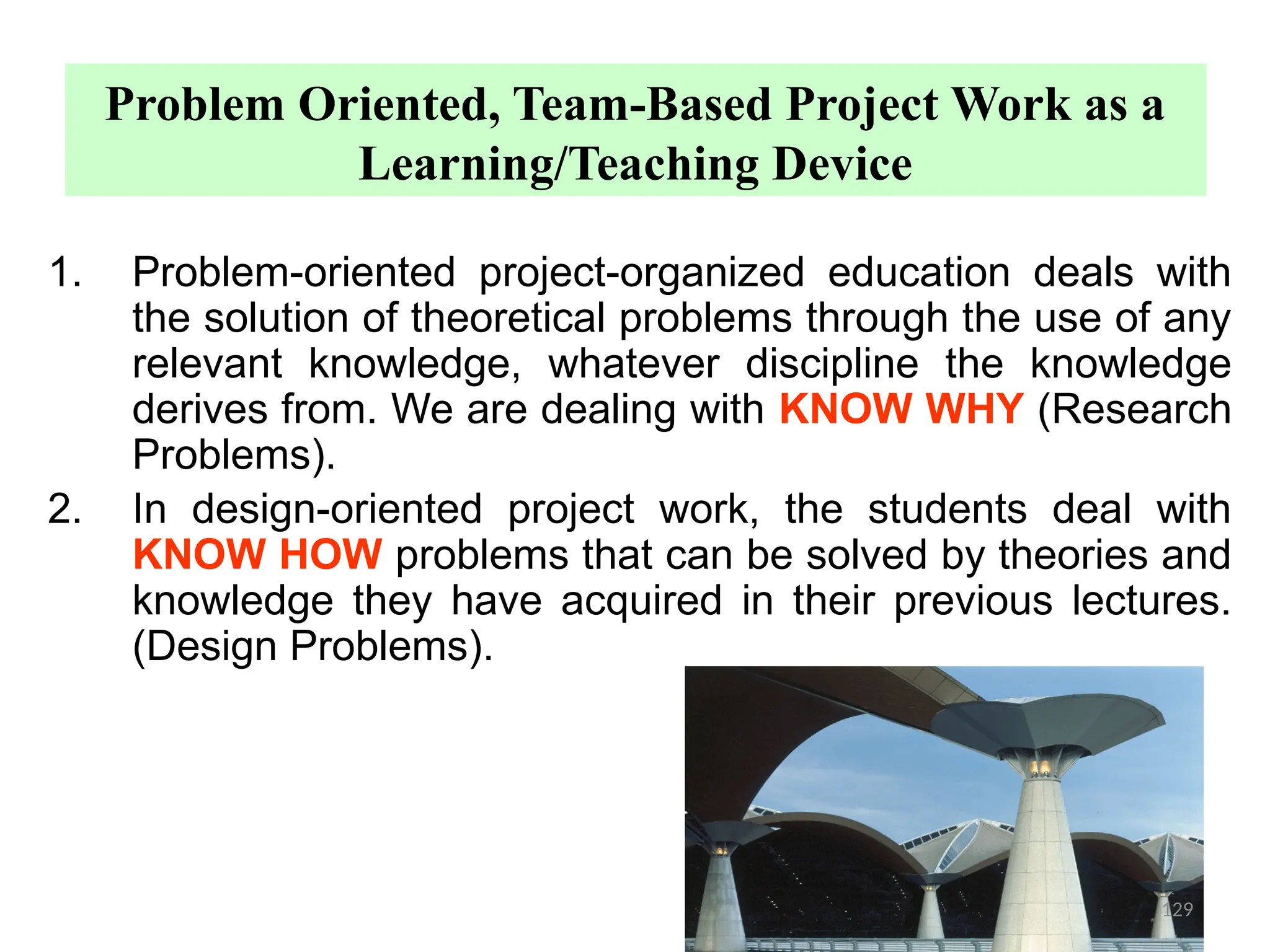
Problem Oriented, Team-Based Project Work as a
Learning/Teaching Device
1. Problem-oriented project-organized education deals with
the solution of theoretical problems through the use of any
relevant knowledge, whatever discipline the knowledge
derives from. We are dealing with KNOW WHY (Research
Problems).
2. In design-oriented project work, the students deal with
KNOW HOW problems that can be solved by theories and
knowledge they have acquired in their previous lectures.
(Design Problems).
129
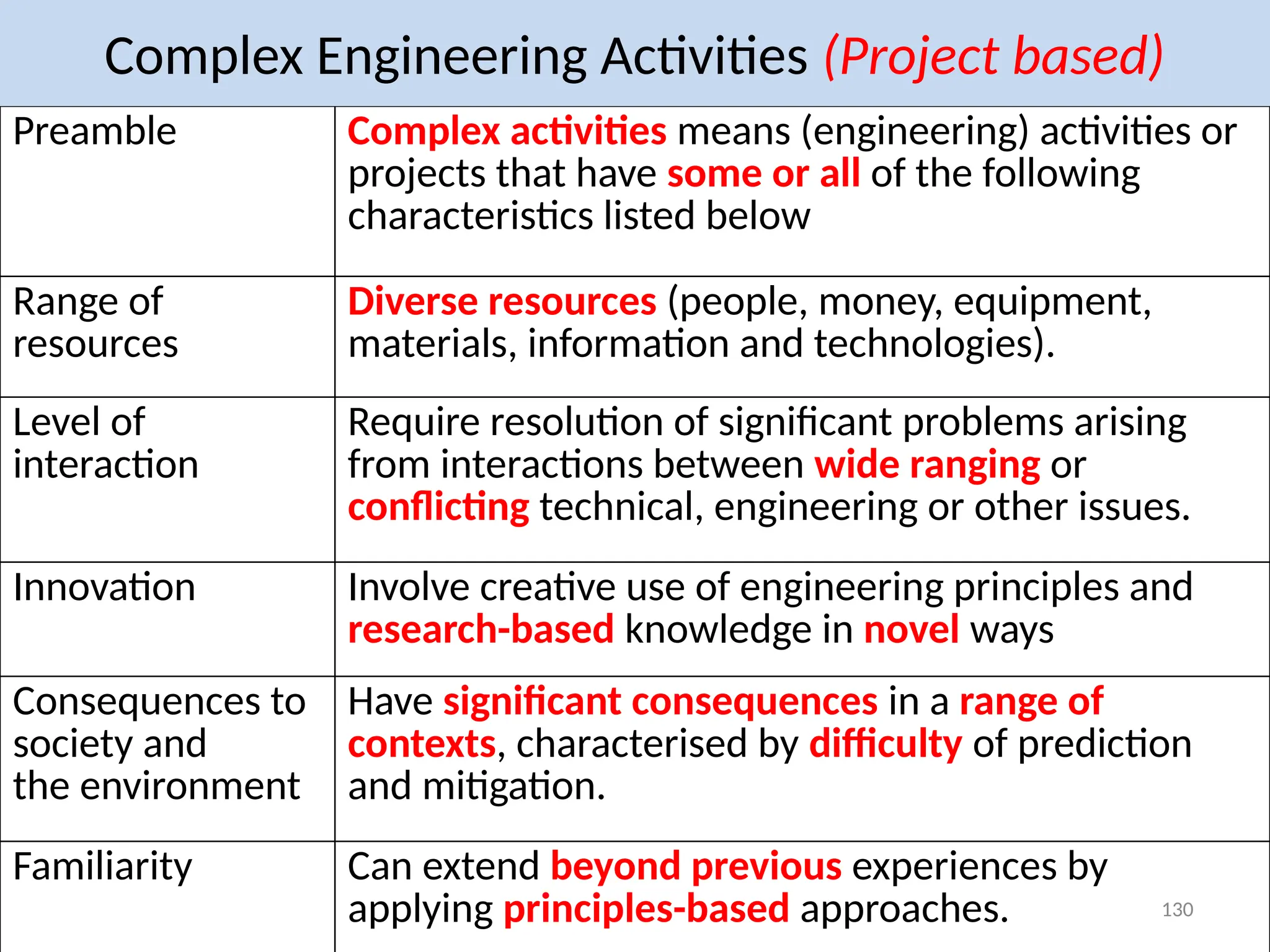
Preamble Complex activities means (engineering) activities or
projects that have some or all of the following
characteristics listed below
Range of
resources
Diverse resources (people, money, equipment,
materials, information and technologies).
Level of
interaction
Require resolution of significant problems arising
from interactions between wide ranging or
conflicting technical, engineering or other issues.
Innovation Involve creative use of engineering principles and
research-based knowledge in novel ways
Consequences to
society and
the environment
Have significant consequences in a range of
contexts, characterised by difficulty of prediction
and mitigation.
Familiarity Can extend beyond previous experiences by
applying principles-based approaches.
Complex Engineering Activities (Project based)
130
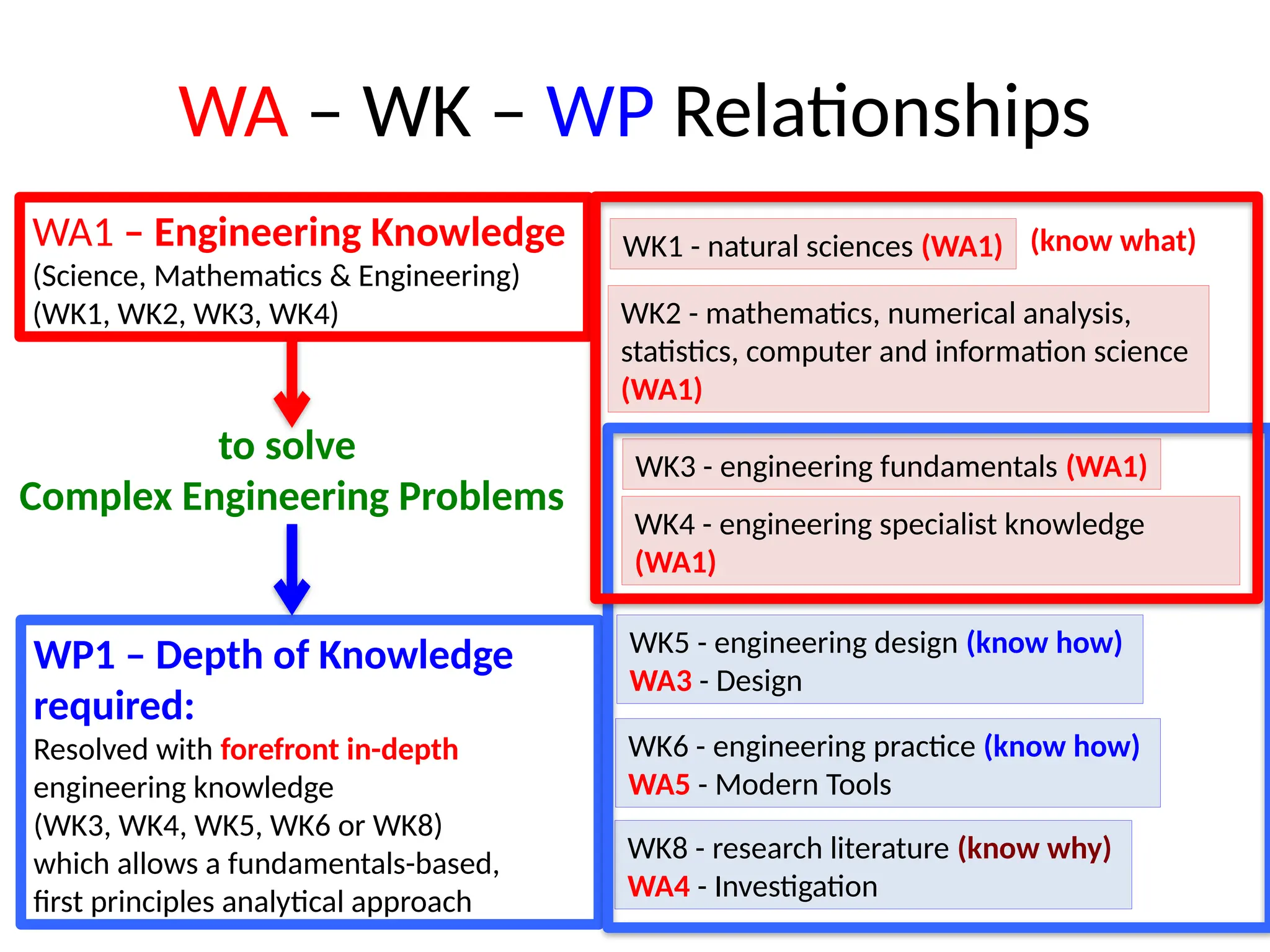
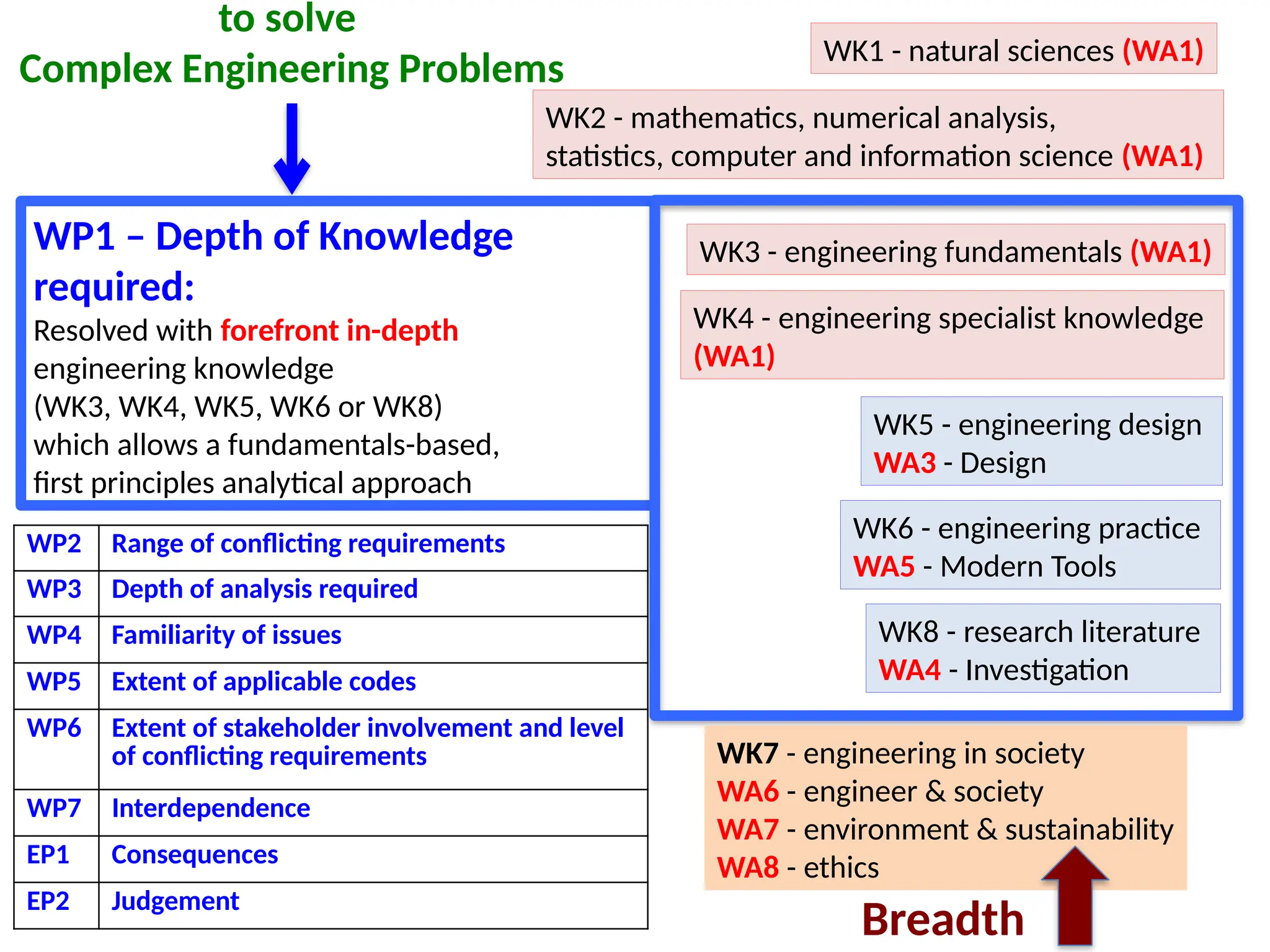
WA – WK – WP Relationships
WA1 – Engineering Knowledge
(Science, Mathematics & Engineering)
(WK1, WK2, WK3, WK4)
to solve
Complex Engineering Problems
WK2 - mathematics, numerical analysis,
statistics, computer and information science
(WA1)
WK1 - natural sciences (WA1)
WK3 - engineering fundamentals (WA1)
WK4 - engineering specialist knowledge
(WA1)
WP1 – Depth of Knowledge
required:
Resolved with forefront in-depth
engineering knowledge
(WK3, WK4, WK5, WK6 or WK8)
which allows a fundamentals-based,
first principles analytical approach
WK5 - engineering design (know how)
WA3 - Design
WK6 - engineering practice (know how)
WA5 - Modern Tools
WK8 - research literature (know why)
WA4 - Investigation
(know what)
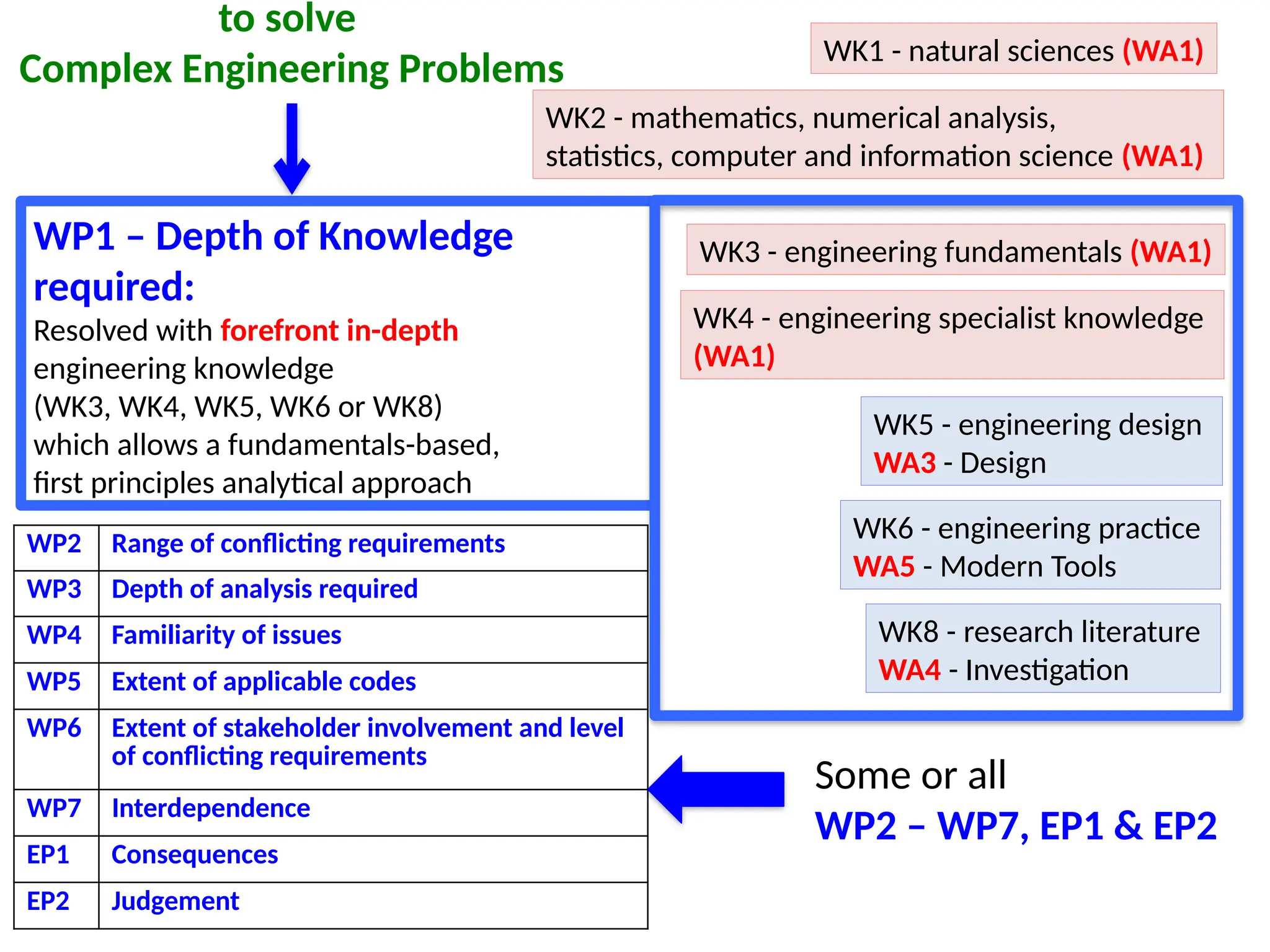
to solve
Complex Engineering Problems
WK2 - mathematics, numerical analysis,
statistics, computer and information science (WA1)
WK1 - natural sciences (WA1)
WK3 - engineering fundamentals (WA1)
WK4 - engineering specialist knowledge
(WA1)
WP1 – Depth of Knowledge
required:
Resolved with forefront in-depth
engineering knowledge
(WK3, WK4, WK5, WK6 or WK8)
which allows a fundamentals-based,
first principles analytical approach
WK5 - engineering design
WA3 - Design
WK6 - engineering practice
WA5 - Modern Tools
WK8 - research literature
WA4 - Investigation
WP2 Range of conflicting requirements
WP3 Depth of analysis required
WP4 Familiarity of issues
WP5 Extent of applicable codes
WP6 Extent of stakeholder involvement and level
of conflicting requirements
WP7 Interdependence
EP1 Consequences
EP2 Judgement
Some or all
WP2 – WP7, EP1 & EP2
to solve
Complex Engineering Problems
WK2 - mathematics, numerical analysis,
statistics, computer and information science (WA1)
WK1 - natural sciences (WA1)
WK3 - engineering fundamentals (WA1)
WK4 - engineering specialist knowledge
(WA1)
WP1 – Depth of Knowledge
required:
Resolved with forefront in-depth
engineering knowledge
(WK3, WK4, WK5, WK6 or WK8)
which allows a fundamentals-based,
first principles analytical approach
WK5 - engineering design
WA3 - Design
WK6 - engineering practice
WA5 - Modern Tools
WK8 - research literature
WA4 - Investigation
WP2 Range of conflicting requirements
WP3 Depth of analysis required
WP4 Familiarity of issues
WP5 Extent of applicable codes
WP6 Extent of stakeholder involvement and level
of conflicting requirements
WP7 Interdependence
EP1 Consequences
EP2 Judgement
WK7 - engineering in society
WA6 - engineer & society
WA7 - environment & sustainability
WA8 - ethics
Breadth
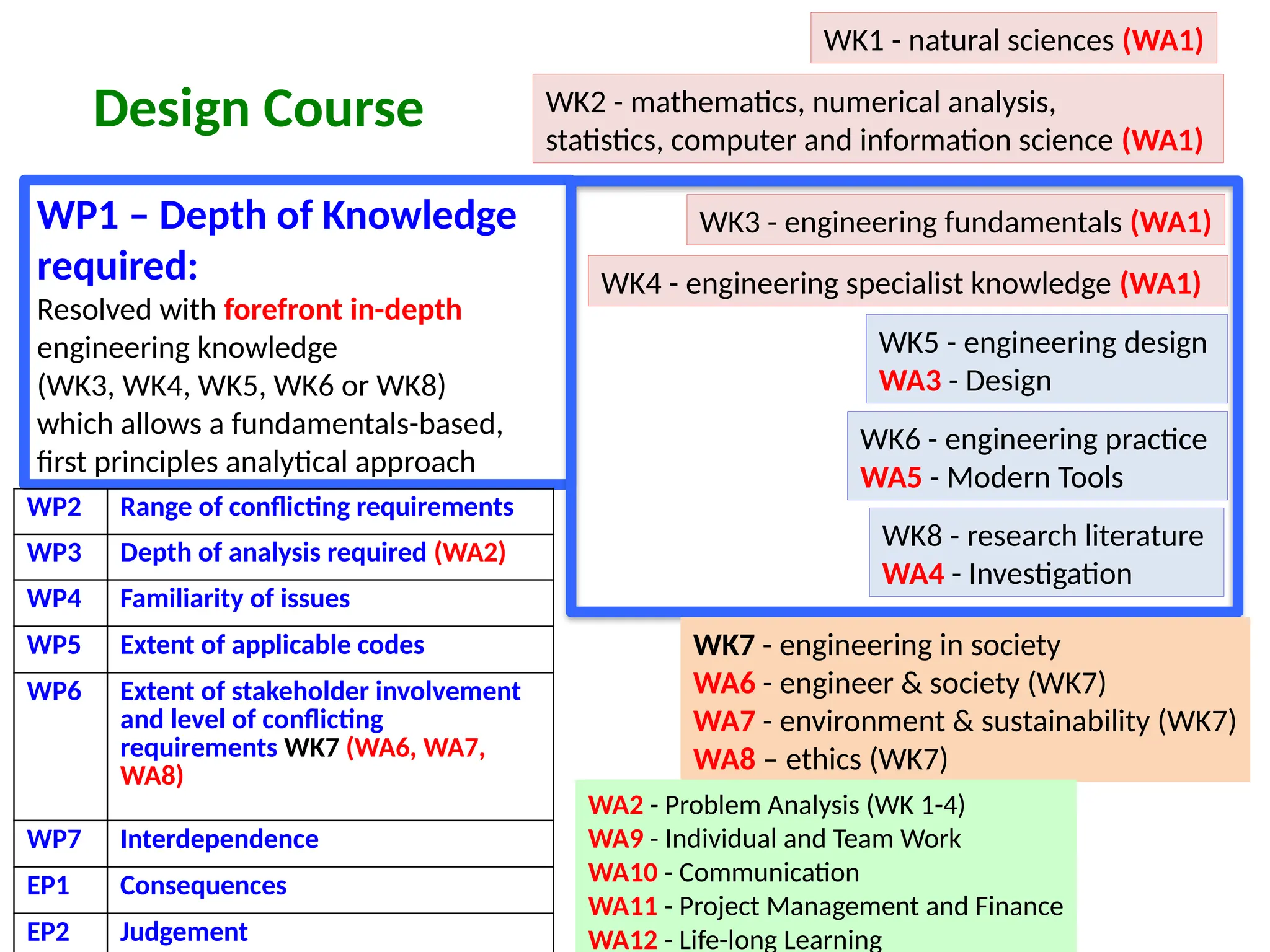
Design Course WK2 - mathematics, numerical analysis,
statistics, computer and information science (WA1)
WK1 - natural sciences (WA1)
WK3 - engineering fundamentals (WA1)
WK4 - engineering specialist knowledge (WA1)
WP1 – Depth of Knowledge
required:
Resolved with forefront in-depth
engineering knowledge
(WK3, WK4, WK5, WK6 or WK8)
which allows a fundamentals-based,
first principles analytical approach
WK5 - engineering design
WA3 - Design
WK6 - engineering practice
WA5 - Modern Tools
WK8 - research literature
WA4 - Investigation
WP2 Range of conflicting requirements
WP3 Depth of analysis required (WA2)
WP4 Familiarity of issues
WP5 Extent of applicable codes
WP6 Extent of stakeholder involvement
and level of conflicting
requirements WK7 (WA6, WA7,
WA8)
WP7 Interdependence
EP1 Consequences
EP2 Judgement
WK7 - engineering in society
WA6 - engineer & society (WK7)
WA7 - environment & sustainability (WK7)
WA8 – ethics (WK7)
WA2 - Problem Analysis (WK 1-4)
WA9 - Individual and Team Work
WA10 - Communication
WA11 - Project Management and Finance
WA12 - Life-long Learning
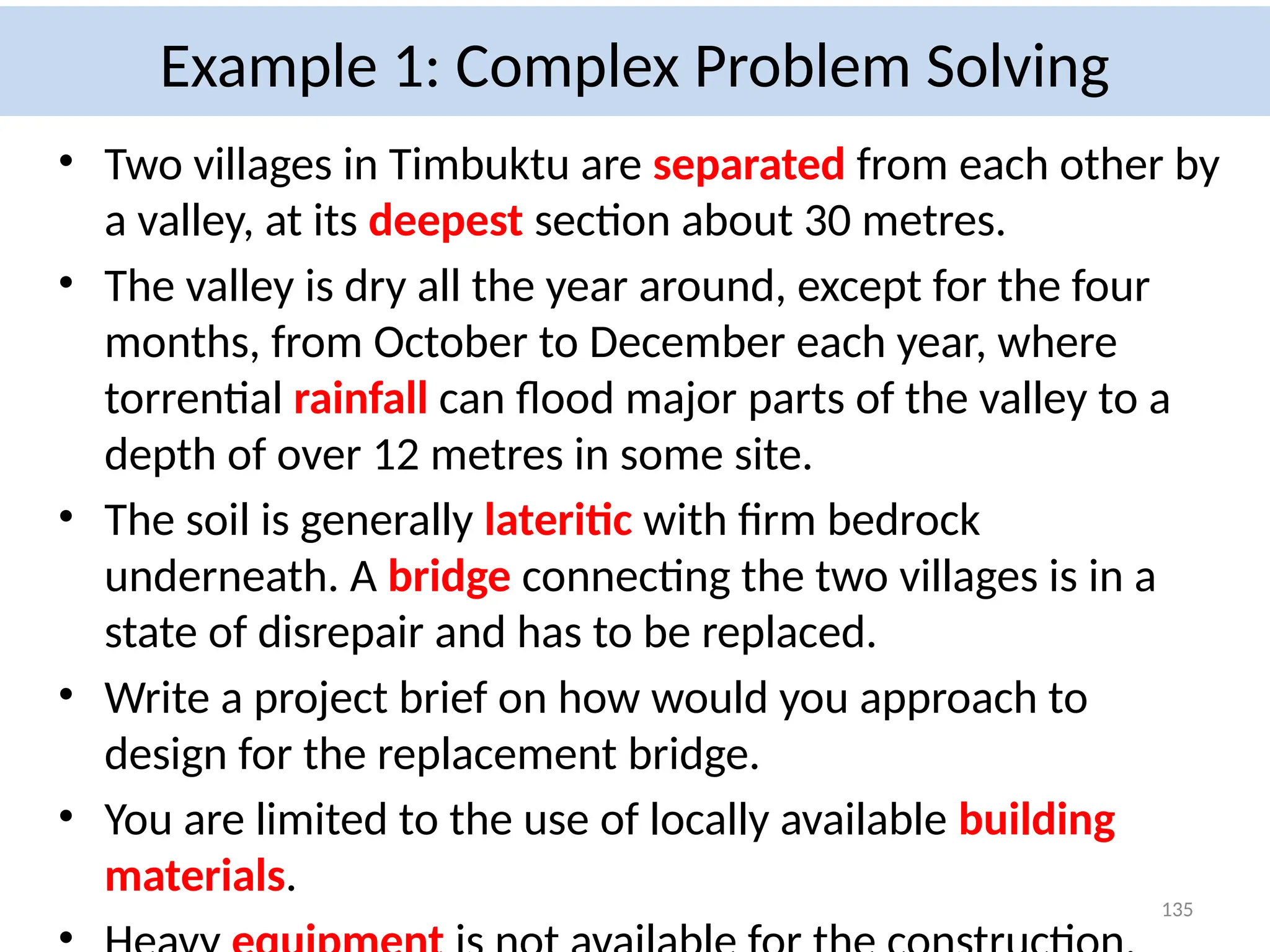
Example 1: Complex Problem Solving
• Two villages in Timbuktu are separated from each other by
a valley, at its deepest section about 30 metres.
• The valley is dry all the year around, except for the four
months, from October to December each year, where
torrential rainfall can flood major parts of the valley to a
depth of over 12 metres in some site.
• The soil is generally lateritic with firm bedrock
underneath. A bridge connecting the two villages is in a
state of disrepair and has to be replaced.
• Write a project brief on how would you approach to
design for the replacement bridge.
• You are limited to the use of locally available building
materials.
135
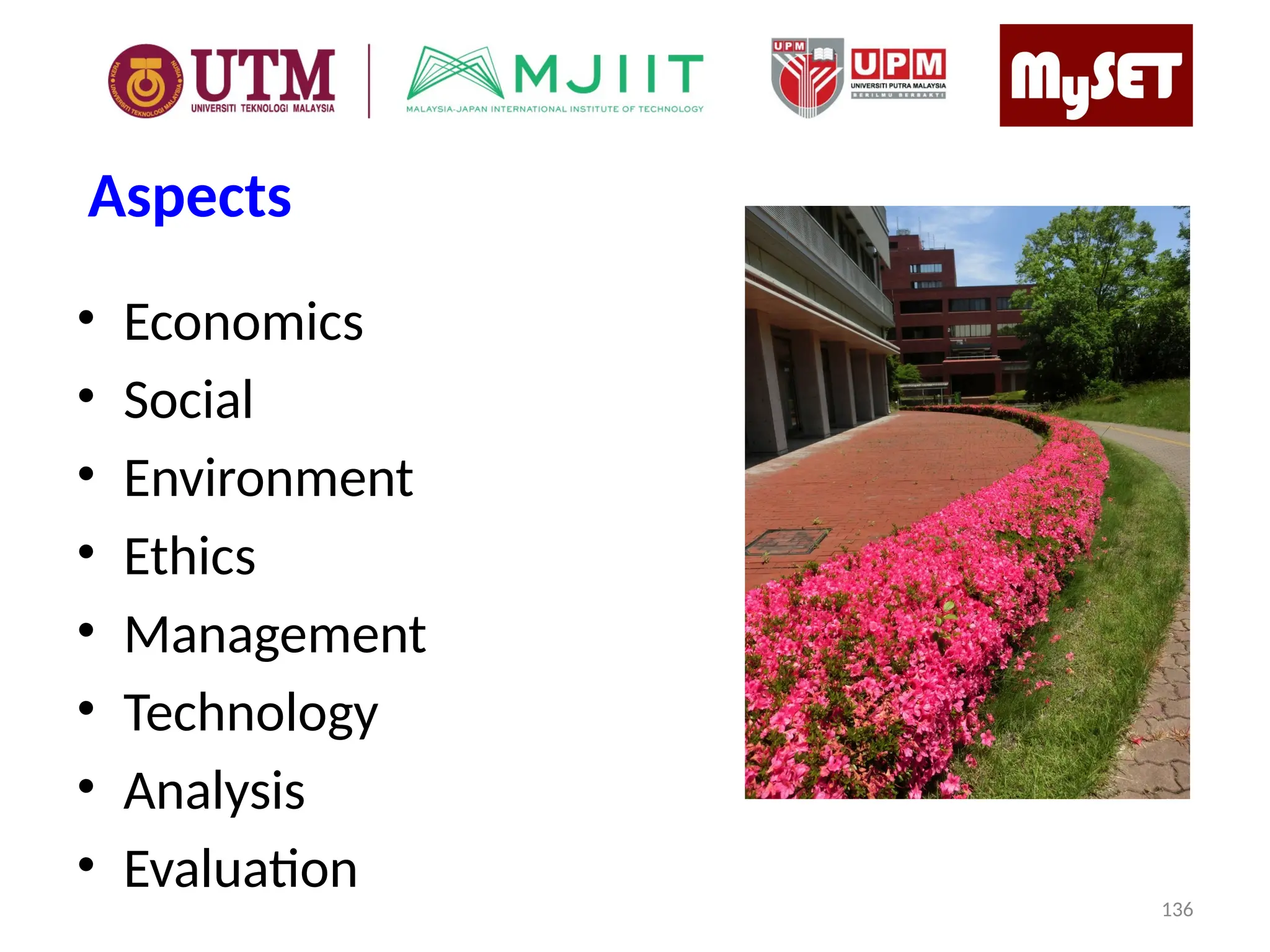
Aspects
• Economics
• Social
• Environment
• Ethics
• Management
• Technology
• Analysis
• Evaluation
136
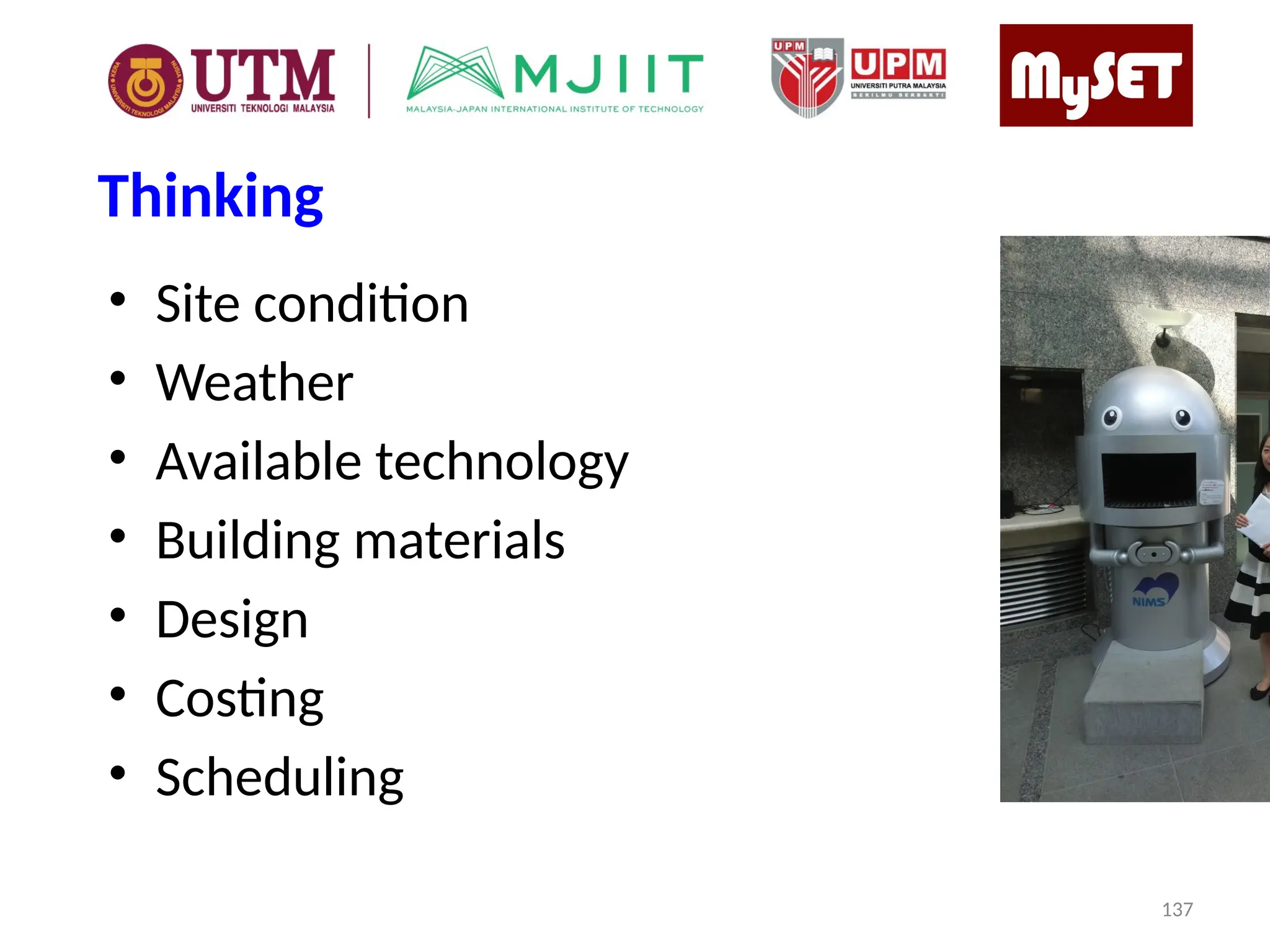
Thinking
• Site condition
• Weather
• Available technology
• Building materials
• Design
• Costing
• Scheduling
137
Solutions?
• Problem solving skills
• Formulate the problem
• Literature
• Experiment?
138
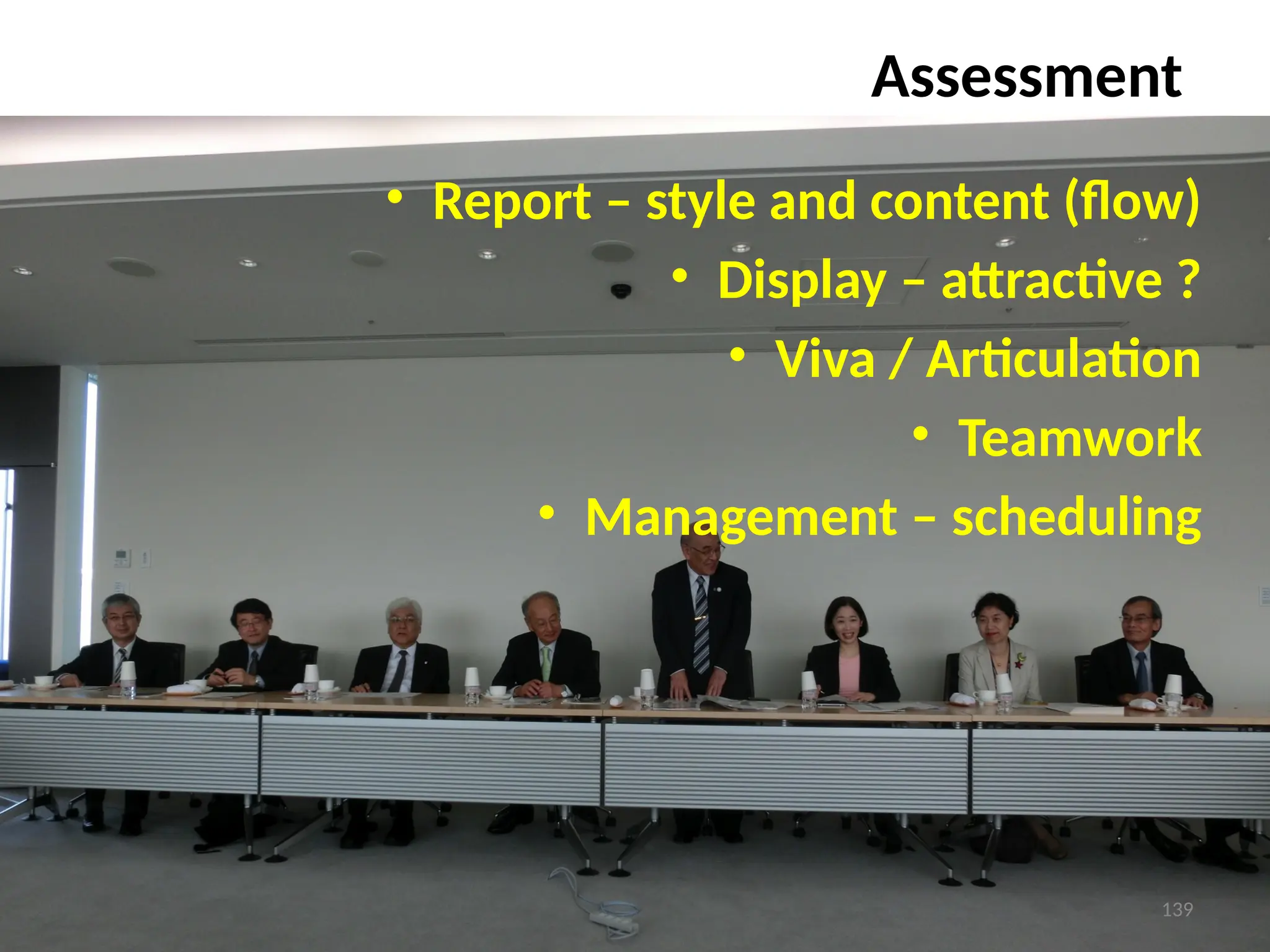
Assessment
• Report – style and content (flow)
• Display – attractive ?
• Viva / Articulation
• Teamwork
• Management – scheduling
139
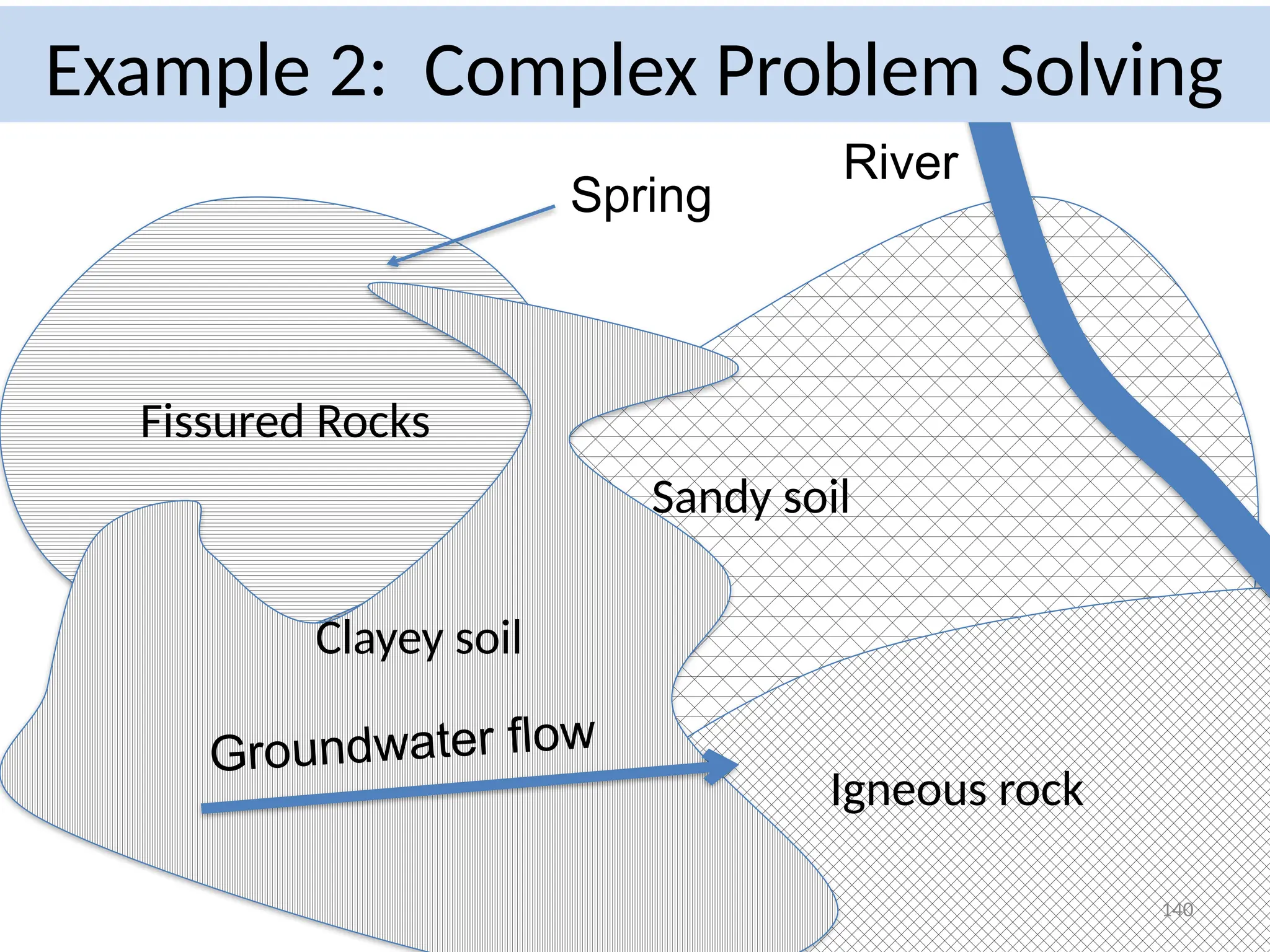
Sandy soil
Fissured Rocks
Igneous rock
Clayey soil
Groundwater flow
Spring
River
Example 2: Complex Problem Solving
140
How does complexity relates to
curriculum?
• General Subjects
• Industrial Placement
• Core & Specialist (Engineering) Subjects –
Complex Problem Solving
• Elective Subjects – Complex Problem Solving
• Design Project – Complex Engineering Activities
• Final Year Project – Complex Problem Solving
141
Closing Remarks
142
Thank You
Appendix
144
Complex Problem Solving (CPS)
• Dynamic, because early actions determine the
environment in which subsequent decision must
be made, and features of the task environment
may change independently of the solver’s actions;
• Time- dependent, because decisions must be
made at the correct moment in relation to
environmental demands;
• Complex, in the sense that most variables are not
related to each other in a one-to-one manner
145
Microworld CPS Model
• The problem requires not one decision, but a
long series, in which early decisions condition
later ones.
• For a task that is changing continuously, the
same action can be definitive at moment t1
and useless at moment t2.
• Include novel solutions to an old dilemma in
general science (external validity vs.
experimental control)
146
Expert-novice CPS Model
• Expert-novice approach most of the time
produces conclusions that are crystal-clear.
• It almost guarantees statistically significant
results, because the groups compared (expert
and novices) are very different and tend to
perform very differently when confronted with
similar experimental situations (Sternberg
1995).
147
Naturalistic decision making (NDM)
• Naturalistic decision making (NDM) (e.g.,
Zsambok and Klein 1997, Salas and Klein
2001)
• ‘real-world’ task
• Example interviewing firefighters after
putting out a fire or a surgeon after she has
decided in real time what to do with a
patient.
148
Dynamic decision making DDM
• Dynamic decision making (DDM) (Brehmer
1992, Sterman 1994).
• Discrete dynamic decision tasks that change
only when the participant introduces a new
set of inputs.
• Variables like time pressure have been
successfully integrated in models like
Busemeyer and Townsend’s (1993) decision
field theory
149
Implicit learning in system control
• This tradition has used tasks like the sugar
factory (Berry and Broadbent 1984) or the
transportation task (Broadbent et al. 1986), that
are governed by comparatively simple
equations.
• The theorization and computational modeling in
this branch of CPS are extremely rich. Models
are based on exemplar learning, rule learning,
and both (e.g., Dienes and Fahey 1995, Gibson
et al. 1997, Lebiere et al. 1998).
150
European complex problem solving (CPS)
• Initiated by Dörner (Dörner and Scholkopf
1991, Dörner and Wearing 1995)
• A large number of tasks that have been
considered complex problem solving are
nowadays affordable for theory development
and computer modeling (e.g. Putz-Osterloh
1993, Vollmeyer et al. 1996, Burns and
Vollmeyer 2002, Schoppek 2002)
• Transport real-life complexity to the lab in a
way that can be partly controlled 151
Time related
• Time variant – time invariant (dynamic vs.
static systems)
• Continuous time – discrete time.
• Degree of time pressure – decision has to be
made quickly
152
Variable related
• Number and type (discrete/continuous) of
variables
• Number and pattern of relationships
between variables
• Non-Linear - Linear
153
System behaviour related
• Opaque - transparent.
• Stochastic - deterministic
• Delayed feedback - immediate feedback.
154
Delivery
• Knowledge-lean vs. knowledge-intensive
• Skill based vs planning based (reactive vs
predictive
• Learning vs. no learning during problem
solving
• Understanding-based vs. search-based
problems
• Ill-defined vs. well-defined
155
Conclusion
• Problem solving has been traditionally a
task-centered field. VanLehn (1989) think
that ‘task’ and ‘problem’ are virtually
synonymous.
156
157
The author would like to thank the contributors of the clip arts
used in this presentation
158

Accreditation-Outcome-Based-Approach.pptx

  • 1.
    Accreditation & Outcome BasedApproach Prof Megat Johari Megat Mohd Noor UTM QRIM@KL & MJIIT Lahore/Faisalabad/Jamshoro, Pakistan September 2016
  • 2.
  • 3.
    3 We are joiningthe Mutual Recognition Train (MRT) !
  • 4.
    4 WASHINGTON ACCORD SYDNEY ACCORD DUBLIN ACCORD 4 YEARS 3 YEARS 2YEARS IPEA International Professional Engineers Agreement (ENGINEERS MOBILITY FORUM) APEC ENGINEER FEANI / EUR-ACE / ENAEE (EUROPE) 3 + 2 YEARS NABEEA (ASIA) EDUCATION ACCORDS PRACTICE AGREEMENTS IETA International Engineering Technologist Agreement (ENGINEERING TECHNOLOGISTS MOBILITY FORUM) INTERNATIONAL ENGINEERING ALLIANCE (IEA) (INTERNATIONAL ENGINEERING MEETING, IEM) AIET Agreement of International Engineering Technician
  • 5.
    5 Development of InternationalEngineering Alliance WA signed by 6 organisations Development of formal peer review processes New Accords and Agreements Development of graduate attribute exemplars 28 Sep 1989 1990s onwards 1997-2015 2001 onwards IEA Established in 2007
  • 6.
    6 WASHINGTON ACCORD FULLSIGNATORY 1. Australia - Engineers Australia (1989) 2. New Zealand - Institution of Professional Engineers NZ (1989) 3. Canada - Engineers Canada (1989) 4. United States - Accreditation Board for Engineering and Technology (1989) 5. United Kingdom - Engineering Council UK (1989) 6. Ireland - Engineers Ireland (1989) 7. Hong Kong China - The Hong Kong Institution of Engineers (1995) 8. South Africa - Engineering Council of South Africa (1999) 9. Japan - Japan Accreditation Board for Engineering Education (2005) 10. Singapore - Institution of Engineers Singapore (2006) 11. Chinese Taipei - Institute of Engineering Education Taiwan (2007) 12. Korea - Accreditation Board for Engineering Education of Korea (2007) 13. Malaysia - Board of Engineers Malaysia (2009) 14. Turkey - MUDEK (2011) 15. Russia - Association for Engineering Education of Russia (2012) 16. India - National Board of Accreditation (2014) 17. Sri Lanka - Institution of Engineers Sri Lanka (2014) 18. China - CAST (2016) Provisional Status 19. Bangladesh 20. Pakistan 21. Phillippines 22. Peru 23. Costa Rica 24. Mexico Potential Applicants 25. Thailand 26. Indonesia
  • 7.
  • 8.
    8 Importance of Accreditationto Institutions of Higher Learning • Recognises institutional missions and goals • Involves faculty/staff in evaluation and planning • Assists institutions in determining the acceptability of transfer credits • Promotes “best practices” in education • Increases visibility and reputation of the institution • Aids engineering schools to identify required operational resources to institution management
  • 9.
    9 Pakistan Washington AccordRoute (2011 – 2016) • Nominator (EME, GIKI) • Mentor (Islamabad, Topi, Risalpur, Faisalabad, Peshawar, Karachi, Lahore) • 1a Reviewer (Universities?) • 1b Reviewer (ADM) Prof Abang (MAL) Prof Megat (MAL) Prof Lock (SIN) Kim (Korea) Collins (UK) Basil (NZ) Nominator Mentor Prof Megat (MAL) Ir Azlan (MAL) Prof Lock (SIN) Reviewer?
  • 10.
    DECIDE ENGINEERING ACCREDITATION BOARD (EAB) Representatives of Professional Societies Representativesof Universities Representatives of Industries Constituents in Accreditation PAKISTAN ENGINEERING COUNCIL (PEC) ACCREDITATION DEPARTMENT (AD) EAB EVALUATION PANEL ENDORSE FACILITATE RECOMMEND Representatives of Government 10
  • 11.
    11 EAB Manual • Frominput based to outcome based 20.. 2014
  • 12.
    12 Programme Objectives (…..) & Outcomes (…..) Students (…..) Academic& Support Staff (…..) Industry Linkage (…..) Facilities (…..) Academic Curriculum (…..) Continual Quality I mprovemen t
  • 13.
    13 Programme Evaluators (PEVs) Chair (Criteria of appointment)  Two members (Criteria of appointment) one member with extensive academic experience and one member with extensive industrial experience - knowledgeable - trained - independent
  • 14.
    Challenges • Paradigm Shift– Outcome & Quality • Maintain Fundamentals while Encourage Inclusion of Latest Technology Advancement in the Curriculum • Allow Academic Innovation and Creativity • Avoid Side-tracked • Variety of Modes of Delivery
  • 15.
    15 Complex Problems Broadly Defined Problems Well defined Problems Solvedusing limited theoretical knowledge, but normally requires extensive practical knowledge Knowledge of principles and applied procedures or methodologies In-depth knowledge that allows a fundamentals- based first principles analytical approach Depth of Knowledge Required
  • 16.
    16 Engineering & TechnologyDomain Engineers Technologists Research & Design Supervision & Maintenance Strong in Mathematics, Engineering Sciences, Professional courses (Theoretical) Appropriate Mathematics, Engineering Sciences, Professional courses (Practical) Education Work Engineering Breadth & Depth of Curricula Technology Breadth & Depth of Curricula
  • 17.
    17 Programme EO /O Development/ Review Internal Stakeholders Teachers Students University External Stakeholders Potential Employers / Industry Alumni Regulatory Body Course O / Content Development / Review 1, 2, 3 …… Course Implementation 1, 2, 3 …… Course Assessment 1, 2, 3 …… Teacher – Knowledge, Skills, Affective Students – Teaching Teacher – Descriptive Self Assessment on Cohort’s Achievement Programme Evaluation Summative - direct Exit Survey - indirect Industry Survey - indirect Alumni Survey - indirect External – direct Accreditation - direct Educational Process & Stakeholders Pull factor Internal Stakeholders Teachers Technicians Students Internal Stakeholders Teachers Students External Stakeholders Potential Employers / Industry Alumni Regulatory Body External Assessor Summative Formative / Summative Internal Stakeholders Teachers Specification
  • 18.
    18 (8) Leadership, governance andadministration (6) Educational resources (1) Vision,mission and learning outcomes (5) Academic Staff (2a) Curriculum Design (2b) Curriculum Delivery INPUT (STUDENTS) (4a) Selection of Students (4b) Supporting Services (7) Programme Monitoring and Review (3) Student Assessments (9) Total Continual Quality Improvements OUTPUT (GRADUATES) STAKEHOLDER NEEDS AND INSTITUTIONAL MISSION FEEDBACKS FROM STAKEHOLDERS STAKEHOLDER’S SATISFACTION Academic IQA Practices in Perspective
  • 19.
    19 OBE Programme Objective (after 3-5Years) Programme Outcome (at Exit) Course/Unit/Learning Outcome (Abilities & Intentional) Directed & Coherent Curriculum Graduate Relevant to Industry Accountable
  • 20.
    20 Characteristics of OBEcurricula • Have programme objectives, programme outcomes, course outcomes and performance indicators. • Stated objectives and outcomes can be assessed and evaluated. • Centered around the needs of the students and the stakeholders.
  • 21.
    21 Characteristics of OBEcurricula • Learning outcomes are intentional and assessed using suitable performance indicators. • Programme objectives address the graduates attainment in their career within 3-5 years after their graduation. • Programme outcomes (abilities attained by students before they graduate) are formulated based on the programme objectives – TOP DOWN.
  • 22.
    22 Characteristics of OBEcurricula • Programme outcomes address Knowledge, Skills and Attitudes to be attained by students. • Course outcomes must satisfy the stated programme outcomes. There is no need for ANY (individual) course to address all programme outcomes. • Teaching/ Learning method may have to be integrated to include different delivery methods to complement the traditional Lecturing method.
  • 23.
    23 OBE in anut shell  What do you want the students to have or able to do?  How can you best help students achieve it?  How will you know what they have achieved it?  How do you close the loop  Knowledge, Skill, Affective  PDCA  Student Centred Delivery  Assessment
  • 24.
    24 Plan, Do, Check& Act (PDCA)
  • 25.
    25 Strategy of OBE •Top down curricula design • Appropriate Teaching & Learning Methods • Appropriate Assessment & Evaluation Methods
  • 26.
    26 Different Levels ofOutcomes Programme Educational Objectives Programme Outcomes Course/subject Outcomes Weekly/Topic Outcomes Upon graduation Upon subject completion Upon weekly/topic completion Few years after Graduation – 3 to 5 years
  • 27.
  • 28.
    28 Preparation for Accreditation •Comprehend the EAB Manual • Prepare the SAR • Address previous accreditation report • Arrange the evidence • Complete the Checklist • Assign key persons according to accreditation schedule
  • 29.
  • 30.
    30 Azlan or a man sitting downin a garden and a lady passing by?
  • 31.
    Issues from • ApprovalReport • First Year Visit Report • External Examiner’s Report • Stakeholders’ Recommendations • Recent Accreditation Visit EVIDENCE BASED Documents & Records Interviews Observations CQI
  • 32.
    Self Assessment Report •Prepare a checklist of questions based on the following criteria in preparing a SAR: – Programme Objectives – Programme Outcomes – Curriculum and Learning Process – Students – Faculty – Support staff – Industry stakeholders – Alumni – Facilities and Infrastructure – Institutional and Financial Support – Continual Quality Improvement – Industry Linkage Exercise
  • 33.
    Industrial Linkage Using theClause 9 of the PEC Manual, evaluate the relevant part of the submitted SAR. Exercise
  • 34.
    3.2.9 Criterion 9:Industrial Linkages Students are expected to undertake assignments from industry to provide solutions to complex engineering problems. Students and faculty should be encouraged to establish collaboration for R&D and product development related projects, with due regard to environmental and societal impact. Feedback from the industry and employers is crucial and an essential part of curriculum review process used to evaluate attainment of the program objectives.
  • 35.
    4.1.9 Industrial Linkages 4.1.9.1 Discussthe involvement of industry in discussions and forums, professional practice exposure, and collaborative projects / research for the solutions to engineering problems.
  • 36.
    36 List down HEI’srepresentatives (parties) that will be involved in an accreditation visit Exercise
  • 37.
    37 Item/Criteria List downthe involved parties Accreditation Planning Opening Meeting Programme Educational Objectives (……) Programme Outcomes (…….) Curriculum (…….) Students (……) Academic & Support Staff (……) Facilities (……) Quality Management System (……) Exit Meeting Exercise
  • 38.
    38 • Sensible questioning •Check records • Observing processes • Analyse inputs and outputs • Organised using tables, matrices, flowcharts and checklists PROGRAMME EVALUATOR’S APPROACHES
  • 39.
    39 What are thesix typical words that Programme Evaluators (PEVs) would usually begin with, when questioning? Quiz Programme Evaluators’ (PEVs’) Best friend –
  • 40.
    40 What are themethods/techniques employed by Programme Evaluators (PEVs) when conducting an accreditation exercise? Quiz
  • 41.
    41 Cause for concernsat Accreditation Decision Meeting • Phases of OBE – Planning – Implementation – Effectiveness • CQI • List of concerns • Breadth & depth (taxonomy & complex problem) • Staffing • Industrial Training • Commitment to change • System failure • Stagnant (no improvement) • Repeat offender • Safety
  • 42.
    42 Rubrics for NewProgramme, New Cycle & Continuing
  • 43.
    43 What WA willbe observing? • Adherence to EAB document • EAB PEV’s aplomb and decorum • Probing questions (not interrogative) • Discussion level • Clarity of reports • Graduate outcomes • Health & safety at HEIs • Equivalency of practice
  • 44.
    44 Opening Meeting You arethe Dean/HoD with three programmes to be evaluated; Mechanical Engineering, Civil Engineering and Electrical Engineering, for the third cycle. Prepare a list of talk points to address the Programme Evaluators (PEVs) at the Opening Meeting. Exercise
  • 45.
    45 • Welcome EvaluationTeam • Introduce team members • Corrective & Preventive Actions from previous accreditation • Short presentation on Faculty/Dept/Prog strengths • Fill up with the latest (within a specified timeframe) if any OPENING MEETING 10 minutes
  • 46.
    46 PEC Manual 2014 ProgrammeEducational Objectives
  • 47.
    Exercise List down potentialstakeholders • Major • Minor
  • 48.
    48 Programme Educational Objectives •Broad statements: What graduates are expected to achieve (BE) a few years after graduation. • Linked to programme outcomes • Include feedback from employers, alumni, academics and other stakeholders
  • 49.
    PROGRAM EDUCATIONAL OBJECTIVE(PEO)  Limit number of statements (manageable)  No restatement of outcomes  Forward looking and challenging  Distinctive/unique features/having own niche  Specific, Measurable, Achievable, Result oriented, and having a Time frame (SMART) Programme Educational Objectives 49
  • 50.
    50 Write down yourevaluation on the following PEO statements Exercise
  • 51.
    51 Write down yourevaluation on the following PEO statements Exercise
  • 52.
  • 53.
    53 Programme Outcomes (PO) Whatthe graduates are expected to know and able to perform or attain by the time of graduation (skills, knowledge and behaviour/attitude) Need to distribute the outcomes throughout the programme, and not one/two courses only addressing a particular outcome There must be a clear linkage between Programme Objective and Outcomes
  • 54.
    54 Programme Outcomes • Discusson HEI’s possible approaches or methods to demonstrate implementation of the 12 programme outcomes • Discuss on the possible models to show attainment of the 12 programme outcomes Exercise
  • 55.
    4 YEARS WA 1 ENGINEERING KNOWLEDGE WA2 PROBLEM ANALYSIS WA3 DESIGN WA5 MODERN TOOLS WA6 ENGR & SOC WA7 ENV & SUST WA8 ETHICS WA4 INVESTIGATION WA9 IND & TEAM WA10 COMMUNICAT- ION WA11 PROJ MGMT & FINANCE WA12 LIFE LONG PEO WHAT YOU WANT YOUR GRADUATES TO BE IN 3 - 5 YEARS EXTRA-CURRICULAR UNIVERSITY EXPERIENCE
  • 57.
    57 Problem Organised ProjectWork or POPBL (Project Oriented Problem Based Learning) Problem Analysis Problem Solving Report Literature Lectures Group Studies Tutorials Field Work Experiment
  • 58.
    58 POPBL Requirements • Highdegree of supervision • Office space • Lectures to be constantly changing or renewed • Flexibility in the distribution of resources
  • 59.
    59 Instructors/Supervisors • Pedagogical skills •Scientific skills • Time management • Project based on staff research
  • 60.
    60 Graduates’ Strength AALBORG UNIV •Strong in problem solving • Communication • Cooperation • General technical knowledge DENMARK TECHNICAL UNIV • Specialist knowledge • Technical methodology
  • 61.
    61 Typical questions onPEO/PO • What are the PEOs/POs? • Who were involved in the development of the PEOs/POs? • How were they developed/improved? • To what extent the stakeholders were involved? • How their attainment were determined? • What were the improvements introduced?
  • 62.
    62 Curriculum • Discuss onthe possible relationship between taxonomy levels and the different knowledge profile with consideration to the 12 programme outcomes • What are typical probing questions in ascertaining that student’s POs have been attained? • What are typical probing questions in ascertaining that student’s COs have been attained? Exercise
  • 63.
    63 ASSESSMENT: Processes that identify,collect, use and prepare data for evaluation of achievement of programme outcomes or educational objectives. EVALUATION: Processes for interpretation of data and evidence from assessment practices that determine the programme outcomes are achieved or result in actions to improve programme.
  • 64.
    Outcome-Based Assessment Implementation Strategy Assessment Strategy Data Sources/Assessment instruments Industrial project Improvestudent competence in communication, teamwork, and project management Exams, interview, survey, observe, assess skill level, monitor development of skills Reports, interview schedule, survey, observation records, grades of exams and projects, exit skill checklist Design course Address industry needs Assessment by industry, and lecturers List of assessment criteria, observation, reports, interview, students evaluation, exams, exit skill checklist 64
  • 65.
    65 Assessment – drives learning(necessary evil!) – is formative or/and summative; to demonstrate student’s competence in demonstrating a specific outcome – is the process that identify, collect, use and prepare data that can be used to evaluate attainment.
  • 66.
    66 Assessment • Do notassess those that have not been taught
  • 67.
    67 What Assessment? • AssessingStudent/Cohort (Course Outcome) • Assessing Student/Cohort & Faculty (Programme Outcome)
  • 68.
    68 Assessment Process –Anecdotal vs.measured results –Reliance on course grades only –Over-reliance on indirect assessment (survey)
  • 69.
    69 University Assessment &Evaluation S t u d e n t , A l u m n i P e r c e p ti o n E m p l o y e r , I n d u s t r y P e r c e p ti o n MEASURE & EVALUATE
  • 70.
    70 How will youknow what they have achieved it?  Formative Assessment  Summative Assessment  Course Assessment  Program Assessment  Assessment Tools  Direct and Indirect Assessment
  • 71.
    71 How do youclose the loop ? • Assessment Plan • Who is doing what and when • Stakeholder participation • CQI in place
  • 72.
    Programme Outcome AssessmentMatrix Outcome indicators & core courses PO 1 PO 2 Project Report A B Course 1 B B Course 2 C B A: slightly, B: moderately, C:substantively - base on a review of course materials (syllabus, learning objectives, tests, other assessment…..) Outcome 1: ability to ….. Outcome 2: ability to ….. 72
  • 73.
    Course Assessment Matrix Outcome-related learningobjectives PO 1 PO 2 Explain A C Perform calculation B B Identify B B Solve B C A: slightly, B: moderately, C: substantively Outcome 1: ability to ….. Outcome 2: ability to ….. 73
  • 74.
    74 Rubric 4 – Exceeds Criteria 3– Meets Criteria 2 - Progressing to Criteria 1 - Below Expectations Content Provides ample supporting detail to support solution/ argument Provides adequate supporting detail to support solution/ argument. Some details but may include extraneous or loosely related material. Inconsistent or few details that may interfere with the meaning of the text. Organization Organizational pattern is logical & conveys completeness & wholeness. Organizational pattern is logical & conveys completeness & wholeness with few lapses. Little completeness & wholeness, though organization attempted. Little evidence of organization or any sense of wholeness & completeness. Style Uses effective language; makes engaging, appropriate word choices for audience & purpose. Uses effective language & appropriate word choices for intended audience & purpose. Limited & predictable vocabulary, perhaps not appropriate for intended audience & purpose. Limited or inappropriate vocabulary for the intended audience & purpose. Consistently follows the rules of standard English. Generally follows the rules for standard English. Generally does not follow the rules of standard English. Does not follow the rules of standard English. Adopted from G.Rogers
  • 75.
    75 Performance Criteria/ Indicators- Good Teamwork Students are able to demonstrate 1. Positive contribution to the team project (minutes of meeting) 2. Well prepared and participate in discussion (observation) 3. Volunteer to take responsibility 4. Prompt and sufficient attendance 5. Aplomb and decorum
  • 76.
    76 Quiz Courses PO1 PO2PO9 PO10 C1 3 2 1 1 C2 2 1 2 2 C3 3 0 3 2 C4 2 1 3 1 Discuss on the potential problems, if any, where 3, 2, 1, and 0 refer to High, Moderate, Low, and No emphasis, respectively. C1..4 refer to the courses, whereas POs 1,2,9 and 10 refer to Programme Outcomes. How would cohort POs attainment be obtained?
  • 77.
    77 Quiz PO1 PO2 PO9PO10 C1-CO1 + + C1-CO2 + + + C1-CO3 + + + C1-CO4 + + How would you design the assessment for the above matrix? CO: Course Outcomes +: There is assessment
  • 78.
    78 Quiz Table 1 PO1 Q1 CO1 + Q2 CO2 + Q3 CO3 + Q4 CO4 + Table 2 PO 1 PO9 Q1 CO1 + CO2 + Q2 CO2 + CO3 + Q3 CO3 + CO4 + Q4 CO4 + Discuss on the attainment of COs and POs for both Tables 1&2, where Qs are questions set to address the COs
  • 79.
    79 Quiz Delivery Assessment Lecture Laboratory PBL Case Method ProjectBased Identify suitable assessment techniques for the different delivery modes.
  • 80.
    80 Lessons learnt fromaccreditation activities related to assessment  Do not know the teaching plan  Done without referring to the plan  Do not know how to translate plan into assessment  Assessing at low-medium level (not challenging)  No feedback to students except at end of semester  Do not know how to relate assessment to expected outcomes  Repetition  Bulk marking  Traditional assessments
  • 81.
    81 Big Picture Programme or Student Improvement? Selective Culminating Hybrid Taxonomy Level (Average, From, Up To) Assessment – Constructive Alignment
  • 82.
    82 Curricula Models Yr. 1 Yr.4 Yr. 3 Yr. 2 K 70% S&A 30% K 70% K 70% K 70% S&A 30% S&A 30% S&A 30% Distribution of Knowledge, Skills & Attitude elements throughout the 4 years A B C D
  • 83.
    83 Evaluation of Outcomesat Programme Level ECV3092 Civil Engineering Design (Capstone Design Course) MyOBE Software
  • 84.
    84 Evaluation of Outcomesat Programme Level ECV3092 Civil Engineering Design (Capstone Design Course) MyOBE Process Module Programme Outcomes Attributes that are expected to be attained by the students Teaching and Assessment Plan Planning of course outcome Planning of course assessment Course Assessment Course Assessment Mark Course Assessment Summary Programme Evaluation Programme Outcomes Summative Trend Analysis
  • 85.
    85 Evaluation of Outcomesat Programme Level ECV3092 Civil Engineering Design (Capstone Design Course) MyOBE Snapshots Lecturers’ Module: Enter all course assessment marks
  • 86.
    86 Evaluation of Outcomesat Programme Level ECV3092 Civil Engineering Design (Capstone Design Course) MyOBE Snapshots
  • 87.
    87 Final Year Design Project FinalYear Courses Third Year Courses Second Year Courses First Year Courses Final Year Project PO Attainment Final Year Project Final Year Design Project Final Year Courses Third Year Courses Second Year Courses First Year Courses
  • 88.
    88 What constitutes strength? Exceeds the minimum standard set by the EAC Engineering Accreditation Manual.  Extensive benchmarking (not only via the external examiners path) with more established programmes/institutions.  The curriculum is built on strong fundamentals (engineering sciences) and appropriate engineering knowledge according to the discipline, which transcend national boundaries.  Generic attributes (professional and/or interpersonal skills) should also be evident to prepare graduates for the advanced part of their career.
  • 89.
    89 What constitutes strength?Cont… • A curriculum with clear (measurable) objective(s) and outcomes (that satisfies the (12) EAC stipulated outcomes) • Involved stakeholders, both internal and external, extensively • An appropriate working load for students determined through extensive consultation with the academics (Usually a 15 – 16 credit per semester loading) • Blend of delivery methods
  • 90.
    90 What constitutes strength?Cont…  Programme challenges students to achieve greater heights than just satisfying the minimum standard  Attain competency in the open-ended project based and problem oriented courses  Majority of the staff has PhD qualification and the number available indicates a low staff-student ratio (that enables greater contact with students)  The academic staffs also conduct research that permeates/contributes to teaching and learning.
  • 91.
    91 What constitutes strength?Cont… • Over and above Industrial Training (extensive & distributed professional exposure) that does not compromise on the cognitive domain • Ergonomics is taken seriously by the institution to reduce occupational hazard • Safety culture • Show that they have the plan and the completion of the quality cycles is widespread • Monitoring of the QMS also indicates strength.
  • 92.
    92 What constitutes strength?Cont… • Students’ ability to give opinion and articulate with substance • Students are clear of their goals upon graduation and highly motivated during their course of study (“constructive criticisms”) • Widespread involvement of students in co- curricular activities (not forced as part of curriculum nor limited to small group of students).
  • 93.
    93 What constitutes strength?Cont… • Academic staff with Professional Engineer status • Academic staff are actively participating in professional activities (not merely members) • Design courses are taught by experienced academics (with consultancy experience or professional engineers).
  • 94.
    94 What constitutes strength?Cont… • Up to date facilities are made available and they exceed the recommended student- equipment ratio appropriate to the relevant discipline. • Extensive electronics publications for life long learning, project based courses and the final year project
  • 95.
  • 96.
    • Knowledge (list) •Comprehension (explain) • Application (calculate, solve, determine) • Analysis (classify, predict, model,derived) • Synthesis (design, improve) • Evaluation (judge, select, critique) Bloom’s Taxonomy 96
  • 97.
  • 98.
  • 99.
  • 100.
    Why are courseoutcomes important? • Define the type and depth of learning students are expected to achieve • Provide an objective benchmark for formative, summative, and prior learning assessment • Clearly communicate expectations to learners • Clearly communicate graduates’ skills to the stakeholders • Define coherent units of learning that can be further subdivided or modularized for classroom or for other delivery modes. • Guide and organize the instructor and the learner. 100
  • 101.
    Three components ofa learning outcome Reaching the “Standard” (criteria of acceptable level of performance) • describe the principles used in designing X.(Verb) • orally describe the principles used in designing X. (Verb & Condition) • orally describe the five principles used in designing X. (Verb & Condition & Standard) • design a beam. (Verb) • design a beam using Microsoft Excel design template . (Verb & Condition) • design a beam using Microsoft Excel design template based on BS 5950:Part 1. (Verb & Condition & Standard) 101
  • 102.
    Learning outcomes byadding a condition and standard Poor • Students should be able to design research. Better • Students should be able to independently design and carry out experimental and correlational research. Best • Students should be able to independently design and carry out experimental and correlational research that yields valid results. Source: Bergen, R. 2000. A Program Guideline for Outcomes Assessment at Geneva College 102
  • 103.
  • 104.
    WA Knowledge Profile (WK) 4YEARS WK1 natural sciences WK3 engineering fundamentals WK2 mathematics, numerical analysis, statistics, computer and information science WK4 engineering specialist knowledge WK5 engineering design WK6 engineering practice WK8 research literature WK7 engineering in society 104
  • 105.
    Theory-based natural sciencesWK1 Conceptually-based mathematics, numerical analysis, statistics and formal aspects of computer and information science to support analysis and modelling WK2 Theory-based engineering fundamentals WK3 Engineering specialist knowledge that provides theoretical frameworks and bodies of knowledge for the practice areas; much is forefront WK4 WA Knowledge Profile (Curriculum) 105
  • 106.
    WA Knowledge Profile Knowledgethat supports Engineering design in the practice areas WK5 Knowledge of Engineering practice (technology) in the practice areas WK6 Comprehension of the role of Engineering in society and identified issues in engineering practice: ethics and professional responsibility of an engineer to public safety; the impact of engineering activity: economic, social, cultural, environmental and sustainability WK7 Engagement with selected knowledge in the Research literature WK8 106
  • 107.
    WA Programme Outcomeor Graduate Attributes (WA) 107
  • 108.
    108 Washington Accord GraduateAttributes PROGRAMME OUTCOMES WA1 Engineering Knowledge Breadth & depth of knowledge WA2 Problem Analysis Complexity of analysis WA3 Design/Development of Solutions Breadth & uniqueness of engineering problems i.e. the extent to which problems are original and to which solutions have previously been identified and coded WA4 Investigation Breadth & depth of investigation and experimentation WA5 Modern Tool Usage Level of understanding of the appropriateness of the tool WA6 The Engineer and Society Level of knowledge and responsibility WA7 Environment and Sustainability Type of solutions WA8 Ethics Understanding and level of practice WA9 Individual and Team Work Role in and diversity of team WA10 Communication Level of communication according to type of activities performed WA11 Project Management and Finance Level of management required for differing types of activity WA12 Life-long Learning Preparation for and depth of continuing learning
  • 109.
    Engineering Knowledge (WA1) Applyknowledge of mathematics, natural science, engineering fundamentals and an engineering specialisation to the solution of complex engineering problems; (WK1 to WK4) PROGRAMME OUTCOME WK = Knowledge Profile = Curriculum WA = Programme Outcome 109
  • 110.
    Problem Analysis -Complexity of analysis (WA2) Identify, formulate, research literature and analyse complex engineering problems reaching substantiated conclusions using first principles of mathematics, natural sciences and engineering sciences (WK1 – WK4) PROGRAMME OUTCOME 110
  • 111.
    Design/Development of Solutions– Breadth and uniqueness of engineering problems i.e. the extent to which problems are original and to which solutions have previously been identified or codified (WA3) Design solutions for complex engineering problems and design systems, components or processes that meet specified needs with appropriate consideration for public health and safety, cultural, societal, and environmental considerations (WK5) PROGRAMME OUTCOME 111
  • 112.
    Investigation - Breadth& Depth of Investigation & Experimentation (WA4) Conduct investigation of complex problems using research based knowledge (WK8) and research methods including design of experiments, analysis and interpretation of data, and synthesis of information to provide valid conclusions PROGRAMME OUTCOME 112
  • 113.
    Modern Tool Usage- Level of understanding of the appropriateness of the tool (WA5) Create, select and apply appropriate techniques, resources, and modern engineering and IT tools, including prediction and modelling, to complex engineering problems, with an understanding of the limitations. (WK6) PROGRAMME OUTCOME 113
  • 114.
    The Engineer andSociety - Level of knowledge and responsibility (WA6) Apply reasoning informed by contextual knowledge to assess societal, health, safety, legal and cultural issues and the consequent responsibilities relevant to professional engineering practice and solutions to complex engineering problems. (WK7) PROGRAMME OUTCOME 114
  • 115.
    Environment and Sustainability- Type of solutions (WA7) Understand and evaluate the sustainabilty and impact of professional engineering work in the solutions of complex engineering problems in societal and environmental contexts (demonstrate knowledge of and need for sustainable development) (WK7) PROGRAMME OUTCOME 115
  • 116.
    PROGRAMME OUTCOME Ethics -Understanding and level of practice (WA8) Apply ethical principles and commit to professional ethics and responsibilities and norms of engineering practice. (WK7) 116
  • 117.
    PROGRAMME OUTCOME Individual andTeam Work – Role in and diversity of team (WA9) Function effectively as an individual, and as a member or leader in diverse teams and in multi- disciplinary settings 117
  • 118.
    Communication – Levelof communication according to type of activities performed (WA10) Communicate effectively on complex engineering activities with the engineering community and with society at large, such as being able to comprehend and write effective reports and design documentation, make effective presentations, and give and receive clear instructions PROGRAMME OUTCOME 118
  • 119.
    PROGRAMME OUTCOME Project Managementand Finance – Level of management required for differing types of activity (WA11) Demonstrate knowledge and understanding of engineering and management principles and economic decision-making and apply these to one’s own work, as a member and leader in a team, to manage projects and in multidisciplinary environments 119
  • 120.
    PROGRAMME OUTCOME Life-long Learning– Preparation for and depth of continuing learning (WA12) Recognise the need for, and have the preparation and ability to engage in independent and life-long learning in the broadest context of technological change 120
  • 121.
    WK1 natural sciences WK2 mathematics, numerical analysis, statistics, computer and information science WK3 engineering fundamentals WK4 engineering specialist knowledge WK5 engineering design WK6 engineering practice WK7 engineeringin society WK8 research literature WA1 ENGINEERING KNOWLEDGE WA2 PROBLEM ANALYSIS WA3 DESIGN WA5 MODERN TOOLS WA6 ENGR & SOC WA7 ENV & SUST WA8 ETHICS WA4 INVESTIGATION WA9 IND & TEAM WA10 COMMUNICAT-ION WA11 PROJ MGMT & FINANCE WA12 LIFE LONG 121 4 YEARS
  • 122.
  • 123.
  • 124.
    Difficulty & Uncertainty •Complexity – the problem contains a large number of diverse, dynamic and interdependent elements • Measurement – it is difficult or practically unfeasible to get good qualitative data • Novelty – there is a new solution evolving or an innovative design is needed 124
  • 125.
  • 126.
    Limited Explanation, Prediction, Control Resultsin an educated guest ? A limited number of features are captured by the Model Operating with scare resources Difficult to measure Complex causal Chains Unbounded Systems, No Experiment Explanation, Prediction, Control Results in a Covering Law f(x,y,z) All the Salient features are captured by the Model Operating with adequate resources Measurable Simple causal Chains Isolatable Systems, Controlled Experiment Complex Technical 126
  • 127.
    Characteristics Complex Problems • Nodefinitive problem boundary • Relatively unique or unprecedented • Unstable and/or unpredictable problem parameters • Multiple experiments are not possible • No bounded set of alternative solutions • Multiple stakeholders with different views or interest • No single optimal and/or objectively testable solution • No clear stopping point Technical Problems • Isolatable boundable problem • Universally similar type • Stable and/or predictable problem parameters • Multiple low-risk experiments are possible • Limited set of alternative solutions • Involve few or homogeneous stakeholders • Single optimal and testable solutions • Single optimal solution can be clearly recognised 127
  • 128.
    WP1 Depth ofKnowledge required Resolved with forefront in-depth engineering knowledge (WK3, WK4, WK5, WK6 or WK8) which allows a fundamentals-based, first principles analytical approach WP2 Range of conflicting requirements Involve wide-ranging or conflicting technical, engineering and other issues. WP3 Depth of analysis required Have no obvious solution and require abstract thinking, originality in analysis to formulate suitable models. WP4 Familiarity of issues Involve infrequently encountered issues WP5 Extent of applicable codes Beyond codes of practice WP6 Extent of stakeholder involvement and level of conflicting requirements Involve diverse groups of stakeholders with widely varying needs. WP7 Interdependence Are high level problems including many component parts or sub-problems. EP1 Consequences Have significant consequences in a range of contexts. EP2 Judgement Require judgement in decision making Complex Engineering Problems have characteristic WP1 and some or all of WP2 to WP7, EP1 and EP2, that can be resolved with in-depth forefront knowledge Complex Problems (Need High Taxonomy Level) 128
  • 129.
    Problem Oriented, Team-BasedProject Work as a Learning/Teaching Device 1. Problem-oriented project-organized education deals with the solution of theoretical problems through the use of any relevant knowledge, whatever discipline the knowledge derives from. We are dealing with KNOW WHY (Research Problems). 2. In design-oriented project work, the students deal with KNOW HOW problems that can be solved by theories and knowledge they have acquired in their previous lectures. (Design Problems). 129
  • 130.
    Preamble Complex activitiesmeans (engineering) activities or projects that have some or all of the following characteristics listed below Range of resources Diverse resources (people, money, equipment, materials, information and technologies). Level of interaction Require resolution of significant problems arising from interactions between wide ranging or conflicting technical, engineering or other issues. Innovation Involve creative use of engineering principles and research-based knowledge in novel ways Consequences to society and the environment Have significant consequences in a range of contexts, characterised by difficulty of prediction and mitigation. Familiarity Can extend beyond previous experiences by applying principles-based approaches. Complex Engineering Activities (Project based) 130
  • 131.
    WA – WK– WP Relationships WA1 – Engineering Knowledge (Science, Mathematics & Engineering) (WK1, WK2, WK3, WK4) to solve Complex Engineering Problems WK2 - mathematics, numerical analysis, statistics, computer and information science (WA1) WK1 - natural sciences (WA1) WK3 - engineering fundamentals (WA1) WK4 - engineering specialist knowledge (WA1) WP1 – Depth of Knowledge required: Resolved with forefront in-depth engineering knowledge (WK3, WK4, WK5, WK6 or WK8) which allows a fundamentals-based, first principles analytical approach WK5 - engineering design (know how) WA3 - Design WK6 - engineering practice (know how) WA5 - Modern Tools WK8 - research literature (know why) WA4 - Investigation (know what)
  • 132.
    to solve Complex EngineeringProblems WK2 - mathematics, numerical analysis, statistics, computer and information science (WA1) WK1 - natural sciences (WA1) WK3 - engineering fundamentals (WA1) WK4 - engineering specialist knowledge (WA1) WP1 – Depth of Knowledge required: Resolved with forefront in-depth engineering knowledge (WK3, WK4, WK5, WK6 or WK8) which allows a fundamentals-based, first principles analytical approach WK5 - engineering design WA3 - Design WK6 - engineering practice WA5 - Modern Tools WK8 - research literature WA4 - Investigation WP2 Range of conflicting requirements WP3 Depth of analysis required WP4 Familiarity of issues WP5 Extent of applicable codes WP6 Extent of stakeholder involvement and level of conflicting requirements WP7 Interdependence EP1 Consequences EP2 Judgement Some or all WP2 – WP7, EP1 & EP2
  • 133.
    to solve Complex EngineeringProblems WK2 - mathematics, numerical analysis, statistics, computer and information science (WA1) WK1 - natural sciences (WA1) WK3 - engineering fundamentals (WA1) WK4 - engineering specialist knowledge (WA1) WP1 – Depth of Knowledge required: Resolved with forefront in-depth engineering knowledge (WK3, WK4, WK5, WK6 or WK8) which allows a fundamentals-based, first principles analytical approach WK5 - engineering design WA3 - Design WK6 - engineering practice WA5 - Modern Tools WK8 - research literature WA4 - Investigation WP2 Range of conflicting requirements WP3 Depth of analysis required WP4 Familiarity of issues WP5 Extent of applicable codes WP6 Extent of stakeholder involvement and level of conflicting requirements WP7 Interdependence EP1 Consequences EP2 Judgement WK7 - engineering in society WA6 - engineer & society WA7 - environment & sustainability WA8 - ethics Breadth
  • 134.
    Design Course WK2- mathematics, numerical analysis, statistics, computer and information science (WA1) WK1 - natural sciences (WA1) WK3 - engineering fundamentals (WA1) WK4 - engineering specialist knowledge (WA1) WP1 – Depth of Knowledge required: Resolved with forefront in-depth engineering knowledge (WK3, WK4, WK5, WK6 or WK8) which allows a fundamentals-based, first principles analytical approach WK5 - engineering design WA3 - Design WK6 - engineering practice WA5 - Modern Tools WK8 - research literature WA4 - Investigation WP2 Range of conflicting requirements WP3 Depth of analysis required (WA2) WP4 Familiarity of issues WP5 Extent of applicable codes WP6 Extent of stakeholder involvement and level of conflicting requirements WK7 (WA6, WA7, WA8) WP7 Interdependence EP1 Consequences EP2 Judgement WK7 - engineering in society WA6 - engineer & society (WK7) WA7 - environment & sustainability (WK7) WA8 – ethics (WK7) WA2 - Problem Analysis (WK 1-4) WA9 - Individual and Team Work WA10 - Communication WA11 - Project Management and Finance WA12 - Life-long Learning
  • 135.
    Example 1: ComplexProblem Solving • Two villages in Timbuktu are separated from each other by a valley, at its deepest section about 30 metres. • The valley is dry all the year around, except for the four months, from October to December each year, where torrential rainfall can flood major parts of the valley to a depth of over 12 metres in some site. • The soil is generally lateritic with firm bedrock underneath. A bridge connecting the two villages is in a state of disrepair and has to be replaced. • Write a project brief on how would you approach to design for the replacement bridge. • You are limited to the use of locally available building materials. 135
  • 136.
    Aspects • Economics • Social •Environment • Ethics • Management • Technology • Analysis • Evaluation 136
  • 137.
    Thinking • Site condition •Weather • Available technology • Building materials • Design • Costing • Scheduling 137
  • 138.
    Solutions? • Problem solvingskills • Formulate the problem • Literature • Experiment? 138
  • 139.
    Assessment • Report –style and content (flow) • Display – attractive ? • Viva / Articulation • Teamwork • Management – scheduling 139
  • 140.
    Sandy soil Fissured Rocks Igneousrock Clayey soil Groundwater flow Spring River Example 2: Complex Problem Solving 140
  • 141.
    How does complexityrelates to curriculum? • General Subjects • Industrial Placement • Core & Specialist (Engineering) Subjects – Complex Problem Solving • Elective Subjects – Complex Problem Solving • Design Project – Complex Engineering Activities • Final Year Project – Complex Problem Solving 141
  • 142.
  • 143.
  • 144.
  • 145.
    Complex Problem Solving(CPS) • Dynamic, because early actions determine the environment in which subsequent decision must be made, and features of the task environment may change independently of the solver’s actions; • Time- dependent, because decisions must be made at the correct moment in relation to environmental demands; • Complex, in the sense that most variables are not related to each other in a one-to-one manner 145
  • 146.
    Microworld CPS Model •The problem requires not one decision, but a long series, in which early decisions condition later ones. • For a task that is changing continuously, the same action can be definitive at moment t1 and useless at moment t2. • Include novel solutions to an old dilemma in general science (external validity vs. experimental control) 146
  • 147.
    Expert-novice CPS Model •Expert-novice approach most of the time produces conclusions that are crystal-clear. • It almost guarantees statistically significant results, because the groups compared (expert and novices) are very different and tend to perform very differently when confronted with similar experimental situations (Sternberg 1995). 147
  • 148.
    Naturalistic decision making(NDM) • Naturalistic decision making (NDM) (e.g., Zsambok and Klein 1997, Salas and Klein 2001) • ‘real-world’ task • Example interviewing firefighters after putting out a fire or a surgeon after she has decided in real time what to do with a patient. 148
  • 149.
    Dynamic decision makingDDM • Dynamic decision making (DDM) (Brehmer 1992, Sterman 1994). • Discrete dynamic decision tasks that change only when the participant introduces a new set of inputs. • Variables like time pressure have been successfully integrated in models like Busemeyer and Townsend’s (1993) decision field theory 149
  • 150.
    Implicit learning insystem control • This tradition has used tasks like the sugar factory (Berry and Broadbent 1984) or the transportation task (Broadbent et al. 1986), that are governed by comparatively simple equations. • The theorization and computational modeling in this branch of CPS are extremely rich. Models are based on exemplar learning, rule learning, and both (e.g., Dienes and Fahey 1995, Gibson et al. 1997, Lebiere et al. 1998). 150
  • 151.
    European complex problemsolving (CPS) • Initiated by Dörner (Dörner and Scholkopf 1991, Dörner and Wearing 1995) • A large number of tasks that have been considered complex problem solving are nowadays affordable for theory development and computer modeling (e.g. Putz-Osterloh 1993, Vollmeyer et al. 1996, Burns and Vollmeyer 2002, Schoppek 2002) • Transport real-life complexity to the lab in a way that can be partly controlled 151
  • 152.
    Time related • Timevariant – time invariant (dynamic vs. static systems) • Continuous time – discrete time. • Degree of time pressure – decision has to be made quickly 152
  • 153.
    Variable related • Numberand type (discrete/continuous) of variables • Number and pattern of relationships between variables • Non-Linear - Linear 153
  • 154.
    System behaviour related •Opaque - transparent. • Stochastic - deterministic • Delayed feedback - immediate feedback. 154
  • 155.
    Delivery • Knowledge-lean vs.knowledge-intensive • Skill based vs planning based (reactive vs predictive • Learning vs. no learning during problem solving • Understanding-based vs. search-based problems • Ill-defined vs. well-defined 155
  • 156.
    Conclusion • Problem solvinghas been traditionally a task-centered field. VanLehn (1989) think that ‘task’ and ‘problem’ are virtually synonymous. 156
  • 157.
  • 158.
    The author wouldlike to thank the contributors of the clip arts used in this presentation 158