© 2014 HDR, all rights reserved.
Rail~Volution Dallas, TX
October 27, 2015
Michael Musso, PE, MS, MPH
A Primer on the
Definition and Applications of
Health Impact Assessment
(HIA)
AGENDA
o Health Impact Assessment –
Definition and Health Determinants
o Value and Applications of HIA
o 6-Step Process
o HIA References
What is HIA ?
Health Impact Assessment (HIA) is a process used to identify how a
project, policy or program might influence health.
HIA uses a combination of procedures, methods and tools to systematically
judge the potential--and sometimes unintended--effects of a proposed
project, plan or policy on the health of a population and the distribution of
those effects within the population.
The HIA also produces recommendations to enhance the health benefits of
the project/policy/program and to mitigate potential harms.
Performance measures = health status outcomes
HIA evaluates Negative AND Positive Impacts
Direct and Indirect Health Impacts
Health Determinants /
Outcomes Evaluated in HIA
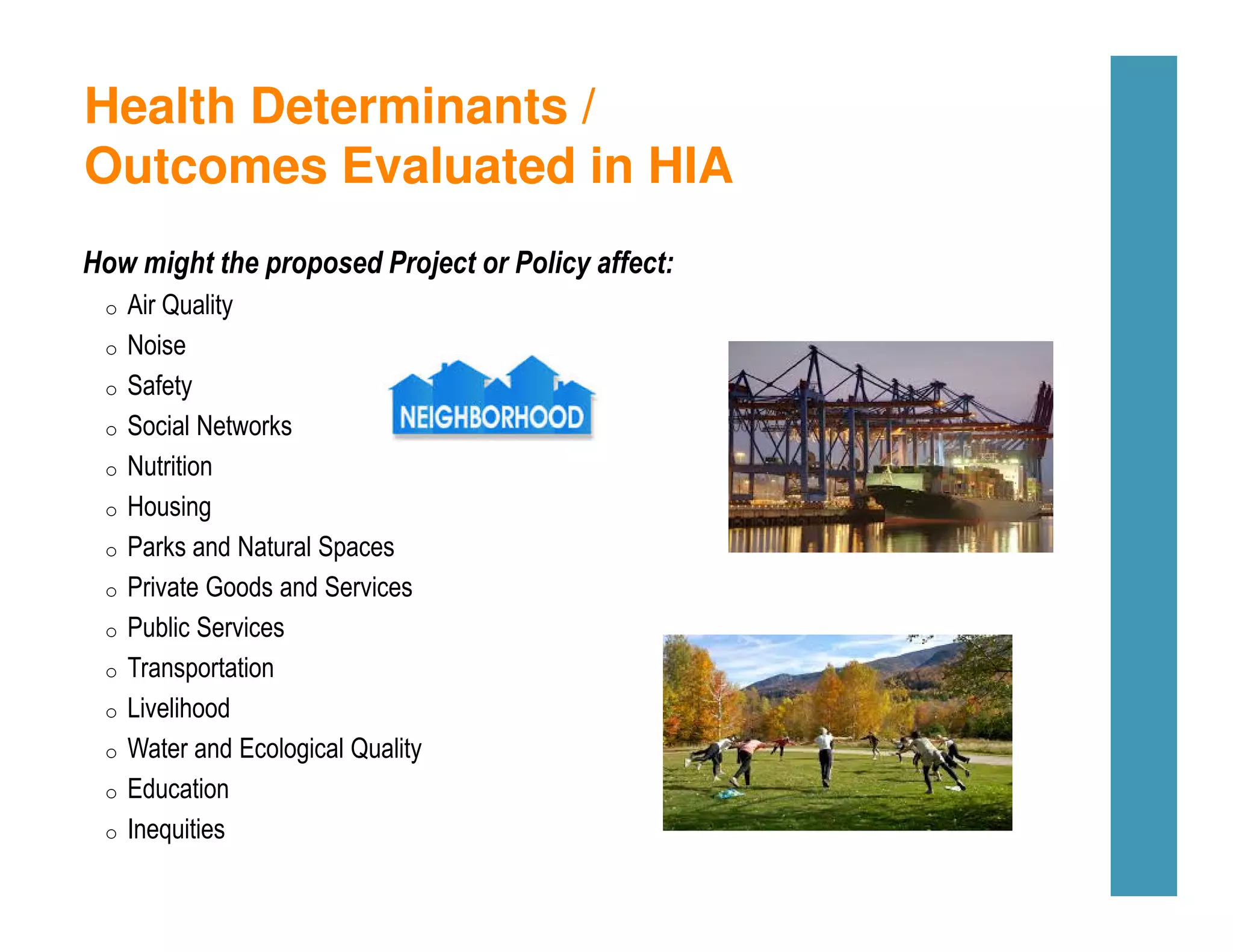
How might the proposed Project or Policy affect:
o Air Quality
o Noise
o Safety
o Social Networks
o Nutrition
o Housing
o Parks and Natural Spaces
o Private Goods and Services
o Public Services
o Transportation
o Livelihood
o Water and Ecological Quality
o Education
o Inequities
What is the Value of HIA ?
HIA is a tool that can:
o Provide a structured process to determine a policy or project's impact on
health (Objectivity).
o Ensure that policy and project dollars are used efficiently to provide the
greatest benefit.
o Engage stakeholders in the process (concept, scoping, planning of a
project or initiative).
HIA – Drivers in Policies and Regulations
States’ authority to protect health and welfare.
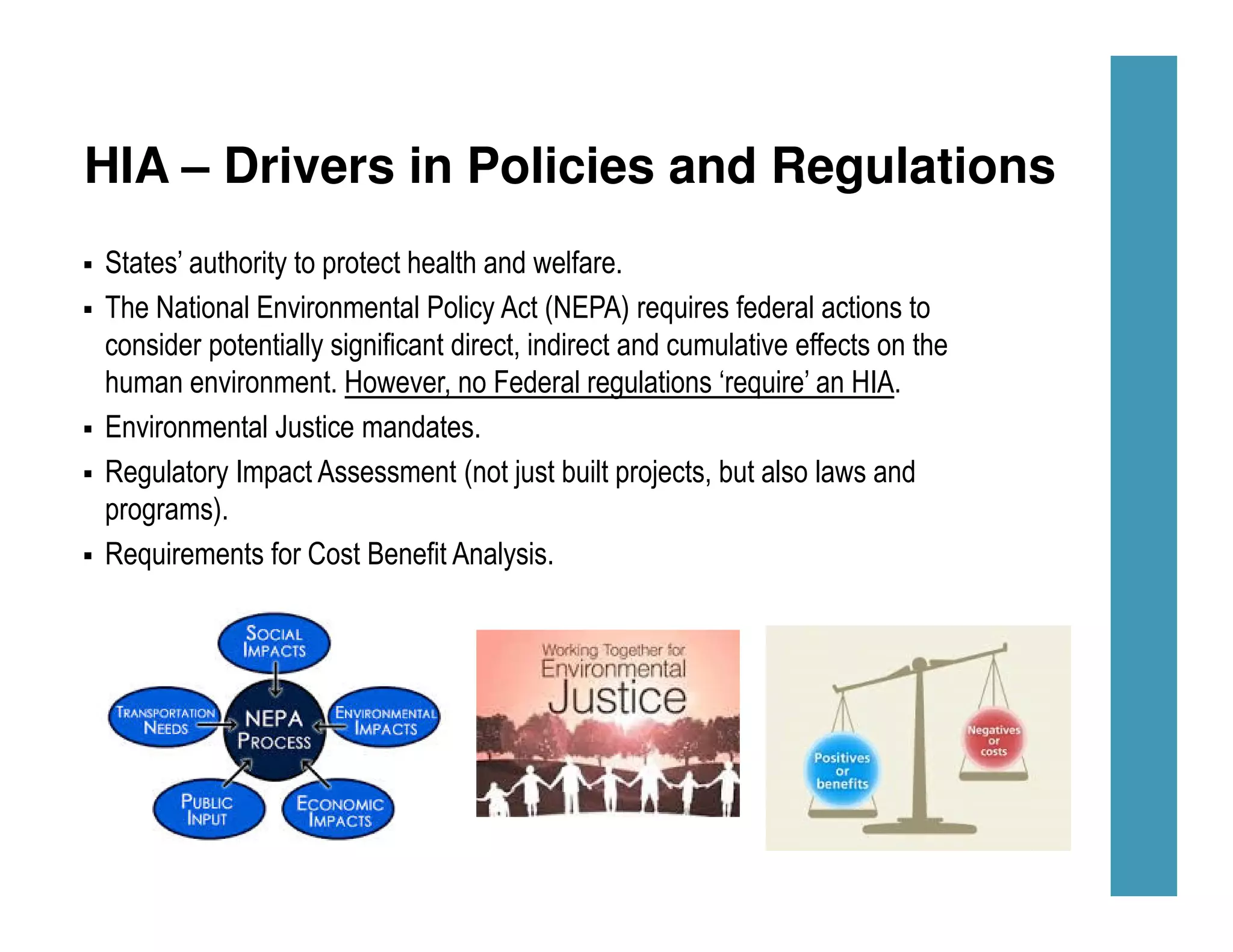
The National Environmental Policy Act (NEPA) requires federal actions to
consider potentially significant direct, indirect and cumulative effects on the
human environment. However, no Federal regulations ‘require’ an HIA.
Environmental Justice mandates.
Regulatory Impact Assessment (not just built projects, but also laws and
programs).
Requirements for Cost Benefit Analysis.
HIA – Drivers in Policies and Regulations
(Relationship to NEPA/EIA)
HIA can add value to Environmental Impact Assessment (EIA). HIA can be
developed independently of an EIA or can be integrated within an EIA
process.
From CDC, Health Places; Health Impact Assessment fact sheet:
o HIA is procedurally similar and complementary to the EIA conducted under NEPA and
equivalent state statutes. NEPA requires that Environmental Impact Statements (EIS) include
consideration and analysis of health effects of specified federal agency actions.
o NEPA does not refer by name to "HIA" as a separate requirement per se, and the current
practice of health analysis in the EIS has been limited. Given the legal mandate to consider
health in the EIA, however, the HIA is a tool that can be used to meet statutory requirements
for health effects analysis, when conducted within the context of an inter-disciplinary EIA.
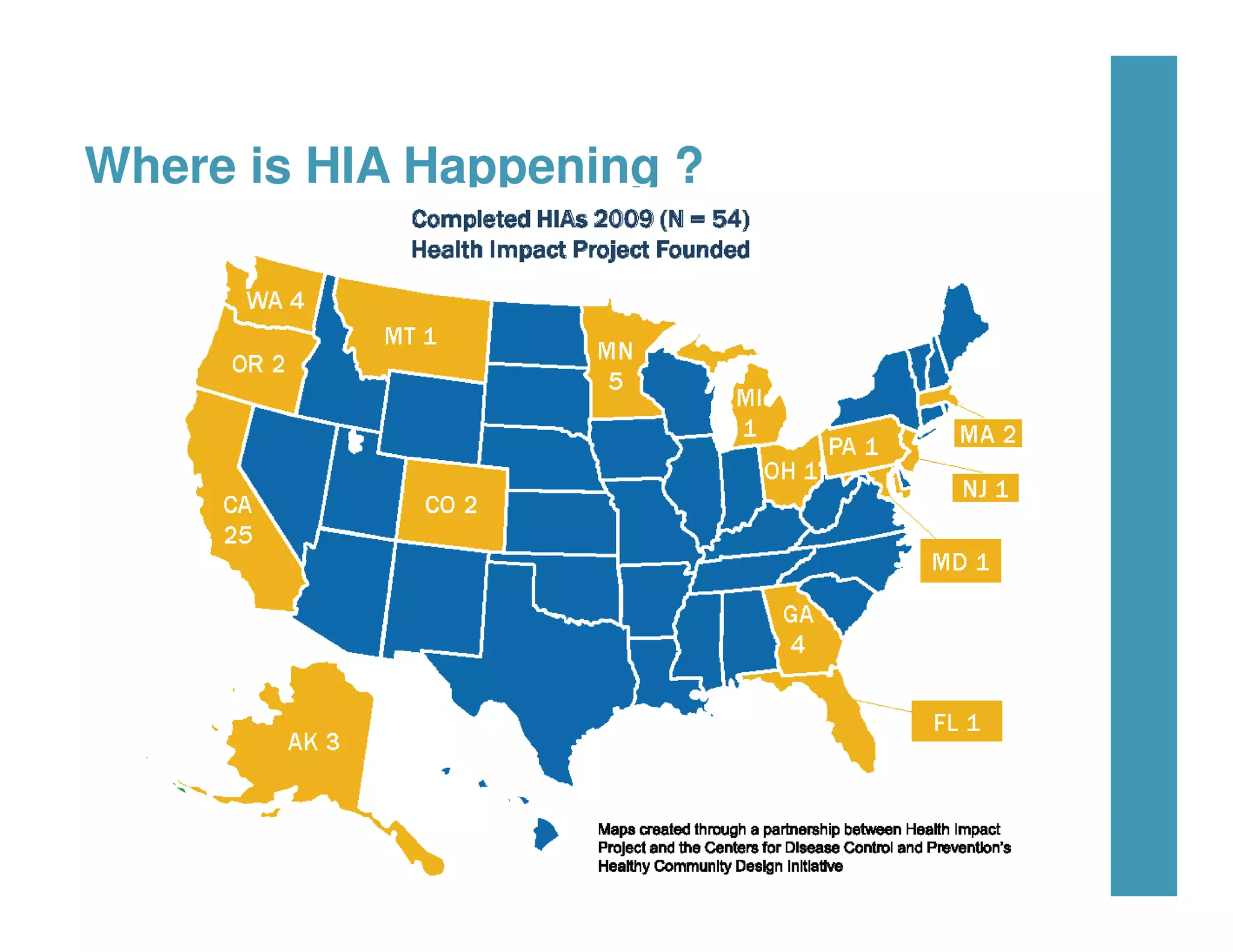
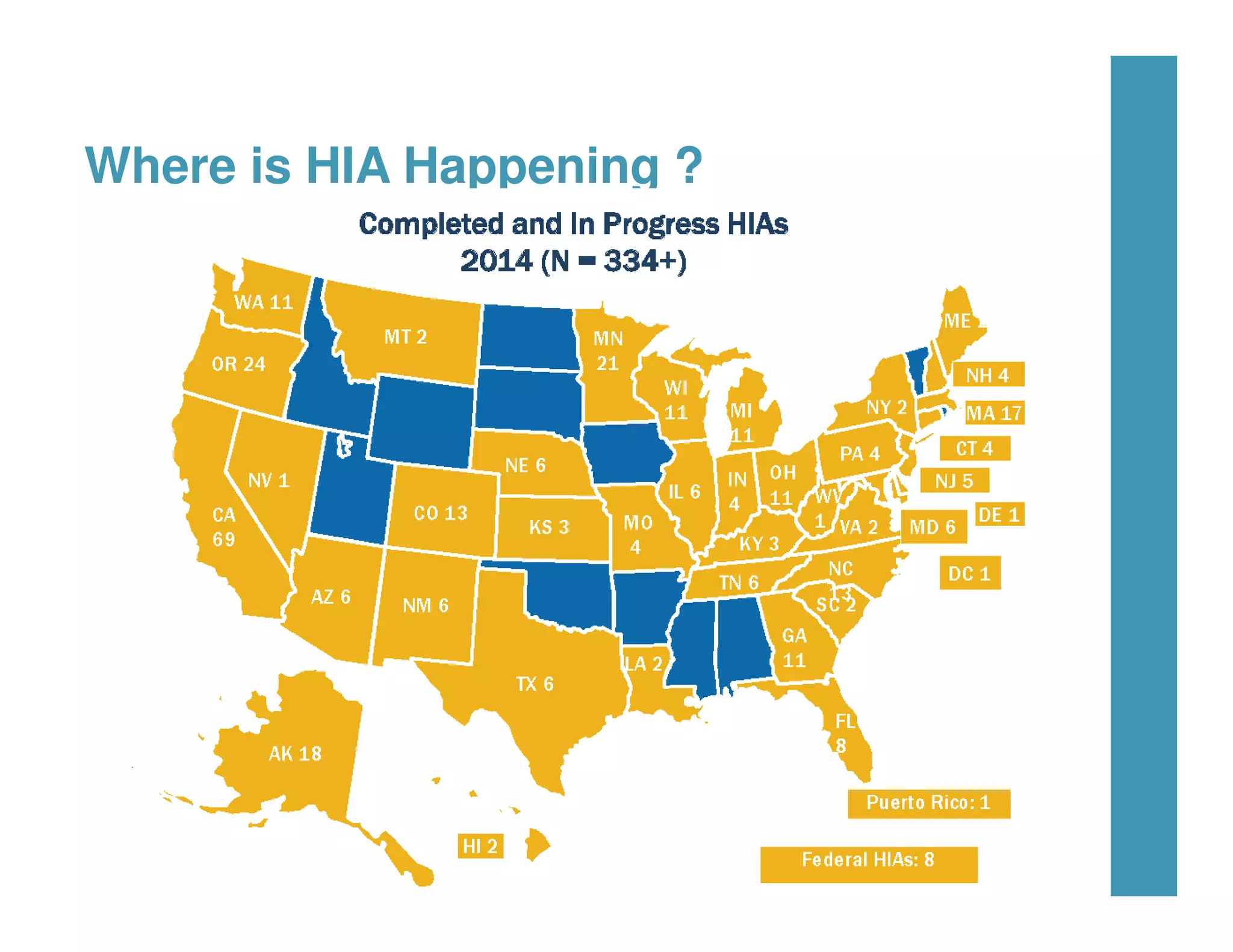
Where is HIA Happening ?
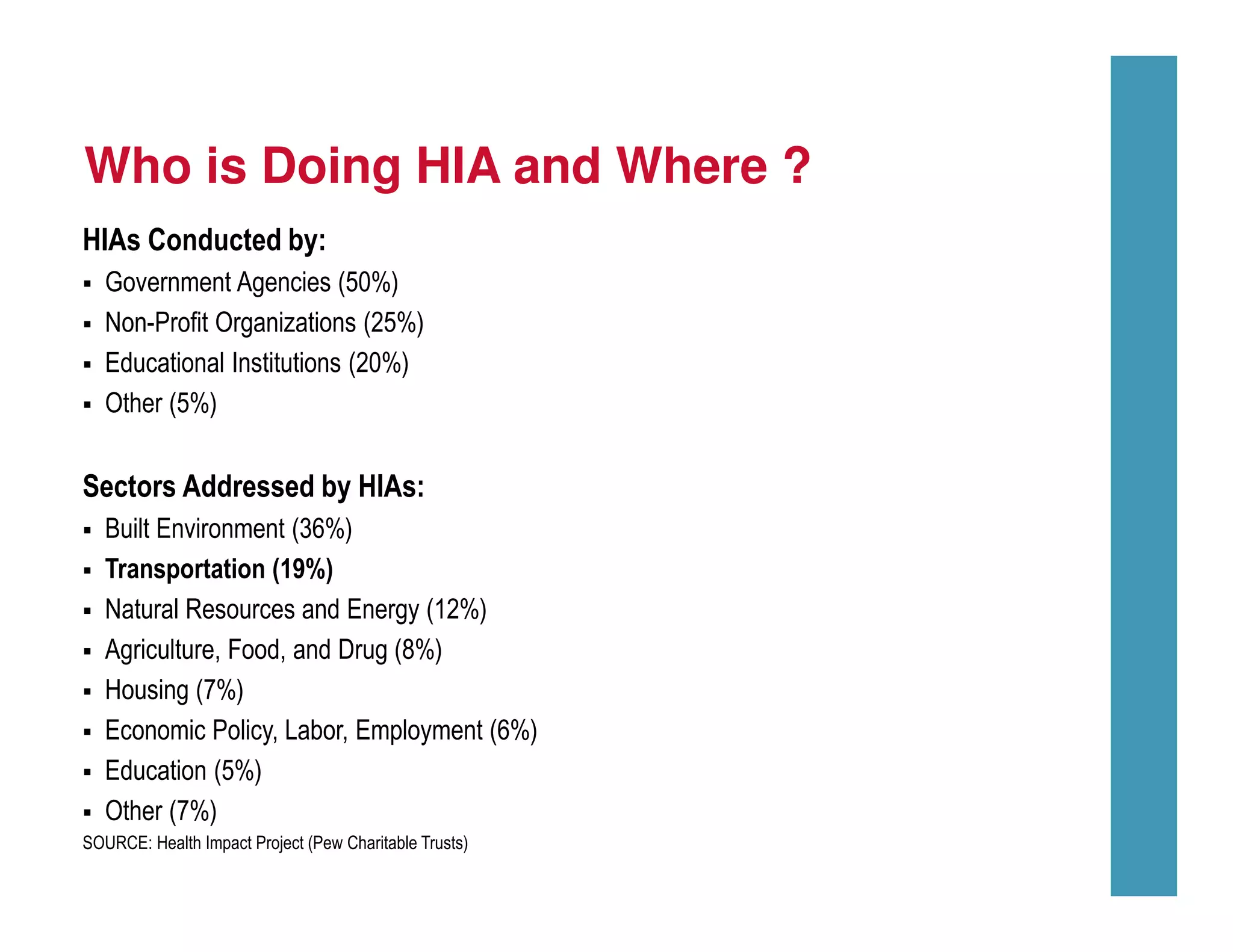
Who is Doing HIA and Where ?
HIAs Conducted by:
Government Agencies (50%)
Non-Profit Organizations (25%)
Educational Institutions (20%)
Other (5%)
Sectors Addressed by HIAs:
Built Environment (36%)
Transportation (19%)
Natural Resources and Energy (12%)
Agriculture, Food, and Drug (8%)
Housing (7%)
Economic Policy, Labor, Employment (6%)
Education (5%)
Other (7%)
SOURCE: Health Impact Project (Pew Charitable Trusts)
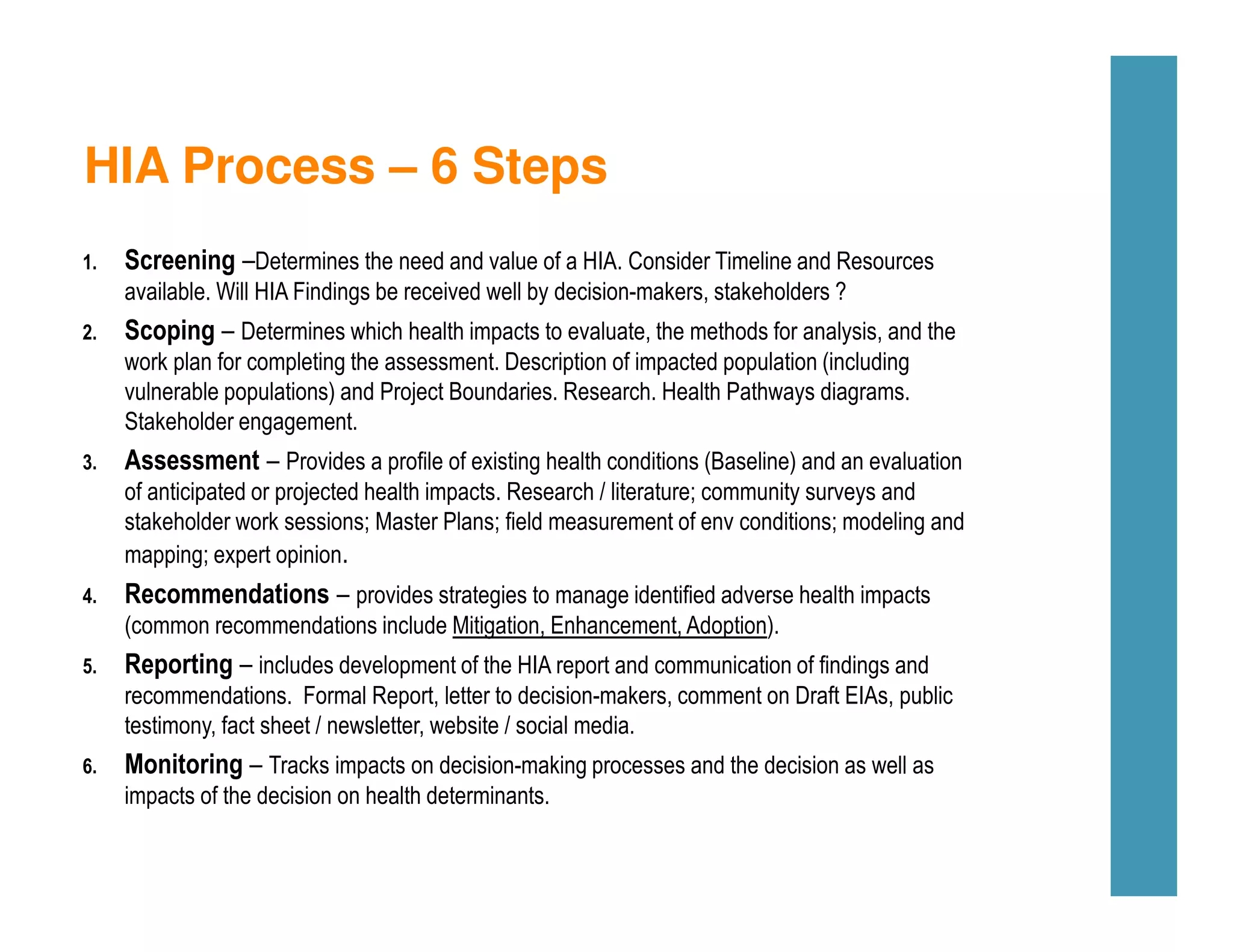
HIA Process – 6 Steps
1. Screening –Determines the need and value of a HIA. Consider Timeline and Resources
available. Will HIA Findings be received well by decision-makers, stakeholders ?
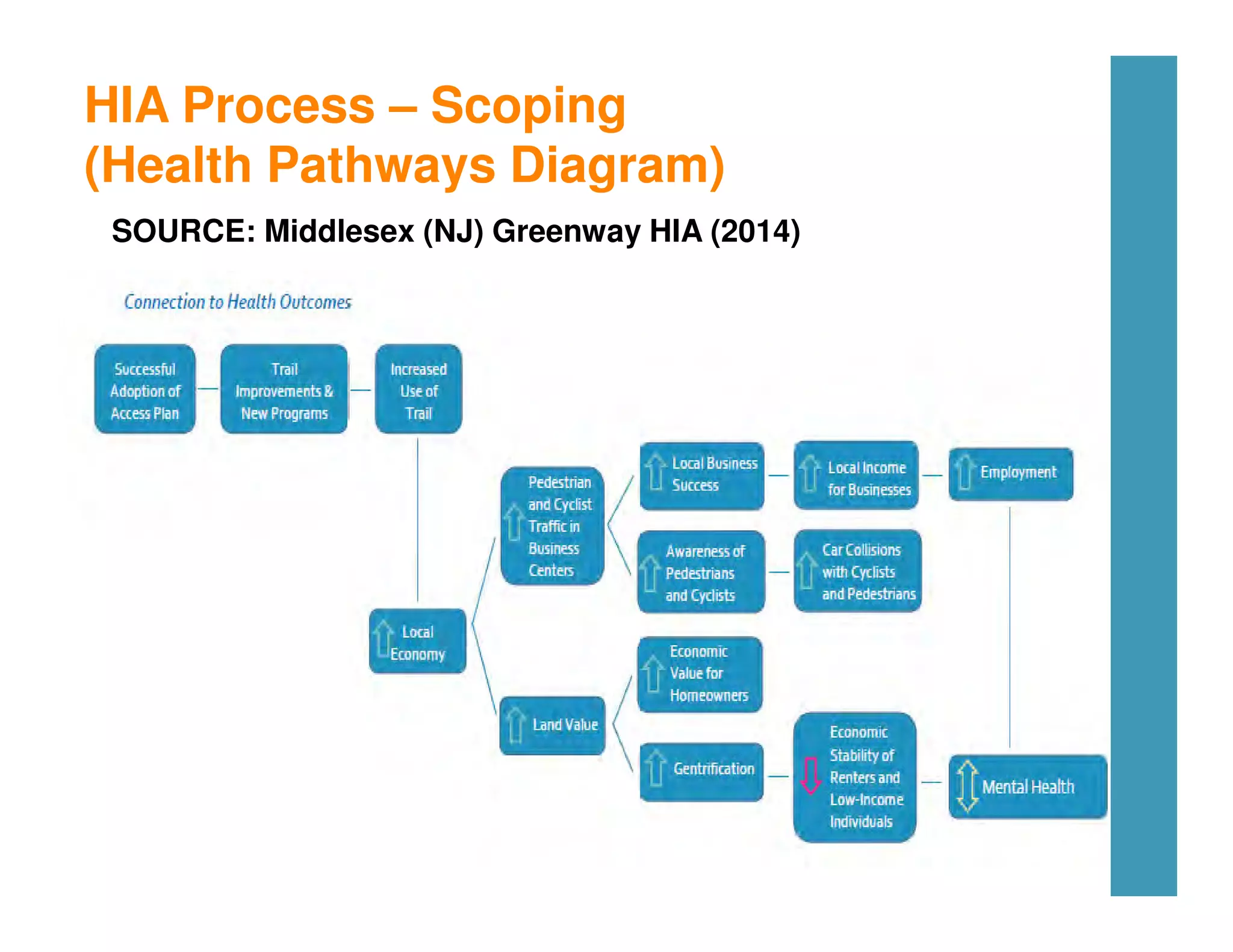
2. Scoping – Determines which health impacts to evaluate, the methods for analysis, and the
work plan for completing the assessment. Description of impacted population (including
vulnerable populations) and Project Boundaries. Research. Health Pathways diagrams.
Stakeholder engagement.
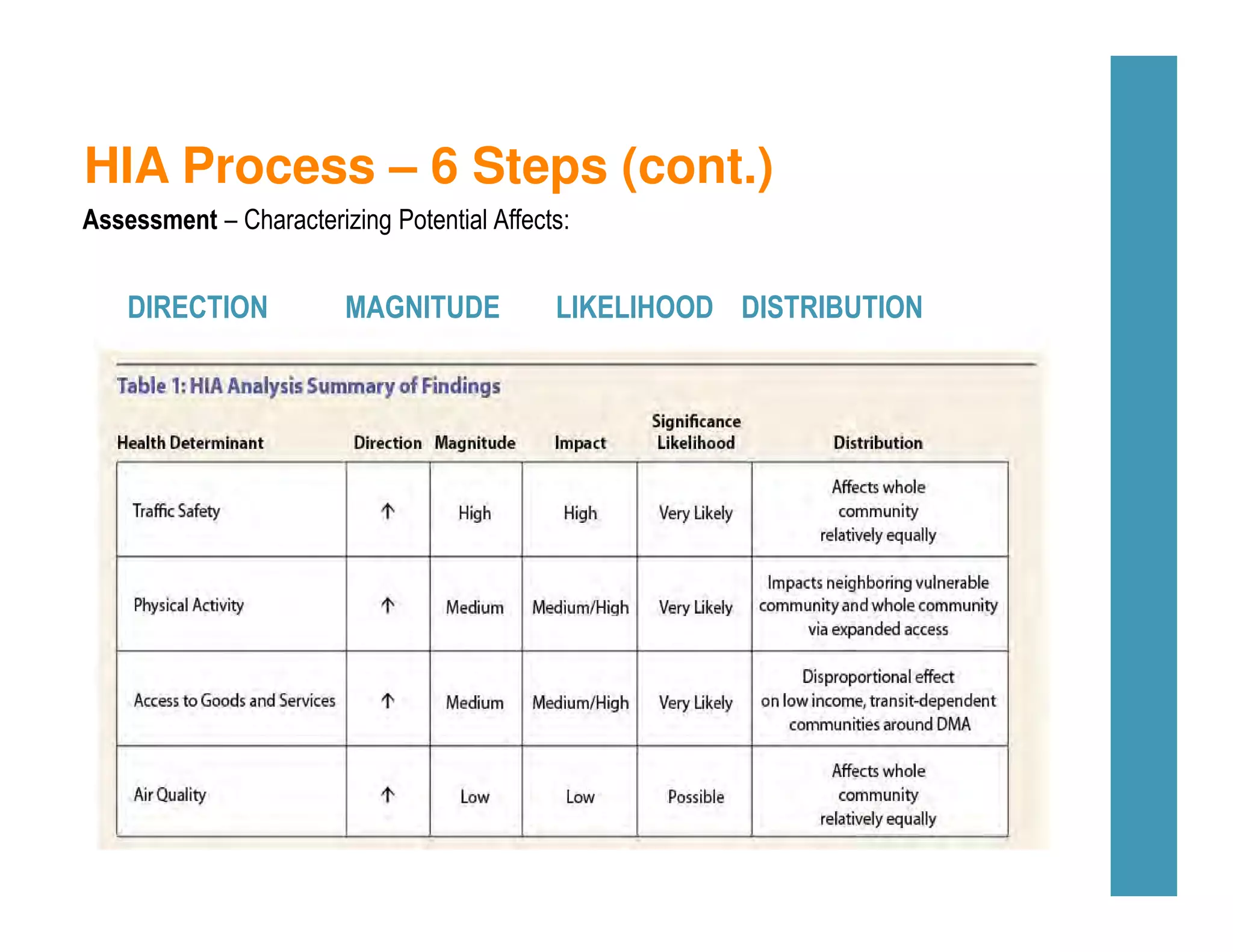
3. Assessment – Provides a profile of existing health conditions (Baseline) and an evaluation
of anticipated or projected health impacts. Research / literature; community surveys and
stakeholder work sessions; Master Plans; field measurement of env conditions; modeling and
mapping; expert opinion.
4. Recommendations – provides strategies to manage identified adverse health impacts
(common recommendations include Mitigation, Enhancement, Adoption).
5. Reporting – includes development of the HIA report and communication of findings and
recommendations. Formal Report, letter to decision-makers, comment on Draft EIAs, public
testimony, fact sheet / newsletter, website / social media.
6. Monitoring – Tracks impacts on decision-making processes and the decision as well as
impacts of the decision on health determinants.
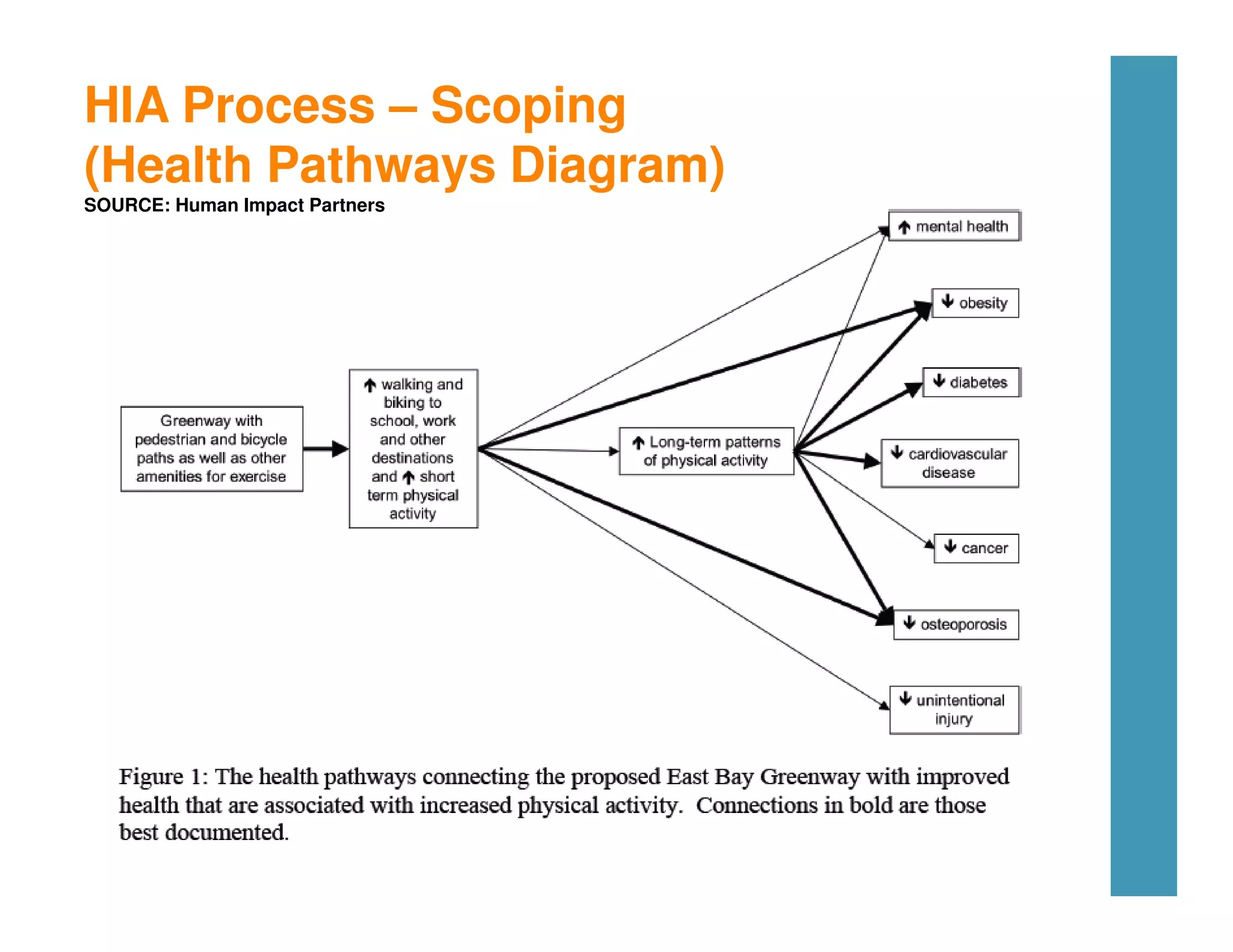
HIA Process – Scoping
(Health Pathways Diagram)
SOURCE: Human Impact Partners
HIA Process – Scoping
(Health Pathways Diagram)
SOURCE: Middlesex (NJ) Greenway HIA (2014)
HIA Process – 6 Steps (cont.)
Assessment – Characterizing Potential Affects:
DIRECTION MAGNITUDE LIKELIHOOD DISTRIBUTION
References and Resources
National Research Council (NRC). Improving Health in the United States: The Role
of Health Impact Assessment. Committee on Health Impact Assessment. 2011.
SOPHIA (Society of Practitioners of Health Impact Assessment). http://hiasociety.org/
o Stakeholder Engagement Tools
o Regional Capacity Building Maps
o Equity Metrics
o Papers and Research
o Sample HIAs
Centers for Disease Control and Prevention (CDC).
World Health Organization (WHO).
Human Impact Partners. www.humanimpact.org
San Francisco Department of Public Health.
Health Impact Project at Pew Charitable Trusts.
http://www.pewtrusts.org/en/projects/health-impact-project/health-impact-assessment
New Jersey Health Impact Collaborative (NJHIC). Rutgers University collaborative.
RV 2015: Back to the Future: Considering Health (Again) in Project Development by Michael Musso

RV 2015: Back to the Future: Considering Health (Again) in Project Development by Michael Musso

  • 1.
    © 2014 HDR,all rights reserved. Rail~Volution Dallas, TX October 27, 2015 Michael Musso, PE, MS, MPH A Primer on the Definition and Applications of Health Impact Assessment (HIA)
  • 2.
    AGENDA o Health ImpactAssessment – Definition and Health Determinants o Value and Applications of HIA o 6-Step Process o HIA References
  • 3.
    What is HIA? Health Impact Assessment (HIA) is a process used to identify how a project, policy or program might influence health. HIA uses a combination of procedures, methods and tools to systematically judge the potential--and sometimes unintended--effects of a proposed project, plan or policy on the health of a population and the distribution of those effects within the population. The HIA also produces recommendations to enhance the health benefits of the project/policy/program and to mitigate potential harms. Performance measures = health status outcomes HIA evaluates Negative AND Positive Impacts Direct and Indirect Health Impacts
  • 4.
    Health Determinants / OutcomesEvaluated in HIA How might the proposed Project or Policy affect: o Air Quality o Noise o Safety o Social Networks o Nutrition o Housing o Parks and Natural Spaces o Private Goods and Services o Public Services o Transportation o Livelihood o Water and Ecological Quality o Education o Inequities
  • 5.
    What is theValue of HIA ? HIA is a tool that can: o Provide a structured process to determine a policy or project's impact on health (Objectivity). o Ensure that policy and project dollars are used efficiently to provide the greatest benefit. o Engage stakeholders in the process (concept, scoping, planning of a project or initiative).
  • 6.
    HIA – Driversin Policies and Regulations States’ authority to protect health and welfare. The National Environmental Policy Act (NEPA) requires federal actions to consider potentially significant direct, indirect and cumulative effects on the human environment. However, no Federal regulations ‘require’ an HIA. Environmental Justice mandates. Regulatory Impact Assessment (not just built projects, but also laws and programs). Requirements for Cost Benefit Analysis.
  • 7.
    HIA – Driversin Policies and Regulations (Relationship to NEPA/EIA) HIA can add value to Environmental Impact Assessment (EIA). HIA can be developed independently of an EIA or can be integrated within an EIA process. From CDC, Health Places; Health Impact Assessment fact sheet: o HIA is procedurally similar and complementary to the EIA conducted under NEPA and equivalent state statutes. NEPA requires that Environmental Impact Statements (EIS) include consideration and analysis of health effects of specified federal agency actions. o NEPA does not refer by name to "HIA" as a separate requirement per se, and the current practice of health analysis in the EIS has been limited. Given the legal mandate to consider health in the EIA, however, the HIA is a tool that can be used to meet statutory requirements for health effects analysis, when conducted within the context of an inter-disciplinary EIA.
  • 8.
    Where is HIAHappening ?
  • 9.
    Where is HIAHappening ?
  • 10.
    Who is DoingHIA and Where ? HIAs Conducted by: Government Agencies (50%) Non-Profit Organizations (25%) Educational Institutions (20%) Other (5%) Sectors Addressed by HIAs: Built Environment (36%) Transportation (19%) Natural Resources and Energy (12%) Agriculture, Food, and Drug (8%) Housing (7%) Economic Policy, Labor, Employment (6%) Education (5%) Other (7%) SOURCE: Health Impact Project (Pew Charitable Trusts)
  • 11.
    HIA Process –6 Steps 1. Screening –Determines the need and value of a HIA. Consider Timeline and Resources available. Will HIA Findings be received well by decision-makers, stakeholders ? 2. Scoping – Determines which health impacts to evaluate, the methods for analysis, and the work plan for completing the assessment. Description of impacted population (including vulnerable populations) and Project Boundaries. Research. Health Pathways diagrams. Stakeholder engagement. 3. Assessment – Provides a profile of existing health conditions (Baseline) and an evaluation of anticipated or projected health impacts. Research / literature; community surveys and stakeholder work sessions; Master Plans; field measurement of env conditions; modeling and mapping; expert opinion. 4. Recommendations – provides strategies to manage identified adverse health impacts (common recommendations include Mitigation, Enhancement, Adoption). 5. Reporting – includes development of the HIA report and communication of findings and recommendations. Formal Report, letter to decision-makers, comment on Draft EIAs, public testimony, fact sheet / newsletter, website / social media. 6. Monitoring – Tracks impacts on decision-making processes and the decision as well as impacts of the decision on health determinants.
  • 12.
    HIA Process –Scoping (Health Pathways Diagram) SOURCE: Human Impact Partners
  • 13.
    HIA Process –Scoping (Health Pathways Diagram) SOURCE: Middlesex (NJ) Greenway HIA (2014)
  • 14.
    HIA Process –6 Steps (cont.) Assessment – Characterizing Potential Affects: DIRECTION MAGNITUDE LIKELIHOOD DISTRIBUTION
  • 15.
    References and Resources NationalResearch Council (NRC). Improving Health in the United States: The Role of Health Impact Assessment. Committee on Health Impact Assessment. 2011. SOPHIA (Society of Practitioners of Health Impact Assessment). http://hiasociety.org/ o Stakeholder Engagement Tools o Regional Capacity Building Maps o Equity Metrics o Papers and Research o Sample HIAs Centers for Disease Control and Prevention (CDC). World Health Organization (WHO). Human Impact Partners. www.humanimpact.org San Francisco Department of Public Health. Health Impact Project at Pew Charitable Trusts. http://www.pewtrusts.org/en/projects/health-impact-project/health-impact-assessment New Jersey Health Impact Collaborative (NJHIC). Rutgers University collaborative.