L l o y d M o o r e , P r e s i d e n t
L l o y d @ C y b e r D a t a - R o b o t i c s . c o m
w w w . C y b e r D a t a - R o b o t i c s . c o m
A Slice of Rust
Agenda:
We are going to look at a collection of topics
related to Rust programming that I have found
interesting over the past year developing several
projects.
In some cases I’ll compare and contrast to C++
and in others we’ll just look at the Rust topic.
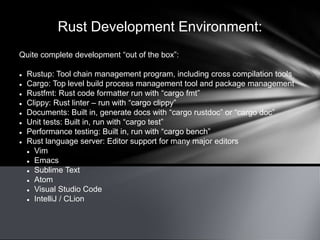
Rust Development Environment:
Quite complete development “out of the box”:
 Rustup: Tool chain management program, including cross compilation tools
 Cargo: Top level build process management tool and package management
 Rustfmt: Rust code formatter run with “cargo fmt”
 Clippy: Rust linter – run with “cargo clippy”
 Documents: Built in, generate docs with “cargo rustdoc” or “cargo doc”
 Unit tests: Built in, run with “cargo test”
 Performance testing: Built in, run with “cargo bench”
 Rust language server: Editor support for many major editors
 Vim
 Emacs
 Sublime Text
 Atom
 Visual Studio Code
 IntelliJ / CLion
Rust Development Cycle
 “Feels” VERY different from a C++ development cycle
 Basic mechanics are the same: Edit, Compile, Run
 Compiler messages will give suggestions as well as
outright errors
 Can also include code snip-its
 Result is you feel more like you are having a “dialog”
with the compiler to edit and build the code
Coding Style Idiom Based
 When coding in Rust look for existing
patterns that already solve your problem.
 Similar to Design Patterns they are much
smaller patterns to solve specific problems
 This is typically referred to as “idomatic
code” and is more important in Rust than
other languages
 In some cases the compiler and/or linter
(clippy) will actually enforce an idomatic
pattern
Rust Language Evolution
 No formal language specification!
 The compiler is the specification
 Does place limits on where the language can be
used – cannot use for some projects requiring
DO-178x – will not be able to fully qualify the tool
chain!
 Allows for faster language iteration
 Language is less “regular” than C++
 Has “Editions” for language breaking changes,
increment every 3 years so far
 Has “stable” and “nightly” compiler versions
 “Stable” compiler updated every 6 weeks!
Crates.io – The package registry
 Packages are called “crates” in Rust
 Registry is integrated with cargo for both package
download and version management
 Appears to be a rather blurry line between a
“standard” library and what ends up in the registry
 Most packages have a MIT or Apache style license
 Not “curated” in any way, watch for:
 Documentation quality
 Number of recent downloads – some crates are
defacto standards, ie: serde and rand
 Last release and release cadance
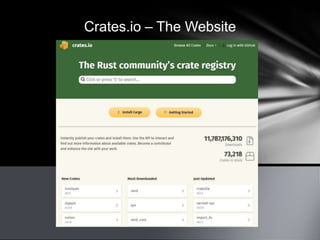
Crates.io – The Website
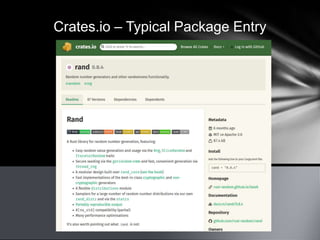
Crates.io – Typical Package Entry
Std::time::Duration vs chrono::Duration
 Lloyd’s rule: If there are two similar things Lloyd
has a 90% chance of finding the wrong one!
 Std::time::Duration and chrono::Duration do
basically the same thing but are not compatible.
 Chrono is the more feature rich package, and
seems to be usually what you want.
 Frequently trips me up though, and error
messages can be more confusing in the context of
two packages with similar constructs.
Borrow Checker
 Likely the most loved and hated feature of Rust!
 Enforces compile time checks on variables:
 Initialized before use
 Not moved twice
 Not moved while “borrowed”
 Cannot be modified by more than one owner at a
time
 Etc….
 Fundamentally responsible for enforcing the safety
guarantees that make Rust unique.
 Will FORCE you to use different and better
patterns when writing code!
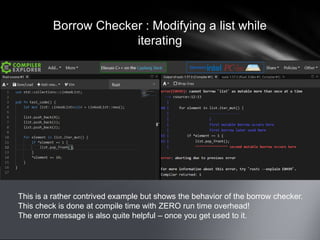
Borrow Checker : Modifying a list while
iterating
This is a rather contrived example but shows the behavior of the borrow checker.
This check is done at compile time with ZERO run time overhead!
The error message is also quite helpful – once you get used to it.
Match Statement Efficiency
 Match statement is much like C++ switch
 Also includes much more advanced pattern
matching.
 Herb Sutter has proposed a similar construct for C++:
 https://www.youtube.com/watch?v=raB_289NxBk
 So just how efficient is this statement?
 Note that Rust currently uses the LLVM back end
compiler and benefits from the optimizations there.
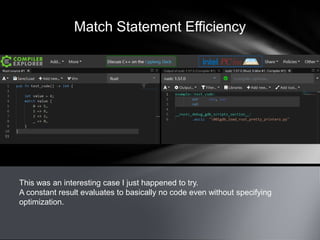
Match Statement Efficiency
This was an interesting case I just happened to try.
A constant result evaluates to basically no code even without specifying
optimization.
Match Statement Efficiency
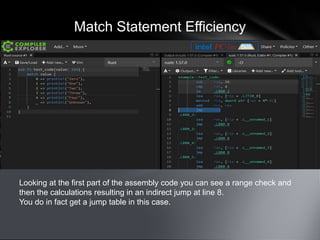
Looking at the first part of the assembly code you can see a range check and
then the calculations resulting in an indirect jump at line 8.
You do in fact get a jump table in this case.
Match Statement Efficiency
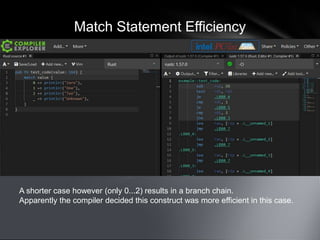
A shorter case however (only 0...2) results in a branch chain.
Apparently the compiler decided this construct was more efficient in this case.
 Overall Rust can be just as efficient as C++.
 If you consider that additional compile time checks
can replace run time checks Rust can be more
efficient than C++ in some cases.
 Rust pays for this with increased build times,
however I’ve found this no worse than using C++
with a linter, such as clang-tidy.
 Construction of code which does not copy values
around is more difficult than in C++ owing to
borrow checker restrictions.
General Rust Efficiency
No Inheritance
 Rust promotes the composition pattern over
inheritance.
 In practice I’ve found this does result in
either:
 Duplicated code as each object must
contain what would be in a base class
 Need to use a different object model
 Need to use generic functions
 Need to use macros to generate a “family”
of objects
Rust Macros
 Macros are much more important and robust
than C++.
 Macro substitution happens in the abstract
syntax tree – NOT textual substitution!
 Parameters in macros can be restricted to
specific syntactic elements (expression,
block, etc.)
 With this can build domain specific
languages with Rust macros that intermix
with normal Rust code.
Rust Macros
 Two types of Rust Macros
 macro_rules
 Conceptually like enhanced C++ macros
 Procedural macros – allows for creating full
syntax extensions, and run code at compile
time.
 Conceptually allow you convert one AST
into another AST
 Have not had a chance to try these yet,
but conceptually very powerful.
Resources
 Rust Home Page
 https://www.rust-lang.org
 The Little Book of Rust Books
 https://lborb.github.io/book/title-page.html
 Rust Language Cheat Sheet
 https://cheats.rs/#cargo
Questions?

A Slice Of Rust - A quick look at the Rust programming language

  • 1.
    L l oy d M o o r e , P r e s i d e n t L l o y d @ C y b e r D a t a - R o b o t i c s . c o m w w w . C y b e r D a t a - R o b o t i c s . c o m A Slice of Rust
  • 2.
    Agenda: We are goingto look at a collection of topics related to Rust programming that I have found interesting over the past year developing several projects. In some cases I’ll compare and contrast to C++ and in others we’ll just look at the Rust topic.
  • 3.
    Rust Development Environment: Quitecomplete development “out of the box”:  Rustup: Tool chain management program, including cross compilation tools  Cargo: Top level build process management tool and package management  Rustfmt: Rust code formatter run with “cargo fmt”  Clippy: Rust linter – run with “cargo clippy”  Documents: Built in, generate docs with “cargo rustdoc” or “cargo doc”  Unit tests: Built in, run with “cargo test”  Performance testing: Built in, run with “cargo bench”  Rust language server: Editor support for many major editors  Vim  Emacs  Sublime Text  Atom  Visual Studio Code  IntelliJ / CLion
  • 4.
    Rust Development Cycle “Feels” VERY different from a C++ development cycle  Basic mechanics are the same: Edit, Compile, Run  Compiler messages will give suggestions as well as outright errors  Can also include code snip-its  Result is you feel more like you are having a “dialog” with the compiler to edit and build the code
  • 5.
    Coding Style IdiomBased  When coding in Rust look for existing patterns that already solve your problem.  Similar to Design Patterns they are much smaller patterns to solve specific problems  This is typically referred to as “idomatic code” and is more important in Rust than other languages  In some cases the compiler and/or linter (clippy) will actually enforce an idomatic pattern
  • 6.
    Rust Language Evolution No formal language specification!  The compiler is the specification  Does place limits on where the language can be used – cannot use for some projects requiring DO-178x – will not be able to fully qualify the tool chain!  Allows for faster language iteration  Language is less “regular” than C++  Has “Editions” for language breaking changes, increment every 3 years so far  Has “stable” and “nightly” compiler versions  “Stable” compiler updated every 6 weeks!
  • 7.
    Crates.io – Thepackage registry  Packages are called “crates” in Rust  Registry is integrated with cargo for both package download and version management  Appears to be a rather blurry line between a “standard” library and what ends up in the registry  Most packages have a MIT or Apache style license  Not “curated” in any way, watch for:  Documentation quality  Number of recent downloads – some crates are defacto standards, ie: serde and rand  Last release and release cadance
  • 8.
  • 9.
    Crates.io – TypicalPackage Entry
  • 10.
    Std::time::Duration vs chrono::Duration Lloyd’s rule: If there are two similar things Lloyd has a 90% chance of finding the wrong one!  Std::time::Duration and chrono::Duration do basically the same thing but are not compatible.  Chrono is the more feature rich package, and seems to be usually what you want.  Frequently trips me up though, and error messages can be more confusing in the context of two packages with similar constructs.
  • 11.
    Borrow Checker  Likelythe most loved and hated feature of Rust!  Enforces compile time checks on variables:  Initialized before use  Not moved twice  Not moved while “borrowed”  Cannot be modified by more than one owner at a time  Etc….  Fundamentally responsible for enforcing the safety guarantees that make Rust unique.  Will FORCE you to use different and better patterns when writing code!
  • 12.
    Borrow Checker :Modifying a list while iterating This is a rather contrived example but shows the behavior of the borrow checker. This check is done at compile time with ZERO run time overhead! The error message is also quite helpful – once you get used to it.
  • 13.
    Match Statement Efficiency Match statement is much like C++ switch  Also includes much more advanced pattern matching.  Herb Sutter has proposed a similar construct for C++:  https://www.youtube.com/watch?v=raB_289NxBk  So just how efficient is this statement?  Note that Rust currently uses the LLVM back end compiler and benefits from the optimizations there.
  • 14.
    Match Statement Efficiency Thiswas an interesting case I just happened to try. A constant result evaluates to basically no code even without specifying optimization.
  • 15.
    Match Statement Efficiency Lookingat the first part of the assembly code you can see a range check and then the calculations resulting in an indirect jump at line 8. You do in fact get a jump table in this case.
  • 16.
    Match Statement Efficiency Ashorter case however (only 0...2) results in a branch chain. Apparently the compiler decided this construct was more efficient in this case.
  • 17.
     Overall Rustcan be just as efficient as C++.  If you consider that additional compile time checks can replace run time checks Rust can be more efficient than C++ in some cases.  Rust pays for this with increased build times, however I’ve found this no worse than using C++ with a linter, such as clang-tidy.  Construction of code which does not copy values around is more difficult than in C++ owing to borrow checker restrictions. General Rust Efficiency
  • 18.
    No Inheritance  Rustpromotes the composition pattern over inheritance.  In practice I’ve found this does result in either:  Duplicated code as each object must contain what would be in a base class  Need to use a different object model  Need to use generic functions  Need to use macros to generate a “family” of objects
  • 19.
    Rust Macros  Macrosare much more important and robust than C++.  Macro substitution happens in the abstract syntax tree – NOT textual substitution!  Parameters in macros can be restricted to specific syntactic elements (expression, block, etc.)  With this can build domain specific languages with Rust macros that intermix with normal Rust code.
  • 20.
    Rust Macros  Twotypes of Rust Macros  macro_rules  Conceptually like enhanced C++ macros  Procedural macros – allows for creating full syntax extensions, and run code at compile time.  Conceptually allow you convert one AST into another AST  Have not had a chance to try these yet, but conceptually very powerful.
  • 21.
    Resources  Rust HomePage  https://www.rust-lang.org  The Little Book of Rust Books  https://lborb.github.io/book/title-page.html  Rust Language Cheat Sheet  https://cheats.rs/#cargo
  • 22.