Vinay Jha
Rural         India The Market
    Size
   Rural India The Market Size Source : Census of
    India 2001 Distribution of National Population
    12.2% of the world's consumers live in rural India.
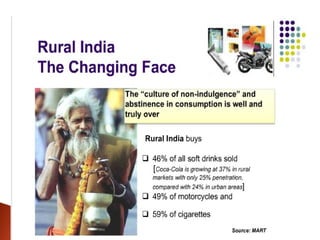
   Rural India The Changing Face The “culture of
    non-indulgence” and abstinence in consumption is
    well and truly over Rural India buys 46% of all soft
    drinks sold [Coca-Cola is growing at 37% in rural
    markets with only 25% penetration, compared with
    24% in urban areas] 49% of motorcycles and 59%
    of cigarettes Source: MART

Rural Markets: the next frontier: 
 Rural markets are the places to watch out for, as

  this is the next battleground for the organizations
  to fight for increasing their market shares, with
  urban markets getting saturated, and farmers
  getting richer, it is no wonder that there is an
  impulse to go rural among the marketers
  particularly FMCG and
   Consumer Durable companies. But the urban
    marketing strategy does not fit into the rural
    marketing structure and it needs a reorientation by
    looking at the competitive landscape and
    challenges of the rural market.
   They have tried tinkering with all the four 'P's of the
    marketing mix i.e. Product, Pricing, Promotion and
    Place [ E.g. HUL has been a pioneer in reaching out to
    the smallest of villages with innovative products such
    as single-use packets of shampoo] To sell in villages,
    products must be priced low, profit margins must be
    kept to the minimum and the marketing message must
    be kept simple.
 
   However, the area where innovation has moved
    to center stage is in the fourth P -- place (or
    distribution). Distribution channels can make or
    break a company's rural marketing efforts.
    Companies know it far too well that unless they
    come up with some innovative distribution
    channels that grasp the rural nuances well, all
    their rural efforts will come a cropper. Some of
    the examples of how India Inc has moved on a
    path-breaking manner to tap this market are
    ITC’s Choupal Sagar HLL’s Project Shakti DCM
    Shriram’s Hariyali Kisaan Bazaar Godrej’s
    Aadhaar Stores Mahindra’s ShubhLabh Stores
    Oil major IOC’s Kisan Seva Kendras
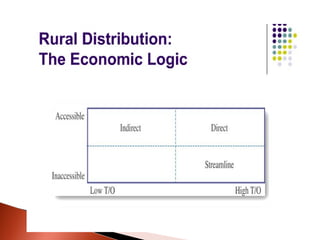
The    Distribution
    Challenge Large and Scattered Markets
    Dispersed population and trade Low density of
    shops/village and high variation in their concentration
    Inadequate Transport Facilities Lack of Retail
    Infrastructure Poor visibility and display of product on
    rural shop shelves Highly credit driven market and low
    investment capacity of retailers Inadequate bank and
    credit facilities for rural retailers Lack of proper
    warehousing facility Multiple Tiers (large no. of
    intermediaries) leading to higher costs *[ Though it
    depends on Cost/Benefit ratio of the individual
    organization] Poor Communication of due to Poor Reach
    of Media
Response                     to the
    Issues              Large and Scattered Markets
   Inadequate Transport Facilities
   Marico and HLL have started using delivery vans to
    cater to rural markets. Coca Cola has opted for a ‘hub
    and spoke’ distribution system. [Coke bottles were
    transported from the bottling plants to the hubs (large
    distributors) and from hubs to spokes (smaller
    distributors) situated in small towns. Further
    distribution is done from there.]
Response                  to the
    Issues
   Large and Scattered Markets
   Inadequate Transport Facilities
   Companies with relatively fewer resources can
    come together through syndicated distribution
    through co-partnering with non-competitive
    marketers for the same market. E.g. Samsung has
    tied up with IFFCO. Motorola and Nokia have
    partnered with ITC e-choupal Aviva life Insurance
    has tied up with BASIX, an NGO
 Response         to the Issues  
 Large and Scattered Markets
 Inadequate Transport Facilities Companies follow a
  strategy called "co-opetition", in which they come
  together to synergize their resources in rural
  markets for benefit of both the partners and yet, can
  compete in the urban markets for market share.
  E.g. Procter & Gamble has tied up with Godrej and
  Marico industries and now it is planning one with
  Nirma for distribution of Camay soaps. ICICI
  collaborating with P & T to open ATMs
Response                     to the Issues
    Lack of Retail Infrastructure
    Lack of proper warehousing facility The concept of ‘rural
    mall’, first introduced by ITC as Choupal Sagar is proving to
    be an effective way out. Along with ITC’s Choupal Sagar,
    few more companies have taken initiative in same direction.
    To name a few are TATA Kissan Sansar, Delhi Shriram’s
    Kissan Haryali Bazaar, Godrej’s Aadhar and Manthan.
Response                 to the Issues
 Multiple Tiers: Poor Communication due to Poor
  Reach of Media
 ITC’s e-Choupal is an innovative, technology based

  way to address this issue where Intermediaries are
  avoided Direct contact with the consumer is
  established, thereby empowering the farmer, to
  decide when to sell, and reducing the information
  asymmetry, by providing real time data on latest rates
  at mandi and CBOT.
   HLL’s Project Shakti showed another smart way of
    reaching 10 lakh homes directly in the villages
    through the use of Self Help Groups
    where traditional communication/distribution
    system is neither efficient nor cost-effective.


    Distribution in Indian rural markets is indeed a
    great challenge but can be tackled by designing
    and adopting effective strategies and  proper use
    of resources: e-chaupal(ITC), shakti amma(HUL),
    ICICI bank, Dabur, Casas Bahai, Jaipur foot,
    Aravind eye hospital, Parry’s, have made
    significant progress in penetrating the rural
    market.
Rural mkt
Rural mkt

Rural mkt

  • 1.
  • 2.
    Rural India The Market Size  Rural India The Market Size Source : Census of India 2001 Distribution of National Population 12.2% of the world's consumers live in rural India.
  • 3.
    Rural India The Changing Face The “culture of non-indulgence” and abstinence in consumption is well and truly over Rural India buys 46% of all soft drinks sold [Coca-Cola is growing at 37% in rural markets with only 25% penetration, compared with 24% in urban areas] 49% of motorcycles and 59% of cigarettes Source: MART 
  • 9.
    Rural Markets: thenext frontier:   Rural markets are the places to watch out for, as this is the next battleground for the organizations to fight for increasing their market shares, with urban markets getting saturated, and farmers getting richer, it is no wonder that there is an impulse to go rural among the marketers particularly FMCG and
  • 10.
    Consumer Durable companies. But the urban marketing strategy does not fit into the rural marketing structure and it needs a reorientation by looking at the competitive landscape and challenges of the rural market.
  • 12.
    They have tried tinkering with all the four 'P's of the marketing mix i.e. Product, Pricing, Promotion and Place [ E.g. HUL has been a pioneer in reaching out to the smallest of villages with innovative products such as single-use packets of shampoo] To sell in villages, products must be priced low, profit margins must be kept to the minimum and the marketing message must be kept simple.
  • 13.
       However, the area where innovation has moved to center stage is in the fourth P -- place (or distribution). Distribution channels can make or break a company's rural marketing efforts. Companies know it far too well that unless they come up with some innovative distribution channels that grasp the rural nuances well, all their rural efforts will come a cropper. Some of the examples of how India Inc has moved on a path-breaking manner to tap this market are ITC’s Choupal Sagar HLL’s Project Shakti DCM Shriram’s Hariyali Kisaan Bazaar Godrej’s Aadhaar Stores Mahindra’s ShubhLabh Stores Oil major IOC’s Kisan Seva Kendras
  • 16.
    The Distribution Challenge Large and Scattered Markets  Dispersed population and trade Low density of shops/village and high variation in their concentration Inadequate Transport Facilities Lack of Retail Infrastructure Poor visibility and display of product on rural shop shelves Highly credit driven market and low investment capacity of retailers Inadequate bank and credit facilities for rural retailers Lack of proper warehousing facility Multiple Tiers (large no. of intermediaries) leading to higher costs *[ Though it depends on Cost/Benefit ratio of the individual organization] Poor Communication of due to Poor Reach of Media
  • 17.
    Response to the Issues Large and Scattered Markets  Inadequate Transport Facilities  Marico and HLL have started using delivery vans to cater to rural markets. Coca Cola has opted for a ‘hub and spoke’ distribution system. [Coke bottles were transported from the bottling plants to the hubs (large distributors) and from hubs to spokes (smaller distributors) situated in small towns. Further distribution is done from there.]
  • 18.
    Response to the Issues  Large and Scattered Markets  Inadequate Transport Facilities  Companies with relatively fewer resources can come together through syndicated distribution through co-partnering with non-competitive marketers for the same market. E.g. Samsung has tied up with IFFCO. Motorola and Nokia have partnered with ITC e-choupal Aviva life Insurance has tied up with BASIX, an NGO
  • 19.
     Response to the Issues    Large and Scattered Markets  Inadequate Transport Facilities Companies follow a strategy called "co-opetition", in which they come together to synergize their resources in rural markets for benefit of both the partners and yet, can compete in the urban markets for market share. E.g. Procter & Gamble has tied up with Godrej and Marico industries and now it is planning one with Nirma for distribution of Camay soaps. ICICI collaborating with P & T to open ATMs
  • 20.
    Response to the Issues  Lack of Retail Infrastructure  Lack of proper warehousing facility The concept of ‘rural mall’, first introduced by ITC as Choupal Sagar is proving to be an effective way out. Along with ITC’s Choupal Sagar, few more companies have taken initiative in same direction. To name a few are TATA Kissan Sansar, Delhi Shriram’s Kissan Haryali Bazaar, Godrej’s Aadhar and Manthan.
  • 21.
    Response to the Issues  Multiple Tiers: Poor Communication due to Poor Reach of Media  ITC’s e-Choupal is an innovative, technology based way to address this issue where Intermediaries are avoided Direct contact with the consumer is established, thereby empowering the farmer, to decide when to sell, and reducing the information asymmetry, by providing real time data on latest rates at mandi and CBOT.
  • 22.
    HLL’s Project Shakti showed another smart way of reaching 10 lakh homes directly in the villages through the use of Self Help Groups where traditional communication/distribution system is neither efficient nor cost-effective.
  • 23.
    Distribution in Indian rural markets is indeed a great challenge but can be tackled by designing and adopting effective strategies and  proper use of resources: e-chaupal(ITC), shakti amma(HUL), ICICI bank, Dabur, Casas Bahai, Jaipur foot, Aravind eye hospital, Parry’s, have made significant progress in penetrating the rural market.