Prepared by - Amar Saxena
Amar Saxena
Prepared by - Amar Saxena
Credits
This presentation is ENTIRELY based on the excellent study on
Rural Markets by Accenture. These studies are -
1. Accenture-Masters-of-Rural-Markets-Selling-Profitably-
Rural-Consumers
2. Accenture-Masters-Rural-Markets
3. Accenture-Rural-India-Markets-Research-2015
4. Accenture-Rural-Markets-Infographic
This presentation highlights some aspects from these studies.
Slide 2
Prepared by - Amar Saxena
Rural India – some stats
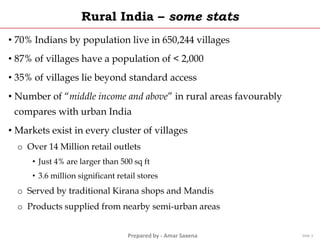
• 70% Indians by population live in 650,244 villages
• 87% of villages have a population of < 2,000
• 35% of villages lie beyond standard access
• Number of “middle income and above” in rural areas favourably
compares with urban India
• Markets exist in every cluster of villages
o Over 14 Million retail outlets
• Just 4% are larger than 500 sq ft
• 3.6 million significant retail stores
o Served by traditional Kirana shops and Mandis
o Products supplied from nearby semi-urban areas
Slide 3
Prepared by - Amar Saxena
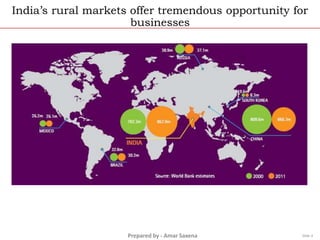
India’s rural markets offer tremendous opportunity for
businesses
Slide 4
Prepared by - Amar Saxena
Strong growth in Income and Spends
Slide 5
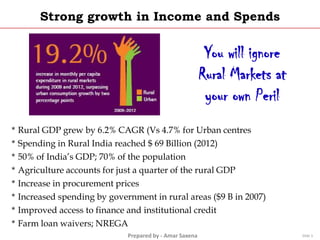
* Rural GDP grew by 6.2% CAGR (Vs 4.7% for Urban centres
* Spending in Rural India reached $ 69 Billion (2012)
* 50% of India’s GDP; 70% of the population
* Agriculture accounts for just a quarter of the rural GDP
* Increase in procurement prices
* Increased spending by government in rural areas ($9 B in 2007)
* Improved access to finance and institutional credit
* Farm loan waivers; NREGA
You will ignore
Rural Markets at
your own Peril
Prepared by - Amar Saxena
No wonder,
Slide 6
Prepared by - Amar Saxena
Buying Behaviour
Slide 7
Prepared by - Amar Saxena
Buying Behaviour …
Slide 8
Prepared by - Amar Saxena
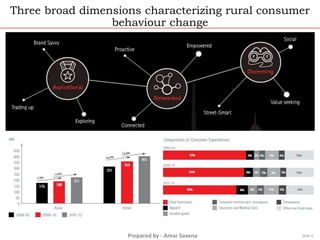
Three broad dimensions characterizing rural consumer
behaviour change
Slide 9
Prepared by - Amar Saxena
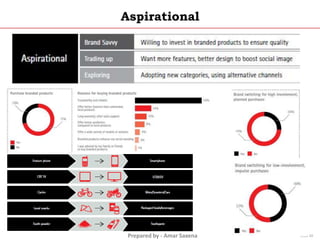
Aspirational
Slide 10
Prepared by - Amar Saxena
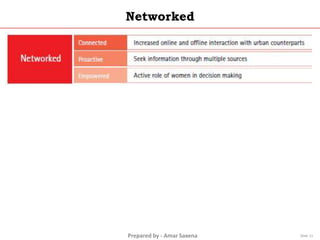
Networked
Slide 11
Prepared by - Amar Saxena
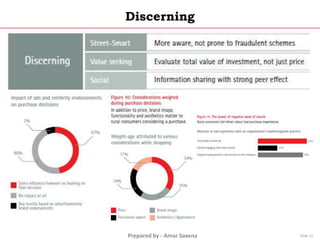
Discerning
Slide 12
Prepared by - Amar Saxena
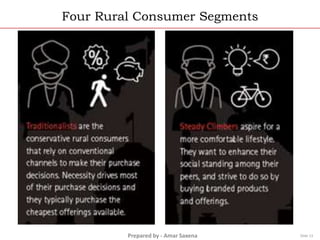
Four Rural Consumer Segments
Slide 13
Prepared by - Amar Saxena
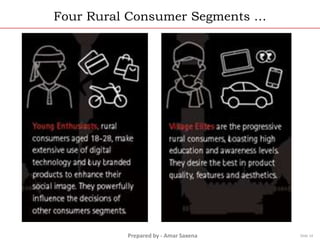
Four Rural Consumer Segments …
Slide 14
Prepared by - Amar Saxena
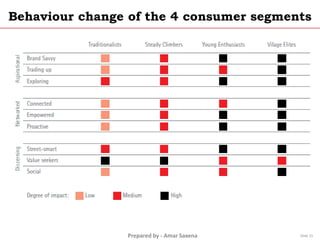
Behaviour change of the 4 consumer segments
Slide 15
Prepared by - Amar Saxena
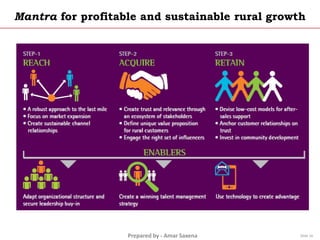
Mantra for profitable and sustainable rural growth
Slide 16
Prepared by - Amar Saxena
Challenges
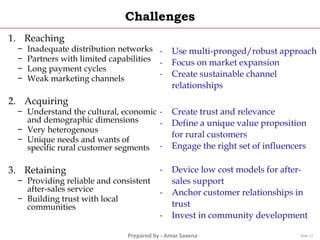
1. Reaching
− Inadequate distribution networks
− Partners with limited capabilities
− Long payment cycles
− Weak marketing channels
2. Acquiring
− Understand the cultural, economic
and demographic dimensions
− Very heterogenous
− Unique needs and wants of
specific rural customer segments
3. Retaining
− Providing reliable and consistent
after-sales service
− Building trust with local
communities
Slide 17
- Use multi-pronged/robust approach
- Focus on market expansion
- Create sustainable channel
relationships
- Create trust and relevance
- Define a unique value proposition
for rural customers
- Engage the right set of influencers
- Device low cost models for after-
sales support
- Anchor customer relationships in
trust
- Invest in community development
Prepared by - Amar Saxena Slide 18
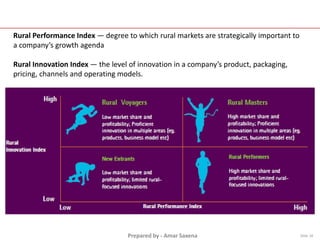
Rural Performance Index — degree to which rural markets are strategically important to
a company’s growth agenda
Rural Innovation Index — the level of innovation in a company’s product, packaging,
pricing, channels and operating models.
Prepared by - Amar Saxena
The Rural Markets
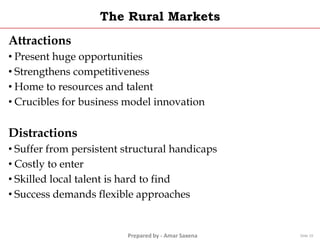
Attractions
• Present huge opportunities
• Strengthens competitiveness
• Home to resources and talent
• Crucibles for business model innovation
Distractions
• Suffer from persistent structural handicaps
• Costly to enter
• Skilled local talent is hard to find
• Success demands flexible approaches
Slide 19
Prepared by - Amar Saxena
What can we learn from successful companies
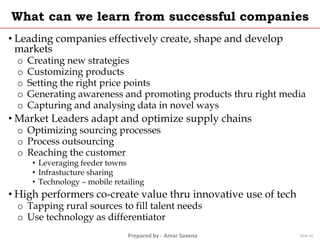
• Leading companies effectively create, shape and develop
markets
o Creating new strategies
o Customizing products
o Setting the right price points
o Generating awareness and promoting products thru right media
o Capturing and analysing data in novel ways
• Market Leaders adapt and optimize supply chains
o Optimizing sourcing processes
o Process outsourcing
o Reaching the customer
• Leveraging feeder towns
• Infrastucture sharing
• Technology – mobile retailing
• High performers co-create value thru innovative use of tech
o Tapping rural sources to fill talent needs
o Use technology as differentiator
Slide 20
Prepared by - Amar Saxena
Busting Myths
What do rural consumers value?
• Rural consumers care only about price and seek stripped-
down, low-cost versions of products.
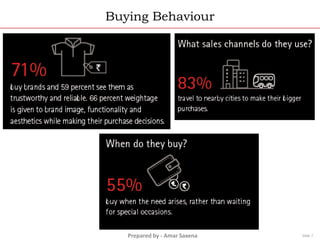
• Respondents attribute 66% weightage to brand image,
functionality and aesthetics when making purchase decisions,
while price carries a weight of 34%
When do rural consumers make big purchases?
• Rural consumers make most of their purchases after the
harvest season and during festivals and other special
occasions.
• 55% of survey respondents said they make purchases when the
need arises rather than waiting for special occasions.
Slide 21
Prepared by - Amar Saxena
Busting Myths
What sales channels do rural consumers use?
• Rural consumers make most purchases within or in the
immediate vicinity of their villages, usually buying from the
local retailer.
• 83% of survey respondents claimed that they go to nearby
cities to make their bigger purchases
Who influences rural consumers?
• Traditional influencers— community leaders, village heads,
retailers, school teachers —still have the biggest impact on
rural Indian’s purchase decisions.
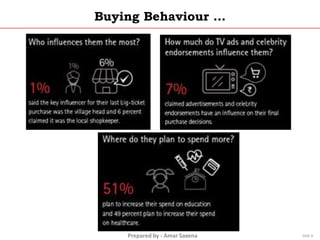
• Only 1% and 6% of survey respondents said that the key
influencer for their last big-ticket purchase was the village
head or the local shopkeeper, respectively.
Slide 22
Prepared by - Amar Saxena
Busting Myths
Addressing Market Requires Reaching All Villages
• Reaching all villages is essential
• Citizens prefer visiting larger villages for their multiple needs
• Creating a distribution point for 5-10 villages at carefully
chosen locations will cover 90% of population
• Distribution point for 25-30 villages will reach 70% of popn
Franchising in the Only Option
• Only option that works; Cannot align remote staff with
corporate culture
• Owned and Employee Operated Models can also be successful
• Careful selection and training of remote staff creates a loyal
and efficient workforce
• Allows flexibility to experiment and innovate
Slide 23
Prepared by - Amar Saxena
Busting Myths
Rural customer unwilling to pay for premium services
• Rural customer is unwilling to pay for premium products and
services
• Rural customers will choose premium services if they are
available and deliver value
• Have become very brand conscious and willing to pay
additional for quality and service
Rural Customers are Demanding
• Rural customers are Demanding and Impatient.
• Quality conscious and unforgiving.
• Absence of Choice, Sub-standard products and Cheap clones
have reduced quality expectations
• Citizens are patient and do not mind waiting their turn
• Much more forgiving product and delivery errors
Slide 24
Prepared by - Amar Saxena
Busting Myths
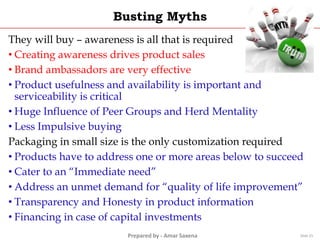
They will buy – awareness is all that is required
• Creating awareness drives product sales
• Brand ambassadors are very effective
• Product usefulness and availability is important and
serviceability is critical
• Huge Influence of Peer Groups and Herd Mentality
• Less Impulsive buying
Packaging in small size is the only customization required
• Products have to address one or more areas below to succeed
• Cater to an “Immediate need”
• Address an unmet demand for “quality of life improvement”
• Transparency and Honesty in product information
• Financing in case of capital investments
Slide 25
Prepared by - Amar Saxena
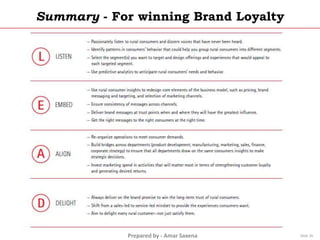
Summary - For winning Brand Loyalty
Slide 26
27
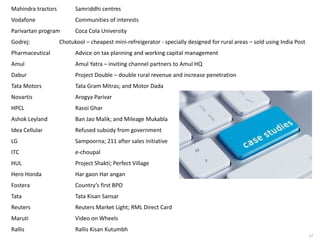
Mahindra tractors Samriddhi centres
Vodafone Communities of interests
Parivartan program Coca Cola University
Godrej: Chotukool – cheapest mini-refreigerator - specially designed for rural areas – sold using India Post
Pharmaceutical Advice on tax planning and working capital management
Amul Amul Yatra – inviting channel partners to Amul HQ
Dabur Project Double – double rural revenue and increase penetration
Tata Motors Tata Gram Mitras; and Motor Dada
Novartis Arogya Parivar
HPCL Rasoi Ghar
Ashok Leyland Ban Jao Malik; and Mileage Mukabla
Idea Cellular Refused subsidy from government
LG Sampoorna; 211 after sales initiative
ITC e-choupal
HUL Project Shakti; Perfect Village
Hero Honda Har gaon Har angan
Fostera Country’s first BPO
Tata Tata Kisan Sansar
Reuters Reuters Market Light; RML Direct Card
Maruti Video on Wheels
Rallis Rallis Kisan Kutumbh

Rural Marketing - Imperatives for Marketers

  • 1.
    Prepared by -Amar Saxena Amar Saxena
  • 2.
    Prepared by -Amar Saxena Credits This presentation is ENTIRELY based on the excellent study on Rural Markets by Accenture. These studies are - 1. Accenture-Masters-of-Rural-Markets-Selling-Profitably- Rural-Consumers 2. Accenture-Masters-Rural-Markets 3. Accenture-Rural-India-Markets-Research-2015 4. Accenture-Rural-Markets-Infographic This presentation highlights some aspects from these studies. Slide 2
  • 3.
    Prepared by -Amar Saxena Rural India – some stats • 70% Indians by population live in 650,244 villages • 87% of villages have a population of < 2,000 • 35% of villages lie beyond standard access • Number of “middle income and above” in rural areas favourably compares with urban India • Markets exist in every cluster of villages o Over 14 Million retail outlets • Just 4% are larger than 500 sq ft • 3.6 million significant retail stores o Served by traditional Kirana shops and Mandis o Products supplied from nearby semi-urban areas Slide 3
  • 4.
    Prepared by -Amar Saxena India’s rural markets offer tremendous opportunity for businesses Slide 4
  • 5.
    Prepared by -Amar Saxena Strong growth in Income and Spends Slide 5 * Rural GDP grew by 6.2% CAGR (Vs 4.7% for Urban centres * Spending in Rural India reached $ 69 Billion (2012) * 50% of India’s GDP; 70% of the population * Agriculture accounts for just a quarter of the rural GDP * Increase in procurement prices * Increased spending by government in rural areas ($9 B in 2007) * Improved access to finance and institutional credit * Farm loan waivers; NREGA You will ignore Rural Markets at your own Peril
  • 6.
    Prepared by -Amar Saxena No wonder, Slide 6
  • 7.
    Prepared by -Amar Saxena Buying Behaviour Slide 7
  • 8.
    Prepared by -Amar Saxena Buying Behaviour … Slide 8
  • 9.
    Prepared by -Amar Saxena Three broad dimensions characterizing rural consumer behaviour change Slide 9
  • 10.
    Prepared by -Amar Saxena Aspirational Slide 10
  • 11.
    Prepared by -Amar Saxena Networked Slide 11
  • 12.
    Prepared by -Amar Saxena Discerning Slide 12
  • 13.
    Prepared by -Amar Saxena Four Rural Consumer Segments Slide 13
  • 14.
    Prepared by -Amar Saxena Four Rural Consumer Segments … Slide 14
  • 15.
    Prepared by -Amar Saxena Behaviour change of the 4 consumer segments Slide 15
  • 16.
    Prepared by -Amar Saxena Mantra for profitable and sustainable rural growth Slide 16
  • 17.
    Prepared by -Amar Saxena Challenges 1. Reaching − Inadequate distribution networks − Partners with limited capabilities − Long payment cycles − Weak marketing channels 2. Acquiring − Understand the cultural, economic and demographic dimensions − Very heterogenous − Unique needs and wants of specific rural customer segments 3. Retaining − Providing reliable and consistent after-sales service − Building trust with local communities Slide 17 - Use multi-pronged/robust approach - Focus on market expansion - Create sustainable channel relationships - Create trust and relevance - Define a unique value proposition for rural customers - Engage the right set of influencers - Device low cost models for after- sales support - Anchor customer relationships in trust - Invest in community development
  • 18.
    Prepared by -Amar Saxena Slide 18 Rural Performance Index — degree to which rural markets are strategically important to a company’s growth agenda Rural Innovation Index — the level of innovation in a company’s product, packaging, pricing, channels and operating models.
  • 19.
    Prepared by -Amar Saxena The Rural Markets Attractions • Present huge opportunities • Strengthens competitiveness • Home to resources and talent • Crucibles for business model innovation Distractions • Suffer from persistent structural handicaps • Costly to enter • Skilled local talent is hard to find • Success demands flexible approaches Slide 19
  • 20.
    Prepared by -Amar Saxena What can we learn from successful companies • Leading companies effectively create, shape and develop markets o Creating new strategies o Customizing products o Setting the right price points o Generating awareness and promoting products thru right media o Capturing and analysing data in novel ways • Market Leaders adapt and optimize supply chains o Optimizing sourcing processes o Process outsourcing o Reaching the customer • Leveraging feeder towns • Infrastucture sharing • Technology – mobile retailing • High performers co-create value thru innovative use of tech o Tapping rural sources to fill talent needs o Use technology as differentiator Slide 20
  • 21.
    Prepared by -Amar Saxena Busting Myths What do rural consumers value? • Rural consumers care only about price and seek stripped- down, low-cost versions of products. • Respondents attribute 66% weightage to brand image, functionality and aesthetics when making purchase decisions, while price carries a weight of 34% When do rural consumers make big purchases? • Rural consumers make most of their purchases after the harvest season and during festivals and other special occasions. • 55% of survey respondents said they make purchases when the need arises rather than waiting for special occasions. Slide 21
  • 22.
    Prepared by -Amar Saxena Busting Myths What sales channels do rural consumers use? • Rural consumers make most purchases within or in the immediate vicinity of their villages, usually buying from the local retailer. • 83% of survey respondents claimed that they go to nearby cities to make their bigger purchases Who influences rural consumers? • Traditional influencers— community leaders, village heads, retailers, school teachers —still have the biggest impact on rural Indian’s purchase decisions. • Only 1% and 6% of survey respondents said that the key influencer for their last big-ticket purchase was the village head or the local shopkeeper, respectively. Slide 22
  • 23.
    Prepared by -Amar Saxena Busting Myths Addressing Market Requires Reaching All Villages • Reaching all villages is essential • Citizens prefer visiting larger villages for their multiple needs • Creating a distribution point for 5-10 villages at carefully chosen locations will cover 90% of population • Distribution point for 25-30 villages will reach 70% of popn Franchising in the Only Option • Only option that works; Cannot align remote staff with corporate culture • Owned and Employee Operated Models can also be successful • Careful selection and training of remote staff creates a loyal and efficient workforce • Allows flexibility to experiment and innovate Slide 23
  • 24.
    Prepared by -Amar Saxena Busting Myths Rural customer unwilling to pay for premium services • Rural customer is unwilling to pay for premium products and services • Rural customers will choose premium services if they are available and deliver value • Have become very brand conscious and willing to pay additional for quality and service Rural Customers are Demanding • Rural customers are Demanding and Impatient. • Quality conscious and unforgiving. • Absence of Choice, Sub-standard products and Cheap clones have reduced quality expectations • Citizens are patient and do not mind waiting their turn • Much more forgiving product and delivery errors Slide 24
  • 25.
    Prepared by -Amar Saxena Busting Myths They will buy – awareness is all that is required • Creating awareness drives product sales • Brand ambassadors are very effective • Product usefulness and availability is important and serviceability is critical • Huge Influence of Peer Groups and Herd Mentality • Less Impulsive buying Packaging in small size is the only customization required • Products have to address one or more areas below to succeed • Cater to an “Immediate need” • Address an unmet demand for “quality of life improvement” • Transparency and Honesty in product information • Financing in case of capital investments Slide 25
  • 26.
    Prepared by -Amar Saxena Summary - For winning Brand Loyalty Slide 26
  • 27.
    27 Mahindra tractors Samriddhicentres Vodafone Communities of interests Parivartan program Coca Cola University Godrej: Chotukool – cheapest mini-refreigerator - specially designed for rural areas – sold using India Post Pharmaceutical Advice on tax planning and working capital management Amul Amul Yatra – inviting channel partners to Amul HQ Dabur Project Double – double rural revenue and increase penetration Tata Motors Tata Gram Mitras; and Motor Dada Novartis Arogya Parivar HPCL Rasoi Ghar Ashok Leyland Ban Jao Malik; and Mileage Mukabla Idea Cellular Refused subsidy from government LG Sampoorna; 211 after sales initiative ITC e-choupal HUL Project Shakti; Perfect Village Hero Honda Har gaon Har angan Fostera Country’s first BPO Tata Tata Kisan Sansar Reuters Reuters Market Light; RML Direct Card Maruti Video on Wheels Rallis Rallis Kisan Kutumbh