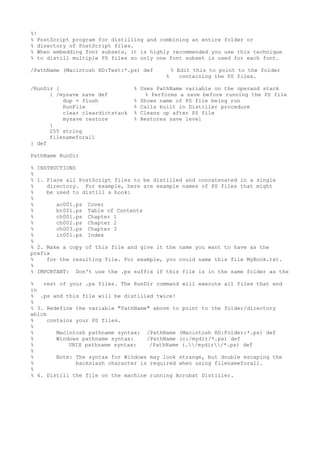
%!
% PostScript program for distilling and combining an entire folder or
% directory of PostScript files.
% When embedding font subsets, it is highly recommended you use this technique
% to distill multiple PS files so only one font subset is used for each font.

/PathName (Macintosh HD:Test:*.ps) def        % Edit this to point to the folder
                                          %      containing the PS files.

/RunDir {                        % Uses PathName variable on the operand stack
      { /mysave save def            % Performs a save before running the PS file
          dup = flush            % Shows name of PS file being run
          RunFile                % Calls built in Distiller procedure
          clear cleardictstack   % Cleans up after PS file
          mysave restore         % Restores save level
      }
      255 string
      filenameforall
} def

PathName RunDir

% INSTRUCTIONS
%
% 1. Place all PostScript files to be distilled and concatenated in a single
%    directory. For example, here are example names of PS files that might
%    be used to distill a book:
%
%       ac001.ps Cover
%       bt001.ps Table of Contents
%       ch001.ps Chapter 1
%       ch002.ps Chapter 2
%       ch003.ps Chapter 3
%       in001.ps Index
%
% 2. Make a copy of this file and give it the name you want to have as the
prefix
%    for the resulting file. For example, you could name this file MyBook.txt.
%
% IMPORTANT: Don't use the .ps suffix if this file is in the same folder as the

%   rest of your .ps files. The RunDir command will execute all files that end
in
% .ps and this file will be distilled twice!
%
% 3. Redefine the variable "PathName" above to point to the folder/directory
which
%     contains your PS files.
%
%        Macintosh pathname syntax: /PathName (Macintosh HD:Folder:*.ps) def
%        Windows pathname syntax:    /PathName (c:/mydir/*.ps) def
%            UNIX pathname syntax:    /PathName (./mydir/*.ps) def
%
%        Note: The syntax for Windows may look strange, but double escaping the
%              backslash character is required when using filenameforall.
%
% 4. Distill the file on the machine running Acrobat Distiller.

Rundirex

  • 1.
    %! % PostScript programfor distilling and combining an entire folder or % directory of PostScript files. % When embedding font subsets, it is highly recommended you use this technique % to distill multiple PS files so only one font subset is used for each font. /PathName (Macintosh HD:Test:*.ps) def % Edit this to point to the folder % containing the PS files. /RunDir { % Uses PathName variable on the operand stack { /mysave save def % Performs a save before running the PS file dup = flush % Shows name of PS file being run RunFile % Calls built in Distiller procedure clear cleardictstack % Cleans up after PS file mysave restore % Restores save level } 255 string filenameforall } def PathName RunDir % INSTRUCTIONS % % 1. Place all PostScript files to be distilled and concatenated in a single % directory. For example, here are example names of PS files that might % be used to distill a book: % % ac001.ps Cover % bt001.ps Table of Contents % ch001.ps Chapter 1 % ch002.ps Chapter 2 % ch003.ps Chapter 3 % in001.ps Index % % 2. Make a copy of this file and give it the name you want to have as the prefix % for the resulting file. For example, you could name this file MyBook.txt. % % IMPORTANT: Don't use the .ps suffix if this file is in the same folder as the % rest of your .ps files. The RunDir command will execute all files that end in % .ps and this file will be distilled twice! % % 3. Redefine the variable "PathName" above to point to the folder/directory which % contains your PS files. % % Macintosh pathname syntax: /PathName (Macintosh HD:Folder:*.ps) def % Windows pathname syntax: /PathName (c:/mydir/*.ps) def % UNIX pathname syntax: /PathName (./mydir/*.ps) def % % Note: The syntax for Windows may look strange, but double escaping the % backslash character is required when using filenameforall. % % 4. Distill the file on the machine running Acrobat Distiller.