












Ruby's influence 
over the Elixir 
language 
by Paolo Montrasio 
paolo.montrasio@conn 
ettiva.eu 
http://connettiva.eu/rubyday
Differences
f(x)→y
Strings
Lists and arrays
Getting serious 
(Mr Algorithm)
DIY
No Devise 
DIY with the 
cookie session
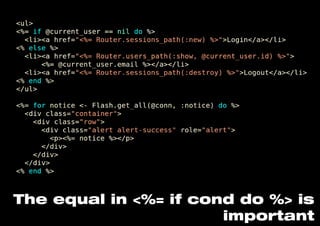
The equal in <%= if cond do %> is 
important
Is it any better?
http://connettiva.eu/ru 
byday 
Paolo Montrasio 
paolo.montrasio@connettiva.CC-BY-SA 4.0 plus the original licences of the images

Ruby's Influence over the Elixir Language - Ruby Day 2014

Editor's Notes

  • #2 Download this presentation from http://connettiva.eu/rubyday Plus links to elixir and phoenix resources Plus three HOWTOs to install erlang, elixir, phoenix. Phoenix demo app at https://github.com/pmontrasio/phoenix-demo-app This presentation is licensed under the CC-BY-SA 4.0 license https://creativecommons.org/licenses/by-sa/4.0/Images are licensed under their original license as stated in the notes of each page. http://commons.wikimedia.org/wiki/File:Pomegranate_Seeds.JPGPublic domain
  • #3 This speech is about things that look like other things but are not those things. They look like rubies but they are not rubies. They are pomegrate seeds. http://commons.wikimedia.org/wiki/File:Pomegranate_Seeds.JPGPublic domain
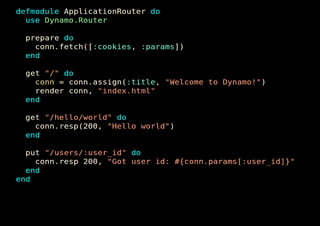
  • #4 This looks like Ruby. It might be Sinatra or some other lightweight framework.
  • #5 Is this Ruby? http://commons.wikimedia.org/wiki/File:Ruby_logo.pngYukihiro Matsumoto, Creative Commons Attribution-Share Alike 2.5 Generic
  • #6 No, this is Elixir Logo from http://elixir-lang.org/© Plataformatec
  • #7 Elixir is a language built on the top of the Erlang VM Logo from http://elixir-lang.org/© Plataformatec Logo from http://commons.wikimedia.org/wiki/File:Erlang_logo.png Public domain
  • #8 So we have a language that looks like Ruby, but actually is Elixir, which deep inside is Erlang. Puzzled? https://www.flickr.com/photos/thesheriff/112137491/ Andrew Mitchell CC BY SA 2.0 (cropped)
  • #9 Probably not :-) Logo from http://elixir-lang.org/© Plataformatec Logo fom http://commons.wikimedia.org/wiki/File:Erlang_logo.png Public domain
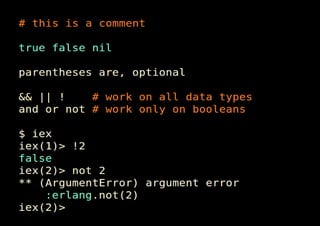
  • #10 Let&amp;apos;s start with some simple syntactical elements. Comments are like in any other Unix based scripting language. Parentheses are optional. No end of statement terminator. The C-like logical operators are what we expect. They work on any data type. The English-worded logical operators work only on booleans. There is a interactive interpreter, iex, which is like irb.
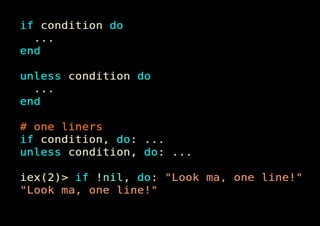
  • #11 Conditionals are like the Ruby ones, with the exception of the do after the condition. One liners are quite different. No postfix notation. Conditionals are expressions. Their true form is if (condition, do: (code block)) if condition do … end is syntactical sugar. Actually if and unless are macros (see defmacro). http://elixir-lang.org/getting_started/5.html
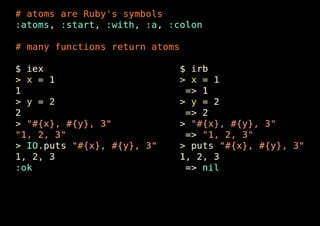
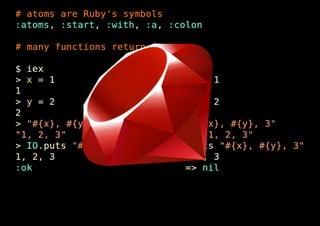
  • #12 Elixir&amp;apos;s atoms and Ruby&amp;apos;s symbols are basically the same thing and have the same syntax. String interpolation is the same.
  • #13 Still quite Ruby-like up to now. http://commons.wikimedia.org/wiki/File:Ruby_logo.pngYukihiro Matsumoto, Creative Commons Attribution-Share Alike 2.5 Generic
  • #14 So what are the big differences with Ruby? http://commons.wikimedia.org/wiki/File:Apples,_Pears,_Oranges.jpg Mark and Allegra Jaroski-Biava Creative Commons Attribution-Share Alike 2.0 Generic (cropped)
  • #15 Elixir is functional. Biggest difference! http://wall.sf.co.ua/id91895
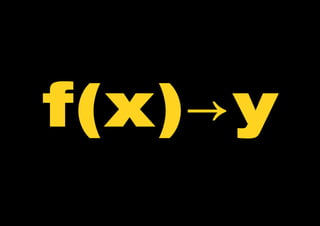
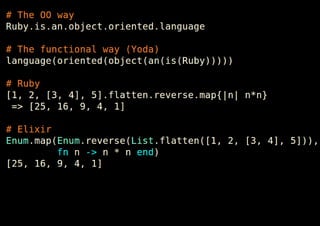
  • #16 A function takes one or more arguments and returns one or more values. It never changes its arguments. It only returns new values. OO languages have methods that change the state of the object they are called upon. Functional languages don&amp;apos;t do that.
  • #17 So the other big difference is: change. http://pixabay.com/en/change-money-coin-coins-20272/ CC0 Public domain
  • #18 Actually, the lack of change. Unmutability. http://pixabay.com/en/change-money-coin-coins-20272/ CC0 Public domain
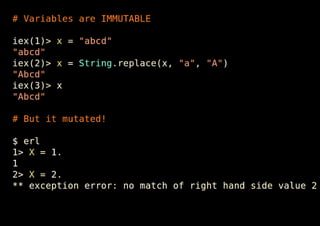
  • #19 Variables are immutable. You can&amp;apos;t change the value of a variable once you assign a value to it. Well, did I mutate the value of x? Not really. Let&amp;apos;s try it in Erlang. Variables are immutable in Erlang too. Same virtual machine. You try to reassign a variable: error! What did Elixir do? For our convenience it forgets about the original x variable and lets us use the same name for the variable at lines 2 and 3. But it is a different variable. Mutability is an illusion. Adding a ^ (the pin operator) as in ^x makes the variable completely immutable.
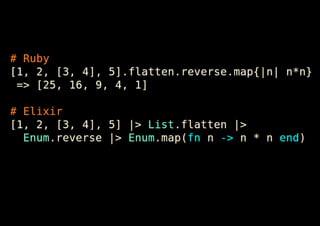
  • #20 Being functional is very different from OO. Think in reverse. It&amp;apos;s function2(function1(value), instead of value.method1.method2 Very nice nested function calls, or not so nice?
  • #21 Tough luck but fortunately this is not the way to do it http://commons.wikimedia.org/wiki/File:SadCat1.jpg Dimitri Torterat (Diti) for original photo Túrelio for derivative Creative Commons Attribution-Share Alike 3.0 Unported (cropped)
  • #22 We use the pipe operator to compose functions in a natural way.
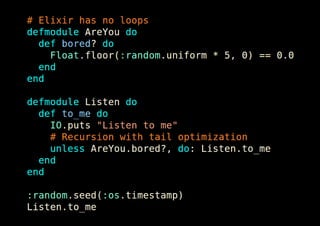
  • #23 There is no need for loops. A loop is made by calling the same function recursively until we reach a return condition. How about stack overflows? The language automatically performs tail call optimization http://stackoverflow.com/questions/310974/what-is-tail-call-optimization No state to store == no frames on the stack. http://elixir-lang.org/getting_started/9.html Functions have somewhat similar conventions to Ruby&amp;apos;s methods. Functions that end with ? return booleans. Functions that end with a bang! raise an exception when they fail.
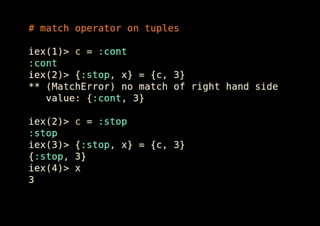
  • #24 Third difference. The assignment is not an assignment. It&amp;apos;s a match operator. https://openclipart.org/detail/167818/not-equal-to-4-by-dripsandcastle Public Domain
  • #25 It means &amp;quot;Do the values on the left side match the values on the right?&amp;quot; If positive, the interpreter assigns unbound variables on the left to the values they match on the right. That&amp;apos;s why x = 3 behaves in a natural way. x = x + 2 won&amp;apos;t work in Erlang. In 1 c can match :cont In 2 :stop can&amp;apos;t match c, because c has value :cont and :stop is an atom so it&amp;apos;s bound by definition. When c becomes :stop the match in 3 succeeds. This is a common way to check for return values from functions and this is why many functions return atoms. http://elixir-lang.org/getting_started/4.html By the way, {we, introduced, tuples}
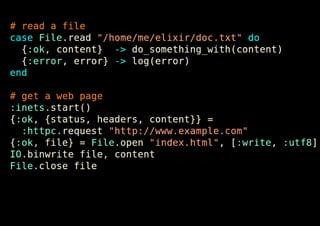
  • #26 Reading a file has the same syntax as in Ruby. The case statement works with matches. Check the cond statement too. :library.function is a way of calling an Erlang library, much like what we can do in JRuby with Java libraries. :httpc.requests and File.open return tuples. If those tuples don&amp;apos;t match the ones on the left the program halts immediately. Pattern matching is the reason why exceptions are rarely used in Elixir but check try catch rescue throw raise after at http://elixir-lang.org/getting_started/17.html
  • #27 Fourth difference: strings. http://commons.wikimedia.org/wiki/File:Piano_strings_6.jpg Alan Levine Creative Commons Attribution 2.0 Generic (cropped)
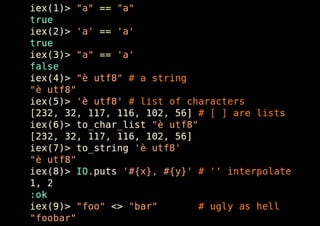
  • #28 Double quotes and single quotes are different. Lists of characters can be built from strings and strings can be built from lists of characters. Square brakets define lists. Interpolation works even in single quotes. Concatenation has a ugly syntax: &amp;lt;&amp;gt; which is the concatenation operator for binary data &amp;lt;&amp;lt;0, 1&amp;gt;&amp;gt; &amp;lt;&amp;gt; &amp;lt;&amp;lt;2, 3&amp;gt;&amp;gt; Ugh! http://elixir-lang.org/getting_started/6.html
  • #29 http://en.wikipedia.org/wiki/File:Beer_Cans-1.jpgVisitor7Creative Commons Attribution-Share Alike 3.0 Unported (cropped, darkened)
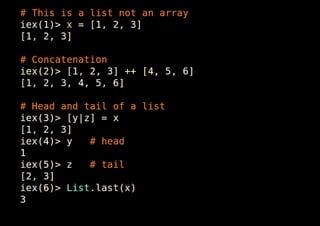
  • #30 [ ] enclose lists. Concatenation operators are not overloaded. They can be quite ugly. Remember the one for strings. Lists have a head and a tail. Very Lispy
  • #31 So many more things to know about Elixir http://www.flickr.com/people/jamescridland/ James Cridland http://james.cridland.net/ CC BY 2.0 (cropped)
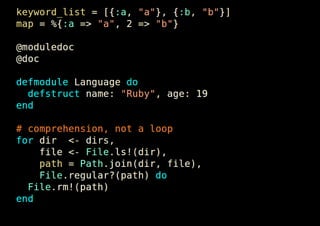
  • #32 Keyword lists Maps (Ruby&amp;apos;s hashes) http://elixir-lang.org/getting_started/7.html Annotations to insert tests and documentation into the code. http://elixir-lang.org/getting_started/14.html http://elixir-lang.org/getting_started/mix_otp/9.html Modules. http://elixir-lang.org/getting_started/8.html Structs. http://elixir-lang.org/getting_started/15.html Comprehension. http://elixir-lang.org/getting_started/18.html
  • #33 But time is running out http://commons.wikimedia.org/wiki/File:Time_is_running_out.jpg Sergey Galyonkin Creative Commons Attribution-Share Alike 2.0 Generic (cropped)
  • #34 Statue of Muḥammad ibn Mūsā al-Khwārizmī at Khiva, Uzbekistan. One of the fathers of algebra. His book “On the Calculation with Hindu Numerals” was translated into Latin as “Algoritmi de numero Indorum” mixing the transliterated author name with the title. By confusion we are talking about algorithms now. http://en.wikipedia.org/wiki/Mu%E1%B8%A5ammad_ibn_M%C5%ABs%C4%81_al-Khw%C4%81rizm%C4%AB Author&amp;apos;s photo of the statue in Khiva, Uzbekistan. CC BY-SA 4.0
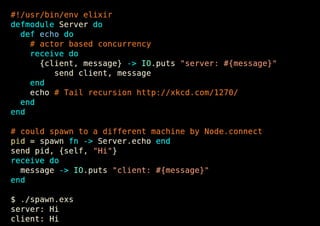
  • #35 A client/server. The server receives tuples {client, message} and puts them to stdout. Then it loops on itself. Tail recursion to the rescue! The client spawns the server process, sends its own id and a message, it waits for the response. http://elixir-lang.org/getting_started/11.html To compile: $ elixirc spawn.exs It generates Elixir.Server.beam Then you can use the Server module in iex $ iex &amp;gt; pid = spawn fn -&amp;gt; Server.echo end &amp;gt; send pid, {self, “Hi”} &amp;gt; ...
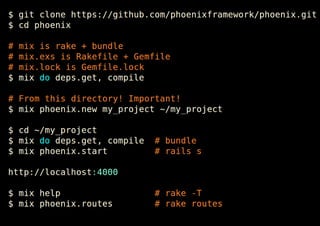
  • #36 $ git clone https://github.com/phoenixframework/phoenix.git $ cd phoenix $ mix do deps.get, compile # From this directory! Important! $ mix phoenix.new my_project ~/my_project $ cd ~/my_project $ mix do deps.get, compile $ mix phoenix.start http://localhost:4000 $ mix help # rake -T $ mix phoenix.routes # rake routes # mix deps.clean –all is nice to know Other web frameworks https://github.com/elixir-web/weber # Rails like https://github.com/dynamo/dynamo # Sinatra like
  • #37 $ git clone https://github.com/phoenixframework/phoenix.git $ cd phoenix $ mix do deps.get, compile # From this directory! Important! $ mix phoenix.new my_project ~/my_project $ cd ~/my_project $ mix do deps.get, compile $ mix phoenix.start http://localhost:4000
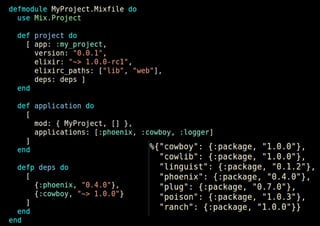
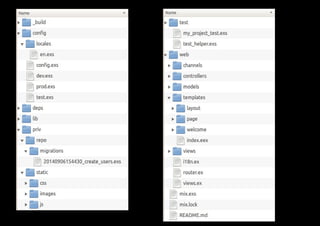
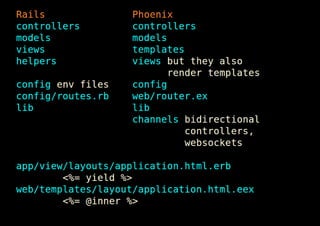
  • #38 The structure of a phoenix application.
  • #39 https://github.com/phoenixframework/phoenix#channels
  • #40 Young framework. Many tools still lacking. Lots of DIY. SElephant http://zh.wikipedia.org/wiki/File:Basic_DIY_Tools.jpg Attribution-ShareAlike 3.0 Unported (cropped, darkened)
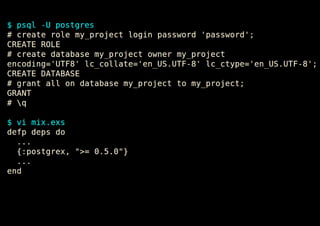
  • #41 Some rough edges. The database must be added manually.
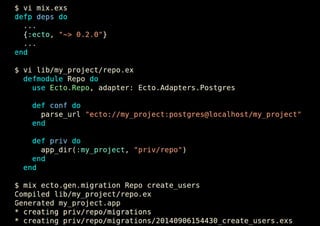
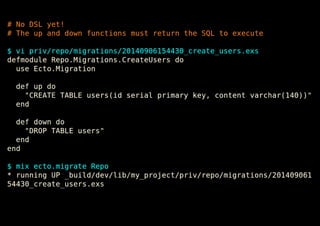
  • #42 Migrations and the DB adapter must be added. Use the ecto database wrapper. https://github.com/elixir-lang/ecto http://elixir-lang.org/docs/ecto/ We have: belongs_to has_many DSL for select / insert / update / transactions but not for creating / dropping tables
  • #43 We don&amp;apos;t have yet: DSL in migrations
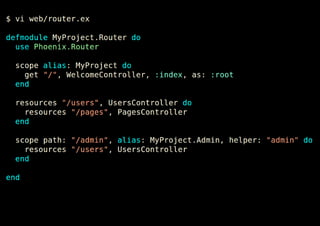
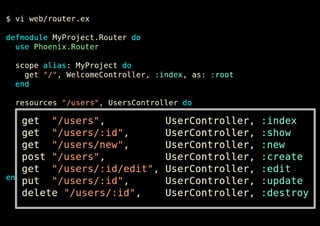
  • #44 Routes are restful and can be nested We have scopes and static routes.
  • #45 The usual restful methods functions in controllers
  • #46 No authentication frameworks yet but phoenix has a cookie based session store that can be used to store the user id https://github.com/elixir-lang/plug/blob/master/lib/plug/session.ex See my implementation with a plug in the github demo app. SElephant http://zh.wikipedia.org/wiki/File:Basic_DIY_Tools.jpg Attribution-ShareAlike 3.0 Unported (cropped, darkened)
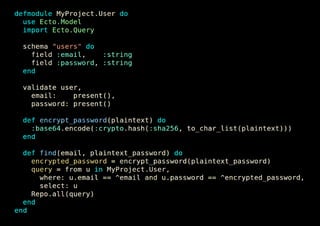
  • #47 There is no ActiveRecord magic to define attributes from the database schema. There are validations (with ecto). A look to the functions: 1) Strings passed to Erlang must be converted to char lists. 2) The ^ pin operator is important inside Ecto queries. Anything without a pin is a variable of the query, not variables of the function. It reminds of how to inject local variables inside a squeel block in Ruby.
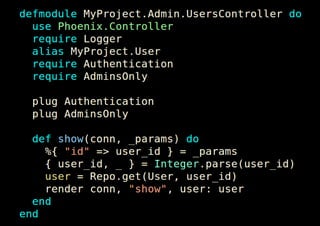
  • #48 The example has no error checks on params and on the result of Repo.get _params with the underscore is the idiomatic way, sorry for that. Authentication and AdminsOnly are two plugs (kind of before actions) that implement authentication and authorization. Custom built for this application. Check the code on github.
  • #49 The default .eex which is similar to .erb Haml and Slim are available too. https://github.com/phoenixframework/phoenix#template-engine-configuration if blocks return a string. Without the equal in &amp;lt;%= the if will execute but its return value (the HTML) won&amp;apos;t be rendered. The for loop is actually a comprehension. Flash is set in controllers like this def destroy(conn, _params) do fetch_session(conn) |&amp;gt; delete_session(:user_id) # this is to logout |&amp;gt; Flash.put(:notice, &amp;quot;Logout successful&amp;quot;) |&amp;gt; redirect Router.pages_path(:index) end
  • #50 Is this Elixir better than Ruby? http://en.wikipedia.org/wiki/File:Benjamin_G_Bowden_-_Spacelander_Bicycle.jpg Brooklyn Museum CC BY 3.0 (cropped)
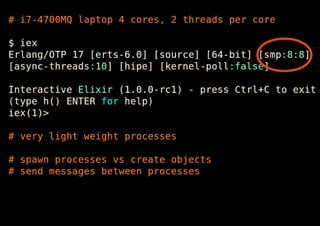
  • #51 Hard to tell but Elixir has a definite advantage when parallelism is important. It accesses all the cores of the CPU. It has very light weight processes. You can have thousands of them running inside your application. Consider changing your approach: create processes to store state and make them exchange messages. Thanks to a Ruby like syntax is an easy entry point into the world of functional languages.
  • #52 10 REM SINCLAIR ZX81 KEYS 20 PRINT “MY FIRST COMPUTER” 30 PRINT “NOT TOO FUNCTIONAL BUT FUNNY” en.wikipedia.org/wiki/File:Sinclair-ZX81.png Evan-Amos CC BY-SA 3.0 (extracted keys from original image)
  • #53 Download this presentation from http://connettiva.eu/rubyday Plus links to elixir and phoenix resources Plus three HOWTOs to install erlang, elixir, phoenix. Phoenix demo app at https://github.com/pmontrasio/phoenix-demo-app This presentation is licensed under the CC-BY-SA 4.0 license https://creativecommons.org/licenses/by-sa/4.0/Images are licensed under their original license as stated in the notes of each page. http://commons.wikimedia.org/wiki/File:Pomegranate_Seeds.JPGPublic domain