www.appstud.com
Go
A modern programming language for modern times
Xwww.appstud.com
by Julien Galletta
Presentation
12
X
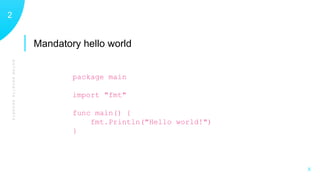
Mandatory hello world
NOTRERECETTESECRÈTE
12
X
package main
import "fmt"
func main() {
    fmt.Println("Hello world!")
}
History
PRESENTATION
12
X
• Designed at Google in 2007
• Publicly announced in November 2009, version 1.0 was released in
March 2012
• Version 1.12 released on February 2019
• Version 2.0 in discussion
Creators
PRESENTATION
12
X
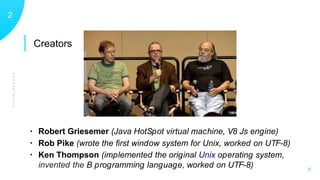
• Robert Griesemer (Java HotSpot virtual machine, V8 Js engine)
• Rob Pike (wrote the first window system for Unix, worked on UTF-8)
• Ken Thompson (implemented the original Unix operating system,
invented the B programming language, worked on UTF-8)
Why
PRESENTATION
12
X
• Computing landscape today is almost unrelated to the environment in
which the languages being used, mostly C++, Java, and Python, had
been created: multicore processors, networked systems, massive
computation clusters, …
• Scale has changed: today’s server programs comprise tens of millions
of lines of code, are worked on by hundreds or even thousands of
programmers, and are updated literally every day
• Build times, even on large compilation clusters, have stretched to
many minutes, even hours
Who’s using it
PRESENTATION
12
X
Guiding principles
11
X
GUIDINGPRINCIPLES
11
X
• Go must work at scale, for large teams of programmers working
on them, for programs with large numbers of dependencies
• Go must be familiar, roughly C-like. Google needs to get
programmers productive quickly in Go, means that the
language cannot be too radical
• Go must be modern. It should have features like concurrency
so that programs can make efficient use of multi core machines.
It should have built-in networking and web server libraries so
that it aids modern development
Go must solve these problems
GUIDINGPRINCIPLES
11
X
Software engineering is what happens to programming when you add
time and other programmers.
— Russ Cox
• Software programming: program you write for yourself
• Software engineering: product that many people will
work on over time
Engineers will come and go, teams will grow and shrink,
requirements will change, features will be added and bugs fixed.
GUIDINGPRINCIPLES
Simplicity
• "I can’t understand this
code”
• You’re scared to make a
change because you’re
worried it’ll break another
part of the program
• A part you don’t
understand and don’t
know how to fix
11
X
Simplicity is prerequisite for
reliability.
— Edsger W. Dijkstra
GUIDINGPRINCIPLES
11
X
There are two ways of constructing a software design: One way is to
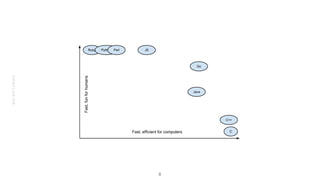
make it so simple that there are obviously no deficiencies, and the other
way is to make it so complicated that there are no obvious deficiencies.
The first method is far more difficult.
— C. A. R. Hoare
Complexity turns reliable software in unreliable software.
Complexity is what kills software projects.
Therefore simplicity is the highest goal of Go.
Whatever programs we write, we should be able to agree
that they are simple.
GUIDINGPRINCIPLES
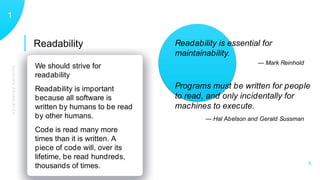
Readability
We should strive for
readability
Readability is important
because all software is
written by humans to be read
by other humans.
Code is read many more
times than it is written. A
piece of code will, over its
lifetime, be read hundreds,
thousands of times.
11
X
Readability is essential for
maintainability.
— Mark Reinhold
Programs must be written for people
to read, and only incidentally for
machines to execute.
— Hal Abelson and Gerald Sussman
GUIDINGPRINCIPLES
11
X
The most important skill for a programmer is the ability to effectively
communicate ideas.
— Gastón Jorquera
If you can’t understand what a program is doing, how can
you hope to maintain it?
A piece of software that more than one person will
contribute to, or that will be used by people over a long
enough time that requirements or features changes, then
your goal must be for your program to be maintainable.
GUIDINGPRINCIPLES
11
X
The first step towards writing maintainable code is making
sure the code is readable.
Use the bloody brackets for fuck’s sake!
GUIDINGPRINCIPLES
Productivity
How much time do you
spend doing useful work
versus waiting for your tools,
or hopelessly lost in a foreign
code-base?
11
X
Design is the art of arranging code
to work today, and be changeable
forever.
— Sandi Metz
GUIDINGPRINCIPLES
11
X
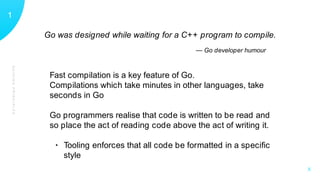
Go was designed while waiting for a C++ program to compile.
— Go developer humour
Fast compilation is a key feature of Go.
Compilations which take minutes in other languages, take
seconds in Go
Go programmers realise that code is written to be read and
so place the act of reading code above the act of writing it.
• Tooling enforces that all code be formatted in a specific
style
GUIDINGPRINCIPLES
11
X
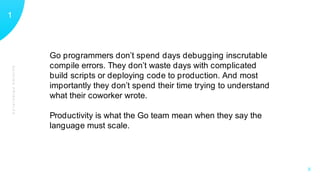
Go programmers don’t spend days debugging inscrutable
compile errors. They don’t waste days with complicated
build scripts or deploying code to production. And most
importantly they don’t spend their time trying to understand
what their coworker wrote.
Productivity is what the Go team mean when they say the
language must scale.
Features
14
X
Open source
FEATURES
12
X
• Free BSD license
• https://github.com/golang/go
• Main contributor is the Google team
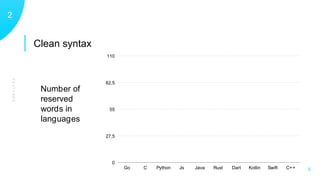
Clean syntax
FEATURES
12
X
0
27,5
55
82,5
110
Go C Python Js Java Rust Dart Kotlin Swift C++
Number of
reserved
words in
languages
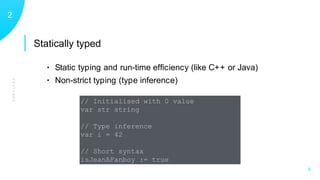
Statically typed
FEATURES
12
X
• Static typing and run-time efficiency (like C++ or Java)
• Non-strict typing (type inference)
// Initialised with 0 value
var str string
// Type inference
var i = 42
// Short syntax
isJeanAFanboy := true
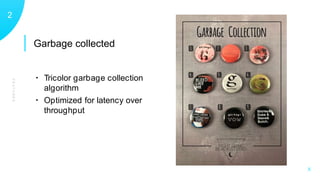
Garbage collected
FEATURES
12
X
• Tricolor garbage collection
algorithm
• Optimized for latency over
throughput
Built in support for concurrency
FEATURES
12
X
Goroutines
• Lightweight thread of execution
• Go runtime multiplexes those goroutines over operating
system threads
• Multiple goroutines can run concurrently on a single
OS thread
Concurrency is about dealing with lots of things at once. Parallelism
is about doing lots of things at once.
FEATURES
12
X
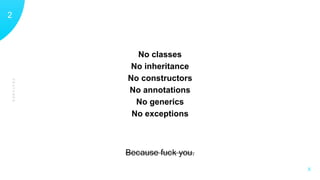
No classes
No inheritance
No constructors
No annotations
No generics
No exceptions
Because fuck you.
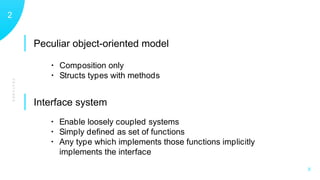
Peculiar object-oriented model
FEATURES
12
X
• Composition only
• Structs types with methods
Interface system
• Enable loosely coupled systems
• Simply defined as set of functions
• Any type which implements those functions implicitly
implements the interface
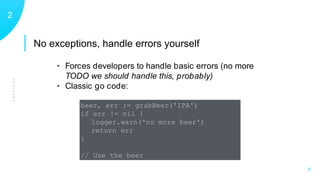
No exceptions, handle errors yourself
FEATURES
12
X
• Forces developers to handle basic errors (no more
TODO we should handle this, probably)
• Classic go code:
beer, err := grabBeer('IPA')
if err != nil {
logger.warn('no more beer')
return err
}
// Use the beer
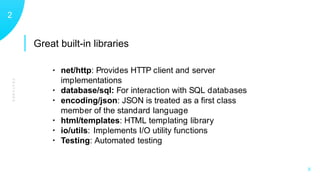
Great built-in libraries
FEATURES
12
X
• net/http: Provides HTTP client and server
implementations
• database/sql: For interaction with SQL databases
• encoding/json: JSON is treated as a first class
member of the standard language
• html/templates: HTML templating library
• io/utils: Implements I/O utility functions
• Testing: Automated testing
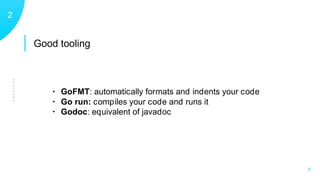
Good tooling
FEATURES
12
X
• GoFMT: automatically formats and indents your code
• Go run: compiles your code and runs it
• Godoc: equivalent of javadoc
Weaknesses
15
X
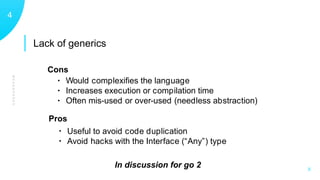
Lack of generics
WEAKNESSES
14
X
• Would complexifies the language
• Increases execution or compilation time
• Often mis-used or over-used (needless abstraction)
• Useful to avoid code duplication
• Avoid hacks with the Interface (“Any”) type
Pros
Cons
In discussion for go 2
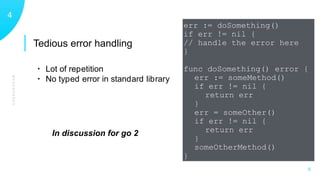
Tedious error handling
WEAKNESSES
14
X
In discussion for go 2
• Lot of repetition
• No typed error in standard library
err := doSomething()
if err != nil {
// handle the error here
}
func doSomething() error {
err := someMethod()
if err != nil {
return err
}
err = someOther()
if err != nil {
return err
}
someOtherMethod()
}
No enumeration type
WEAKNESSES
14
X
Workarounds are verbose
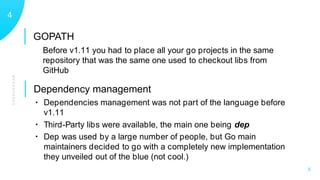
GOPATH
WEAKNESSES
14
X
• Dependencies management was not part of the language before
v1.11
• Third-Party libs were available, the main one being dep
• Dep was used by a large number of people, but Go main
maintainers decided to go with a completely new implementation
they unveiled out of the blue (not cool.)
Dependency management
Before v1.11 you had to place all your go projects in the same
repository that was the same one used to checkout libs from
GitHub
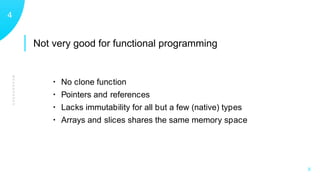
Not very good for functional programming
WEAKNESSES
14
X
• No clone function
• Pointers and references
• Lacks immutability for all but a few (native) types
• Arrays and slices shares the same memory space
Conclusion
13
X
CONCLUSION
12
X
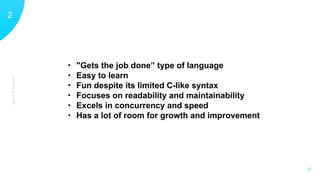
• "Gets the job done” type of language
• Easy to learn
• Fun despite its limited C-like syntax
• Focuses on readability and maintainability
• Excels in concurrency and speed
• Has a lot of room for growth and improvement
CONCLUSION
12
X
Go programming language

Go programming language

  • 1.
    www.appstud.com Go A modern programminglanguage for modern times Xwww.appstud.com by Julien Galletta
  • 2.
  • 3.
    Mandatory hello world NOTRERECETTESECRÈTE 12 X packagemain import "fmt" func main() {     fmt.Println("Hello world!") }
  • 4.
    History PRESENTATION 12 X • Designed atGoogle in 2007 • Publicly announced in November 2009, version 1.0 was released in March 2012 • Version 1.12 released on February 2019 • Version 2.0 in discussion
  • 5.
    Creators PRESENTATION 12 X • Robert Griesemer(Java HotSpot virtual machine, V8 Js engine) • Rob Pike (wrote the first window system for Unix, worked on UTF-8) • Ken Thompson (implemented the original Unix operating system, invented the B programming language, worked on UTF-8)
  • 6.
    Why PRESENTATION 12 X • Computing landscapetoday is almost unrelated to the environment in which the languages being used, mostly C++, Java, and Python, had been created: multicore processors, networked systems, massive computation clusters, … • Scale has changed: today’s server programs comprise tens of millions of lines of code, are worked on by hundreds or even thousands of programmers, and are updated literally every day • Build times, even on large compilation clusters, have stretched to many minutes, even hours
  • 7.
  • 8.
  • 9.
    GUIDINGPRINCIPLES 11 X • Go mustwork at scale, for large teams of programmers working on them, for programs with large numbers of dependencies • Go must be familiar, roughly C-like. Google needs to get programmers productive quickly in Go, means that the language cannot be too radical • Go must be modern. It should have features like concurrency so that programs can make efficient use of multi core machines. It should have built-in networking and web server libraries so that it aids modern development Go must solve these problems
  • 10.
    GUIDINGPRINCIPLES 11 X Software engineering iswhat happens to programming when you add time and other programmers. — Russ Cox • Software programming: program you write for yourself • Software engineering: product that many people will work on over time Engineers will come and go, teams will grow and shrink, requirements will change, features will be added and bugs fixed.
  • 11.
    GUIDINGPRINCIPLES Simplicity • "I can’tunderstand this code” • You’re scared to make a change because you’re worried it’ll break another part of the program • A part you don’t understand and don’t know how to fix 11 X Simplicity is prerequisite for reliability. — Edsger W. Dijkstra
  • 12.
    GUIDINGPRINCIPLES 11 X There are twoways of constructing a software design: One way is to make it so simple that there are obviously no deficiencies, and the other way is to make it so complicated that there are no obvious deficiencies. The first method is far more difficult. — C. A. R. Hoare Complexity turns reliable software in unreliable software. Complexity is what kills software projects. Therefore simplicity is the highest goal of Go. Whatever programs we write, we should be able to agree that they are simple.
  • 13.
    GUIDINGPRINCIPLES Readability We should strivefor readability Readability is important because all software is written by humans to be read by other humans. Code is read many more times than it is written. A piece of code will, over its lifetime, be read hundreds, thousands of times. 11 X Readability is essential for maintainability. — Mark Reinhold Programs must be written for people to read, and only incidentally for machines to execute. — Hal Abelson and Gerald Sussman
  • 14.
    GUIDINGPRINCIPLES 11 X The most importantskill for a programmer is the ability to effectively communicate ideas. — Gastón Jorquera If you can’t understand what a program is doing, how can you hope to maintain it? A piece of software that more than one person will contribute to, or that will be used by people over a long enough time that requirements or features changes, then your goal must be for your program to be maintainable.
  • 15.
    GUIDINGPRINCIPLES 11 X The first steptowards writing maintainable code is making sure the code is readable. Use the bloody brackets for fuck’s sake!
  • 16.
    GUIDINGPRINCIPLES Productivity How much timedo you spend doing useful work versus waiting for your tools, or hopelessly lost in a foreign code-base? 11 X Design is the art of arranging code to work today, and be changeable forever. — Sandi Metz
  • 17.
    GUIDINGPRINCIPLES 11 X Go was designedwhile waiting for a C++ program to compile. — Go developer humour Fast compilation is a key feature of Go. Compilations which take minutes in other languages, take seconds in Go Go programmers realise that code is written to be read and so place the act of reading code above the act of writing it. • Tooling enforces that all code be formatted in a specific style
  • 18.
    GUIDINGPRINCIPLES 11 X Go programmers don’tspend days debugging inscrutable compile errors. They don’t waste days with complicated build scripts or deploying code to production. And most importantly they don’t spend their time trying to understand what their coworker wrote. Productivity is what the Go team mean when they say the language must scale.
  • 19.
  • 20.
    Open source FEATURES 12 X • FreeBSD license • https://github.com/golang/go • Main contributor is the Google team
  • 21.
    Clean syntax FEATURES 12 X 0 27,5 55 82,5 110 Go CPython Js Java Rust Dart Kotlin Swift C++ Number of reserved words in languages
  • 22.
    Statically typed FEATURES 12 X • Statictyping and run-time efficiency (like C++ or Java) • Non-strict typing (type inference) // Initialised with 0 value var str string // Type inference var i = 42 // Short syntax isJeanAFanboy := true
  • 23.
    Garbage collected FEATURES 12 X • Tricolorgarbage collection algorithm • Optimized for latency over throughput
  • 24.
    Built in supportfor concurrency FEATURES 12 X Goroutines • Lightweight thread of execution • Go runtime multiplexes those goroutines over operating system threads • Multiple goroutines can run concurrently on a single OS thread Concurrency is about dealing with lots of things at once. Parallelism is about doing lots of things at once.
  • 25.
    FEATURES 12 X No classes No inheritance Noconstructors No annotations No generics No exceptions Because fuck you.
  • 26.
    Peculiar object-oriented model FEATURES 12 X •Composition only • Structs types with methods Interface system • Enable loosely coupled systems • Simply defined as set of functions • Any type which implements those functions implicitly implements the interface
  • 27.
    No exceptions, handleerrors yourself FEATURES 12 X • Forces developers to handle basic errors (no more TODO we should handle this, probably) • Classic go code: beer, err := grabBeer('IPA') if err != nil { logger.warn('no more beer') return err } // Use the beer
  • 28.
    Great built-in libraries FEATURES 12 X •net/http: Provides HTTP client and server implementations • database/sql: For interaction with SQL databases • encoding/json: JSON is treated as a first class member of the standard language • html/templates: HTML templating library • io/utils: Implements I/O utility functions • Testing: Automated testing
  • 29.
    Good tooling FEATURES 12 X • GoFMT:automatically formats and indents your code • Go run: compiles your code and runs it • Godoc: equivalent of javadoc
  • 30.
  • 31.
    Lack of generics WEAKNESSES 14 X •Would complexifies the language • Increases execution or compilation time • Often mis-used or over-used (needless abstraction) • Useful to avoid code duplication • Avoid hacks with the Interface (“Any”) type Pros Cons In discussion for go 2
  • 32.
    Tedious error handling WEAKNESSES 14 X Indiscussion for go 2 • Lot of repetition • No typed error in standard library err := doSomething() if err != nil { // handle the error here } func doSomething() error { err := someMethod() if err != nil { return err } err = someOther() if err != nil { return err } someOtherMethod() }
  • 33.
  • 34.
    GOPATH WEAKNESSES 14 X • Dependencies managementwas not part of the language before v1.11 • Third-Party libs were available, the main one being dep • Dep was used by a large number of people, but Go main maintainers decided to go with a completely new implementation they unveiled out of the blue (not cool.) Dependency management Before v1.11 you had to place all your go projects in the same repository that was the same one used to checkout libs from GitHub
  • 35.
    Not very goodfor functional programming WEAKNESSES 14 X • No clone function • Pointers and references • Lacks immutability for all but a few (native) types • Arrays and slices shares the same memory space
  • 36.
  • 38.
    CONCLUSION 12 X • "Gets thejob done” type of language • Easy to learn • Fun despite its limited C-like syntax • Focuses on readability and maintainability • Excels in concurrency and speed • Has a lot of room for growth and improvement
  • 39.