PRESENTATION ON
RIGHT TO INFORMATION ACT, 2005
PRESENTED BY:-
 GOLDY SINGH
What is Right to InformationACT,2005?
• RTI CAME INTO FORCE ON THE 12TH OCT,2005.
• Rights to information means the statutory right of a citizen of India to seek
information from government and public sector offices, institutions and
non-government organisations which are situated in India and are owned,
controlled or substantially financed by funds provided directly or indirectly
by central government or state government, regarding their functions and
activities. It also includes the right to-
Inspect works, documents, records,
Take notes, extracts or certified copies of documents or records,
Take certified samples of material,
Obtain information in the form of disketters, floppies, tapes, video
cassettes or in any other electronic mode or through printouts where such
information is stored in a computer or in any other device.
WHOISPUBLICAUTHORITY?
• Public Authority means any authority or body or institution
established or constituted;
By or under the constitution;
By any other law made by parliament;
By any other law made by state legislature;
By notification issued or order made by the appropriate government
and includes any
1. Body owned, controlled or substantially financed,
2. Non-government organization substantially financed directly or
indirectly by funds provided by the appropriate government;
Whatdoesinformationmean?
Any material in any form including,
Records
Documents
Memos
Press release
Circulars, orders & logo books
Contracts
Repots, papers, samples and models
Data material held in any electronic form and information related to any
private body which can be assessed by public authority .
OBJECTIVESOF RTI ACT,2005
The basic object of the Right to Information Act is to empower the
citizens,promote transparency and accountability in the working of
the Government,contain corruption, and make our democracy work for the
people in real sense.Thus, this act passed with the following objectives:-
To provide for setting out practical regime of right to information for
citizens to secure access to information under the control of public
authorities.
To promote transparency and accountability in the working of every public
authority.
To set up central information commission and state information
commission for the matters concerned therewith.
SAILENTFEATURESOF RTI ACT,2005
1. This Act may be called RTI ACT,2005
2. This Act defines ‘Appropriate Government’ which may be termed as public authority.
3. This public authority is established, constituted, owned, controlled or substantially financed by
funds provided directly or indirectly by the central Government or the Union Territory or State
Government.
4. The Act extends to the whole of India except Jammu & Kashmir (SINCE AUGUST 5, 2019 AFTER ARTICLE 370
REVOKED this act extended to whole of India).
5. All citizens shall have the right to information, subject to provisions of the Act.
6. Fee will be payable by the applicant depending on the nature of information sought.
7. Certain categories of information have been exempted from disclosure under Section 8 and 9 of the Act.
8. The amount of fee deposited by the applicant for the seeking information shall have to be returned, if
information is not furnished within specified period.
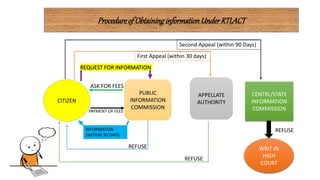
Procedureof ObtaininginformationUnderRTI,ACT
CITIZEN
PUBLIC
INFORMATION
COMMISSION
APPELLATE
AUTHORITY
CENTRL/STATE
INFORMATION
COMMISSION
WRIT IN
HIGH
COURT
ASK FOR FEES
PAYMENT OF FEES
REQUEST FOR INFORMATION
INFORMATION
(WITHIN 30 DAYS)
REFUSE
REFUSE
REFUSE
First Appeal (within 30 days)
Second Appeal (within 90 Days)
PENALTYOFRTI ACT,2005
Where the information commission,at the time of deciding any
complaint or appeal is of the opinion that the public information
officer, has,without any reasonable cause, refused to receive an
application for information or has not furnished information within the
time specified or malafidely denied the request for information or
destroyed information which was the subject of the request or
obstructed in any manner in furnishing the information ,it shall impose
a penalty of Rs.250/day till application is received or information is
furnished subject to the total amount of such penalty not exceeding
Rs.25000.
EXEMPTIONFROMDISCLOSUREOFINFORMATION
Information disclosure of which the sovereignty and integrity of india.
Information which involves infringement of copy right subsisting in a
person other then state.
The intelligence and security organization or any information
furnished by such organization to government.
Information which has been expressly forbidden to be published by
any court of law or tribunal or the disclosure of which may constitute
contempt of court.
RTI ACT,2005.pptx

RTI ACT,2005.pptx

  • 1.
    PRESENTATION ON RIGHT TOINFORMATION ACT, 2005 PRESENTED BY:-  GOLDY SINGH
  • 2.
    What is Rightto InformationACT,2005? • RTI CAME INTO FORCE ON THE 12TH OCT,2005. • Rights to information means the statutory right of a citizen of India to seek information from government and public sector offices, institutions and non-government organisations which are situated in India and are owned, controlled or substantially financed by funds provided directly or indirectly by central government or state government, regarding their functions and activities. It also includes the right to- Inspect works, documents, records, Take notes, extracts or certified copies of documents or records, Take certified samples of material, Obtain information in the form of disketters, floppies, tapes, video cassettes or in any other electronic mode or through printouts where such information is stored in a computer or in any other device.
  • 3.
    WHOISPUBLICAUTHORITY? • Public Authoritymeans any authority or body or institution established or constituted; By or under the constitution; By any other law made by parliament; By any other law made by state legislature; By notification issued or order made by the appropriate government and includes any 1. Body owned, controlled or substantially financed, 2. Non-government organization substantially financed directly or indirectly by funds provided by the appropriate government;
  • 4.
    Whatdoesinformationmean? Any material inany form including, Records Documents Memos Press release Circulars, orders & logo books Contracts Repots, papers, samples and models Data material held in any electronic form and information related to any private body which can be assessed by public authority .
  • 5.
    OBJECTIVESOF RTI ACT,2005 Thebasic object of the Right to Information Act is to empower the citizens,promote transparency and accountability in the working of the Government,contain corruption, and make our democracy work for the people in real sense.Thus, this act passed with the following objectives:- To provide for setting out practical regime of right to information for citizens to secure access to information under the control of public authorities. To promote transparency and accountability in the working of every public authority. To set up central information commission and state information commission for the matters concerned therewith.
  • 6.
    SAILENTFEATURESOF RTI ACT,2005 1.This Act may be called RTI ACT,2005 2. This Act defines ‘Appropriate Government’ which may be termed as public authority. 3. This public authority is established, constituted, owned, controlled or substantially financed by funds provided directly or indirectly by the central Government or the Union Territory or State Government. 4. The Act extends to the whole of India except Jammu & Kashmir (SINCE AUGUST 5, 2019 AFTER ARTICLE 370 REVOKED this act extended to whole of India). 5. All citizens shall have the right to information, subject to provisions of the Act. 6. Fee will be payable by the applicant depending on the nature of information sought. 7. Certain categories of information have been exempted from disclosure under Section 8 and 9 of the Act. 8. The amount of fee deposited by the applicant for the seeking information shall have to be returned, if information is not furnished within specified period.
  • 7.
    Procedureof ObtaininginformationUnderRTI,ACT CITIZEN PUBLIC INFORMATION COMMISSION APPELLATE AUTHORITY CENTRL/STATE INFORMATION COMMISSION WRIT IN HIGH COURT ASKFOR FEES PAYMENT OF FEES REQUEST FOR INFORMATION INFORMATION (WITHIN 30 DAYS) REFUSE REFUSE REFUSE First Appeal (within 30 days) Second Appeal (within 90 Days)
  • 8.
    PENALTYOFRTI ACT,2005 Where theinformation commission,at the time of deciding any complaint or appeal is of the opinion that the public information officer, has,without any reasonable cause, refused to receive an application for information or has not furnished information within the time specified or malafidely denied the request for information or destroyed information which was the subject of the request or obstructed in any manner in furnishing the information ,it shall impose a penalty of Rs.250/day till application is received or information is furnished subject to the total amount of such penalty not exceeding Rs.25000.
  • 9.
    EXEMPTIONFROMDISCLOSUREOFINFORMATION Information disclosure ofwhich the sovereignty and integrity of india. Information which involves infringement of copy right subsisting in a person other then state. The intelligence and security organization or any information furnished by such organization to government. Information which has been expressly forbidden to be published by any court of law or tribunal or the disclosure of which may constitute contempt of court.