RSA ALGORITHM
Introduction
● RSA was developed by Ron Rivest, Adi Shamir, and Len Adleman at MIT in 1977.
● It is a public-key cryptographic algorithm.
● The RSA scheme is a block cipher in which the plaintext and ciphertext are integers between 0 and n -
1 for some n.
● A typical size for n is 1024 bits, or 309 decimal digits.
Integer Factorization Problem
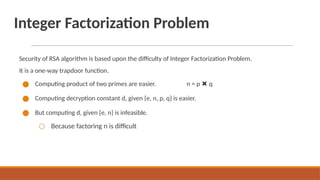
Security of RSA algorithm is based upon the difficulty of Integer Factorization Problem.
It is a one-way trapdoor function.
● Computing product of two primes are easier. n = p ✖ q
● Computing decryption constant d, given {e, n, p, q} is easier.
● But computing d, given {e, n} is infeasible.
○ Because factoring n is difficult
Algorithm Description
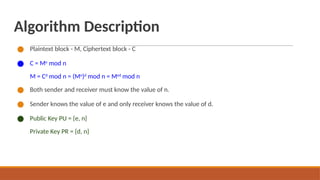
● Plaintext block - M, Ciphertext block - C
● C = Me
mod n
M = Cd
mod n = (Me
)d
mod n = Med
mod n
● Both sender and receiver must know the value of n.
● Sender knows the value of e and only receiver knows the value of d.
● Public Key PU = {e, n}
Private Key PR = {d, n}
Algorithm Description
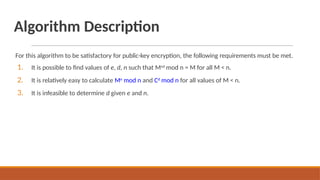
For this algorithm to be satisfactory for public-key encryption, the following requirements must be met.
1. It is possible to find values of e, d, n such that Med
mod n = M for all M < n.
2. It is relatively easy to calculate Me
mod n and Cd
mod n for all values of M < n.
3. It is infeasible to determine d given e and n.
Algorithm Description
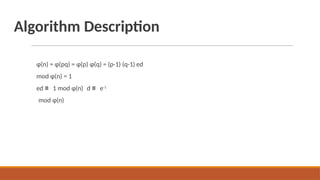
ɸ(n) = ɸ(pq) = ɸ(p) ɸ(q) = (p-1) (q-1) ed
mod ɸ(n) = 1
ed ≡ 1 mod ɸ(n) d ≡ e-1
mod ɸ(n)
RSA Algorithm
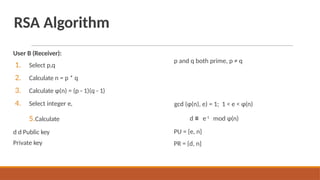
User B (Receiver):
1. Select p,q
2. Calculate n = p * q
3. Calculate ɸ(n) = (p - 1)(q - 1)
4. Select integer e,
5.Calculate
d d Public key
Private key
p and q both prime, p ≠ q
gcd (ɸ(n), e) = 1; 1 < e < ɸ(n)
d ≡ e-1
mod ɸ(n)
PU = {e, n}
PR = {d, n}
RSA Algorithm
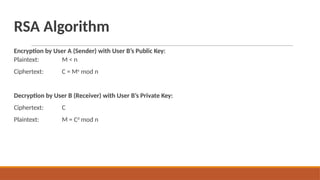
Encryption by User A (Sender) with User B’s Public Key:
Plaintext:
Ciphertext:
M < n
C = Me
mod n
Decryption by User B (Receiver) with User B’s Private Key:
Ciphertext:
Plaintext:
C
M = Cd
mod n
Encryption Example
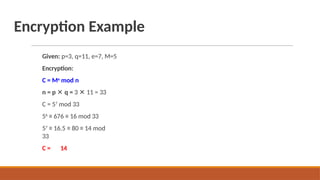
Given: p=3, q=11, e=7, M=5
Encryption:
C = Me
mod n
n = p ✕ q = 3 ✕ 11 = 33
C = 57
mod 33
56
≡ 676 ≡ 16 mod 33
57
≡ 16.5 ≡ 80 ≡ 14 mod
33
C = 14
Decryption Example
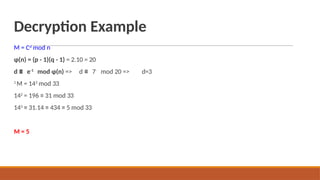
M = Cd
mod n
ɸ(n) = (p - 1)(q - 1) = 2.10 = 20
d ≡ e-1
mod ɸ(n) => d ≡ 7-
1
M = 143
mod 33
142
= 196 ≡ 31 mod 33
143
≡ 31.14 ≡ 434 ≡ 5 mod 33
mod 20 => d=3
M = 5
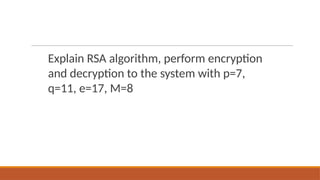
Explain RSA algorithm, perform encryption
and decryption to the system with p=7,
q=11, e=17, M=8
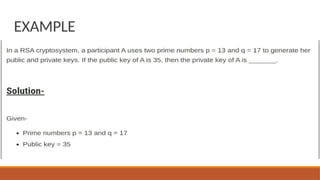
EXAMPLE
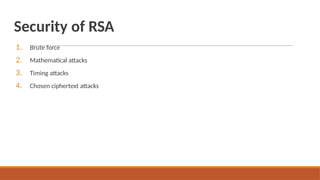
Security of RSA
1. Brute force
2. Mathematical attacks
3. Timing attacks
4. Chosen ciphertext attacks

RSA ALGORITHM UNIT-3 PPT FULL DESCRIPTION

  • 1.
  • 2.
    Introduction ● RSA wasdeveloped by Ron Rivest, Adi Shamir, and Len Adleman at MIT in 1977. ● It is a public-key cryptographic algorithm. ● The RSA scheme is a block cipher in which the plaintext and ciphertext are integers between 0 and n - 1 for some n. ● A typical size for n is 1024 bits, or 309 decimal digits.
  • 3.
    Integer Factorization Problem Securityof RSA algorithm is based upon the difficulty of Integer Factorization Problem. It is a one-way trapdoor function. ● Computing product of two primes are easier. n = p ✖ q ● Computing decryption constant d, given {e, n, p, q} is easier. ● But computing d, given {e, n} is infeasible. ○ Because factoring n is difficult
  • 4.
    Algorithm Description ● Plaintextblock - M, Ciphertext block - C ● C = Me mod n M = Cd mod n = (Me )d mod n = Med mod n ● Both sender and receiver must know the value of n. ● Sender knows the value of e and only receiver knows the value of d. ● Public Key PU = {e, n} Private Key PR = {d, n}
  • 5.
    Algorithm Description For thisalgorithm to be satisfactory for public-key encryption, the following requirements must be met. 1. It is possible to find values of e, d, n such that Med mod n = M for all M < n. 2. It is relatively easy to calculate Me mod n and Cd mod n for all values of M < n. 3. It is infeasible to determine d given e and n.
  • 6.
    Algorithm Description ɸ(n) =ɸ(pq) = ɸ(p) ɸ(q) = (p-1) (q-1) ed mod ɸ(n) = 1 ed ≡ 1 mod ɸ(n) d ≡ e-1 mod ɸ(n)
  • 7.
    RSA Algorithm User B(Receiver): 1. Select p,q 2. Calculate n = p * q 3. Calculate ɸ(n) = (p - 1)(q - 1) 4. Select integer e, 5.Calculate d d Public key Private key p and q both prime, p ≠ q gcd (ɸ(n), e) = 1; 1 < e < ɸ(n) d ≡ e-1 mod ɸ(n) PU = {e, n} PR = {d, n}
  • 8.
    RSA Algorithm Encryption byUser A (Sender) with User B’s Public Key: Plaintext: Ciphertext: M < n C = Me mod n Decryption by User B (Receiver) with User B’s Private Key: Ciphertext: Plaintext: C M = Cd mod n
  • 9.
    Encryption Example Given: p=3,q=11, e=7, M=5 Encryption: C = Me mod n n = p ✕ q = 3 ✕ 11 = 33 C = 57 mod 33 56 ≡ 676 ≡ 16 mod 33 57 ≡ 16.5 ≡ 80 ≡ 14 mod 33 C = 14
  • 10.
    Decryption Example M =Cd mod n ɸ(n) = (p - 1)(q - 1) = 2.10 = 20 d ≡ e-1 mod ɸ(n) => d ≡ 7- 1 M = 143 mod 33 142 = 196 ≡ 31 mod 33 143 ≡ 31.14 ≡ 434 ≡ 5 mod 33 mod 20 => d=3 M = 5
  • 11.
    Explain RSA algorithm,perform encryption and decryption to the system with p=7, q=11, e=17, M=8
  • 12.
  • 13.
    Security of RSA 1.Brute force 2. Mathematical attacks 3. Timing attacks 4. Chosen ciphertext attacks