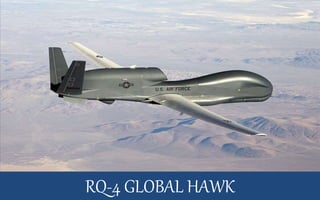
RQ-4 GLOBAL HAWK
Contents
• Introduction
• Development
• Euro Hawk
• Design
• Variants
• Specifications
• Performance
Introduction
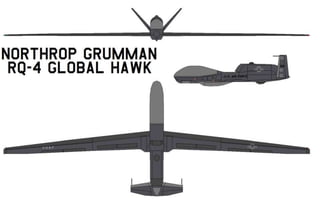
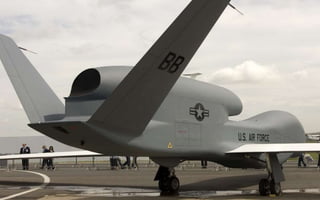
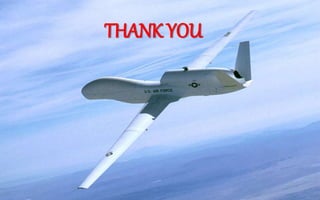
• The Northrop Grumman RQ-4 Global Hawk is
an unmanned aerial vehicle (UAV) surveillance aircraft.
• It can survey as much as 40,000 square miles
(100,000 km2) of terrain a day.
• The Global Hawk is operated by the United States Air
Force and U.S. Navy.
• It is used as a high-altitude platform for surveillance
and security.
• The U.S. Navy has developed the Global Hawk into
the MQ-4C Triton version for maritime surveillance.
Development
• The Global Hawk took its first flight on 28 February 1998.
• The first seven aircraft were built under the Advanced
Concept Technology Demonstration (ACTD) program,
sponsored by DARPA.
• Nine production Block 10 aircraft, sometimes referred to as
RQ-4A, were produced; of these, two were sold to the US
Navy and an additional two were deployed to Iraq to support
operations there.
• First flight of the Block 20 from the USAF Plant 42 in Palmdale,
California to Edwards Air Force Base took place on 1 March
2007.
• Developmental testing of Block 20 took place in 2008.
EuroHawk
• The German Air Force (Luftwaffe) ordered a variant of the
RQ-4B, to be equipped with a customized sensor suit
designated EuroHawk.
• The aircraft was based on the RQ-4B Block 20/30/40 and
was to be equipped with an EADS-built SIGINT package.
• The EuroHawk was officially rolled out on 8 October 2009
and its first flight took place on 29 June 2010.
• On 8 August 2013, the EuroHawk set an endurance record
by flying continuously in European airspace for 25.3 hours,
reaching an altitude of 58,600 feet (17,900 m).
• It was the longest flight by an unrefueled UAS weighing
more than 30,000 lb (14,000 kg) in European skies.
Design
• The Global Hawk UAV system comprises the RQ-4 air vehicle, which is
outfitted with various equipment such as sensor packages and
communication systems.
• A ground element consisting of a Launch and Recovery Element (LRE),
and a Mission Control Element (MCE) with ground communications
equipment.
• Each RQ-4 air vehicle is powered by an Allison Rolls-
Royce AE3007H turbofan engine with 7,050 lbf (31.4 kN) thrust, and
carries a payload of 2,000 pounds (910 kilograms).
• The fuselage comprises an aluminum, semi-monocoque construction;
the wings are made of lightweight high-strength composite materials.
Variants
• RQ-4A
• RQ-4B
• RQ-4E Euro Hawk
• EQ-4B
• Autonomous tanker variant
• Model 396
Specifications
• Crew: 0 onboard (3 remote: LRE pilot; MCE pilot and
sensor operator)
• Length: 47.6 ft (14.5 m)
• Wingspan: 130.9 ft (39.9 m)
• Height: 15.3 ft (4.7 m)
• Empty weight: 14,950 lb (6,781 kg)
• Gross weight: 32,250 lb (14,628 kg)
• Powerplant: 1 × Rolls-Royce F137-RR-
100 turbofan engine, 7,600 lbf (34 kN) thrust
Performance
• Cruise speed: 357 mph (310 kn; 575 km/h)
• Range: 8,700 mi (7,560 nmi; 14,001 km)
• Endurance: 28 hours
• Service ceiling: 60,000 ft (18,288 m)
THANK YOU

Rq

  • 1.
  • 2.
    Contents • Introduction • Development •Euro Hawk • Design • Variants • Specifications • Performance
  • 3.
    Introduction • The NorthropGrumman RQ-4 Global Hawk is an unmanned aerial vehicle (UAV) surveillance aircraft. • It can survey as much as 40,000 square miles (100,000 km2) of terrain a day. • The Global Hawk is operated by the United States Air Force and U.S. Navy. • It is used as a high-altitude platform for surveillance and security. • The U.S. Navy has developed the Global Hawk into the MQ-4C Triton version for maritime surveillance.
  • 5.
    Development • The GlobalHawk took its first flight on 28 February 1998. • The first seven aircraft were built under the Advanced Concept Technology Demonstration (ACTD) program, sponsored by DARPA. • Nine production Block 10 aircraft, sometimes referred to as RQ-4A, were produced; of these, two were sold to the US Navy and an additional two were deployed to Iraq to support operations there. • First flight of the Block 20 from the USAF Plant 42 in Palmdale, California to Edwards Air Force Base took place on 1 March 2007. • Developmental testing of Block 20 took place in 2008.
  • 7.
    EuroHawk • The GermanAir Force (Luftwaffe) ordered a variant of the RQ-4B, to be equipped with a customized sensor suit designated EuroHawk. • The aircraft was based on the RQ-4B Block 20/30/40 and was to be equipped with an EADS-built SIGINT package. • The EuroHawk was officially rolled out on 8 October 2009 and its first flight took place on 29 June 2010. • On 8 August 2013, the EuroHawk set an endurance record by flying continuously in European airspace for 25.3 hours, reaching an altitude of 58,600 feet (17,900 m). • It was the longest flight by an unrefueled UAS weighing more than 30,000 lb (14,000 kg) in European skies.
  • 9.
    Design • The GlobalHawk UAV system comprises the RQ-4 air vehicle, which is outfitted with various equipment such as sensor packages and communication systems. • A ground element consisting of a Launch and Recovery Element (LRE), and a Mission Control Element (MCE) with ground communications equipment. • Each RQ-4 air vehicle is powered by an Allison Rolls- Royce AE3007H turbofan engine with 7,050 lbf (31.4 kN) thrust, and carries a payload of 2,000 pounds (910 kilograms). • The fuselage comprises an aluminum, semi-monocoque construction; the wings are made of lightweight high-strength composite materials.
  • 11.
    Variants • RQ-4A • RQ-4B •RQ-4E Euro Hawk • EQ-4B • Autonomous tanker variant • Model 396
  • 13.
    Specifications • Crew: 0onboard (3 remote: LRE pilot; MCE pilot and sensor operator) • Length: 47.6 ft (14.5 m) • Wingspan: 130.9 ft (39.9 m) • Height: 15.3 ft (4.7 m) • Empty weight: 14,950 lb (6,781 kg) • Gross weight: 32,250 lb (14,628 kg) • Powerplant: 1 × Rolls-Royce F137-RR- 100 turbofan engine, 7,600 lbf (34 kN) thrust
  • 15.
    Performance • Cruise speed:357 mph (310 kn; 575 km/h) • Range: 8,700 mi (7,560 nmi; 14,001 km) • Endurance: 28 hours • Service ceiling: 60,000 ft (18,288 m)
  • 16.