Rough Draft
COLLEGE/UNIVERSITY NAME
RESEARCH QUESTION
FULL NAME
PROFESSOR’S NAME
COURSE NAME AND SECTION
DUE DATE
ASSIGNMENT
RVCC
English Composition II
Project 2 Assignment
The syllabus includes course policies about rough and final drafts.
Rough Draft
Due date and time are on the syllabus
Requirements: Submit at least five (5) sources from the pre-selected readings list. Include at
least one quote in each summary. In your Annotated Bibliography, alphabetize the sources
by the author’s last name.
Final Draft
Due date and time are on the syllabus. The final copy must include twelve (12) pre-selected
sources. Include at least one quote in each summary. In your Annotated Bibliography,
alphabetize the sources by the author’s last name.
*Essay Preparation
Ensure that you have completed the readings necessary to do this assignment. The pre-
selected readings are listed at the end of this document.
Prompt
Using the same visual image that you used for Project #1, use the pre-selected sources to
research the biographical, cultural, political, and historical forces that inspired/helped
create the (multisensory) visual image. Document each source and reflect on each source
you located to create an Annotated Bibliography.
This is a research assignment.
Audience
The intended audience for your essay should be people who have already read the assigned
texts but are not experts in the material. Your classmates are your audience.
Research Question
Create a research question that responds to the assignment prompt.
Create a research question that is a single question. (Examples: How was artist Banksy
influenced by the political happenings of 1948? Or How does Salvador Dali’s painting Chess
Mask on the Sea manifest a fascination with religion? Or How is Frida Kahlo’s painting Los
Dos Fridas influenced by gender politics? Or Who is this artist now and what would likely be
this artist’s next art project? Or Why is Leonardo da Vinci’s mural The Last Supper still
relevant today?
Create a research question that motivates you to research an answer.
Place your research question at the top of your annotated bibliography.
In order to present an effective Annotated Bibliography, you need to address the following
questions
What is the title and author of the source?
What is the author’s main point?
What details are provided by the author in support of his/her/their viewpoint? Include a
quote from the source.
Why do you think this article will be helpful in answering your research question?
Additional requirements (for the final draft)
At least 5 pages, Times New Roman 12, 1-inch margins, double-spaced, typed, black ink,
title, and page numbers
A research question that is clear and concise and responds to the assignment
Sources in MLA format that total 5 pages (minimum of 12 sources). You are allowed to add
additional sources to the minimum of twelve.
Summaries for each source with clear topic sentences, and a logical sequence (the
summaries need to be approximately 100 words)
Nominal grammar and spelling errors
A picture of the painting on the title page
A full heading on the title page
Sample Response
Title: Annotated Bibliography for Artist X
[selected artwork image]
Student’s Fist name and last name
Professor’s last name
Course and section
Final copy due date: day, month, and year
Assignment: Project #2: Annotated Bibliography
Research Question: Why was artist Titus Kaphar obsessed with the Voting Rights Act of
1965?
Garrow, David J. Protest at Selma: Martin Luther King and the Voting Rights Act of 1965.
New Haven: Yale University Press, 1978.
David J. Garrow, Professor of Law and History and Distinguished Scholar at the University of
Pittsburgh School of Law, describes how the strategy of protest employed by Martin Luther
King, Jr., and SCLC at Selma influenced the emergence of the Voting Rights Act of 1965.
Garrow contends that the choice of Selma as a site for civil rights protests and the specific
tactics that SCLC adopted in Selma were part of a plan to force the introduction and passage
of national voting rights legislation. The foremost consideration in this campaign was the
need to elicit "unprovoked racial violence aimed at peaceful and unresisting civil rights
demonstrators." Garrow argues that at Selma "a strategy that bordered on nonviolent
provocation supplanted the earlier belief in nonviolent persuasion." SCLC correctly
assumed that police violence would generate national media coverage and this, in turn,
would stimulate reactions "throughout the country, and especially Washington," leading to
pressure for federal voting rights legislation.
David J. Garrow’s book should be helpful and likely will serve as the basis of my argument.
Punlap, Henry. "Predictors of Young Adult Voting Behavior; the Beavis and Butthead'
Experience." Annals of Antipathy 30.1 (2000): 57-98. I.
Henry Punlap, Professor of American History at Vassar College, argues that Titus Kaphar
was angered by today’s youths apathy towards voting.
Punlap’s humorous satire of young voters also includes considerable research. Included are
results of four surveys of first-time voters conducted during the 1990s. Punlap states, “Too
many teens lose enthusiasm from the age of 16-18.” Punlap's tongue-in-cheek approach to
developing his article entertains but doesn't distract the reader. For example, Punlap says,
“Beavis is a perfect model for today’s youth.” Punlap is harsh at times and the harshness
sometimes detracts from his thesis.
Henry Punlap’s book will provide information about Kaphar’s interest in history.
Grading Rubric
Course Title: 112
Essay Submission:
Submit your essay as an attachment (dox, docx, html, or pdf).
*PRE-SELECTED READINGS:
HOW TO ACCESS THE ARTICLES BELOW:
STEP 1: TYPE 'RVCC LIBRARY' IN GOOGLE.
STEP 2: CLICK ON 'DATABASES.'
STEP 3: CLICK ON 'SCHOLARLY ARTICLES.'
STEP 4: CLICK ON THE SPECIFIED DATABASE TO LOCATE EACH ARTICLE BELOW BY
DOING A TITLE SEARCH OF THE ARTICLE. BEGIN WITH 'ACADEMIC SEARCH PREMIER'
AND 'JSTOR.'
STEP 5: TAKE NOTES ON THE ARTICLE. INCLUDE IN YOUR NOTES: AUTHOR BIO INFO,
THE AUTHOR'S MAIN IDEA (THESIS), ONE QUOTE OF OPINION, AND HOW THIS INFO IS
SIMILAR TO THE INFO FROM ANOTHER ARTICLE.
JEAN-MICHAEL BASQUIAT
SEARCHING FOR JEAN-MICHAEL BASQUIAT BY STEPHEN METCALF (JUL/AUG 2018)
GLIMPSES INTO A PRODIGY'S PSYCHE BY ROBERTA SMITH (4/3/2015)
BASQUIAT'S DEFACEMENT: THE UNTOLD STORY BY TIANA REID (OCT 2019)
BASQUIAT'S TRAGEDY BY DOUGLAS MURRAY (12/31/2017)
THE BOUNDLESS IMAGINATION OF JEAN-MICHAEL BASQUIAT BY HERB BOYD (4/21/22)
THE ART OF NOISE BY MATT BARKER (SEPT 29, 2017)
THE COLLABORATION BY CHARLES ISHERWOOD (122/23/22)
BASQUIAT AND THE COLLECTING OF HISTORY BY BOB NICKAS (SUMMER 2015)
SAMO@ AS AN ESCAPE CLAUSE BY LAURIE A. RODRIQUES (MAY 2011)
BASQUIAT AT 50 BY JENNIFER JAZZ (2010)
JEAN-MICHAEL BASQUIAT, OUTSIDER SUPERSTAR BY CORA MARSHALL (1999)
BEN OKRI ON BASQUIAT BY BEN OKRI (MAY 2005)
SALVADOR DALI
AN ALTERNATIVE PARADIGM TO THE OPPRESSION OF NUCLEAR WAR BY PATRICIA
FRISCH (MARCH 2014)
THE GRAND MASTR OF SURREALISM SLVADOR DALI BY USA TODAY (MAY 2005)
THE MAD, MAGNIFICENT SALVADOR DALI BY MELISSA BURDICK HARMON (JAN 2001)
SALVADOR DALI'S LOBSTERS BY NANCY FRAZIER (FALL 2009)
NEW SKIN, A NEW LAND BY JULIA PINE (SPRING 2008)
OBJECT ORIENTED SURREALISM BY ROGER ROTHMAN (JULY 2016)
THE LINK BETWEEN ARTISTIC CREATIVITY AND PSYCHOPATHOLOGY BY CAROLINE
MURPHY (JUNE 2009)
LANGUAGE AS AN UNDELYING IDEA IN SALVADOR DALI'S WORKS BY O.B. ZASLAUSKII
(JAN-MAR 2005)
THE HALLUCINOGENIC SALVADOR BY STANFORD SCHWARTZ (10/1/94)
THE PERSISTENCE OF DALI BY CHARLES STUCKEY (MAR 2005)
DALI, DISNEY, AND THE DIONYSIAN BY JUSTIN MUCHNICK (DEC 2017)
TINY SURREALISM BY EFFIE RENTZOU (2018)
THE HALLUCINOGENIC TOREADOR FROM US NATIONAL CENTR FOR INFECTIOUS
DISEASES (SEPT 2000)
AGNES DENES
JSTOR DATABASE: EARTHWORKS: PAST AND PRESENT BY ROBERT HOBBS (1982)
ARTISTIC VISION & MOLECULAR GENETICS BY AGNES DENES (SPRING 1996)
A BUMPER CROP OF URBAN CORN BY DAVID EBONG (NOV 2005)
AGNES DENES, BRIAN SHOLIS (MAY 2007)
JSTOR: LANDSCAPE ART AND THE CITY BY JOHN MCLAUGHLIN (2009)
AGNES DENES BY NICK STILLMAN (FEB 2010)
JSTOR: ECOLOGICAL ART BY RUTH WALLEN (2012)
JSTOR: DISEQUILIBRIUM IN ARTS AND ARTS ED BY KEVIN SLIVKA (SUMMER 2012)
ENVIRONMENT COMPLETE DATABASE: (HOW GREEN IS EARTH ART?) REGENERATION
ON TREE MOUNTAIN BY ROBERT LOUIS CHIANESE (2013)
JSTOR: BEYOND EARTH ART BY ALICIA INEZ GUZMAN (MAY/JUNE 2014)
ARTS & HUMANITIES: LAND OF THE LIVING BY LAUREN O'NEILL BUTLER (OCT 2019)
MY ART IS ABOUT OVERCOMING OUR LIMITATIONS BY GABRIELLE SCHWARZ (SEPT
2019)
SCIENCE, TECH, AND UTOPIAS BY CHARLIE GERE (APRIL 2021)
WHEATFIELD: A CONFRONTATION: BATTERY PARK LANDFILL, DOWNTOWN
MANHATTAN BY AGNES DENES (1982)
FRIDA KAHLO
FRIDOLATRY BY RACHAEL SYME (2019)
FRIDA BY WILLIAM FRIED (AUGUST 2020)
UNINHABITED DRESSES BY ALBA ARAGON (NOV 2014)
MORE THAN MEETS THE EYE BY GEORGIA KYRIAKOV (JAN-FEB 2021)
FRIDA KAHLO'S PHOTOGRAPHIC POSING BY NIEVES LIMON SERRANO (JUNE 2019)
FASHIONING AN IDENTITY BY CAROLYN L. E. BENESH
PSYCHE AND SOMA BY F. DIANE BARTH (1998)
UNDER HER SKIN BY DEBORAH LEVY (6/29/2018)
THE TROUBLE WITH FRIDA KAHLO BY STEPHANIE MENCIMER (JUNE 2002)
FRIDA KAHLO BY PHYLLIS TUCHMAN (NOV 2002)
KAHLO'S WORLD SPLIT OPEN BY EVELYN TORTON BECK (SPRING 2006)
NEUROLOGICAL DFICITS IN THE LIFE AND THE WORKS OF FRIDA KAHLO BY VALMANTAS
BUDRYS (FEB 2006)
NORMAN ROCKWELL
ROCKWELL'S FOUR FREEDOMS BY PATRICK PERRY (JAN/FEB 2018)
NORMAN ROCKWELL AND THE FASHIONNG OF AMRICAN MASCULINITY BY ERIC SEGAL
(DEC 1996)
ROCKWELL'S DOGS BY SATURDAY EVENING POST (MAY/JUNE 2019)
AMERICAN QUEERER BY CLAIRE SISCO KING (2016)
WHY I PAINT THE WAY I PAINT BY NORMAN ROCKWELL (MAY/JUNE 2016)
PICTURES FRAMED BY PATRICK TONER (JUL/AUG 2015)
PICTURES FOR THE AMERICAN PEOPLE
AMERICAN CHRONICLES BY MARK M. JOHNSON (APRIL 2009)
AMERICA'S ARTIST (COVER STORY) BY PAMELA V. KROL (MAR/APR 2010)
REVISITING ROCKWELL BY ABIGAIL TUCKER (MAR 2018)
NORMAN ROCKWELL: AMERICAN REALIST BY WILLIAM MURCHISON (MAY-JUNE 2020)
WHY NORMAN ROCKWELL LEFT THANKSGIVING AMERICANA BEHIND BY ANDREW L.
YARROW (NOV 24, 2021)
AI WEI WEI
HUMAN FLOW BY GULSUM DEPELI-SEVINE (SEPT 2022)
BEYOND THE MIDDLE FINGER BY JASON MILLER (AUG-NOV 2016)
AI WEI WEI, ART, AND RIGHTS IN CHINA BY MINKY WORDEN (SPRING 2016)
ON INTERVIEWING AI WEI WEI BY EITHAN COHEN (SP 2016)
TWITTER BODHISATTVA BY GIORGIO STRAFELLA (MARCH 2015)
ON AI WEI WEI BY MELISSA CHIU (SP 2016)
INTRODUCTION: A CONVERSATION ABOUT AI WEI WEI BY JEROME COHEN (SP 2016)
ART AND POLITICS IN CHINA AND TAIWAN BY JOAN LEBOLD COHEN (2011)
A CONVRSATION BY AI WEI WEI (SPRING 2016)
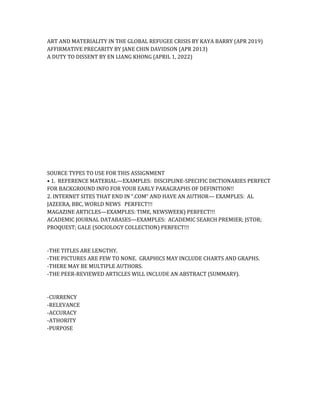
ART AND MATERIALITY IN THE GLOBAL REFUGEE CRISIS BY KAYA BARRY (APR 2019)
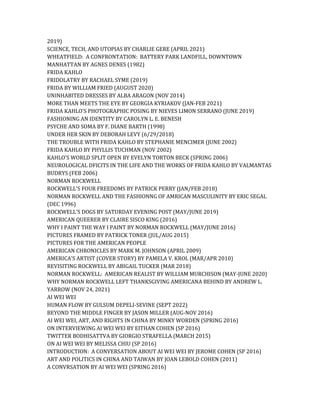
AFFIRMATIVE PRECARITY BY JANE CHIN DAVIDSON (APR 2013)
A DUTY TO DISSENT BY EN LIANG KHONG (APRIL 1, 2022)
SOURCE TYPES TO USE FOR THIS ASSIGNMENT
• 1. REFERENCE MATERIAL—EXAMPLES: DISCIPLINE-SPECIFIC DICTIONARIES PERFECT
FOR BACKGROUND INFO FOR YOUR EARLY PARAGRAPHS OF DEFINITION!!
2. INTERNET SITES THAT END IN “.COM” AND HAVE AN AUTHOR— EXAMPLES: AL
JAZEERA, BBC, WORLD NEWS PERFECT!!!
MAGAZINE ARTICLES—EXAMPLES: TIME, NEWSWEEK) PERFECT!!!
ACADEMIC JOURNAL DATABASES—EXAMPLES: ACADEMIC SEARCH PREMIER; JSTOR;
PROQUEST; GALE (SOCIOLOGY COLLECTION) PERFECT!!!
-THE TITLES ARE LENGTHY.
-THE PICTURES ARE FEW TO NONE. GRAPHICS MAY INCLUDE CHARTS AND GRAPHS.
-THERE MAY BE MULTIPLE AUTHORS.
-THE PEER-REVIEWED ARTICLES WILL INCLUDE AN ABSTRACT (SUMMARY).
-CURRENCY
-RELEVANCE
-ACCURACY
-ATHORITY
-PURPOSE
SKILL SHEET #300: NARROWING YOUR TOPIC WHEN RESEARCHING A SUBJECT
A common challenge when beginning to write a research paper is determining how to
narrow down your topic. Even if your professor gives you a specific topic to study, it will
almost never be so specific that you won’t have to narrow it down at least to some degree
[besides, it is very boring to grade fifty papers that are all about the exact same thing!].
A topic is too broad to be manageable when a review of the literature reveals too many
different, and oftentimes conflicting or only remotely related, ideas about how to investigate
the research problem. Although you will want to start the writing process by considering a
variety of different approaches to studying the research problem, you will need to narrow
the focus of your investigation at some point early in the writing process. This way, you
don't attempt to do too much in one paper.
Here are some strategies to help narrow your topic:
Aspect -- choose one lens through which to view the research problem or look at just one
facet of it [e.g., rather than studying the role of food in South Asian religious rituals, study
the role of food in Hindu ceremonies or the role of one particular type of food among
several religions].
The Population -- determine if your initial variable or unit of analysis can be broken into
smaller parts, which can then be analyzed more precisely [e.g., a study of tobacco use among
adolescents can focus on just chewing tobacco rather than all forms of usage or, rather than
adolescents in general, focus on female adolescents in a certain age range who choose to use
tobacco].
Place -- generally, the smaller the geographic unit of analysis, the more narrow the focus
[e.g., rather than study trade relations in West Africa, study trade relations between Niger
and Cameroon as a case study that helps to explain economic problems in the region].
Time -- the shorter the time period of the study, the more narrow the focus [e.g., study of
trade relations between Niger and Cameroon during the period of 2010 - 2020].
Type -- focus your topic in terms of a specific type or class of people, places, or phenomena
[e.g., a study of developing safer traffic patterns near schools can focus on SUVs, or just
student drivers, or just the timing of traffic signals in the area].
Combination -- use two or more of the above strategies to focus your topic more narrowly.
NOTE: Apply one of the above strategies first in designing your study to determine if that
gives you a manageable research problem to investigate. You will know if the problem is
manageable by reviewing the literature on this more specific problem and assessing
whether prior research on the narrower topic is sufficient to move forward in your study
[i.e., not too much, not too little]. Be careful, however, because combining multiple
strategies risks creating the opposite problem--your problem becomes too narrowly
defined and you can't locate enough research or data to support your study.
Booth, Wayne C. The Craft of Research. Fourth edition. Chicago, IL: The University of
Chicago Press, 2016; Coming Up With Your Topic. Institute for Writing Rhetoric. Dartmouth
College; Narrowing a Topic. Writing Center. University of Kansas; Narrowing
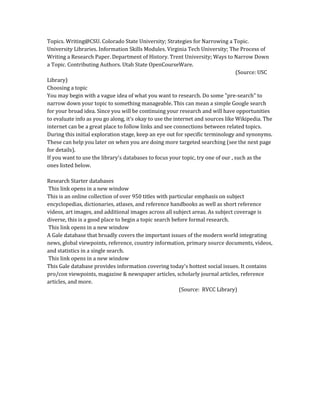
Topics. Writing@CSU. Colorado State University; Strategies for Narrowing a Topic.
University Libraries. Information Skills Modules. Virginia Tech University; The Process of
Writing a Research Paper. Department of History. Trent University; Ways to Narrow Down
a Topic. Contributing Authors. Utah State OpenCourseWare.
(Source: USC
Library)
Choosing a topic
You may begin with a vague idea of what you want to research. Do some "pre-search" to
narrow down your topic to something manageable. This can mean a simple Google search
for your broad idea. Since you will be continuing your research and will have opportunities
to evaluate info as you go along, it's okay to use the internet and sources like Wikipedia. The
internet can be a great place to follow links and see connections between related topics.
During this initial exploration stage, keep an eye out for specific terminology and synonyms.
These can help you later on when you are doing more targeted searching (see the next page
for details).
If you want to use the library's databases to focus your topic, try one of our , such as the
ones listed below.
Research Starter databases
This link opens in a new window
This is an online collection of over 950 titles with particular emphasis on subject
encyclopedias, dictionaries, atlases, and reference handbooks as well as short reference
videos, art images, and additional images across all subject areas. As subject coverage is
diverse, this is a good place to begin a topic search before formal research.
This link opens in a new window
A Gale database that broadly covers the important issues of the modern world integrating
news, global viewpoints, reference, country information, primary source documents, videos,
and statistics in a single search.
This link opens in a new window
This Gale database provides information covering today's hottest social issues. It contains
pro/con viewpoints, magazine & newspaper articles, scholarly journal articles, reference
articles, and more.
(Source: RVCC Library)

Rough Draft.pdf

  • 1.
    Rough Draft COLLEGE/UNIVERSITY NAME RESEARCHQUESTION FULL NAME PROFESSOR’S NAME COURSE NAME AND SECTION DUE DATE ASSIGNMENT RVCC English Composition II Project 2 Assignment The syllabus includes course policies about rough and final drafts. Rough Draft Due date and time are on the syllabus Requirements: Submit at least five (5) sources from the pre-selected readings list. Include at least one quote in each summary. In your Annotated Bibliography, alphabetize the sources by the author’s last name. Final Draft Due date and time are on the syllabus. The final copy must include twelve (12) pre-selected sources. Include at least one quote in each summary. In your Annotated Bibliography, alphabetize the sources by the author’s last name. *Essay Preparation Ensure that you have completed the readings necessary to do this assignment. The pre- selected readings are listed at the end of this document. Prompt Using the same visual image that you used for Project #1, use the pre-selected sources to research the biographical, cultural, political, and historical forces that inspired/helped create the (multisensory) visual image. Document each source and reflect on each source you located to create an Annotated Bibliography. This is a research assignment. Audience The intended audience for your essay should be people who have already read the assigned texts but are not experts in the material. Your classmates are your audience. Research Question
  • 2.
    Create a researchquestion that responds to the assignment prompt. Create a research question that is a single question. (Examples: How was artist Banksy influenced by the political happenings of 1948? Or How does Salvador Dali’s painting Chess Mask on the Sea manifest a fascination with religion? Or How is Frida Kahlo’s painting Los Dos Fridas influenced by gender politics? Or Who is this artist now and what would likely be this artist’s next art project? Or Why is Leonardo da Vinci’s mural The Last Supper still relevant today? Create a research question that motivates you to research an answer. Place your research question at the top of your annotated bibliography. In order to present an effective Annotated Bibliography, you need to address the following questions What is the title and author of the source? What is the author’s main point? What details are provided by the author in support of his/her/their viewpoint? Include a quote from the source. Why do you think this article will be helpful in answering your research question? Additional requirements (for the final draft) At least 5 pages, Times New Roman 12, 1-inch margins, double-spaced, typed, black ink, title, and page numbers A research question that is clear and concise and responds to the assignment Sources in MLA format that total 5 pages (minimum of 12 sources). You are allowed to add additional sources to the minimum of twelve. Summaries for each source with clear topic sentences, and a logical sequence (the summaries need to be approximately 100 words) Nominal grammar and spelling errors A picture of the painting on the title page A full heading on the title page Sample Response Title: Annotated Bibliography for Artist X [selected artwork image] Student’s Fist name and last name Professor’s last name Course and section Final copy due date: day, month, and year Assignment: Project #2: Annotated Bibliography Research Question: Why was artist Titus Kaphar obsessed with the Voting Rights Act of 1965? Garrow, David J. Protest at Selma: Martin Luther King and the Voting Rights Act of 1965. New Haven: Yale University Press, 1978. David J. Garrow, Professor of Law and History and Distinguished Scholar at the University of Pittsburgh School of Law, describes how the strategy of protest employed by Martin Luther King, Jr., and SCLC at Selma influenced the emergence of the Voting Rights Act of 1965. Garrow contends that the choice of Selma as a site for civil rights protests and the specific
  • 3.
    tactics that SCLCadopted in Selma were part of a plan to force the introduction and passage of national voting rights legislation. The foremost consideration in this campaign was the need to elicit "unprovoked racial violence aimed at peaceful and unresisting civil rights demonstrators." Garrow argues that at Selma "a strategy that bordered on nonviolent provocation supplanted the earlier belief in nonviolent persuasion." SCLC correctly assumed that police violence would generate national media coverage and this, in turn, would stimulate reactions "throughout the country, and especially Washington," leading to pressure for federal voting rights legislation. David J. Garrow’s book should be helpful and likely will serve as the basis of my argument. Punlap, Henry. "Predictors of Young Adult Voting Behavior; the Beavis and Butthead' Experience." Annals of Antipathy 30.1 (2000): 57-98. I. Henry Punlap, Professor of American History at Vassar College, argues that Titus Kaphar was angered by today’s youths apathy towards voting. Punlap’s humorous satire of young voters also includes considerable research. Included are results of four surveys of first-time voters conducted during the 1990s. Punlap states, “Too many teens lose enthusiasm from the age of 16-18.” Punlap's tongue-in-cheek approach to developing his article entertains but doesn't distract the reader. For example, Punlap says, “Beavis is a perfect model for today’s youth.” Punlap is harsh at times and the harshness sometimes detracts from his thesis. Henry Punlap’s book will provide information about Kaphar’s interest in history. Grading Rubric Course Title: 112 Essay Submission: Submit your essay as an attachment (dox, docx, html, or pdf). *PRE-SELECTED READINGS: HOW TO ACCESS THE ARTICLES BELOW: STEP 1: TYPE 'RVCC LIBRARY' IN GOOGLE. STEP 2: CLICK ON 'DATABASES.' STEP 3: CLICK ON 'SCHOLARLY ARTICLES.' STEP 4: CLICK ON THE SPECIFIED DATABASE TO LOCATE EACH ARTICLE BELOW BY DOING A TITLE SEARCH OF THE ARTICLE. BEGIN WITH 'ACADEMIC SEARCH PREMIER' AND 'JSTOR.' STEP 5: TAKE NOTES ON THE ARTICLE. INCLUDE IN YOUR NOTES: AUTHOR BIO INFO, THE AUTHOR'S MAIN IDEA (THESIS), ONE QUOTE OF OPINION, AND HOW THIS INFO IS SIMILAR TO THE INFO FROM ANOTHER ARTICLE. JEAN-MICHAEL BASQUIAT SEARCHING FOR JEAN-MICHAEL BASQUIAT BY STEPHEN METCALF (JUL/AUG 2018)
  • 4.
    GLIMPSES INTO APRODIGY'S PSYCHE BY ROBERTA SMITH (4/3/2015) BASQUIAT'S DEFACEMENT: THE UNTOLD STORY BY TIANA REID (OCT 2019) BASQUIAT'S TRAGEDY BY DOUGLAS MURRAY (12/31/2017) THE BOUNDLESS IMAGINATION OF JEAN-MICHAEL BASQUIAT BY HERB BOYD (4/21/22) THE ART OF NOISE BY MATT BARKER (SEPT 29, 2017) THE COLLABORATION BY CHARLES ISHERWOOD (122/23/22) BASQUIAT AND THE COLLECTING OF HISTORY BY BOB NICKAS (SUMMER 2015) SAMO@ AS AN ESCAPE CLAUSE BY LAURIE A. RODRIQUES (MAY 2011) BASQUIAT AT 50 BY JENNIFER JAZZ (2010) JEAN-MICHAEL BASQUIAT, OUTSIDER SUPERSTAR BY CORA MARSHALL (1999) BEN OKRI ON BASQUIAT BY BEN OKRI (MAY 2005) SALVADOR DALI AN ALTERNATIVE PARADIGM TO THE OPPRESSION OF NUCLEAR WAR BY PATRICIA FRISCH (MARCH 2014) THE GRAND MASTR OF SURREALISM SLVADOR DALI BY USA TODAY (MAY 2005) THE MAD, MAGNIFICENT SALVADOR DALI BY MELISSA BURDICK HARMON (JAN 2001) SALVADOR DALI'S LOBSTERS BY NANCY FRAZIER (FALL 2009) NEW SKIN, A NEW LAND BY JULIA PINE (SPRING 2008) OBJECT ORIENTED SURREALISM BY ROGER ROTHMAN (JULY 2016) THE LINK BETWEEN ARTISTIC CREATIVITY AND PSYCHOPATHOLOGY BY CAROLINE MURPHY (JUNE 2009) LANGUAGE AS AN UNDELYING IDEA IN SALVADOR DALI'S WORKS BY O.B. ZASLAUSKII (JAN-MAR 2005) THE HALLUCINOGENIC SALVADOR BY STANFORD SCHWARTZ (10/1/94) THE PERSISTENCE OF DALI BY CHARLES STUCKEY (MAR 2005) DALI, DISNEY, AND THE DIONYSIAN BY JUSTIN MUCHNICK (DEC 2017) TINY SURREALISM BY EFFIE RENTZOU (2018) THE HALLUCINOGENIC TOREADOR FROM US NATIONAL CENTR FOR INFECTIOUS DISEASES (SEPT 2000) AGNES DENES JSTOR DATABASE: EARTHWORKS: PAST AND PRESENT BY ROBERT HOBBS (1982) ARTISTIC VISION & MOLECULAR GENETICS BY AGNES DENES (SPRING 1996) A BUMPER CROP OF URBAN CORN BY DAVID EBONG (NOV 2005) AGNES DENES, BRIAN SHOLIS (MAY 2007) JSTOR: LANDSCAPE ART AND THE CITY BY JOHN MCLAUGHLIN (2009) AGNES DENES BY NICK STILLMAN (FEB 2010) JSTOR: ECOLOGICAL ART BY RUTH WALLEN (2012) JSTOR: DISEQUILIBRIUM IN ARTS AND ARTS ED BY KEVIN SLIVKA (SUMMER 2012) ENVIRONMENT COMPLETE DATABASE: (HOW GREEN IS EARTH ART?) REGENERATION ON TREE MOUNTAIN BY ROBERT LOUIS CHIANESE (2013) JSTOR: BEYOND EARTH ART BY ALICIA INEZ GUZMAN (MAY/JUNE 2014) ARTS & HUMANITIES: LAND OF THE LIVING BY LAUREN O'NEILL BUTLER (OCT 2019) MY ART IS ABOUT OVERCOMING OUR LIMITATIONS BY GABRIELLE SCHWARZ (SEPT
  • 5.
    2019) SCIENCE, TECH, ANDUTOPIAS BY CHARLIE GERE (APRIL 2021) WHEATFIELD: A CONFRONTATION: BATTERY PARK LANDFILL, DOWNTOWN MANHATTAN BY AGNES DENES (1982) FRIDA KAHLO FRIDOLATRY BY RACHAEL SYME (2019) FRIDA BY WILLIAM FRIED (AUGUST 2020) UNINHABITED DRESSES BY ALBA ARAGON (NOV 2014) MORE THAN MEETS THE EYE BY GEORGIA KYRIAKOV (JAN-FEB 2021) FRIDA KAHLO'S PHOTOGRAPHIC POSING BY NIEVES LIMON SERRANO (JUNE 2019) FASHIONING AN IDENTITY BY CAROLYN L. E. BENESH PSYCHE AND SOMA BY F. DIANE BARTH (1998) UNDER HER SKIN BY DEBORAH LEVY (6/29/2018) THE TROUBLE WITH FRIDA KAHLO BY STEPHANIE MENCIMER (JUNE 2002) FRIDA KAHLO BY PHYLLIS TUCHMAN (NOV 2002) KAHLO'S WORLD SPLIT OPEN BY EVELYN TORTON BECK (SPRING 2006) NEUROLOGICAL DFICITS IN THE LIFE AND THE WORKS OF FRIDA KAHLO BY VALMANTAS BUDRYS (FEB 2006) NORMAN ROCKWELL ROCKWELL'S FOUR FREEDOMS BY PATRICK PERRY (JAN/FEB 2018) NORMAN ROCKWELL AND THE FASHIONNG OF AMRICAN MASCULINITY BY ERIC SEGAL (DEC 1996) ROCKWELL'S DOGS BY SATURDAY EVENING POST (MAY/JUNE 2019) AMERICAN QUEERER BY CLAIRE SISCO KING (2016) WHY I PAINT THE WAY I PAINT BY NORMAN ROCKWELL (MAY/JUNE 2016) PICTURES FRAMED BY PATRICK TONER (JUL/AUG 2015) PICTURES FOR THE AMERICAN PEOPLE AMERICAN CHRONICLES BY MARK M. JOHNSON (APRIL 2009) AMERICA'S ARTIST (COVER STORY) BY PAMELA V. KROL (MAR/APR 2010) REVISITING ROCKWELL BY ABIGAIL TUCKER (MAR 2018) NORMAN ROCKWELL: AMERICAN REALIST BY WILLIAM MURCHISON (MAY-JUNE 2020) WHY NORMAN ROCKWELL LEFT THANKSGIVING AMERICANA BEHIND BY ANDREW L. YARROW (NOV 24, 2021) AI WEI WEI HUMAN FLOW BY GULSUM DEPELI-SEVINE (SEPT 2022) BEYOND THE MIDDLE FINGER BY JASON MILLER (AUG-NOV 2016) AI WEI WEI, ART, AND RIGHTS IN CHINA BY MINKY WORDEN (SPRING 2016) ON INTERVIEWING AI WEI WEI BY EITHAN COHEN (SP 2016) TWITTER BODHISATTVA BY GIORGIO STRAFELLA (MARCH 2015) ON AI WEI WEI BY MELISSA CHIU (SP 2016) INTRODUCTION: A CONVERSATION ABOUT AI WEI WEI BY JEROME COHEN (SP 2016) ART AND POLITICS IN CHINA AND TAIWAN BY JOAN LEBOLD COHEN (2011) A CONVRSATION BY AI WEI WEI (SPRING 2016)
  • 6.
    ART AND MATERIALITYIN THE GLOBAL REFUGEE CRISIS BY KAYA BARRY (APR 2019) AFFIRMATIVE PRECARITY BY JANE CHIN DAVIDSON (APR 2013) A DUTY TO DISSENT BY EN LIANG KHONG (APRIL 1, 2022) SOURCE TYPES TO USE FOR THIS ASSIGNMENT • 1. REFERENCE MATERIAL—EXAMPLES: DISCIPLINE-SPECIFIC DICTIONARIES PERFECT FOR BACKGROUND INFO FOR YOUR EARLY PARAGRAPHS OF DEFINITION!! 2. INTERNET SITES THAT END IN “.COM” AND HAVE AN AUTHOR— EXAMPLES: AL JAZEERA, BBC, WORLD NEWS PERFECT!!! MAGAZINE ARTICLES—EXAMPLES: TIME, NEWSWEEK) PERFECT!!! ACADEMIC JOURNAL DATABASES—EXAMPLES: ACADEMIC SEARCH PREMIER; JSTOR; PROQUEST; GALE (SOCIOLOGY COLLECTION) PERFECT!!! -THE TITLES ARE LENGTHY. -THE PICTURES ARE FEW TO NONE. GRAPHICS MAY INCLUDE CHARTS AND GRAPHS. -THERE MAY BE MULTIPLE AUTHORS. -THE PEER-REVIEWED ARTICLES WILL INCLUDE AN ABSTRACT (SUMMARY). -CURRENCY -RELEVANCE -ACCURACY -ATHORITY -PURPOSE
  • 7.
    SKILL SHEET #300:NARROWING YOUR TOPIC WHEN RESEARCHING A SUBJECT A common challenge when beginning to write a research paper is determining how to narrow down your topic. Even if your professor gives you a specific topic to study, it will almost never be so specific that you won’t have to narrow it down at least to some degree [besides, it is very boring to grade fifty papers that are all about the exact same thing!]. A topic is too broad to be manageable when a review of the literature reveals too many different, and oftentimes conflicting or only remotely related, ideas about how to investigate the research problem. Although you will want to start the writing process by considering a variety of different approaches to studying the research problem, you will need to narrow the focus of your investigation at some point early in the writing process. This way, you don't attempt to do too much in one paper. Here are some strategies to help narrow your topic: Aspect -- choose one lens through which to view the research problem or look at just one facet of it [e.g., rather than studying the role of food in South Asian religious rituals, study the role of food in Hindu ceremonies or the role of one particular type of food among several religions]. The Population -- determine if your initial variable or unit of analysis can be broken into smaller parts, which can then be analyzed more precisely [e.g., a study of tobacco use among adolescents can focus on just chewing tobacco rather than all forms of usage or, rather than adolescents in general, focus on female adolescents in a certain age range who choose to use tobacco]. Place -- generally, the smaller the geographic unit of analysis, the more narrow the focus [e.g., rather than study trade relations in West Africa, study trade relations between Niger and Cameroon as a case study that helps to explain economic problems in the region]. Time -- the shorter the time period of the study, the more narrow the focus [e.g., study of trade relations between Niger and Cameroon during the period of 2010 - 2020]. Type -- focus your topic in terms of a specific type or class of people, places, or phenomena [e.g., a study of developing safer traffic patterns near schools can focus on SUVs, or just student drivers, or just the timing of traffic signals in the area]. Combination -- use two or more of the above strategies to focus your topic more narrowly. NOTE: Apply one of the above strategies first in designing your study to determine if that gives you a manageable research problem to investigate. You will know if the problem is manageable by reviewing the literature on this more specific problem and assessing whether prior research on the narrower topic is sufficient to move forward in your study [i.e., not too much, not too little]. Be careful, however, because combining multiple strategies risks creating the opposite problem--your problem becomes too narrowly defined and you can't locate enough research or data to support your study. Booth, Wayne C. The Craft of Research. Fourth edition. Chicago, IL: The University of Chicago Press, 2016; Coming Up With Your Topic. Institute for Writing Rhetoric. Dartmouth College; Narrowing a Topic. Writing Center. University of Kansas; Narrowing
  • 8.
    Topics. Writing@CSU. ColoradoState University; Strategies for Narrowing a Topic. University Libraries. Information Skills Modules. Virginia Tech University; The Process of Writing a Research Paper. Department of History. Trent University; Ways to Narrow Down a Topic. Contributing Authors. Utah State OpenCourseWare. (Source: USC Library) Choosing a topic You may begin with a vague idea of what you want to research. Do some "pre-search" to narrow down your topic to something manageable. This can mean a simple Google search for your broad idea. Since you will be continuing your research and will have opportunities to evaluate info as you go along, it's okay to use the internet and sources like Wikipedia. The internet can be a great place to follow links and see connections between related topics. During this initial exploration stage, keep an eye out for specific terminology and synonyms. These can help you later on when you are doing more targeted searching (see the next page for details). If you want to use the library's databases to focus your topic, try one of our , such as the ones listed below. Research Starter databases This link opens in a new window This is an online collection of over 950 titles with particular emphasis on subject encyclopedias, dictionaries, atlases, and reference handbooks as well as short reference videos, art images, and additional images across all subject areas. As subject coverage is diverse, this is a good place to begin a topic search before formal research. This link opens in a new window A Gale database that broadly covers the important issues of the modern world integrating news, global viewpoints, reference, country information, primary source documents, videos, and statistics in a single search. This link opens in a new window This Gale database provides information covering today's hottest social issues. It contains pro/con viewpoints, magazine & newspaper articles, scholarly journal articles, reference articles, and more. (Source: RVCC Library)