ROOT ZONE MANAGEMENT
Soil Amendments and
Substrates From Plug to
Planting
Kevin Donnelly CH
Horticultural Soil Scientist
ROOT ZONE MANAGEMENT
DISUCSSION OF SOME BACKGROUND
CONTAINER SUBSTRATES
TRANSITION INTO LANDSCAPE
WHAT DO WE DO AS AN
INDUSTRY
 Provide attractive
landscapes
 Improve property value
 Ecosystem services
WHAT ARE ECOSYSTEM
SERVICES
Support
Biological
diversity
Nutrient cycling
Habitat creation
Regulat
e
Climate
Erosion control
Air purifying
Water filtration
Cultural
Aesthetic beauty
Wellbeing
Property value
Provisio
n
Energy
Food
FOCUS ON ABOVE GROUND
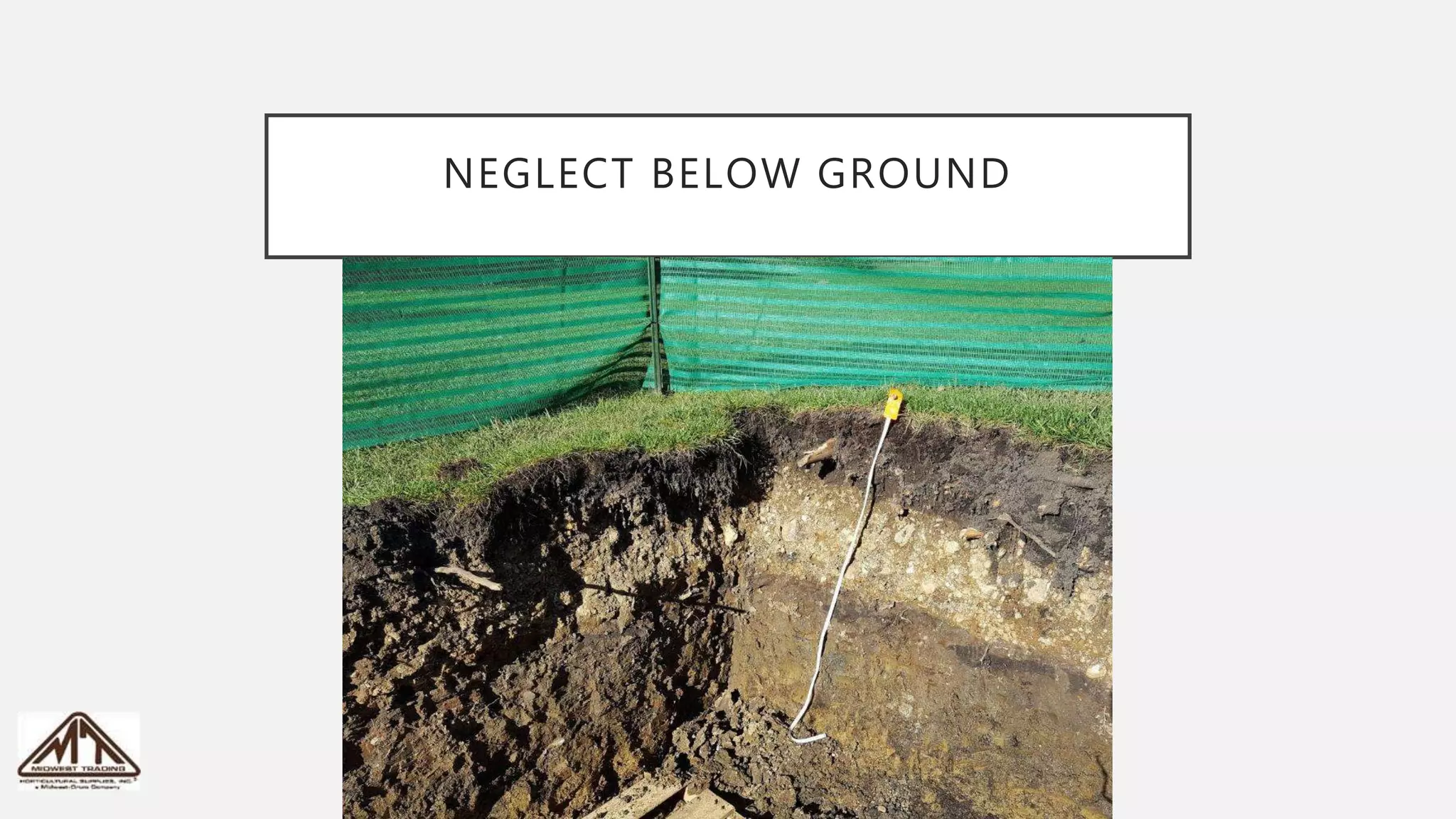
NEGLECT BELOW GROUND
SOIL STRUCTURE
Porosity
Water Holding Capacity
Plant Available Water
Hydraulic Conductivity
Can prevent bad
porosity!
SOIL STRUCTURE
• Can’t change in container
• Impacts plant available
water and hydrology
• Impacts oxygen available to
roots
• Pores made up of Macro
and Micro pores
NESTING EFFECT
Air Porosity
20
5
20
20
FINDING RESOURCES THROUGH
EXTENSION
• “mushroom compost”
• 10,300,000 results
• Sponsored product
• 9 gardening site
• 8 sales sites
• Wikipedia,
• 1 extension site
• “mushroom compost
extension”
• 1,740,000 results
• 16 extension results
• 4 gardening related sites
• www.e-gro.org
ANNUALS
ANNUALS
• Container production
• Peat based mixes
• 45-65 peat
• 20-40 bark
• Perlite or PBH
• Small containers, short crop times
• Landscape
• Loose soils needed for fine root
system
• May need fertilizer or amendment
annually
TREES
Acer griseum
Mature tree transpant
on U of I Campus
TREES
• Container production ~ 2
year before shift up
• Root architecture crucial
• Consider pot in pot or
specialized containers
• http://hort.ufl.edu/woody/
• Ed Gilman
PERENNIALS AND SHRUBS
PERENNIAL AND SHRUBS
• Growing
• Quart size to 5+ gallon
container
• 12 weeks to 2 years in a
containers
• Shifting up
• Landscape
• Tilling in amendments not
advised.
• Amending/mulching around
plants or in fall over open
ground
CHOOSING A SUBSTRATE
• Irrigation method
• Fertilizer strategy
• Crop time
• How many mixes can you
justify
• Goals
• Logistics
• Cost
• Consistency!
NURSERY CONTAINER MIXES
• Typical 1- 5 gallon mix
• 50-80 bark either coarse or fine
• 10-40 peat
• Compost 5-20%
PINE BARK
• Builds Structure as an
aggregate
• Retains moisture
• Extent varies on particle size
• Low pH 4.5-5.5
• Low Buffering Capacity-easy to
change
• Slow to break down
• Typically 50%-80% in nursery
mix
CANADIAN SPHAGNUM PEAT
• Retains moisture
• Low highly buffered pH
• Different sources have
different qualities
• Typically 10-40% in nursery
mix
COMPOST
• THIS IS A PROCESS NOT A
PRODUCT
• Landscape waste or manure
based
• Mushroom Compost
• Provides water retention
• Low cost
• Provides some fertility
• Typically 5-20% in nursery
mix
OTHER COMPONENTS
• Wood Fines
• Rice Hulls
• Parboiled Rice Hulls
• Perlite
• Topsoil
• Sand
• Wood Fiber
• Calcined Clay Aggregates
• Coir
ADDITIVES
• Lime to increase pH
• Sulfates to lower pH
• Fertilizers
• Wetting agents
• Mycorrhizae
• Biochar
• Biologicals
• Water absorbing Gels
TEST YOUR PH
GET A WATER TEST
This should be done at least
yearly.
If on well water, it can change
season to season
CONTROLLED RELEASE TECHNOLOGY
• Temperature
• Active above 40 degrees
• Analysis
• Release length
• Based on 70 degrees
• Release curve
• Inclusion of micros
• Polyon (Harrells)
• Released based on diffusion
• Osmocote
• Release based on thickness of
coating
IDEAS TO CONSIDER
• Improve yield with proper
moisture
• Incorporate fertilizer vs topdress
• Try something new to see if you
can optimize growth with
different mixes
• Weed suppression with PBH
• Considering value engineering?
PARBOILED RICE HULLS (PBH)
FOR WEED SUPPRESSION
• Apply 1.5-2 inches
• Inhibits weed growth
• Topdress
• Apply with leaf blower
IN THE LANDSCAPE
ENSURING SUCCESS OF
PERENNIALS AND SHRUBS
BIGGEST ISSUES
• Soil compaction
• Poor drainage
• Low fertility
• Higher loss and more
replacement costs
AMENDMENT OPTIONS
• When in doubt add
compost!
• Match amendment to the
aesthetic
• Look at value added
amendments
• Mulches
• Hardwood bark mulch
• Pine bark mulch
• Leaf mulch
• Wood chip mulch
IDEAS FOR SUCCESS
• Invest in the soil to reduce
replacements
• Look at materials that are easier
to spread and handle
• Consider a mulch with compost
incorporated into it
• Bagged products can increase
efficiency and cost accounting for
job
SAVE THROUGH ONE STEP
THANK YOU
KEVIN DONNELLY CH
HORTICULTURAL SOIL SCIENTIST
MIDWEST TRADING

Root zone management

  • 1.
    ROOT ZONE MANAGEMENT SoilAmendments and Substrates From Plug to Planting Kevin Donnelly CH Horticultural Soil Scientist
  • 2.
    ROOT ZONE MANAGEMENT DISUCSSIONOF SOME BACKGROUND CONTAINER SUBSTRATES TRANSITION INTO LANDSCAPE
  • 3.
    WHAT DO WEDO AS AN INDUSTRY  Provide attractive landscapes  Improve property value  Ecosystem services
  • 4.
    WHAT ARE ECOSYSTEM SERVICES Support Biological diversity Nutrientcycling Habitat creation Regulat e Climate Erosion control Air purifying Water filtration Cultural Aesthetic beauty Wellbeing Property value Provisio n Energy Food
  • 5.
  • 6.
  • 7.
    SOIL STRUCTURE Porosity Water HoldingCapacity Plant Available Water Hydraulic Conductivity Can prevent bad porosity!
  • 8.
    SOIL STRUCTURE • Can’tchange in container • Impacts plant available water and hydrology • Impacts oxygen available to roots • Pores made up of Macro and Micro pores
  • 9.
  • 10.
    FINDING RESOURCES THROUGH EXTENSION •“mushroom compost” • 10,300,000 results • Sponsored product • 9 gardening site • 8 sales sites • Wikipedia, • 1 extension site • “mushroom compost extension” • 1,740,000 results • 16 extension results • 4 gardening related sites • www.e-gro.org
  • 11.
  • 12.
    ANNUALS • Container production •Peat based mixes • 45-65 peat • 20-40 bark • Perlite or PBH • Small containers, short crop times • Landscape • Loose soils needed for fine root system • May need fertilizer or amendment annually
  • 13.
    TREES Acer griseum Mature treetranspant on U of I Campus
  • 14.
    TREES • Container production~ 2 year before shift up • Root architecture crucial • Consider pot in pot or specialized containers • http://hort.ufl.edu/woody/ • Ed Gilman
  • 15.
  • 16.
    PERENNIAL AND SHRUBS •Growing • Quart size to 5+ gallon container • 12 weeks to 2 years in a containers • Shifting up • Landscape • Tilling in amendments not advised. • Amending/mulching around plants or in fall over open ground
  • 17.
    CHOOSING A SUBSTRATE •Irrigation method • Fertilizer strategy • Crop time • How many mixes can you justify • Goals • Logistics • Cost • Consistency!
  • 18.
    NURSERY CONTAINER MIXES •Typical 1- 5 gallon mix • 50-80 bark either coarse or fine • 10-40 peat • Compost 5-20%
  • 19.
    PINE BARK • BuildsStructure as an aggregate • Retains moisture • Extent varies on particle size • Low pH 4.5-5.5 • Low Buffering Capacity-easy to change • Slow to break down • Typically 50%-80% in nursery mix
  • 20.
    CANADIAN SPHAGNUM PEAT •Retains moisture • Low highly buffered pH • Different sources have different qualities • Typically 10-40% in nursery mix
  • 21.
    COMPOST • THIS ISA PROCESS NOT A PRODUCT • Landscape waste or manure based • Mushroom Compost • Provides water retention • Low cost • Provides some fertility • Typically 5-20% in nursery mix
  • 22.
    OTHER COMPONENTS • WoodFines • Rice Hulls • Parboiled Rice Hulls • Perlite • Topsoil • Sand • Wood Fiber • Calcined Clay Aggregates • Coir
  • 24.
    ADDITIVES • Lime toincrease pH • Sulfates to lower pH • Fertilizers • Wetting agents • Mycorrhizae • Biochar • Biologicals • Water absorbing Gels
  • 25.
  • 26.
    GET A WATERTEST This should be done at least yearly. If on well water, it can change season to season
  • 27.
    CONTROLLED RELEASE TECHNOLOGY •Temperature • Active above 40 degrees • Analysis • Release length • Based on 70 degrees • Release curve • Inclusion of micros • Polyon (Harrells) • Released based on diffusion • Osmocote • Release based on thickness of coating
  • 28.
    IDEAS TO CONSIDER •Improve yield with proper moisture • Incorporate fertilizer vs topdress • Try something new to see if you can optimize growth with different mixes • Weed suppression with PBH • Considering value engineering?
  • 29.
    PARBOILED RICE HULLS(PBH) FOR WEED SUPPRESSION • Apply 1.5-2 inches • Inhibits weed growth • Topdress • Apply with leaf blower
  • 30.
    IN THE LANDSCAPE ENSURINGSUCCESS OF PERENNIALS AND SHRUBS
  • 31.
    BIGGEST ISSUES • Soilcompaction • Poor drainage • Low fertility • Higher loss and more replacement costs
  • 32.
    AMENDMENT OPTIONS • Whenin doubt add compost! • Match amendment to the aesthetic • Look at value added amendments • Mulches • Hardwood bark mulch • Pine bark mulch • Leaf mulch • Wood chip mulch
  • 33.
    IDEAS FOR SUCCESS •Invest in the soil to reduce replacements • Look at materials that are easier to spread and handle • Consider a mulch with compost incorporated into it • Bagged products can increase efficiency and cost accounting for job
  • 34.
  • 35.
    THANK YOU KEVIN DONNELLYCH HORTICULTURAL SOIL SCIENTIST MIDWEST TRADING

Editor's Notes

  • #2 -welcome -Kevin Donnelly, hort soils scientist -
  • #3 Based out of Virgil and supply soils, mulches compost, mixes etc Here is what we will discuss today:
  • #4 On the ornamental, most of the plants we grow end up in a landscape. This provides pretty things for people to look at, can certainly improve property values but also have some other benefits that can be outlined through ecosystem services
  • #5 This is a way of relating the ecosystem to our every day lives. There are dollar values you can place on some of these and can demonstrate for instance that urban forests are providing hundreds of millions of dollars in services. This can be in relationship to forests and rives etc, but for landscapes There are 4 catagories: Support Regulate Cultural provision
  • #6 Now the end user and often the many in the industry spend a lot of time focusing on what is above the ground. As they should. It is what we see, what the consumer sees and provides a lot of benefit. But I am a dirt guy, so my job is to also stress the importance of what is below
  • #7 This is an example of what is called lithologic discontinuity. We were at a soils conference last year at Morton and got to see a hill top site that had really poor drainage, stayed wet and trees had trouble. The reason is it was a renovated site that used to be a parking lot. Trouble was the contractor didn’t bother to rip out the base grade of gravel. The water had no where to go. Roots won’t grow in anthing but the first 6-8 inches of topsoil. You see soil and substrate structure is critical because
  • #8 Chemical characteristics like pH, salinity, fertility can all be altered, for the most part on the site. The physical properties like porosity, water holding capacity,
  • #9 lShow illustration of soil aggregate sizes in container Talk about PSD Focus on container Can’t physically alter Proper moisture content Nesting effect
  • #10 Soil Compaction in containers can alter the air porosity and therefore the performance and consistency of crops
  • #11 We work in the realm of the countries most popular hobby. Gardening. As such there are a lot of opinions. So when
  • #12 Need image of annuals planting bed, greenhouse mix, greenhouse plants Just picture of annual planting
  • #14 *need image of tree maybe roots etc.*
  • #18 Irrigation Talk about water distribution Fert liquid or CRF Crop time Logistics like # mixes Weight Cost Goals- show fast drain to slow drain
  • #24 Talk about difference between can we do it and what do you want
  • #25 For chemical additives there are a lot of options: Lime will increase pH Often you can balance that with with dolomitica and hicalcium lime The gradation maters based on how fast it will react and for how long There are different sulfur products that will both provide nutrition and lower pH. Iron sulfate, aluminum sulfate, elemental sulfur Fertilizers take many forms. Water soluble for quicker availability, something like ureaform which is a 38-0-0 that breaks down based on microbial activity Controlled release fertilizers have at polymer coating which I’ll touch on in a minute Wetting agents are surfactants that break the surface tension of water and help products like peat and pie absorb water and rewet if dry Mycorrhizae: There has been a lot in the market in recent years on mycorrhizae. There are two main kinds, endo and ecto. Different species have evolved to do different things. Some will enhance water uptake and act as and extended root network, other benefits include phosphorus uptake. There are some areas I think there can be some effect, but it far from universal. The one question in my mind that needs to be evaluated is the ROI on some of them. I don’t know the answers myself, but something we look at Biochar There are a lot of claims maid on biochar and the most important thing I can share is that the feed stock and exact methond of manufacture can drastically alters the characteristics. It will provide lots of micropores for water and nutrient retention as well as microbial organisms. Think of it as a soil coral reef. Other biologicals such as root shield which is a trichoderma, some bacillus and Streptomyces provides various mode of action, usually a general suppression to crowd out pathogens. If you choose to use any of these, just make sure to understand their longevity and Silicon This is one
  • #26 For anyone growing, it is very important to test the pH as this can be a first method of troubleshooting any issues. For those of you not familiar with this chart, basically pH impacts the availability of nutrients. For example, if you have chlorosis and your pH is high, you likely have iron deficiency, doesn’t mean there is no iron, just not available to the plant. Lower pH, fix the problem
  • #27 Aditionally a water test is of great value. You need oto understand your inputs and water is one of the most important. Look to the alkalinity as that will often cause your pH to drift. Depending on your source, you could have an abundance or lack of micronutrients that will inform you fertilizer choices. Keep in mind that this is not a static number. If the alkalinity is high you may find it necessary to neutralize with an acid. This is done more in greenhouse production than nursery
  • #28 Looking specifically at CRF There are polymer coated Osmocote for instance has different thicknesses of coating and at temps above 45 will absorb water, swell then burst releasing the fertilizer Another technology is polyon wherer and solution difuse through the membrane, so the prills will shrivel up over time The price and analysis depending on the base fertilizers, urea I believe is a cheaper form of N compared to say calcium nitrate. Release rate
  • #29 Yield- discuss not cramming in, need mix that will hold structure CRF instead of topdress Mix design, we are at point on what do you want it to do Understand plant available water to reduce losses through over or underwatering
  • #31 So moving into the landscape. Once you take the time to grow strong healthy plants, you want them to thrive.
  • #32 Often urban sites start off as compacted clays with poor drainage. Look at this newly prepped area. You can see how smooth it is and the tracks on the ground. This particular site had a new planting soil added on top with a nice boarder that turned the area into a bathtub.
  • #33 There are a lot of options: Texture Compatibility with plants
  • #34 Have ready to use material instead of dealing with unknown Less cleanup Quicker out of the yard