Focus
May 2019
rollits.com
Private Client
2 Private Client Focus May 2019
Meet the team
Our specialist Private Capital Team is based across both offices in Hull and
York. The team is headed by John Lane and comprises highly experienced
lawyers offering a wide range of private client services. Our expert lawyers can
provide sound independent legal advice in areas such as wills, tax planning,
trust creation and lasting powers of attorney. In addition, we have extensive
experience of dealing with landed estates.
The team is also a campaign supporter of
Remember a Charity; a consortium made
up of 200 UK charities who are working
together to raise awareness about
charitable giving in Wills.
All lawyers are members of the Society
of Trust and Estate Practitioners (STEP)
with John Lane, Sue Brad, Sarah Adams
and Andy Cook being qualified Trust
and Estate Practitioners (TEPs). STEP
is a global professional association
for practitioners specialising in family
inheritance and succession planning.
Emma Fawke is a student members of
STEP and is currently undertaking her
diploma in Trusts and Estates. She has
also recently become full accredited
member of Solicitors For the Elderly, an
organisation providing specialist training
in relation to working with older and
vulnerable clients.
May 2019 Private Client Focus 3
4 Private Client Focus May 2019
The OPG has a duty to investigate
concerns and can help if there is a
registered Lasting Power of Attorney or
Enduring Power of Attorney in place.
The OPG has reported that concerns are
usually raised as part of a family dispute,
and although there is no evidence of
abuse in most of these cases, family
disputes do sometimes mean that not all
decisions are being made in the donor’s
best interests.
The OPG is running a pilot scheme until
summer to test whether a mediation
service could help to protect a donor
in this kind of situation. It believes that
there may be benefits to offering a
mediation service to ensure issues are
addressed in the best interests of the
vulnerable person.
It is important to consider potential
disputes before completing Lasting
Powers of Attorney, and the suitability
of your chosen attorneys. Before
completing such documents we would
recommend seeking legal advice. In
addition, if you have any concerns over
an attorney’s actions, then you should
make contact with a solicitor or contact
the OPG directly.
Sarah Adams
There has been recent news that investigations into Lasting Powers
of Attorneys are on the rise; both private client solicitors and
the Office of the Public Guardian (OPG) are being contacted by
individuals who have concerns about how an attorney or deputy is
managing someone else’s money.
Lasting Powers
of Attorney
OPG runs pilot scheme
on mediation service
May 2019 Private Client Focus 5
This article explores the legal implications
of separated parents taking children on
holiday abroad and practical steps that
can be take so as minimise the potential
for dispute.
Is the permission of both
parents needed?
This depends on whether orders have
been made under Children Act 1989.
Where there are no court orders in place,
neither parent can take the child out of
the United Kingdom without the written
consent of the other parent, assuming
that they have parental responsibility.
A mother will automatically acquire
parental responsibility following the birth
of a child. The other parent will acquire
parental responsibility by being named
on the child’s birth certificate, married
to the child’s mother or through other
ways such as obtaining a court order or
entering into a Parental Responsibility
Agreement with the child’s mother. It
is advisable to ensure that consent is
obtained in writing, rather than just
verbally. There can be issues at airport
check-ins where children with different
surnames to their parents have been
stopped and written consent of the other
parent has been requested by border
control officials.
In the event that arrangements cannot
be agreed, the parent wanting to go on
holiday with the child will need to apply
to the Family Court for permission and
request a Specific Issue Order. The court
will have to decide what is in the best
interests of the child. It is unlikely that the
court would refuse a week in Majorca,
but there may be issues if there are
serious concerns that the child may not
be returned, especially if the destination
country is not part of the Hague
Convention which seeks to protect
children from the harmful effects of
international abduction by encouraging a
prompt return to the country where they
regularly live.
If one parent has a Child Arrangement
(Live with) Order (previously known as
a Residence Order) in place, this allows
them to take their child abroad for a
period of one month and does not
require the consent of the other parent.
In the event that only the child’s mother
holds parental responsibility, the consent
of the other parent is not required.
However, the other parent, if they object
may apply to the Family Court for a
Parental Responsibility Order and seek
a temporary order suspending planned
trip, known as a Prohibited Steps Order.
It is often good practice, in any event
to speak to the other parent about any
future plans.
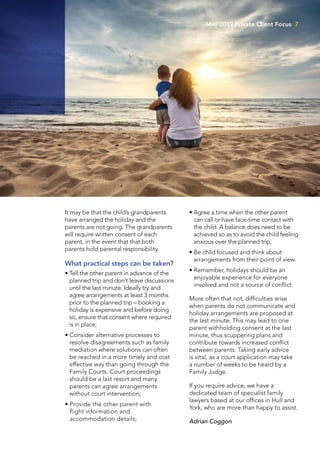
Making holiday arrangements for children when parents are
separated is not always a straightforward experience. It should be
a time to look forward to, but can often be a source of conflict,
especially when one parent wants to go abroad.
6 Private Client Focus May 2019
Sun, sand and a whole
heap of disagreement…
It may be that the child’s grandparents
have arranged the holiday and the
parents are not going. The grandparents
will require written consent of each
parent, in the event that that both
parents hold parental responsibility.
What practical steps can be taken?
• Tell the other parent in advance of the
planned trip and don’t leave discussions
until the last minute. Ideally try and
agree arrangements at least 3 months
prior to the planned trip – booking a
holiday is expensive and before doing
so, ensure that consent where required
is in place;
• Consider alternative processes to
resolve disagreements such as family
mediation where solutions can often
be reached in a more timely and cost
effective way than going through the
Family Courts. Court proceedings
should be a last resort and many
parents can agree arrangements
without court intervention;
• Provide the other parent with
flight information and
accommodation details;
• Agree a time when the other parent
can call or have face-time contact with
the child. A balance does need to be
achieved so as to avoid the child feeling
anxious over the planned trip;
• Be child focused and think about
arrangements from their point of view.
• Remember, holidays should be an
enjoyable experience for everyone
involved and not a source of conflict.
More often that not, difficulties arise
when parents do not communicate and
holiday arrangements are proposed at
the last minute. This may lead to one
parent withholding consent at the last
minute, thus scuppering plans and
contribute towards increased conflict
between parents. Taking early advice
is vital, as a court application may take
a number of weeks to be heard by a
Family Judge.
If you require advice, we have a
dedicated team of specialist family
lawyers based at our offices in Hull and
York, who are more than happy to assist.
Adrian Coggon
May 2019 Private Client Focus 7
When someone passes away, an
application for a Grant of Probate is
usually needed for executors to gain
legal authority to deal with assets in the
deceased’s estate. The executors have
to pay a fee before a Grant of Probate
can be issued and before they will have
access to the assets in the estate.
The current fee is £155 on all estates in
excess of £5,000 if applied for through
a solicitor, or £215 if applied for by the
executors themselves. The new system
will see the cost of a Grant of Probate
application linked to a banded pricing
structure where the fee will increase
based on the value of the deceased’s
estate; the effect of this is set out below.
Clearly this will be a huge increase in
costs for higher value estates.
Any probate applications submitted
prior to the fee increase should only
incur the current lower fees. It is unclear
at the moment when the fee increase
will come into effect. Therefore, if you
are currently in the position of applying
for probate you should submit your
applications as soon as possible to
hopefully avoid incurring, in most cases,
much higher costs.
Our Private Capital team at Rollits would
be happy to assist you with this process
at what can be a difficult time for many
people acting as executors.
Lucy Trynka
8 Private Client Focus May 2019
Probate fees
The Government has recently put forward controversial plans to
increase application fees for a Grant of Probate. Despite much
opposition, a draft order is currently being considered and it is
highly likely that this new fee structure will be implemented in
the near future.
Value of estate New fee
Up to £50,000 £0
£50,000 to £300,000 £250
£300,000 to £500,000 £750
£500,000 to £1 million £2,500
£1 million to £1.6 million £4,000
£1.6 million to £2 million £5,000
Over £2 million £6,000
1. Be realistic about your budget
Before you start looking at properties
and fall in love with your dream home,
sit down and work out what you can
really afford. Don’t just look at your
maximum borrowing capacity according
to an online calculator. It makes sense
to sit down with a mortgage advisor
who can help you work out what is really
affordable for your lifestyle and can
consider your long term future plans,
such as whether you intend to live in the
property forever or if you wish to move
on in a couple of years, which may affect
the most suitable mortgage product
for you. Make sure that you budget for
all of the costs associated with moving
house in particular Stamp Duty Land
Tax – unless the property you are buying
is under £125,000.00 or you are a first
time buyer where no SDLT is payable
on properties worth up to £300,000.00.
Make sure you also budget for legal fees
and moving costs.
Continues on next page…
May 2019 Private Client Focus 9
Buying a house?
Read our essential guide
Buying a house together is an exciting time but without the right
advice it can be a complex and stressful process. Having helped
purchasers for generations our residential property team share
their top tips below:
2. Beware of hidden charges
When you do start to look for properties
make sure you get information in respect
of any ongoing costs in relation to the
property. Leasehold properties, as well
as a yearly ground rent, will usually have
annual service charges that relates to
management fees and things like the
costs of maintaining communal areas.
This is usually a variable amount and
the costs will often increase overtime.
Many new freehold developments also
have such charges, for example for
maintaining a communal grassed area.
Some properties may be located on a
private road that is not maintained by
the council and residents are required to
contribute to the upkeep of that. Make
sure you aware of these costs before you
make the decision to buy.
Make sure you check what council tax
band the property is in and what the
monthly cost of that will be and factor
that into your monthly outgoings. Also,
make sure that you fully understand the
legal costs you have been quoted by your
conveyancer. Conveyancing solicitors will
charge an amount for their fees for the
work that they undertake on your behalf,
on top of which VAT will be payable in
addition. As well as the conveyancer’s
fees there will be disbursements. These
are sums paid by your conveyancer to a
third party such as for search fees or Land
Registry fees. Certain disbursements
will be payable in any conveyancing
transaction but others may not and can
include, in reality, additional fees being
charged by the conveyancing company
to try and keep their overall quote in
respect of legal fees artificially low.
3. Make sure you know what you
are buying
Your conveyancer will obtain a copy
of the legal title to the property which
will include a title plan. This is usually
registered with the Land Registry as the
majority of homes are now registered
land, although there are still some
exceptions to this. The title plan will show
the full outline of the property that you
are buying – the boundary will usually be
marked in red. Make sure that you check
this against your understanding of the
extent of the property as described to
you by the estate agent and from your
own physical viewing of the property.
It can be really helpful to instruct a local
solicitor who is familiar with the area and
so will understand if something doesn’t
look right. They are more likely to know
about plans for development in the
region that might affect the property you
are intending to purchase, for example
plans for a housing estate on the field
behind the house. Local knowledge
and familiarity with the local planning
authority goes a long way.
4. Be clear about your intentions
If you are buying a property together
as a couple or with a friend or a family
member, is one of you going to be
contributing more to the deposit than
the other? If so would you intend the
differing contributions to be reflected
when the property is sold at a later date,
or is it your intention that everything
should be shared equally?
When you buy a property together the
legal title can be in your joint names
or one of your names only. However,
the legal title is only one side of the
story. The true value of your share in
the property is known as your beneficial
interest. You will be asked by your
conveyancing solicitor whether you
wish to hold your beneficial interest in
the property as joint tenants or tenants
in common. With a joint tenancy you
can only ever have equal beneficial
interests and the right of survivorship
Buying a house? Read our essential guide (continued)
10 Private Client Focus May 2019
applies which means that your interest
in the property will automatically pass
to the other person on your death, and
vice versa, no matter what any Will you
have prepared says. With a tenancy in
common you can hold your beneficial
interest in any share that you choose,
for example 75%/25%, and your interest
will pass in accordance with your Will
or under the rules of intestacy if you do
not have a Will prepared. Without a Will
under the rules of intestacy a cohabiting
partner does not automatically inherit
your estate and they would be reliant on
making a claim to the court which can be
a difficult thing to contemplate at such
a time. Therefore if one of you is making
a bigger financial contribution you
might want to protect that by giving that
person a larger percentage interest in
the property and you do this by entering
into a Declaration of Trust.
As it is becoming harder and harder to
get on the property ladder many couples
buying their first home will fund all or
some of their deposit with help from “the
bank of Mum and Dad”. It is important
to be clear from the outset whether any
such contribution is intended to be a
gift to both of you, one of you, a loan or
something else, again by entering into a
Declaration of Trust.
Be careful though as if you intend to get
married or enter a civil partnership then
you need to be aware that the court
can make orders that would effectively
override the Declaration of Trust. In that
situation you might want to think about
having a Marital Agreement, also known
as a Pre-Nuptial Agreement, prepared. If
you remain unmarried but have children
Continues on next page…
May 2019 Private Client Focus 11
together the court can also be asked
to make orders for financial provision
for the benefit of children which could
impact upon your interest in the property.
It is therefore important to talk to your
conveyancing solicitor about your long
term future plans so they can ensure that
you get the right advice.
5. Get a Living Together
Agreement
If you move in together as a couple but
are not marrying then you are not alone
– cohabitation is the fastest growing
family type. Many people believe that
after you have lived together for a
certain period of time you become the
other person’s “common law spouse”,
in fact a British Attitude’s Survey at the
beginning of this year found that 46%
of the population are under the wrong
impression that a cohabiting couple form
a common law marriage. The reality is
that cohabiting couples currently have
little legal protection when they separate
and couples are reliant on inappropriate
property law remedies that can result in
some very unfair outcomes.
A Living Together Agreement, also
known as a Cohabitation Agreement,
commonly sets out what the parties
would deem to be a fair outcome in
the event of their separation, and can
go further than the strict property law
principles would allow for example,
to place a value on non-financial
contributions to the relationship or to
make provision for future maintenance.
It can also set out how you will deal with
financial matters during the relationship,
such as whether you will have a joint
account and what impact any financial
contributions either of you make for
example to improvements or repairs
is intended to have in respect of your
beneficial interest in the property (if any).
Abbie Bielby  Emma Hopkins Jones
Information
If you have any queries on any issues raised in
this newsletter, or any private client matters in
general please contact:
John Lane on 01482 337339 or email
john.lane@rollits.com
This newsletter is for general guidance only
and provides information in a concise form.
Action should not be taken without obtaining
specific advice. We hope you have found this
newsletter useful, but if you do not wish to
receive further mailings from us please write
to Pat Coyle, Rollits, Citadel House,
58 High Street, Hull HU1 1QE or email
pat.coyle@rollits.com. For details of how we
use your personal information please refer
to our Privacy Policy by writing to the same
address or accessing our website at rollits.com
The law is stated as at 5 April 2019.
Hull Office
Citadel House, 58 High Street,
Hull HU1 1QE
Tel +44 (0)1482 323239
York Office
Forsyth House, Alpha Court,
Monks Cross, York YO32 9WN
Tel +44 (0)1904 625790
rollits.com
Authorised and Regulated by the Solicitors Regulation
Authority under number 524629
Rollits is a trading name of Rollits LLP. Rollits LLP is
a limited liability partnership, registered in England
and Wales, registered number OC 348965, registered
office Citadel House, 58 High Street, Hull HU1 1QE
A list of members’ names is available for inspection
at our offices. We use the term ‘partner’ to denote
members of Rollits LLP.
12 Private Client Focus May 2019
Buying a house? Read our essential guide (continued)

Rollits Private Client newsletter - May 2019

  • 1.
  • 2.
    2 Private ClientFocus May 2019 Meet the team Our specialist Private Capital Team is based across both offices in Hull and York. The team is headed by John Lane and comprises highly experienced lawyers offering a wide range of private client services. Our expert lawyers can provide sound independent legal advice in areas such as wills, tax planning, trust creation and lasting powers of attorney. In addition, we have extensive experience of dealing with landed estates.
  • 3.
    The team isalso a campaign supporter of Remember a Charity; a consortium made up of 200 UK charities who are working together to raise awareness about charitable giving in Wills. All lawyers are members of the Society of Trust and Estate Practitioners (STEP) with John Lane, Sue Brad, Sarah Adams and Andy Cook being qualified Trust and Estate Practitioners (TEPs). STEP is a global professional association for practitioners specialising in family inheritance and succession planning. Emma Fawke is a student members of STEP and is currently undertaking her diploma in Trusts and Estates. She has also recently become full accredited member of Solicitors For the Elderly, an organisation providing specialist training in relation to working with older and vulnerable clients. May 2019 Private Client Focus 3
  • 4.
    4 Private ClientFocus May 2019
  • 5.
    The OPG hasa duty to investigate concerns and can help if there is a registered Lasting Power of Attorney or Enduring Power of Attorney in place. The OPG has reported that concerns are usually raised as part of a family dispute, and although there is no evidence of abuse in most of these cases, family disputes do sometimes mean that not all decisions are being made in the donor’s best interests. The OPG is running a pilot scheme until summer to test whether a mediation service could help to protect a donor in this kind of situation. It believes that there may be benefits to offering a mediation service to ensure issues are addressed in the best interests of the vulnerable person. It is important to consider potential disputes before completing Lasting Powers of Attorney, and the suitability of your chosen attorneys. Before completing such documents we would recommend seeking legal advice. In addition, if you have any concerns over an attorney’s actions, then you should make contact with a solicitor or contact the OPG directly. Sarah Adams There has been recent news that investigations into Lasting Powers of Attorneys are on the rise; both private client solicitors and the Office of the Public Guardian (OPG) are being contacted by individuals who have concerns about how an attorney or deputy is managing someone else’s money. Lasting Powers of Attorney OPG runs pilot scheme on mediation service May 2019 Private Client Focus 5
  • 6.
    This article exploresthe legal implications of separated parents taking children on holiday abroad and practical steps that can be take so as minimise the potential for dispute. Is the permission of both parents needed? This depends on whether orders have been made under Children Act 1989. Where there are no court orders in place, neither parent can take the child out of the United Kingdom without the written consent of the other parent, assuming that they have parental responsibility. A mother will automatically acquire parental responsibility following the birth of a child. The other parent will acquire parental responsibility by being named on the child’s birth certificate, married to the child’s mother or through other ways such as obtaining a court order or entering into a Parental Responsibility Agreement with the child’s mother. It is advisable to ensure that consent is obtained in writing, rather than just verbally. There can be issues at airport check-ins where children with different surnames to their parents have been stopped and written consent of the other parent has been requested by border control officials. In the event that arrangements cannot be agreed, the parent wanting to go on holiday with the child will need to apply to the Family Court for permission and request a Specific Issue Order. The court will have to decide what is in the best interests of the child. It is unlikely that the court would refuse a week in Majorca, but there may be issues if there are serious concerns that the child may not be returned, especially if the destination country is not part of the Hague Convention which seeks to protect children from the harmful effects of international abduction by encouraging a prompt return to the country where they regularly live. If one parent has a Child Arrangement (Live with) Order (previously known as a Residence Order) in place, this allows them to take their child abroad for a period of one month and does not require the consent of the other parent. In the event that only the child’s mother holds parental responsibility, the consent of the other parent is not required. However, the other parent, if they object may apply to the Family Court for a Parental Responsibility Order and seek a temporary order suspending planned trip, known as a Prohibited Steps Order. It is often good practice, in any event to speak to the other parent about any future plans. Making holiday arrangements for children when parents are separated is not always a straightforward experience. It should be a time to look forward to, but can often be a source of conflict, especially when one parent wants to go abroad. 6 Private Client Focus May 2019 Sun, sand and a whole heap of disagreement…
  • 7.
    It may bethat the child’s grandparents have arranged the holiday and the parents are not going. The grandparents will require written consent of each parent, in the event that that both parents hold parental responsibility. What practical steps can be taken? • Tell the other parent in advance of the planned trip and don’t leave discussions until the last minute. Ideally try and agree arrangements at least 3 months prior to the planned trip – booking a holiday is expensive and before doing so, ensure that consent where required is in place; • Consider alternative processes to resolve disagreements such as family mediation where solutions can often be reached in a more timely and cost effective way than going through the Family Courts. Court proceedings should be a last resort and many parents can agree arrangements without court intervention; • Provide the other parent with flight information and accommodation details; • Agree a time when the other parent can call or have face-time contact with the child. A balance does need to be achieved so as to avoid the child feeling anxious over the planned trip; • Be child focused and think about arrangements from their point of view. • Remember, holidays should be an enjoyable experience for everyone involved and not a source of conflict. More often that not, difficulties arise when parents do not communicate and holiday arrangements are proposed at the last minute. This may lead to one parent withholding consent at the last minute, thus scuppering plans and contribute towards increased conflict between parents. Taking early advice is vital, as a court application may take a number of weeks to be heard by a Family Judge. If you require advice, we have a dedicated team of specialist family lawyers based at our offices in Hull and York, who are more than happy to assist. Adrian Coggon May 2019 Private Client Focus 7
  • 8.
    When someone passesaway, an application for a Grant of Probate is usually needed for executors to gain legal authority to deal with assets in the deceased’s estate. The executors have to pay a fee before a Grant of Probate can be issued and before they will have access to the assets in the estate. The current fee is £155 on all estates in excess of £5,000 if applied for through a solicitor, or £215 if applied for by the executors themselves. The new system will see the cost of a Grant of Probate application linked to a banded pricing structure where the fee will increase based on the value of the deceased’s estate; the effect of this is set out below. Clearly this will be a huge increase in costs for higher value estates. Any probate applications submitted prior to the fee increase should only incur the current lower fees. It is unclear at the moment when the fee increase will come into effect. Therefore, if you are currently in the position of applying for probate you should submit your applications as soon as possible to hopefully avoid incurring, in most cases, much higher costs. Our Private Capital team at Rollits would be happy to assist you with this process at what can be a difficult time for many people acting as executors. Lucy Trynka 8 Private Client Focus May 2019 Probate fees The Government has recently put forward controversial plans to increase application fees for a Grant of Probate. Despite much opposition, a draft order is currently being considered and it is highly likely that this new fee structure will be implemented in the near future. Value of estate New fee Up to £50,000 £0 £50,000 to £300,000 £250 £300,000 to £500,000 £750 £500,000 to £1 million £2,500 £1 million to £1.6 million £4,000 £1.6 million to £2 million £5,000 Over £2 million £6,000
  • 9.
    1. Be realisticabout your budget Before you start looking at properties and fall in love with your dream home, sit down and work out what you can really afford. Don’t just look at your maximum borrowing capacity according to an online calculator. It makes sense to sit down with a mortgage advisor who can help you work out what is really affordable for your lifestyle and can consider your long term future plans, such as whether you intend to live in the property forever or if you wish to move on in a couple of years, which may affect the most suitable mortgage product for you. Make sure that you budget for all of the costs associated with moving house in particular Stamp Duty Land Tax – unless the property you are buying is under £125,000.00 or you are a first time buyer where no SDLT is payable on properties worth up to £300,000.00. Make sure you also budget for legal fees and moving costs. Continues on next page… May 2019 Private Client Focus 9 Buying a house? Read our essential guide Buying a house together is an exciting time but without the right advice it can be a complex and stressful process. Having helped purchasers for generations our residential property team share their top tips below:
  • 10.
    2. Beware ofhidden charges When you do start to look for properties make sure you get information in respect of any ongoing costs in relation to the property. Leasehold properties, as well as a yearly ground rent, will usually have annual service charges that relates to management fees and things like the costs of maintaining communal areas. This is usually a variable amount and the costs will often increase overtime. Many new freehold developments also have such charges, for example for maintaining a communal grassed area. Some properties may be located on a private road that is not maintained by the council and residents are required to contribute to the upkeep of that. Make sure you aware of these costs before you make the decision to buy. Make sure you check what council tax band the property is in and what the monthly cost of that will be and factor that into your monthly outgoings. Also, make sure that you fully understand the legal costs you have been quoted by your conveyancer. Conveyancing solicitors will charge an amount for their fees for the work that they undertake on your behalf, on top of which VAT will be payable in addition. As well as the conveyancer’s fees there will be disbursements. These are sums paid by your conveyancer to a third party such as for search fees or Land Registry fees. Certain disbursements will be payable in any conveyancing transaction but others may not and can include, in reality, additional fees being charged by the conveyancing company to try and keep their overall quote in respect of legal fees artificially low. 3. Make sure you know what you are buying Your conveyancer will obtain a copy of the legal title to the property which will include a title plan. This is usually registered with the Land Registry as the majority of homes are now registered land, although there are still some exceptions to this. The title plan will show the full outline of the property that you are buying – the boundary will usually be marked in red. Make sure that you check this against your understanding of the extent of the property as described to you by the estate agent and from your own physical viewing of the property. It can be really helpful to instruct a local solicitor who is familiar with the area and so will understand if something doesn’t look right. They are more likely to know about plans for development in the region that might affect the property you are intending to purchase, for example plans for a housing estate on the field behind the house. Local knowledge and familiarity with the local planning authority goes a long way. 4. Be clear about your intentions If you are buying a property together as a couple or with a friend or a family member, is one of you going to be contributing more to the deposit than the other? If so would you intend the differing contributions to be reflected when the property is sold at a later date, or is it your intention that everything should be shared equally? When you buy a property together the legal title can be in your joint names or one of your names only. However, the legal title is only one side of the story. The true value of your share in the property is known as your beneficial interest. You will be asked by your conveyancing solicitor whether you wish to hold your beneficial interest in the property as joint tenants or tenants in common. With a joint tenancy you can only ever have equal beneficial interests and the right of survivorship Buying a house? Read our essential guide (continued) 10 Private Client Focus May 2019
  • 11.
    applies which meansthat your interest in the property will automatically pass to the other person on your death, and vice versa, no matter what any Will you have prepared says. With a tenancy in common you can hold your beneficial interest in any share that you choose, for example 75%/25%, and your interest will pass in accordance with your Will or under the rules of intestacy if you do not have a Will prepared. Without a Will under the rules of intestacy a cohabiting partner does not automatically inherit your estate and they would be reliant on making a claim to the court which can be a difficult thing to contemplate at such a time. Therefore if one of you is making a bigger financial contribution you might want to protect that by giving that person a larger percentage interest in the property and you do this by entering into a Declaration of Trust. As it is becoming harder and harder to get on the property ladder many couples buying their first home will fund all or some of their deposit with help from “the bank of Mum and Dad”. It is important to be clear from the outset whether any such contribution is intended to be a gift to both of you, one of you, a loan or something else, again by entering into a Declaration of Trust. Be careful though as if you intend to get married or enter a civil partnership then you need to be aware that the court can make orders that would effectively override the Declaration of Trust. In that situation you might want to think about having a Marital Agreement, also known as a Pre-Nuptial Agreement, prepared. If you remain unmarried but have children Continues on next page… May 2019 Private Client Focus 11
  • 12.
    together the courtcan also be asked to make orders for financial provision for the benefit of children which could impact upon your interest in the property. It is therefore important to talk to your conveyancing solicitor about your long term future plans so they can ensure that you get the right advice. 5. Get a Living Together Agreement If you move in together as a couple but are not marrying then you are not alone – cohabitation is the fastest growing family type. Many people believe that after you have lived together for a certain period of time you become the other person’s “common law spouse”, in fact a British Attitude’s Survey at the beginning of this year found that 46% of the population are under the wrong impression that a cohabiting couple form a common law marriage. The reality is that cohabiting couples currently have little legal protection when they separate and couples are reliant on inappropriate property law remedies that can result in some very unfair outcomes. A Living Together Agreement, also known as a Cohabitation Agreement, commonly sets out what the parties would deem to be a fair outcome in the event of their separation, and can go further than the strict property law principles would allow for example, to place a value on non-financial contributions to the relationship or to make provision for future maintenance. It can also set out how you will deal with financial matters during the relationship, such as whether you will have a joint account and what impact any financial contributions either of you make for example to improvements or repairs is intended to have in respect of your beneficial interest in the property (if any). Abbie Bielby Emma Hopkins Jones Information If you have any queries on any issues raised in this newsletter, or any private client matters in general please contact: John Lane on 01482 337339 or email john.lane@rollits.com This newsletter is for general guidance only and provides information in a concise form. Action should not be taken without obtaining specific advice. We hope you have found this newsletter useful, but if you do not wish to receive further mailings from us please write to Pat Coyle, Rollits, Citadel House, 58 High Street, Hull HU1 1QE or email pat.coyle@rollits.com. For details of how we use your personal information please refer to our Privacy Policy by writing to the same address or accessing our website at rollits.com The law is stated as at 5 April 2019. Hull Office Citadel House, 58 High Street, Hull HU1 1QE Tel +44 (0)1482 323239 York Office Forsyth House, Alpha Court, Monks Cross, York YO32 9WN Tel +44 (0)1904 625790 rollits.com Authorised and Regulated by the Solicitors Regulation Authority under number 524629 Rollits is a trading name of Rollits LLP. Rollits LLP is a limited liability partnership, registered in England and Wales, registered number OC 348965, registered office Citadel House, 58 High Street, Hull HU1 1QE A list of members’ names is available for inspection at our offices. We use the term ‘partner’ to denote members of Rollits LLP. 12 Private Client Focus May 2019 Buying a house? Read our essential guide (continued)