Compare the role of the childin at least three of the set texts.Angel Leung 4XAnthea Wong 4YColettie Lee 4YPoonYui Sum 4U
Child - DefinitionBelow 12 years oldParent’s son / daughter
Characters involvedBoy(Birches)Rosie(Seventeen Syllables)Dee(Everyday Use)Maggie(Everyday Use)
Boy & rosieCOMPARISON
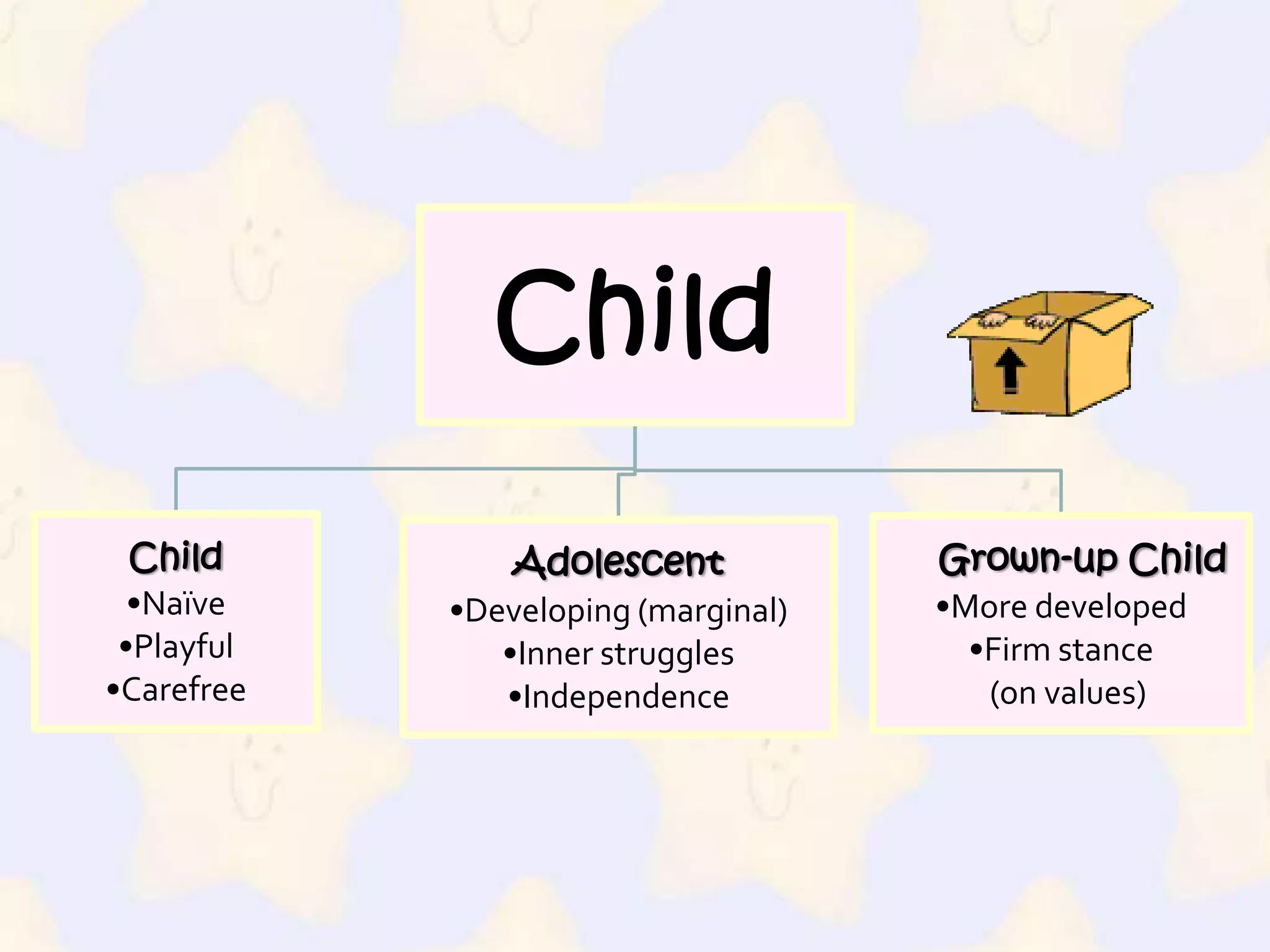
Boybending movement  escape into his imagination (upward movement) and coming back to reality (downward movement)Role as a child:allows him to have such imaginations and freedomgives a stark contrast to the role as an adultgives readers a stress-free sense towards the character given with this roleComparison (boy and Rosie)
RosieWesternized:her name “Rosie”her imitation of Shirley Templeher struggles and limitations contrast to those of her motherRosie + Tome have conflictse.g. views on getting married or notComparison (boy and Rosie)
Comparison (boy and Rosie)Role as a child (Rosie):explore matters in life such as love/infatuation and playfulnesscuriosity and playfulness as a child + her westernized mindset create conflicts in ways of looking at things between herself and her mum Tome
BOY & DEECOMPARISON
Comparison (boy and Dee)Not the subjectObject of attentionBoy:“I should prefer to have some boy bend them”(23)Dee:“a dress so loud it hurts my eyes” & “Bracelets dangling and making noises”pg. 347Dee:aggressive and proud
Comparison (boy and Dee)Freedom and LibertyBoy:imagine and conquer on birchesDee:leave countryside  town
ROSIE & MaggieCOMPARISON
Comparison (Rosie & Maggie)Level of being influenced/affected by external factorsRelationship between parents (mothers) 
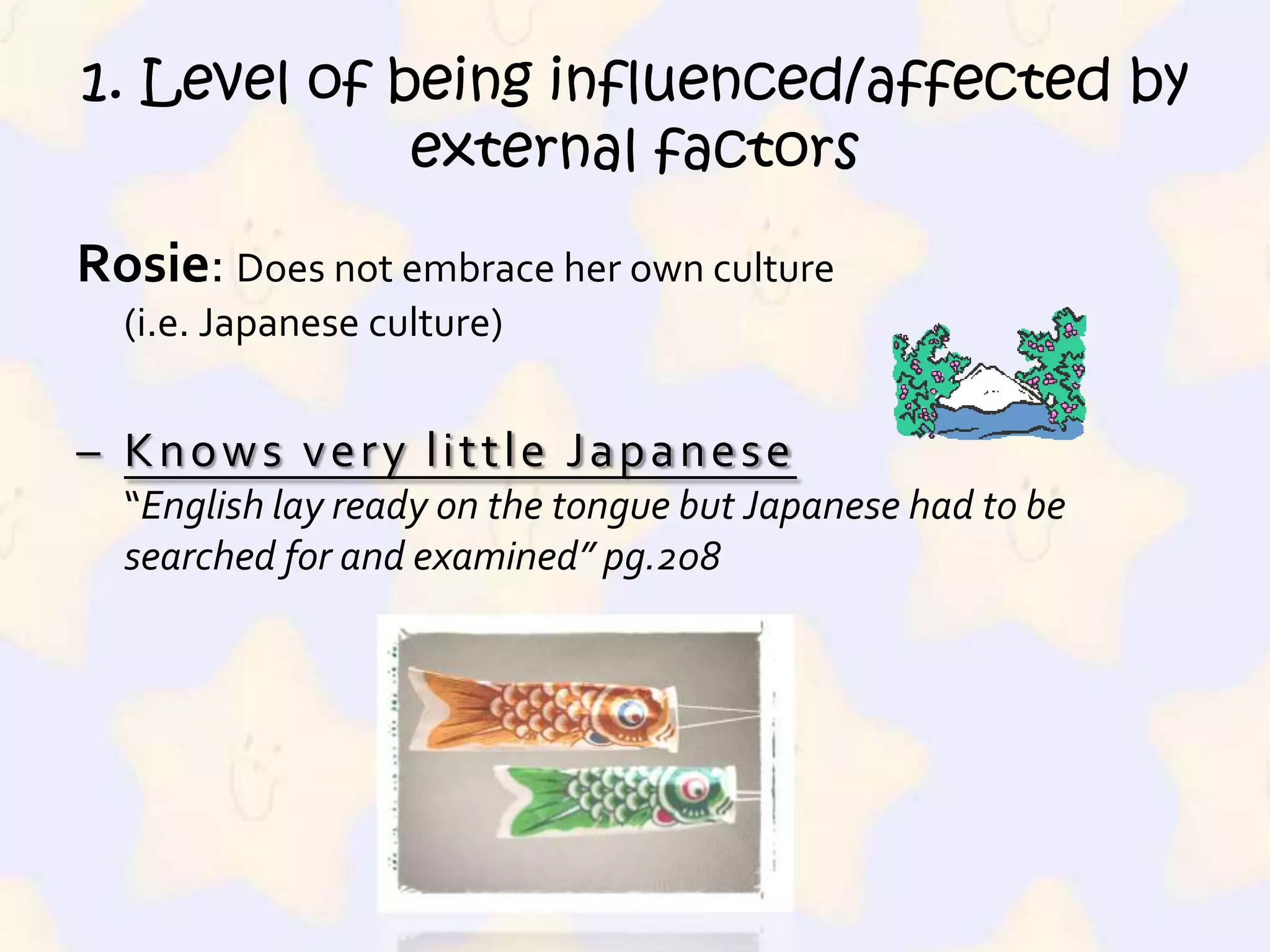
1. Level of being influenced/affected by external factorsRosie: Does not embrace her own culture (i.e. Japanese culture)Knows very little Japanese“English lay ready on the tongue but Japanese had to be searched for and examined” pg.2081. Level of being influenced/affected by external factors‘worship’s Western culture“she was the child Shirley Temple piping ‘On the Good Ship Lollipop’ ”  pg.216Source: Hatena, ecx.images-amazon.com/images/I/51MGP2BBV7L.jpg
Maggie: cherishes her own heritage although Dee does nothas profound understanding of the history behind historical objects“Aunt Dee’s first husband whittled the dash,” said Maggie so low you almost couldn’t hear her.  “His name was Henry, but they called him Stash.”  pg. 350not affected by Dee’s behavior1. Level of being influenced/affected by external factors
2. Relationship between parents (mothers) Rosie: distant relationship with Mrs. HayashiLinguistic barrier (Western VS Japanese)does not fully understand each other“…Rosie pretended to understand [the Haiku Tome wrote] thoroughly and appreciate it no end”  pg. 208Generational difference (Nisei VS Issei)Rosie does not understand Tome’s situation“Do you know why I married your father?” [Tome] said without turning.“No,” said Rosie.
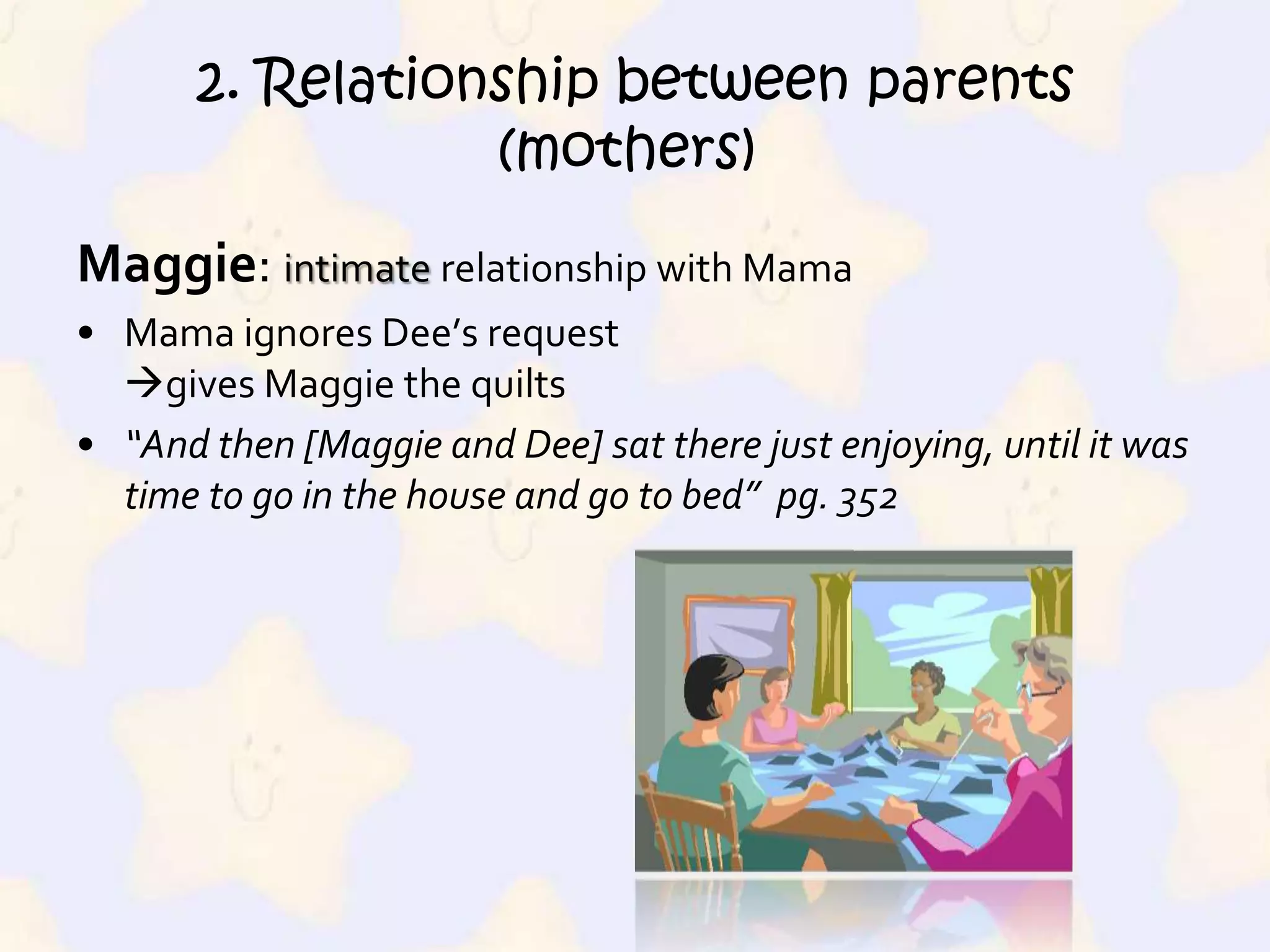
Maggie: intimate relationship with MamaMama ignores Dee’s requestgives Maggie the quilts“And then [Maggie and Dee] sat there just enjoying, until it was time to go in the house and go to bed”  pg. 3522. Relationship between parents (mothers) 
DEE & MAGGIECOMPARISON
Comparison (Dee & Maggie)3 Differences:1) Different level of intimacy with Mama     (conveys different parent-child relationships)2) Different ways in valuing heritage     (brings out the theme of heritage, ancestors  younger generation)3) Showy Vs Practical     (brings out the theme of generational difference,      contrasted by narrow generation gap between      Maggie and Mama)Krakow Spotlight, www.usinfo.pl/krakow/images/everydayuse.jpg
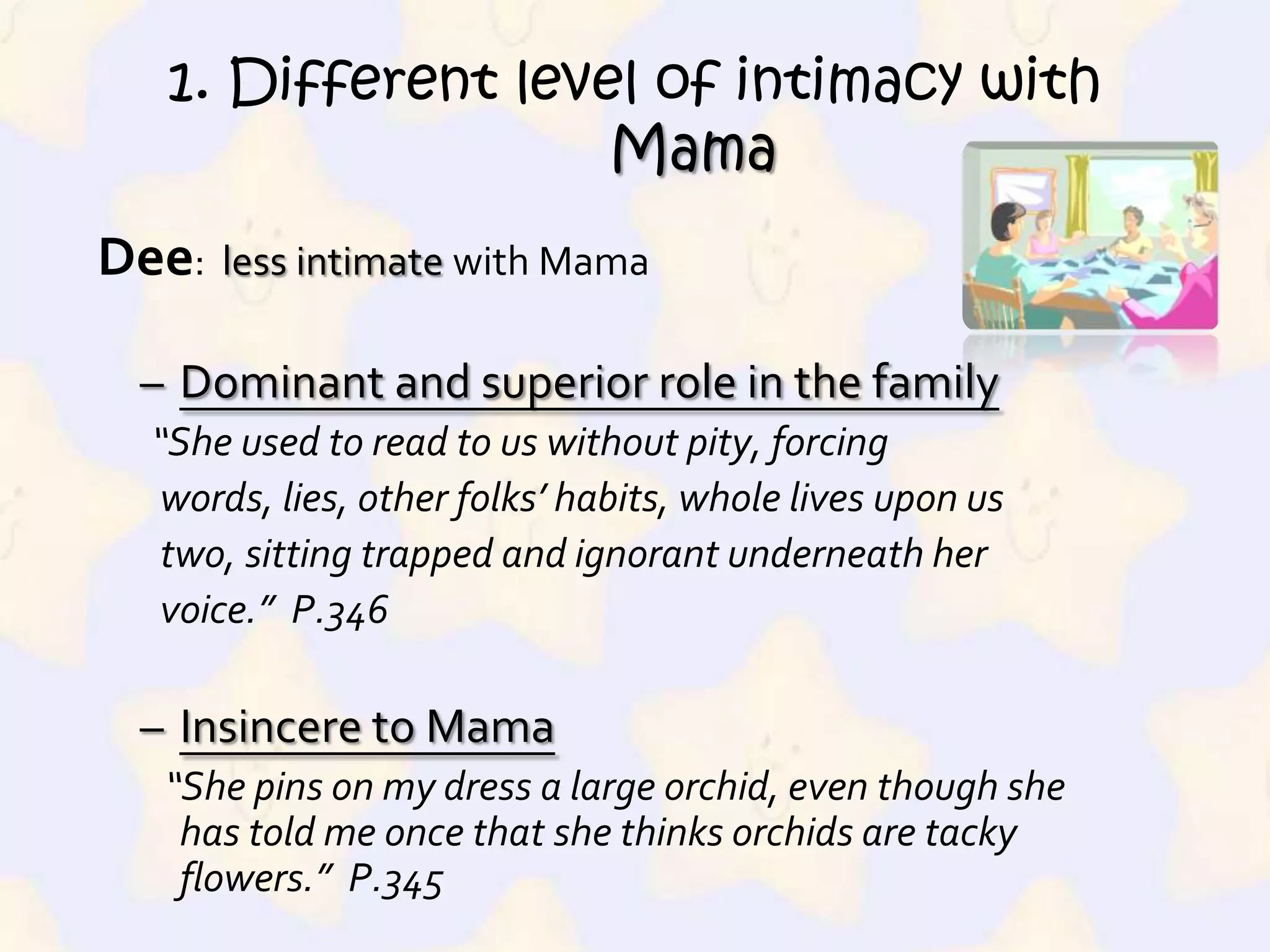
1. Different level of intimacy with MamaDee: less intimate with MamaDominant and superior role in the family“She used to read to us without pity, forcing          words, lies, other folks’ habits, whole lives upon us          two, sitting trapped and ignorant underneath her          voice.”  P.346Insincere to Mama“She pins on my dress a large orchid, even though she has told me once that she thinks orchids are tacky flowers.”  P.345
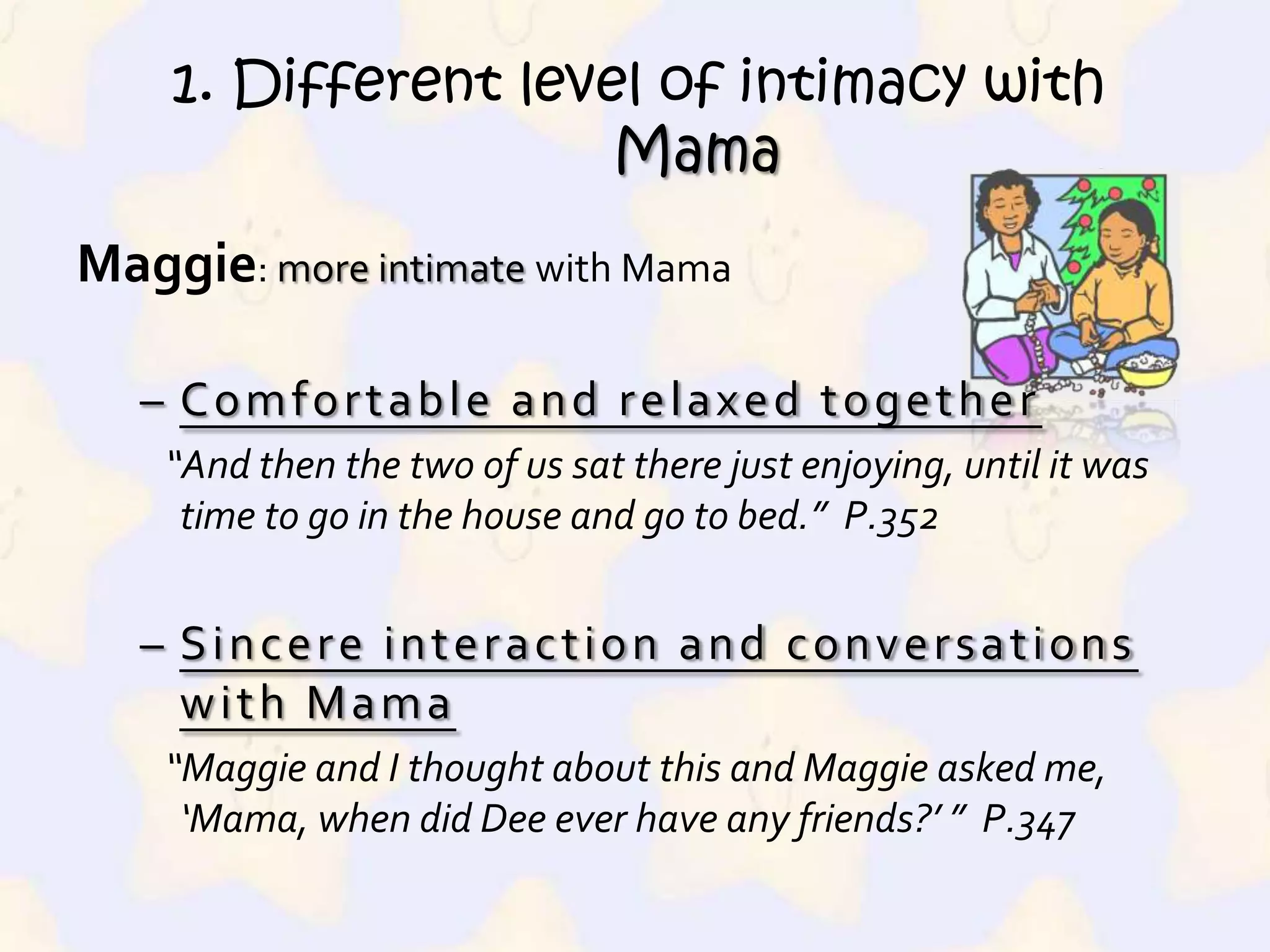
1. Different level of intimacy with MamaMaggie: more intimate with MamaComfortable and relaxed together“And then the two of us sat there just enjoying, until it was time to go in the house and go to bed.”  P.352Sincere interaction and conversations with Mama“Maggie and I thought about this and Maggie asked me, ‘Mama, when did Dee ever have any friends?’ ”  P.347
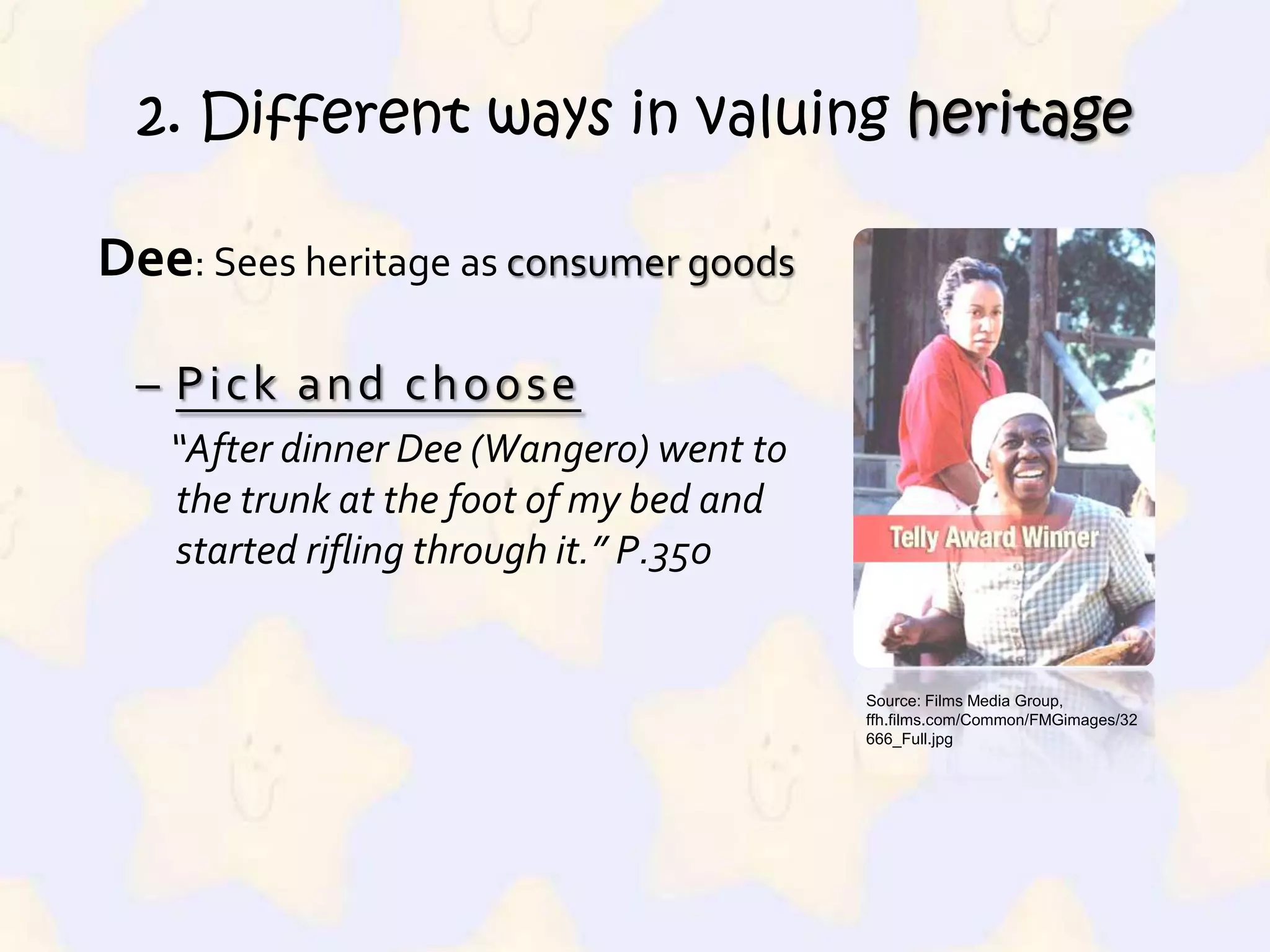
2. Different ways in valuing heritageDee: Sees heritage as consumer goodsPick and choose“After dinner Dee (Wangero) went to the trunk at the foot of my bed and started rifling through it.” P.350Source: Films Media Group, ffh.films.com/Common/FMGimages/32666_Full.jpg
2. Different ways in valuing heritageMaggie: VeneratesheritageDeep understanding in its history  “ ‘Aunt Dee’s first husband whittled the dash,’ said Maggie so low you almost couldn’t hear her.  ‘His name was Henry, but they called him Stash.’ ” P.350
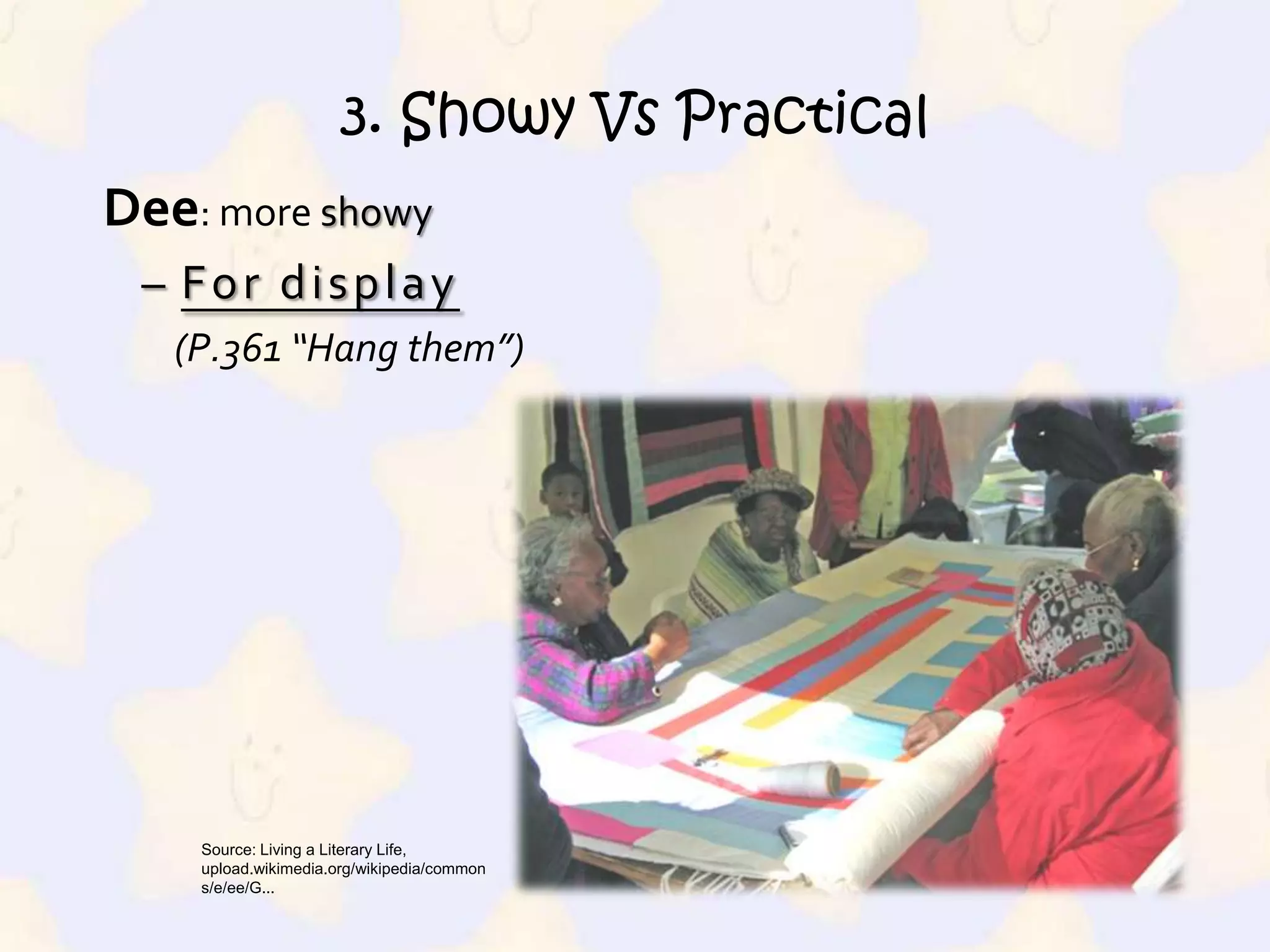
3. Showy Vs PracticalDee: more showyFor display(P.361 “Hang them”)Source: Living a Literary Life, upload.wikimedia.org/wikipedia/commons/e/ee/G...
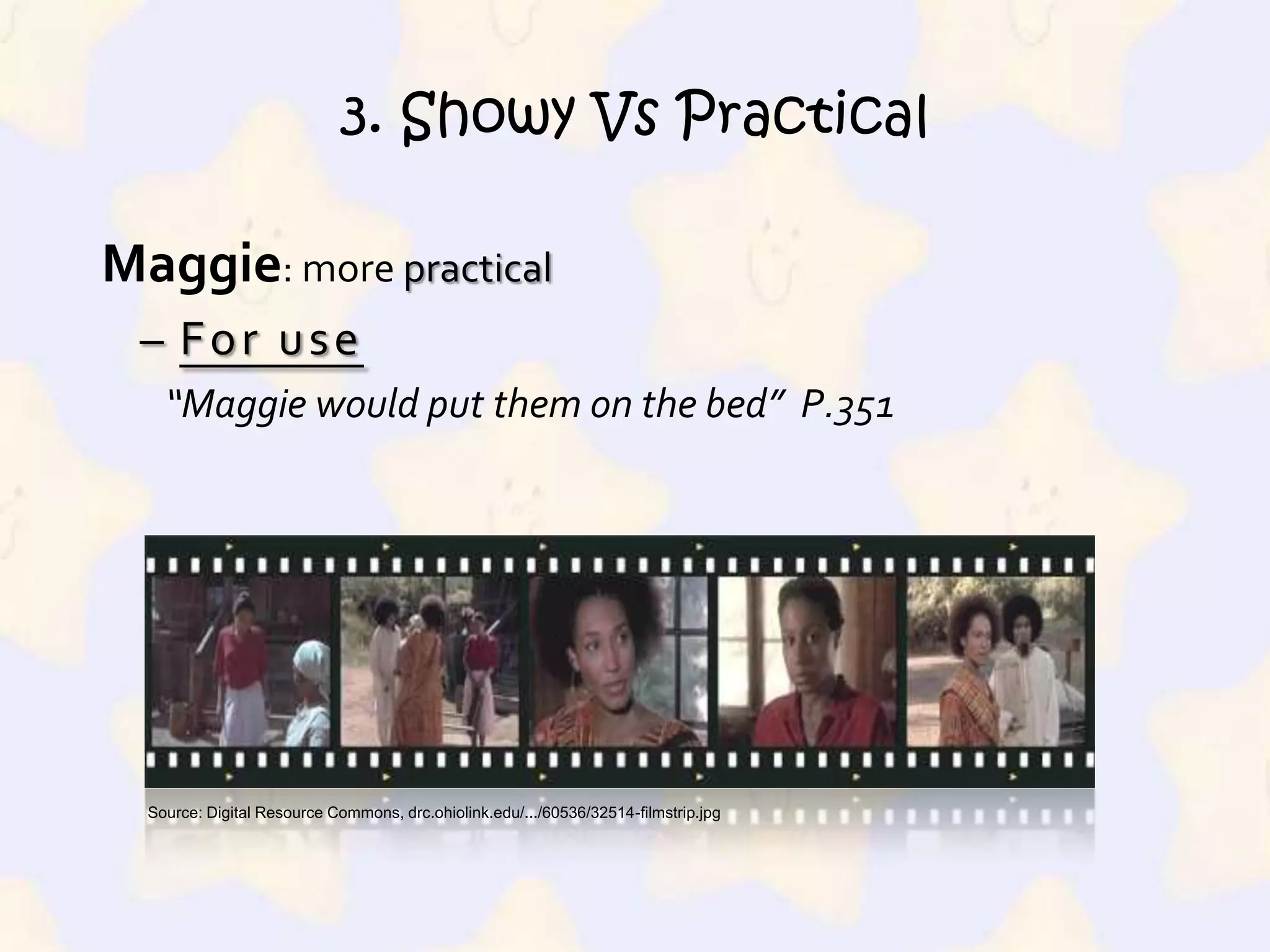
3. Showy Vs PracticalMaggie: more practicalFor use“Maggie would put them on the bed”  P.351 Source: Digital Resource Commons, drc.ohiolink.edu/.../60536/32514-filmstrip.jpg
GENERAL  ROLEOF  CHILDRENSUMMARY
Role of child (general)To represent innocence and purity To contrast the burden and worries of adultse.g. Birches: the playful and carefree boy in the    nostalgic memory of the weary persona
To provide a naïve perspective (applicable only to children and adolescents)e.g. Seventeen Syllables:  Rosie=naïve narratorA naïve narrator: uncomprehending character e.g. a child or simple minded adultnarrates the story without realizing its implicationstheir ignorance/inexperience serves to expose faults/ issues in their worldResult: readers know more about what’s going on than the narratorEffect: sense of irony or pathos(an evocation of sympathy, pity, sorrow in reader)
To convey parent-child relationships To bring out the centre of thoughts (themes) of the literaturee.g. Seventeen Syllables, Everyday Use
Role of Child

Role of Child

  • 1.
    Compare the roleof the childin at least three of the set texts.Angel Leung 4XAnthea Wong 4YColettie Lee 4YPoonYui Sum 4U
  • 2.
    Child - DefinitionBelow12 years oldParent’s son / daughter
  • 4.
  • 5.
  • 6.
    Boybending movement escape into his imagination (upward movement) and coming back to reality (downward movement)Role as a child:allows him to have such imaginations and freedomgives a stark contrast to the role as an adultgives readers a stress-free sense towards the character given with this roleComparison (boy and Rosie)
  • 7.
    RosieWesternized:her name “Rosie”herimitation of Shirley Templeher struggles and limitations contrast to those of her motherRosie + Tome have conflictse.g. views on getting married or notComparison (boy and Rosie)
  • 8.
    Comparison (boy andRosie)Role as a child (Rosie):explore matters in life such as love/infatuation and playfulnesscuriosity and playfulness as a child + her westernized mindset create conflicts in ways of looking at things between herself and her mum Tome
  • 9.
  • 10.
    Comparison (boy andDee)Not the subjectObject of attentionBoy:“I should prefer to have some boy bend them”(23)Dee:“a dress so loud it hurts my eyes” & “Bracelets dangling and making noises”pg. 347Dee:aggressive and proud
  • 11.
    Comparison (boy andDee)Freedom and LibertyBoy:imagine and conquer on birchesDee:leave countryside  town
  • 12.
  • 13.
    Comparison (Rosie &Maggie)Level of being influenced/affected by external factorsRelationship between parents (mothers) 
  • 14.
    1. Level ofbeing influenced/affected by external factorsRosie: Does not embrace her own culture (i.e. Japanese culture)Knows very little Japanese“English lay ready on the tongue but Japanese had to be searched for and examined” pg.2081. Level of being influenced/affected by external factors‘worship’s Western culture“she was the child Shirley Temple piping ‘On the Good Ship Lollipop’ ” pg.216Source: Hatena, ecx.images-amazon.com/images/I/51MGP2BBV7L.jpg
  • 15.
    Maggie: cherishes herown heritage although Dee does nothas profound understanding of the history behind historical objects“Aunt Dee’s first husband whittled the dash,” said Maggie so low you almost couldn’t hear her. “His name was Henry, but they called him Stash.” pg. 350not affected by Dee’s behavior1. Level of being influenced/affected by external factors
  • 16.
    2. Relationship betweenparents (mothers) Rosie: distant relationship with Mrs. HayashiLinguistic barrier (Western VS Japanese)does not fully understand each other“…Rosie pretended to understand [the Haiku Tome wrote] thoroughly and appreciate it no end” pg. 208Generational difference (Nisei VS Issei)Rosie does not understand Tome’s situation“Do you know why I married your father?” [Tome] said without turning.“No,” said Rosie.
  • 17.
    Maggie: intimate relationshipwith MamaMama ignores Dee’s requestgives Maggie the quilts“And then [Maggie and Dee] sat there just enjoying, until it was time to go in the house and go to bed” pg. 3522. Relationship between parents (mothers) 
  • 18.
  • 19.
    Comparison (Dee &Maggie)3 Differences:1) Different level of intimacy with Mama (conveys different parent-child relationships)2) Different ways in valuing heritage (brings out the theme of heritage, ancestors  younger generation)3) Showy Vs Practical (brings out the theme of generational difference, contrasted by narrow generation gap between Maggie and Mama)Krakow Spotlight, www.usinfo.pl/krakow/images/everydayuse.jpg
  • 20.
    1. Different levelof intimacy with MamaDee: less intimate with MamaDominant and superior role in the family“She used to read to us without pity, forcing words, lies, other folks’ habits, whole lives upon us two, sitting trapped and ignorant underneath her voice.” P.346Insincere to Mama“She pins on my dress a large orchid, even though she has told me once that she thinks orchids are tacky flowers.” P.345
  • 21.
    1. Different levelof intimacy with MamaMaggie: more intimate with MamaComfortable and relaxed together“And then the two of us sat there just enjoying, until it was time to go in the house and go to bed.” P.352Sincere interaction and conversations with Mama“Maggie and I thought about this and Maggie asked me, ‘Mama, when did Dee ever have any friends?’ ” P.347
  • 22.
    2. Different waysin valuing heritageDee: Sees heritage as consumer goodsPick and choose“After dinner Dee (Wangero) went to the trunk at the foot of my bed and started rifling through it.” P.350Source: Films Media Group, ffh.films.com/Common/FMGimages/32666_Full.jpg
  • 23.
    2. Different waysin valuing heritageMaggie: VeneratesheritageDeep understanding in its history “ ‘Aunt Dee’s first husband whittled the dash,’ said Maggie so low you almost couldn’t hear her. ‘His name was Henry, but they called him Stash.’ ” P.350
  • 24.
    3. Showy VsPracticalDee: more showyFor display(P.361 “Hang them”)Source: Living a Literary Life, upload.wikimedia.org/wikipedia/commons/e/ee/G...
  • 25.
    3. Showy VsPracticalMaggie: more practicalFor use“Maggie would put them on the bed” P.351 Source: Digital Resource Commons, drc.ohiolink.edu/.../60536/32514-filmstrip.jpg
  • 26.
    GENERAL ROLEOF CHILDRENSUMMARY
  • 27.
    Role of child(general)To represent innocence and purity To contrast the burden and worries of adultse.g. Birches: the playful and carefree boy in the nostalgic memory of the weary persona
  • 28.
    To provide anaïve perspective (applicable only to children and adolescents)e.g. Seventeen Syllables: Rosie=naïve narratorA naïve narrator: uncomprehending character e.g. a child or simple minded adultnarrates the story without realizing its implicationstheir ignorance/inexperience serves to expose faults/ issues in their worldResult: readers know more about what’s going on than the narratorEffect: sense of irony or pathos(an evocation of sympathy, pity, sorrow in reader)
  • 29.
    To convey parent-childrelationships To bring out the centre of thoughts (themes) of the literaturee.g. Seventeen Syllables, Everyday Use