RODENT PEST MANAGEMENT
DRARUN KUMAR
Rodents are the major vertebrate pests causing damage to
various crops and commodities by feeding and indirect damage
by spoilage, contamination and hording during on-farm and post-
harvest stages. The analysis of the reviews on pre harvest losses
indicates a range of 5-15% damage to cereal crops like rice and
wheat. During 2001 it was reported that the overall losses of
grain to rodents in India were approximately 25% in pre harvest
and 25-30% in post-harvest situations bringing the loss to at
least US$ 5 billion annually in stored food and seed grain in India.
India is inhabited by around 84 species of rodents. Out of
them 18 species are harmful to the mankind. Because they not
only cause damage to the basic needs like food, clothes and
shelter, but also destructive towards the agricultural field. Here
the complete narration, regarding their habitat, food habit and
life cycle, have been given on some of the important species.
They belongs to Kingdom Animalia,Phylum Chordata, Class
Mammalia and Order Rodentia.
What Does Rodent Mean???
Rodents are the quadruped mammals having their body
completely covered with fur. They are having a pair of sickle
shaped ever growing incisor teeth in each jaw adopted for
gnawing. But they lack canine teeth. They posses diastema (gap
between incisor and cheek teeth). Cheek teeth as a rule are
adopted for dealing with veg food. The presence of these two
pairs of incisor teeth makes the rodent class separate from other
mammals.
Distribution of rodent pests
2.
The distribution ofrodent varies with the species. Some
species are widely distributed while others are locally important.
The lesser bandicoot rat is predominant in irrigated crop fields
and grass lands throughout the country except in Indian desert,
Lakshadweep and Andaman islands. It has turned commensals
and inhabits godowns and other premises in metropolitan cities.
The other species, which are widespread in both, irrigated
and dry farming system in the country are the Indian gerbil, T.
indica, Hie soft furred field rat, Millardia meltada and house
mouse, Mus musculus. However, both T. indica and
M. meltada have not been reported from Northeastern hill region.
The Indian crested porcupine is widely distributed in South Asia in
forest, rocky, moist and arid habitats.
Species with restricted distribution are the desert
gerbil, Meriones hurrianae and hairy footed gerbil, Gerbil/us
gleadowi in the Indian desert; the Himalayan rat, R. nitidus in
north eastern hill region; the short tailed bandicoot rat, Nesokia
indica in north-western plains; the three striped palm squirrel in
the southern peninsula and Western Ghat squirrel, F. tristriatus in
the west coast of southern peninsula.
The house rat and house mouse are the major commensal
pests. R. norvegicus is restricted mainly to ports. In the southern
part of the country, R. rattus is a serious pest or orchards and in
central India, it also occurs in rice, sugarcane and other field
crops.
Classification Hierarchy
India is inhabited by around 84 species of rodents. Out of them
18 species are harmful to the mankind. Because they not only
cause damage to the basic needs like food, clothes and shelter,
but also destructive towards the agricultural field. Here the
3.
complete narration, regardingtheir habitat, food habit and life
cycle, have been given on some of the important species.
Kingdom :Animalia
Phylum :Chordata
Class :Mammalia
Order :Rodentia
Order Rodentia divided into five major suborders:
1. Anomaluromorpha – eg.scaly tailed squirrels, spring hares.
2. Castorimorpha- eg.bevers, pocket gophers, kangaroo rats,
kangaroo mice.
3. Hystricomorpha-eg.capybara, porcupine.
4. Myomorpha- eg.mice, rat, gerbils, voles, mole rats.
5. Sciuromorpha-eg.squrrels.
Six Families of order Rodentia
Ellerman (1961): 6 families:
I. Sciuridae (Squirrels)
II. Hystricidae (Porcupines)
III. Dipodidae (Jerboas and birch mice)
IV. Muscardinidae (Dormice)
V. Rhizomydae ( Bamboo rats)
VI. Muridae (Marmots,voles,rats, mice, Gerbils etc)
Four Sub families of sub family Muridae
Ellerman (1961) : 4 subfamilies
4.
a. Cricetinae: Hamsters
b.Microtinae: Voles
c. Gerbillinae: Gerbils
d. Murinae : Rats & Mice
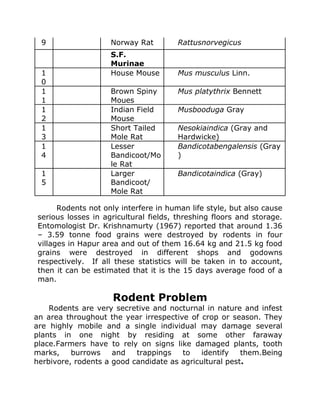
RODENT SPECIES OF ECONOMIC IMPORTANCE
Sl
n
o
Family Common
Name
Name of species
1 Sciuridae Five stripped
/ Northern
palm squirrel
FunambuluspennantiWroug
hton
2 Three striped
/ Southern
Indian palm
squirrel
Funambuluspalmarum
3 Hystricida
e
Indian
Crested
Porcupine
Htstrixindica Kerr
4 Muridae S.F.
Gerbillinae
Indian desert
gerbil
MerioneshurrianaeJerdon
Indian gerbil TateraindicaHardwicki
Hairy footed
gerbil
GerbillusgleadowiMurray
S.F.
Murinae
7 House/
Black/Ship
Rat
Rattusrattus (Linn.)
8 Soft furred
field rat
Millardiameltada(Gray)
5.
9 Norway RatRattusnorvegicus
S.F.
Murinae
1
0
House Mouse Mus musculus Linn.
1
1
Brown Spiny
Moues
Mus platythrix Bennett
1
2
Indian Field
Mouse
Musbooduga Gray
1
3
Short Tailed
Mole Rat
Nesokiaindica (Gray and
Hardwicke)
1
4
Lesser
Bandicoot/Mo
le Rat
Bandicotabengalensis (Gray
)
1
5
Larger
Bandicoot/
Mole Rat
Bandicotaindica (Gray)
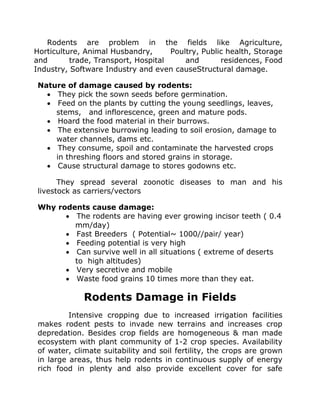
Rodents not only interfere in human life style, but also cause
serious losses in agricultural fields, threshing floors and storage.
Entomologist Dr. Krishnamurty (1967) reported that around 1.36
– 3.59 tonne food grains were destroyed by rodents in four
villages in Hapur area and out of them 16.64 kg and 21.5 kg food
grains were destroyed in different shops and godowns
respectively. If all these statistics will be taken in to account,
then it can be estimated that it is the 15 days average food of a
man.
Rodent Problem
Rodents are very secretive and nocturnal in nature and infest
an area throughout the year irrespective of crop or season. They
are highly mobile and a single individual may damage several
plants in one night by residing at some other faraway
place.Farmers have to rely on signs like damaged plants, tooth
marks, burrows and trappings to identify them.Being
herbivore, rodents a good candidate as agricultural pest.
6.
Rodents are problemin the fields like Agriculture,
Horticulture, Animal Husbandry, Poultry, Public health, Storage
and trade, Transport, Hospital and residences, Food
Industry, Software Industry and even causeStructural damage.
Nature of damage caused by rodents:
• They pick the sown seeds before germination.
• Feed on the plants by cutting the young seedlings, leaves,
stems, and inflorescence, green and mature pods.
• Hoard the food material in their burrows.
• The extensive burrowing leading to soil erosion, damage to
water channels, dams etc.
• They consume, spoil and contaminate the harvested crops
in threshing floors and stored grains in storage.
• Cause structural damage to stores godowns etc.
They spread several zoonotic diseases to man and his
livestock as carriers/vectors
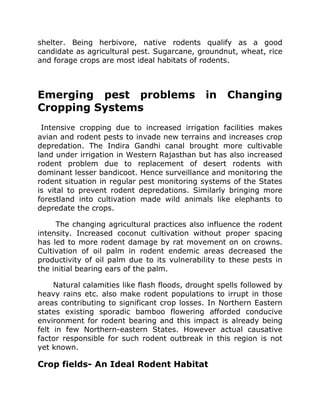
Why rodents cause damage:
• The rodents are having ever growing incisor teeth ( 0.4
mm/day)
• Fast Breeders ( Potential~ 1000//pair/ year)
• Feeding potential is very high
• Can survive well in all situations ( extreme of deserts
to high altitudes)
• Very secretive and mobile
• Waste food grains 10 times more than they eat.
Rodents Damage in Fields
Intensive cropping due to increased irrigation facilities
makes rodent pests to invade new terrains and increases crop
depredation. Besides crop fields are homogeneous & man made
ecosystem with plant community of 1-2 crop species. Availability
of water, climate suitability and soil fertility, the crops are grown
in large areas, thus help rodents in continuous supply of energy
rich food in plenty and also provide excellent cover for safe
7.
shelter. Being herbivore,native rodents qualify as a good
candidate as agricultural pest. Sugarcane, groundnut, wheat, rice
and forage crops are most ideal habitats of rodents.
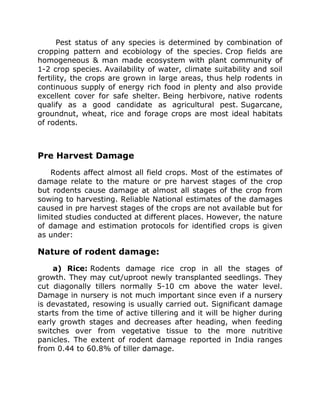
Emerging pest problems in Changing
Cropping Systems
Intensive cropping due to increased irrigation facilities makes
avian and rodent pests to invade new terrains and increases crop
depredation. The Indira Gandhi canal brought more cultivable
land under irrigation in Western Rajasthan but has also increased
rodent problem due to replacement of desert rodents with
dominant lesser bandicoot. Hence surveillance and monitoring the
rodent situation in regular pest monitoring systems of the States
is vital to prevent rodent depredations. Similarly bringing more
forestland into cultivation made wild animals like elephants to
depredate the crops.
The changing agricultural practices also influence the rodent
intensity. Increased coconut cultivation without proper spacing
has led to more rodent damage by rat movement on on crowns.
Cultivation of oil palm in rodent endemic areas decreased the
productivity of oil palm due to its vulnerability to these pests in
the initial bearing ears of the palm.
Natural calamities like flash floods, drought spells followed by
heavy rains etc. also make rodent populations to irrupt in those
areas contributing to significant crop losses. In Northern Eastern
states existing sporadic bamboo flowering afforded conducive
environment for rodent bearing and this impact is already being
felt in few Northern-eastern States. However actual causative
factor responsible for such rodent outbreak in this region is not
yet known.
Crop fields- An Ideal Rodent Habitat
8.
Pest status ofany species is determined by combination of
cropping pattern and ecobiology of the species. Crop fields are
homogeneous & man made ecosystem with plant community of
1-2 crop species. Availability of water, climate suitability and soil
fertility, the crops are grown in large areas, thus help rodents in
continuous supply of energy rich food in plenty and also provide
excellent cover for safe shelter. Being herbivore, native rodents
qualify as a good candidate as agricultural pest. Sugarcane,
groundnut, wheat, rice and forage crops are most ideal habitats
of rodents.
Pre Harvest Damage
Rodents affect almost all field crops. Most of the estimates of
damage relate to the mature or pre harvest stages of the crop
but rodents cause damage at almost all stages of the crop from
sowing to harvesting. Reliable National estimates of the damages
caused in pre harvest stages of the crops are not available but for
limited studies conducted at different places. However, the nature
of damage and estimation protocols for identified crops is given
as under:
Nature of rodent damage:
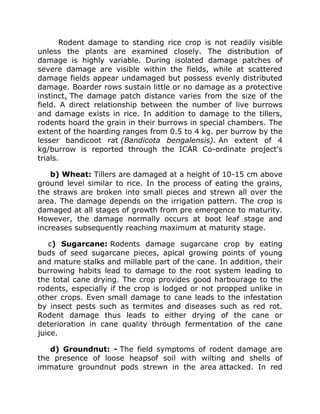
a) Rice: Rodents damage rice crop in all the stages of
growth. They may cut/uproot newly transplanted seedlings. They
cut diagonally tillers normally 5-10 cm above the water level.
Damage in nursery is not much important since even if a nursery
is devastated, resowing is usually carried out. Significant damage
starts from the time of active tillering and it will be higher during
early growth stages and decreases after heading, when feeding
switches over from vegetative tissue to the more nutritive
panicles. The extent of rodent damage reported in India ranges
from 0.44 to 60.8% of tiller damage.
9.
Rodent damage tostanding rice crop is not readily visible
unless the plants are examined closely. The distribution of
damage is highly variable. During isolated damage patches of
severe damage are visible within the fields, while at scattered
damage fields appear undamaged but possess evenly distributed
damage. Boarder rows sustain little or no damage as a protective
instinct. The damage patch distance varies from the size of the
field. A direct relationship between the number of live burrows
and damage exists in rice. In addition to damage to the tillers,
rodents hoard the grain in their burrows in special chambers. The
extent of the hoarding ranges from 0.5 to 4 kg. per burrow by the
lesser bandicoot rat (Bandicota bengalensis). An extent of 4
kg/burrow is reported through the ICAR Co-ordinate project's
trials.
b) Wheat: Tillers are damaged at a height of 10-15 cm above
ground level similar to rice. In the process of eating the grains,
the straws are broken into small pieces and strewn all over the
area. The damage depends on the irrigation pattern. The crop is
damaged at all stages of growth from pre emergence to maturity.
However, the damage normally occurs at boot leaf stage and
increases subsequently reaching maximum at maturity stage.
c) Sugarcane: Rodents damage sugarcane crop by eating
buds of seed sugarcane pieces, apical growing points of young
and mature stalks and millable part of the cane. In addition, their
burrowing habits lead to damage to the root system leading to
the total cane drying. The crop provides good harbourage to the
rodents, especially if the crop is lodged or not propped unlike in
other crops. Even small damage to cane leads to the infestation
by insect pests such as termites and diseases such as red rot.
Rodent damage thus leads to either drying of the cane or
deterioration in cane quality through fermentation of the cane
juice.
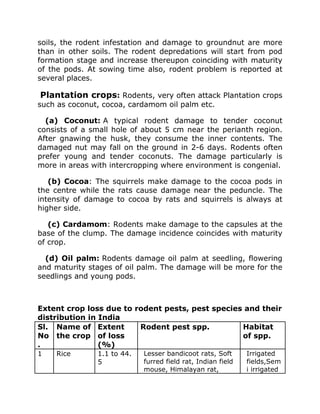
d) Groundnut: - The field symptoms of rodent damage are
the presence of loose heapsof soil with wilting and shells of
immature groundnut pods strewn in the area attacked. In red
10.
soils, the rodentinfestation and damage to groundnut are more
than in other soils. The rodent depredations will start from pod
formation stage and increase thereupon coinciding with maturity
of the pods. At sowing time also, rodent problem is reported at
several places.
Plantation crops: Rodents, very often attack Plantation crops
such as coconut, cocoa, cardamom oil palm etc.
(a) Coconut: A typical rodent damage to tender coconut
consists of a small hole of about 5 cm near the perianth region.
After gnawing the husk, they consume the inner contents. The
damaged nut may fall on the ground in 2-6 days. Rodents often
prefer young and tender coconuts. The damage particularly is
more in areas with intercropping where environment is congenial.
(b) Cocoa: The squirrels make damage to the cocoa pods in
the centre while the rats cause damage near the peduncle. The
intensity of damage to cocoa by rats and squirrels is always at
higher side.
(c) Cardamom: Rodents make damage to the capsules at the
base of the clump. The damage incidence coincides with maturity
of crop.
(d) Oil palm: Rodents damage oil palm at seedling, flowering
and maturity stages of oil palm. The damage will be more for the
seedlings and young pods.
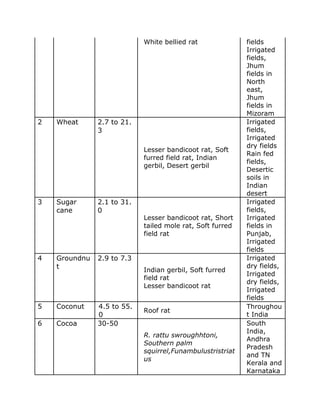
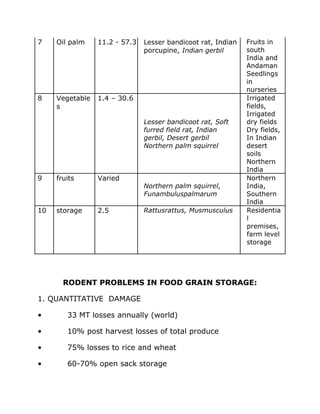
Extent crop loss due to rodent pests, pest species and their
distribution in India
Sl.
No
.
Name of
the crop
Extent
of loss
(%)
Rodent pest spp. Habitat
of spp.
1 Rice 1.1 to 44.
5
Lesser bandicoot rats, Soft
furred field rat, Indian field
mouse, Himalayan rat,
Irrigated
fields,Sem
i irrigated
11.
White bellied ratfields
Irrigated
fields,
Jhum
fields in
North
east,
Jhum
fields in
Mizoram
2 Wheat 2.7 to 21.
3
Lesser bandicoot rat, Soft
furred field rat, Indian
gerbil, Desert gerbil
Irrigated
fields,
Irrigated
dry fields
Rain fed
fields,
Desertic
soils in
Indian
desert
3 Sugar
cane
2.1 to 31.
0
Lesser bandicoot rat, Short
tailed mole rat, Soft furred
field rat
Irrigated
fields,
Irrigated
fields in
Punjab,
Irrigated
fields
4 Groundnu
t
2.9 to 7.3
Indian gerbil, Soft furred
field rat
Lesser bandicoot rat
Irrigated
dry fields,
Irrigated
dry fields,
Irrigated
fields
5 Coconut 4.5 to 55.
0
Roof rat
Throughou
t India
6 Cocoa 30-50
R. rattu swroughhtoni,
Southern palm
squirrel,Funambulustristriat
us
South
India,
Andhra
Pradesh
and TN
Kerala and
Karnataka
12.
7 Oil palm11.2 - 57.3 Lesser bandicoot rat, Indian
porcupine, Indian gerbil
Fruits in
south
India and
Andaman
Seedlings
in
nurseries
8 Vegetable
s
1.4 – 30.6
Lesser bandicoot rat, Soft
furred field rat, Indian
gerbil, Desert gerbil
Northern palm squirrel
Irrigated
fields,
Irrigated
dry fields
Dry fields,
In Indian
desert
soils
Northern
India
9 fruits Varied
Northern palm squirrel,
Funambuluspalmarum
Northern
India,
Southern
India
10 storage 2.5 Rattusrattus, Musmusculus Residentia
l
premises,
farm level
storage
RODENT PROBLEMS IN FOOD GRAIN STORAGE:
1. QUANTITATIVE DAMAGE
• 33 MT losses annually (world)
• 10% post harvest losses of total produce
• 75% losses to rice and wheat
• 60-70% open sack storage
13.
• (6% loss– out which 50% due to rodents)
2. QUALITATIVE DAMAGE, 3. HEALTH HAZARDS, 4. DAMAGE TO
STRUCTURES
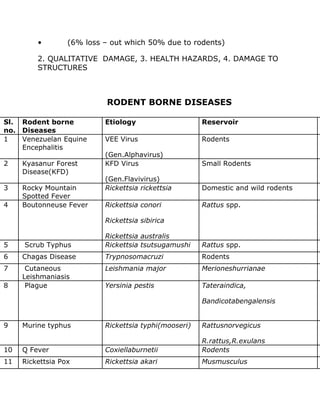
RODENT BORNE DISEASES
Sl.
no.
Rodent borne
Diseases
Etiology Reservoir
1 Venezuelan Equine
Encephalitis
VEE Virus
(Gen.Alphavirus)
Rodents
2 Kyasanur Forest
Disease(KFD)
KFD Virus
(Gen.Flavivirus)
Small Rodents
3 Rocky Mountain
Spotted Fever
Rickettsia rickettsia Domestic and wild rodents
4 Boutonneuse Fever Rickettsia conori
Rickettsia sibirica
Rickettsia australis
Rattus spp.
5 Scrub Typhus Rickettsia tsutsugamushi Rattus spp.
6 Chagas Disease Trypnosomacruzi Rodents
7 Cutaneous
Leishmaniasis
Leishmania major Merioneshurrianae
8 Plague Yersinia pestis Tateraindica,
Bandicotabengalensis
9 Murine typhus Rickettsia typhi(mooseri) Rattusnorvegicus
R.rattus,R.exulans
10 Q Fever Coxiellaburnetii Rodents
11 Rickettsia Pox Rickettsia akari Musmusculus
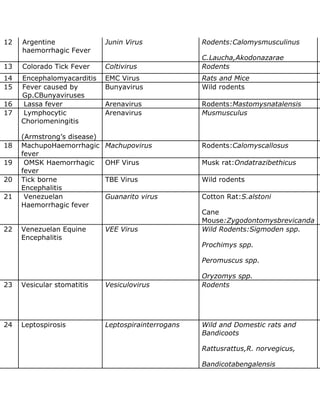
25 ANGIOSTROGYLIASIS
A nematodedisease of
the CNS
Parastrongyluscantonensis RattusandBandicotaSp
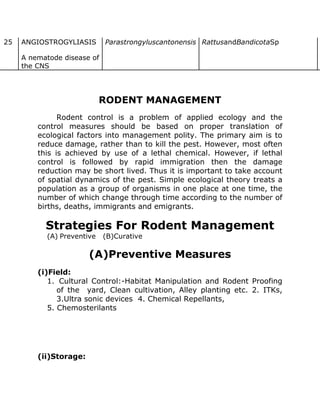
RODENT MANAGEMENT
Rodent control is a problem of applied ecology and the
control measures should be based on proper translation of
ecological factors into management polity. The primary aim is to
reduce damage, rather than to kill the pest. However, most often
this is achieved by use of a lethal chemical. However, if lethal
control is followed by rapid immigration then the damage
reduction may be short lived. Thus it is important to take account
of spatial dynamics of the pest. Simple ecological theory treats a
population as a group of organisms in one place at one time, the
number of which change through time according to the number of
births, deaths, immigrants and emigrants.
Strategies For Rodent Management
(A) Preventive (B)Curative
(A)Preventive Measures
(i)Field:
1. Cultural Control:-Habitat Manipulation and Rodent Proofing
of the yard, Clean cultivation, Alley planting etc. 2. ITKs,
3.Ultra sonic devices 4. Chemical Repellants,
5. Chemosterilants
(ii)Storage:
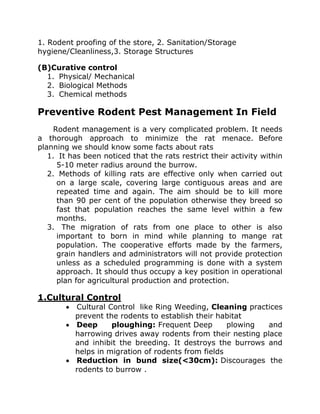
16.
1. Rodent proofingof the store, 2. Sanitation/Storage
hygiene/Cleanliness,3. Storage Structures
(B)Curative control
1. Physical/ Mechanical
2. Biological Methods
3. Chemical methods
Preventive Rodent Pest Management In Field
Rodent management is a very complicated problem. It needs
a thorough approach to minimize the rat menace. Before
planning we should know some facts about rats
1. It has been noticed that the rats restrict their activity within
5-10 meter radius around the burrow.
2. Methods of killing rats are effective only when carried out
on a large scale, covering large contiguous areas and are
repeated time and again. The aim should be to kill more
than 90 per cent of the population otherwise they breed so
fast that population reaches the same level within a few
months.
3. The migration of rats from one place to other is also
important to born in mind while planning to mange rat
population. The cooperative efforts made by the farmers,
grain handlers and administrators will not provide protection
unless as a scheduled programming is done with a system
approach. It should thus occupy a key position in operational
plan for agricultural production and protection.
1.Cultural Control
• Cultural Control like Ring Weeding, Cleaning practices
prevent the rodents to establish their habitat
• Deep ploughing: Frequent Deep plowing and
harrowing drives away rodents from their nesting place
and inhibit the breeding. It destroys the burrows and
helps in migration of rodents from fields
• Reduction in bund size(<30cm): Discourages the
rodents to burrow .
17.
• Cultivation ofnon- preferred crops: Guar, castor
etc may be taken as strip crop (10 m).
• Cultivation of non- preferred crops: Guar, castor
etc may be taken as strip crop (10 m).
• Weed control: Weeds provide food and shelter.
Regular weed control practices may minimize the
rodent infestation considerably.
• Burning/Removal of wild vegetation & refuge of
pervious crops,
• Grazing,
• Irrigation.
• Trap barrier System may be employed in rice farming
as fencing and for fixing traps.
Habitat Management:
▪ Removal of weeds within the crop and along the field bunds.
▪ Reducing size and number of bunds, transplantation of
paddy over a larger area at a time,
Proper water management will play a greater role in checking
the rat population
Rodent Proofing the Yard
1. Eliminate Food Sources
➢Remove defective refuse cans.
➢Provide a sufficient amount of refuse cans. A 32 gallon
container with a tight fitting lit is best
➢DO NOT LITTER. Be sure garbage in secure in container and
not on the ground.
➢Drain and wrap garbage before disposing.
➢Remove pet food immediately and clean up animal
2. Eliminate Water
18.
➢Keep all drainscovered and secure.
➢Make sure hoses are not leaking.
➢Get rid of any standing water in yard.
➢Fix any defective pipes or drains.
3. Eliminate Rodent Hiding Places
➢Get rid of junk, lumber, old boxes, discarded appliances
chairs or bedding on the ground or under porches.
➢Remove abandoned vehicles.
2. Itks For Rodent Pest Management
• Barleriabuxifolia is planted around the grain storage area
. These plants being full of thorns keep rats away from
the area {HoneyBee,2000,11(2):10}
• In Gujarat people use a plant called laut. The branches of
the plant is smooth and colourful creating the illusion of a
snake.
• The fruit of Cassia fistula can also be used for the same
purpose. Placement of these materials must be changed
every 15 days twice or thrice
• Inserting 10 – 12 inches long fresh pieces of stem of
Jatropha plant into active rat holes makes the field rat
free.
• Erection of fused florescent tube lights @ 4-5/ acre
reflects moon light to scare away the rodents and tube
light also provides perching place for owls.
• Keep the bolus of Caesalpiniabonduc seeds &jowar flour
near the active rat burrows. The smell / taste keeps the
rats away from the field (Ref: Honey Bee vol 24(4),
2013: 14)
Rat repellant:
• Mucuna pruriens Back (Baidonka in Oriya) (Fam:
Papilionaceae) fruits are kept in the live rat holes. While
entering the hole rats colloid with hairy fruits and get
19.
irritation & leavesthe spot immediately [HoneyBee, vol.
9(3):1998].
• Rattlers are erected at different points in the field to keep
away nocturnal rats, mice and porcupines. For this a
bamboo pole of about 2-3 meters in length is erected
firmly on the ground.
• A large sized teak (Tectonagrandis) leaf is hung at the
upper end using a 0.5 – 0.8m long peel strip procured
from leaf rachis of wild date palm (Phoenix
sylvestris). When the leaf dries, it moves with the wind
and strikes the pole making a rattling sound
• Neem leaf powder (5%) showed anti feedant action on
rodents
• Neem oil repelled the rats to the tune of 18-48%.
• Botanicals like kaner seeds, neem cake, castor seeds and
jatropha seeds showed anti rodent properties in
preliminary trials
• Crude cotton-seed oil (5%) showed anti fertility effects on
bandicoots
Repelling House mouse / House rat :
• Rats are easily repelled by certain smells. Effective
smells are of their natural predators, such as
cats.Peppermint oil / cedar leaf oil have been shown to
deter rats for up to a few days. Naphthalene balls in
places of rat activity will make the area rat free.
ITKs to Kill Rats:
• Gliricidiasepium – a rat killer: Mix ground leaves with
cereals & allow them to ferment, then use it as rat
killer.72% Philippino farmers use Gliricidia branches in
rice fields to repel the bugs and other pests.US scientists
confirmed the effectiveness of Gliricidia as rat killer as it
contains coumarin which gets converted to anticoagulant
dicoumerol by bacterial fermentation. This reduces the
protein Prothrombin to cause death in rats due to internal
bleeding
• [Honey Bee,5(1):19,1994]
20.
• Place amixture of 90% sesame or g.nut or niger flour 5%
thick sugar 5% powdered bulb or tube light near rat
holes. The rats will die within a week.
• Soak 3kg sorghum seeds in 4 l of water & 1kg Urea for
8hrs – this serves as rat kill bait. The seeds are spread
near the burrows of the rice fields (TN).
• Half a kg of jatropha seed powder is boiled in 2-3 liters of
water. After filtering the decoction, one kg of sorghum is
added and cooked again. The cooked seeds of sorghum
are spread on the bunds of rice fields where rat menace is
prevalent (TN/AP)
• Bait with three parts of dry food 1 part cement
3. Ultrasonic Devices
Ultrasonic sonic devices puts the stress to rodents. Ultrasonic
rodent repellers emit high frequency ultrasound waves to
create an acoustically hostile environment that repels
rodents, over the long period. Kinder than traps, safer than
poisons, and inaudible to people and non-rodent pets.
The principal of ultrasonic devices is to create a loud noise
above the range of human hearing (above18-20 kHz) that is
unpleasant to pest species.
The problems with ultrasound are numerous. Animals can
adapt to most situations, and in a short amount of time they
become familiar to the sound.
4.Chemical Repellent
• Lauronitrite, actidione ,Denatonium benzoate
(10ppm),Neem, kaner, Jojoba and malathion are some
of the reported repellents .
• A repellent called R-55 (Rodaban) has been developed
recently in USA .
21.
5.Chemosterilants
• Chemical ofplant origin:-Alpha cclorohydrin (
chemical) Gossypol, crude cotton seed oil and
Glycosides of Trypataregiumwilfordi show potential as
antifertility compounds.
• Chemicals which make the rat sterile are Furadantine
@0.02g andcolchicine@0.14 g. These are generally
used as mixture of one tablet of furadantine and half
tablet of colchicine in the wheat floor to make both
sexes sterile
6.Pheromones (Sex Attractants)
Pheromones that promote aggression are the secretions of
Sebaceous glands
• Urinary compounds : used as Attractant,
• Preputial gland of female has an attractant i.e dimethyl
disulphide and dimethyl sulphite to attract matured
males. Females are attracted to alkyl acetates of prophyl,
pentyl and decyl alcohol
• Ecodon, a caster oil based repellent is effective
against rodents particularly porcupines. It is effective
against porcupines for one month and rats for 15
days which is applied @1:10.
Rodent Pest Management in stores
1.Storage Hygiene OR Sanitation Measures:
❖Keep the store absolutely clean.
❖Keep the store free of rubbish in order not to provide the
animals with any places to hide or nest. Bum or bury it.
❖Keep the areas surrounding the store free of tall weeds so
as not to give the animals any cover.
❖Keep the areas free of any stagnant water in the vicinity
of the store and ensures that rain water is drained away.
2. Rodent proofing of the store
22.
It checks themovements of house rats and mice into or outside
the house, farm, storage and other building.
For this purpose,
• All smallest and larger openings are completely sealed
and closed.
• The edges of all doors, windows and other inlets and
outlets are covered with metal sheets.
• Concrete walls and shallow foundations should
beconstructed.
• Devices should be installed to keep the door closed.
(B)CURATIVE CONTROL
1.MECHANICAL CONTROL
1.Trapping may be an effective tool for field rodent management
in limited areas, like threshing yards where application of poisons
is not possible.
2. It is extremely useful for management of residual pest
population surviving after poison baiting.
3. It is essentially required for identification, survey and
monitoring of the pest species.
TRAPS
➢The trapping of rodent pests is often preferable to the use of
poisons.
➢Traps prevent rodents from dying in inaccessible places and
causing an odor problem.
➢There is no chance of an accidental poisoning or secondary
poisoning of non-target animals.
Traps can be used in situations where poisons are not allowed or
recommended.
Pit Fall Traps:- Cow dung slurry/ baits etc.
Dead Fall Traps
Snares:- Used in coconut trees.
23.
Cage Traps/WonderTraps:- Multiple catch trap, baiting
required. For bandicoot it is not effective but for social rats.
Sherman Traps/ Box Traps
Glue board Traps:- Disposable type. Very easy to in any
situation , indoors-offices, resturants,hotels,ships,
railways(pantry cars)
Snap Traps
Bow Traps
Box Traps
Nets
TYPE OF TRAPS
A. KILL TRAPS: Snap traps or spring trap. Killing the rodents
during trapping Only single catch type
B. LIVE TRAPS: Trapping the rodents unharmed
(a) Single catch trap : only one rodent is caught in one
setting.
(b)Multiple catch trap: More than one rodents are
caught in one setting.
Fumigation in burrows :
Fumigation with ALP pellets of 0.6g each can be utilized @2
pellets/ live burrow.
For Bandicoots-2 pellets/burrow
For Mus sp.-1 pellet/burrow
Fumigation to the burrows should be done with the help of a rod
like hollow applicator during the lean period in order to get
maximum catch.
Ground Baiting
24.
Pre-baiting @ 50gm in bait stations for 2-3 days prior to poison
baiting. (Pre-baiting helps in acclimatization of rodents to feed on
new food at an specific place).
Poison baiting zinc phosphide @10 gm/station for one day:-
For1hectare, prepare the following materials:- 15 baiting stations
with 12” long bamboo slightly slanted cut at both ends.
Procedure
1. Lay-out the baiting stations near ground thrashes and other
areas frequently moved by rats. The distance of the baiting
station from the other baiting stations is at least 20 meters.
2.Place the baiting stations along the coconut rows so as not to
hinder farm operations such as plowing and harvesting.
3.Place the bait mixture at the center of the baiting station using
a wooden spoon. This will hide the bait from domesticated
animals.
4.Inspect the baiting stations daily. Replenish bait when
necessary. Install additional baiting stations if baits are readily
consumed.
5. Continue baiting as long as there is still considerable bait
consumption.
Stop when there is no decrease in bait and no observable
increase in rat infestation
For Anticoagulants:
Bromadiolone (0.005%) @ 15-20 g/burrow
This procedure is safe for non target species and also the rodents
feel security during feeding.
Crown Baiting
25.
I. Select thepalms which has rodent infestation as shown by
gnawed premature fallen nuts. This should represent at least
10% of the total plant population.
II. Take a anticoagulant, Bromadiolonesachet(0.005% a.i.) and
break into 6 blocks. Each block having is16.6 gm.
III. Tie one Bromadiolone wax block with wire and fixed at the
crown. In this way, tied 2 blocks on the crown at alternate
manner.
IV. Apply the Bromadiolone block twice a year at an interval of 6
months.
V. Repeat the procedure every year until the infestation
disappears.
2. CHEMICAL CONTROL
Categories of rodenticides:
(A) Acute : Zinc phosphide, Barium carbonate, Aluminium
phosphide (fumigant)
Chronic: Anticoagulants
(B) Multi dose: First generation ; Warfarin,
Fumarin,Coumatetralyl.
Single dose: Second generation; Bromadiolone, Brodifacoum,
Difethialone
(C) Vitamin D based :Cholecalciferol
1.Respiratory rodenticides
Aluminium Phosphide pellets -0.6gm (2 pellets/burrow)
2.Oral poisons
26.
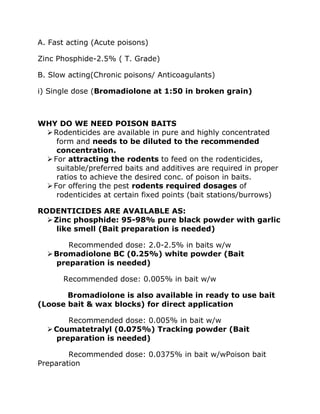
A. Fast acting(Acute poisons)
Zinc Phosphide-2.5% ( T. Grade)
B. Slow acting(Chronic poisons/ Anticoagulants)
i) Single dose (Bromadiolone at 1:50 in broken grain)
WHY DO WE NEED POISON BAITS
➢Rodenticides are available in pure and highly concentrated
form and needs to be diluted to the recommended
concentration.
➢For attracting the rodents to feed on the rodenticides,
suitable/preferred baits and additives are required in proper
ratios to achieve the desired conc. of poison in baits.
➢For offering the pest rodents required dosages of
rodenticides at certain fixed points (bait stations/burrows)
RODENTICIDES ARE AVAILABLE AS:
➢Zinc phosphide: 95-98% pure black powder with garlic
like smell (Bait preparation is needed)
Recommended dose: 2.0-2.5% in baits w/w
➢Bromadiolone BC (0.25%) white powder (Bait
preparation is needed)
Recommended dose: 0.005% in bait w/w
Bromadiolone is also available in ready to use bait
(Loose bait & wax blocks) for direct application
Recommended dose: 0.005% in bait w/w
➢Coumatetralyl (0.075%) Tracking powder (Bait
preparation is needed)
Recommended dose: 0.0375% in bait w/wPoison bait
Preparation
27.
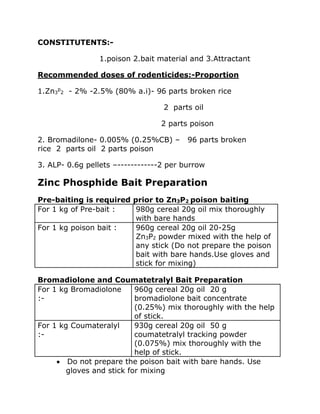
CONSTITUTENTS:-
1.poison 2.bait materialand 3.Attractant
Recommended doses of rodenticides:-Proportion
1.Zn3
p
2 - 2% -2.5% (80% a.i)- 96 parts broken rice
2 parts oil
2 parts poison
2. Bromadilone- 0.005% (0.25%CB) – 96 parts broken
rice 2 parts oil 2 parts poison
3. ALP- 0.6g pellets –------------2 per burrow
Zinc Phosphide Bait Preparation
Pre-baiting is required prior to Zn3P2 poison baiting
For 1 kg of Pre-bait : 980g cereal 20g oil mix thoroughly
with bare hands
For 1 kg poison bait : 960g cereal 20g oil 20-25g
Zn3P2 powder mixed with the help of
any stick (Do not prepare the poison
bait with bare hands.Use gloves and
stick for mixing)
Bromadiolone and Coumatetralyl Bait Preparation
For 1 kg Bromadiolone
:-
960g cereal 20g oil 20 g
bromadiolone bait concentrate
(0.25%) mix thoroughly with the help
of stick.
For 1 kg Coumateralyl
:-
930g cereal 20g oil 50 g
coumatetralyl tracking powder
(0.075%) mix thoroughly with the
help of stick.
• Do not prepare the poison bait with bare hands. Use
gloves and stick for mixing
28.
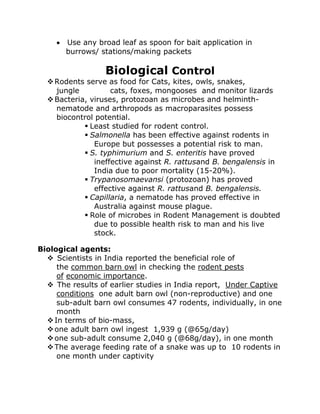
• Use anybroad leaf as spoon for bait application in
burrows/ stations/making packets
Biological Control
❖Rodents serve as food for Cats, kites, owls, snakes,
jungle cats, foxes, mongooses and monitor lizards
❖Bacteria, viruses, protozoan as microbes and helminth-
nematode and arthropods as macroparasites possess
biocontrol potential.
▪ Least studied for rodent control.
▪ Salmonella has been effective against rodents in
Europe but possesses a potential risk to man.
▪ S. typhimurium and S. enteritis have proved
ineffective against R. rattusand B. bengalensis in
India due to poor mortality (15-20%).
▪ Trypanosomaevansi (protozoan) has proved
effective against R. rattusand B. bengalensis.
▪ Capillaria, a nematode has proved effective in
Australia against mouse plague.
▪ Role of microbes in Rodent Management is doubted
due to possible health risk to man and his live
stock.
Biological agents:
❖ Scientists in India reported the beneficial role of
the common barn owl in checking the rodent pests
of economic importance.
❖ The results of earlier studies in India report, Under Captive
conditions one adult barn owl (non-reproductive) and one
sub-adult barn owl consumes 47 rodents, individually, in one
month
❖In terms of bio-mass,
❖one adult barn owl ingest 1,939 g (@65g/day)
❖one sub-adult consume 2,040 g (@68g/day), in one month
❖The average feeding rate of a snake was up to 10 rodents in
one month under captivity
29.
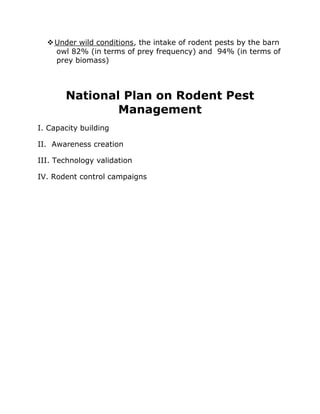
❖Under wild conditions,the intake of rodent pests by the barn
owl 82% (in terms of prey frequency) and 94% (in terms of
prey biomass)
National Plan on Rodent Pest
Management
I. Capacity building
II. Awareness creation
III. Technology validation
IV. Rodent control campaigns
![irritation & leaves the spot immediately [HoneyBee, vol.
9(3):1998].
• Rattlers are erected at different points in the field to keep
away nocturnal rats, mice and porcupines. For this a
bamboo pole of about 2-3 meters in length is erected
firmly on the ground.
• A large sized teak (Tectonagrandis) leaf is hung at the
upper end using a 0.5 – 0.8m long peel strip procured
from leaf rachis of wild date palm (Phoenix
sylvestris). When the leaf dries, it moves with the wind
and strikes the pole making a rattling sound
• Neem leaf powder (5%) showed anti feedant action on
rodents
• Neem oil repelled the rats to the tune of 18-48%.
• Botanicals like kaner seeds, neem cake, castor seeds and
jatropha seeds showed anti rodent properties in
preliminary trials
• Crude cotton-seed oil (5%) showed anti fertility effects on
bandicoots
Repelling House mouse / House rat :
• Rats are easily repelled by certain smells. Effective
smells are of their natural predators, such as
cats.Peppermint oil / cedar leaf oil have been shown to
deter rats for up to a few days. Naphthalene balls in
places of rat activity will make the area rat free.
ITKs to Kill Rats:
• Gliricidiasepium – a rat killer: Mix ground leaves with
cereals & allow them to ferment, then use it as rat
killer.72% Philippino farmers use Gliricidia branches in
rice fields to repel the bugs and other pests.US scientists
confirmed the effectiveness of Gliricidia as rat killer as it
contains coumarin which gets converted to anticoagulant
dicoumerol by bacterial fermentation. This reduces the
protein Prothrombin to cause death in rats due to internal
bleeding
• [Honey Bee,5(1):19,1994]](https://image.slidesharecdn.com/rodentpestmanagement-converted-compressed-250714172527-f4817061/85/RODENT-PEST-MANAGEMENT-converted-compressed-pdf-19-320.jpg)


![谷歌留痕技术 [ 𝙩𝙤𝙥 𝟮𝟯𝟯. 𝙘 𝙤𝙢 ]](https://cdn.slidesharecdn.com/ss_thumbnails/top233-260130174328-3833018c-thumbnail.jpg?width=640&height=640&fit=bounds)


