2
2
What is Physiology?
Whatis Physiology?
• Physiology
Physiology: biological sciences
: biological sciences
• dealing with the normal life phenomena
dealing with the normal life phenomena
exhibited by all living organisms.
exhibited by all living organisms.
• Human physiology
Human physiology: basic sciences
: basic sciences
• dealing with normal life phenomena of the
dealing with normal life phenomena of the
human body.
human body.
• Goal of physiology
Goal of physiology:
:
• explain the physical and chemical factors
explain the physical and chemical factors
that are responsible for the origin,
that are responsible for the origin,
development and progression of life.
development and progression of life.
3.
3
3
Human Physiology
Human Physiology
•Physiology:
Physiology: (Greek) The study of nature, t
(Greek) The study of nature, t
he involvement of Physics and Chemistry.
he involvement of Physics and Chemistry.
• The basis for
The basis for
– Pathophysiology
Pathophysiology
– Pharmacology
Pharmacology
– Immunology
Immunology
– Biochemistry
Biochemistry
– Microbiology
Microbiology
4.
4
4
Why do westudy
Why do we study Physiology
Physiology?
?
Understand the physiologic principle
Understand the physiologic principle
underlie normal function in order to cu
underlie normal function in order to cu
re the impairments.
re the impairments.
5.
5
5
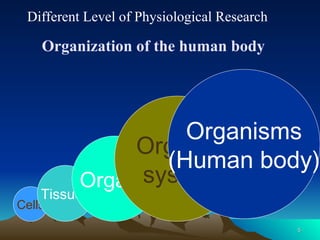
Organization of thehuman body
Cells
Tissues
Organs
Organ
systems
Organisms
(Human body)
Different Level of Physiological Research
9
9
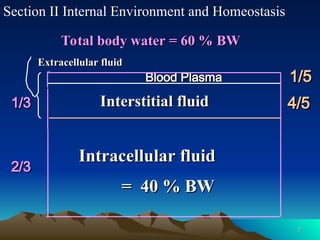
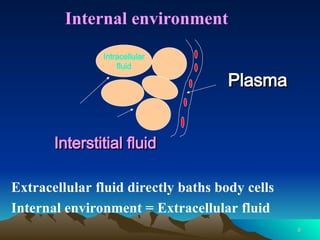
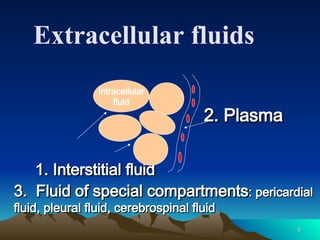
Extracellular fluids
Intracellular
fluid
2. Plasma
2.Plasma
1. Interstitial fluid
1. Interstitial fluid
3. Fluid of special compartments
3. Fluid of special compartments: pericardial
: pericardial
fluid, pleural fluid, cerebrospinal fluid
fluid, pleural fluid, cerebrospinal fluid
10.
10
10
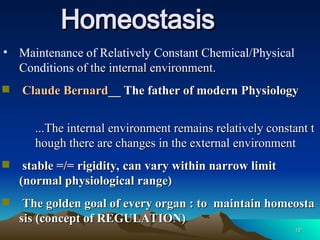
Homeostasis
Homeostasis
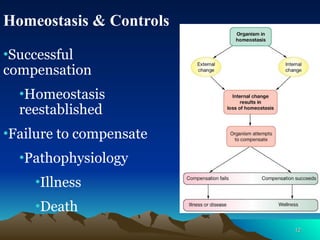
• Maintenance ofRelatively Constant Chemical/Physical
Conditions of the internal environment.
of the internal environment.
Claude Bernard
Claude Bernard__ The father of modern Physiology
__ The father of modern Physiology
...The internal environment remains relatively constant t
...The internal environment remains relatively constant t
hough there are changes in the external environment
hough there are changes in the external environment
stable =/= rigidity, can vary within narrow limit
stable =/= rigidity, can vary within narrow limit
(normal physiological range)
(normal physiological range)
The golden goal of every organ : to maintain homeosta
The golden goal of every organ : to maintain homeosta
sis
sis (concept of REGULATION)
(concept of REGULATION)
11.
11
11
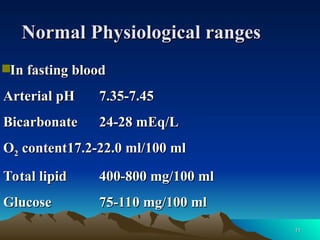
In fasting blood
Infasting blood
Arterial pH
Arterial pH 7.35-7.45
7.35-7.45
Bicarbonate
Bicarbonate 24-28 mEq/L
24-28 mEq/L
O
O2
2 content
content17.2-22.0 ml/100 ml
17.2-22.0 ml/100 ml
Total lipid
Total lipid 400-800 mg/100 ml
400-800 mg/100 ml
Glucose
Glucose 75-110 mg/100 ml
75-110 mg/100 ml
Normal
Normal Physiological ranges
Physiological ranges
13
13
Section 3 Regulationof the Body Functions
Regulation- the ability of an organism to maintain a stable
internal conditions in a constantly changing environment
-Three types:
1. Chemical (hormonal) Regulation- a regulatory process
performed by hormone or active chemical substance in blood or
tissue.
-It responds slowly, acts extensively and lasts for a long time.
2. Nervous Regulation- a process in which body functions are
controlled by nerve system
- Pathway: nerve reflex
- Types: unconditioned reflex and conditioned reflex
14.
14
14
- Example: baroreceptorreflex of arterial blood pressure
- Characteristics: response fast; acts exactly or locally, last for a
short time
3. Autoregulation – a tissue or an organ can directly respond to
environmental changes that are independent of nervous and
hormonal control
Characteristics :
Amplitude of the regulation is smaller than other two types.
Extension of the effects is smaller than other two types.
In the human body these three regulations have coordinated
and acts as one system, “feedback control system”.
15.
15
15
Section 4 ControlSystem
1. Non-automatic Control
Open-loop system
2. Feedback Control
The word “feedback” means a process in which a part of
output (feedback signal) from controlled organ returns to
affect or modify the action of the control system.
Feedback control mechanism consists of two forms: negative
and positive feedback control.
16.
16
16
The feedback signalsfrom controlled
The feedback signals from controlled
system produces effect opposite to the
system produces effect opposite to the
action of the control system.
action of the control system.
The opposite effect is mainly
The opposite effect is mainly
“inhibitory action”.
“inhibitory action”.
Negative feedback
Negative feedback
17.
17
17
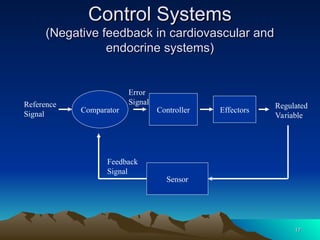
Control Systems
Control Systems
(Negativefeedback in cardiovascular and
(Negative feedback in cardiovascular and
endocrine systems)
endocrine systems)
Reference
Signal
Comparator Controller Effectors
Regulated
Variable
Sensor
Feedback
Signal
Error
Signal
18.
18
18
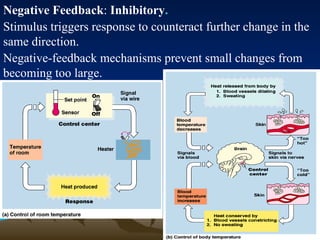
Negative Feedback: Inhibitory.
Stimulustriggers response to counteract further change in the
same direction.
Negative-feedback mechanisms prevent small changes from
becoming too large.
20
20
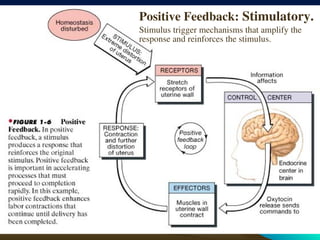
Positive feedback
Positive feedback
Thefeedback signal or output from the
The feedback signal or output from the
controlled system increases the action of
controlled system increases the action of
the control system
the control system
Examples: Blood clotting, Micturition,
Examples: Blood clotting, Micturition,
defecation, Na
defecation, Na+
+
inflow in genesis of nerve
inflow in genesis of nerve
signals, Contraction of the uterus during
signals, Contraction of the uterus during
childbirth (parturition).
childbirth (parturition).
22
22
Importance:
1) Enhance theaction of original stimulus
or amplify or reinforce change, promote
an activity to finish
2) It is known as a vicious circle because it
can lead to instability or even death
23.
23
23
3. Feed-forward control
Concept:a direct effect of stimulus on the
control system before the action of
feedback signal occurs.
Here the direct effect of the stimulus is
termed disturb signal or interfere signal.
Example: Shivering before diving into the
cold water
24.
24
24
Significance of Feedback-forward:
adaptive feedback control.
makes the human body to foresee and adapt
the environment promptly and exactly
(prepare the body for the change).