One Flew Over the Cuckoo’s Nest
Julia Miele Rodas
Lehman College / CUNY
Spring 2022
THE BASICS
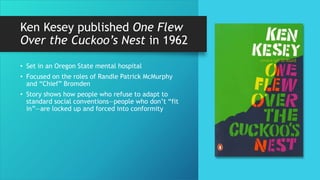
Ken Kesey published One Flew
Over the Cuckoo’s Nest in 1962
‱ Set in an Oregon State mental hospital
‱ Focused on the roles of Randle Patrick McMurphy
and “Chief” Bromden
‱ Story shows how people who refuse to adapt to
standard social conventions—people who don’t “fit
in”—are locked up and forced into conformity
Grounded in 1960s
antipsychiatry movement
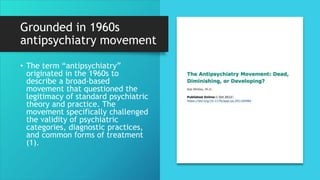
‱ The term “antipsychiatry”
originated in the 1960s to
describe a broad-based
movement that questioned the
legitimacy of standard psychiatric
theory and practice. The
movement specifically challenged
the validity of psychiatric
categories, diagnostic practices,
and common forms of treatment
(1).
Grounded in 1960s antipsychiatry movement
‱ The antipsychiatry movement was motivated by anger at the
perceived arbitrariness of psychiatric diagnostic practice as well
as outrage at the apparent inhumanity of certain treatments,
such as electroconvulsive therapy and long-term involuntary
hospitalization (2). Specific parts of the critique propelled
reform, including rapid deinstitutionalization and attempts to
improve the codification and reliability of psychiatric categories
and diagnostic practices embodied in DSM-III and standardized
clinical interviews.
Grounded in 1960s
antipsychiatry movement
‱ Nevertheless, mainstream
psychiatry—the body of accredited
personnel working in psychiatry and
the common practices, treatments,
theories, and categorizations they
employ—rejected the underlying
critique that psychiatry was little
more than a pseudoscientific agent
of social control.
essential critiques: ableism & rampant
misogyny
 Kill or cure: another disability snuff film: once McMurphy is
disabled, his character is seen as better off dead: murder as
“mercy killing”
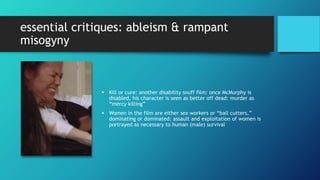
 Women in the film are either sex workers or “ball cutters,”
dominating or dominated: assault and exploitation of women is
portrayed as necessary to human (male) survival
essential themes
 power & resistance
 structural &
institutional
ableism, racism,
homophobia
 Christian allegory
film & the book
McMurphy & Bromden: two versions
film clips
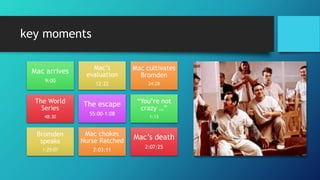
key moments
Mac arrives
9:00
Mac’s
evaluation
12:22
Mac cultivates
Bromden
24:28
The World
Series
48:30
The escape
55:00-1:08
“You’re not
crazy 
”
1:13
Bromden
speaks
1:25:07
Mac chokes
Nurse Ratched
2:03:11
Mac’s death
2:07:25
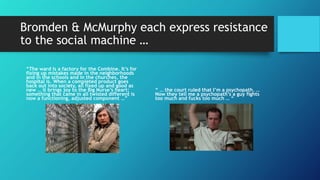
Bromden & McMurphy each express resistance
to the social machine 

“The ward is a factory for the Combine. It’s for
fixing up mistakes made in the neighborhoods
and in the schools and in the churches, the
hospital is. When a completed product goes
back out into society, all fixed up and good as
new 
 it brings joy to the Big Nurse’s heart;
something that came in all twisted different is
now a functioning, adjusted component 
”
“ 
 the court ruled that I’m a psychopath. 

Now they tell me a psychopath’s a guy fights
too much and fucks too much 
 “
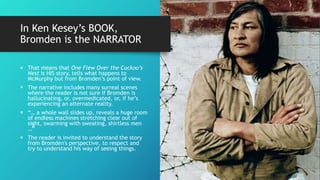
In Ken Kesey’s BOOK,
Bromden is the NARRATOR
 That means that One Flew Over the Cuckoo’s
Nest is HIS story, tells what happens to
McMurphy but from Bromden’s point of view.
 The narrative includes many surreal scenes
where the reader is not sure if Bromden is
hallucinating, or, overmedicated, or, if he’s
experiencing an alternate reality.
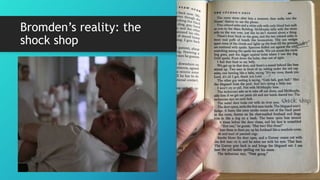
 “
 a whole wall slides up, reveals a huge room
of endless machines stretching clear out of
sight, swarming with sweating, shirtless men

”
 The reader is invited to understand the story
from Bromden's perspective, to respect and
try to understand his way of seeing things.
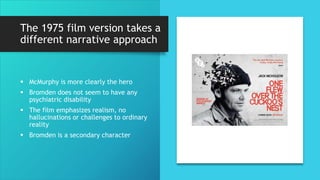
The 1975 film version takes a
different narrative approach
 McMurphy is more clearly the hero
 Bromden does not seem to have any
psychiatric disability
 The film emphasizes realism, no
hallucinations or challenges to ordinary
reality
 Bromden is a secondary character
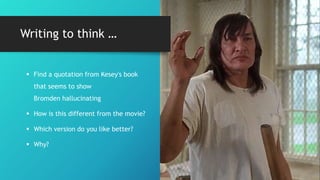
Writing to think 

 Find a quotation from Kesey's book
that seems to show
Bromden hallucinating
 How is this different from the movie?
 Which version do you like better?
 Why?
Bromden’s reality: the
shock shop
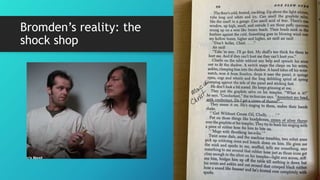
Bromden’s reality: the
shock shop
Stay in touch!
Julia Miele Rodas
@JuliaMieleRodas
julia.rodas@bcc.cuny.edu

RODAS Kesey's Cuckoo's Nest.pptx

  • 1.
    One Flew Overthe Cuckoo’s Nest Julia Miele Rodas Lehman College / CUNY Spring 2022
  • 2.
  • 3.
    Ken Kesey publishedOne Flew Over the Cuckoo’s Nest in 1962 ‱ Set in an Oregon State mental hospital ‱ Focused on the roles of Randle Patrick McMurphy and “Chief” Bromden ‱ Story shows how people who refuse to adapt to standard social conventions—people who don’t “fit in”—are locked up and forced into conformity
  • 4.
    Grounded in 1960s antipsychiatrymovement ‱ The term “antipsychiatry” originated in the 1960s to describe a broad-based movement that questioned the legitimacy of standard psychiatric theory and practice. The movement specifically challenged the validity of psychiatric categories, diagnostic practices, and common forms of treatment (1).
  • 5.
    Grounded in 1960santipsychiatry movement ‱ The antipsychiatry movement was motivated by anger at the perceived arbitrariness of psychiatric diagnostic practice as well as outrage at the apparent inhumanity of certain treatments, such as electroconvulsive therapy and long-term involuntary hospitalization (2). Specific parts of the critique propelled reform, including rapid deinstitutionalization and attempts to improve the codification and reliability of psychiatric categories and diagnostic practices embodied in DSM-III and standardized clinical interviews.
  • 6.
    Grounded in 1960s antipsychiatrymovement ‱ Nevertheless, mainstream psychiatry—the body of accredited personnel working in psychiatry and the common practices, treatments, theories, and categorizations they employ—rejected the underlying critique that psychiatry was little more than a pseudoscientific agent of social control.
  • 7.
    essential critiques: ableism& rampant misogyny  Kill or cure: another disability snuff film: once McMurphy is disabled, his character is seen as better off dead: murder as “mercy killing”  Women in the film are either sex workers or “ball cutters,” dominating or dominated: assault and exploitation of women is portrayed as necessary to human (male) survival
  • 8.
    essential themes  power& resistance  structural & institutional ableism, racism, homophobia  Christian allegory
  • 9.
    film & thebook McMurphy & Bromden: two versions
  • 10.
  • 11.
    key moments Mac arrives 9:00 Mac’s evaluation 12:22 Maccultivates Bromden 24:28 The World Series 48:30 The escape 55:00-1:08 “You’re not crazy 
” 1:13 Bromden speaks 1:25:07 Mac chokes Nurse Ratched 2:03:11 Mac’s death 2:07:25
  • 12.
    Bromden & McMurphyeach express resistance to the social machine 
 “The ward is a factory for the Combine. It’s for fixing up mistakes made in the neighborhoods and in the schools and in the churches, the hospital is. When a completed product goes back out into society, all fixed up and good as new 
 it brings joy to the Big Nurse’s heart; something that came in all twisted different is now a functioning, adjusted component 
” “ 
 the court ruled that I’m a psychopath. 
 Now they tell me a psychopath’s a guy fights too much and fucks too much 
 “
  • 13.
    In Ken Kesey’sBOOK, Bromden is the NARRATOR  That means that One Flew Over the Cuckoo’s Nest is HIS story, tells what happens to McMurphy but from Bromden’s point of view.  The narrative includes many surreal scenes where the reader is not sure if Bromden is hallucinating, or, overmedicated, or, if he’s experiencing an alternate reality.  “
 a whole wall slides up, reveals a huge room of endless machines stretching clear out of sight, swarming with sweating, shirtless men 
”  The reader is invited to understand the story from Bromden's perspective, to respect and try to understand his way of seeing things.
  • 14.
    The 1975 filmversion takes a different narrative approach  McMurphy is more clearly the hero  Bromden does not seem to have any psychiatric disability  The film emphasizes realism, no hallucinations or challenges to ordinary reality  Bromden is a secondary character
  • 15.
    Writing to think
  Find a quotation from Kesey's book that seems to show Bromden hallucinating  How is this different from the movie?  Which version do you like better?  Why?
  • 16.
  • 17.
  • 18.
    Stay in touch! JuliaMiele Rodas @JuliaMieleRodas julia.rodas@bcc.cuny.edu