Printable
     Lesson Materials
     Print these materials as a study guide

                                  These printable materials allow you to study away from
                                  your computer, which many students find beneficial. These
                                  materials consist of two parts: graphic summaries of the
                                  content and a multiple choice quiz.


                                  Graphic Summaries
                                  This portion of your printable materials consists of dozens of
                                  frames that summarize the content in this lesson. The frames are
                                  arranged on the page to make it easy for you to study the material
                                  and add your own notes from your textbook or the online course.


                                  Quizzes
                                  Many students learn best from sets of questions, and this
                                  multiple choice quiz allows you to focus your review of the
                                  material to important topics.


                    13218 NE 20th Street Bellevue, WA 98005 425-747-7272 800-221-9347
                                     www.rockwellinstitute.com

© 2009 Rockwell Institute
California Real Estate Law


                Lesson 21:
                Antitrust Law


                    © Copyright 2007 Rockwell Publishing, Inc.


Introduction

This lesson will discuss:
  l antitrust law
  l prohibited acts
  l enforcing the law
  l antitrust law and the real estate profession


                    © Copyright 2007 Rockwell Publishing, Inc.


Antitrust Law

Antitrust laws are aimed at preventing business
arrangements and practices that have effect of
restraining trade.


Examples:
  l monopolies
  l price fixing
  l anticompetitive agreements

                    © Copyright 2007 Rockwell Publishing, Inc.


                                                                 1
Antitrust Law

Focus of antitrust laws:
  l originally: oil, gas, tobacco companies
  l later: communication and transportation
    companies
  l today: software companies and Internet-
    related services


                  © Copyright 2007 Rockwell Publishing, Inc.


Antitrust Law
Purpose of antitrust law
When businesses work together to control prices or
limit supply ? higher prices; economy suffers


When marketplace is competitive ? better products
and prices


                  © Copyright 2007 Rockwell Publishing, Inc.


Antitrust Law
Purpose of antitrust law
Antitrust laws support competition in marketplace.


Antitrust laws also designed to encourage:
  l entrepreneurs
  l small businesses


                  © Copyright 2007 Rockwell Publishing, Inc.


                                                               2
Antitrust Law
History of antitrust law
In late 1880s, businesses in certain industries (oil,
gas, tobacco, etc.) began merging and
consolidating into huge corporations known as
trusts.


Monopoly: occurs when one seller of goods or
provider of services has exclusive control over
market; results in lack of competition with no
reasonable substitutes

                   © Copyright 2007 Rockwell Publishing, Inc.


Antitrust Law
History of antitrust law
States began enacting antitrust laws, but these laws
were only effective within state borders.


Sherman Antitrust Act: federal law enacted in 1890
  l Congress has since passed other antitrust
    laws, but Sherman Act remains foundation of
    federal antitrust law.


                   © Copyright 2007 Rockwell Publishing, Inc.


Antitrust Law
History of antitrust law
Sherman Act regulates interstate restraints on
trade.
  l at first, only used to break up trusts in certain
    industries


Courts later expanded meaning of “trade” to include
not just production and sale of goods, but also the
provision of services.


                   © Copyright 2007 Rockwell Publishing, Inc.


                                                                3
Antitrust Law
History of antitrust law
In 1950, U.S. Supreme Court held that federal
antitrust laws apply to real estate industry.


In 1976, California supreme court held that
California’s antitrust law (Cartwright Act) applies to
services by real estate brokers.


                   © Copyright 2007 Rockwell Publishing, Inc.


Summary
Antitrust Law


    l Monopoly
    l Sherman Antitrust Act
    l Cartwright Act


                   © Copyright 2007 Rockwell Publishing, Inc.


Prohibited Acts

Not all business decisions that increase profits or
market share violate antitrust laws.
  l competitive practices and lower prices aren’t
    necessarily antitrust violations—may simply
    be good business practices


Market share: amount of business a company does
in a particular area


                  © Copyright 2007 Rockwell Publishing, Inc.


                                                                4
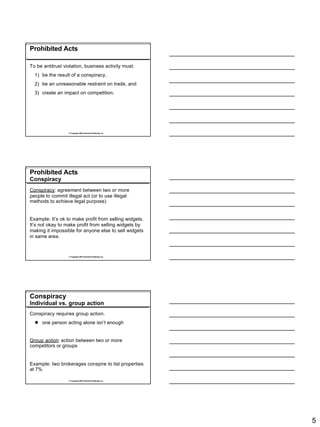
Prohibited Acts

To be antitrust violation, business activity must:
  1) be the result of a conspiracy,
  2) be an unreasonable restraint on trade, and
  3) create an impact on competition.


                  © Copyright 2007 Rockwell Publishing, Inc.


Prohibited Acts
Conspiracy
Conspiracy: agreement between two or more
people to commit illegal act (or to use illegal
methods to achieve legal purpose)


Example: It’s ok to make profit from selling widgets.
It’s not okay to make profit from selling widgets by
making it impossible for anyone else to sell widgets
in same area.


                  © Copyright 2007 Rockwell Publishing, Inc.


Conspiracy
Individual vs. group action
Conspiracy requires group action.
  l one person acting alone isn’t enough


Group action: action between two or more
competitors or groups


Example: two brokerages conspire to list properties
at 7%

                  © Copyright 2007 Rockwell Publishing, Inc.


                                                               5
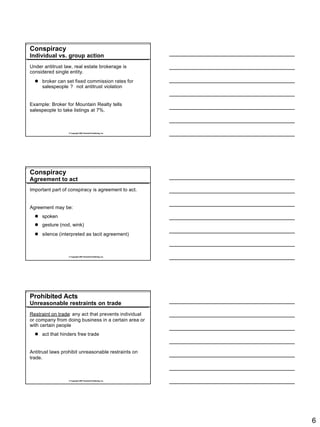
Conspiracy
Individual vs. group action
Under antitrust law, real estate brokerage is
considered single entity.
  l broker can set fixed commission rates for
    salespeople ? not antitrust violation


Example: Broker for Mountain Realty tells
salespeople to take listings at 7%.


                  © Copyright 2007 Rockwell Publishing, Inc.


Conspiracy
Agreement to act
Important part of conspiracy is agreement to act.


Agreement may be:
  l spoken
  l gesture (nod, wink)
  l silence (interpreted as tacit agreement)


                  © Copyright 2007 Rockwell Publishing, Inc.


Prohibited Acts
Unreasonable restraints on trade
Restraint on trade: any act that prevents individual
or company from doing business in a certain area or
with certain people
  l act that hinders free trade


Antitrust laws prohibit unreasonable restraints on
trade.


                  © Copyright 2007 Rockwell Publishing, Inc.


                                                               6
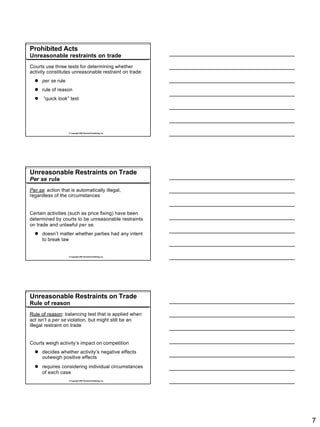
Prohibited Acts
Unreasonable restraints on trade
Courts use three tests for determining whether
activity constitutes unreasonable restraint on trade:
  l per se rule
  l rule of reason
  l   “quick look” test


                   © Copyright 2007 Rockwell Publishing, Inc.


Unreasonable Restraints on Trade
Per se rule
Per se: action that is automatically illegal,
regardless of the circumstances


Certain activities (such as price fixing) have been
determined by courts to be unreasonable restraints
on trade and unlawful per se.
  l doesn’t matter whether parties had any intent
    to break law


                   © Copyright 2007 Rockwell Publishing, Inc.


Unreasonable Restraints on Trade
Rule of reason
Rule of reason: balancing test that is applied when
act isn’t a per se violation, but might still be an
illegal restraint on trade


Courts weigh activity’s impact on competition
  l decides whether activity’s negative effects
    outweigh positive effects
  l requires considering individual circumstances
    of each case
                   © Copyright 2007 Rockwell Publishing, Inc.


                                                                7
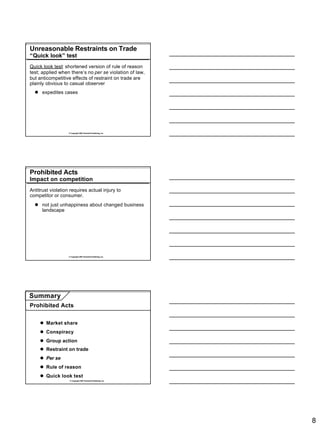
Unreasonable Restraints on Trade
“Quick look” test
Quick look test: shortened version of rule of reason
test; applied when there’s no per se violation of law,
but anticompetitive effects of restraint on trade are
plainly obvious to casual observer
  l expedites cases


                   © Copyright 2007 Rockwell Publishing, Inc.


Prohibited Acts
Impact on competition
Antitrust violation requires actual injury to
competitor or consumer.
  l not just unhappiness about changed business
    landscape


                   © Copyright 2007 Rockwell Publishing, Inc.


Summary
Prohibited Acts


     l Market share
     l Conspiracy
     l Group action
     l Restraint on trade
     l Per se
     l Rule of reason
     l Quick look test
                    © Copyright 2007 Rockwell Publishing, Inc.


                                                                 8
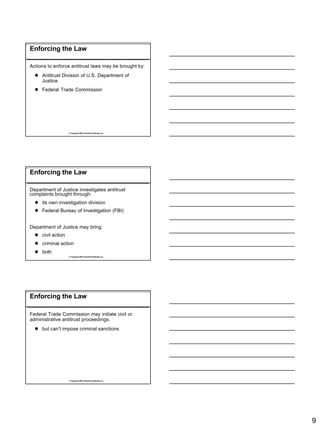
Enforcing the Law

Actions to enforce antitrust laws may be brought by:
  l Antitrust Division of U.S. Department of
    Justice
  l Federal Trade Commission


                   © Copyright 2007 Rockwell Publishing, Inc.


Enforcing the Law

Department of Justice investigates antitrust
complaints brought through:
  l its own investigation division
  l Federal Bureau of Investigation (FBI)


Department of Justice may bring:
  l civil action
  l criminal action
  l both
                   © Copyright 2007 Rockwell Publishing, Inc.


Enforcing the Law

Federal Trade Commission may initiate civil or
administrative antitrust proceedings.
  l but can’t impose criminal sanctions


                   © Copyright 2007 Rockwell Publishing, Inc.


                                                                9
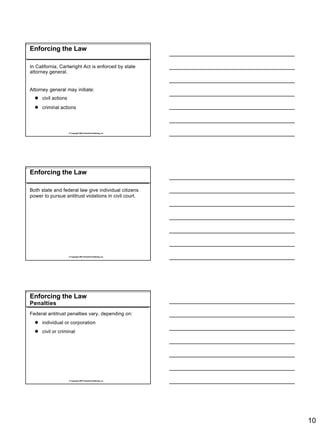
Enforcing the Law

In California, Cartwright Act is enforced by state
attorney general.


Attorney general may initiate:
  l civil actions
  l criminal actions


                    © Copyright 2007 Rockwell Publishing, Inc.


Enforcing the Law

Both state and federal law give individual citizens
power to pursue antitrust violations in civil court.


                    © Copyright 2007 Rockwell Publishing, Inc.


Enforcing the Law
Penalties
Federal antitrust penalties vary, depending on:
  l individual or corporation
  l civil or criminal


                    © Copyright 2007 Rockwell Publishing, Inc.


                                                                 10
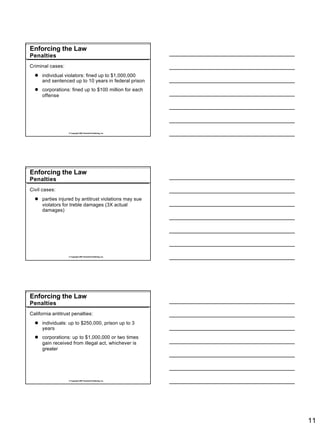
Enforcing the Law
Penalties
Criminal cases:
  l individual violators: fined up to $1,000,000
    and sentenced up to 10 years in federal prison
  l corporations: fined up to $100 million for each
    offense


                   © Copyright 2007 Rockwell Publishing, Inc.


Enforcing the Law
Penalties
Civil cases:
  l parties injured by antitrust violations may sue
    violators for treble damages (3X actual
    damages)


                   © Copyright 2007 Rockwell Publishing, Inc.


Enforcing the Law
Penalties
California antitrust penalties:
  l individuals: up to $250,000, prison up to 3
    years
  l corporations: up to $1,000,000 or two times
    gain received from illegal act, whichever is
    greater


                   © Copyright 2007 Rockwell Publishing, Inc.


                                                                11
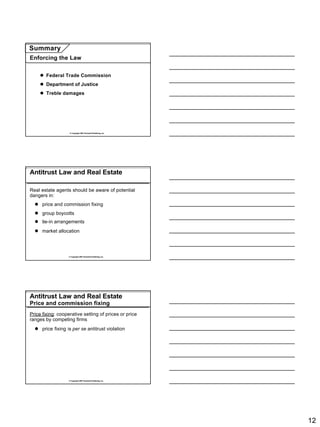
Summary
Enforcing the Law


    l Federal Trade Commission
    l Department of Justice
    l Treble damages


                   © Copyright 2007 Rockwell Publishing, Inc.


Antitrust Law and Real Estate

Real estate agents should be aware of potential
dangers in:
  l price and commission fixing
  l group boycotts
  l tie-in arrangements
  l market allocation


                  © Copyright 2007 Rockwell Publishing, Inc.


Antitrust Law and Real Estate
Price and commission fixing
Price fixing: cooperative setting of prices or price
ranges by competing firms
  l price fixing is per se antitrust violation


                  © Copyright 2007 Rockwell Publishing, Inc.


                                                                12
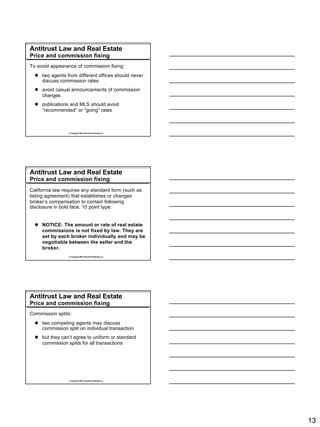
Antitrust Law and Real Estate
Price and commission fixing
To avoid appearance of commission fixing:
  l two agents from different offices should never
    discuss commission rates
  l avoid casual announcements of commission
    changes
  l publications and MLS should avoid
    “recommended” or “going” rates


                 © Copyright 2007 Rockwell Publishing, Inc.


Antitrust Law and Real Estate
Price and commission fixing
California law requires any standard form (such as
listing agreement) that establishes or changes
broker’s compensation to contain following
disclosure in bold face, 10 point type:


  l NOTICE: The amount or rate of real estate
    commissions is not fixed by law. They are
    set by each broker individually and may be
    negotiable between the seller and the
    broker.
                 © Copyright 2007 Rockwell Publishing, Inc.


Antitrust Law and Real Estate
Price and commission fixing
Commission splits:
  l two competing agents may discuss
    commission split on individual transaction
  l but they can’t agree to uniform or standard
    commission splits for all transactions


                 © Copyright 2007 Rockwell Publishing, Inc.


                                                              13
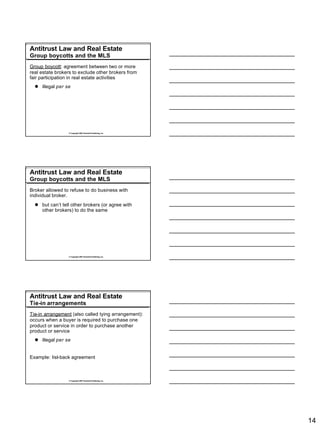
Antitrust Law and Real Estate
Group boycotts and the MLS
Group boycott: agreement between two or more
real estate brokers to exclude other brokers from
fair participation in real estate activities
  l illegal per se


                 © Copyright 2007 Rockwell Publishing, Inc.


Antitrust Law and Real Estate
Group boycotts and the MLS
Broker allowed to refuse to do business with
individual broker.
  l but can’t tell other brokers (or agree with
    other brokers) to do the same


                 © Copyright 2007 Rockwell Publishing, Inc.


Antitrust Law and Real Estate
Tie-in arrangements
Tie-in arrangement (also called tying arrangement):
occurs when a buyer is required to purchase one
product or service in order to purchase another
product or service
  l illegal per se


Example: list-back agreement


                 © Copyright 2007 Rockwell Publishing, Inc.


                                                              14
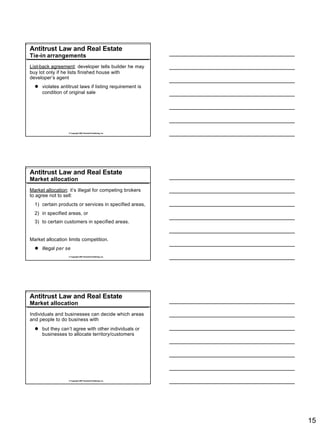
Antitrust Law and Real Estate
Tie-in arrangements
List-back agreement: developer tells builder he may
buy lot only if he lists finished house with
developer’s agent
  l violates antitrust laws if listing requirement is
    condition of original sale


                  © Copyright 2007 Rockwell Publishing, Inc.


Antitrust Law and Real Estate
Market allocation
Market allocation: it’s illegal for competing brokers
to agree not to sell:
  1) certain products or services in specified areas,
  2) in specified areas, or
  3) to certain customers in specified areas.


Market allocation limits competition.
  l illegal per se
                  © Copyright 2007 Rockwell Publishing, Inc.


Antitrust Law and Real Estate
Market allocation
Individuals and businesses can decide which areas
and people to do business with
  l but they can’t agree with other individuals or
    businesses to allocate territory/customers


                  © Copyright 2007 Rockwell Publishing, Inc.


                                                               15
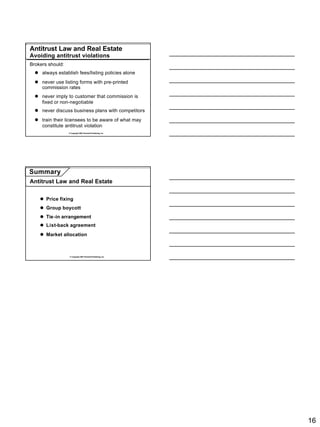
Antitrust Law and Real Estate
Avoiding antitrust violations
Brokers should:
  l always establish fees/listing policies alone
  l never use listing forms with pre-printed
    commission rates
  l never imply to customer that commission is
    fixed or non-negotiable
  l never discuss business plans with competitors
  l train their licensees to be aware of what may
    constitute antitrust violation
                  © Copyright 2007 Rockwell Publishing, Inc.


Summary
Antitrust Law and Real Estate


    l Price fixing
    l Group boycott
    l Tie-in arrangement
    l List-back agreement
    l Market allocation


                   © Copyright 2007 Rockwell Publishing, Inc.


                                                                16
Legal Aspects of Real Estate
                                    Lesson 21 Cumulative Quiz

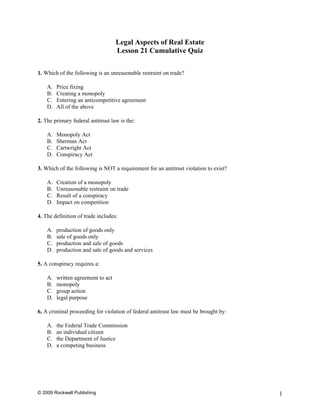
1. Which of the following is an unreasonable restraint on trade?

    A.   Price fixing
    B.   Creating a monopoly
    C.   Entering an anticompetitive agreement
    D.   All of the above

2. The primary federal antitrust law is the:

    A.   Monopoly Act
    B.   Sherman Act
    C.   Cartwright Act
    D.   Conspiracy Act

3. Which of the following is NOT a requirement for an antitrust violation to exist?

    A.   Creation of a monopoly
    B.   Unreasonable restraint on trade
    C.   Result of a conspiracy
    D.   Impact on competition

4. The definition of trade includes:

    A.   production of goods only
    B.   sale of goods only
    C.   production and sale of goods
    D.   production and sale of goods and services

5. A conspiracy requires a:

    A.   written agreement to act
    B.   monopoly
    C.   group action
    D.   legal purpose

6. A criminal proceeding for violation of federal antitrust law must be brought by:

    A.   the Federal Trade Commission
    B.   an individual citizen
    C.   the Department of Justice
    D.   a competing business


© 2009 Rockwell Publishing                                                            1
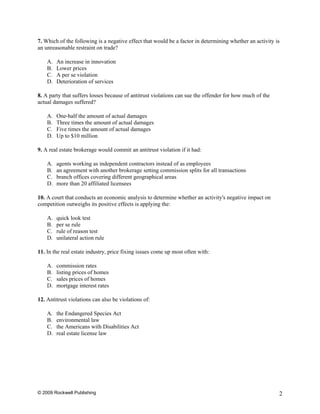
7. Which of the following is a negative effect that would be a factor in determining whether an activity is
an unreasonable restraint on trade?

    A.   An increase in innovation
    B.   Lower prices
    C.   A per se violation
    D.   Deterioration of services

8. A party that suffers losses because of antitrust violations can sue the offender for how much of the
actual damages suffered?

    A.   One-half the amount of actual damages
    B.   Three times the amount of actual damages
    C.   Five times the amount of actual damages
    D.   Up to $10 million

9. A real estate brokerage would commit an antitrust violation if it had:

    A.   agents working as independent contractors instead of as employees
    B.   an agreement with another brokerage setting commission splits for all transactions
    C.   branch offices covering different geographical areas
    D.   more than 20 affiliated licensees

10. A court that conducts an economic analysis to determine whether an activity's negative impact on
competition outweighs its positive effects is applying the:

    A.   quick look test
    B.   per se rule
    C.   rule of reason test
    D.   unilateral action rule

11. In the real estate industry, price fixing issues come up most often with:

    A.   commission rates
    B.   listing prices of homes
    C.   sales prices of homes
    D.   mortgage interest rates

12. Antitrust violations can also be violations of:

    A.   the Endangered Species Act
    B.   environmental law
    C.   the Americans with Disabilities Act
    D.   real estate license law


© 2009 Rockwell Publishing                                                                                2
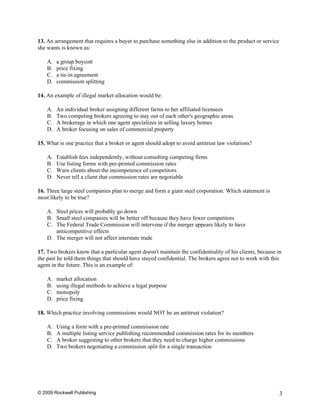
13. An arrangement that requires a buyer to purchase something else in addition to the product or service
she wants is known as:

    A.   a group boycott
    B.   price fixing
    C.   a tie-in agreement
    D.   commission splitting

14. An example of illegal market allocation would be:

    A.   An individual broker assigning different farms to her affiliated licensees
    B.   Two competing brokers agreeing to stay out of each other's geographic areas
    C.   A brokerage in which one agent specializes in selling luxury homes
    D.   A broker focusing on sales of commercial property

15. What is one practice that a broker or agent should adopt to avoid antitrust law violations?

    A.   Establish fees independently, without consulting competing firms
    B.   Use listing forms with pre-printed commission rates
    C.   Warn clients about the incompetence of competitors
    D.   Never tell a client that commission rates are negotiable

16. Three large steel companies plan to merge and form a giant steel corporation. Which statement is
most likely to be true?

    A. Steel prices will probably go down
    B. Small steel companies will be better off because they have fewer competitors
    C. The Federal Trade Commission will intervene if the merger appears likely to have
       anticompetitive effects
    D. The merger will not affect interstate trade

17. Two brokers know that a particular agent doesn't maintain the confidentiality of his clients, because in
the past he told them things that should have stayed confidential. The brokers agree not to work with this
agent in the future. This is an example of:

    A.   market allocation
    B.   using illegal methods to achieve a legal purpose
    C.   monopoly
    D.   price fixing

18. Which practice involving commissions would NOT be an antitrust violation?

    A.   Using a form with a pre-printed commission rate
    B.   A multiple listing service publishing recommended commission rates for its members
    C.   A broker suggesting to other brokers that they need to charge higher commissions
    D.   Two brokers negotiating a commission split for a single transaction


© 2009 Rockwell Publishing                                                                                  3
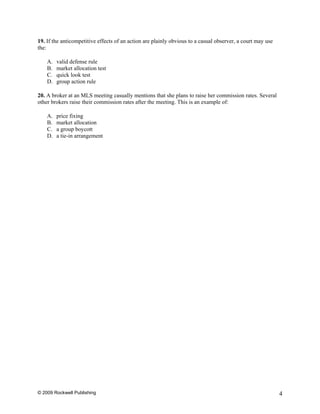
19. If the anticompetitive effects of an action are plainly obvious to a casual observer, a court may use
the:

    A.   valid defense rule
    B.   market allocation test
    C.   quick look test
    D.   group action rule

20. A broker at an MLS meeting casually mentions that she plans to raise her commission rates. Several
other brokers raise their commission rates after the meeting. This is an example of:

    A.   price fixing
    B.   market allocation
    C.   a group boycott
    D.   a tie-in arrangement


© 2009 Rockwell Publishing                                                                                  4

Rockwell publishing real estate law chapter 21

  • 1.
    Printable Lesson Materials Print these materials as a study guide These printable materials allow you to study away from your computer, which many students find beneficial. These materials consist of two parts: graphic summaries of the content and a multiple choice quiz. Graphic Summaries This portion of your printable materials consists of dozens of frames that summarize the content in this lesson. The frames are arranged on the page to make it easy for you to study the material and add your own notes from your textbook or the online course. Quizzes Many students learn best from sets of questions, and this multiple choice quiz allows you to focus your review of the material to important topics. 13218 NE 20th Street Bellevue, WA 98005 425-747-7272 800-221-9347 www.rockwellinstitute.com © 2009 Rockwell Institute
  • 2.
    California Real EstateLaw Lesson 21: Antitrust Law © Copyright 2007 Rockwell Publishing, Inc. Introduction This lesson will discuss: l antitrust law l prohibited acts l enforcing the law l antitrust law and the real estate profession © Copyright 2007 Rockwell Publishing, Inc. Antitrust Law Antitrust laws are aimed at preventing business arrangements and practices that have effect of restraining trade. Examples: l monopolies l price fixing l anticompetitive agreements © Copyright 2007 Rockwell Publishing, Inc. 1
  • 3.
    Antitrust Law Focus ofantitrust laws: l originally: oil, gas, tobacco companies l later: communication and transportation companies l today: software companies and Internet- related services © Copyright 2007 Rockwell Publishing, Inc. Antitrust Law Purpose of antitrust law When businesses work together to control prices or limit supply ? higher prices; economy suffers When marketplace is competitive ? better products and prices © Copyright 2007 Rockwell Publishing, Inc. Antitrust Law Purpose of antitrust law Antitrust laws support competition in marketplace. Antitrust laws also designed to encourage: l entrepreneurs l small businesses © Copyright 2007 Rockwell Publishing, Inc. 2
  • 4.
    Antitrust Law History ofantitrust law In late 1880s, businesses in certain industries (oil, gas, tobacco, etc.) began merging and consolidating into huge corporations known as trusts. Monopoly: occurs when one seller of goods or provider of services has exclusive control over market; results in lack of competition with no reasonable substitutes © Copyright 2007 Rockwell Publishing, Inc. Antitrust Law History of antitrust law States began enacting antitrust laws, but these laws were only effective within state borders. Sherman Antitrust Act: federal law enacted in 1890 l Congress has since passed other antitrust laws, but Sherman Act remains foundation of federal antitrust law. © Copyright 2007 Rockwell Publishing, Inc. Antitrust Law History of antitrust law Sherman Act regulates interstate restraints on trade. l at first, only used to break up trusts in certain industries Courts later expanded meaning of “trade” to include not just production and sale of goods, but also the provision of services. © Copyright 2007 Rockwell Publishing, Inc. 3
  • 5.
    Antitrust Law History ofantitrust law In 1950, U.S. Supreme Court held that federal antitrust laws apply to real estate industry. In 1976, California supreme court held that California’s antitrust law (Cartwright Act) applies to services by real estate brokers. © Copyright 2007 Rockwell Publishing, Inc. Summary Antitrust Law l Monopoly l Sherman Antitrust Act l Cartwright Act © Copyright 2007 Rockwell Publishing, Inc. Prohibited Acts Not all business decisions that increase profits or market share violate antitrust laws. l competitive practices and lower prices aren’t necessarily antitrust violations—may simply be good business practices Market share: amount of business a company does in a particular area © Copyright 2007 Rockwell Publishing, Inc. 4
  • 6.
    Prohibited Acts To beantitrust violation, business activity must: 1) be the result of a conspiracy, 2) be an unreasonable restraint on trade, and 3) create an impact on competition. © Copyright 2007 Rockwell Publishing, Inc. Prohibited Acts Conspiracy Conspiracy: agreement between two or more people to commit illegal act (or to use illegal methods to achieve legal purpose) Example: It’s ok to make profit from selling widgets. It’s not okay to make profit from selling widgets by making it impossible for anyone else to sell widgets in same area. © Copyright 2007 Rockwell Publishing, Inc. Conspiracy Individual vs. group action Conspiracy requires group action. l one person acting alone isn’t enough Group action: action between two or more competitors or groups Example: two brokerages conspire to list properties at 7% © Copyright 2007 Rockwell Publishing, Inc. 5
  • 7.
    Conspiracy Individual vs. groupaction Under antitrust law, real estate brokerage is considered single entity. l broker can set fixed commission rates for salespeople ? not antitrust violation Example: Broker for Mountain Realty tells salespeople to take listings at 7%. © Copyright 2007 Rockwell Publishing, Inc. Conspiracy Agreement to act Important part of conspiracy is agreement to act. Agreement may be: l spoken l gesture (nod, wink) l silence (interpreted as tacit agreement) © Copyright 2007 Rockwell Publishing, Inc. Prohibited Acts Unreasonable restraints on trade Restraint on trade: any act that prevents individual or company from doing business in a certain area or with certain people l act that hinders free trade Antitrust laws prohibit unreasonable restraints on trade. © Copyright 2007 Rockwell Publishing, Inc. 6
  • 8.
    Prohibited Acts Unreasonable restraintson trade Courts use three tests for determining whether activity constitutes unreasonable restraint on trade: l per se rule l rule of reason l “quick look” test © Copyright 2007 Rockwell Publishing, Inc. Unreasonable Restraints on Trade Per se rule Per se: action that is automatically illegal, regardless of the circumstances Certain activities (such as price fixing) have been determined by courts to be unreasonable restraints on trade and unlawful per se. l doesn’t matter whether parties had any intent to break law © Copyright 2007 Rockwell Publishing, Inc. Unreasonable Restraints on Trade Rule of reason Rule of reason: balancing test that is applied when act isn’t a per se violation, but might still be an illegal restraint on trade Courts weigh activity’s impact on competition l decides whether activity’s negative effects outweigh positive effects l requires considering individual circumstances of each case © Copyright 2007 Rockwell Publishing, Inc. 7
  • 9.
    Unreasonable Restraints onTrade “Quick look” test Quick look test: shortened version of rule of reason test; applied when there’s no per se violation of law, but anticompetitive effects of restraint on trade are plainly obvious to casual observer l expedites cases © Copyright 2007 Rockwell Publishing, Inc. Prohibited Acts Impact on competition Antitrust violation requires actual injury to competitor or consumer. l not just unhappiness about changed business landscape © Copyright 2007 Rockwell Publishing, Inc. Summary Prohibited Acts l Market share l Conspiracy l Group action l Restraint on trade l Per se l Rule of reason l Quick look test © Copyright 2007 Rockwell Publishing, Inc. 8
  • 10.
    Enforcing the Law Actionsto enforce antitrust laws may be brought by: l Antitrust Division of U.S. Department of Justice l Federal Trade Commission © Copyright 2007 Rockwell Publishing, Inc. Enforcing the Law Department of Justice investigates antitrust complaints brought through: l its own investigation division l Federal Bureau of Investigation (FBI) Department of Justice may bring: l civil action l criminal action l both © Copyright 2007 Rockwell Publishing, Inc. Enforcing the Law Federal Trade Commission may initiate civil or administrative antitrust proceedings. l but can’t impose criminal sanctions © Copyright 2007 Rockwell Publishing, Inc. 9
  • 11.
    Enforcing the Law InCalifornia, Cartwright Act is enforced by state attorney general. Attorney general may initiate: l civil actions l criminal actions © Copyright 2007 Rockwell Publishing, Inc. Enforcing the Law Both state and federal law give individual citizens power to pursue antitrust violations in civil court. © Copyright 2007 Rockwell Publishing, Inc. Enforcing the Law Penalties Federal antitrust penalties vary, depending on: l individual or corporation l civil or criminal © Copyright 2007 Rockwell Publishing, Inc. 10
  • 12.
    Enforcing the Law Penalties Criminalcases: l individual violators: fined up to $1,000,000 and sentenced up to 10 years in federal prison l corporations: fined up to $100 million for each offense © Copyright 2007 Rockwell Publishing, Inc. Enforcing the Law Penalties Civil cases: l parties injured by antitrust violations may sue violators for treble damages (3X actual damages) © Copyright 2007 Rockwell Publishing, Inc. Enforcing the Law Penalties California antitrust penalties: l individuals: up to $250,000, prison up to 3 years l corporations: up to $1,000,000 or two times gain received from illegal act, whichever is greater © Copyright 2007 Rockwell Publishing, Inc. 11
  • 13.
    Summary Enforcing the Law l Federal Trade Commission l Department of Justice l Treble damages © Copyright 2007 Rockwell Publishing, Inc. Antitrust Law and Real Estate Real estate agents should be aware of potential dangers in: l price and commission fixing l group boycotts l tie-in arrangements l market allocation © Copyright 2007 Rockwell Publishing, Inc. Antitrust Law and Real Estate Price and commission fixing Price fixing: cooperative setting of prices or price ranges by competing firms l price fixing is per se antitrust violation © Copyright 2007 Rockwell Publishing, Inc. 12
  • 14.
    Antitrust Law andReal Estate Price and commission fixing To avoid appearance of commission fixing: l two agents from different offices should never discuss commission rates l avoid casual announcements of commission changes l publications and MLS should avoid “recommended” or “going” rates © Copyright 2007 Rockwell Publishing, Inc. Antitrust Law and Real Estate Price and commission fixing California law requires any standard form (such as listing agreement) that establishes or changes broker’s compensation to contain following disclosure in bold face, 10 point type: l NOTICE: The amount or rate of real estate commissions is not fixed by law. They are set by each broker individually and may be negotiable between the seller and the broker. © Copyright 2007 Rockwell Publishing, Inc. Antitrust Law and Real Estate Price and commission fixing Commission splits: l two competing agents may discuss commission split on individual transaction l but they can’t agree to uniform or standard commission splits for all transactions © Copyright 2007 Rockwell Publishing, Inc. 13
  • 15.
    Antitrust Law andReal Estate Group boycotts and the MLS Group boycott: agreement between two or more real estate brokers to exclude other brokers from fair participation in real estate activities l illegal per se © Copyright 2007 Rockwell Publishing, Inc. Antitrust Law and Real Estate Group boycotts and the MLS Broker allowed to refuse to do business with individual broker. l but can’t tell other brokers (or agree with other brokers) to do the same © Copyright 2007 Rockwell Publishing, Inc. Antitrust Law and Real Estate Tie-in arrangements Tie-in arrangement (also called tying arrangement): occurs when a buyer is required to purchase one product or service in order to purchase another product or service l illegal per se Example: list-back agreement © Copyright 2007 Rockwell Publishing, Inc. 14
  • 16.
    Antitrust Law andReal Estate Tie-in arrangements List-back agreement: developer tells builder he may buy lot only if he lists finished house with developer’s agent l violates antitrust laws if listing requirement is condition of original sale © Copyright 2007 Rockwell Publishing, Inc. Antitrust Law and Real Estate Market allocation Market allocation: it’s illegal for competing brokers to agree not to sell: 1) certain products or services in specified areas, 2) in specified areas, or 3) to certain customers in specified areas. Market allocation limits competition. l illegal per se © Copyright 2007 Rockwell Publishing, Inc. Antitrust Law and Real Estate Market allocation Individuals and businesses can decide which areas and people to do business with l but they can’t agree with other individuals or businesses to allocate territory/customers © Copyright 2007 Rockwell Publishing, Inc. 15
  • 17.
    Antitrust Law andReal Estate Avoiding antitrust violations Brokers should: l always establish fees/listing policies alone l never use listing forms with pre-printed commission rates l never imply to customer that commission is fixed or non-negotiable l never discuss business plans with competitors l train their licensees to be aware of what may constitute antitrust violation © Copyright 2007 Rockwell Publishing, Inc. Summary Antitrust Law and Real Estate l Price fixing l Group boycott l Tie-in arrangement l List-back agreement l Market allocation © Copyright 2007 Rockwell Publishing, Inc. 16
  • 18.
    Legal Aspects ofReal Estate Lesson 21 Cumulative Quiz 1. Which of the following is an unreasonable restraint on trade? A. Price fixing B. Creating a monopoly C. Entering an anticompetitive agreement D. All of the above 2. The primary federal antitrust law is the: A. Monopoly Act B. Sherman Act C. Cartwright Act D. Conspiracy Act 3. Which of the following is NOT a requirement for an antitrust violation to exist? A. Creation of a monopoly B. Unreasonable restraint on trade C. Result of a conspiracy D. Impact on competition 4. The definition of trade includes: A. production of goods only B. sale of goods only C. production and sale of goods D. production and sale of goods and services 5. A conspiracy requires a: A. written agreement to act B. monopoly C. group action D. legal purpose 6. A criminal proceeding for violation of federal antitrust law must be brought by: A. the Federal Trade Commission B. an individual citizen C. the Department of Justice D. a competing business © 2009 Rockwell Publishing 1
  • 19.
    7. Which ofthe following is a negative effect that would be a factor in determining whether an activity is an unreasonable restraint on trade? A. An increase in innovation B. Lower prices C. A per se violation D. Deterioration of services 8. A party that suffers losses because of antitrust violations can sue the offender for how much of the actual damages suffered? A. One-half the amount of actual damages B. Three times the amount of actual damages C. Five times the amount of actual damages D. Up to $10 million 9. A real estate brokerage would commit an antitrust violation if it had: A. agents working as independent contractors instead of as employees B. an agreement with another brokerage setting commission splits for all transactions C. branch offices covering different geographical areas D. more than 20 affiliated licensees 10. A court that conducts an economic analysis to determine whether an activity's negative impact on competition outweighs its positive effects is applying the: A. quick look test B. per se rule C. rule of reason test D. unilateral action rule 11. In the real estate industry, price fixing issues come up most often with: A. commission rates B. listing prices of homes C. sales prices of homes D. mortgage interest rates 12. Antitrust violations can also be violations of: A. the Endangered Species Act B. environmental law C. the Americans with Disabilities Act D. real estate license law © 2009 Rockwell Publishing 2
  • 20.
    13. An arrangementthat requires a buyer to purchase something else in addition to the product or service she wants is known as: A. a group boycott B. price fixing C. a tie-in agreement D. commission splitting 14. An example of illegal market allocation would be: A. An individual broker assigning different farms to her affiliated licensees B. Two competing brokers agreeing to stay out of each other's geographic areas C. A brokerage in which one agent specializes in selling luxury homes D. A broker focusing on sales of commercial property 15. What is one practice that a broker or agent should adopt to avoid antitrust law violations? A. Establish fees independently, without consulting competing firms B. Use listing forms with pre-printed commission rates C. Warn clients about the incompetence of competitors D. Never tell a client that commission rates are negotiable 16. Three large steel companies plan to merge and form a giant steel corporation. Which statement is most likely to be true? A. Steel prices will probably go down B. Small steel companies will be better off because they have fewer competitors C. The Federal Trade Commission will intervene if the merger appears likely to have anticompetitive effects D. The merger will not affect interstate trade 17. Two brokers know that a particular agent doesn't maintain the confidentiality of his clients, because in the past he told them things that should have stayed confidential. The brokers agree not to work with this agent in the future. This is an example of: A. market allocation B. using illegal methods to achieve a legal purpose C. monopoly D. price fixing 18. Which practice involving commissions would NOT be an antitrust violation? A. Using a form with a pre-printed commission rate B. A multiple listing service publishing recommended commission rates for its members C. A broker suggesting to other brokers that they need to charge higher commissions D. Two brokers negotiating a commission split for a single transaction © 2009 Rockwell Publishing 3
  • 21.
    19. If theanticompetitive effects of an action are plainly obvious to a casual observer, a court may use the: A. valid defense rule B. market allocation test C. quick look test D. group action rule 20. A broker at an MLS meeting casually mentions that she plans to raise her commission rates. Several other brokers raise their commission rates after the meeting. This is an example of: A. price fixing B. market allocation C. a group boycott D. a tie-in arrangement © 2009 Rockwell Publishing 4