Submitted by – Ravi Sah
Class – B.Ed. 4th semester
Roll no. – 36
NERIE-NCERT, Umiam, Meghalaya
 Rocks are made from minerals.
 A mineral is a naturally occurring
inorganic substance with a definite
chemical composition found on Earth.
 A rock may be composed of only one kind
of mineral such as pure limestone, which
is composed of calcite.
 Others may have more than one mineral
like granite which has three minerals –
quartz, feldspar and mica.
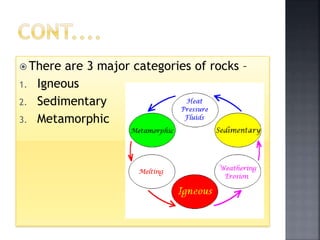
 There are 3 major categories of rocks –
1. Igneous
2. Sedimentary
3. Metamorphic
 Igneous rocks are formed from magma
that has cooled and hardened either
beneath the surface or from a volcanic
eruption.
 Coarse-grained rocks(rough) are from
magma.
 Fine-grained rocks(smooth) are from lava.
 Igneous rocks can be of different types
depending on how the magma cools.
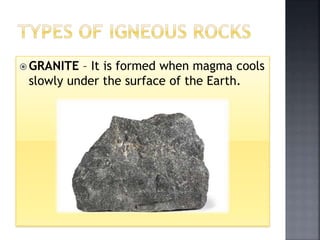
 GRANITE – It is formed when magma cools
slowly under the surface of the Earth.
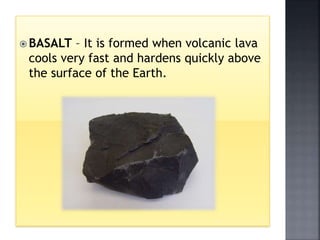
 BASALT – It is formed when volcanic lava
cools very fast and hardens quickly above
the surface of the Earth.
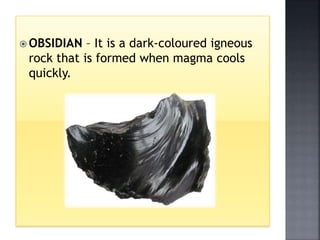
 OBSIDIAN – It is a dark-coloured igneous
rock that is formed when magma cools
quickly.
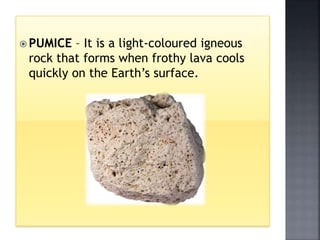
 PUMICE – It is a light-coloured igneous
rock that forms when frothy lava cools
quickly on the Earth’s surface.
 Sedimentary rocks are formed from layers
of sediments, created by weathering, and
erosion, that are laid down in horizontal
strata by water or wind and are squeezed
and stuck together.
 Fossils are usually found in sedimentary
rocks.
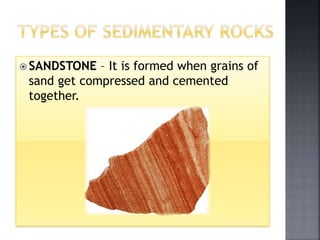
 SANDSTONE – It is formed when grains of
sand get compressed and cemented
together.
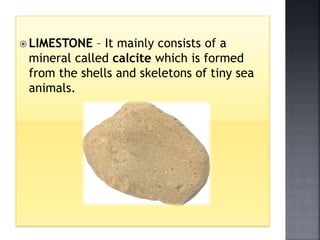
 LIMESTONE – It mainly consists of a
mineral called calcite which is formed
from the shells and skeletons of tiny sea
animals.
 SHALE – It is formed when layers of clay
and silt harden.
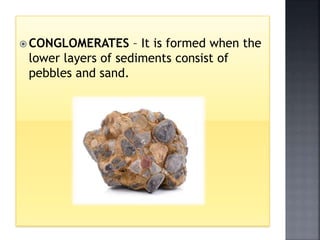
 CONGLOMERATES – It is formed when the
lower layers of sediments consist of
pebbles and sand.
 Metamorphic rocks are formed when
extreme pressure or heat is applied to
sedimentary or igneous rocks.
 The crystalline shape presses together
and changes their appearance which
makes them tougher and harder.
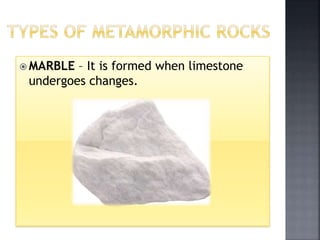
 MARBLE – It is formed when limestone
undergoes changes.
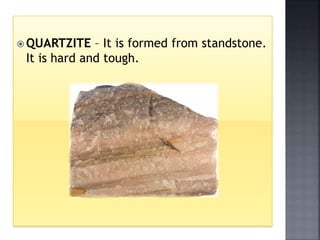
 QUARTZITE – It is formed from standstone.
It is hard and tough.
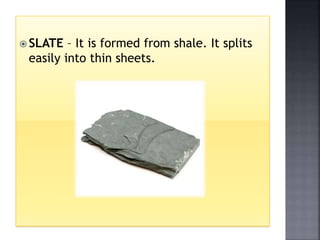
 SLATE – It is formed from shale. It splits
easily into thin sheets.
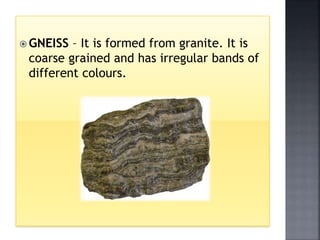
 GNEISS – It is formed from granite. It is
coarse grained and has irregular bands of
different colours.
ROCKS
 https://youtu.be/t0AS5G5v9co
REFERENCES
 https://www.slideshare.net/goatkell/rocks-
minerals-15180147
 https://www.slideshare.net/espinorachel/ro
cks-and-minerals-57767998
 https://www.slideshare.net/belalelnagar3/m
inerals-and-rocks-for-presentations
 https://www.slideshare.net/luchislinda/rock
s-and-minerals-55995096
Rocks and minerals

Rocks and minerals

  • 1.
    Submitted by –Ravi Sah Class – B.Ed. 4th semester Roll no. – 36 NERIE-NCERT, Umiam, Meghalaya
  • 2.
     Rocks aremade from minerals.  A mineral is a naturally occurring inorganic substance with a definite chemical composition found on Earth.  A rock may be composed of only one kind of mineral such as pure limestone, which is composed of calcite.  Others may have more than one mineral like granite which has three minerals – quartz, feldspar and mica.
  • 3.
     There are3 major categories of rocks – 1. Igneous 2. Sedimentary 3. Metamorphic
  • 4.
     Igneous rocksare formed from magma that has cooled and hardened either beneath the surface or from a volcanic eruption.  Coarse-grained rocks(rough) are from magma.  Fine-grained rocks(smooth) are from lava.  Igneous rocks can be of different types depending on how the magma cools.
  • 5.
     GRANITE –It is formed when magma cools slowly under the surface of the Earth.
  • 6.
     BASALT –It is formed when volcanic lava cools very fast and hardens quickly above the surface of the Earth.
  • 7.
     OBSIDIAN –It is a dark-coloured igneous rock that is formed when magma cools quickly.
  • 8.
     PUMICE –It is a light-coloured igneous rock that forms when frothy lava cools quickly on the Earth’s surface.
  • 9.
     Sedimentary rocksare formed from layers of sediments, created by weathering, and erosion, that are laid down in horizontal strata by water or wind and are squeezed and stuck together.  Fossils are usually found in sedimentary rocks.
  • 10.
     SANDSTONE –It is formed when grains of sand get compressed and cemented together.
  • 11.
     LIMESTONE –It mainly consists of a mineral called calcite which is formed from the shells and skeletons of tiny sea animals.
  • 12.
     SHALE –It is formed when layers of clay and silt harden.
  • 13.
     CONGLOMERATES –It is formed when the lower layers of sediments consist of pebbles and sand.
  • 14.
     Metamorphic rocksare formed when extreme pressure or heat is applied to sedimentary or igneous rocks.  The crystalline shape presses together and changes their appearance which makes them tougher and harder.
  • 15.
     MARBLE –It is formed when limestone undergoes changes.
  • 16.
     QUARTZITE –It is formed from standstone. It is hard and tough.
  • 17.
     SLATE –It is formed from shale. It splits easily into thin sheets.
  • 18.
     GNEISS –It is formed from granite. It is coarse grained and has irregular bands of different colours.
  • 19.
    ROCKS  https://youtu.be/t0AS5G5v9co REFERENCES  https://www.slideshare.net/goatkell/rocks- minerals-15180147 https://www.slideshare.net/espinorachel/ro cks-and-minerals-57767998  https://www.slideshare.net/belalelnagar3/m inerals-and-rocks-for-presentations  https://www.slideshare.net/luchislinda/rock s-and-minerals-55995096