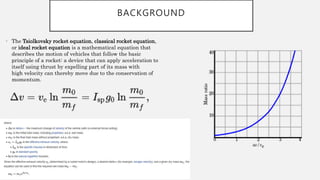
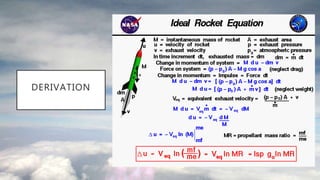
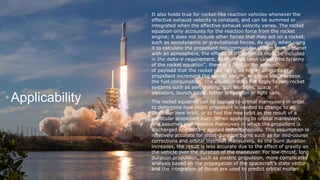
The Tsiolkovsky rocket equation describes the motion of rocket vehicles and was derived independently by several scientists in the 19th and early 20th centuries. It states that the change in velocity of a rocket is determined by the exhaust velocity and the ratio of the rocket's initial mass to its final mass. The rocket equation accounts only for thrust and does not include other forces like gravity. It indicates that higher fuel loads require more propellant due to the increased overall mass, illustrating the inefficiency of rocket propulsion.