Food Safety in Plant Based Foods
the challenge ahead
Robyn McConchie
Faculty of Agriculture and Environment
University of Sydney
Presentation
› Fruit and Veg – they’re healthy and nutritious aren’t they?
› Main safety issues with plant based foods
› Overseas experiences we don’t want to replicate here
› Food safety incidents in Australia
› Food safety research & education at the Faculty of Agriculture and
Environment
Hitching a ride!
Fruit and Veg – healthy and nutritious aren’t they?
Europe – average consumption is
half the daily recommended intake
U.S. – 6-8% of individuals achieve
recommended daily target
Australia – 5.6% of adults had an
adequate daily consumption of
F&V 2011-12
Worldwide daily intake of F&V well
below recommended WHO levels
Source: The Louis Bonduelle Foundation, 2011; Produce for Better
Health Foundation, 2010; Australian Bureau of Statistics, 2012
Do you eat 400g fruit and veg per day?
3
Globally 1.7 million deaths (2.8%) deaths per
annum linked to low F&V consumption (WHO 2013)
Australian Guide to Healthy Eating
2 serves of fruit and 5 serves of
vegetables a day
Fruit and Veg ARE good for you
The last thing we want to risk
human health with unsafe food
Raw food does not have a kill step
Ranked safest among ASEAN
countries
› Source: The Economist Intelligence Unit 2012
Source: Australian Institute of Health and Welfare,
2012
4
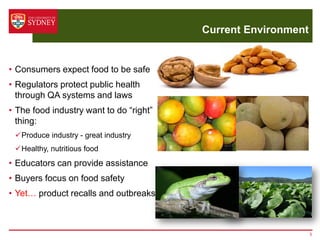
Current Environment
• Consumers expect food to be safe
• Regulators protect public health
through QA systems and laws
• The food industry want to do “right”
thing:
Produce industry - great industry
Healthy, nutritious food
• Educators can provide assistance
• Buyers focus on food safety
• Yet… product recalls and outbreaks
5
BUT Can we rest on our reputation?
› Australia - safest food supplies in the
world…. but we have 5.4 million cases of
food-borne illness a year costing est. $1.2
billion (DAFF 2013)
› Gap between food production and
consumption - consumers know little about
the origin and handling of food
› Consumers have to rely on the food
regulation system for the provision of safe
food
› They do a good job… but need continuous
updating and education of stakeholders in
the supply chains and the consumer
› Incidents and outbreaks of foodborne
disease are monitored and detected via
Communicable Disease Network Australia
and OzFoodNet
Australia has a clean, green image for food production
6
What are the risks with plant based foods?
› Microbial – raw fruit and
vegetables, unpasteurised juices,
fresh cuts e.g. Salmonella,
Campylobacter, Listeria, Shiga-
toxin–producing E. coli
› Pesticide contamination
› Mycotoxins e.g. aflatoxins,
fumonisin, alternariol, patulin,
ochratoxin
› Allergens e.g. peanuts, gluten,
plant defence compounds
7
Sprouts in Europe 2011
May 2011, Germany had a massive epidemic of
bloody diarrhoea and the hemolytic–uremic syndrome
caused by Shiga-toxin–producing Escherichia coli
O104:H4
Over 3 months more than 4000 illnesses, 800 cases
of the hemolytic–uremic syndrome, and 50 deaths in
Germany and in 15 other countries.
8
Spanish fruit and
vegetable exporters
estimate they
lost 200m euros per
week
Melons in the USA 2011
› In 2011, cantaloupes were
contaminated with the bacterium
Listeria monocytogenes
› Caused one of the deadliest
foodborne illness outbreaks in U.S.
history
› Tainted melons sickened 147
people in 28 states, killed 33, and
caused one pregnant woman to
miscarry
9
In Australia?
• An unofficial listing of recalls and
reported illnesses over 10 years in
Horticultural produce (n=45)
• Microbial contamination the most
prevalent category
• Salmonella the most prevalent
individual
• Fruit and veg equally represented
• Nuts also prominent, particularly
almonds
• Residues not as significant as
expectedSource: Richard Bennett 2014 PMA Technical
Manager
Microbial contamination 2012
› Recall of almonds due to
Salmonella contamination
› Wet season almonds lay on the
ground
› Vacuum steam pasturisation and
processing minimises risk
Allergens
› Food allergy occurs in around 1 in 20
children and in about 2 in 100 adults
› Common plant triggers are peanuts
and tree nuts, sesame, soy and wheat
› Some food allergies can be severe,
causing life threatening anaphylaxis -
600 cases per year
› Incorrect labelling major cause
› Industries and service providers are
responsible for correct labelling
› Zero tolerance for presence of
allergens
Source: SCIA http://www.allergy.org.au/patients/food-
allergy
Pesticide contamination 2009
› Situation that could cause material
(economic) and/or reputational
harm to a business, region or
industry
› “Macadamia farmers on
Queensland's Sunshine Coast
are at the centre of a controversy
over two-headed fish
hatchlings.”
› Source: Australian Wildlife Health Network 2009
Farm run-off blamed for two-headed Noosa bass
Mycotoxins
› Mycotoxins are associated with dried
fruit, fruit and fruit juices, coffee
grains, cereals, nuts, spices,
oilseeds, oils and starches
› Toxins produced by fungi
› Tasteless, invisible and can’t be
easily destroyed
› Main pathogens associated with
aflatoxins: Aspergillus flavus,
Aspergillus parasiticus
› In humans causes liver cancer and
damage, immunosuppression
› In animals decreased milk and egg
production
14
“In March this year, a consignment of Australian apple
juice was tested in Japan and found to have
unacceptably high levels of the toxin patulin in it.”
Source: Are your fruit safe for juice? Patulin – the toxic substance
found in juice fruit. Australian Fruitgrower. June 2012.
“Excessive levels of ‘mycotoxins’ found in European
apple juices and cereals.”
Source: AusFoodNews:
http://www.ausfoodnews.com.au/2013/06/24/excessive-levels-of-
%E2%80%98mycotoxins%E2%80%99-found-in-european-apple-
juices-and-cereals.html June 24, 2013
Patulin
Food Safety @ the Faculty of Agriculture and
Environment
15
Project Goals Partners
Australia: A New Collaborative
Paradigm for Fresh Produce Safety:
Stage 2 – A Fresh Produce Safety
Centre.
Research, outreach education funded
and managed by industry
HAL, Produce Marketing Association
A-NZ , 19 Industry partners
Australia: Remediation of soil
contaminated by Salmonella enterica
to expedite plant or replant of
vegetables
Safe use of chicken manure
amendments and risk management
strategies
CPS USA, UC Davis, HAL, Vet Faculty
Africa: Australia Awards for Africa
Short course - Post-harvest
management of maize, rice and
legumes
Post-harvest management and
handling of grains
DFAT, GRM, Universities of Nairobi,
Stellenbosch and Kwame Nkrumah
Science and Technology in Kumasi,
Ghana
Africa: Strengthening food and
nutrition security through family poultry
and crop integration in Tanzania and
Zambia
Linking agricultural R&D with human
health and focus on production
systems under the control of women
Faculty of Vet Science (Lead), Australian
International Food Security Centre,
Ministry of Health, Zambia; Kyeema
Foundation, University of the
Witwatersrand, Tanzania Food and
Nutrition Centre, Royal Veterinary College,
UK; Tanzania Veterinary Laboratory
Agency, Ministry of Agriculture and
Livestock, Zambia; University of Zambia,
Ministry of Agriculture, Food Security and
Cooperatives, Tanzania.
In Australia: Fresh Produce Safety Centre
› Independent, industry-managed
organisation, based at the Faculty
of Agriculture and Environment and
affiliated to the Center for Produce
Safety (US) at University of
California (Davis).
› Role will be to promote fresh
produce safety across Australia
and New Zealand through
research, outreach and education
http:/freshproducesafety-anz.com/
16
Establishment of Fresh Produce Safety Centre at the University of Sydney
Industry Driven and Funded
Hosted by the University of Sydney
17
In Africa: Postharvest interventions to
reduce aflatoxins
Bimodal wet seasons in central Africa
often means harvesting wet grain
above 12% moisture
Fungi can produce mycotoxins pre
and post harvest
Safer Food – Reducing Mycotoxins
18
• Drying Grain 12-14%
• Whole unbroken grain
• Hermetic storage
• Education
Hermetic Storage in Uganda Extension to famers in Kenya
In Africa : Poultry-Crop Systems and
Poultry Value Chains
Potential Cropping Interventions
19
› Identifying product demand – animal feed?
› Identify nutritious products
› Better access to markets/ co-ops
› Safer and better quality food
› Pre-harvest – cultural aspects
› Postharvest Quality
- Drying, grading and storage
- Insect and fungal attack
- Handling and distribution
› Dr Robert Whittaker, Chief Science and Technology Officer PMA USA
› Michael Worthington, CEO PMA Australia and New Zealand
› Richard Bennett Technical Manager PMA Australia and New Zealand
› Erika Watson, Communications Manager FAE
› Reetica Rekhy, Ph D student FAE
› Francis Musavi, Crop Protection Manager Ministry of Agriculture Nairobi, Kenay
› Dr Harriet Muyzinza, Postharvest Scientist, NARO, Uganda
Acknowledgements
20
Thank you
21

Robyn mc conchie_food_safety_overview

  • 1.
    Food Safety inPlant Based Foods the challenge ahead Robyn McConchie Faculty of Agriculture and Environment University of Sydney
  • 2.
    Presentation › Fruit andVeg – they’re healthy and nutritious aren’t they? › Main safety issues with plant based foods › Overseas experiences we don’t want to replicate here › Food safety incidents in Australia › Food safety research & education at the Faculty of Agriculture and Environment Hitching a ride!
  • 3.
    Fruit and Veg– healthy and nutritious aren’t they? Europe – average consumption is half the daily recommended intake U.S. – 6-8% of individuals achieve recommended daily target Australia – 5.6% of adults had an adequate daily consumption of F&V 2011-12 Worldwide daily intake of F&V well below recommended WHO levels Source: The Louis Bonduelle Foundation, 2011; Produce for Better Health Foundation, 2010; Australian Bureau of Statistics, 2012 Do you eat 400g fruit and veg per day? 3
  • 4.
    Globally 1.7 milliondeaths (2.8%) deaths per annum linked to low F&V consumption (WHO 2013) Australian Guide to Healthy Eating 2 serves of fruit and 5 serves of vegetables a day Fruit and Veg ARE good for you The last thing we want to risk human health with unsafe food Raw food does not have a kill step Ranked safest among ASEAN countries › Source: The Economist Intelligence Unit 2012 Source: Australian Institute of Health and Welfare, 2012 4
  • 5.
    Current Environment • Consumersexpect food to be safe • Regulators protect public health through QA systems and laws • The food industry want to do “right” thing: Produce industry - great industry Healthy, nutritious food • Educators can provide assistance • Buyers focus on food safety • Yet… product recalls and outbreaks 5
  • 6.
    BUT Can werest on our reputation? › Australia - safest food supplies in the world…. but we have 5.4 million cases of food-borne illness a year costing est. $1.2 billion (DAFF 2013) › Gap between food production and consumption - consumers know little about the origin and handling of food › Consumers have to rely on the food regulation system for the provision of safe food › They do a good job… but need continuous updating and education of stakeholders in the supply chains and the consumer › Incidents and outbreaks of foodborne disease are monitored and detected via Communicable Disease Network Australia and OzFoodNet Australia has a clean, green image for food production 6
  • 7.
    What are therisks with plant based foods? › Microbial – raw fruit and vegetables, unpasteurised juices, fresh cuts e.g. Salmonella, Campylobacter, Listeria, Shiga- toxin–producing E. coli › Pesticide contamination › Mycotoxins e.g. aflatoxins, fumonisin, alternariol, patulin, ochratoxin › Allergens e.g. peanuts, gluten, plant defence compounds 7
  • 8.
    Sprouts in Europe2011 May 2011, Germany had a massive epidemic of bloody diarrhoea and the hemolytic–uremic syndrome caused by Shiga-toxin–producing Escherichia coli O104:H4 Over 3 months more than 4000 illnesses, 800 cases of the hemolytic–uremic syndrome, and 50 deaths in Germany and in 15 other countries. 8 Spanish fruit and vegetable exporters estimate they lost 200m euros per week
  • 9.
    Melons in theUSA 2011 › In 2011, cantaloupes were contaminated with the bacterium Listeria monocytogenes › Caused one of the deadliest foodborne illness outbreaks in U.S. history › Tainted melons sickened 147 people in 28 states, killed 33, and caused one pregnant woman to miscarry 9
  • 10.
    In Australia? • Anunofficial listing of recalls and reported illnesses over 10 years in Horticultural produce (n=45) • Microbial contamination the most prevalent category • Salmonella the most prevalent individual • Fruit and veg equally represented • Nuts also prominent, particularly almonds • Residues not as significant as expectedSource: Richard Bennett 2014 PMA Technical Manager
  • 11.
    Microbial contamination 2012 ›Recall of almonds due to Salmonella contamination › Wet season almonds lay on the ground › Vacuum steam pasturisation and processing minimises risk
  • 12.
    Allergens › Food allergyoccurs in around 1 in 20 children and in about 2 in 100 adults › Common plant triggers are peanuts and tree nuts, sesame, soy and wheat › Some food allergies can be severe, causing life threatening anaphylaxis - 600 cases per year › Incorrect labelling major cause › Industries and service providers are responsible for correct labelling › Zero tolerance for presence of allergens Source: SCIA http://www.allergy.org.au/patients/food- allergy
  • 13.
    Pesticide contamination 2009 ›Situation that could cause material (economic) and/or reputational harm to a business, region or industry › “Macadamia farmers on Queensland's Sunshine Coast are at the centre of a controversy over two-headed fish hatchlings.” › Source: Australian Wildlife Health Network 2009 Farm run-off blamed for two-headed Noosa bass
  • 14.
    Mycotoxins › Mycotoxins areassociated with dried fruit, fruit and fruit juices, coffee grains, cereals, nuts, spices, oilseeds, oils and starches › Toxins produced by fungi › Tasteless, invisible and can’t be easily destroyed › Main pathogens associated with aflatoxins: Aspergillus flavus, Aspergillus parasiticus › In humans causes liver cancer and damage, immunosuppression › In animals decreased milk and egg production 14 “In March this year, a consignment of Australian apple juice was tested in Japan and found to have unacceptably high levels of the toxin patulin in it.” Source: Are your fruit safe for juice? Patulin – the toxic substance found in juice fruit. Australian Fruitgrower. June 2012. “Excessive levels of ‘mycotoxins’ found in European apple juices and cereals.” Source: AusFoodNews: http://www.ausfoodnews.com.au/2013/06/24/excessive-levels-of- %E2%80%98mycotoxins%E2%80%99-found-in-european-apple- juices-and-cereals.html June 24, 2013 Patulin
  • 15.
    Food Safety @the Faculty of Agriculture and Environment 15 Project Goals Partners Australia: A New Collaborative Paradigm for Fresh Produce Safety: Stage 2 – A Fresh Produce Safety Centre. Research, outreach education funded and managed by industry HAL, Produce Marketing Association A-NZ , 19 Industry partners Australia: Remediation of soil contaminated by Salmonella enterica to expedite plant or replant of vegetables Safe use of chicken manure amendments and risk management strategies CPS USA, UC Davis, HAL, Vet Faculty Africa: Australia Awards for Africa Short course - Post-harvest management of maize, rice and legumes Post-harvest management and handling of grains DFAT, GRM, Universities of Nairobi, Stellenbosch and Kwame Nkrumah Science and Technology in Kumasi, Ghana Africa: Strengthening food and nutrition security through family poultry and crop integration in Tanzania and Zambia Linking agricultural R&D with human health and focus on production systems under the control of women Faculty of Vet Science (Lead), Australian International Food Security Centre, Ministry of Health, Zambia; Kyeema Foundation, University of the Witwatersrand, Tanzania Food and Nutrition Centre, Royal Veterinary College, UK; Tanzania Veterinary Laboratory Agency, Ministry of Agriculture and Livestock, Zambia; University of Zambia, Ministry of Agriculture, Food Security and Cooperatives, Tanzania.
  • 16.
    In Australia: FreshProduce Safety Centre › Independent, industry-managed organisation, based at the Faculty of Agriculture and Environment and affiliated to the Center for Produce Safety (US) at University of California (Davis). › Role will be to promote fresh produce safety across Australia and New Zealand through research, outreach and education http:/freshproducesafety-anz.com/ 16 Establishment of Fresh Produce Safety Centre at the University of Sydney
  • 17.
    Industry Driven andFunded Hosted by the University of Sydney 17
  • 18.
    In Africa: Postharvestinterventions to reduce aflatoxins Bimodal wet seasons in central Africa often means harvesting wet grain above 12% moisture Fungi can produce mycotoxins pre and post harvest Safer Food – Reducing Mycotoxins 18 • Drying Grain 12-14% • Whole unbroken grain • Hermetic storage • Education Hermetic Storage in Uganda Extension to famers in Kenya
  • 19.
    In Africa :Poultry-Crop Systems and Poultry Value Chains Potential Cropping Interventions 19 › Identifying product demand – animal feed? › Identify nutritious products › Better access to markets/ co-ops › Safer and better quality food › Pre-harvest – cultural aspects › Postharvest Quality - Drying, grading and storage - Insect and fungal attack - Handling and distribution
  • 20.
    › Dr RobertWhittaker, Chief Science and Technology Officer PMA USA › Michael Worthington, CEO PMA Australia and New Zealand › Richard Bennett Technical Manager PMA Australia and New Zealand › Erika Watson, Communications Manager FAE › Reetica Rekhy, Ph D student FAE › Francis Musavi, Crop Protection Manager Ministry of Agriculture Nairobi, Kenay › Dr Harriet Muyzinza, Postharvest Scientist, NARO, Uganda Acknowledgements 20
  • 21.