Download to read offline









![text = "This is some generic text"
index = 0
while index < len(text):
print(text[index])
index += 1](https://image.slidesharecdn.com/robustpython-221119152942-6a61ebb5/85/Robust-Python-pptx-38-320.jpg)




![def print_receipt(
order: Order,
restaurant: tuple[str, int,
str]):
total = (order.subtotal *
(1 + tax[restaurant[2]]))](https://image.slidesharecdn.com/robustpython-221119152942-6a61ebb5/85/Robust-Python-pptx-48-320.jpg)
![def print_receipt(
order: Order,
restaurant: tuple[str, int,
str]):
total = (order.subtotal *
(1 + tax[restaurant[2]]))](https://image.slidesharecdn.com/robustpython-221119152942-6a61ebb5/85/Robust-Python-pptx-49-320.jpg)
![def print_receipt(
order: Order,
restaurant: Restaurant):
total = (order.subtotal *
(1 + tax[restaurant.city]))
print(Receipt(restaurant.name,](https://image.slidesharecdn.com/robustpython-221119152942-6a61ebb5/85/Robust-Python-pptx-50-320.jpg)




![def create_daughter_sauce(
mother_sauce: str,
extra_ingredients: list[str]):
# ...
create_daughter_sauce(MOTHER_SAUCE[0],
["Onion"])](https://image.slidesharecdn.com/robustpython-221119152942-6a61ebb5/85/Robust-Python-pptx-58-320.jpg)
![def create_daughter_sauce(
mother_sauce: str,
extra_ingredients: list[str]):
# ...
# What was MOTHER_SAUCE[0] again?
create_daughter_sauce(MOTHER_SAUCE[0],
["Onion"])](https://image.slidesharecdn.com/robustpython-221119152942-6a61ebb5/85/Robust-Python-pptx-59-320.jpg)
![def create_daughter_sauce(
mother_sauce: str,
extra_ingredients: list[str]):
# ...
create_daughter_sauce(MOTHER_SAUCE[0],
["Onion"])](https://image.slidesharecdn.com/robustpython-221119152942-6a61ebb5/85/Robust-Python-pptx-60-320.jpg)
![def create_daughter_sauce(
mother_sauce: str,
extra_ingredients: list[str]):
# ...
create_daughter_sauce("Bechamel",
["Onion"])](https://image.slidesharecdn.com/robustpython-221119152942-6a61ebb5/85/Robust-Python-pptx-61-320.jpg)
![def create_daughter_sauce(
mother_sauce: str,
extra_ingredients: list[str]):
# ...
create_daughter_sauce("BBQ Sauce",
["Onion"])](https://image.slidesharecdn.com/robustpython-221119152942-6a61ebb5/85/Robust-Python-pptx-62-320.jpg)
![def create_daughter_sauce(
mother_sauce: str,
extra_ingredients: list[str]):
# ...
create_daughter_sauce("BBQ Sauce",
["Onion"])
Wrong](https://image.slidesharecdn.com/robustpython-221119152942-6a61ebb5/85/Robust-Python-pptx-63-320.jpg)
![def create_daughter_sauce(
mother_sauce: str,
extra_ingredients: list[str]):
# ...
create_daughter_sauce("Bechamel",
["Onion"])](https://image.slidesharecdn.com/robustpython-221119152942-6a61ebb5/85/Robust-Python-pptx-64-320.jpg)
![def create_daughter_sauce(
mother_sauce: str,
extra_ingredients: list[str]):
# ...
create_daughter_sauce("Béchamel",
["Onion"])](https://image.slidesharecdn.com/robustpython-221119152942-6a61ebb5/85/Robust-Python-pptx-65-320.jpg)


![def create_daughter_sauce(
mother_sauce: str,
extra_ingredients: list[str]):
# ...
create_daughter_sauce(MOTHER_SAUCE[0],
["Onion"])](https://image.slidesharecdn.com/robustpython-221119152942-6a61ebb5/85/Robust-Python-pptx-69-320.jpg)
![def create_daughter_sauce(
mother_sauce: str,
extra_ingredients: list[str]):
# ...
create_daughter_sauce(MOTHER_SAUCE[0],
["Onion"])](https://image.slidesharecdn.com/robustpython-221119152942-6a61ebb5/85/Robust-Python-pptx-70-320.jpg)
![def create_daughter_sauce(
mother_sauce: MotherSauce,
extra_ingredients: list[str]):
# ...
create_daughter_sauce(MotherSauce.BÉCHAMEL,
["Onion"])](https://image.slidesharecdn.com/robustpython-221119152942-6a61ebb5/85/Robust-Python-pptx-71-320.jpg)


![@dataclass
class OnlineRecipe:
name: str
author_name: str
author_life_story: str
number_of_servings: int
ingredients: list[Ingredient]
recipe: str](https://image.slidesharecdn.com/robustpython-221119152942-6a61ebb5/85/Robust-Python-pptx-81-320.jpg)
![recipe = OnlineRecipe(
"Pasta With Sausage",
"Pat Viafore",
"When I was 15, I remember ......",
6,
["Rigatoni", ..., "Basil", "Sausage"],
"First, brown the sausage ...."
)](https://image.slidesharecdn.com/robustpython-221119152942-6a61ebb5/85/Robust-Python-pptx-82-320.jpg)


![Heterogeneous data
● Heterogeneous data is data that may be multiple different
types (such as str, int, list[Ingredient], etc.)
● Typically not iterated over -- you access a single field at a
time](https://image.slidesharecdn.com/robustpython-221119152942-6a61ebb5/85/Robust-Python-pptx-85-320.jpg)
![# DO NOT DO THIS
recipe = {
"name": "Pasta With Sausage",
"author": "Pat Viafore",
"story": "When I was 15, I remember
....",
"number_of_servings": 6,
"ingredients": ["Rigatoni", ..., "Basil"],
"recipe": "First, brown the sausage ...."](https://image.slidesharecdn.com/robustpython-221119152942-6a61ebb5/85/Robust-Python-pptx-86-320.jpg)
![# is life story the right key name?
do_something(recipe["life_story"])
# What type is recipe?
def do_something_else(recipe: dict):
# .... snip ....](https://image.slidesharecdn.com/robustpython-221119152942-6a61ebb5/85/Robust-Python-pptx-87-320.jpg)


![@dataclass
class Pizza:
radius_in_cm: int
toppings: list[str]](https://image.slidesharecdn.com/robustpython-221119152942-6a61ebb5/85/Robust-Python-pptx-99-320.jpg)
![pizza = Pizza(15, ["Tomato Sauce",
"Mozzarella",
"Pepperoni"])
# THIS IS BAD!
pizza.radius_in_cm = 1000
pizza.toppings.append("Alfredo Sauce")](https://image.slidesharecdn.com/robustpython-221119152942-6a61ebb5/85/Robust-Python-pptx-100-320.jpg)

![@dataclass
class Pizza:
radius_in_cm: int
toppings: list[str]](https://image.slidesharecdn.com/robustpython-221119152942-6a61ebb5/85/Robust-Python-pptx-102-320.jpg)
![class Pizza:
def __init__(self, radius_in_cm: int,
toppings: list[str])
assert 15 <= radius_in_cm <= 30
sauces = [t for t in toppings
if is_sauce(t)]
assert len(sauces) <= 1
self.__radius_in_cm = radius_in_cm
sauce = sauces[:1]
self.__toppings = sauce +
[t for t in toppings if not is_sauce(t)]](https://image.slidesharecdn.com/robustpython-221119152942-6a61ebb5/85/Robust-Python-pptx-103-320.jpg)
![class Pizza:
def __init__(self, radius_in_cm: int,
toppings: list[str])
assert 15 <= radius_in_cm <= 30
sauces = [t for t in toppings
if is_sauce(t)]
assert len(sauces) <= 1
self.__radius_in_cm = radius_in_cm
sauce = sauces[:1]
self.__toppings = sauce +
[t for t in toppings if not is_sauce(t)]
INVARIAN
T
CHECKING](https://image.slidesharecdn.com/robustpython-221119152942-6a61ebb5/85/Robust-Python-pptx-104-320.jpg)
![# Now an exception
pizza = Pizza(1000, ["Tomato Sauce",
"Mozzarella",
"Pepperoni"])](https://image.slidesharecdn.com/robustpython-221119152942-6a61ebb5/85/Robust-Python-pptx-105-320.jpg)
![class Pizza:
def __init__(self, radius_in_cm: int,
toppings: list[str])
assert 15 <= radius_in_cm <= 30
sauces = [t for t in toppings
if is_sauce(t)]
assert len(sauces) <= 1
self.__radius_in_cm = radius_in_cm
sauce = sauces[:1]
self.__toppings = sauce +
[t for t in toppings if not is_sauce(t)]](https://image.slidesharecdn.com/robustpython-221119152942-6a61ebb5/85/Robust-Python-pptx-106-320.jpg)
![class Pizza:
def __init__(self, radius_in_cm: int,
toppings: list[str])
assert 15 <= radius_in_cm <= 30
sauces = [t for t in toppings
if is_sauce(t)]
assert len(sauces) <= 1
self.__radius_in_cm = radius_in_cm
sauce = sauces[:1]
self.__toppings = sauce +
[t for t in toppings if not is_sauce(t)]
"Private"
Members](https://image.slidesharecdn.com/robustpython-221119152942-6a61ebb5/85/Robust-Python-pptx-107-320.jpg)







![FOOD_TRUCK_AREA_SIZES = [
Rectangle(1, 20),
Rectangle(5, 5),
Rectangle(20, 30)
]](https://image.slidesharecdn.com/robustpython-221119152942-6a61ebb5/85/Robust-Python-pptx-124-320.jpg)


![FOOD_TRUCK_AREA_SIZES = [
Rectangle(1, 20),
Rectangle(5, 5),
Rectangle(20, 30)
]](https://image.slidesharecdn.com/robustpython-221119152942-6a61ebb5/85/Robust-Python-pptx-130-320.jpg)
![FOOD_TRUCK_AREA_SIZES = [
Rectangle(1, 20),
Square(5),
Rectangle(20, 30)
]](https://image.slidesharecdn.com/robustpython-221119152942-6a61ebb5/85/Robust-Python-pptx-131-320.jpg)




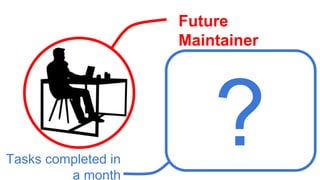
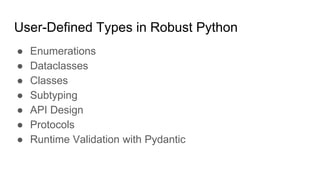
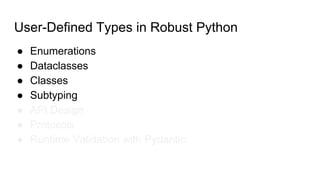
The document discusses how to write robust Python code that will be maintainable for future collaborators. It emphasizes communicating intent through deliberate choices in code abstractions like enums, data classes, classes, and inheritance. These choices should make it hard for developers to introduce errors and easy to understand the constraints of the system. The goal is to minimize future friction and enable collaborators to focus on delivering value rather than debugging issues.


