Python
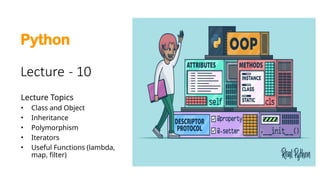
Lecture - 10
Lecture Topics
• Class and Object
• Inheritance
• Polymorphism
• Iterators
• Useful Functions (lambda,
map, filter)
Python Classes and Objects
• Class: A blueprint for creating objects (instances)
• Object: An instance of a class with attributes and methods
Example: 01
class Car:
color = “black”
Audi = Car()
print(Audi.color)
Example: 02
class Student:
def __init__(self, fname, lname, tuition):
self.first_name = fname
self.last_name = lname
self. tuition = tuition
def myfunc(self):
print("Hello my name is " +
self.first_name)
student_1= Student(“Jane“ , “Smith” ,
20000)
student_1.myfunc()
student_2= Student(“John“ , “Deo” , 20000)
student_2.myfunc()
Output:
Hello my name is Jane
Hello my name is John
#The __init__() Function
The __init__() function in Python initializes object
properties and performs necessary setup when an
object is created from a class.
The __str__() Function
WITHOUT the __str__() function
• class Person:
def __init__(self, name, age):
self.name = name
self.age = age
p1 = Person("John", 36)
print(p1)
• Output
• <__main__.Person object at
0x15039e602100>
WITH the __str__() function
• class Person:
def __init__(self, name, age):
self.name = name
self.age = age
def __str__(self):
return f"{self.name}
({self.age})"
p1 = Person("John", 36)
print(p1)
• Output
• John(36)
Self parameter
• The self parameter is a reference to the current instance of the class
• Used to access variable
• It does not have to be named self
• It has to be the first parameter of any function
• class Person:
def __init__(asif, name, age):
asif.name = name
asif.age = age
def myfunc(abc):
print("Hello my name is " + abc.name)
p1 = Person("John", 36)
p1.myfunc()
Modify or Delete Object and using pass
• p1.age = 40
• del p1.age # delete variable
• del p1 # delete object
• class Person:
pass
• class definitions cannot be empty, but if you
for some reason have a class definition with no
content, put in the pass statement to avoid
getting an error.
Inheritance in Python
• Allows a class to inherit attributes and methods from another class
• Supports code reuse and enhances functionality
Parent/Base/Super class is the class being
inherited from, also called base class
Child/Sub class is the class that inherits from
another class, also called derived class
Child Class
• class Student(Person):
pass
• Add the __init__() function to the Student class:
• class Student(Person):
def __init__(self, fname, lname):
#add properties etc.
• The child's __init__() function overrides the base __init__
• To keep the inheritance of the parent's __init__()
function, add a call to the parent's __init__() function:
• class Student(Person):
def __init__(self, fname, lname):
Person.__init__(self, fname, lname)
Without super() function
class Person:
def __init__(self, fname, lname):
self.firstname = fname
self.lastname = lname
def printname(self):
print(self.firstname,
self.lastname)
class Student(Person):
pass
x = Student("Mike", "Olsen")
x.printname()
class Person:
def __init__(self, fname, lname):
self.firstname = fname
self.lastname = lname
def printname(self):
print(self.firstname, self.lastname)
class Student(Person):
def __init__(self, fname, lname):
super(). __init__(fname, lname)
x = Student("Mike", "Olsen")
x.printname()
#Use the super() Function
The super() function that will make the child class inherit all the
methods and properties from its parent:
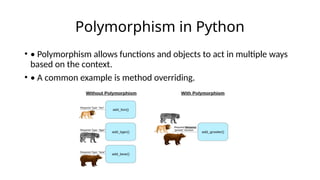
Polymorphism in Python
• • Polymorphism allows functions and objects to act in multiple ways
based on the context.
• • A common example is method overriding.
Polymorphism
• means "many forms“
• Refers to methods/functions/operators with the same name
• len() function
• Return the length of string, list, tupple
• Polymorphism is often used in Class methods
• Multiple classes with the same method name
Polymorphism: Class
class Car:
def __init__(self, brand, model):
self.brand = brand
self.model = model
def move(self):
print("Drive!")
class Boat:
def __init__(self, brand, model):
self.brand = brand
self.model = model
def move(self):
print("Sail!")
class Plane:
def __init__(self, brand, model):
self.brand = brand
self.model = model
def move(self):
print("Fly!")
car1 = Car("Ford", "Mustang") #Create a Car class
boat1 = Boat("Ibiza", "Touring 20") #Create a Boat class
plane1 = Plane("Boeing", "747") #Create a Plane class
for x in (car1, boat1, plane1):
x.move()
Polymorphism: Inheritance Class
• Parent Class: Vehicle, Child Class: Car, Boat, Plane
class Vehicle:
def __init__(self, brand, model):
self.brand = brand
self.model = model
def move(self):
print("Move!")
class Car(Vehicle):
pass
class Boat(Vehicle):
def move(self):
print("Sail!")
class Plane(Vehicle):
def move(self):
print("Fly!")
car1 = Car("Ford", "Mustang") #Create a Car object
boat1 = Boat("Ibiza", "Touring 20") #Create a Boat object
plane1 = Plane("Boeing", "747") #Create a Plane object
for x in (car1, boat1, plane1):
print(x.brand)
print(x.model)
x.move()
Without Polymorphism
With Polymorphism
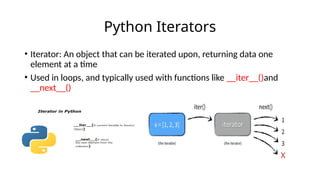
Python Iterators
• Iterator: An object that can be iterated upon, returning data one
element at a time
• Used in loops, and typically used with functions like __iter__()and
__next__()
Mytuple = (“I", “am", "coding“, “and”, “learning”)
x = iter(Mytuple)
print(next(x))
print(next(x))
print(next(x))
print(next(x))
print(next(x))
for i in x: # using for
print(i)
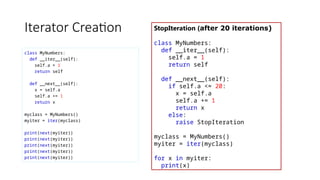
Iterator Creation
class MyNumbers:
def __iter__(self):
self.a = 1
return self
def __next__(self):
x = self.a
self.a += 1
return x
myclass = MyNumbers()
myiter = iter(myclass)
print(next(myiter))
print(next(myiter))
print(next(myiter))
print(next(myiter))
print(next(myiter))
StopIteration (after 20 iterations)
class MyNumbers:
def __iter__(self):
self.a = 1
return self
def __next__(self):
if self.a <= 20:
x = self.a
self.a += 1
return x
else:
raise StopIteration
myclass = MyNumbers()
myiter = iter(myclass)
for x in myiter:
print(x)
Useful Functions
lambda()
• Mainly used to create a function without a name
• Can be used with filter() and map()
• Only have one expression but may have multiple arguments
• lambda arguments : expression
• x = lambda a : a + 10
print(x(5)) # 15
map() Function
• Takes function and a list as input
• Performs operation on the entire list and return the result in a new
list
• Syntax: map(function, iterables)
Parameter Description
function Required. The function to execute for each item
iterable Required. A sequence, collection or an iterator object. You can send
as many iterables as you like, just make sure the function has one
parameter for each iterable.
Map() Function
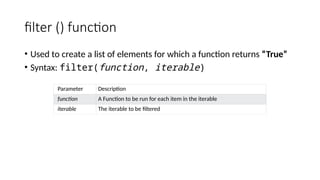
filter () function
• Used to create a list of elements for which a function returns “True”
• Syntax: filter(function, iterable)
Parameter Description
function A Function to be run for each item in the iterable
iterable The iterable to be filtered
filter () function Example
Exercise Time
Exercise
1. Combine map() and filter() to first filter out all the negative
numbers from a list of integers, and then square the remaining
numbers. For example, given [-1, 2, -3, 4], the output should be
[4, 16].
2. Write a single line of code that uses filter() to get all the words
longer than 4 letters from a list, and map() to convert them to
uppercase.
3. Create a list of tuples where each tuple contains a name and an
age. Use filter() to get all tuples where the age is greater than
18, then use map() to create a list of names of those individuals.
• 2. Map Function Exercises:
• - Problem 4: Given a list of temperatures in Celsius, use map() to convert them to
Fahrenheit. The conversion formula is: F = (9/5)*C + 32.
• - Problem 5: Create a list of strings representing numbers. Use map() to convert these
strings into integers.
• - Problem 6: Use map() to compute the lengths of a list of words. For example, for the list
["apple", "banana", "cherry"], the output should be [5, 6, 6].
• 3. Filter Function Exercises:
• - Problem 7: Given a list of integers, use filter() to extract all the even numbers from the list.
• - Problem 8: Write a program that takes a list of strings and uses filter() to return only those
strings that have more than 5 characters.
• - Problem 9: Use filter() to remove all negative numbers from a given list of integers.
Exercise: lambda
1. Write a lambda function that takes two numbers and
returns their product. Test the function with different pairs
of numbers.
2. Create a lambda function that checks if a given string is a
palindrome (reads the same forwards and backwards). Use
the function to test the strings "radar" and "hello".
3. Write a lambda function that takes a list of integers and
returns the maximum value in the list.
Exercise: map and filter
• Map
• Given a list of temperatures in Celsius, use map() to convert them to Fahrenheit.
The conversion formula is: F = (9/5)*C + 32.
• Create a list of strings representing numbers. Use map() to convert these strings
into integers.
• Use map() to compute the lengths of a list of words. For example, for the list
["apple", "banana", "cherry"], the output should be [5, 6, 6].
• Filter
• Given a list of integers, use filter() to extract all the even numbers from the list.
• Write a program that takes a list of strings and uses filter() to return only those
strings that have more than 5 characters.
• Use filter() to remove all negative numbers from a given list of integers.
Reference
• Foundations of Data Science with Python by John M. Shea
• Python Data Science Handbook by Jake VanderPlas
• Python Basics: A Practical Introduction to Python 3 by David Amos
Dan, Joanna Jablonski, Fletcher Heisler
• Internet Resources (geeksforgeeks, tutorialpoint, w3schools,
datacamp)
• Online Courses (Udemy, Udacity, Coursera, Harvard eduX)

Python Basic for Data science enthusiast

  • 1.
    Python Lecture - 10 LectureTopics • Class and Object • Inheritance • Polymorphism • Iterators • Useful Functions (lambda, map, filter)
  • 2.
    Python Classes andObjects • Class: A blueprint for creating objects (instances) • Object: An instance of a class with attributes and methods Example: 01 class Car: color = “black” Audi = Car() print(Audi.color)
  • 3.
    Example: 02 class Student: def__init__(self, fname, lname, tuition): self.first_name = fname self.last_name = lname self. tuition = tuition def myfunc(self): print("Hello my name is " + self.first_name) student_1= Student(“Jane“ , “Smith” , 20000) student_1.myfunc() student_2= Student(“John“ , “Deo” , 20000) student_2.myfunc() Output: Hello my name is Jane Hello my name is John #The __init__() Function The __init__() function in Python initializes object properties and performs necessary setup when an object is created from a class.
  • 4.
    The __str__() Function WITHOUTthe __str__() function • class Person: def __init__(self, name, age): self.name = name self.age = age p1 = Person("John", 36) print(p1) • Output • <__main__.Person object at 0x15039e602100> WITH the __str__() function • class Person: def __init__(self, name, age): self.name = name self.age = age def __str__(self): return f"{self.name} ({self.age})" p1 = Person("John", 36) print(p1) • Output • John(36)
  • 5.
    Self parameter • Theself parameter is a reference to the current instance of the class • Used to access variable • It does not have to be named self • It has to be the first parameter of any function • class Person: def __init__(asif, name, age): asif.name = name asif.age = age def myfunc(abc): print("Hello my name is " + abc.name) p1 = Person("John", 36) p1.myfunc()
  • 6.
    Modify or DeleteObject and using pass • p1.age = 40 • del p1.age # delete variable • del p1 # delete object • class Person: pass • class definitions cannot be empty, but if you for some reason have a class definition with no content, put in the pass statement to avoid getting an error.
  • 7.
    Inheritance in Python •Allows a class to inherit attributes and methods from another class • Supports code reuse and enhances functionality Parent/Base/Super class is the class being inherited from, also called base class Child/Sub class is the class that inherits from another class, also called derived class
  • 8.
    Child Class • classStudent(Person): pass • Add the __init__() function to the Student class: • class Student(Person): def __init__(self, fname, lname): #add properties etc. • The child's __init__() function overrides the base __init__ • To keep the inheritance of the parent's __init__() function, add a call to the parent's __init__() function: • class Student(Person): def __init__(self, fname, lname): Person.__init__(self, fname, lname)
  • 9.
    Without super() function classPerson: def __init__(self, fname, lname): self.firstname = fname self.lastname = lname def printname(self): print(self.firstname, self.lastname) class Student(Person): pass x = Student("Mike", "Olsen") x.printname() class Person: def __init__(self, fname, lname): self.firstname = fname self.lastname = lname def printname(self): print(self.firstname, self.lastname) class Student(Person): def __init__(self, fname, lname): super(). __init__(fname, lname) x = Student("Mike", "Olsen") x.printname() #Use the super() Function The super() function that will make the child class inherit all the methods and properties from its parent:
  • 10.
    Polymorphism in Python •• Polymorphism allows functions and objects to act in multiple ways based on the context. • • A common example is method overriding.
  • 11.
    Polymorphism • means "manyforms“ • Refers to methods/functions/operators with the same name • len() function • Return the length of string, list, tupple • Polymorphism is often used in Class methods • Multiple classes with the same method name
  • 12.
    Polymorphism: Class class Car: def__init__(self, brand, model): self.brand = brand self.model = model def move(self): print("Drive!") class Boat: def __init__(self, brand, model): self.brand = brand self.model = model def move(self): print("Sail!") class Plane: def __init__(self, brand, model): self.brand = brand self.model = model def move(self): print("Fly!") car1 = Car("Ford", "Mustang") #Create a Car class boat1 = Boat("Ibiza", "Touring 20") #Create a Boat class plane1 = Plane("Boeing", "747") #Create a Plane class for x in (car1, boat1, plane1): x.move()
  • 13.
    Polymorphism: Inheritance Class •Parent Class: Vehicle, Child Class: Car, Boat, Plane class Vehicle: def __init__(self, brand, model): self.brand = brand self.model = model def move(self): print("Move!") class Car(Vehicle): pass class Boat(Vehicle): def move(self): print("Sail!") class Plane(Vehicle): def move(self): print("Fly!") car1 = Car("Ford", "Mustang") #Create a Car object boat1 = Boat("Ibiza", "Touring 20") #Create a Boat object plane1 = Plane("Boeing", "747") #Create a Plane object for x in (car1, boat1, plane1): print(x.brand) print(x.model) x.move()
  • 14.
  • 15.
    Python Iterators • Iterator:An object that can be iterated upon, returning data one element at a time • Used in loops, and typically used with functions like __iter__()and __next__()
  • 16.
    Mytuple = (“I",“am", "coding“, “and”, “learning”) x = iter(Mytuple) print(next(x)) print(next(x)) print(next(x)) print(next(x)) print(next(x)) for i in x: # using for print(i)
  • 17.
    Iterator Creation class MyNumbers: def__iter__(self): self.a = 1 return self def __next__(self): x = self.a self.a += 1 return x myclass = MyNumbers() myiter = iter(myclass) print(next(myiter)) print(next(myiter)) print(next(myiter)) print(next(myiter)) print(next(myiter)) StopIteration (after 20 iterations) class MyNumbers: def __iter__(self): self.a = 1 return self def __next__(self): if self.a <= 20: x = self.a self.a += 1 return x else: raise StopIteration myclass = MyNumbers() myiter = iter(myclass) for x in myiter: print(x)
  • 18.
    Useful Functions lambda() • Mainlyused to create a function without a name • Can be used with filter() and map() • Only have one expression but may have multiple arguments • lambda arguments : expression • x = lambda a : a + 10 print(x(5)) # 15
  • 20.
    map() Function • Takesfunction and a list as input • Performs operation on the entire list and return the result in a new list • Syntax: map(function, iterables) Parameter Description function Required. The function to execute for each item iterable Required. A sequence, collection or an iterator object. You can send as many iterables as you like, just make sure the function has one parameter for each iterable.
  • 21.
  • 22.
    filter () function •Used to create a list of elements for which a function returns “True” • Syntax: filter(function, iterable) Parameter Description function A Function to be run for each item in the iterable iterable The iterable to be filtered
  • 23.
  • 24.
  • 25.
    Exercise 1. Combine map()and filter() to first filter out all the negative numbers from a list of integers, and then square the remaining numbers. For example, given [-1, 2, -3, 4], the output should be [4, 16]. 2. Write a single line of code that uses filter() to get all the words longer than 4 letters from a list, and map() to convert them to uppercase. 3. Create a list of tuples where each tuple contains a name and an age. Use filter() to get all tuples where the age is greater than 18, then use map() to create a list of names of those individuals.
  • 26.
    • 2. MapFunction Exercises: • - Problem 4: Given a list of temperatures in Celsius, use map() to convert them to Fahrenheit. The conversion formula is: F = (9/5)*C + 32. • - Problem 5: Create a list of strings representing numbers. Use map() to convert these strings into integers. • - Problem 6: Use map() to compute the lengths of a list of words. For example, for the list ["apple", "banana", "cherry"], the output should be [5, 6, 6]. • 3. Filter Function Exercises: • - Problem 7: Given a list of integers, use filter() to extract all the even numbers from the list. • - Problem 8: Write a program that takes a list of strings and uses filter() to return only those strings that have more than 5 characters. • - Problem 9: Use filter() to remove all negative numbers from a given list of integers.
  • 27.
    Exercise: lambda 1. Writea lambda function that takes two numbers and returns their product. Test the function with different pairs of numbers. 2. Create a lambda function that checks if a given string is a palindrome (reads the same forwards and backwards). Use the function to test the strings "radar" and "hello". 3. Write a lambda function that takes a list of integers and returns the maximum value in the list.
  • 28.
    Exercise: map andfilter • Map • Given a list of temperatures in Celsius, use map() to convert them to Fahrenheit. The conversion formula is: F = (9/5)*C + 32. • Create a list of strings representing numbers. Use map() to convert these strings into integers. • Use map() to compute the lengths of a list of words. For example, for the list ["apple", "banana", "cherry"], the output should be [5, 6, 6]. • Filter • Given a list of integers, use filter() to extract all the even numbers from the list. • Write a program that takes a list of strings and uses filter() to return only those strings that have more than 5 characters. • Use filter() to remove all negative numbers from a given list of integers.
  • 29.
    Reference • Foundations ofData Science with Python by John M. Shea • Python Data Science Handbook by Jake VanderPlas • Python Basics: A Practical Introduction to Python 3 by David Amos Dan, Joanna Jablonski, Fletcher Heisler • Internet Resources (geeksforgeeks, tutorialpoint, w3schools, datacamp) • Online Courses (Udemy, Udacity, Coursera, Harvard eduX)