The document discusses the implementation of robust H-infinity (H∞) control techniques for aircraft landing to mitigate the effects of low-level wind shear, which poses significant risks during landing phases. It evaluates the effectiveness of both H2 and H∞ control methods, showing that H∞ control offers superior stability and transition quality during landings affected by unpredictable disturbances. Simulation results demonstrate the H∞ control's efficacy in enhancing robust stability against wind-induced uncertainties.
![International Journal of Electrical and Computer Engineering (IJECE)
Vol. 12, No. 4, August 2022, pp. 3572~3582
ISSN: 2088-8708, DOI: 10.11591/ijece.v12i4.pp3572-3582 3572
Journal homepage: http://ijece.iaescore.com
Robust control of aircraft flight in conditions of disturbances
Satybaldina Dana Karimtaevna, Amirzhanova Zinara Bekbolatovna, Mashtayeva Aida Assilkhanovna
Depаrtment of System Anаlysis аnd Control, Faculty of Information Technologies, L.N. Gumilyov Eurаsiаn Nаtionаl University,
Nur-Sultan, Kazakhstan
Article Info ABSTRACT
Article history:
Received May 1, 2021
Revised Feb 16, 2022
Accepted Mar 10, 2022
One of the most dangerous parts of the flight is the landing phase, as most
accidents occur at this stage. In order to reduce the effect of the low-level
wind shear on the longitudinal motion of the aircraft in the glide path
landing mode (task) a robust H− control isproposed. Dynamic models of the
plane and wind shear are built. 𝐻2 and 𝐻∞ synthesis methods are
investigated for the task of aircraft flight control in a vertical plane during
landing under conditions of undefined disturbances. Both control methods
allow to reduce height deviation significantly. However, suboptimal control
𝐻∞ provides better quality of transition processes both in height and speed
than optimal control 𝐻2. The results of simulation of the synthesized system
confirm the effectiveness of 𝐻∞ − control for increasing robust stability to
uncertainties caused by wind disturbances.
Keywords:
Aircraft control
Optimization
Robust 𝐻∞ control
Uncertainty
Wind shear This is an open access article under the CC BY-SA license.
Corresponding Author:
Amirzhanova Zinara Bekbolatovna
Depаrtment of System Anаlysis аnd Control, L.N. Gumilyov Eurаsiаn Nаtionаl University
11 Pushkin street, building 2, 010008, Nur-Sultan, Kazakhstan
Email: zinara_amir@mail.ru
1. INTRODUCTION
Ensuring flight safety is an urgent problem of modern aviation, especially during flights in difficult
meteorological conditions. The most dangerous meteorological phenomenon for aviation flights is low-level
wind shear with large gradients of wind components in height and range, which is caused by local
disturbances of the atmosphere. Suddenly arising disturbances in the state of the atmosphere are extremely
dangerous during an aircraft landing. They led, for example, to two known disasters: at New Orleans
International Airport on July 9, 1982 the plane Boeing B-727 crashed during landing and at Dallas
International Airport on August 2, 1985 plane Lockheed L-1011 crashed during landing. Due to the great
relevance of the problem developers around the world were engaged in the construction of automated flight
control systems capable of preventing such catastrophes. Various control algorithms based on different
physical principles and mathematical concepts have been proposed, built for different models of the local
state of the atmosphere, which somehow solved this problem [1]–[5].
The studies [1], [2], [5] consider the analysis and design of a robust controller. The controller is
significant component of an entire automatic landing system developed as part of the aircraft landing task,
which was proposed by AIRBUS and ONERA. Techniques of robust synthesis (e.g., structured 𝐻∞
synthesis) acts as an effective basis for accomplishment of these tasks. In research [3] a robust automatic
landing controller (SIRAC) based on stable inversion (SI) is proposed. The SI algorithm improves an
indicator such as the output tracking accuracy, at the same time the application of the 𝐻∞ synthesis is aimed
at increasing the robust stability to uncertainties that arise because of wind disturbances. In research [4] the
vertical speed of the aircraft prior to landing is controlled based on a structured 𝐻∞ − control structure,](https://image.slidesharecdn.com/24157068287927111em16feb221mayn-220629013011-4de290ab/75/Robust-control-of-aircraft-flight-in-conditions-of-disturbances-1-2048.jpg)
![Int J Elec & Comp Eng ISSN: 2088-8708
Robust control of aircraft flight in conditions of disturbances (Satybaldina Dana Karimtaevna)
3573
minimizing the effects of wind shear, ground effects and airspeed changes. A specific multi-model strategy is
considered accounting changes in mass and center of gravity location.
In research [6] a pseudo-sliding mode control synthesis procedure is considered and applied to
develop control system for a nonlinear NASA Langley generic transport model. The synthesized control
system allows minimizing aircraft loss-of-control by maintaining primary pilot input-system response
characteristics throughout the flight, taking into account the possibility of actuator damage. In research [7]
the problem of robust active fault-tolerant control (FTC) was considered for systems with undefined linear
parameter variation (LPV) with simultaneous actuator and sensor failures. In research [8] a parameter
independent embedded sliding mode controller with self-adaptation was developed that converges in the
system in a finite time, focusing on the uncertain linear parameter variation (LPV) model of the aircraft
variant, which has large-scale sweep angle variation and expansion. In research [9] a robust control scheme
for commercial aircraft is presented. The control law is supplemented with a prior information about wind
gusts. The main contribution of this article is the integration of the wind gust alleviation system using light
detection and ranging (LIDAR) with the widely used flight control architecture the so-called C* control law.
In research [10] the active vibration control of composite panels with uncertain parameters in a hypersonic
flow is studied using the non-probabilistic reliability theory. Using the piezoelectric patches as active control
actuators, dynamic equations of panel are determined by the finite element method and Hamilton’s principle.
The results of the research prove the fact that the control method influenced by reliability, 𝐻∞ performance
index, and approach velocity is effective for the vibration suppression of panel throughout an entire interval
of uncertain parameters.
The research [11] developed a multi-loop controller for a morphing aircraft to guarantee stability of
the wing-shaped transition response. The suggested controller uses a set of inner-loop gains to ensure
stability using classical techniques, whereas a gain of self-adaptive 𝐻∞ outer-loop controller is designed to
provide a certain level of robust stability and performance of the time-varying dynamics. The paper [12]
describes an analysis method, a generalization of the developed parameters of the robust controller for
aircraft lateral control using auxiliary damping automatic devices (ADAD). The H∞ and μ methods served as
the basis for performing the synthesis of the proposed controller. The research [13] considers the µ-synthesis
procedure for developing a robust autopilot. The software-in-the-loop (SIL) verifications applying blade
element theory (BET) confirms that the autopilot is capable to navigate and land the plane in conditions of
strong fluctuations in parameters and powerful winds. In studies [14]–[16] Lyapunov functions are used to
construct robustly stable control systems. The Lyapunov function is constructed in the form of a vector
function, the anti-gradient of which is set by the components of the velocity vector of the system. Some
researches [17]–[19] are devoted to the synthesis of robust controllers of aircraft motion parameters using the
𝐻∞ technique. Works [20]–[22] consider the problems of constructing a robust control of the aircraft under
the action of uncontrolled disturbances, in which the so-called weight functions are introduced.
𝐻∞ − control theory is widely used in motion control tasks. The modern period of development of
control theory is characterized by the setting and solution of problems, taking into account the inaccuracy of
mathematical model of the control object and external disturbances affecting on it. The robust control allows
to eliminate indicators such as external disturbances and internal parametric uncertainties. The idea of 𝐻∞ −
synthesis is to ensure the stability of a closed-loop system not only for a nominal (without model errors)
object, but also for a "disturbed" object (taking into account the model uncertainties and disturbances
affecting on the control object) [23]–[25].
This paper investigates𝐻2 and 𝐻∞ synthesis techniques for the aircraft flight control problem in the
vertical plane during landing in conditions of undefined disturbances. The application of 𝐻∞ − control is
effective for increasing robustness to uncertainties caused by wind perturbations. This document is organized
as: section 2 describes the principles of stabilization when using H-controls, the synthesis algorithms for
𝐻2 − optimal and 𝐻∞ − suboptimal controls, and builds a mathematical model of the aircraft movement in
the vertical plane with regard to wind disturbances, section 3 presents a mathematical model of a vortex ring-
shaped wind microburst. The results of 𝐻2 and 𝐻∞ synthesis methods for the problem of aircraft flight
control during landing under uncertain perturbations are presented. The efficiency of 𝐻∞ − control is
confirmed by the results of simulation of the synthesized system, and section 4 presents the main conclusions
of this article.
2. RESEARCH METHOD
2.1. Mathematical model of the longitudinal motion of an airplane
Kinematic and dynamic variables for the equations of motion of the center of mass of the airplane
are shown in Figure 1. In Figure 1: 𝑋 is the drag force; 𝑥, 𝑦 is axes of the coordinate system; 𝑌 is the lifting
force; 𝑂 is the center of mass of the aircraft; 𝑉 is the airspeed of the aircraft; 𝑉
𝑒 is the aircraft ground speed;](https://image.slidesharecdn.com/24157068287927111em16feb221mayn-220629013011-4de290ab/75/Robust-control-of-aircraft-flight-in-conditions-of-disturbances-2-2048.jpg)
![ ISSN: 2088-8708
Int J Elec & Comp Eng, Vol. 12, No. 4, August 2022: 3572-3582
3574
𝑤𝑥 is the horizontal component of wind speed; 𝑤𝑦 is the vertical component of wind speed; 𝛼 is the angle of
attack; 𝜃 is the angle of inclination of the trajectory in the air coordinate system. The dynamic equations of
the aircraft motion in the vertical plane taking into account wind disturbances in projections on the axes of
the air coordinate system are set by the system of nonlinear differential (1) [26]–[28]:
𝑚𝑉̇ = 𝑇𝑐𝑜𝑠𝛼 − 𝑋 − 𝑚𝑔𝑠𝑖𝑛𝜃 − 𝑚(𝑤̇ 𝑥𝑐𝑜𝑠𝜃 + 𝑤̇𝑦𝑠𝑖𝑛𝜃);
𝑚𝑉𝜃̇ = 𝑃𝑠𝑖𝑛𝛼 + 𝑌 − 𝑚𝑔𝑐𝑜𝑠𝜃 + 𝑚(𝑤̇𝑥𝑠𝑖𝑛𝜃 + 𝑤̇ 𝑦𝑐𝑜𝑠𝜃);
𝐽𝑧𝜔̇𝑧 = 𝑀𝑧;
𝜗̇ = 𝜔𝑧;
ℎ̇ = 𝑉𝑠𝑖𝑛𝜃 + 𝑊ℎ(𝑥, ℎ)
∆𝑇̇ =
1
ТДВ
(−∆𝑇 + КДВ∆𝛿𝑡) (1)
Figure 1. Airplane coordinate system and variables
The control variables are the thrust 𝑇 and the angle of attack 𝛼, which depend, respectively, on the
deflection of the engine throttle and the elevator. Here 𝛿𝑡 is the engine throttle deflection from the specified
value. As a result of linearization [29], [30] the nonlinear model of the aircraft (1) is reduced to a linear
system of ordinary differential equations in increments, which in matrix form has the form (2):
𝑥̇ = 𝐴𝑥 + 𝐵1𝑛𝑤 + 𝐵2𝑛𝑢, (2)
where 𝑥 = (∆𝑉, ∆𝜃, ∆𝑤𝑧, ∆𝜗, ∆ℎ, ∆𝑇)𝑇
= the state vector,
𝑤 = (𝑤𝑦, 𝑤̇ 𝑥,𝑤̇ 𝑦)
𝑇
= the wind disturbance vector,
𝑢 = (∆𝛿𝑒, ∆𝛿𝑡)𝑇
= the control vector.
The equation for the measured output 𝑦 in the state space model in the presence of measurement
noise 𝑛𝑦 is written as:
𝑦 = 𝐶𝑦𝑥 + 𝐼𝑦𝑛𝑦,
where 𝐶𝑦 is the measured output matrix and 𝐼𝑦 is the identity matrix of the corresponding dimension. Thus,
the mathematical model of the longitudinal motion of the aircraft with considering external wind disturbances
in the state space model is described by the system (3):
{
𝑥̇ = 𝐴𝑥 + 𝐵1𝑛𝑤 + 𝐵2𝑛𝑢,
𝑦 = 𝐶𝑦𝑥 + 𝐼𝑦𝑛𝑦. (3)
The vector of controlled outputs 𝑧𝑙for a linear model of the longitudinal motion of an aircraft taking
into account wind disturbances in the state space model (3) has the form (4):
𝑧𝑙 = 𝐶𝑧𝑥. (4)](https://image.slidesharecdn.com/24157068287927111em16feb221mayn-220629013011-4de290ab/75/Robust-control-of-aircraft-flight-in-conditions-of-disturbances-3-2048.jpg)
![Int J Elec & Comp Eng ISSN: 2088-8708
Robust control of aircraft flight in conditions of disturbances (Satybaldina Dana Karimtaevna)
3575
Consider a vector of controlled outputs 𝑧̅ which is defined as (5):
𝑧̅ = [
𝑧1
𝑧2
] = [
𝑧
𝑢
]. (5)
Combining (3), (4) and (5), a system of equations describing the controlled system is obtained:
{
𝑥̇ = 𝐴𝑥 + 𝐵1𝑛𝑤 + 𝐵2𝑛𝑢,
𝑧1 = 𝐶𝑧𝑥,
𝑧2 = 𝐼𝑢𝑢,
𝑦 = 𝐶𝑦𝑥 + 𝐼𝑦𝑛𝑦.
(6)
The system of equations describing a standard object in the state space model for an extended vector
of controlled outputs 𝑧̅ = (𝑧𝑇
, 𝑢𝑇
)𝑇
and an extended vector of external inputs 𝑤
̅ = (𝑤𝑇
, 𝑛𝑦
𝑇
)𝑇
has the form
{
𝑥̇ = 𝐴𝑥 + 𝐵1𝑤
̅ + 𝐵2𝑢,
𝑧̅ = 𝐶1𝑥 + 𝐷11𝑤
̅ + 𝐷12𝑢,
𝑦 = 𝐶2𝑥 + 𝐷21𝑤
̅ + 𝐷22𝑢,
(7)
where
𝐵1 = [𝐵1𝑛 0],𝐵2 = 𝐵2𝑛, 𝐶1 = [
𝐶𝑧
0
] , 𝐶2 = 𝐶𝑦, 𝐷11 = [
0 0
0 0
] , 𝐷12 = [
0
𝐼𝑢
], 𝐷21 = [0 𝐼𝑦], 𝐷22 = 0.
2.2 Robust 𝑯 - control
The algorithms for solving the problems of building 𝐻2 – optimal and 𝐻∞– suboptimal controls are
considered in this part. Let a finite-dimensional linear controlled and observed object be identified by
experimental data in the state space model in the form (8) [23], [24]:
{
𝑥̇(𝑡) = 𝐴𝑥(𝑡) + B1𝑤(𝑡) + B2𝑢(𝑡)
𝑧(𝑡) = C1𝑥(𝑡) + D12𝑢(𝑡)
𝑦(𝑡) = C2𝑥(𝑡) + D21𝑤(𝑡)
(8)
where 𝑥(𝑡) is the vector of system states; 𝑢(𝑡) is the control vector; 𝑤(𝑡) is the uncertainty vector,
characterizing the inaccuracy of the model; 𝑦(𝑡) is the vector of measured outputs; 𝑧(𝑡) is the vector of
controlled outputs of the system; 𝐴, B1, B2, C1, C2, D11 and D21 is the constant matrices of corresponding
dimensions.
The structural diagram shown in Figure 2 represents the synthesized system. Matrices 𝐾(𝑠) and
𝐺(𝑠) are the transfer matrices of the controller and control object respectively. The matrix 𝐺(𝑠) has the
structure (9):
𝐺(𝑠) = [
G11 G12
G21 G22
] = [
𝐴 | B1 B2
− | − −
C1 | 0 D12
C2 | D21 0
] (9)
Figure 2. Stabilization principle when using 𝐻-control](https://image.slidesharecdn.com/24157068287927111em16feb221mayn-220629013011-4de290ab/75/Robust-control-of-aircraft-flight-in-conditions-of-disturbances-4-2048.jpg)
![ ISSN: 2088-8708
Int J Elec & Comp Eng, Vol. 12, No. 4, August 2022: 3572-3582
3576
Robust control is included in the lower subsystem loop [𝐺21𝐺22]. Uncontrolled signals passing
through the upper subsystem [𝐺11𝐺12] must be effectively suppressed by it. Let the matrix of transfer
functions from input 𝑤(𝑡) to output 𝑧(𝑡) as shown in Figure 2 of the closed-loop system has the form (10):
T𝑤𝑧 = 𝐴 + [B1B2](𝐼 − 𝐾 [
D11 D12
D21 D22
])−1
𝐾 [
C1
C2
] (10)
The limitation (rationing) 𝑇𝑤𝑧 is very important. The functional spaces 𝐿2 (the space bounded by the square
of the function) and 𝐿∞ (the space of essentially bounded functions) are considered to describe and define the
norms 𝑇𝑤𝑧 [23].
Robust 𝐻2 and 𝐻∞ − controls are sought in the form of feedbacks 𝑢(𝑡) = 𝐾𝑦(𝑡) such that the signal
norms in the spaces 𝐿2 and 𝐿∞, respectively, equal to ‖𝑇𝑤𝑧‖2 and ‖𝑇𝑤𝑧‖∞ are minimal.
||T𝑤𝑧||2
2
= (
1
2𝜋
∫ 𝑡𝑟{𝑇𝑤𝑧
𝑇 (−𝑗𝜔) ∙ T𝑤𝑧(𝑗𝜔)}𝑑𝜔
∞
−∞
)1/2
< ∞ (11)
||T𝑤𝑧||∞ = 𝑠𝑢𝑝𝜎
̅
−∞<𝜔<∞
{T𝑤𝑧(𝑗𝜔)} < 𝛾 (12)
Where ‖⋅‖ is the norm in Hardy functional space; 𝑊(𝑗𝜔) = 𝑤(𝑝)|𝑝=𝑗𝜔 is the system frequency response;
𝑡𝑟 is the matrix trace; 𝑠𝑢𝑝𝜎
̅{𝑊(𝑗𝜔)} is the maximum singular value of the matrix 𝑊(𝑗𝜔).
The value ||T𝑤𝑧||2
2
means the signal energy, and ||T𝑤𝑧||∞ means its intensity in many physical
applications. Hence, 𝐿2 is the space of signals of limited energy, and L∞ is the space of signals of limited
intensity. The energy of the error signal under the worst possible perturbation is minimizing while
minimizing the norm ‖T𝑤𝑧‖∞. According to [24], the 𝐻2 − control equations can be written in the form of an
optimal observer and an optimal control shaper.
{
𝑥
̂̇(𝑡) = 𝐴𝑥
̂(𝑡) + B2𝑢(𝑡) + L2(C2𝑥
̂(𝑡) − 𝑦(𝑡))
𝑢(𝑡) = F2𝑥
̂(𝑡)
(13)
Where F2 is the matrix of the gain coefficients of the optimal 𝐻2 − the control feedback; 𝐿2 is the matrix of
the optimal feedback gain coefficients by 𝐻2 observation.
𝐻∞ − control has the form (14):
{
𝑥
̂̇(𝑡) = 𝐴𝑥
̂(𝑡) + B1𝑊
̂𝑤𝑜𝑟𝑠𝑡(𝑡) + B2𝑢(𝑡) + Z∞L∞(C2𝑥
̂(𝑡) − 𝑦(𝑡))
𝑢(𝑡) = F∞𝑥
̂(𝑡)
𝑊
̂𝑤𝑜𝑟𝑠𝑡(𝑡) = 𝛾−2
𝐵1
𝑇
𝑋∞𝑥
̂(𝑡)
(14)
where F∞ is the matrix of the gain coefficients of the optimal 𝐻∞ − the control feedback; Z∞L∞ is the matrix
of the optimal feedback gain coefficients by 𝐻∞ observation. It can be seen from these equations that unlike
the 𝐻2 − observer, the 𝐻∞ − observer has anobserver-based compensator structure (because of the
B1𝑊
̂𝑤𝑜𝑟𝑠𝑡(𝑡) component). The main differences in the control structure are the appearance of a new structural
component B1𝑊
̂𝑤𝑜𝑟𝑠𝑡(𝑡) in the 𝐻∞ − case and the replacement of L2 by Z∞L∞.
𝐻2-optimal control can be constructed in a finite number of operations. However, it is necessary to
make a reservation that the real program uses iterative procedures to solve the algebraic Riccati equation,
which makes this statement true if the procedure for solving the Riccati equation considered as a separate
operation. The 𝐻2-optimal control synthesis algorithm has a linear structure as shown in Figure 3. Unlike the
𝐻2 − case 𝐻∞ − suboptimal control (like 𝐻∞ − norm) cannot be defined by a finite number of operations and
requires an iterative procedure.
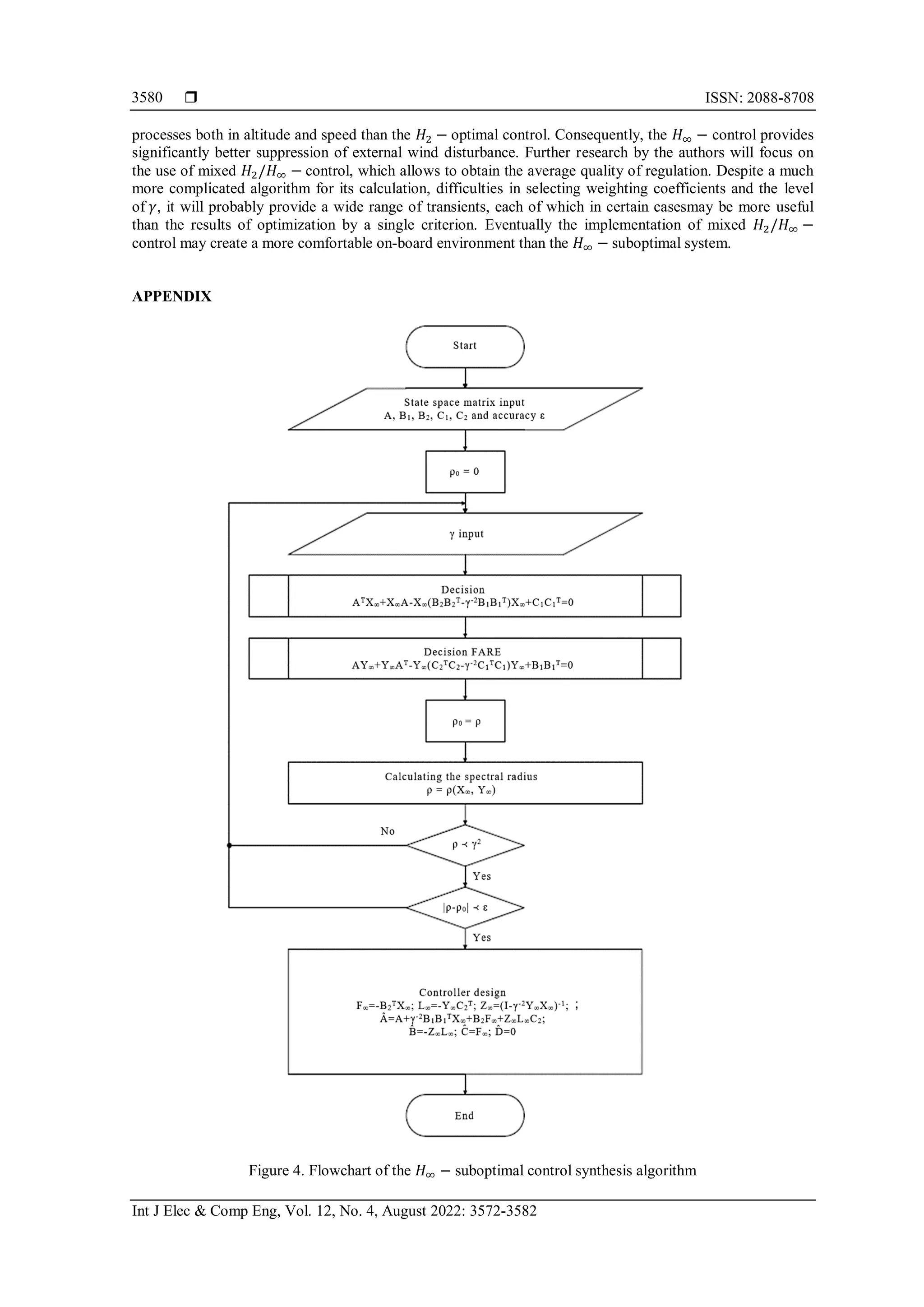
The synthesis algorithm of 𝐻∞ − control, shown in Figure 4 (in appendix), has a branched structure,
this is explained by the need to check the condition ρ(X∞Y∞) < 𝛾2
and find 𝛾 with the required degree of
accuracy 𝜀. If the condition is not met, it is necessary to enter a new value of 𝛾 larger than the previous one;
if the accuracy condition |𝜌 − 𝜌0| < 𝜀 is not met, where 𝜌0 is the spectral radius at the previous value of 𝛾
and 𝜌 is for current value, it is necessary to enter a new 𝛾 smaller than the previous one. This algorithm
implements the input of 𝛾 at each step manually. Construction of the control is carried out already at the
selected value of 𝛾 and the corresponding matrices and X∞ and Y∞. It is seen that the synthesis of 𝐻∞ −
control is much more labor-intensive than the synthesis of 𝐻2 − control also because it is necessary to solve
two Riccati equations in each cycle of choosing 𝛾, while for the 𝐻2 − case these equations are solved once.](https://image.slidesharecdn.com/24157068287927111em16feb221mayn-220629013011-4de290ab/75/Robust-control-of-aircraft-flight-in-conditions-of-disturbances-5-2048.jpg)
![Int J Elec & Comp Eng ISSN: 2088-8708
Robust control of aircraft flight in conditions of disturbances (Satybaldina Dana Karimtaevna)
3577
Figure 3. Flowchart of the 𝐻2 − optimal control synthesis algorithm
3. RESULTS AND ANALYSIS
3.1. Mathematical model of a wind microburst in the form of a vortex ring
Wind shear is a change in the magnitude and direction of the wind speed during the transition from
one point in space to another, related to the distance between the points under consideration. The aircraft is
strongly disturbed during wind shear, therefore, in the take-off and landing modes (due to the low flight
altitude), a dangerous situation can quickly arise without vigorous and timely intervention of the pilot in the
aircraft control. Piloting an aircraft in wind shear conditions is challenging due to the need to simultaneously
control the elevator (balancing the aircraft) and the engine thrust (recovering speed). All of this has led to the
fact that wind shear at low altitude has become a dangerous phenomenon. Mathematical models of wind
microbursts of varying complexity have been developed for research and development of automatic or
manual control systems.
The generated wind profiles of this model allow simulating atmospheric conditions corresponding to
some real-life situations, in particular, at Dallas (1985) and New Orleans (1982) airports. According to this
model [3], [30], the wind microburst area is formed by the flow around a vortex ring located above a flat
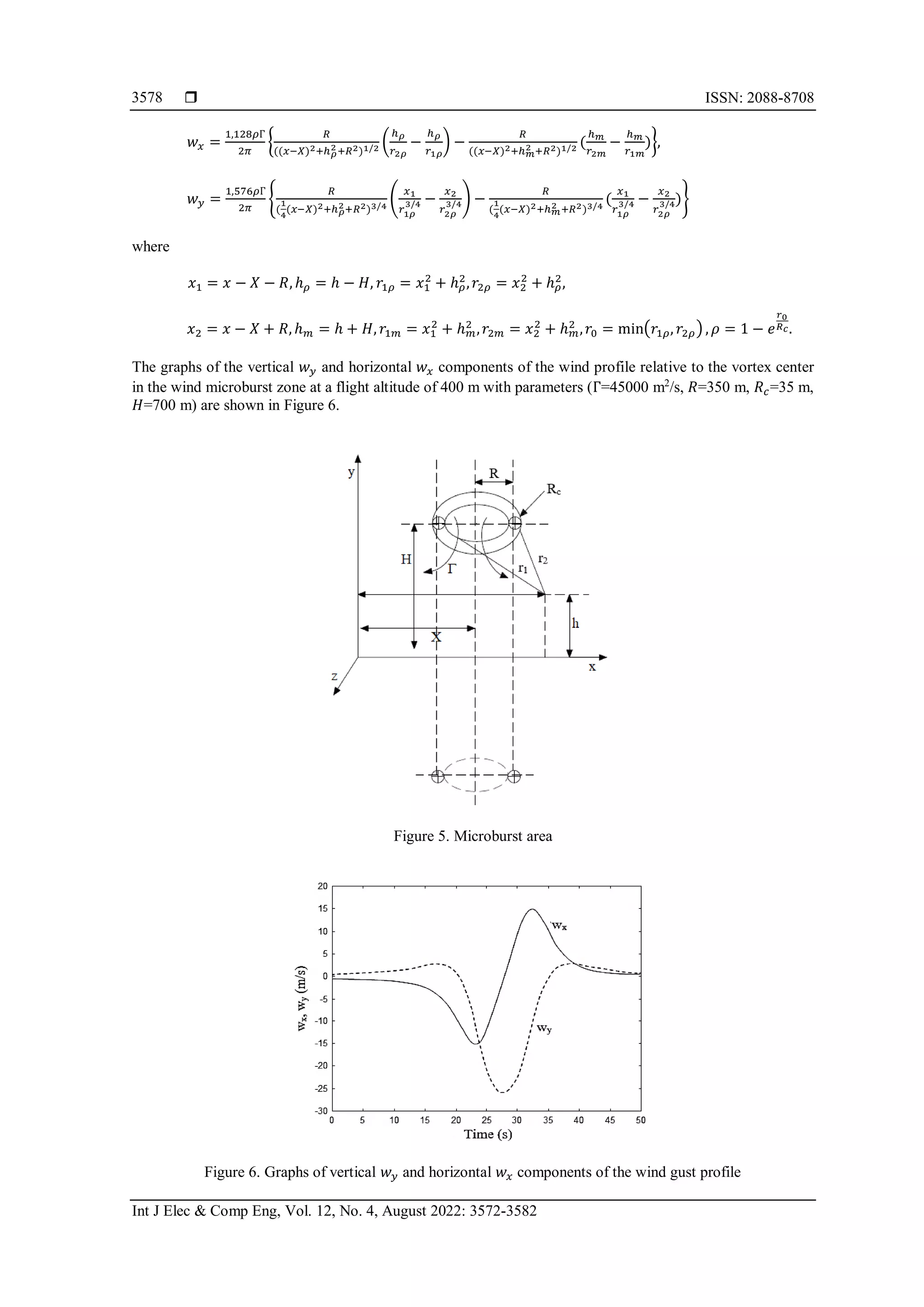
surface. The geometric relations are shown in Figure 5. The mathematical model of a vortex ring-shaped
wind microburst is described in (15):
𝜓 =
Г
2𝜋
(𝑟1 + 𝑟2)[𝐹(𝜆) − 𝐹(𝜆)], (15)
where Г is the circulation, 𝑅 is the radius of the filament of the vortex ring, 𝐹(𝜆), 𝐹(𝜆) are the complete
elliptic integrals of the first and second kind, 𝑟1,𝑟2 are the largest and smallest distances from the current
point (𝑥, 𝑧, ℎ) to the filament of the vortex ring, 𝑅𝑐 is the effective radius of the vortex ring core and a
dimensionless variable.
𝜆 =
𝑟2 − 𝑟1
𝑟2 + 𝑟1
.
The final formulas for wind speeds at the points in space with coordinates (𝑥, ℎ) are as:](https://image.slidesharecdn.com/24157068287927111em16feb221mayn-220629013011-4de290ab/75/Robust-control-of-aircraft-flight-in-conditions-of-disturbances-6-2048.jpg)
![Int J Elec & Comp Eng ISSN: 2088-8708
Robust control of aircraft flight in conditions of disturbances (Satybaldina Dana Karimtaevna)
3579
3.2 Simulation results
This part considers the specific trajectory of the aircraft glide path [30]–[32]. This trajectory in
coordinates of altitude and range is a straight line with a given trajectory inclination angle Ө𝑔𝑙 (Ө𝑔𝑙= -2.7
degrees). The task of the control system is to provide a constant air speed 𝑉0 = 71.375 m/s and a given height
ℎ = 400 m when moving along the glide path under the action of wind disturbances, the model of which is
described above.
The results of a comparison of the quality of transient processes of closed-loop systems with the
above described 𝐻2 − and 𝐻∞ − controls constructed using the proposed methodology are presented further.
During the simulation, the same signal was applied to the input of each closed-loop system, simulating the
wind disturbance 𝑤
̅acting on the aircraft when it moves in the zone of the wind microburst. Figure 7 shows
the graphs of the deviation of the airspeed 𝑉 from the nominal value for two controls. The maximum speed
deviation when using 𝐻2 − control is about 3.49 m/s, and when using 𝐻∞ − suboptimal control is about
1.375 m/s. 𝐻∞ − suboptimal control provides better quality of transient processes than 𝐻2 − control
according to the airspeed deviation.
Figure 8 shows the graphs of the deviation of the altitude ℎ from the nominal value for two controls.
𝐻∞ − suboptimal control also provides better quality of transient processes than 𝐻2 − control by deviation of
altitude. Then the maximum height deviation when using 𝐻2 − control is about 18.75 m, and when using
𝐻∞ − suboptimal control is about 7.7 m, that is, almost 2.5 times less. This characteristic is very important
because a sharp loss of altitude in the microburst zone is the main cause of accidents during aircraft landing.
Thus, it could be concluded that the optimal systems synthesized by the quadratic quality criterion
are sensitive to the model parameters of the real object and the characteristics of the input influences, i.e are
not robust [32], [33]. The optimal control has been synthesized by taking into account the need to provide a
compromise between the minimum possible deviation of the controlled outputs (airspeed and altitude) from
the nominal values and the power limitations of the control units (engines and elevators). For this purpose, a
value characterizing the control was introduced into the optimality criterion. 𝐻∞ − control solves the
problem of minimum sensitivity of the closed-loop system for the worst-case external perturbation. The
energy of the disturbance passing to the output is determined by the 𝐻∞ − norm of the matrix transfer
function of the closed-loop system from the external disturbance to the controlled output. The idea of robust
control synthesis is to provide with one control the stability of a closed-loop system not only for a nominal
(without model errors) object, but also for a "perturbed" object (taking into account model uncertainties and
perturbations acting on the control object).
Figure 7. Velocity deviation 𝑉 when using 𝐻2 − and
𝐻∞ − control
Figure 8. Altitude deviation ℎ when using 𝐻2 − and
𝐻∞ − control methods
4. CONCLUSION
This paper examines 𝐻2 and 𝐻∞ synthesis methods to reduce the influence of low-altitude wind
shear on the longitudinal motion of the aircraft in the glide path landing mode. A mathematical model of
aircraft movement in the vertical plane with considering wind disturbances, and a mathematical model of a
wind microburst in the form of a vortex ring were obtained. Both controls allow for a significant reduction in
altitude deviation. However, the 𝐻∞ − suboptimal control method provides better quality of transient](https://image.slidesharecdn.com/24157068287927111em16feb221mayn-220629013011-4de290ab/75/Robust-control-of-aircraft-flight-in-conditions-of-disturbances-8-2048.jpg)
![Int J Elec & Comp Eng ISSN: 2088-8708
Robust control of aircraft flight in conditions of disturbances (Satybaldina Dana Karimtaevna)
3581
REFERENCES
[1] D. Navarro-Tapia, P. Simplício, A. Iannelli, and A. Marcos, “Robust flare control design using structured H ∞
synthesis: a civilian aircraft landing challenge,” IFAC-PapersOnLine, vol. 50, no. 1, pp. 3971–3976, Jul. 2017, doi:
10.1016/j.ifacol.2017.08.769.
[2] P. Simplício, D. Navarro-Tapia, A. Iannelli, and A. Marcos, “From standard to structured robust control design:
application to aircraft automatic glide-slope approach,” IFAC-PapersOnLine, vol. 51, no. 25, pp. 140–145, 2018,
doi: 10.1016/j.ifacol.2018.11.095.
[3] X. Wang, Y. Sang, and G. Zhou, “Combining stable inversion and H∞ synthesis for trajectory tracking and
disturbance rejection control of civil aircraft auto landing,” Applied Sciences, vol. 10, no. 4, Feb. 2020, doi:
10.3390/app10041224.
[4] J.-M. Biannic and C. Roos, “Robust auto land design by multi-model H∞ synthesis with a focus on the flare phase,”
Aerospace, vol. 5, no. 1, Feb. 2018, doi: 10.3390/aerospace5010018.
[5] A. Iannelli, P. Simplício, D. Navarro-Tapia, and A. Marcos, “LFT modeling and μ analysis of the aircraft landing
benchmark,” IFAC-PapersOnLine, vol. 50, no. 1, pp. 3965–3970, Jul. 2017, doi: 10.1016/j.ifacol.2017.08.766.
[6] R. Hess, “Robust flight control design to minimize aircraft loss-of-control incidents,” Aerospace, vol. 1, no. 1,
pp. 1–17, Nov. 2013, doi: 10.3390/aerospace1010001.
[7] R. Tayari, A. Ben Brahim, F. Ben Hmida, and A. Sallami, “Active fault tolerant control design for LPV systems
with simultaneous actuator and sensor faults,” Mathematical Problems in Engineering, vol. 2019, pp. 1–14, Jan.
2019, doi: 10.1155/2019/5820394.
[8] Q. Wu, Z. Liu, F. Liu, and X. Chen, “LPV-based self-adaption integral sliding mode controller with L2 gain
performance for a morphing aircraft,” IEEE Access, vol. 7, pp. 81515–81531, 2019, doi:
10.1109/ACCESS.2019.2923313.
[9] R. Takase, K. Fujita, Y. Hamada, T. Tsuchiya, T. Shimomura, and S. Suzuki, “Robust C* control law design
augmented with LIDAR-based gust information,” IFAC-PapersOnLine, vol. 52, no. 12, pp. 122–127, 2019, doi:
10.1016/j.ifacol.2019.11.119.
[10] Y.-W. Zhang, G.-Q. Jiang, and B. Fang, “Suppression of panel flutter of near-space aircraft based on non-
probabilistic reliability theory,” Advances in Mechanical Engineering, vol. 8, no. 3, Mar. 2016, doi:
10.1177/1687814016638806.
[11] T. Yue, L. Wang, and J. Ai, “Gain self-scheduled H∞ control for morphing aircraft in the wing transition process
based on an LPV model,” Chinese Journal of Aeronautics, vol. 26, no. 4, pp. 909–917, Aug. 2013, doi:
10.1016/j.cja.2013.06.004.
[12] R. Bréda, T. Lazar, R. Andoga, and L. Madarász, “Robust controller in the structure of lateral control of
maneuvering aircraft,” Acta Polytechnica Hungarica, vol. 10, no. 5, Sep. 2013, doi: 10.12700/APH.10.05.2013.5.7.
[13] C. Kasnakoğlu, “Investigation of multi-input multi-output robust control methods to handle parametric
uncertainties in autopilot design,” PLOS ONE, vol. 11, no. 10, Oct. 2016, doi: 10.1371/journal.pone.0165017.
[14] M. Beisenbi, S. T. Suleimenova, V. V Nikulin, and D. K. Satybaldina, “Construction of control systems with high
potential of robust stability in the case of catastrophe elliptical umbilic,” International Journal of Applied
Engineering Research, vol. 12, no. 17, pp. 6954–6961, 2017.
[15] M. Beisenbi, A. Sagymbay, D. Satybaldina, and N. Kissikova, “Velocity gradient method of lyapunov vector
functions,” in Proceedings of the 2019 the 5th International Conference on e-Society, e-Learning and e-
Technologies - ICSLT 2019, 2019, pp. 88–92, doi: 10.1145/3312714.3312724.
[16] М. А. Beisenbi and Z. O. Basheyeva, “Solving output control problems using Lyapunov gradient-velocity vector
function,” International Journal of Electrical and Computer Engineering (IJECE), vol. 9, no. 4, pp. 2874–2879,
Aug. 2019, doi: 10.11591/ijece.v9i4.pp2874-2879.
[17] V. Burnashev and A. Zbrutsky, “Robust controller for supersonic unmanned aerial vehicle,” Aviation, vol. 23, no.
1, pp. 31–35, May 2019, doi: 10.3846/aviation.2019.10300.
[18] S. Waitman and A. Marcos, “Active flutter suppression: non-structured and structured H∞ design,” IFAC-
PapersOnLine, vol. 52, no. 12, pp. 146–151, 2019, doi: 10.1016/j.ifacol.2019.11.184.
[19] A. Legowo and H. Okubo, “Robust flight control design for a turn coordination system with parameter
uncertainties,” American Journal of Applied Sciences, vol. 4, no. 7, pp. 496–501, Jul. 2007, doi:
10.3844/ajassp.2007.496.501.
[20] A. Mashtayeva, Z. Amirzhanova, and D. Satybaldina, “Development of aircraft dynamics model in the vertical
plane,” in Informacionnye tekhnologii v nauke, upravlenii, social’noi sfere i medicine: sbornik nauchnyh trudov V
Mezhdunarodnoi nauchnoi konferencii, 2018, pp. 18–21.
[21] Z. B. Amirzhanova, A. A. Mashtaeva, and D. K. Satybaldina, “Development of a robust aircraft control system in
conditions of disturbances,” in Informacionnyetekhnologiiisistemy 2019 (ITS 2019), 2019, pp. 30–31.
[22] R. J. Adams, J. M. Buffington, A. G. Sparks, and S. S. Banda, Robust multivariable flight control. London:
Springer London, 1994.
[23] S. Skogestad and I. Postlethwaite, Multivariable feedback control: analysis and design, John Wiley. 2001.
[24] O. Sushchenko and V. Azarskov, “Proektirovanie robastnyh sistem stabilizacii oborudovaniya bespilotnyh
letatel’nyh apparatov,” Vestnik Samarskogo gosudarstvennogo aerokosmicheskogo universiteta, vol. 1, no. 43,
pp. 80–90, 2014.
[25] J. Roskam, Airplane flight dynamics and automatic flight controls - part I. Design, Analysis and Research
Corporation (DARcorporation), 2018.
[26] D. Schmidt, Modern flight dynamics. New York, USA: McGraw-Hill, 2012.
[27] R. P. G. Collinson, Introduction to avionics systems. Dordrecht: Springer Netherlands, 2011.](https://image.slidesharecdn.com/24157068287927111em16feb221mayn-220629013011-4de290ab/75/Robust-control-of-aircraft-flight-in-conditions-of-disturbances-10-2048.jpg)
![ ISSN: 2088-8708
Int J Elec & Comp Eng, Vol. 12, No. 4, August 2022: 3572-3582
3582
[28] W. Durham, Aircraft dynamics. Virginia Polytechnic Institute &State University, 2002.
[29] R. Ali, “Sintezrobastnyhregulyatorovstabilizaciitransportnyhsredstv,” in Sankt-Peterburgskii Gosudarstvennyi
Politekhnicheskii universitet, 164AD, 2002.
[30] D. H. Hodges and G. A. Pierce, “Introduction to structural dynamics and aeroelasticity,” in Introduction to
Structural Dynamics and Aeroelasticity, Cambridge: Cambridge University Press, 2011.
[31] Y. Shtessel, C. Edwards, L. Fridman, and A. Levant, Sliding mode control and observation. New York, NY:
Springer New York, 2014.
[32] D. Satybaldina, A. Mashtayeva, and E. Smailov, “Development of an evaluation system of orientation angles of
maneuver objects,” Engineering Computations, vol. 8, no. 35, pp. 3204–3214, 2018.
[33] D. Kutzhanova, Z. Amirzhanova, and D. Satybaldina, “Development of an optimal aircraft control system,” in
Problèmeset perspectives d’introduction de la recherchescientifiqueinnovante: sur les matériaux de la
conférencescientifique et pratique international, Brussels, Belgium, 2019, pp. 67–69.
BIOGRAPHIES OF AUTHORS
Satybaldina Dana Karimtaevna - Candidate of Technical Sciences, specialty
05.13.01 - "System Analysis, Control and Information Processing (by industry)", Associate
Professor of the Department of System Analysis and Control of L.N. Gumilyov Eurasian National
University. She has published over 80 papers in journals and conferences on various topics related
to the research and development of robust control systems. Research interests include the
following areas: systems analysis and control, modern control theory, robust automatic control
systems. She can be contacted at email: satybaldinad@mail.ru.
Amirzhanova Zinara Bekbolatovna received a bachelor degree of Engineering and
Technology in the specialty 5B070200 - "Automation and Control" in 2015, an academic degree of
a master of Science in Engineering in a specialty 6M070200- "Automation and Control" of L.N.
Gumilyov Eurasian National University in 2018. Since 2018 she has been studying for a doctorate
in the specialty 6D070200 - "Automation and Control" of L.N. Gumilyov Eurasian National
University. Her research interests include the development of robust aircraft control. She can be
contacted at email: zinara_amir@mail.ru.
Mashtayeva Aida Assilkhanovna received a bachelor degree of Engineering and
Technology in the specialty 5B070200 - "Automation and Control" in 2017, an academic degree of
a master of Science in Engineering in a specialty 6M070200- "Automation and Control" of L.N.
Gumilyov Eurasian National University in 2019. Since 2019 she has been studying for a doctorate
in the specialty 6D070200 - "Automation and Control" of L.N. Gumilyov Eurasian National
University. Her research interests include the development of robust aircraft control. She can be
contacted at email: mashtayeva@mail.ru.](https://image.slidesharecdn.com/24157068287927111em16feb221mayn-220629013011-4de290ab/75/Robust-control-of-aircraft-flight-in-conditions-of-disturbances-11-2048.jpg)


