Robust Automatic Speech Recognition A Bridge To
Practical Applications 1st Edition Deng download
https://ebookbell.com/product/robust-automatic-speech-
recognition-a-bridge-to-practical-applications-1st-edition-
deng-5432680
Explore and download more ebooks at ebookbell.com
Here are some recommended products that we believe you will be
interested in. You can click the link to download.
Robust Adaptation To Nonnative Accents In Automatic Speech Recognition
1st Edition Silke Goronzy Eds
https://ebookbell.com/product/robust-adaptation-to-nonnative-accents-
in-automatic-speech-recognition-1st-edition-silke-goronzy-eds-1535058
Test Automation Engineering Handbook Learn And Implement Techniques
For Building Robust Test Automation Frameworks 1st Manikandan
Sambamurthy
https://ebookbell.com/product/test-automation-engineering-handbook-
learn-and-implement-techniques-for-building-robust-test-automation-
frameworks-1st-manikandan-sambamurthy-47580422
Selenium And Appium With Python Build Robust And Scalable Test
Automation Frameworks Using Selenium Appium And Python Yogashiva
Mathivanan
https://ebookbell.com/product/selenium-and-appium-with-python-build-
robust-and-scalable-test-automation-frameworks-using-selenium-appium-
and-python-yogashiva-mathivanan-50457814
Robust Comprehension Instruction With Questioning The Author Isabel L
Beck
https://ebookbell.com/product/robust-comprehension-instruction-with-
questioning-the-author-isabel-l-beck-46144048
Robust Control Youla Parameterization Approach Farhad Assadian
https://ebookbell.com/product/robust-control-youla-parameterization-
approach-farhad-assadian-46243078
Robust Formation Control For Multiple Unmanned Aerial Vehicles Hao Liu
https://ebookbell.com/product/robust-formation-control-for-multiple-
unmanned-aerial-vehicles-hao-liu-46507354
Robust Network Compressive Sensing Guangtao Xue Yichao Chen
https://ebookbell.com/product/robust-network-compressive-sensing-
guangtao-xue-yichao-chen-46768610
Robust Mechanism Design The Role Of Private Information And Higher
Order Beliefs Dirk Bergemann
https://ebookbell.com/product/robust-mechanism-design-the-role-of-
private-information-and-higher-order-beliefs-dirk-bergemann-47363774
Robust Statistics Wiley Series In Probability And Statistics 2nd
Edition 2nd Peter J Huber
https://ebookbell.com/product/robust-statistics-wiley-series-in-
probability-and-statistics-2nd-edition-2nd-peter-j-huber-47439188
Discovering Diverse Content Through
Random Scribd Documents
The Project Gutenberg eBook of Mechanics of
the Household
This ebook is for the use of anyone anywhere in the United
States and most other parts of the world at no cost and with
almost no restrictions whatsoever. You may copy it, give it away
or re-use it under the terms of the Project Gutenberg License
included with this ebook or online at www.gutenberg.org. If you
are not located in the United States, you will have to check the
laws of the country where you are located before using this
eBook.
Title: Mechanics of the Household
Author: E. S. Keene
Release date: January 4, 2016 [eBook #50846]
Most recently updated: October 22, 2024
Language: English
Credits: E-text prepared by Chris Curnow, Chris Jordan, and the
Online Distributed Proofreading Team
(http://www.pgdp.net) from page images generously
made available by Internet Archive
(https://archive.org)
*** START OF THE PROJECT GUTENBERG EBOOK MECHANICS OF
THE HOUSEHOLD ***
The Project Gutenberg eBook, Mechanics of the Household, by E. S.
(Edward Spencer) Keene
Note: Images of the original pages are available through Internet
Archive. See
https://archive.org/details/mechanicsofhouse00keen
MECHANICS OF THE
HOUSEHOLD
McGraw-Hill Book Co.,
Inc.
PUBLISHERS OF BOOKS FOR
Coal Age ▼ Electric Railway Journal
Electrical World ▼ Engineering News-
Record American Machinist ▼ The
Contractor Engineering & Mining Journal
▼ Power Metallurgical & Chemical
Engineering Electrical Merchandising
MECHANICS
OF THE
HOUSEHOLD
A COURSE OF STUDY DEVOTED TO
DOMESTIC MACHINERY AND
HOUSEHOLD MECHANICAL
APPLIANCES
E. S. KEENE
DEAN OF MECHANIC ARTS
NORTH DAKOTA AGRICULTURAL COLLEGE
First Edition
McGRAW-HILL BOOK COMPANY, Inc.
239 WEST 39TH STREET. NEW YORK
LONDON: HILL PUBLISHING CO., Ltd.
6 & 8 BOUVERIE ST., E. C.
1918
Copyright, 1918, by the
McGraw-Hill Book Company, Inc.
INTRODUCTION
This book is intended to be a presentation of the physical principles
and mechanism employed in the equipment that has been developed
for domestic convenience. Its aim is to provide information relative
to the general practice of domestic engineering. The scope of the
work is such as to present: first, the use of household mechanical
appliances; second, the principles involved and the mechanism
employed. It is not exhaustive, neither does it touch many of the
secondary topics that might be discussed in connection with the
various subjects. It does, however, describe at least one
representative piece of each type of household apparatus that is
used in good practice.
The mechanism used in the equipment of a modern dwelling is
worthy of greater attention, as a course of study, than it has been
heretofore accorded. The fact that any house, rural or urban, may
be provided with all domestic conveniences included in: furnace
heating, mechanical temperature regulation, lighting facilities, water
supply, sewage disposal and other appliances, indicates the general
use of domestic machinery in great variety. To comprehend the
application and adaptability of this mechanism requires a knowledge
of its general plan of construction and principles of operation.
Heating systems in great variety utilize steam, hot water, or hot air
as the vehicle of transfer of heat from the furnace, throughout the
house. Each of these is made in the form of special heating plants
that may be adapted, in some special advantage to the various
conditions of use. A knowledge of their working principles and
general mechanical arrangement furnishes a fund of information that
is of every day application.
The systems available for household water distribution take
advantage of natural laws, which aided by suitable mechanical
devices and conveniently arranged systems of pipes, provide water-
supply plants to satisfy any condition of service. They may be of
simple form, to suit a cottage, or elaborated to the requirements of
large residences and made entirely automatic in action. In each, the
apparatus consists of parts that perform definite functions. The parts
may be obtained from different makers and assembled as a working
unit or the plant may be purchased complete as some special system
of water supply. An acquaintance with domestic water supply
apparatus may be of service in every condition of life.
The type of illumination for a house or a group of buildings, may be
selected from a variety of lighting systems. In rural homes, choice
may be made between oil gas, gasolene, acetylene and electricity,
each of which is used in a number of successful plants that differ
only in the mechanism employed.
Any building arranged with toilet, kitchen and laundry conveniences
must be provided with some form of sewage disposal. Private
disposal plants are made to meet many conditions of service. The
mechanical construction and principles of operation are not difficult
to comprehend and their adaptation to a given service is only an
intelligent conception of the possible conditions of disposal,
dependent on the natural surroundings.
There are few communities where household equipment cannot be
found to illustrate each of the subjects discussed. Most modern
school houses are equipped for automatic control of temperature,
ventilation and humidity. They are further provided with systems of
gas, water and electric distribution and arrangements for sewage
disposal. These facilities furnish demonstration apparatus that are
also examples of their application. Additional examples of the various
forms of plumbing and pipe fittings, valves, traps and water fixtures
may be found in the shop of dealers in plumbers and steam-fitters
supplies.
Attention is called to the value of observing houses in process of
construction and the means employed for the placement of the pipes
for the sewer, gas, water, electric conduits, etc. These are generally
located by direction of the specifications provided by the architect
but observation of their installation is necessary for a comprehension
of actual working conditions. It is suggested that the work be made
that of, first, acquiring an idea of established practice, and second,
that of investigating the examples of its application.
CONTENTS
Preface v
CHAPTER I
Page
The Steam Heating Plant
Heat of Vaporization—Steam Temperature—Gage Pressure
—Absolute Pressure—Two-pipe System—Separate-return
System—Overhead or Drop System—Water-filled Radiators
—Air Vents—Automatic Air Vents—Steam Radiator Valves—
The House-heating Steam Boiler—Boiler Trimmings—The
Water Column—The Steam Gage—The Safety Valve—The
Draft Regulator—Rule for Proportioning Radiators—
Proportioning the Size of Mains—Forms of Radiators—
Radiator Finishings—Pipe Coverings—Vapor-system
Heating.
1
CHAPTER II
The Hot-water Heating Plant
The Low-pressure Hot-water System—The High-pressure
Hot-water System—Heating-plant Design—Overhead
System of Hot-water Heating—Expansion Tanks—Radiator
Connection—Hot-water Radiators—Hot-water Radiator
Valves—Air Vents—Automatic Hot-water Air Vents.
37
CHAPTER III
The Hot-air Furnace
Construction—Furnace-gas Leaks—Location of the Furnace
—Flues—Combination Hot-air and Hot-water Heater.
51
CHAPTER IV
Temperature Regulation
Hand Regulation—Damper Regulator for Steam Boiler—
Damper Regulators for Hot-water Furnaces—The
Thermostat Motor—Combined Thermostat and Damper
Regulator—Thermostat-motor Connections.
59
CHAPTER V
Management of Heating Plants
General Advice—The Economy of Good Draft—General
Firing Rules—Weather and Time of Day—Night Firing—
First-day Firing—Other Day Firing—Economy and Fuels—
For Burning Soft Coal—For Burning Coke—Other Rules for
Water Boilers—Air-vent Valves on Radiators—The Air Valves
—End of the Season—The Right Chimney Flue—“Smokey”
Chimneys.
70
CHAPTER VI
Plumbing
Water Supply—Water Cocks—Bibb-cocks—Self-closing
Bibbs—Lever-handle Bibbs—Fuller Cocks—Wash-tray Bibbs
—Basin Cocks—Pantry Cocks—Sill Cocks—Valves—Kitchen
and Laundry Fixtures—The Bathroom—Bath Tubs—Wash
Stands and Lavatories—Traps—Back-venting—Soil Pipe—
Water Closets—Washout Closets—Washdown Closets—
Siphon-jet Closet—Flush Tanks—Low-down Flush Tank—
Opening Stopped Pipes—Sewer Gas—Range Boilers—The
Water-back—Excessive Pressure—Blow-off Cock—Location
of Range Boiler—Double Heater Connections—Horizontal
Range Boilers—Tank Heaters—Overheater Water—Furnace
Hot-water Heaters—Instantaneous Heaters.
82
CHAPTER VII
Water Supply
Water Analysis—Pokegama Water—River Water—Artesian
Water—Medical Water—Organic Matter—Ammonia—
125
Hardness in Water—Iron in Water—Water Softening With
Hydrated Silicates—Chlorine—Polluted Water—Pollution of
Wells—Safe Distance in the Location of Wells—Surface
Pollution of Wells—Water Table—The Divining Rod—
Selection of a Type of Well—Flowing Wells—Construction of
Wells—Dug Wells—Open Wells—The Ideal Well—Coverings
of Concrete—Artesian Wells—Driven Wells—Bored Wells—
Cleaning Wells—Gases in Wells—Peculiarities of Wells—
Breathing Well—Freezing Wells—Pumps—The Lift Pump—
The Force Pump—Tank Pump—Well Pumps—Wooden Pump
—Pumps for Driven Wells—Deep-well Pumps—Tubular Well
Cylinders—Chain Pumps—Rain Water Cisterns—Filters—The
Hydraulic Ram—Single-acting Hydraulic Ram—The Double-
acting Hydraulic Ram—Domestic Water-supply Plants—
Gravity Water Supply—Pressure-tank System of Water
Supply—The Pressure Tank—Power Water-supply Plants—
Electric Power Water Supply—The Water Lift.
CHAPTER VIII
Sewage Disposal
The Septic Tank—The Septic Tank With a Sand-bed Filter—
The Septic Tank and Anaerobic Filter—Limit of Efficiency.
168
CHAPTER IX
Coal Oxidation of Hydrocarbons—Graphitic Anthracite—
Cannel Coal—Lignite—Peat—Wood—Charcoal—Coke—Gas-
coke—Briquettes —Comparative Value of Coal to Other
Fuels—Price of Coal.
182
CHAPTER X
Atmospheric Humidity
Humidity of the Air—Relative Humidity—The Hygrometer—
The Hygrodeik—Dial Hygrometers—The Swiss Cottage
“Barometer”—Dew-point—To Determine the Dew-point—
196
Frost Prediction—Prevention of Frost—Humidifying
Apparatus.
CHAPTER XI
Ventilation
196 Quantity of Air Discharged by a Flue—Cost of
Ventilation—The Wolpert Air Tester—Pneumatic
Temperature Regulation—Mechanical Ventilation—The
Plenum Method—Ventilation Apparatus—Air Conditioning—
Humidifying Plants—Vaporization as a Cooling Agent—Air-
cooling Plants—Humidity Control.
219
CHAPTER XII
Gaseous and Liquid Fuels
Gaseous and Liquid Fuels—Coal Gas—All-oil Water Gas—
Pintsch Gas—Blau Gas—Water Gas—Measurement of Gas—
Gas Meters How to Read the Index—Prepayment Meters—
Gas-service Rules—Gas Ranges—Lighting and Heating with
Gasoline—Gasoline—Kerosene—The Cold-process Gas
Machine—The Hollow-wire System of Gasoline Lighting and
Heating—Mantle Gas Lamps—Open-flame Gas Burners—
The Inverted-mantle Gasoline Lamp—Portable Gasoline
Lamp—Central Generator Plants—Central-generator Gas
Lamps—Boulevard Lamps—Gasoline Sad Irons—Alcohol
Sad Irons—Alcohol Table Stoves—Danger from Gaseous
and Liquid Fuels—Acetylene-gas Machine—Types of
Acetylene Generators—Gas Lighters—Acetylene Stoves.
250
CHAPTER XIII
Electricity
Incandescent Electric Lamps—The Mazda Lamp—
Candlepower—Lamp Labels—Illumination—The Foot-candle
—The Lumen—Reflectors—Choice of Reflector—Lamp
Transformers—Units of Electrical Measurements—Miniature
Lamps—Effects of Voltage Variations—Turn-down Electric
305
Lamps—The Dim-a-lite—Gas-filled Lamps—Daylight Lamps
—Miniature Tungsten Lamps—Flash Lights—The Electric
Flat-iron—The Electric Toaster—Motors, Fuse Plugs—
Electric Heaters—Intercommunicating Telephones—Electric
Signals—Buzzers—Burglar Alarms—Annunciators—Table
Pushes—Bell-ringing Transformers—The Recording
Wattmeter—To Read the Meter—State Regulation of Meter
Service—Electric Batteries—Battery Formation—Battery
Testers—Electric Conductors—Lamp Cord—Portable Cord—
Annunciator Wire—Private Electric Generating Plants—
Storage Batteries—The Pilot Cell—National Electrical Code
—Electric Light Wiring—Outlet Boxes—Automatic Door
Switch—Plug Receptacles—Heater Switch, Pilot and
Receptacle—Service Switch—Local Switches—Pilot Lights—
Wall and Ceiling Sockets—Drop Lights.
Index 385
MECHANICS OF THE HOUSEHOLD
CHAPTER I
THE STEAM HEATING PLANT
The use of steam as a means of heating dwellings is common in
every part of the civilized world. Plants of all sizes are constructed,
that not only give satisfactory service but are efficient in the use of
fuel, and require the minimum amount of attention.
The manufacture of steam heating apparatus has come to be a
distinct industry, and represents a special branch of engineering.
Many manufacturing companies, pursue this line of business
exclusively. The result has been the development of many distinctive
features and systems of steam heating, that are very excellent for
the purposes intended.
Practice has shown that large plants can be operated more
economically than small ones. Steam may be carried through
underground, insulated pipes to great distances with but small loss
of heat. This has lead to the sale of exhaust steam, from the engines
of manufacturing plants, for heating purposes and the establishment
of community heating plants, where the dwellings of a neighborhood
are heated from a central heating plant; each subscriber paying for
his heat according to the number of square feet of radiating surface
his house contains.
In the practice most commonly followed, with small steam heating
plants, the steam is generated in a boiler located at any convenient
place, but commonly in the basement. The steam is distributed
through insulated pipes to the rooms, where it gives up its heat to
cast-iron radiators, and from them it is imparted to the air; partly by
radiation but most of the heat is transmitted to the air in direct
contact with the radiator surface.
The heating capacity of a radiator is determined by its outside
surface area, and is commonly termed, radiating surface or heating
surface. Radiators of different styles and sizes are listed by
manufacturers, according to the amount of heating surface each
possesses. Radiators are sold at a definite amount per square foot,
and may be made to contain any amount of heating surface, for
different heights from 12 to 45 inches.
The widespread use of steam as a means of heating buildings is due
to its remarkable heat content. When water is converted into vapor
the change is attended by the absorption of a large amount of heat.
No matter at what temperature water is evaporated, a definite
quantity of heat is required to merely change the water into vapor
without changing its temperature. The heat used to vaporize water
in a steam boiler is given up in the radiators when the steam is
condensed. It is because of this property that steam is such a
convenient vehicle for transferring heat from the furnace—where it is
generated—to the place to be warmed. This heat of vaporization is
really the property which gives to steam its usefulness as a means of
heating.
Heat of Vaporization.
—The temperature of the steam is comparatively an unimportant
factor in the amount of heat given up by the radiator. It is the heat
liberated at the time the steam changes from vapor to water that
produces the greatest effect in changing the temperature of the
house. This evolution of heat by condensation is sometimes called
the latent heat of vaporization. It is the heat that was used up in
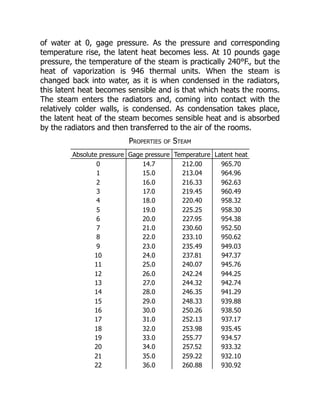
changing the water to vapor. The following table of the properties of
steam shows the temperatures and exact amounts of latent heat
that correspond to various pressures.
When water at the boiling point is turned into steam at the same
temperature, there are required 965.7 B.t.u. for each pound of water
changed into steam. In the table, this is the latent heat of the vapor
of water at 0, gage pressure. As the pressure and corresponding
temperature rise, the latent heat becomes less. At 10 pounds gage
pressure, the temperature of the steam is practically 240°F., but the
heat of vaporization is 946 thermal units. When the steam is
changed back into water, as it is when condensed in the radiators,
this latent heat becomes sensible and is that which heats the rooms.
The steam enters the radiators and, coming into contact with the
relatively colder walls, is condensed. As condensation takes place,
the latent heat of the steam becomes sensible heat and is absorbed
by the radiators and then transferred to the air of the rooms.
Properties of Steam
Absolute pressure Gage pressure Temperature Latent heat
0 14.7 212.00 965.70
1 15.0 213.04 964.96
2 16.0 216.33 962.63
3 17.0 219.45 960.49
4 18.0 220.40 958.32
5 19.0 225.25 958.30
6 20.0 227.95 954.38
7 21.0 230.60 952.50
8 22.0 233.10 950.62
9 23.0 235.49 949.03
10 24.0 237.81 947.37
11 25.0 240.07 945.76
12 26.0 242.24 944.25
13 27.0 244.32 942.74
14 28.0 246.35 941.29
15 29.0 248.33 939.88
16 30.0 250.26 938.50
17 31.0 252.13 937.17
18 32.0 253.98 935.45
19 33.0 255.77 934.57
20 34.0 257.52 933.32
21 35.0 259.22 932.10
22 36.0 260.88 930.92
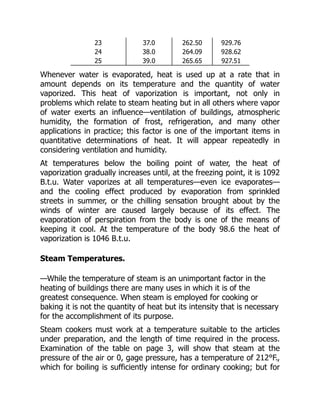
23 37.0 262.50 929.76
24 38.0 264.09 928.62
25 39.0 265.65 927.51
Whenever water is evaporated, heat is used up at a rate that in
amount depends on its temperature and the quantity of water
vaporized. This heat of vaporization is important, not only in
problems which relate to steam heating but in all others where vapor
of water exerts an influence—ventilation of buildings, atmospheric
humidity, the formation of frost, refrigeration, and many other
applications in practice; this factor is one of the important items in
quantitative determinations of heat. It will appear repeatedly in
considering ventilation and humidity.
At temperatures below the boiling point of water, the heat of
vaporization gradually increases until, at the freezing point, it is 1092
B.t.u. Water vaporizes at all temperatures—even ice evaporates—
and the cooling effect produced by evaporation from sprinkled
streets in summer, or the chilling sensation brought about by the
winds of winter are caused largely because of its effect. The
evaporation of perspiration from the body is one of the means of
keeping it cool. At the temperature of the body 98.6 the heat of
vaporization is 1046 B.t.u.
Steam Temperatures.
—While the temperature of steam is an unimportant factor in the
heating of buildings there are many uses in which it is of the
greatest consequence. When steam is employed for cooking or
baking it is not the quantity of heat but its intensity that is necessary
for the accomplishment of its purpose.
Steam cookers must work at a temperature suitable to the articles
under preparation, and the length of time required in the process.
Examination of the table on page 3, will show that steam at the
pressure of the air or 0, gage pressure, has a temperature of 212°F.,
which for boiling is sufficiently intense for ordinary cooking; but for
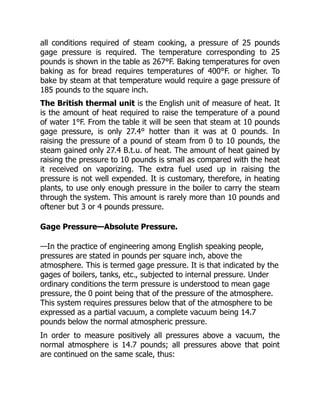
all conditions required of steam cooking, a pressure of 25 pounds
gage pressure is required. The temperature corresponding to 25
pounds is shown in the table as 267°F. Baking temperatures for oven
baking as for bread requires temperatures of 400°F. or higher. To
bake by steam at that temperature would require a gage pressure of
185 pounds to the square inch.
The British thermal unit is the English unit of measure of heat. It
is the amount of heat required to raise the temperature of a pound
of water 1°F. From the table it will be seen that steam at 10 pounds
gage pressure, is only 27.4° hotter than it was at 0 pounds. In
raising the pressure of a pound of steam from 0 to 10 pounds, the
steam gained only 27.4 B.t.u. of heat. The amount of heat gained by
raising the pressure to 10 pounds is small as compared with the heat
it received on vaporizing. The extra fuel used up in raising the
pressure is not well expended. It is customary, therefore, in heating
plants, to use only enough pressure in the boiler to carry the steam
through the system. This amount is rarely more than 10 pounds and
oftener but 3 or 4 pounds pressure.
Gage Pressure—Absolute Pressure.
—In the practice of engineering among English speaking people,
pressures are stated in pounds per square inch, above the
atmosphere. This is termed gage pressure. It is that indicated by the
gages of boilers, tanks, etc., subjected to internal pressure. Under
ordinary conditions the term pressure is understood to mean gage
pressure, the 0 point being that of the pressure of the atmosphere.
This system requires pressures below that of the atmosphere to be
expressed as a partial vacuum, a complete vacuum being 14.7
pounds below the normal atmospheric pressure.
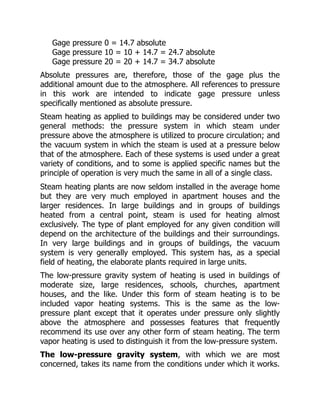
In order to measure positively all pressures above a vacuum, the
normal atmosphere is 14.7 pounds; all pressures above that point
are continued on the same scale, thus:
Gage pressure 0 = 14.7 absolute
Gage pressure 10 = 10 + 14.7 = 24.7 absolute
Gage pressure 20 = 20 + 14.7 = 34.7 absolute
Absolute pressures are, therefore, those of the gage plus the
additional amount due to the atmosphere. All references to pressure
in this work are intended to indicate gage pressure unless
specifically mentioned as absolute pressure.
Steam heating as applied to buildings may be considered under two
general methods: the pressure system in which steam under
pressure above the atmosphere is utilized to procure circulation; and
the vacuum system in which the steam is used at a pressure below
that of the atmosphere. Each of these systems is used under a great
variety of conditions, and to some is applied specific names but the
principle of operation is very much the same in all of a single class.
Steam heating plants are now seldom installed in the average home
but they are very much employed in apartment houses and the
larger residences. In large buildings and in groups of buildings
heated from a central point, steam is used for heating almost
exclusively. The type of plant employed for any given condition will
depend on the architecture of the buildings and their surroundings.
In very large buildings and in groups of buildings, the vacuum
system is very generally employed. This system has, as a special
field of heating, the elaborate plants required in large units.
The low-pressure gravity system of heating is used in buildings of
moderate size, large residences, schools, churches, apartment
houses, and the like. Under this form of steam heating is to be
included vapor heating systems. This is the same as the low-
pressure plant except that it operates under pressure only slightly
above the atmosphere and possesses features that frequently
recommend its use over any other form of steam heating. The term
vapor heating is used to distinguish it from the low-pressure system.
The low-pressure gravity system, with which we are most
concerned, takes its name from the conditions under which it works.
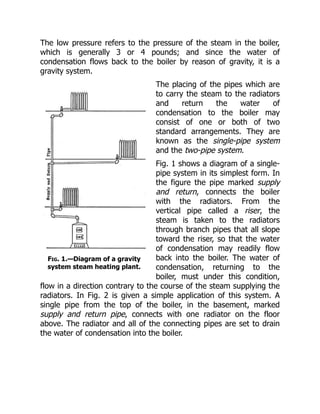
Fig. 1.—Diagram of a gravity
system steam heating plant.
The low pressure refers to the pressure of the steam in the boiler,
which is generally 3 or 4 pounds; and since the water of
condensation flows back to the boiler by reason of gravity, it is a
gravity system.
The placing of the pipes which are
to carry the steam to the radiators
and return the water of
condensation to the boiler may
consist of one or both of two
standard arrangements. They are
known as the single-pipe system
and the two-pipe system.
Fig. 1 shows a diagram of a single-
pipe system in its simplest form. In
the figure the pipe marked supply
and return, connects the boiler
with the radiators. From the
vertical pipe called a riser, the
steam is taken to the radiators
through branch pipes that all slope
toward the riser, so that the water
of condensation may readily flow
back into the boiler. The water of
condensation, returning to the
boiler, must under this condition,
flow in a direction contrary to the course of the steam supplying the
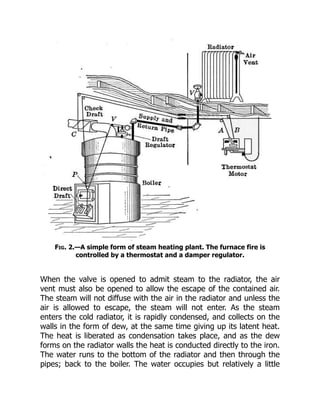
radiators. In Fig. 2 is given a simple application of this system. A
single pipe from the top of the boiler, in the basement, marked
supply and return pipe, connects with one radiator on the floor
above. The radiator and all of the connecting pipes are set to drain
the water of condensation into the boiler.
Fig. 2.—A simple form of steam heating plant. The furnace fire is
controlled by a thermostat and a damper regulator.
When the valve is opened to admit steam to the radiator, the air
vent must also be opened to allow the escape of the contained air.
The steam will not diffuse with the air in the radiator and unless the
air is allowed to escape, the steam will not enter. As the steam
enters the cold radiator, it is rapidly condensed, and collects on the
walls in the form of dew, at the same time giving up its latent heat.
The heat is liberated as condensation takes place, and as the dew
forms on the radiator walls the heat is conducted directly to the iron.
The water runs to the bottom of the radiator and then through the
pipes; back to the boiler. The water occupies but relatively a little
space and may return through the same pipe, while more steam is
entering the radiator. As the steam condenses in the radiator, its
reduction in volume tends to reduce the pressure and thus aids
additional steam from the boiler to enter. In this manner a constant
supply of heat enters the radiator in the form of steam which when
condensed goes back to the boiler at a temperature very near the
boiling point to be revaporized. It should be kept in mind that it is
the heat of vaporization, not the temperature of the steam that is
utilized in the radiator, and that the heat of vaporization is the
vehicle of transfer. The water returning to the boiler may be at the
boiling point and the steam supplying the heat to the radiators may
be at the same temperature.
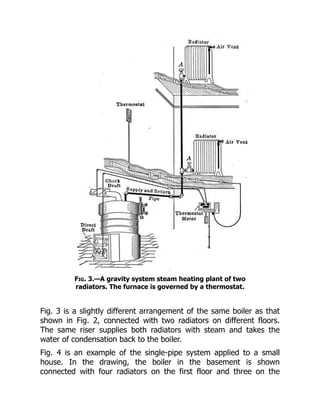
Fig. 3.—A gravity system steam heating plant of two
radiators. The furnace is governed by a thermostat.
Fig. 3 is a slightly different arrangement of the same boiler as that
shown in Fig. 2, connected with two radiators on different floors.
The same riser supplies both radiators with steam and takes the
water of condensation back to the boiler.
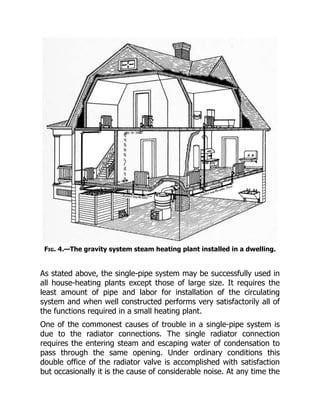
Fig. 4 is an example of the single-pipe system applied to a small
house. In the drawing, the boiler in the basement is shown
connected with four radiators on the first floor and three on the
second floor. The pipes connecting with the more distant radiators
are only extensions of the pipes connecting the radiators near the
boiler. As in Figs. 1, 2 and 3, all of the pipes and radiators are set to
drain back into the boiler. If at any place the pipe is so graded that a
part of the water is retained, poor circulation will result, because of
the restricted area of the pipe, and the radiators will not be properly
heated. This lack of drainage is also a common cause of hammering
and pounding in steam systems, known as water-hammer. The
formation of water-hammer is caused by steam flowing through a
water-restricted area, into a cold part of the system, where
condensation takes place very rapidly. The condensation of the
steam is so rapid and complete that the resulting vacuum draws the
trapped water into the space with the force of a hammer stroke. The
hammering will continue so long as the conditions exist. The pipes in
the basement are suspended from the floor joists by hangers as
shown in the drawing. In practice the pipes in the basement are
covered with some form of insulating material to prevent loss of
heat.
Fig. 4.—The gravity system steam heating plant installed in a dwelling.
As stated above, the single-pipe system may be successfully used in
all house-heating plants except those of large size. It requires the
least amount of pipe and labor for installation of the circulating
system and when well constructed performs very satisfactorily all of
the functions required in a small heating plant.
One of the commonest causes of trouble in a single-pipe system is
due to the radiator connections. The single radiator connection
requires the entering steam and escaping water of condensation to
pass through the same opening. Under ordinary conditions this
double office of the radiator valve is accomplished with satisfaction
but occasionally it is the cause of considerable noise. At any time the
Welcome to our website – the perfect destination for book lovers and
knowledge seekers. We believe that every book holds a new world,
offering opportunities for learning, discovery, and personal growth.
That’s why we are dedicated to bringing you a diverse collection of
books, ranging from classic literature and specialized publications to
self-development guides and children's books.
More than just a book-buying platform, we strive to be a bridge
connecting you with timeless cultural and intellectual values. With an
elegant, user-friendly interface and a smart search system, you can
quickly find the books that best suit your interests. Additionally,
our special promotions and home delivery services help you save time
and fully enjoy the joy of reading.
Join us on a journey of knowledge exploration, passion nurturing, and
personal growth every day!
ebookbell.com

Robust Automatic Speech Recognition A Bridge To Practical Applications 1st Edition Deng

  • 1.
    Robust Automatic SpeechRecognition A Bridge To Practical Applications 1st Edition Deng download https://ebookbell.com/product/robust-automatic-speech- recognition-a-bridge-to-practical-applications-1st-edition- deng-5432680 Explore and download more ebooks at ebookbell.com

  • 2.
    Here are somerecommended products that we believe you will be interested in. You can click the link to download. Robust Adaptation To Nonnative Accents In Automatic Speech Recognition 1st Edition Silke Goronzy Eds https://ebookbell.com/product/robust-adaptation-to-nonnative-accents- in-automatic-speech-recognition-1st-edition-silke-goronzy-eds-1535058 Test Automation Engineering Handbook Learn And Implement Techniques For Building Robust Test Automation Frameworks 1st Manikandan Sambamurthy https://ebookbell.com/product/test-automation-engineering-handbook- learn-and-implement-techniques-for-building-robust-test-automation- frameworks-1st-manikandan-sambamurthy-47580422 Selenium And Appium With Python Build Robust And Scalable Test Automation Frameworks Using Selenium Appium And Python Yogashiva Mathivanan https://ebookbell.com/product/selenium-and-appium-with-python-build- robust-and-scalable-test-automation-frameworks-using-selenium-appium- and-python-yogashiva-mathivanan-50457814 Robust Comprehension Instruction With Questioning The Author Isabel L Beck https://ebookbell.com/product/robust-comprehension-instruction-with- questioning-the-author-isabel-l-beck-46144048
  • 3.
    Robust Control YoulaParameterization Approach Farhad Assadian https://ebookbell.com/product/robust-control-youla-parameterization- approach-farhad-assadian-46243078 Robust Formation Control For Multiple Unmanned Aerial Vehicles Hao Liu https://ebookbell.com/product/robust-formation-control-for-multiple- unmanned-aerial-vehicles-hao-liu-46507354 Robust Network Compressive Sensing Guangtao Xue Yichao Chen https://ebookbell.com/product/robust-network-compressive-sensing- guangtao-xue-yichao-chen-46768610 Robust Mechanism Design The Role Of Private Information And Higher Order Beliefs Dirk Bergemann https://ebookbell.com/product/robust-mechanism-design-the-role-of- private-information-and-higher-order-beliefs-dirk-bergemann-47363774 Robust Statistics Wiley Series In Probability And Statistics 2nd Edition 2nd Peter J Huber https://ebookbell.com/product/robust-statistics-wiley-series-in- probability-and-statistics-2nd-edition-2nd-peter-j-huber-47439188
  • 5.
    Discovering Diverse ContentThrough Random Scribd Documents
  • 9.
    The Project GutenbergeBook of Mechanics of the Household
  • 10.
    This ebook isfor the use of anyone anywhere in the United States and most other parts of the world at no cost and with almost no restrictions whatsoever. You may copy it, give it away or re-use it under the terms of the Project Gutenberg License included with this ebook or online at www.gutenberg.org. If you are not located in the United States, you will have to check the laws of the country where you are located before using this eBook. Title: Mechanics of the Household Author: E. S. Keene Release date: January 4, 2016 [eBook #50846] Most recently updated: October 22, 2024 Language: English Credits: E-text prepared by Chris Curnow, Chris Jordan, and the Online Distributed Proofreading Team (http://www.pgdp.net) from page images generously made available by Internet Archive (https://archive.org) *** START OF THE PROJECT GUTENBERG EBOOK MECHANICS OF THE HOUSEHOLD ***
  • 11.
    The Project GutenbergeBook, Mechanics of the Household, by E. S. (Edward Spencer) Keene Note: Images of the original pages are available through Internet Archive. See https://archive.org/details/mechanicsofhouse00keen MECHANICS OF THE HOUSEHOLD McGraw-Hill Book Co., Inc. PUBLISHERS OF BOOKS FOR Coal Age ▼ Electric Railway Journal Electrical World ▼ Engineering News- Record American Machinist ▼ The Contractor Engineering & Mining Journal
  • 12.
    ▼ Power Metallurgical& Chemical Engineering Electrical Merchandising
  • 13.
    MECHANICS OF THE HOUSEHOLD A COURSEOF STUDY DEVOTED TO DOMESTIC MACHINERY AND HOUSEHOLD MECHANICAL APPLIANCES E. S. KEENE DEAN OF MECHANIC ARTS NORTH DAKOTA AGRICULTURAL COLLEGE First Edition McGRAW-HILL BOOK COMPANY, Inc. 239 WEST 39TH STREET. NEW YORK LONDON: HILL PUBLISHING CO., Ltd. 6 & 8 BOUVERIE ST., E. C. 1918
  • 14.
    Copyright, 1918, bythe McGraw-Hill Book Company, Inc.
  • 16.
    INTRODUCTION This book isintended to be a presentation of the physical principles and mechanism employed in the equipment that has been developed for domestic convenience. Its aim is to provide information relative to the general practice of domestic engineering. The scope of the work is such as to present: first, the use of household mechanical appliances; second, the principles involved and the mechanism employed. It is not exhaustive, neither does it touch many of the secondary topics that might be discussed in connection with the various subjects. It does, however, describe at least one representative piece of each type of household apparatus that is used in good practice. The mechanism used in the equipment of a modern dwelling is worthy of greater attention, as a course of study, than it has been heretofore accorded. The fact that any house, rural or urban, may be provided with all domestic conveniences included in: furnace heating, mechanical temperature regulation, lighting facilities, water supply, sewage disposal and other appliances, indicates the general use of domestic machinery in great variety. To comprehend the application and adaptability of this mechanism requires a knowledge of its general plan of construction and principles of operation. Heating systems in great variety utilize steam, hot water, or hot air as the vehicle of transfer of heat from the furnace, throughout the house. Each of these is made in the form of special heating plants that may be adapted, in some special advantage to the various conditions of use. A knowledge of their working principles and general mechanical arrangement furnishes a fund of information that is of every day application. The systems available for household water distribution take advantage of natural laws, which aided by suitable mechanical
  • 17.
    devices and convenientlyarranged systems of pipes, provide water- supply plants to satisfy any condition of service. They may be of simple form, to suit a cottage, or elaborated to the requirements of large residences and made entirely automatic in action. In each, the apparatus consists of parts that perform definite functions. The parts may be obtained from different makers and assembled as a working unit or the plant may be purchased complete as some special system of water supply. An acquaintance with domestic water supply apparatus may be of service in every condition of life. The type of illumination for a house or a group of buildings, may be selected from a variety of lighting systems. In rural homes, choice may be made between oil gas, gasolene, acetylene and electricity, each of which is used in a number of successful plants that differ only in the mechanism employed. Any building arranged with toilet, kitchen and laundry conveniences must be provided with some form of sewage disposal. Private disposal plants are made to meet many conditions of service. The mechanical construction and principles of operation are not difficult to comprehend and their adaptation to a given service is only an intelligent conception of the possible conditions of disposal, dependent on the natural surroundings. There are few communities where household equipment cannot be found to illustrate each of the subjects discussed. Most modern school houses are equipped for automatic control of temperature, ventilation and humidity. They are further provided with systems of gas, water and electric distribution and arrangements for sewage disposal. These facilities furnish demonstration apparatus that are also examples of their application. Additional examples of the various forms of plumbing and pipe fittings, valves, traps and water fixtures may be found in the shop of dealers in plumbers and steam-fitters supplies. Attention is called to the value of observing houses in process of construction and the means employed for the placement of the pipes for the sewer, gas, water, electric conduits, etc. These are generally
  • 18.
    located by directionof the specifications provided by the architect but observation of their installation is necessary for a comprehension of actual working conditions. It is suggested that the work be made that of, first, acquiring an idea of established practice, and second, that of investigating the examples of its application.
  • 20.
    CONTENTS Preface v CHAPTER I Page TheSteam Heating Plant Heat of Vaporization—Steam Temperature—Gage Pressure —Absolute Pressure—Two-pipe System—Separate-return System—Overhead or Drop System—Water-filled Radiators —Air Vents—Automatic Air Vents—Steam Radiator Valves— The House-heating Steam Boiler—Boiler Trimmings—The Water Column—The Steam Gage—The Safety Valve—The Draft Regulator—Rule for Proportioning Radiators— Proportioning the Size of Mains—Forms of Radiators— Radiator Finishings—Pipe Coverings—Vapor-system Heating. 1 CHAPTER II The Hot-water Heating Plant The Low-pressure Hot-water System—The High-pressure Hot-water System—Heating-plant Design—Overhead System of Hot-water Heating—Expansion Tanks—Radiator Connection—Hot-water Radiators—Hot-water Radiator Valves—Air Vents—Automatic Hot-water Air Vents. 37 CHAPTER III The Hot-air Furnace Construction—Furnace-gas Leaks—Location of the Furnace —Flues—Combination Hot-air and Hot-water Heater. 51 CHAPTER IV
  • 21.
    Temperature Regulation Hand Regulation—DamperRegulator for Steam Boiler— Damper Regulators for Hot-water Furnaces—The Thermostat Motor—Combined Thermostat and Damper Regulator—Thermostat-motor Connections. 59 CHAPTER V Management of Heating Plants General Advice—The Economy of Good Draft—General Firing Rules—Weather and Time of Day—Night Firing— First-day Firing—Other Day Firing—Economy and Fuels— For Burning Soft Coal—For Burning Coke—Other Rules for Water Boilers—Air-vent Valves on Radiators—The Air Valves —End of the Season—The Right Chimney Flue—“Smokey” Chimneys. 70 CHAPTER VI Plumbing Water Supply—Water Cocks—Bibb-cocks—Self-closing Bibbs—Lever-handle Bibbs—Fuller Cocks—Wash-tray Bibbs —Basin Cocks—Pantry Cocks—Sill Cocks—Valves—Kitchen and Laundry Fixtures—The Bathroom—Bath Tubs—Wash Stands and Lavatories—Traps—Back-venting—Soil Pipe— Water Closets—Washout Closets—Washdown Closets— Siphon-jet Closet—Flush Tanks—Low-down Flush Tank— Opening Stopped Pipes—Sewer Gas—Range Boilers—The Water-back—Excessive Pressure—Blow-off Cock—Location of Range Boiler—Double Heater Connections—Horizontal Range Boilers—Tank Heaters—Overheater Water—Furnace Hot-water Heaters—Instantaneous Heaters. 82 CHAPTER VII Water Supply Water Analysis—Pokegama Water—River Water—Artesian Water—Medical Water—Organic Matter—Ammonia— 125
  • 22.
    Hardness in Water—Ironin Water—Water Softening With Hydrated Silicates—Chlorine—Polluted Water—Pollution of Wells—Safe Distance in the Location of Wells—Surface Pollution of Wells—Water Table—The Divining Rod— Selection of a Type of Well—Flowing Wells—Construction of Wells—Dug Wells—Open Wells—The Ideal Well—Coverings of Concrete—Artesian Wells—Driven Wells—Bored Wells— Cleaning Wells—Gases in Wells—Peculiarities of Wells— Breathing Well—Freezing Wells—Pumps—The Lift Pump— The Force Pump—Tank Pump—Well Pumps—Wooden Pump —Pumps for Driven Wells—Deep-well Pumps—Tubular Well Cylinders—Chain Pumps—Rain Water Cisterns—Filters—The Hydraulic Ram—Single-acting Hydraulic Ram—The Double- acting Hydraulic Ram—Domestic Water-supply Plants— Gravity Water Supply—Pressure-tank System of Water Supply—The Pressure Tank—Power Water-supply Plants— Electric Power Water Supply—The Water Lift. CHAPTER VIII Sewage Disposal The Septic Tank—The Septic Tank With a Sand-bed Filter— The Septic Tank and Anaerobic Filter—Limit of Efficiency. 168 CHAPTER IX Coal Oxidation of Hydrocarbons—Graphitic Anthracite— Cannel Coal—Lignite—Peat—Wood—Charcoal—Coke—Gas- coke—Briquettes —Comparative Value of Coal to Other Fuels—Price of Coal. 182 CHAPTER X Atmospheric Humidity Humidity of the Air—Relative Humidity—The Hygrometer— The Hygrodeik—Dial Hygrometers—The Swiss Cottage “Barometer”—Dew-point—To Determine the Dew-point— 196
  • 23.
    Frost Prediction—Prevention ofFrost—Humidifying Apparatus. CHAPTER XI Ventilation 196 Quantity of Air Discharged by a Flue—Cost of Ventilation—The Wolpert Air Tester—Pneumatic Temperature Regulation—Mechanical Ventilation—The Plenum Method—Ventilation Apparatus—Air Conditioning— Humidifying Plants—Vaporization as a Cooling Agent—Air- cooling Plants—Humidity Control. 219 CHAPTER XII Gaseous and Liquid Fuels Gaseous and Liquid Fuels—Coal Gas—All-oil Water Gas— Pintsch Gas—Blau Gas—Water Gas—Measurement of Gas— Gas Meters How to Read the Index—Prepayment Meters— Gas-service Rules—Gas Ranges—Lighting and Heating with Gasoline—Gasoline—Kerosene—The Cold-process Gas Machine—The Hollow-wire System of Gasoline Lighting and Heating—Mantle Gas Lamps—Open-flame Gas Burners— The Inverted-mantle Gasoline Lamp—Portable Gasoline Lamp—Central Generator Plants—Central-generator Gas Lamps—Boulevard Lamps—Gasoline Sad Irons—Alcohol Sad Irons—Alcohol Table Stoves—Danger from Gaseous and Liquid Fuels—Acetylene-gas Machine—Types of Acetylene Generators—Gas Lighters—Acetylene Stoves. 250 CHAPTER XIII Electricity Incandescent Electric Lamps—The Mazda Lamp— Candlepower—Lamp Labels—Illumination—The Foot-candle —The Lumen—Reflectors—Choice of Reflector—Lamp Transformers—Units of Electrical Measurements—Miniature Lamps—Effects of Voltage Variations—Turn-down Electric 305
  • 24.
    Lamps—The Dim-a-lite—Gas-filled Lamps—DaylightLamps —Miniature Tungsten Lamps—Flash Lights—The Electric Flat-iron—The Electric Toaster—Motors, Fuse Plugs— Electric Heaters—Intercommunicating Telephones—Electric Signals—Buzzers—Burglar Alarms—Annunciators—Table Pushes—Bell-ringing Transformers—The Recording Wattmeter—To Read the Meter—State Regulation of Meter Service—Electric Batteries—Battery Formation—Battery Testers—Electric Conductors—Lamp Cord—Portable Cord— Annunciator Wire—Private Electric Generating Plants— Storage Batteries—The Pilot Cell—National Electrical Code —Electric Light Wiring—Outlet Boxes—Automatic Door Switch—Plug Receptacles—Heater Switch, Pilot and Receptacle—Service Switch—Local Switches—Pilot Lights— Wall and Ceiling Sockets—Drop Lights. Index 385
  • 25.
  • 26.
    CHAPTER I THE STEAMHEATING PLANT The use of steam as a means of heating dwellings is common in every part of the civilized world. Plants of all sizes are constructed, that not only give satisfactory service but are efficient in the use of fuel, and require the minimum amount of attention. The manufacture of steam heating apparatus has come to be a distinct industry, and represents a special branch of engineering. Many manufacturing companies, pursue this line of business exclusively. The result has been the development of many distinctive features and systems of steam heating, that are very excellent for the purposes intended. Practice has shown that large plants can be operated more economically than small ones. Steam may be carried through underground, insulated pipes to great distances with but small loss of heat. This has lead to the sale of exhaust steam, from the engines of manufacturing plants, for heating purposes and the establishment of community heating plants, where the dwellings of a neighborhood are heated from a central heating plant; each subscriber paying for his heat according to the number of square feet of radiating surface his house contains. In the practice most commonly followed, with small steam heating plants, the steam is generated in a boiler located at any convenient place, but commonly in the basement. The steam is distributed through insulated pipes to the rooms, where it gives up its heat to cast-iron radiators, and from them it is imparted to the air; partly by radiation but most of the heat is transmitted to the air in direct contact with the radiator surface.
  • 27.
    The heating capacityof a radiator is determined by its outside surface area, and is commonly termed, radiating surface or heating surface. Radiators of different styles and sizes are listed by manufacturers, according to the amount of heating surface each possesses. Radiators are sold at a definite amount per square foot, and may be made to contain any amount of heating surface, for different heights from 12 to 45 inches. The widespread use of steam as a means of heating buildings is due to its remarkable heat content. When water is converted into vapor the change is attended by the absorption of a large amount of heat. No matter at what temperature water is evaporated, a definite quantity of heat is required to merely change the water into vapor without changing its temperature. The heat used to vaporize water in a steam boiler is given up in the radiators when the steam is condensed. It is because of this property that steam is such a convenient vehicle for transferring heat from the furnace—where it is generated—to the place to be warmed. This heat of vaporization is really the property which gives to steam its usefulness as a means of heating. Heat of Vaporization. —The temperature of the steam is comparatively an unimportant factor in the amount of heat given up by the radiator. It is the heat liberated at the time the steam changes from vapor to water that produces the greatest effect in changing the temperature of the house. This evolution of heat by condensation is sometimes called the latent heat of vaporization. It is the heat that was used up in changing the water to vapor. The following table of the properties of steam shows the temperatures and exact amounts of latent heat that correspond to various pressures. When water at the boiling point is turned into steam at the same temperature, there are required 965.7 B.t.u. for each pound of water changed into steam. In the table, this is the latent heat of the vapor
  • 28.
    of water at0, gage pressure. As the pressure and corresponding temperature rise, the latent heat becomes less. At 10 pounds gage pressure, the temperature of the steam is practically 240°F., but the heat of vaporization is 946 thermal units. When the steam is changed back into water, as it is when condensed in the radiators, this latent heat becomes sensible and is that which heats the rooms. The steam enters the radiators and, coming into contact with the relatively colder walls, is condensed. As condensation takes place, the latent heat of the steam becomes sensible heat and is absorbed by the radiators and then transferred to the air of the rooms. Properties of Steam Absolute pressure Gage pressure Temperature Latent heat 0 14.7 212.00 965.70 1 15.0 213.04 964.96 2 16.0 216.33 962.63 3 17.0 219.45 960.49 4 18.0 220.40 958.32 5 19.0 225.25 958.30 6 20.0 227.95 954.38 7 21.0 230.60 952.50 8 22.0 233.10 950.62 9 23.0 235.49 949.03 10 24.0 237.81 947.37 11 25.0 240.07 945.76 12 26.0 242.24 944.25 13 27.0 244.32 942.74 14 28.0 246.35 941.29 15 29.0 248.33 939.88 16 30.0 250.26 938.50 17 31.0 252.13 937.17 18 32.0 253.98 935.45 19 33.0 255.77 934.57 20 34.0 257.52 933.32 21 35.0 259.22 932.10 22 36.0 260.88 930.92
  • 29.
    23 37.0 262.50929.76 24 38.0 264.09 928.62 25 39.0 265.65 927.51 Whenever water is evaporated, heat is used up at a rate that in amount depends on its temperature and the quantity of water vaporized. This heat of vaporization is important, not only in problems which relate to steam heating but in all others where vapor of water exerts an influence—ventilation of buildings, atmospheric humidity, the formation of frost, refrigeration, and many other applications in practice; this factor is one of the important items in quantitative determinations of heat. It will appear repeatedly in considering ventilation and humidity. At temperatures below the boiling point of water, the heat of vaporization gradually increases until, at the freezing point, it is 1092 B.t.u. Water vaporizes at all temperatures—even ice evaporates— and the cooling effect produced by evaporation from sprinkled streets in summer, or the chilling sensation brought about by the winds of winter are caused largely because of its effect. The evaporation of perspiration from the body is one of the means of keeping it cool. At the temperature of the body 98.6 the heat of vaporization is 1046 B.t.u. Steam Temperatures. —While the temperature of steam is an unimportant factor in the heating of buildings there are many uses in which it is of the greatest consequence. When steam is employed for cooking or baking it is not the quantity of heat but its intensity that is necessary for the accomplishment of its purpose. Steam cookers must work at a temperature suitable to the articles under preparation, and the length of time required in the process. Examination of the table on page 3, will show that steam at the pressure of the air or 0, gage pressure, has a temperature of 212°F., which for boiling is sufficiently intense for ordinary cooking; but for
  • 30.
    all conditions requiredof steam cooking, a pressure of 25 pounds gage pressure is required. The temperature corresponding to 25 pounds is shown in the table as 267°F. Baking temperatures for oven baking as for bread requires temperatures of 400°F. or higher. To bake by steam at that temperature would require a gage pressure of 185 pounds to the square inch. The British thermal unit is the English unit of measure of heat. It is the amount of heat required to raise the temperature of a pound of water 1°F. From the table it will be seen that steam at 10 pounds gage pressure, is only 27.4° hotter than it was at 0 pounds. In raising the pressure of a pound of steam from 0 to 10 pounds, the steam gained only 27.4 B.t.u. of heat. The amount of heat gained by raising the pressure to 10 pounds is small as compared with the heat it received on vaporizing. The extra fuel used up in raising the pressure is not well expended. It is customary, therefore, in heating plants, to use only enough pressure in the boiler to carry the steam through the system. This amount is rarely more than 10 pounds and oftener but 3 or 4 pounds pressure. Gage Pressure—Absolute Pressure. —In the practice of engineering among English speaking people, pressures are stated in pounds per square inch, above the atmosphere. This is termed gage pressure. It is that indicated by the gages of boilers, tanks, etc., subjected to internal pressure. Under ordinary conditions the term pressure is understood to mean gage pressure, the 0 point being that of the pressure of the atmosphere. This system requires pressures below that of the atmosphere to be expressed as a partial vacuum, a complete vacuum being 14.7 pounds below the normal atmospheric pressure. In order to measure positively all pressures above a vacuum, the normal atmosphere is 14.7 pounds; all pressures above that point are continued on the same scale, thus:
  • 31.
    Gage pressure 0= 14.7 absolute Gage pressure 10 = 10 + 14.7 = 24.7 absolute Gage pressure 20 = 20 + 14.7 = 34.7 absolute Absolute pressures are, therefore, those of the gage plus the additional amount due to the atmosphere. All references to pressure in this work are intended to indicate gage pressure unless specifically mentioned as absolute pressure. Steam heating as applied to buildings may be considered under two general methods: the pressure system in which steam under pressure above the atmosphere is utilized to procure circulation; and the vacuum system in which the steam is used at a pressure below that of the atmosphere. Each of these systems is used under a great variety of conditions, and to some is applied specific names but the principle of operation is very much the same in all of a single class. Steam heating plants are now seldom installed in the average home but they are very much employed in apartment houses and the larger residences. In large buildings and in groups of buildings heated from a central point, steam is used for heating almost exclusively. The type of plant employed for any given condition will depend on the architecture of the buildings and their surroundings. In very large buildings and in groups of buildings, the vacuum system is very generally employed. This system has, as a special field of heating, the elaborate plants required in large units. The low-pressure gravity system of heating is used in buildings of moderate size, large residences, schools, churches, apartment houses, and the like. Under this form of steam heating is to be included vapor heating systems. This is the same as the low- pressure plant except that it operates under pressure only slightly above the atmosphere and possesses features that frequently recommend its use over any other form of steam heating. The term vapor heating is used to distinguish it from the low-pressure system. The low-pressure gravity system, with which we are most concerned, takes its name from the conditions under which it works.
  • 32.
    Fig. 1.—Diagram ofa gravity system steam heating plant. The low pressure refers to the pressure of the steam in the boiler, which is generally 3 or 4 pounds; and since the water of condensation flows back to the boiler by reason of gravity, it is a gravity system. The placing of the pipes which are to carry the steam to the radiators and return the water of condensation to the boiler may consist of one or both of two standard arrangements. They are known as the single-pipe system and the two-pipe system. Fig. 1 shows a diagram of a single- pipe system in its simplest form. In the figure the pipe marked supply and return, connects the boiler with the radiators. From the vertical pipe called a riser, the steam is taken to the radiators through branch pipes that all slope toward the riser, so that the water of condensation may readily flow back into the boiler. The water of condensation, returning to the boiler, must under this condition, flow in a direction contrary to the course of the steam supplying the radiators. In Fig. 2 is given a simple application of this system. A single pipe from the top of the boiler, in the basement, marked supply and return pipe, connects with one radiator on the floor above. The radiator and all of the connecting pipes are set to drain the water of condensation into the boiler.
  • 33.
    Fig. 2.—A simpleform of steam heating plant. The furnace fire is controlled by a thermostat and a damper regulator. When the valve is opened to admit steam to the radiator, the air vent must also be opened to allow the escape of the contained air. The steam will not diffuse with the air in the radiator and unless the air is allowed to escape, the steam will not enter. As the steam enters the cold radiator, it is rapidly condensed, and collects on the walls in the form of dew, at the same time giving up its latent heat. The heat is liberated as condensation takes place, and as the dew forms on the radiator walls the heat is conducted directly to the iron. The water runs to the bottom of the radiator and then through the pipes; back to the boiler. The water occupies but relatively a little
  • 34.
    space and mayreturn through the same pipe, while more steam is entering the radiator. As the steam condenses in the radiator, its reduction in volume tends to reduce the pressure and thus aids additional steam from the boiler to enter. In this manner a constant supply of heat enters the radiator in the form of steam which when condensed goes back to the boiler at a temperature very near the boiling point to be revaporized. It should be kept in mind that it is the heat of vaporization, not the temperature of the steam that is utilized in the radiator, and that the heat of vaporization is the vehicle of transfer. The water returning to the boiler may be at the boiling point and the steam supplying the heat to the radiators may be at the same temperature.
  • 35.
    Fig. 3.—A gravitysystem steam heating plant of two radiators. The furnace is governed by a thermostat. Fig. 3 is a slightly different arrangement of the same boiler as that shown in Fig. 2, connected with two radiators on different floors. The same riser supplies both radiators with steam and takes the water of condensation back to the boiler. Fig. 4 is an example of the single-pipe system applied to a small house. In the drawing, the boiler in the basement is shown connected with four radiators on the first floor and three on the
  • 36.
    second floor. Thepipes connecting with the more distant radiators are only extensions of the pipes connecting the radiators near the boiler. As in Figs. 1, 2 and 3, all of the pipes and radiators are set to drain back into the boiler. If at any place the pipe is so graded that a part of the water is retained, poor circulation will result, because of the restricted area of the pipe, and the radiators will not be properly heated. This lack of drainage is also a common cause of hammering and pounding in steam systems, known as water-hammer. The formation of water-hammer is caused by steam flowing through a water-restricted area, into a cold part of the system, where condensation takes place very rapidly. The condensation of the steam is so rapid and complete that the resulting vacuum draws the trapped water into the space with the force of a hammer stroke. The hammering will continue so long as the conditions exist. The pipes in the basement are suspended from the floor joists by hangers as shown in the drawing. In practice the pipes in the basement are covered with some form of insulating material to prevent loss of heat.
  • 37.
    Fig. 4.—The gravitysystem steam heating plant installed in a dwelling. As stated above, the single-pipe system may be successfully used in all house-heating plants except those of large size. It requires the least amount of pipe and labor for installation of the circulating system and when well constructed performs very satisfactorily all of the functions required in a small heating plant. One of the commonest causes of trouble in a single-pipe system is due to the radiator connections. The single radiator connection requires the entering steam and escaping water of condensation to pass through the same opening. Under ordinary conditions this double office of the radiator valve is accomplished with satisfaction but occasionally it is the cause of considerable noise. At any time the
  • 38.
    Welcome to ourwebsite – the perfect destination for book lovers and knowledge seekers. We believe that every book holds a new world, offering opportunities for learning, discovery, and personal growth. That’s why we are dedicated to bringing you a diverse collection of books, ranging from classic literature and specialized publications to self-development guides and children's books. More than just a book-buying platform, we strive to be a bridge connecting you with timeless cultural and intellectual values. With an elegant, user-friendly interface and a smart search system, you can quickly find the books that best suit your interests. Additionally, our special promotions and home delivery services help you save time and fully enjoy the joy of reading. Join us on a journey of knowledge exploration, passion nurturing, and personal growth every day! ebookbell.com