Plumbing Systems Provide ltw engineering essentials
1.
Copyright 2021. ProjectLead The Way, Inc.
1
Albert Einstein was named an honorary member of the
Plumbers and Steamfitters Union after publicly stating that
he would become a plumber if he had to do it all over again.
PLTW Engineering
Civil Engineering and Architecture
Activity 2.3.9 Residential Plumbing
Plumbing System
2.
Copyright 2021. ProjectLead The Way, Inc.
2
Residential Plumbing Systems
• The Romans
• Water Supply System
• Drain-Waste-Vent System
• Plumbing Codes
• Plumbing Plans
• Energy Conservation
3.
Copyright 2021. ProjectLead The Way, Inc.
3
The Romans
Water Supply
• Aqueducts transported water from sources
- Highest quality supplied drinking fountains
- Lower quality supplied public baths and latrines
• Lead pipes transferred water to limited users
wikimedia
4.
Copyright 2021. ProjectLead The Way, Inc.
4
The Romans
Wastewater System
• Chamber pots in residences
- Dumped out windows
• Toilets (luxury)
- Hole in the floor drained
to cesspool below
• Public latrines
- Wastewater flowed through central channel into
main sewage system and into nearby rivers and
streams
• Few private wastewater system connections
wikimedia
5.
Copyright 2021. ProjectLead The Way, Inc.
5
Plumbing System
• Water supply pipes
• Fixture – A device that uses water (sink, toilet,
dishwasher, etc.)
• Soil, waste, and vent pipes
• Drain and sewer
• Gas pipes
• Storm water drainage
6.
Copyright 2021. ProjectLead The Way, Inc.
6
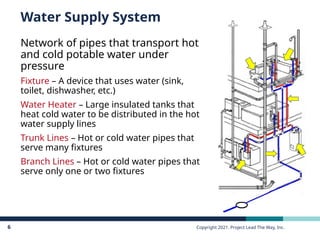
Water Supply System
Network of pipes that transport hot
and cold potable water under
pressure
Fixture – A device that uses water (sink,
toilet, dishwasher, etc.)
Water Heater – Large insulated tanks that
heat cold water to be distributed in the hot
water supply lines
Trunk Lines – Hot or cold water pipes that
serve many fixtures
Branch Lines – Hot or cold water pipes that
serve only one or two fixtures
7.
Copyright 2021. ProjectLead The Way, Inc.
7
SERVICE
Water Supply System
• Water Main – Supply pipe installed
and maintained by a public entity and
on public property
• Water Service – Pipe from the water
main to the building supply pipes
• Meter – Measures the amount of
water transported through water
service
• Valve – A fitting used to control water
flow (located next to the meter)
MAIN
8.
Copyright 2021. ProjectLead The Way, Inc.
8
Drain-Waste-Vent System
Network of pipes that transport
wastewater and sewer gases
from the building
Drain Pipe – A pipe that carries
wastewater in a building
Vent Pipe – A vertical pipe that
provides circulation of air to and from
the drainage system
Trap – A fitting (usually U-shaped) that
provides a seal to prevent the flow of
sewer gases
Stack – A vertical pipe (waste or vent)
that extends through at least one
story
Cleanout – An access opening to allow
cleanout of the pipe
9.
Copyright 2021. ProjectLead The Way, Inc.
9
Drain-Waste-Vent System
Sewage – Any liquid waste
containing animal or vegetable
matter, including liquids
containing chemicals
Sanitary Sewer – A sewer pipe that
carries only sewage
Storm Sewer – A sewer pipe that
carries storm water or other
drainage (but not sewage)
Building Sewer or Sewer Lateral –
Part of the drainage system from
the building to the public, private,
or individual sewer disposal
system
Sewer Main – A sewer pipe
installed and maintained by a
public entity and on public
property
MAIN
LATERAL
10.
Copyright 2021. ProjectLead The Way, Inc.
10
Plumbing Codes
• Protect health and safety of community
• Reduce potential for widespread disease
• Provide rules and regulations for installing
drinking water or sewer facilities
• Identify required methods for installing plumbing
systems
• Provide permits and inspections
The International Residential Code for One- and Two-family
Dwellings includes requirements for residential plumbing systems.
International Plumbing Code is a model code that has been widely
adopted throughout the United States for non-residential facilities.
Copyright 2021. ProjectLead The Way, Inc.
15
Energy Conservation
• Locate hot water heater in conditioned space
• Insulate hot water heater
• Insulate exposed hot water pipes
• Insulate cold water pipes with freezing potential
• Place water pipes in interior walls, if possible
• Use low-flow fixtures
• Seal all wall fenestrations
16.
Copyright 2021. ProjectLead The Way, Inc.
16
Residential Plumbing Systems
• The Romans
• Water Supply System
• Drain-Waste-Vent System
• Plumbing Codes
• Plumbing Plans
• Energy Conservation
17.
Copyright 2021. ProjectLead The Way, Inc.
17
Image Resources
www.istock.com. Images retrieved December 8,
2009.
www.wikimedia.com. Images retrieved December 8,
2009.
Editor's Notes
#3 The Romans are well known for their public water supply and wastewater systems. However, except for the wealthy, most access points to the systems were located outside of buildings.
#5 A plumbing system consists of all the elements that provide water or convey water or wastewater within the building as well as those elements that vent the wastewater system. Often gas and stormwater drainpipes are also installed and are considered part of the plumbing system.
#6 [Note that yellow arrows point to each component as it is defined]
#8 The drain-waste-vent system is designed to safely convey the waste and wastewater from the building while allowing noxious gases created from sewage to escape to the exterior of the building.
In the diagram the drain piping is shown in green, and the vent piping is shown in orange
#9 A sanitary sewer is distinguished from a storm sewer by the type of water that it carries. If sewage is conveyed, the sewer is a sanitary sewer. If the water conveys storm water, it is called a storm drain.
The part of a building’s drainage system that extends from the building to the disposal system is often called a sewer lateral. The wastewater disposal system can be a municipal system, a private system, or an individual system. We will discuss these wastewater systems later in Unit 3.
#12 Although the International Plumbing Code provides requirements for all aspects of a building’s plumbing system, the IBC incorporates a few of the plumbing regulations including the minimum number of certain plumbing fixtures, the location of toilet facilities, and the design of the toilet room and partitions.
The picture shows a row of showers and lavatories in a sports club.
#13 Plumbing plans are used to show the location of the water supply, vent, and drain lines but may also include storm water drains and gas lines. Note the difference in the line types. Color has been used here to better differentiate between the various lines; however, most plumbing plans will be black and white. The line style is used to differentiate the various types of pipe. Be sure to record the line style and color of each pipe. You will need this information for the next activity.
This plumbing plan was created with Revit software. New detail line styles were defined.
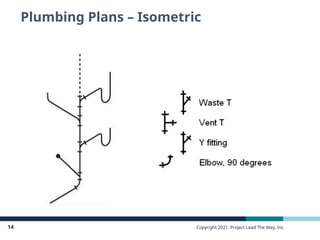
#14 Another common type of plumbing views is an isometric. This drawing illustrates a drain-waste-vent (DWV) system. Although not common for residential systems, isometrics are often created for larger commercial facilities due to the complexity of the piping. Note that toilets often have traps incorporated into their design and therefore do not require an additional trap in the system.
Also note that the connections in the sanitary drains are Y-shaped and not T-shaped to facilitate movement of waste.
Many software packages such as Revit MEP (mechanical, electrical, and plumbing) can create isometric piping drawings.
#15 These design tips will provide energy savings when designing a plumbing system.






![ceramic-art-and-pottery [Autosaved].pptx](https://cdn.slidesharecdn.com/ss_thumbnails/ceramic-art-and-potteryautosaved-260113113456-35c55ddb-thumbnail.jpg?width=640&height=640&fit=bounds)


