Robots for Aged Care:
Socio-ethical Issues
Katina Michael
Faculty of Engineering and Information Sciences
University of Wollongong
katinamichael.com/seminars | katina@uow.edu.au
Canadian Kim Trynacity’s Film
• Kim Trynacity is an award-winning journalist and CBC
Alberta's provincial affairs reporter.
• Completed MA in International and Intercultural
Communications circa 2014 in Canada.
• For her MA thesis Kim researched, shot and edited a
video documentary called "Close Enough to Care".
• It explores the impact on people, of replacing human caregivers
with robots. It's emotional, compelling and thought provoking.
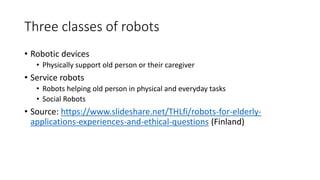
Three classes of robots
• Robotic devices
• Physically support old person or their caregiver
• Service robots
• Robots helping old person in physical and everyday tasks
• Social Robots
• Source: https://www.slideshare.net/THLfi/robots-for-elderly-
applications-experiences-and-ethical-questions (Finland)
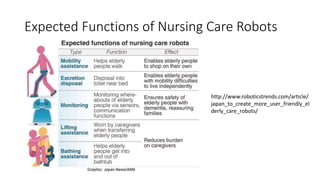
Expected Functions of Nursing Care Robots
http://www.roboticstrends.com/article/
japan_to_create_more_user_friendly_el
derly_care_robots/
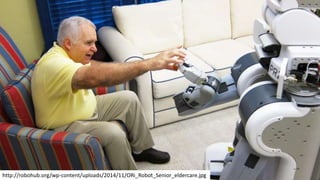
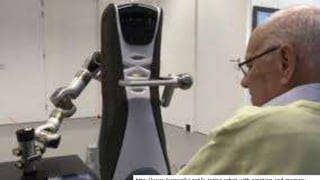
http://robohub.org/wp-content/uploads/2014/11/ORi_Robot_Senior_eldercare.jpg
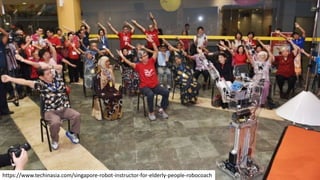
https://www.techinasia.com/singapore-robot-instructor-for-elderly-people-robocoach
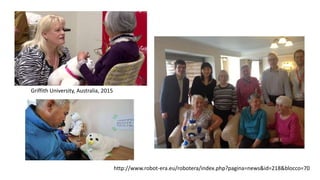
http://www.robot-era.eu/robotera/index.php?pagina=news&id=218&blocco=70
Griffith University, Australia, 2015
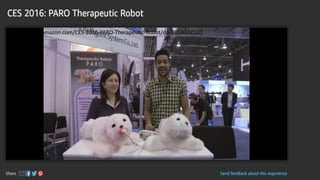
https://www.amazon.com/CES-2016-PARO-Therapeutic-Robot/dp/B01AG5CUJ2
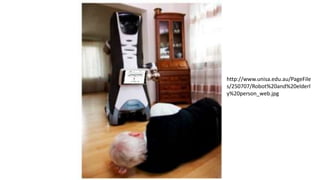
http://www.unisa.edu.au/PageFile
s/250707/Robot%20and%20elderl
y%20person_web.jpg
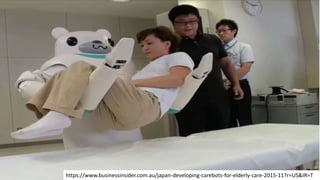
https://www.businessinsider.com.au/japan-developing-carebots-for-elderly-care-2015-11?r=US&IR=T
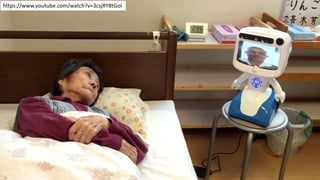
https://www.youtube.com/watch?v=3csjRY8tGoI
Illustration by Tom Eichacker https://www.good.is/articles/robots-elder-care-pepper-exoskeletons-japan
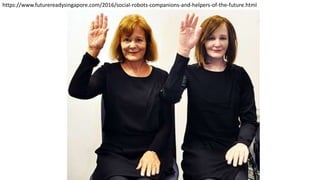
https://www.futurereadysingapore.com/2016/social-robots-companions-and-helpers-of-the-future.html
What about teddy bears?
• Not surprisingly, in this new climate dolls began for the first time to receive comment from child-
rearing authorities and popularisers. Some objected to the kind of fantasies that dolls
“stimulated: why foster a craving for novelty and variety that life cannot satisfy?” A minister
blasted teddy bears as substitute objects of affection that corrupted the maternal instinct. More
observers, however, commented on the positive roles that dolls could play in an emotional life.
Thus teddy bears “may have robbed childhood of one of its terrors” – the fear of animals. The
importance of the new dolls’ cuddly qualities was emphasised, both because the facilitated
causes acquisition of maternal instincts and, more generally because they provided infants of
both sexes with a concrete reliable focus for attachments. In 1931 observer in Hygeia with the
point directly, though stiffly: “With the realisation of the psychologic importance of the child’s
early years, there has arisen a new need, that of definite toys of peace and a technic of presenting
play material that will furnish the right background when associations for feelings.” Or, in an
article of 1914: “children’s affections [have] come to centre around the toys with which they have
lived and played.” For infants, parents were advised to “choose a soft animal; the affections as yet
are very physical, and this is known as the ‘cuddling’ age.” The link between dolls and other toys
and children’s emotions, than at an invention of the 20th century, was almost certainly expanding.
• Peter N. Stearns, “Consumerism and Childhood: New Targets for American Emotions” in Peter N. sStearns, Jan
Lewis, An Emotional History of the United States edited, New York, New York University Press, p. 403.
Questions
• If faced with the choice of being utterly alone at end-of-life or with a
robot which would you choose?
• Could you imagine embracing a humanoid robot for comfort?
• What if you had dementia and it helped to stimulate positive feelings?
• Humanoid robots that look like loved ones?
• What are the costs on real relationships of these social robots?
• What are the negatives?
• What are the positives?
• Is this a solution for an ageing population?

Robots for Aged Care: Socio-ethical Issues

  • 1.
    Robots for AgedCare: Socio-ethical Issues Katina Michael Faculty of Engineering and Information Sciences University of Wollongong katinamichael.com/seminars | katina@uow.edu.au
  • 2.
    Canadian Kim Trynacity’sFilm • Kim Trynacity is an award-winning journalist and CBC Alberta's provincial affairs reporter. • Completed MA in International and Intercultural Communications circa 2014 in Canada. • For her MA thesis Kim researched, shot and edited a video documentary called "Close Enough to Care". • It explores the impact on people, of replacing human caregivers with robots. It's emotional, compelling and thought provoking.
  • 3.
    Three classes ofrobots • Robotic devices • Physically support old person or their caregiver • Service robots • Robots helping old person in physical and everyday tasks • Social Robots • Source: https://www.slideshare.net/THLfi/robots-for-elderly- applications-experiences-and-ethical-questions (Finland)
  • 4.
    Expected Functions ofNursing Care Robots http://www.roboticstrends.com/article/ japan_to_create_more_user_friendly_el derly_care_robots/
  • 6.
  • 8.
  • 9.
  • 10.
  • 11.
  • 12.
  • 13.
  • 14.
    Illustration by TomEichacker https://www.good.is/articles/robots-elder-care-pepper-exoskeletons-japan
  • 15.
  • 16.
    What about teddybears? • Not surprisingly, in this new climate dolls began for the first time to receive comment from child- rearing authorities and popularisers. Some objected to the kind of fantasies that dolls “stimulated: why foster a craving for novelty and variety that life cannot satisfy?” A minister blasted teddy bears as substitute objects of affection that corrupted the maternal instinct. More observers, however, commented on the positive roles that dolls could play in an emotional life. Thus teddy bears “may have robbed childhood of one of its terrors” – the fear of animals. The importance of the new dolls’ cuddly qualities was emphasised, both because the facilitated causes acquisition of maternal instincts and, more generally because they provided infants of both sexes with a concrete reliable focus for attachments. In 1931 observer in Hygeia with the point directly, though stiffly: “With the realisation of the psychologic importance of the child’s early years, there has arisen a new need, that of definite toys of peace and a technic of presenting play material that will furnish the right background when associations for feelings.” Or, in an article of 1914: “children’s affections [have] come to centre around the toys with which they have lived and played.” For infants, parents were advised to “choose a soft animal; the affections as yet are very physical, and this is known as the ‘cuddling’ age.” The link between dolls and other toys and children’s emotions, than at an invention of the 20th century, was almost certainly expanding. • Peter N. Stearns, “Consumerism and Childhood: New Targets for American Emotions” in Peter N. sStearns, Jan Lewis, An Emotional History of the United States edited, New York, New York University Press, p. 403.
  • 17.
    Questions • If facedwith the choice of being utterly alone at end-of-life or with a robot which would you choose? • Could you imagine embracing a humanoid robot for comfort? • What if you had dementia and it helped to stimulate positive feelings? • Humanoid robots that look like loved ones? • What are the costs on real relationships of these social robots? • What are the negatives? • What are the positives? • Is this a solution for an ageing population?