Robotics
R&N: ch 25
based on material from Jean-
Claude Latombe, Daphne Koller,
Stuart Russell
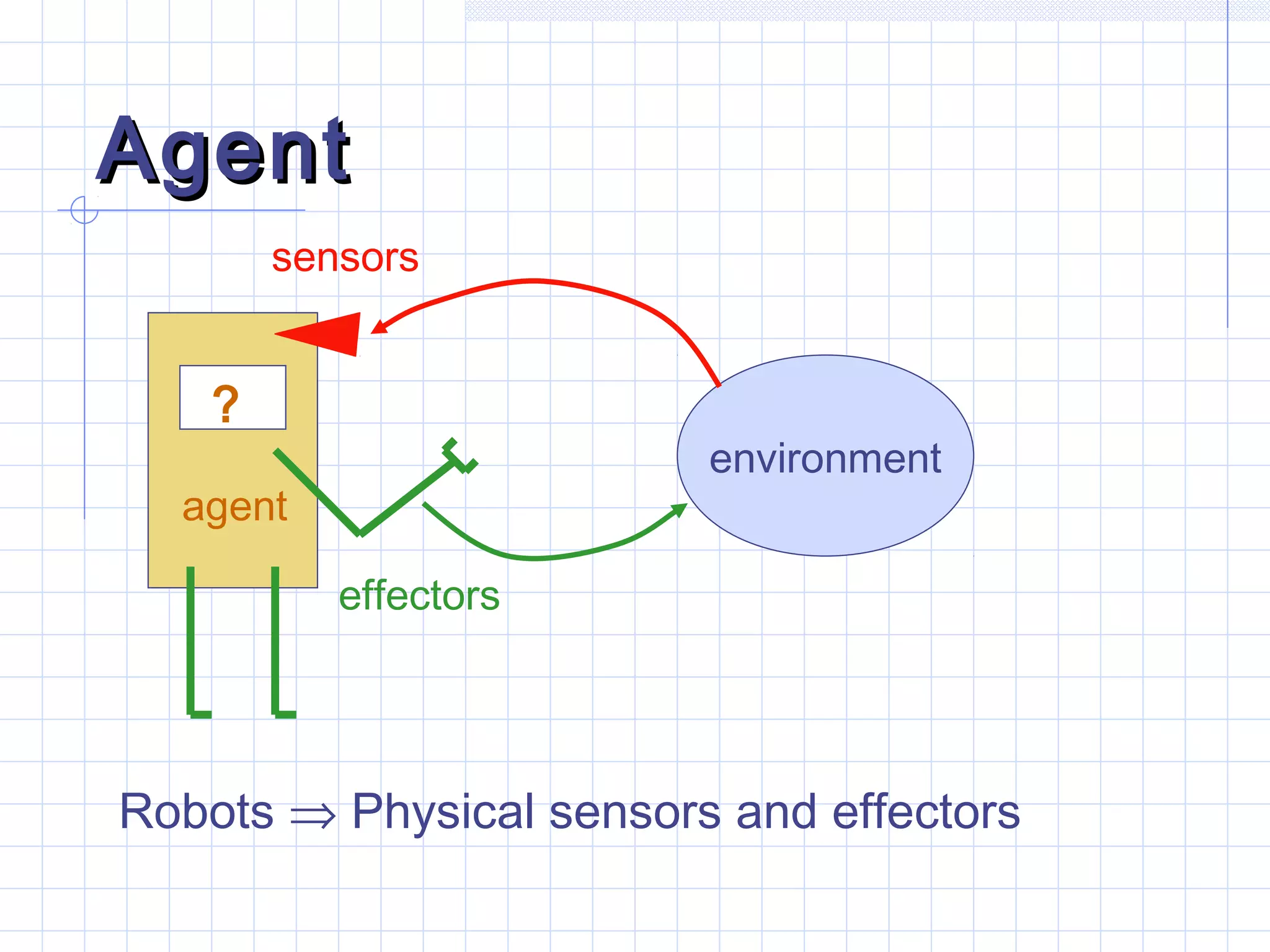
AgentAgent
environment
agent
?
sensors
effectors
Robots ⇒ Physical sensors and effectors
Sensors
Sensors that tell the robot position/change of
joints: odometers, speedometers, etc.
Force sensing. Enables compliant motion--
robot just maintains contact with object
(video: compliant)
Sonar. Send out sound waves and measure
how long it takes for it to be reflected back.
Good for obstacle avoidance.
Vision systems
Effectors
Converts software commands into
physical motion
Typically electrical motors or
hydraulic/pneumatic cylinders
Two main types of effectors:
 locomotion
 manipulation
Locomotion
Legs!
 traditional (video: honda human)
 Other types
 Statically stable locomotion: can pause at any stage
during its gate without falling
 Dynamically stable locomotion: stable only as long as it
keeps moving (video: hopper)
Still, wheeled or tread locomotion like Shakey
is still most practical for typical environments
Other methods: reconfigurable robots, fish
robots, snake-like robots. (video: mod-robot)
Manipulation
Manipulation of objects
Typical manipulators allow for:
 Prismatic motion (linear movement)
 Rotary motion (around a fixed hub)
Robot hands go from complex anthromorphic
models to simpler ones that are just graspers
 (video: manipulation)
 (video: heart surgery)
Problems in Robotics
Localization and Mapping
Motion planning
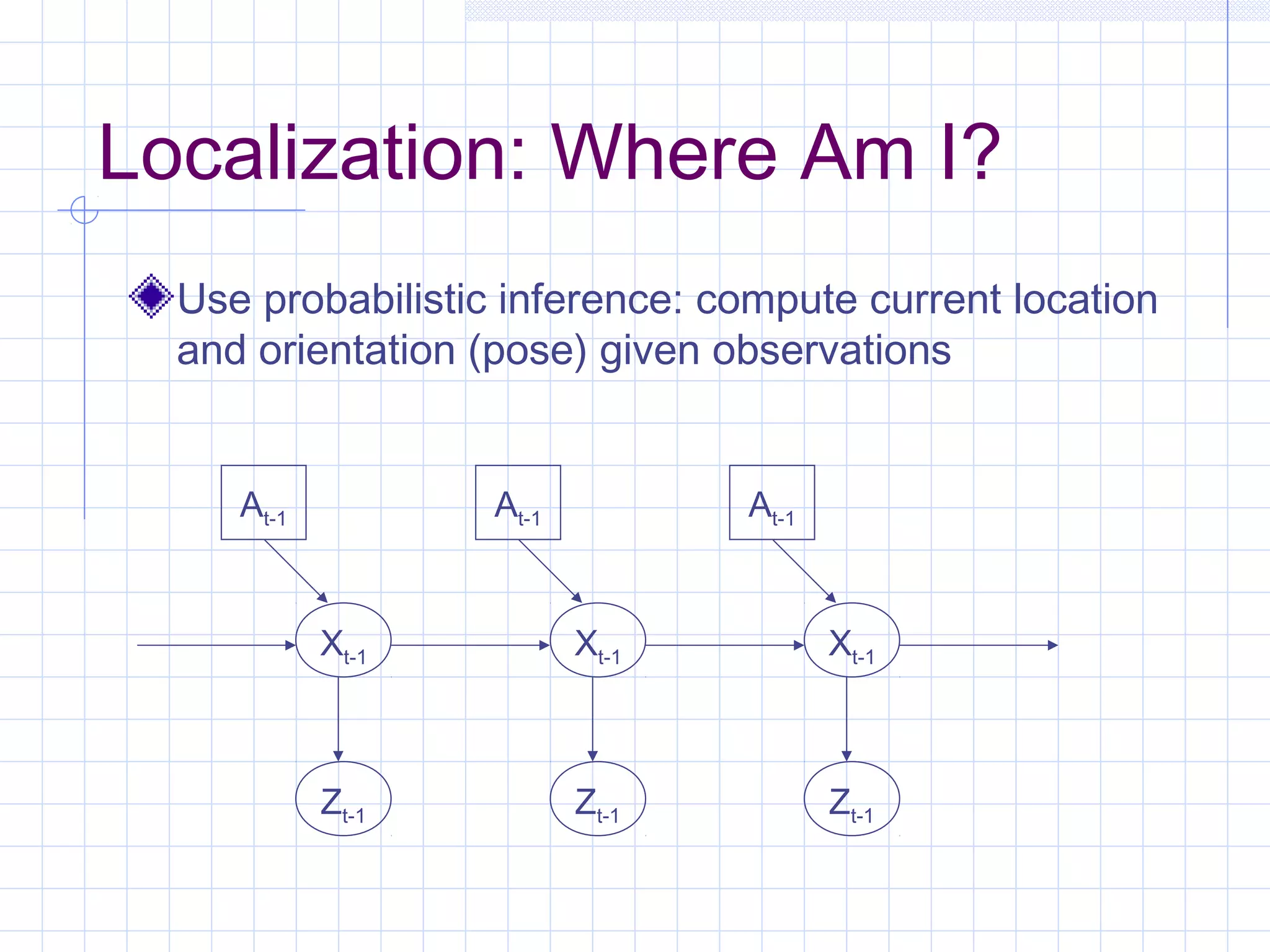
Localization: Where Am I?
Use probabilistic inference: compute current location
and orientation (pose) given observations
At-1
Xt-1
Zt-1
At-1
Xt-1
Zt-1
At-1
Xt-1
Zt-1
Motion Planning
Simplest task that a robot needs to
accomplish
Two aspects:
 Finding a path robot should follow
 Adjusting motors to follow that path
Goal: move robot from one
configuration to another
Configuration space
Describe robot’s configuration using a set of
real numbers
Flatland -- robot in 2D -- how to describe?
Degrees of freedom: a robot has k degrees of
freedom if it can be described fully by a set of
k real numbers
 e.g. robot arm (slide)
Want minimum-dimension parameterization
Set of all possible configurations of the robot
in the k-dimensional space is called the
configuration space of the robot.
Example
workspace for 2-D robot that can only
translate, not rotate
configuration space describes legal
configurations
 free-space
 obstacles
Configuration space depends on how
big robot is—need reference point
Path planning
Goal: move the robot from an initial
configuration to a goal position
path must be contained entirely in free space
assumptions:
 robot can follow any path (as long as avoids
obstacles)
 dynamics are completely reliable
 obstacles known in advance
 obstacles don’t move
Assumption #1
robot can follow any path
what about a car?
degrees of freedom vs. controllable
degrees of freedom
 holonomic (same)
 nonholonomic
 (video: holonomic)
Motion planning
reduces to problem of finding a path
from an initial state to a goal in robot’s
configuration space
why is this hard?
Reformulate as discrete
search
finely discretized grid
cell decomposition: decompose the space
into large cells where each cell is simple,
motion planning in each cell is trivial
roadmap (skeletonization) methods: come up
with a set of major “landmarks” in the space
and a set of roads between them
Issues in Search
Complete
Optimality
Computational Complexity
Motion planning algorithms
grid
cell decomposition
 exact
 approximate
roadmap (skeletonization) methods:
 visibility graphs
 randomized path planning
Robotics: Summary
We’ve just seen a brief introduction…
Issues:
 sensors, effectors
 Locomotion, manipulation
Some problems:
 Localization
 Motion Planning
Lots more!!

Robotics (1)

  • 1.
    Robotics R&N: ch 25 basedon material from Jean- Claude Latombe, Daphne Koller, Stuart Russell
  • 2.
  • 3.
    Sensors Sensors that tellthe robot position/change of joints: odometers, speedometers, etc. Force sensing. Enables compliant motion-- robot just maintains contact with object (video: compliant) Sonar. Send out sound waves and measure how long it takes for it to be reflected back. Good for obstacle avoidance. Vision systems
  • 4.
    Effectors Converts software commandsinto physical motion Typically electrical motors or hydraulic/pneumatic cylinders Two main types of effectors:  locomotion  manipulation
  • 5.
    Locomotion Legs!  traditional (video:honda human)  Other types  Statically stable locomotion: can pause at any stage during its gate without falling  Dynamically stable locomotion: stable only as long as it keeps moving (video: hopper) Still, wheeled or tread locomotion like Shakey is still most practical for typical environments Other methods: reconfigurable robots, fish robots, snake-like robots. (video: mod-robot)
  • 6.
    Manipulation Manipulation of objects Typicalmanipulators allow for:  Prismatic motion (linear movement)  Rotary motion (around a fixed hub) Robot hands go from complex anthromorphic models to simpler ones that are just graspers  (video: manipulation)  (video: heart surgery)
  • 7.
    Problems in Robotics Localizationand Mapping Motion planning
  • 8.
    Localization: Where AmI? Use probabilistic inference: compute current location and orientation (pose) given observations At-1 Xt-1 Zt-1 At-1 Xt-1 Zt-1 At-1 Xt-1 Zt-1
  • 9.
    Motion Planning Simplest taskthat a robot needs to accomplish Two aspects:  Finding a path robot should follow  Adjusting motors to follow that path Goal: move robot from one configuration to another
  • 10.
    Configuration space Describe robot’sconfiguration using a set of real numbers Flatland -- robot in 2D -- how to describe? Degrees of freedom: a robot has k degrees of freedom if it can be described fully by a set of k real numbers  e.g. robot arm (slide) Want minimum-dimension parameterization Set of all possible configurations of the robot in the k-dimensional space is called the configuration space of the robot.
  • 11.
    Example workspace for 2-Drobot that can only translate, not rotate configuration space describes legal configurations  free-space  obstacles Configuration space depends on how big robot is—need reference point
  • 12.
    Path planning Goal: movethe robot from an initial configuration to a goal position path must be contained entirely in free space assumptions:  robot can follow any path (as long as avoids obstacles)  dynamics are completely reliable  obstacles known in advance  obstacles don’t move
  • 13.
    Assumption #1 robot canfollow any path what about a car? degrees of freedom vs. controllable degrees of freedom  holonomic (same)  nonholonomic  (video: holonomic)
  • 14.
    Motion planning reduces toproblem of finding a path from an initial state to a goal in robot’s configuration space why is this hard?
  • 15.
    Reformulate as discrete search finelydiscretized grid cell decomposition: decompose the space into large cells where each cell is simple, motion planning in each cell is trivial roadmap (skeletonization) methods: come up with a set of major “landmarks” in the space and a set of roads between them
  • 16.
  • 17.
    Motion planning algorithms grid celldecomposition  exact  approximate roadmap (skeletonization) methods:  visibility graphs  randomized path planning
  • 18.
    Robotics: Summary We’ve justseen a brief introduction… Issues:  sensors, effectors  Locomotion, manipulation Some problems:  Localization  Motion Planning Lots more!!