JEDBURGH OPERATIONS
___    SUPPORT     TO TH4E    FRENCH RESISTANCE IN EASTERN         BRITTANY
__                           FROM JUNE-SEPTEMBER 1944


        A thesis        presented to the Faculty of the U.S.              Arm.
            Command and General Staff College in partial
                 fulfillment     of the requirements for the
                                      degree

                    MASTER OF MILIARY ART AND SCIENCE


                                        by

                      RALPH D. NTCHOLS, MAJOR, USA
           B.A.,     University of Texas at Arlington,             1976


                                                                   I.D'


                             Fort Leavenworth,       Kansas
                                       1.993


      Approved   for public      release;    distribution     is   unlimited.


                                                            93-28162


93    11           1l
i         /orm Appioveu

                             REPORT DOCUMENTATION PAGE                                                                                                                    OMB No 0/04016

              *j.1ttt.~ua~tt.     r ttdthe ,,?, nr-ta. a      lOmp .tin
                                                                      try a ir-en.    f) Ithet ýlctianu  i nto~rfltuf n     r          rrrnt        n,ýja3,j It- .~ I,. -jL   .- ' th                      r',.                  A?ý th,ý
     .Ic,.jti      3?
                  o ,inttrinla,tl      Ln fl.3in
                                         d      -jjI    tol~ii tt~ur   I       tnmuoef IQ, A      tyur -mno0QujrIetwf
                                                                                               hnt,        4          rv        er       Iý.n u~rdte tý, 10 -t .1-1             -,.' ,uft     Wl I    t.          I)        ..   te.f~lw
    L         Mýjtr.-, , .e 12U4
                             t            j       4.A 1,2202.4302 ý.td I lthe Ott ,eot Mr. , ,erentt In .3 u~jeji o , per   -,t      rIt-3-att      Pri.-.! kj/Ua a itt)              ,n.1.r i.

    1. AGENCY USE ONLY RLedve bink)                               2. REPORT DATE                                  I 3. REPORT         TYPE AN)             DATES COVERED

                                                              7      4 June 1993                                  plaster's Thesis,                              1 Aug 92--4 June 93
    4. TITLE AND SUBTITLE                                                                                                                                5. FUNDING NUMBERS


     Jedburgh Operations:   Support to the French Resistance
     in Eastern Brittany from June -- September 1944
    6. AUTHOR(S)


*    MAJ Ralph D.                   Nichols,               USA

    7. PERFORMING ORGANIZATION NAME(S) AND ADDRESS(ES)                                                                                                   8. PERFOHMING ORGANIZATION
                                                                                                                                                            REPORT NUMBER
     U.S. Aarmy Command and General Staff College
     ATTN:  ATZL-SWD-GD
     Ft. Leavenworth, KS  66027-6900


    9. SPONSORING/MONITORING AGENCY NAME(S) AND ADDRESS(ES)                                                                                              10. SPONSORING, MONITOKING
                                                                                                                                                             AGENCY REPORT NUNWfER


    "11. SUPPLEMENTARY              NOTES


    12a. DISTRIBUTION / AVAILABILITY STATEMENT                                                                                                           111b. Ohimts
                                                                                                                                                                   IuTiON COOt


     Approved for Public Release;                                           distribution                     is     unlimited.


113. ABSTRACT (Maxitmumn 200 words)

      Specially trained teams, known as Jedburghs, were inserted into France in
                                    t
      conljunctionl with Operation " Overlord," to hell) liberate it from German
      occupation. The Jedburglhs were three--man team,     comprised of two commlissionled
      officers, (at least on French and one nion-commissioned officer in charge of the
      radio (wireless telegraphy).    All Jedburghs were volunteers. They received
      highly specialized training in guerrilla warfare. Jedburghs served in harm's
      way, deep behind enemy lines. They were subordinate to the- Supreme
      Headquarters Allied Expeditionary Force (SHAFF), and its commander, General
      Dwight D. Eisenhower. Their convert mission in Operation "Overlord" helped
      pave the way for the liberation of France, and ultimately resulted in a
      campaign             to free Europe from Nazi rule.


    14. SUBJECT TERMS                                                                                                                                                     15. NUMBER OF PAGES
    Joint and Combined Operations, Special Operations                                                                                                                                             9
    Guerrilla Warfare                                                                                                                                                     16. PRICE COUL)

            '.'-,iTY CLASJIfCATiolli                   1b.   SrflCU,(iTY CLASS4: CATION                      19.    SECURa Y (ýASSIH-I.ATION                             20. LICitMrI.j,ifiu                            -r.Tr.CT
                                                                                                                                                                                                                       .,

          Ot kEPORT                                          OF THIS PAGE                                           OF ABSTRAC. T

    UNCLASSTFIED
            -     -
                                                    IUN4CLASSIFIED                                       I           UNCLASSIFIED                                         __________
JEDBURGH OPERATIONS
 SUPPORT   TO THE       FRENCH RESISTANCE IN EASTERN                 BRITTANY
                       FROM JUNE-SEPTEMBER 1944


  A thesis        presented   to  the Faculty     of the   U.S.            Army
      Command and General Staff              College in partial
           fulfillment      of the   requirements      for the
                                   degree                                 AccCI1       or
                                                                           NTIS
                 MASTER OF MILIARY        ART AND        SCIENCE           DT,2   7Kl


                                                                            Ey


                                                by                        F        .


                    RALPH     D.   NICHOLS,   MAJOR,      USA
      B.A.,      University of Texas at Arlington,                    1976


                       Fort    Leavenworth,          Kansas
                                    1.993


Approved   for     public      release;   distribution          is   unlimited.
MASTER OF    MILITARY      ART AND       SCIENCE

                                  THESIS      APPROVAL      PAGE


Name     of candidate:            Major      Ralph   D.    Nichols

Title of thesis:                JEDBURGH      OPERATIONS:    Support to the
French Resistance               in Eastern      Brittany  from June-September
1944.


Approved         by:


                                                  Thesis    Committee       Chairman
         Jams H.          Willbanks,     M.A.,     M.S.,    M.M.A.S.


Samuel      J.     Le w        Ph.D.I,           Member


Accepted         this      4th day of June         1993    by:


   __     "_________________                     Director,       Graduate    Degree

Philip      j.Brookes,           Ph.D.             Programs


The opinions     and conclusions  expressed herein        are those of
the student    author   and do not necessarily     represent    the
views of the U.S. Army Command and General Staff             College or
any other    governmental agency.       (References to this     study
should include      the foregoing statement.)
ABSTRACT


JEDBURGH OPERATIONS:   SUPPORT TO THE FRENCH RESISTANCE            IN
     EASTERN BRITTANY FROM JUNE-SEPTEMBER 1944 by Major            Ralph
    D. Nichols, USA, 90 pages.


Specially trained teams, known as Jedburghs, were inserted
into France in conjunction with Operation "Overlord," to
help liberate       it     from German occupation.   The Jedburghs were
three-man allied           teams, comprised of two commissioned
officers,       (at least     one French) and a non-commissioned
officer     in charge of the radio (wireless telegraphy).         All
Jedhurghs were volunteers.             They received highly specialized
training      in guerrilla       warfare.  Jedburghs served in harm's
way, deep behind enemy lines.             They were subordinate to the
Supreme Headquarters Allied Expeditionary Force (SHAEF),              and
its     commander, General Dwight D. Eisenhower.         Their covert
mission in Operation "Overlord" helped pave the way for the
liberation       of France, and ultimately resulted in a campaign
to free Europe from Nazi rule.
This study explores the origins, purpose, training  and
missions of the Jedburghs.   I will examine the actual
operations of seven Jedburgh teams in Eastern Brittany.
Their actions and effectiveness will be compared with
operations of other Jedburgh teams.


                                  iii
PREFACE


                This study examines           the role of seven Jedburgh                          teams

in      Eastern Brittany.           The Jedburghs helped develop the art

of unconventional             warfare,       pioneering methods                 that       would

later      be used by today's Special                     Forces.          The British

Special         Operations Executive            (SOE)        and    its     U.S.    counterpart,

the Office of Strategic                  Services         (OSS);      the Special           Air

Service         (SAS),     operational       groups         (OG's)        and other inter-

allied         missions     are mentioned         in      this     study only when they

affected         the operations of the Jedburgh                       teams under

consideration.


                The study of the seven Jedburgh teams                           are arranged

chronologically,             by date      of insertion.              The     recently

declassified             operational      records of the Jedburghs                       form     the

nucleus of the documentation                    for this           study.       Unfortunately,

a great wealth of knowldege remains                              untapped      in   this     arena.

Many SOE records             are still       classified            and not available               for

use.


                                                iv
The names of intelligence                         circuits          will    be

capitalized               to help         the reader           discern          them.      The names of

individuals               mentioned          in    the text are assumed                    to be real              (as

best    as that            can be determined).                       I have provided                the nom de

guerre of each French Jedburgh                                 in    the appropriate                footnote.


                   I would like to take this                         opportunity to thank Dr.

Samuel        J.     Lewis and LTC                (USA,     Retired)            James H.       Willbanks,

my thesis            committee,            for their           support and encouragement.                                I

acknowledge               the staff          of    the Combined Arms Research                         Library

at Fort Leavenworth                       for their         invaluable assistance                     in    this

endeavor.             I    respectfully             salute,         with deep gratitude,                    every

member of each Jedburgh                           team.        Tha Jedburghs were                   the

progenitors               of today's modern Special                         Forces.           All    "Jeds"

were    volunteers,               selfless          and fiercely                dedicated.           They

helped        liberate          Europe        from Nazi             tyranny       in    1944    through

their     covert           role in         Operation "Overlord."


                   To my family,             especially             my wife Marilyn,                words

cannot adequately express my love                                    for you.           Thank you for

the patience and unwavering                               support       you have given me.


                                                           v
TABLE OF                   CONTENTS


APPROVAL             PAGE ......................................                                 ii

ABSTRACT ...........................................                                           iii

PREFACE ............................................                                             ix

LIST        OF     FIGURES ..........                             ..........................   vii

CHAPTER

     1.       ORIGINS ......................................                                          1

    2.        JEDBURGH              DOCTRINE ............................                        13

     3.       TEAM         FREDERICK ...............................                             30

    4.        TEAM GEORGE                    I ................................                  39

     5.       TEAM         FELIX ...................................                             48

    6.        TEAMS          GAVIN          AND GUY ..........................                   53

     7.       TEAM GERALD ..................................                                     66

    8.        TEAM DANIEL ..................................                                     73

    9.        CONCLUSION ...................................                                     77

GLOSSARY ...........................................                                             86

BIBLIOGRAPHY .......................................                                             88

INITIAL            DISTRIBUTION ...............................                                  90


                                                                             vi
LIST OF FIGURES

Figure                                                                      Page

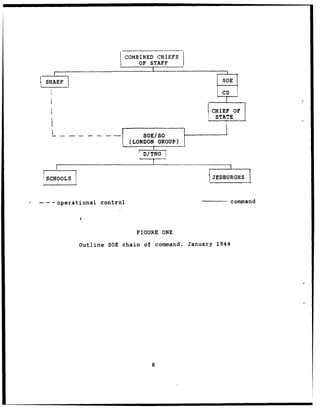
  1.     SOE,   Chain of Command,      January        1944 ..............     8

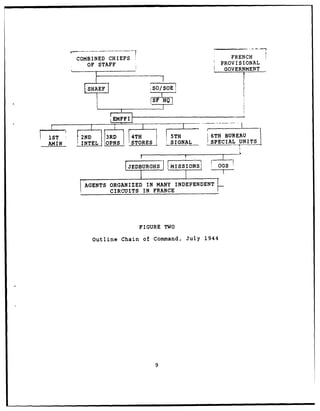
  2.     Chain of Command,    July 1944 ......................                9

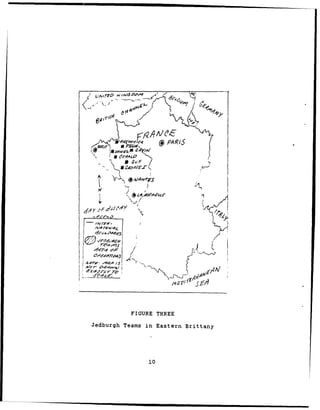
  3.     Jedburgh Teams in    Eastern Brittany ...............               10


                                      vii
CHAPTER ONE

                                                   ORIGINS


Introduction

              This study will                recount and evaluate                the operations

of seven Jedburgh                teams operating              in    Eastern Brittany during

the summer of               1944.        This has became            possible with recent

declassification               of       records.          Who were    these Jedburghs?

They were three-man special                         operations        teams      from the United

Kingdom,           United States,            France and           several    other allied

nations.            They worked directly                   with resistance groups as

part of a covert war employed                             by the Western allies.                     All

Jedburghs were               volunteers.            The teams deployed                  in    Eastern

Brittany were               specially trained               to conduct       guerrilla             warfare

with the French               resistance,            in    support of the Allied

invasion of France.I

              The Special               Operations         Executive    (SOE),           was

responsible           for clandestine               warfare        operations           for Great

Britain's           War Office.            Its     Ameri-Rn counterpart                  in      London,

Special       Operations            (SO)     branch of        the Office of Strategic

Services           (OSS),     jointly       developed         Jedburgh       objectives.

These       included:          advising           and assisting        local          partisan

forces       in     order     to synchronize               resistance       efforts           with
theater- headquarters,                and      to arrange         for the         restippiy       of

aVMs ,     mun it inns,         -,d equipment         to suista in         part    i san war

efforts.            .j-Q
                       •.,rgh     teams would establish                   contact         with

French -esistance               groups,        providing         them with the             necessary

leaiership,           communications,            supplies         and     linking        them with

the Supreme Headquarters                    Allied Expeditionary                   Force

(SHAEF).            During      covert operations,               Jedburghs would

maintain            communications with Special                        Forces Headquarters

(SFHQ),        an allied        organization          under       the command of             the

SHAEF.        This communications                link helped             coordinate         the

Supreme        Allied Commander's               (General         Eisenhower)             intent       and

desires        to French        resistance        leaders. 4


Jedburgh        Concept

               In    the spring of 1942,              when the Allies began

preparing           for an      invasion of Europe,               Great      Britain's           SOE

planning        section developed               the concept             of specially         trained

teams--later            to be named         "Jedburghs."               The Chief of Staff,

Supreme Allied Commander                    (COSSAC),           devised phased             taskings

for Jedburghs             to execute        during      their          covert support            to

French partisans.                In   phase one,         SOE would organize

resistance           forces     and direct        attacks on enemy rail                     and

signal        communications.             In    phase    two      it    would provide             guides

for British           ground      forces,       and organize             raiding partioes,

which would penetrate                 German      lines.


                                                  2
By June       1942   joint          coordination              began        between     the

Rr-itish SOP and            its American            partner,           Special           Oper-ations

(SO)       branch of       the OSS.         They        formed a unified                  headquarters

in     London,      which helped           facilitate               communications               between

the allies          in   support      for Operation                  "Overlord"--the               Allied

invasion          of Europe.       The      SO and SOE agreed                     to form a

combined          organization        to support               and direct           resistance

groups       in    German occupied            countries.               The OSS,           commanded        by

General       William J.          "Wild Bill"               Donovan,        had     identified        the

need       for the Special         Operations                (SO)     Branch        in    the summer of

1941.

              On 6 July        1942,       Major General               C.    McV.        Gubbins,

Military          Deputy    to the SOE,            initially           described           the concept

of the       covert operations               in    support of Operation                      "Overlord,"

stating:

                   A project is under consideration for dropping
           behind      enemy lines, in cooperation with an Allied
           invasion of the Continent, small parties           of
           officers     and men to raise    and arm the civilian
           population to carry out guerill&        activities
           against the enemy's lines        of communication.    These
           men are to be recruited and trained by SOE.           It is
           requested that "Jumpers" or some other appropriate
           code name be alloted      to this   personnel.t

On the       following day,           the code name                  "Jedburghs"           was     ascribed

to the project.

              SOE went       on    to develop               a role     for    the Jedburghs            to

support       a planned       Allied invasion of                      Europe        in    the summer of

1943.        On 22 July        1942 SOE decided                     that    70 Jedburgh            teams


                                                        3
would be      required       for the covert             operation.             An equal           amount

of teams      (35    each)     would be        required         from the British                  and

the Americans.            SOE departments              held meetings during the

summer of 1942           to evaluate         the Jedburgh program,                       facilities

and equipment         required          for training          and deployment.                    In

August      1942,    the British          Chiefs of Staff narrowed                        the         focus

of the Jedburgh           role     in    covert operations.                   They decided

that      Jedburgh    teams would not provide                    guides and labor

parties      for conventional             forces,       in    effect      eliminating                 phase

two of the original               concept.       In     December         1942,      it      was

decided      that Jedburghs would wear military                           uniforms.

Additionally,         one    of the two officers                 in     each team was to be

of the nationality             of the country            to which the              team would

deploy.      Jedburgh       teams were         to be dropped             in    secure         areas,

where      they would be met by SOE agents.                            Jedburgh          teams would

not be used         to help tactical            plans of conventional                       ground

forces.       This was due to the               fact     that Jedburgh              teams would

be inserted         too late       to help these             forces.          In   many cases,

72 hours or more would elapse between                            the time a commander

approved      a task and when a team could                       infiltrate              and begin

operations.          SOE agreed to test                the concepts            during         Exercise

"Spartan"--a general              headquarters           exercise         to take place

from 3-I1      March      1943.

             SOE staff       personnel         fielded eleven             Jedburgh            tears

during      Exercise      "Spartan."          The exercise              simulated an Allied


                                                 4
breakout      from the initial               invasion bridgehead                          area.       During

the exercise,         Jedburgh            teams helped the British                          Second Army

advance.       The 8th Battalion of the Royal                               Welsh Fusiliers

trained as       local        resistance       groups.            SOE personnel                    inserted

individual agents behind "enemy"                         lines.             They also deployed

SOE staff      officers           at army and corps headquarters.                                   Captain

Franklin 0. Canfield                    represented      the SO branch during

Exercise      "Spartan." 10              SOE and SO personnel                     successfully

accomplished         their        missions.         Primary missions included:

blowing up five              targets,       preventing three demolitions,

cutting      two enemy          lines      of communications and                          attacking           an

enemy headquarters.                     Secondary missions                 that          followed

consisted      of guerrilla               attacks against               small enemy

detachments,         and targeting enemy staff                         officers.              Agents           in

the field      communicated with SOE staff                            officers             at army and

corps    headquarters             by way of an SOE radio station                              in

Scotland.       After the exercise,                    SOE decided                that      Jedburgh

teams should be parachuted                    in    at night,              at a distance of at

least    40 miles behind enemy lines                      in      order to prevent

detection.        Jedburghs would conduct                      guerrilla                 warfare
                                                                  1
against      enemy lines              of communications.               1

            The Jedburghs served                   as a SOE and SO "strategic

reserve."       In    this        role,     they    could be directed by the

allied      commander to handle military                       situations                  behind enemy

lines.       SHAEF and          its     major subordinate                  commands would now


                                                   5
be able to synchronize their conventional forces        in the

initial stages of Operation "Overlord" with the presence of
                                               France. 12
Jedburgh teams working with partisan groups in

        With the    lessons learned compiled from Exercise

"Spartan,"    SOE and SO concurrently developed position papers

supporting the Jedburgh concept.      These papers were

submitted through their respective chains of command to seek

approval,    support and personnel   for the project.   Lieutenant

General Frederick E. Morgan, COSSAC, approved the SOE

proposals on 19 July 1943.     His report to the British Chiefs

of Staff Committee concluded:

        I have discussed with SOE their proposals for
    establishing shortly before D-day:

        a.  Small SOE staffs and Signal Sections at
    Headquarters of Armies, and SOE representatives at
    Headquarters of Army Groups and of the Supreme
    Commander, for controlling resistance groups.

        b.  Reserve teams of personnel (JEDBURGHS) to
    be kept in this country for use after D-day, to
    provide, if necessary, suitable leadership and
    equipment for those resistance groups found to be
    in need of them.

        I have agreed in principle to these proposals,
    and request that the Chiefs of Staff instruct the
    War Office to prepare the detailed establishments
    and arrange at the appropriate time,
                                         for th I'
    transfer of SOE of any personnel necessary.'

General Morgan's request was approved by the British Chiefs

of Staff Committee on 21    July 1943. 14

        Meanwhile, Lieutenant General Jacob L. Devers,           the

European Theater Commander, United States Army (ETOUSA),


                                 6
approved          the SO proposal            submitted        from the OSS on 24 August

1943.          He also authorized                 the recruitment         of     Jedburgh

personnel.              SOE and SO both agreed to provide personnel                                to

fill      35 American Jedburgh                    teams,    with 15 more teams to be

held      in    reserve.          It    was also agreed            that       the Free     French

would supply a third                    man for each Jedburgh                 team. 1 5

                The British            SOE and American SO branch of the OSS

had now jointly                 agreed on an organization                 whose mission

would be to conduct guerilla                         warfare       directed against              enemy

lines      of communication.                 The Jedburgh            teams would assist

local partisan                 groups to help prosecute                this      covert mission.

So      far,    all     of this        was just      a good        idea on paper,         another

concept.              Personnel would have                to be    recruited and trained.

Just how this                 was to be accomplished               would prove to be a

monumental,             ground-breaking             task.     More     questions          than

answers         arose during this                 time period that presented

challenges             that     had to be overcome            in    a short period of

time.          Who would train            the Jedburghs?             How would they be

recruited?              Where would they deploy,                   and when?         What

equipment would they use?                          Who would they be working with?

The      answers and            innovative         solutions to these questions were

soon      to be addressed.


                                                      7
COMBINED CHIEFS
                                  OF STAFF


                                                            CHIEF OF
                                                             STATE

                                   SOE/So
                               (LONDON       GROUP)

                                    r~~I


  ,SCHOOLS                                                   JEDBURGHS


---   operational   control                                          command


                                 FIGURE ONE

             Outline SOE chain of command,            January 1944


                                         8
COMBINED CHIEFS                                  FRENCH
          OF STAFF                                   PROVISIONAL
                                                   SGOVERNMENT


          SHAEF                 ISO/SOE
                                    I                       I_
                                ISF HQJ


1ST     2ND       3RD    f4TH          rTH         6TH BUREAU
AMIN    INTEL     OPNS   STORES!       SIGNAL      SPECIAL UNITS


                         JEDBURGHS     MISSIONS1     OGS


         AGENTS ORGANIZED IN M4ANY INDEPENDENT
                CIRCUITS IN FRANCE


                            FIGURE TWO

              Outline Chain of Command, July 1944


                                   9
"PS                                I    I


                   lPA/)S


                        poaM
                         -7AK
Y ",           U P•,4.1ES
                      Sg,        t<


       r    -~ -       a S'#    A'
                                      6
                                          (


                        SIK                                  !


                               Z              R    H
   edurg                       Say                 an


                                              IO
                 7a-                                    A/


                               FIGURE THREE
Jedburgh Teams in Eastern Brittany


                                              10
Endnotes

             In March 1944, General Charles de Gaulle formed the
Forces Francaises de l'Interieure,       the underground army of
his French government in exile.       "Local clandestine
activities,"     he said, "had to take on at the right moment
the character of a national effort;       had to become consistent
enough to play a part in allied      strategy, and lastly,    had to
lead the army of th- shadows to fuse with the rest         into a
single French army."       M. R. D. Foot, SOE in France:     An
Account of the Work of the British       Special Operations
Executive in France 1940-1944.       (London:   Her Majesty's
Stationery Office, 1966), p. 360, hereafter       cited as SOE in
France.
              Ibid.,   pp.        33-34.

        John Medelsohn, ed., Covert Warfare Intelligence,
Counterintelligence, and Military Deception During World War
II Era, 18 vols.   (New York: Garland Publishing, 1989) 3:
ii.

              Anthony Cave Brown, The Last Hero - Wild Bill
Donovan,       (New York:  Times Books, 1982), p. 525.
         5    S.
            J. Lewis, Jedburgh Team Operations in Support                                    nf
the 12th Army Group, August 1944, (CSI, USACGSC, Fort
Leavenworth, KS  66027,  1991), p. 4.
         6    In   1940,    William "Wild Bill" Donovan. served as                         the
unofficial      observer for the Secretary of the Navy in Great
Britain.       Donovan also had a mission from President
Roosevelt to observe resistance movements, while serving as
coordinator of intelligence.         On 13 June 1942, Donovan was
appointed director       of the OSS, forerunner of the Central
Intelligence Agency (CIA).        On 1 October 1945, the OSS was
terminated by executive order.         Its functions were
distributed      between the War Department and the Department of
State.       John Keegan, editor,   Who's Who in World War II, (New
York:       Thomas Y. Crowell Publishers, 1978), p. 69.
              Mendelsohn,          Covert Warfare,    Vol.   3,   p.        i.
              Ibid.   Jedburgh is a village located                    in        Cheviot
Hills,       southeast of Edinburgh, Scotland.

              Lewis,   p.    5.
              Mendelsohn,         Covert Warfare,     Vol.   3,   p.        i.


                                              11
Lewis,     pp. 5-6.

         OSS/London:  Special Operations Branch and Secret
Intelligence Branch War Diaries (microfilm; Frederick, MD:
University Publications of America, 1985),  Reel III, Vol.
IV, JEDBURGHS, Preamble to 1 January 1944, pp. iv-xi,
hereafter cited as OSS/London SO microfilm.

     13.     Mendelsohn,       Covert Warfare,   Vol.   3,   p.    xiv.

     14.  OSS/London SO Branch micro,            Reel III,        Vol.    IV,
JEDBURGHS, Preable to 1 January 1944,            pp. xiii-xiv.

     15.     Ibid.,     pp.   xv-xvi.


                                        12
CHAPTER TWO

                                   JEDBURGH         DOCTRINE


Jedburgh       Recruitment

              In    the fall     of 1943 no Jedburgh                     force existed.

Planning       for the Allied           invasion of Europe                   was in          full

swing,       with the execution order to follow                            in     short order.

The Jedburghs were              to have a key role                  in    Operation

"Overlord."           The task at hand           for the SOE and the OSS was                                   to

select       volunteers        to become     Jedburghs.                 SOE and OSS           recruited

officers       and non-commissioned             officers                (NCOs)     in    the autumn

of 1943.           NCOs would be assigned as                    radio operators.                        The

officers       would     serve as Jedburghs             or as staff                officers              of

Special       Forces     (SF)    detachments.1             In     Washington,            D.C.,           OSS

Headquarters          authorized        100 officer             slots      for the Jedburgh

proposals.           The distribution          of officers                would be:                50    for

Jedburgh teams,            34 for SF detachments,                       and 16 for SOE/SO

Headquarters          (which     would later          become SFHQ).                    The    G2

Division,          War Department,        helped       coordinate                the

recruitment.2           OSS qualifications             for Jedburgh                officers              were

as   follows:

               Officers recruited as leaders and seconds                                      in
           command should be picked for qualities  of
           leadership and daring, ability  to speak and

                                               13
understand French, and all-around physical
       condition.     They should be experienced in handling
       men, preferably in an active theater         of
       operations, and be prepared to be parachuted in
       uniform behind enemy lines and operate on their
       own for some time.         They must have had at least
       basic military    training     and prefprably have
       aptitude for small arms weapons.

            Qualifications          for Jedburgh          radio operators          were

less   stringent.         They were as follows:

              Qualifications for radio operator are not so
       high as for leaders and seconds-in-command and a
       fair   working knowledge of French is sufficient.
       In addition to normal requirements for good radio
       operators, they must be of exceptionally good
       physique to stand up to training and be prepared
       to be parachuted into enemy lines to operate their
       sets   in open under war conditions.  They should
       attain   a speed of 14 words per minute before being
       shipped to the U.K.

SO selected          56 NCOs for Jedburgh            radio operators          in     the

United States from Army Signal Corps                          schools at Fort

Monmouth,       New Jersey and Camp Crowder,                   Missouri.

            Screening       procedures       for Jedburghs were rigorous.

Of 55 officers          selected     for further training             in     Great

Britain,      only 35 actually          became      Jedburghs.        OSS had to

expand the search            for qualified         recruits       to U.S.     Army units

stationed       in   Great Britain.          Some of these officers                were

recruited       immediately.         Several       of the volunteers           did not

report    to Milton Hall          for training          however,     until     late

February,       1944,    after    basic      training         for Jedburghs had

already begun.


                                              14
The OSS also attracted                     ten French             officers         to the

Jedburgh cause             from          the French Military             Mission            in

Washington.               SOE recruited            70 French Jedburghs                     from the

Middle East          in    January-February               1944.        These         recruits       were

all       combat    veterans.             This would help             compensate             for the

fact that          the 70 French Jedburghs                    from the Middle East would

miss nearly          two months            of preliminary             training             and
                                            8
specialized          instruction.

              Much less             is   known about        the SOE selection                    process,

due to ongoing             security classifications.                            SOE selected

British       Jedburghs             from its      own rank and file,                   recruiting

soldiers       who had volunteered                  for hazardous                duty with assault

and/or airborne              forces,        or had experience                 with those units.ý

              With Jedburgh               recruitment         ongoing,           SO and SOE worked

out a plan to govern                     the operational            details          of the

Jedburghs          during      the last          few months of            1943.            The   result

was the Basic             Jedburgh Directive of 20 December                                 1943,   which

outlined       the operational                  role,    training        equipment,

coordination,             liaison         and cover       stories        for Jedburgh

teams.         The    Basic Jedburgh               Directive          stated:

                 JEDBURGHS are specially     trained three-man
           teams.    They will be dropped by parachute at
           prearranged spots in France, Belgium and Holland
           on and after    D-Day.   Each JEDBURGH team consists
           of two officers    and a radio operator with his W/T
           set.   One officer    is a native of the country to
           which the team is going, and the other British        or
           American.     The members of the team are soldiers
           and will normally arrive in the field       in uniform.
           There they will make contact with the resistance

                                                    15
groups, bringing them instructions  from the
            Supreme Allied Commander, W/T communicatjoris,
            supplies, and, if necessary, leadership.>
               With recruitment            completed,              SOE and          the OSS next                had

to properly prepare                 selected     volunteers                 for their              upcoming

covert role           in    the Allied      invasion              of Europe as                members of

Jedburgh        teams.        This would be             achieved            through a rather

vigorous,        intense        training      program for the Jedburghs.


Jedburgh Training

               SOE provided          the   training          sites          in    Great        Britain and

the majority of              instructors         for the Jedburghs.                           American

recruits        arrived       in    Great Britain             in     late        December            1943.

Officers        spent two weeks undergoing                         psychological                   testing

near Peterfield.                From there        the American                   officers           rotated

through        the three        Special     Training Schools                       (STS)       during          the

month        of January       at Walsingham,             Gumley Hall                and       Fairford.

The American            radio operators          attended             the SOE communications

school        at Henley-on-Thames.               The American NCOs also endured

the grueling psychological                    tests        administered                  to    the

officers.            They also practised               basic marksmanship,                          self-

defense        and    rigorous       physical         training.              At the conclusion

of January,           all    Americans      underwent              parachute             training,

conducted        at     the Ringway parachute                     school.           At      this      three-

day    course,        they    learned      how    to parachute                   through the                 "joe

hole"        (small     opening)       of an RAF bomber.


                                                  16
With            preliminary                  training                   behind                them,             and       with           a

new        set        of        "jump          wings,              Jedburgh                   volunteers                        reported                  to

Milton             Hall           on 5         February              1944           to        begin               their              specialized

and        technical                     training.                 Milton Hall                         is         located               outside

Peterborough,                          Northamptonshire.                                 It       remains                     the       ancestral

home         of        the        Fitzwilliam                    family.                 Jedburghs                        conducted

training                 at       this         estate;             with weapons                             training                   in     the         sunken
                                                                                                                                13
garden,               and        Morse           code       training                 in         the dairy.                               British                   and

Dutch            volunteers                    also        conducted                 training                       at        this          site.

French               recruits               did       not        arrive             from          the Middle                          East           until

late         March,               1944.14             The        target             date          for             completion                        of

training                was           1 April            1944,            with       1 May                  set          as     the         projected

date         for         D-Day by                SOE and             the       OSS.               It         was          imperative                      that

all        American and                        British             officers                   have            a    working                  knowldege

of     the French                        language           and           customs.

                      Operational                     training                for        the Jedburghs                                began              on    21

February                and           continued             until             D-Day.                   During                 this          phase             of

training,                  Milton              Hall        emphasized                    guerrilla                        warfare                   tactics

and        skills:                    enemy weapon                   use,           map         reading,                      agent           circuit

operations,                       intelligence,                      sabotage,                   escape                   and         evasion,

counterespionage,                                ambushes,                 use       of        couriers                       and       continued

emphasis                on        hand-to-hand                     combat.                    Additionally,                             Jedburghs

perfected                     their          French         speaking                 skills,                      Morse              code,           and

conducted                     long         road       marches.                 Jedburghs                          also          received

extensive                  briefings                  on    the           history              and           organization                            of       the


                                                                              17
resistance          movement         in    France.                During    this          phase,

demanding         field      exercises emphasized                       team training.                  This

contrasted with              the     individual             training        of the preliminary
                                                  17
                                                 7
phase conducted              in    January.

               SOE/SO,       or SFHQ as it              was now known,                labeled

Milton Hall as              ME/65,        and the Jedburghs as                     "Allied

Commandoes."              This was done to provide a cover story                                    for the

Jeds as        they conducted              training          in    Great Britain,                 and    in

case of capture.18                 SOE developed                  four plans         involving

resistance coordination                      for northwest Europe.                          Plan "Vert"

focused        attention          on sabotage           against railroads.                        Plan

"Torture" would concentrate                           sabotage          against       bridges and

highways.           Plan "Blue"            entailed          the destruction of

electrical          supply systems used by the German Army.                                         Plan

"Violet"         involved         the disruption of the German

telecommunication                 system.         These           four major plans served                        as

the     foundation          for the series              of exercises               that      Jedburghs

undertook during              the spring              of 1944.19

               The field          exercises were               the most        important element

of operational              planning.           During these exercises,                           actual

field        conditions       and challenges                 arose that            simulated            likely

encounters with resistance                        groups          and    the enemy           in    France.

The purpose           of the exercises                 was to evaluate                tactical

procedures          for Jedburgh             teams and validate                    staff      operations

for the Special              Forces        Detachments.                 The exercises              varied         in


                                                       18
duration            from 36 hours to ten days.                   20
                                                                       The    major exercises

were        "SPILL OUT,"             "LEVEE,"         and "SALLY"       (originally           called

"VERMILLION").                 "SPILL      OUT"        took place       in    the     last    week of

March.         It     consisted          of:       establishment         and maintenance                   of

communication networks,                        road block attacks,              drops        to

reception committees,                     and escape and evasion games

with mock Gestapo                    agents. 2 1

               Two command post exercises                         in   March evaluated

Special        Forces         (SF)     Detachments'          operational            procedures             for

coordinating            with Jedburgh teams.                     During exercise              "LEVEE,"

US SO personnel                served as SF Detachments                      assigned to field

armies.         SOE controlled                 this     exercise.        In    "SALLY,"           US SO

controlled the exercise.                           This exercise         revealed problems

with Jedburgh briefing procedures.                                 This problem was                later

rectified            by adopting the Air Corps briefing                             system.

Exercise            "SALLY"     displayed             the inexperience          of staff

personnel            of the SO/SOE France Country Sections and the Low
                                 22
Countries            section.

              By April          the Jedburghs had                completed the essential

part of their            training.              Meanwhile,         SHAEF moved the planned

Allied invasion                to     1 June       1944.23       Individual         and collective

training        refinements              continued during April.                      During       24-25

April,       exercise          "SPUR"      simulated         a   partisan ambush upon a

German        headquarters.               Notable        improvements were               made by the


                                                        19
SOE/SO Headquarters                  staff       in    improving          its     Country     Sections'

working        procedures during                 exercise          "SPUR.''4

               By the end of April                    the Jedburghs              had formed     their

own teams and trained on all                           tasks.           Many Jedburgh teams

participated             in    exercise         "LASH"       from 31 May to 8 June.                   The

area of operations extended                           over Leicestershire's                  Charnwood

Forest.         The exercise            required Jedburgh                  teams to contact

resistance         groups and direct                   attacks on rail              communications

and    other targets.                The radio            (W/T)     sent instructions            to

Jedburgh        teams.          Milton Hall            labeled the              exercise a success,

despite        the detection of daylight movement to target                                     areas

by large groups of resistance                             forces.         SFHQ (SOE/SO)

concluded        that         the guerrillas              should have            broken down     into

smaller groups                to avoid        detection.            Other problems            that

surfaced,         in     the category of "minor criticisms,'                             was that

guerrilla        groups had received                      vague orders,            which led     to

some confusion.                 Additionally,               Jedburgh groups           had problems
                                                                   25
with escape             and evasion techniques.

               Preparations            for the reception of teams                       in    France

began in        earnest,          while Jedburgh              training          was being

conducted.              Captain M. Millet went                     to France        to organize

what was        later         to become         the Mitchell             Plan,     which invovled

the identification                 of safe houses and                    the organization            of

reception committees.                        The latter           tasks would be


                                                       20
accomplished               by French military                    delegates,            known as           the

Bureau des recherches                       et d'actions                 a Londre       (BRAL).-


Jedburgh Team Equipment

             SFHQ (SOE/SO)                  established                 a committee          to select              and

procure Jedburgh                 equipment.                Milton Hall obtained and

stored      supplies for team "kits."27                                  SOE signals section

designed      a short wave radio                      set suitable                 for field            use,

designating           it     the "A         Mark III            set."        It    weighed

approximately               nine pounds,            coupled with accessories                              and

suitcase.        It         had a range of 500 miles,                             with a      five watt

output.       A modified              radio        for longer ranges                    (B-2)      weighed            32

pounds.       All messages were encoded using a 9"                                           x 4.5"         piece

of silk     and ten microfilmed                       pages of key lists.                        The silk

handerchief           contained 500 printed                             four letter          codes        for

reporting      and/or requesting operations.                                       The key       lists

measured 4.5"               x 4."      They contained a                      thousand groups that

required encoding via a magnifying glass.                                              The key          lists

were captured by the Germans,                               but never decoded.                     The

microfilmed pages were                       made of special                  paper,         which was

edible,     or could             be dissolved               instantly             in   hot    liquids.28

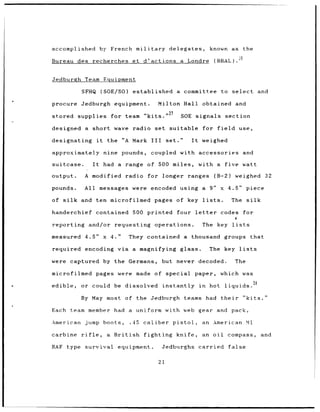
            By May most of the Jedburgh                                   teams had their                 "kits."

Each      team member            had a       uniform with web gear                       and pack,

American jump boots,                       .45   caliber           pistol,         an American              Ml

carbine rifle,               a   British         fighting               knife,     an oil      compass,             and

RAF type survival                 equipment.                Jedburghs             carried       false

                                                           21
documents,            which included:                  an identity              card,          ration card,

certificate             of domicile,              work permit,              and driving            license.

These         documents gave Jedburghs                          the    flexibility              to stay        in

uniform,         which afforded POW protection                                 rights          under

the Geneva Convention,                      or to wear civilian                         clothes.


Jedburgh Dispatch and Deployment                                  Procedures

                     To assist         the allied               invasion        of northwest Europe,

the French Forces of the                          Interior            (FFI),         developed a         six

phase         concept of operation.                        Phase       one centered on

disrupting            the movement            of enemy reserve                       forces to Normandy,

and dislocation               of communications.                        The second phase

concentrated             on the        liberation               of Brittany.               Phase       three

efforts         involved assisting                    the allied            advance to the Seine

River,         by providing            tactical            intelligence.                 This phase would

be followed             by assisting              allied         forces        in     southern France.

Phase         five    featured the            liberation               of Paris.               Finally,        phase

six would harass the withdrawl of German                                             forces      from the
                                      30
western and southern areas of France.

                Jedburgh teams would deploy to France to support

these         operations.         The       "Operational                Procedure of Special

Force Headquarter-s,                   12 May         1944,"          specified          dispatch

procedures.              SO/SF staffs,                located          in   the       field,      normally

initiated            requests     for Jedburgh                   teams.         The      appropriate

country section handled                       the requests.                    Following          the

selection of a Jedburgh                       team by Milton Hall,                         a warning order

                                                           22
would be         issued to the team and                to the country section.                   The

country         section then made preparations                    and all    other

required         arrangements,          to include coordinating              mission

details,         and conducting mission briefings.                       The country

section was also responsible                     for requesting aircraft

through the RAF and the U.S.                     Army Eighth Air Force,                   labeled

the "Carpetbaggers,"                  based at Harrington Aeorodrome,

Kettering.            The "Carpetbaggers"              arranged      for parachutes,

packages,         ordering of containers                   for mission equipment,                and

coordinating            transport       of team members           to the airfield.'3

                Once alerted          for movement,          the Jedburgh team would

be transported              from Milton Hall to London for its                     mission

briefing.           The respective         country section              involved conducted

formal         briefings,        which were similar            to Air Corps briefings,

and lasted for several                  hours.        Final preparations           were

conducted         at these meetings.              Jedburghs        learned      their       final

destinations            after     they received a current Michelin                        road map

of the area,            and the name of their               dropping     zone     (DZ).

Jedburgh         teams reported          back to SFHQ immediately,                 and

requested         follow-on drop zones                in    the prescribed       manner;          the

number of         the Michelin map,          section          number,    and coordinates.

The        reception committee on the ground would mark the DZ with

an assigned           code letter        designator,          using small       fires       or

blinking         flashlights,          or the signal         of   a beacon      light       to

indicate         a clear        DZ.   Once on the ground,             Jedburghs


                                                 23
immediately        contacted SFHQ.                   After codewords           and       bona fides

were exchanged         with resistance groups,                        Jedburghs          began       the

process     of coordinating                  operations with resistance                     leaders

and SFHQ.         Locations         of safe          towns and houses,               indicated by

a   bearing and distance                in        kilometers       from the DZ,           provided

refuge for team members                      in    the operational           area.


Jedburgh Operations

            SFHQ dispatched seven Jedburgh                            teams from Great

Britain     into Eastern Brittany in                        the    summer of 1944,             as part

of an overall         effort,         which         involved       the insertion            of other

Jedburghs        throughout         Northwest Europe.                  In    the period of

July-August        1944,        the French Resistance                  received          thousands

of air    dropped      supplies,              through the coordinating                    efforts          of

Jedburgh     teams.

            In    the ensuing chapters,                     I will discuss and evaluate

operations        of each of the                  teams inserted        into the Eastern

Brittany region of France.                          Included will           be the Jedburgh

link up with resistance                      groups and       their     guerrilla           actions

leading     up to the definitive                     message       to the French

resistance        by General          Koenig.             The message,        entitled         "Le

chapeau     de Napoleon,            est-il          toujours a Perros-Guired?",

transmitted        over the BBC,                  directed    the French            resistance         in

Brittany to begin               large scale operations                  on 4 August            1944.":

           On 3 August            General Koenig elicited                     a patriotic            call

to arms     for all      citizens             of France,          when he espoused:

                                                     24
French people of Brittany, the hour of your
       liberation       has come!   The provisional government of
       the French Reupublic calls        for the national
       uprising!        French people of Brittany, workers,
       peasants, official        employees!  The time has come for
       you to take part, with or without weapons,         in the
       last     battle.    French people of Brittany!   The whole
       of France salutes you!         The whole of France will
       follow you in the national insurrection.

This speech,          sent over the BBC,               was    followed by the French

national       anthem,    signalling            the French          to form battalions.

From this       point onward,           the French resistance                    (Maquisards)

sought out          individual and/or            small groups of Germans                  to
                                  36
neutralize          or destroy.


German       Rear Area Operations

              Jedburgh    teams did not normally encounter                             large-

scale German combat units.                      Most engagements were with rear-

area security elements.                  These consisted                of administration

and supply units          of the Military Governor of France,                             which

was directly          responsible        to the German Army High Command.

German security          forces were aware of how                       the French

resistance          was organized,        its        radio links to Great               Britain,

and    its    mission    to prepare           and assist          Operation          "Overlord"--

the Allied invasion of                 France.         The majority of the French

population sympathized                 and supported            the     resistance.           French

police and          security   forces,          in    some cases,         assisted       the

resistance.           Few Frenchmen willingly provided                          information       to

the Germans.           The Third        Reich categorized               all     resistance

activity       as    terrorism.         The     German       reprisal         for terrorism

                                                 25
was   met with Gestapo          counterterrorism          against       the French

populace:       shootings,        illegal      arrests,    and     torture.

             By August    1944,      the German occupation forces                       did not

have a comprehensive            picture of what was occurring                      in

the French countryside.                If   an area appeared quiet                 and

orderly,      German occupation             forces were    generally satisfied.

The threat      of FFI ambushes on small parties                    led the Germans

to send only large            armed units       outside    their      garrisons.

Thus,   large areas      of France were left              unobserved          by
                         38
occupation forces.


                                              26
Endnotes

      1.    Lewis,    Jedburgh Team Operations,                        p.     7.

      2.  OSS/London SO Branch micro, Reel III,     Vol.                                     IV,
JEDBURGHS, Preamble to I January 1944, pp. xviii-xxi.

      3.    Ibid.,    p.    xviii.

      4.    Ibid.,    p.    xix.

      5.    Ibid.,    p.    xxi.

      6.    Lewis,    p.    8.

      7.  0SS/London SO Branch micro, Reel IT!   Vol. IV,
JEDBURGHS, Preamble to 1 January 1944, p. xx,  xnd January to
July 1944, p. 4.

       8. OSS/London SO Branch micro, Reel I, Vol. II,
PLANNING, Preamble to I January 1944, p. xxx; and OSS/London
SO Branch micro, Reel III, Vol. IV, JEDBURGHS, January to
July 1944, p. 8.

      9.    Foot,    SOE in          France,        p.   18,   35,    pp.     40-42.

     10.    OSS/London SO Branch micro,                        Reel I, Vol.            II,
PLANNING,   Preamble to 1 January 1944,                        p. xxxi.

     11.    Ibid.,    p.    xxxi.

     12.    Lewis,    pp.        10-11.

     13.    Stanley Cannicott, Journey of a Jed,                                   (Cheddar,
Somerset:    Cheddar Valley Press, 1986), p. 22.

      14.  OSS/London SO Branch micro, Reel                            III,        Vol.      IV,
JEDBURGHS, January to July 1944, pp. 8-9.

     15.  OSS/London SO Branch micro, Reel III,      Vol.                                    IV,
JEDBURGHS, Preamble to 1 January 1944, pp. xxii-xxiii.

     16.    Lewis,    p.    11.


     17.  OSS/London SO Branch micro, Reel                             III,        Vol.      IV,
JEDBURGHS, January to July 1944, p. 10.

     18.    Mendolsohn,          Covert Warfare,               Vol.    3,     p.     xxv.


                                               27
19.   Brown,    The Last Hero          - Wild Bill    Donovan,           p.     567.

     20.  OSS/London SO Branch micro, Reel                    III,        Vol.    IV,
JEDBURGHS, January to July 1944, p. 12.

        21.   Ibid.,    p.   12.

     22.      OSS/London SO Branch micro,              Reel   I, Vol. II,
PLANNING,     January-September 1944, pp.              5-6,   and p. 30.

     23.  OSS/London SO Branch micro, Reel                    III,        Vol.    IV,
JEDBURGHS, January to July, 1944, p. 14.

      24.  Ibid., p. 12;  OSS/London SO Branch micro, Reel                                     I,
Volume II,  PLANNING, January-September 1944, p. 5; and
OSS/London SO Branch micro, Reel V,   Vol. V, ARMY STAFFS,
April, May, June 1944, p. 11.

        25.   Lewis,    p.   11.

        26.   Mendolsohn,      Covert Warfare,         Vol.   3,     p.    31.

     27.  OSS/London SO Branch micro, Reel III,                           Vol.    IV,
JEDBURGHS, Preamble to 1 January 1944, p. xiv.

     28.  M.R.D. Foot, SOE:  An Outline History of the
Special Operations Executive 1940-1946.   (New York:
University Publications of America, 1986), pp. 110-112,                                  and
pp. 124-125.

     29.  Robert G. Gutjahr, "The Role of Jedburgh Teams in
Operation Market Garden," MMAS thesis,  U.S. Army Command and
General Staff College, Fort Leavenworth, KS, 1990, pp. 4 6 - 4 7 .

      30. Combined Administrative Liquidating Agency,
"History of Organization of Command of Operations by FFI,"
(SOE/SO & SFHQ, 1945), p. 11.

        31.   Mendelsohn,          Covert Warfare,     Vol.   3,     pp.    30-31.

        32.   Ibid,    pp.   32-35.


        33.   Ibid.

        34.   Anthony Cave Brown, The Bodyguard of Lies,                              (New
York:      Harper & Row, Publishers, 1975), p. 694.

        35.   Ibid.,    p.   780.

                                          28
36.   Ibid.,   p.    781.

37.   Lewis,   pp.    18-19.

38.   Ibid.,   pp.    19-20.


                               29
CHAPTER THREE

                                              TEAM FREDERICK


             On the ninth of                    June,     SFHQ dispatched Team Frederick

into Eastern Brittany to Cotes du Nord,                                         along with an SAS

team.       It        was the       third       Jedburgh team to be dispatched                             into

France      from the United Kingdom.                            In      charge     of the group was

Major Adrian W. Wise,                        a British        officer.            Rounding out             the

team were Captain P.                        Aguirec      from France,             and an Ameiican

non-commissioned                 officer,          1SG Robert            F.     Kehoe,     who      served as

the radio operator.                         Operation         "Overlord"          was unfolding.

Team Frederick would spend the next                                     three months

successfully operating                        behind enemy lines                  before          returning

to Great          Britain.

                 The primary mission assigned                            to Team Frederick was

to assist             the British            SAS in      establishing             their      base     of

operations.                The base,          called       "Samwest,"            would be used as a

sanctuary and a                  re-supply point for other SAS parties.                                        The

base would also serve as a                          storage          facility         for arms        and

stores      that would              be required            by the French resistance                        in
                  2
the area.

                 The SAS mode of operations                          were dissmiliar                to the

Jedburghs.               Their operations consisted                           of attacking           enemy

rear area             targets,       often without coordinating                           their      efforts

                                                         30
with        the local            resistance.                    This often          resulted        in    German

reprisals           against             the French populace,                        such as mass

shootings of civilians,                               torture          and    the        like.     SAS    tactics

often conflicted with methods employed                                              hy the Jedburghs,

which placed                   emphasis on providing                         training,           leadership             and

building close                   ties         with the Maquis.                    The      fact    th;it the SAS

and     the Jedburghs had separate chains of command exacerbated

their        difficulties                    in    working        with each other.

                 Intelligence                     indicated no knowldege                     of established

resistance              groups          in        Cote du Nord area.                     This would            later

prove not               to be the case                     During          the next         three months,

Team Frederick would encounter a well organized                                                     resistance

movement.               The Gendarmerie                    (French           police)        throughout

Brittany were also                           known to be sympathetic                        to the Allied

cause.           Their strength in                       the Brittany area was estimated                                    by

SFHQ to be 3,000 men.'

                 The area of operations                               in   Cotes du Nord is

characterized                  by a          series      of denuded             folds of ancient

sedimentary              rocks,              that have           extensive          intrusions           of     granite

masses.            It     is     in     the northwestern                     area of France,              in      the

northern part of the old province                                          of Brittany.             Cotes du

Nord        is   bounded north by the English channel,                                            west by the

departement              of Finistere,                   south by Moribihan                      and east         by

Ille        et Vilaine.                 It        covers        nearly 2,800             square     miles.              Many

winding,          steep-sided                     valleys        traverse         across         the grain             of


                                                                 31
the country.                The coast           is     rocky and             indented.        More        level

land lies           inland.         Saint-Brieuc                  is    the capital          of Cotes du

Nord.           The population was estimated                              to be 500,000.4

                 On the         16th of June,               the team reported that                   it        had

cut      the Paris Brest underground                             cable,          and that all        railway

lines in           the area were out.                       The Jeds were executing                       a

mission that they had                    been trained                   for at Milton Hall.

Contacts           with local        resistance groups began                           in    earnest.              For

the next           week,        ISG Kehoe        requested             additional           supplies           from

SFHQ,           such as weapons,           ammunition,                 money and clothing                     to

support resistance                  fighters.                On the          23rd of June,        Team

Frederick reported encountering                                  heavy enemy activity                     in

their           area of operations.                   The Jeds carried                out an attack                  on

German           rear area communications                         facilities.             This action

resulted           in   severing       enemy lines momentarily.                              Team

Frederick also                  reported        a high state                 of morale among              their
       5
group.

                  For the        remainder of June,                    Team Frederick

concentrated             on contacting                all        resistance         leaders      and groups

in      their      assigned area.                They continued                   to build up needed

supplies to sustain                  special            operations               behind enemy lines.

                 The    first      week of July brought                          inclement weather                 to

the Cotes           du Nord.         This            repeatedly delayed               aircraft

drops           of supplies.         Team Frederick,                      however,        did not         remain

idle.            Indeed,        on the 7th of July,                     in      concert     with the           local


                                                            32
resistance,           they destroyed           20 German            lorries           near Rostrenen.

The Jeds also blew up a                   high tension              line between Brest and

Gouyec.       The team continued                 to provide            intelligence             back        to

SFHQ on the dispostion                   and strength of German                        forces    in

their     area.        Enemy strength estimates provided                                to SFHQ on 8

July indicated           2300 Germans            in    the village               of Plounevez

Moedec.       Team Frederick also reported a general's

headquarters and command post with an estimated                                          combined
                                                                                         6
strength of 6380 enemy                   infantry and artillerymen.

             By the 20th of July contact with the enemy became

more    frequent        and intense.             Team Frederick                  found itself

encircled by a           superior sized German                      force,        but managed          to

break out.            They lost         everything        except         their         small arms and

cipher.       SFHQ resupplied              the team with a                    radio by airdrop.

The Avecchre FFI             (local       resistance groups)                     served well          in
                                                                                                           7
the escape.            Many were later            decorated            for their          bravery.

             Close work and training                    with the Maquis                  in    Eastern

Brittany was coming               to fruition.                 The FFI,          in    teamwork with

the Jedburghs and             the British             SAS,      were beginning                to exact a

heavy toll        on German           forces     in    their        area.         During       the

Plesidy battle,           Team        Frederick reported                 an estimated 500

German casualties             (killed       or wounded)              to SFHQ.            The    Maquis

suffered      light      casualties         in    comparison.                 Their esprit            de

corps continued            to be outstanding                   in   the face of

adversity.v


                                                  33
The start          of August brought                  a shift         in      the mode of

operations        for Team Frederick.                     The Allied advance                    was

rapidly coming          in    their      direction.              Instead of conducting

small    scale attacks           on German communication                         lines         and

railway networks,             the Jedburgh               task was now to save them

from enemy destruct.on.                    SFHQ       instructed            Team Frederick to

safeguard the road networks leading                              towards the cities                    of

Morlaix,    Saint Brieuc              and Lamballe,              preventing enemy

demolition of road bridges and culverts.                                     This was necessary

to safeguard          the Allied advance.

           Unfortunately,              Team Frederick was not able                              to stop

the Germans        from committing                atrocities           in    Paimpol and

Pluebian.      The Maquis             and the Jeds were                 strong enough to

contain the enemy,             but hot to attack                     him at      this         time.

Details of the alleged                 atrocities              are not provided in                    the

dispatches     of Team Frederick's                       reports back to SFHQ during

this    period.        For the remainder of their                           time        in    Cotes du

Nord,    Team Frederick continued                        to request          help for the FFI

area    of Paimpol.           The team returned                  to Great          Britain on the
               t
20th of August. o


Team Frederick Conclusions

           The team successfully completed                              their         assigned

mission of establishing                  a base          in    Cotes du Nord,                 which

provided    liaison          and arms           and materials           for the              local

resistance.           However,        initial         intelligence              estimates

                                                    34
indicated             little       known resistance         movement          in    Brittany.

This information                   proved to be erroneous.               If        the     resistance

movement had been contacted                         two weeks before               D-Day,     a better

estimate of resistance                      strength could have been determined.

In      actuality,              the FFI was nearly         2,000 strong              in    the area,

but         short on arms and ammunition.                    Due    to the intelligence

shortfall,             Team Frederick was forced to continually request

airdrop          resupply to fulfill                Maquis needs.             This hampered

operations              to an extent,            especially when bad weather did not
                                            11
permit aerial                   resupply.

                 Team Frederick experienced                  poor security during

their        jump into their             assigned area.            The reception

committee consisted of a gaggle of onlookers                                       (men     and

women),          who were smoking,               despite    the    fact that Germans were

                                                          away.
                                                                  La
in      a   town just            seven kilometers

                 Team Frederick had good fortune                       with their            radio

(W/T)        equipment,            operated with skill            by 1SG Kehoe.               When

they lost             their       radio sets      during    one skirmish with the

Germans,             they were quickly resupplied with two additional

radio sets that                   also operated perfectly.

                 The team successfully arranged                     a number of

parachutings                   of men and equipment         throughout             their     stay    in

Brittany.              They also coordinated               a reception             committee        for

Team Felix (which                   will be analyzed         in    a later          chapter).


                                                     35
The    leadership and          teamwork of Team Frederick and

the Maquis        in   Cotes du Nord should not be underestimated.

Both fought        with bravery and courage                     in   the face of

tremendous        adversity,     while fighting                 outnumbered.

           The team was successful                    in   executing           missions      that

they were trained to perform.                        They cut rail             lines,

disrupted     enemy cable and telephone                     communications,

organized a        number of small unit attacks on convoys,

contacted     resistance        leaders         and resupplied                their      members

with what they needed to sustain the                            fight against the

Germans.

           As a result         of protecting road networks                             and

preventing        the Germans     from blowing bridges,                        American Task

Force A,     led by Brig.        Gen.      Herbert         L.    Earnest,             had a clear

run through to Morlaix,            as      it    rapidly advanced.                      General

Patton considered this            an important mission when he

requested Major          General Robert W. Grow of the 6th Armored

Division to keep an eye out for the bridges                                   along the

railroad     network      in   Brittany,         particularly                the one at

Morlaix.13        Once advance     units             of the US Army began to

overrun Team Frederick/Maquis                    positions,           the normal Jed role

ceased     at his point,        and the team soon returned                             to home

station.

           Relations with the SAS proved strained.                                      The lack of

coordination with the SAS led to some                            failures.              The SAS


                                                36
provided      resistance members with arms,                               without    giving    them
                                                                                         4
proper   training,              in   the opinion of Team Frederick.

           The Jeds were very successful                              in    sabotage.        They

succeeded      in     blowing         60,000 gallons of petrol                      at St Brieuc.

Sabotage was complimented with weekly attacks on enemy

convoys,    with the most important                          attack near Rostrenen,
                                      15
destroying      20 lorries.

           Lastly,             one of the more              interesting        observations         of

the team noted that in                 the battle              of the Paimpol          peninsula,

showed that          resistance            fighters         could be used as            infantry.

During this          battle,         the French            resistance        held    the towns of

Lexandrieux,          Treguler,        and Plunex with the assistance                          of

American tanks.16


                                                      37
Endnotes

           1. Mendolsohn, Covert Warfare, Vol. 8, p. 33.         The
members of Team Frederick had operational code names.             The
French usually had a nom de guerre.       Listed are some
personal information on Team Frederick members.            True name:
Major A. W. Wise, code name:      KINROS, nationality:         French.
True name:     Captain P. Aguirec, code name:        VIRE,
nationality:      French, nom de guerre:   Paul Bloch-Auroch.
True name:      ISG Robert F. Kehoe, code name:        PESETA,
nationality:      American.

         2.   Ibid.,   p.    34.

         3.   Ibid.,   p.    33.

         4.   Encyclopedia          Britannica,   Chicago:   1966,   Vol.    6,
p.   609.

       5. Mendolsohn, Covert Warfare, pp. 36-37.     The term
"Boche" was a slang term used by the French to refer    to
Germans.

         6.   Ibid.,   pp.    137-138.

       7.  Ibid., p. 140.  Team Frederick noted that the
radio equipment worked exceptionally well throughout their
operations in Western Brittany.

         8.   Ibid.,   p.    140.

         9.   Ibid.,   p.    141.

        10.   Ibid.,   p.    142.

       11.    Ibid.,   p.    143.

        12.   Ibid.,   p.    143.

     13.   Blumenson, Martin.   US Army in World War II,
European Theater of Operations, Breakout and Pursuit.
Washington, D.C.:    US Army Center of Military History,                    1984,
p. 349.

        14.   Ibid.,   p.    152.

       15.    Ibid.,   p.    153.

        16.   Ibid.


                                          38
CHAPTER FOUR

                                               TEAM GEORGE I


            SFHQ dispatched Team George,                              along with Team

Frederick,          on the 9th of June                        from Great     Britain into

Brittany.           Like Frederick,                     Team George was also sent with an

SAS party.            Three        officers             made up the team:         Captain Paul

Cyr (American),                Captain          Phillipe          Reaguenau    (French)     and 2D

Lieutenant          Pierre Gay             (French).              Team George    would not

return to home                station          until         23 August of 1944.1

            The mission for Team George was to drop with a party

of SAS and assist                  them in             establishing a base west of Redon.

They were to organize                      local         resistance     elements     and provide

them with          liaison,             arms    and materials.             Although the team

operated with the                  SAS,        they were subordinate             to SFHQ.      Any

cooperation between                      the two elements would be voluntary.

Initial     relations              between             the Jeds and the SAS were

strained.           Each organization                        was apprehensive     of the other.

            The reception                  (parachute             landing)    of Team George

at Dingson           (located east                of the port city            of Vannes)    was

marked by poor                security.                The    team reported     that many people

were      laughing and             talking             loudly,     although Germans were
                                             3
located     just        two kilometers away.


                                                             39
Team George           established               its        base at Farm de                la

Nouee,     near Dingson.             After          two hours                sleep,     the SAS

proceeded        to conduct demolition operations.                                      They cut

railroad     ties,      telephone           lines         and     all         other lines           of

communication.           The     SAS and the Jeds                       coordinated air                  drop

supplies during the next                    few days.                 The supplies             in    the

containers        would equip and arm the partisans                                     in    the area of
             4
Morbihan.

           Team George operated                      primarily in                    the Loire

Inferieure        department         (now      referred               to as Loire Atlantique),

in   Brittany.         The landscape                of the region consisted of many

small fields          divided by low hedges.                            It     was a heavy

populated area with little                     cover,            which proved                to be
                                                                  5
unfavorable          for defensive           purposes.

            Jed relations            with the SAS began                         to     improve.           Team

George and        the SAS jointly              planned            and conducted                operations.

This ad hoc arrangement                    would prove to be mutually

beneficial       during      the summer              of 1944.6

           On the 17th of July SFHQ acknowledged                                         receipt          of a

George     transmission          requesting arms                      for an estimated 4,000

men in     the Loire        Inferieure.'              What accounted                    for the delay

in   not   immediately         reporting             to SFHQ,            as was the Jed

established          procedure?            When they             landed         in    early June,           one

of the radio sets            broke during                 the     landing,            and the other

was damaged.          The team attempted                    to cannibalize                   the two sets


                                                     40
into one              functional       set,         but        it   still      did not work properly.

This was              compounded by the                  fact       that within          ten minutes              of

attempting              to transmit            a message,               the Jed        team was         located

by German              radio location cars.                         On top of this             situation,

the Germans              jammed the                frequency          that London was               sending on.

Although the team informed SFHQ that                                         they could not              receive

messages on this                 frequency,                   the request            was never

acknowledged.

                 Another task challenged                            Captain Cyr's abilities                       to

control          the local        resistance                   forces.         As soon as           *hoy began

to arm the local                 resistance               members,           many of them

immediately              sought out and shot the nearest German.                                            They

returned with their                    truck and booty to the Jed headquarters.

This mistake              resulted            in    a large scale German attack on the

Jed's        base,       which    was now compromised.

                 Having been discovered at                              the farmhouse           by the

enemy,         Team George            decided            to concentrate                on the area of

Loire        Inferieure,          which presented                       lucrative        sabotage

targets.               Before    they could pull up stakes,                              however,           the

Germans          lauched a        furious attack on their                              base at Dingson.

During         the confusion of the battle,                                 the French         resistance

did not          coordinate           their          fires.          This unfortunately                  resulted

in      fratricide.             The    battle            featured untrained                   resistance

fighters              equipped    with only small arms,                              locked    in   a

stationary              position.             The Germans held                      the high ground,              and


                                                               41
thus     they were able              to call           artillery              fire     on Jed and

resistance positions.                      The     Germans pinned                     them down with

covering        fires        from mortars and machine guns.                                The    Jeds

counterattacked               in    the early evening of battle.                              Captain

Cyr's company was outflanked                            by the Germans,                  as a result          of

his troops advancing                     too    fast       in      relation           to other units          in

the counterattack.                   The Jed team managed                            to escape,    but the

French        resistance suffered heavy casualties.                                       Team George          I

credited        the training at                 Milton Hall               for helping         them to

conduct a         successful             breakout         against the enemy.

               After surviving the breakout                               from Dingson,           the Jeds

held a        "council of war"                 with their             SAS counterparts.                 The

SAS commanding officer                     decided           that       his men would part ways

with the Jeds and move                     to a different                     location.       They agreed

that Team George,                  now    joined by SOE agents                         "Hauteur"     and

"Fonction"          (who     had been recently                       inserted          into the area)

would all         transfer          towards the Loire                     Inferieure.            At this

point,        Team George,           "Fonction"              and      "Hauter" worked
                                           1
essentially             as one team.

               Unfortunately,              bad luck continued                        to haunt     the Jeds.

On arrival          in    the village            of Saffre,               the team learned              that       a

Gestapo agent had discovered                            the exact location of                     the

resistance         weapons cache.                  At 0600 on                 the     28th of June,        the

Jeds came under attack once                            again from a large                  German

force.         A tactical           assessment            of the situation                 showed that


                                                        42
they were completely                         surrounded.         During    the confusion           that

followed            in    this     battle,       the combined        team of George,

"Fonction"               and     "Hauteur"       attempted        to take charge of the

situation.                They organized the                  resistance       elements     into

three separate                   groups and       sent them out           in    different

directions,               in     an attempt       to break out.            Once again,        after

hiding in            thick bushes and surviving                     repeated grenade

assaults            on their        positions,           the Jeds managed to escape.

They took only what they could carry on their                                       backs:      small

arms,         radio and some equipment.                         The Jeds then traveled

northwest            until        they reached Ancenis              on the river          Loire.12

                 The Jedburghs                were now established at La Roche

Blance         (a    safe house).               The team did not have civilian

identification                   papers.        The    last     battery of their           radio set

was now dead.                    The Jeds had          to rely on couriers               to relay

messages            to the French              resistance.         Finally,       on 15 August,            a

resistance agent brought                         the team a battery.                The team again

attempted            to radio London,                 despite     the presence of nearby

enemy soldiers.                    Germans would bathe              in    the    rivcr     right      in

front of the Jed safe house.                                They were     also being observed

by a       suspicious Frenchman.                       In     order to disguise his accent,

Captain Cyr stammered when conversing                                with the watchful

stranger when approached.                             According     to team       reports,      this

proved         to be a rather humorous                        exercise,    since the        Frenchman

also       spoke         in    a similar        fashion!         Captain Cyr's woes


                                                         43
continued.                       He         liked               to eat             in      a     restaurant                        patronized                      by

Germans.                   After             arguing                   one         day         with a             Luftwaffe                    lieutenant,

the         team decided                       it          would              be      best           for      Captain                   Cyr        to pretend

that        he       had been                  wounded                    in       the mouth.                        Afterwards,                             he

always            wore           a    bandage                    over           his        mouth.                 Eating                proved                rather
                                                   1
difficult                  for        him.             3


                    Team George                            stayed               on the               move.               They           decided                   to

move         to      the         nearby                  village                of      La Meilleraye-La                                 Varadas.

During             their             stay           at          this          location,                    they          organized                      small

scale            operations                    against                    enemy              lines           of      communications.

Among            their           accomplishments:                                       burning               of         a     bridge              at

Ancenis,                 cutting               a         rail          line           from Nantes                        to Angers                      at

numerous                 places              and           cutting                 two         locks           in        the        Nantes                   to    Brest

canal.              The          Jeds          also              destoyed                  a     German              petrol              dump near
                   14
Nantes.

                     According                         to Team George,                               the       Loire               Inferieure

resistance                   needed                    leadership,                      unity,               confidence,                       and            above

all,         arms          and money.                            There             never             seemed              to        be    enough of                      the

latter             two       items.                      Problems                  with          radio            gear             hampered                   the

team throughout                              their                three            month             stay           in       the        region.                    The

team was                 not         able           to          request               their           requirements                            to        London.

In       spite           of this               shortcoming,                             when Team George                                  I    departed

the         Loire          Inferieure                           on     23       August,               they           left           a     force               of       some

2,500            men.            These                 resistance                     fighters                were             fully           armed.                  They

succeeded                  in        protecting                        the         right             flank           of        the Third                      Army


                                                                                      44
from       St..     Etienne to Redon.                            The       resistance              kept constant

contact            with elements of                      the German               265th      Infantry      Division

in    St.     Nazaire.


Team George                   I Conclusions

                   The Allies planned                       to        intensify         resistance

activities                in    Northwest               Europe         (including            Brittany)      after

trained            guerrilla            leaders,            arms,          ammuntion and              supplies had

beer, inserted.                      SFHQ planned                to      fully      develop          resistance

forces            about the same                  time American troops entered                             the

peninsula.                    U.S.    troop exploitation was                            so    rapid,      however,

that the French                      resistance             forces          had to begin operating

before            they could be                 fully      developed.16                 The        fact   that Team

George was not inserted until                                     9 June           1944,      did not      fully

support            the above mentioned plan.                                     Perhaps      if     they had been

inserted            earlier, more arms                        and equipment                  2ould have been

put      into       the hands of the FFI.

                  Poor security hampered Team George during                                               their

entire        stay in            Brittany.               Untrained                resistance          members

unwittingly                   revealed          their       location              through a series             of

blunders             (i.e.,          bringing            war booty to               headquarters,           being

double crossed                   by Gestapo               infiltrators),                  which       led to       the

Germans continually                         chasing           them from one                  location      to the

nextt.

                  Poor radio communications                                 throughout              the summer of

1944 hampered Team George.                                   Upon          return to home station,                       the


                                                                 45
team   learned   why they did not receive       more    arms and other

equipment    from SFHQ:    long lapses of no communication

between    the team and headquarters.        This gap,     SFHQ surmised,

could have    been because     the team may have       come under Gestapo

control.     Of course,   in   retrospect,   this   was   not the case.


                                    46
Endnotes

           1. Mendosohn, Covert Warfare, Vol. 4, p. 157.           The
members of Team George I had operational code names.               The
French usually had a nom de guerre.              Listed are some
personal information on Team George I members.               True name:
Captain Paul Cyr, code name:           WIGTON, nationality:
American.        True name:     Captain Phillipe    Reaguenau, code
name:        SAVE, nationality:     French, nom de guerre:      P. Erard.
True name:        2D Lieutenant Pierre Gay, code name:         RUPEE,
nationality:        French, nom de guerre:        C. Lejeune.

       2.   Ibid.,   p.    157.

       3.   Ibid.,   p.    159.

       4.   Ibid.,   p.    160.

       5.   Ibid.,   p.    191.

       6.   Ibid.,   p.    162.

       7.   Ibid.,   p.    155.

       8.   Ibid.,   pp.    163-164.

       9.   Ibid.,   p.    165.

     10.  Ibid., pp. 169-171.  NOTM:            The date of the battle
was not recorded by the team in their           report to SFHQ.

      11.   Ibid.,   p.    172.

      12.   Ibid.,   pp.    179-183.

      13.   Ibid.,   pp.    198-204.

      14.   Ibid.,   p.    206.

      15.   Ibid.,   pp.    189-90.

      16.   Blumenson,      Breakout    and Pursuit,   p.   354.

      17.   Mendolsohn,      Covert Warfare,    Vol.   4,   pp.    236-241.


                                       47
CHAPTER FIVE

                                              TEAM FELIX


               Team Felix was the eighth                      team dispatched         into

France        from the United Kingdom.                       The team dropped         into the

eastern area of Cotes du Nord on the night of 8/9 July 1944.

It    consisted of         two British           soldiers,          a Captain J.       J.

Merchant and Sergeant P.                      Calvin,        and a Frenchman,         Captain

Jean Souqet.            Team Felix would assist                     another Jed team

already operating             in     Cotes du Nord--Team               Frederick

(discussed        in    Chapter Three),               and Team George I          in    the Loire

Inferieure        (now     called Loire Atlantique,                    noted in       Chapter

Four).         Also in     the area were two SAS bases--Dingson                              in    the

Morbihan area and Grog                   in    Loire    Inferieure       department.

               The purpose         of their       mission was to organize                    and arm

resistance        groups.          The team would also                investigate           the

possibility        of finding            a suitable           place   on the coast           to

resupply        the resistance            from the sea for Cotes du Nord.

               The reception of Team Felix was well organized                                     and

efficient.         Unlike the earlier                  insertions       of Teams George                 I

and Frederick,            these Jeds did not                  encounter poor security.

The     fact    that their         air    drop went undetected             by the enemy is

noteworthy.            A battalion            of Germans was          reported     to be


                                                  48
resting          for the evening                   just      one kilometer                       from the drop
           2
zone.

                 Team Felix             reported no large                         SAS forces             in      their

area of operations,                      just       single officers                          and NCO's working

alone.           The only SAS member known                                  in    their          region was a

Lieutenant           Fouquet.                Repeated             efforts               to contact           the

Lieutenant           proved           fruitless.                  This caused considerable

consternation                  for the Jed team,                     due to the                  fact that

Lieutenant           Fouqet often gave orders                                    that        conflicted with

theirs.3

                 The Jedburghs and the SAS appeared                                              to have t½e            same

operational               goals      of organizing and arming                                    the French

resistance.                However,            due to separate                      chains of command,                     and

lack of joint                  planning         and coooperation                          letween the SAS and

SFHQ,          some problems              in    the       field        developed.                    Whereas        the

Jeds had          been instructed                   to keep            resistance activity                          to a

minimum while arming was in                                progress,                the SAS continued

their          sabotage         activities            in     the       area of Dinan and Legouray.

This caused               increased            surveillance                  and        repressive            measures

against          the French            resistance,                 which was                 still     getting

organized.                It    also cut down on the amount                                      of time to

properly          train         resistance            fighters               on weapons               use and

sabotage          tactics.             Compounding                 this          situation            was     the    fact

that most SAS parties                          did not have a                     radio.             Thus,       they

often continued                  to work with obsolete                              orders. 4


                                                             49
During the           first        part of      July Team Felix

concentrated           on meeting with local                   resistance                 leaders       in        an

attempt       to achieve unity of effort                       among         the various French

resistance        factions.                On the       13th of July they reported                           to

SFHQ in       London that they had prepared                          the bridge at Lancieux

for demolition.               The Jeds also coordinated                             numerous air

drops of arms,              ammunition and money to sustain the

resistance        effort.           On the 23rd of July,                     the team requested

an additional           Jed team be dispatched between Team Frederick

and   their     location.              Encounters with the Germans were

increasing        in    the area.               They also requested more                        arms for

resistance        fighters.                The remainder          of July saw Team Felix

continuing        to contact               FFI leaders and coordinating                              their

small scale guerrilla                      efforts       with SFHQ and other Jedburghs

adjacent       to their        area of operations                  (i.e.,            Frederick and

George 1).5

              The first        of August brought changes                             in    tactics       for

the Jeds.         Due to the rapid Allied advance,                                  SFHQ directed

Team Felix to prevent                      the enemy from carrying out demolition

of road bridges,              culverts,               and roads    in       their         area.

              Attacks on German                      convoys continued however.                         From 2

through       18 August,           Jedburgh directed attacks on German

convoys       resulted        in    the capture of enemy trucks,                              ammunition,

supplies and the capture                        of over      two hundred prisoners,                          as

reported to SFHQ by Team Felix.                              Having accomplished                       their


                                                        50
mission       in    the area,         the    team returned             from the field          to the

United Kingdom on the                  23rd of August.


Team Felix Conclusions

              Overall,       Team Felix felt              that their           mission      had been

a   success.        Their     final         report    to SFHQ expressed              the sole

regret of not having been                     sent in      earlier.            This analysis

seems to be similiar                  to the sentiment              expressed by other

Jedburgh teams that              participated             in    Operation         "Overlord."

              One can only speculate                  how much more effective

partisan support and effectiveness                             would have         been if      the

SAS and the Jedburghs had achieved                             unity of effort            through

closer planning             and cooperation.               This was hampered by the

fact that          although both had a               similar purpose--the

organizaticn and arming of the French resistance                                     in    Cotes du

Nord,       the    fact of the matter            is      that they           served two

different          masters    (different         chains of command).                    This    led

to conflicting          guidance and orders being                           issued to

resistance          groups.

              Another noteworthy comment                       provided to SFHQ by Team

Felix was the          fact that they were                 not        issued suitable

maps of the area of operations.                          Michelin           road maps did not

meet mission needs.                   Even these maps were                  not   issued     to the

team until          three    weeks after         their         insertion.


                                                 51
F n dnotes

       1.  Mendolsohn, Covert Warfare, Vol. 4, p. 363.   The
members of Team Felix had operational code names.   The
French usually had a nom de guerre.   Listed are some
personal information on Team Felix members.   True name:
Captain Jean Souquet, code name:   CARNAVON, nationality:
French, nom de guerre:   J. Kennevel.  True name:  Captain J.
J. Merchant, code name:   SOMERSET, nationality:  British.
True name:   Sergeant P. Calvin (killed in a plane crash
taking off from Calcutta in January, 1945), code name:
MIDDLESEX, nationality:   British.

      2.   Ibid.,   pp. 369-70.

      3.   Ibid.,   pp.    370-71    and p.   379.

      4.   Ibid.,   p.    379.

      5.   Ibid.,   pp.    355-56.

      6.   Ibid.,   p. 367.

      7.   Ibid.,   p. 369.

      8.   Ibid.,   p. 379.


                                      52
CHAPTER SIX

                                     TEAMS GAVIN AND GUY


Team Gavin

           Team Gavin was the eleventh                                team inserted       from the

United Kingdom              into France.                SFHQ dispatched          the    team to the

northern      part of the             Ille         et Vilaine Department on the

evening    of 11/12               July 1944.            The team members           were     led by a

French    officer,             Major Jean Carbuccia.                    He was accompanied                  by

2nd Lieutenant              Paul Valentini,                   also a French officer              and

Captain William B.                  Dreux,         a    23-year-old       lawyer    from
               1
Louisiana.

           The mission of Team Gavin was to organize and                                            arm

resistance          fighters         in      the northern             sector of the       Ille        et

Vilaine Department.                   Intelligence                  from SFHQ indicated             that

they would need to organize                             the department         for the reception

of stores and equipment                       for approximately               2,500 men.

           The area of operations                             covered approximately                2,700

square miles,             facing the English channel                       coast at the             root

of the Breton peninsula                       in       the Bay of St.         Michel.       Ille       et

Villaine      is      bounded        in   the west             by Cotes du Nord,          southwest

by Morbihan,            south by Loire Atlantique                        (referred      to in         i944

as   "Loire        Inferiere"),           east by Mayenne and northeast                          by

Manche.       Most        of the Department                    is   drained    south by the


                                                         53
river        Lilaine and               its      tributaries.                         The Vilaine            has been

canalized as                 far as Rennes.                     There           it      is    connected           by a

canal       via the Ille                  River.              Much of the area                       near

the coast             is     relatively               flat,      and     is           used         for market

gardening.                  Farther          inland the               ribs of hard rocks form

higher ground.

                    Team Gavin dropped                        near Courcite                   in    Mayenne,        which

was approximately                      75 miles from where                              the team was supposed

to work.              Unfortunately                   there      is    no mention of security at
                                                                                                                          4
the drop zone,                  as in        previous            reports by other                       Jed teams.

Adjacent Jedburgh                      teams operating                   in           Morbihan and Cotes du

Nord       (i.e.,           Frederick,           George          I,    Felix)                were to assist              Team

Gavin.              SAS groups            also operated                in            the same areas

(operating             bases at              "Dingson"           and "Samwest"                       as noted       in

previous chapters).                          They came under the command                                     of

"Commandant                 Bourgoin"           (a     nom de guerre).                         Jedburghs were

instructed                 to assist          the SAS as far as possible,                                    but they
                                                                            5
would not come under                          their           command.                The men under the SAS

command of "Commandant                           Bourgoin"              were uniformed                       soldiers,

with an estimated strength of 300.

                    Team Gavin            reported to SFHQ on 13 July of their                                           safe

arrival,             along with their                     containers                  and associated

equipment.                  However,          just        two days              later         the team reported

having problems with a radio set.


                                                                54
On the            18th of July,                  SFHQ instructed Team Gavin to

link up with Team Guy.                               On the 25th of July,                  Team Gavin

reported      an estimated strength                                of 4,000 armed Maquis                   in

Mayenne.          However,            the           resistance        in        the area    lacked         proper

liaison      and leadership                         according        to Team Gavin.              On the 31st

of July the team informed                              SFHQ that           it     still    had not
                                     8
contacted         team Guy.

             Meanwhile               on the 29th of July,                        General     Omar

Bradley's         12th Army Group assumed command of the FFI                                               in

Brittany,         and placed              it         under control of the Third Army.

General      Pierre Koenig                     (Commander            of SFHQ operations                  in

France)      designated               Col.           Albert M.        Eon as the commander                        of

the entire          FFI        in    Brittany.                American conventional                    forces

planned      to penetrate                 Brittany along two principal axes:

Dinan-Brest           and Avranches-Rennes-Redon.                                     The FFI,        (assisted

by the Jedburghs                    and the SAS)               would help that              effort.               SFHQ

planned to parachute                      a small             reconnaissance              party into

Brittany on the evening of 2 August to establish                                                 a command

post for Colonel Eon.                               Poor weather conditions,                   however,

forced cancellation                      of the drop.                 On 3 August the British

Broadcasting Corporation                              (BBC)        radioed a          coded message               to

the FFI      in     Brittany.                  It     signaled        the start           of general

guerrilla         activities              short of open warfare.                           Because

American      troops had already sped beyond                                        Dinan and Rennes                   by

the 4th of August,                   General            Koenig        requested           Colonel Eon to


                                                              55
set up a command post                     and secure          the high ground north of

Vannes      in    the Quiberon Bay area.                       Although Colonel                 Eon had

no parachute            experience,             he nevertheless               parachuted             into

Brittany on the night of 4 August.3

             Team Gavin         finally             linked up with team Guy on 2

August.          Team "Guy Gavin"                (as       described      in    their        after

action      report)       reported          their          location at Combourg.                      There

they helped mop up the district.                               For the next two weeks

they continued            to assist             conventional          forces        (i.e.,           the 83rd

Infantry Division)              in        mop up actions             in   the regions                between
                                     10
Cancale and St.            Malo.


Team Guy

             Team Guy was the                   13th team inserted                into France               from

the United Kingdom.                  They dropped              in    the same area as Team

Gavin      on the night of 11/12 July.                          Their         assigned area of

operations         would be the             southern area of the Ille                         et Vilaine

department.             Team members             included:          Captain Andre Duron and

2nd Lieutenant            Roger Groult,                both French officers,                    and a
                                                                          1
British      officer,       Captain A.              E.      Trofimov. 1

             The mission of Team Guy was                            to organize,             equip and

lead resistance            forces          in    the Rennes/Vitres               area.          The     team

had very little            intelligence                concerning         the     resistance            in

this      area.     The    team's          radio       set was       smashed when              they

jumped      into France.             As a        result,       SFHQ did not hear                     from the

team until         3 August,         when        they linked up with Team Gavin for

                                                       56
operations.             From this       point    forward,         the Jedburgh           teams       of

Gavin    and Guy were            to operate       as a unified            team in        Tlle et
             19
Vilaine."


Combined Operations               of Teams Gavin/Guy

             Team Gavin dropped               several          hundred yards away           from

its   drop zone,             while Team Guy landed a half a mile away.

Both teams         were       inserted    near Courcite            in    Mayenne,        which       was

about    75 miles away from the area that                          they were        to work          in.

The Jedburghs               decided    that Team Gavin would work in                      Mayenne,

while Team Guy would go                  to the southern sector of Ille                         et

Villaine.13

             On 24 July an alleged                British         SOE agent    by the name

of "Dennis"            (a    nom de guerre)       informed         the Jeds that there

were two available               drop zones       in    Ille      et Villaine which              had

been used         (apparently          by the SAS).            On 30 July "Dennis"

arranged      to have another radio                   set dropped on one of these
                                  4
drop zones         for Team Guy.1

             Team Gavin was faced with the prospect                           of covering

75 miles to get to their                  assigned area.                The team covered

the first         15    miles on foot at night.                  Captain     Dreux        (of    team

Gavin)      was able to purchase an old car in                           order to cover              the

60    remaining         miles.        Along   the way his car was stopped by                          a

German patrol.               A German soldier          approached          the car,        and

proceedEd         to poke his submachine gun at Captain                        Dreux's

chest.       Captain Dreux asked                the German questions                in    English.

                                                 57
The German      soldier          was      perplexed                   at the response                         given by

Captain Dreux.            It      is    not clear whether                             the         soldier             did not

understand      English,           or if             he    felt           he    was        in    a      trap set by

the resistance.             Amidst             the confusion                        of the situation,                          Team
                                                                                      15
Gavin's car drove through the                                roadblock.

          On 2 August the combined Jedburgh                                                 teams of Gavin and

Guy arrived      in     Combourg.                    Third Army troops had already                                   been

there.    The allied             advance was proceediig                                     at a            rapid pace. 16

          Captain Duron                  (of Team Guy)                         reported                to

Headquarters,         6th Armored                    Division at                    Loudeac on 3 August,

per SFHQ directive.                    There he was informed                                    that         resistance

groups   (led by Jedburghs)                          were         tu round up all                           Germans         in

the area and act as                a covering                     force to protect                           lines        of

communication         for the rapidly advancing                                       6th Armored

Division.       During          this      operation,                      1,400 German prisoners

were   taken    in    the areas of Tinteniac                                    and Combourg. !?

          On 6 August the Jeds                             reached the outskirts                                     of Dinan.

Both bridges         there       had been blown by the Germans.                                                      Captains

Dreux and Duron were                   among the                  first         Allied officers                        to

enter the city,           just         after          the evacuation                        of the Germans.

          Not all         Jedburgh operations                                  in    the        Ille         et Villaine

department      were      successful.                      While           on a reconnaissance

patrol   in    the village              of La Bastille,                             Captain Dreux                     reported

that severpl         tactical           blunders were made.                                     First         and

foremost,      Captain          Dreux          lit        a cigarette,                     which immediately


                                                           58
gave        his    position               away         to a         well       emplaced                    enemy machine                    gun

position.               Captain               Dreux           was    not       able            to      observe              the enemy

position           clearly,               because              he    had       left            his         binoculars                 behind.

Captain Dreux                     had     assigned                the machine                    guns            to    Algerian             and

Sengalese              soldiers.                  He assumed,                  because                 of their              combat

experience,                that          these         soldiers               would            fight             well.

Unfortunately,                     the        assumptions                 were          unwarranted.                         The

Algerian           and        Sengalese                soldiers               froze            in      combat,              proving

useless           to     the       small          patrol.                As    a      result               of these            mistakes,

two       resistance               fighters              were        wounded,                  one         severely.

Fortunately                the       patrol            escaped            without                further               incident.i3


                  On 7 August                    the     Jeds        learned              that             the        83rd     Infantry

Division,              with headquarters                            at St.            Pierre,               was anxious                 to

include           resistance fighters                               to support their                              effort.             The

Division Commander,                              Major General Robert C.                                         Macon and

Brigadier General                         Claude B.                 Farenbaugh                   (the Assistant

Division Commander)                              arranged a meeting.                                   At this              meeting          the

Jedburghs were                     given the mission to protect                                                  the right             flank

on the division's                         push towards                    St.         Malo.20                At the meeting,

Captain           Dreux           recalled             that         he    accepted                   the         mission         despite

the fact           that           the local              Maquis were                    yet to be armed,                              the

resistance               strength                in    the area was unknown,                                      and they were

not       yet     organized.'

                  Captain Duron                       led a patrol                    of approximately                           15

resistance               fighters                to Rotheneuf                  on 9 August,                           and


                                                                     59
encountered              no Germans.           That       same evening               the Jeds

established              a base camp at Rotheneuf,                         establishing              posts

along      the coast and               scouting roads              leading           up to the German

fortress         of Rotheneuf.                The    Jedburghs provided                     valuable

intelligence                 to    the 82nd    Battalion of                the 329th              Infantry

Regiment         concerning the various                        routes leading               to      the fort.

On 10 August,                 Major Jean Carbuccia                    (of Team Gavin)

participated                 in    the attack on the             fort,           which     fell      to the
                                        22
Allies that afternoon.

                Due to the            rapid advance of                the 83rd           Infantry

Division,          the covering              force       provideo          by the teams Gavin/Guy

was no         longer         required.        The only remaining                     position          (in

early August                 1944)    was    the citadel          of       St.     Malo,      which was

being attacked                    by advancing       columns of the division.                              Since

their      covert            mission was complete                in      Ille      et Vil]aine

(having         their         positions overrun               by American forces),                      the

Jedburghs contacted                    SFHQ in       London.             The mission was

completed          on 23 August.


Team Gavin/Guy                    Conclusions

                The      teams cf Gavi.             and Guy,          like earlier                Jedburgh

teams sent              in    before    Lhem,       operated          in        an area where another

covert         organization--the               British         SAS also            operated.            Could

the effort              to help       the resistance            have            been more effective

with a combined                    operation     with         the same chain             of command?

How much duplicity                    of effoct          resulted          from this          structure?

                                                         60
There     are questions           that      remain unanswered                  and which                       are

subject      to continued           speculation and warrant                               further study.

             Perhaps        the Jedburghs           could have been                        inserted

closer to their             assigned        area of operations                       if     they had

known about          the two available              drop zones              (provided                     by the

alleged British             agent    "Dennis").

             Radio problems continued                    to plague Jedburgh

operations.           Causing       further annoyance,                     was the               reported

ineptitude of some               radio operators            at SFHQ,             who were unaware
                                                4
of Team Guy's radio problems.2

             The    teams reported            that they were sent out                                     into the

field     without any intelligence                  contacts,               civilian                 clothes
                                                                                                     5
and     false papers.            This hampered           their        operations.

             According          to Captain A.E.           Trofimov              (Team             Guy),          the

Jedburghs      should have been               inserted           earlier         into              the area.

This would have given the Jeds                       more time              to establish                        better

contact with the cla,-destine                   members           of the resistance--

people who did normal                jobs during          the day but undertook
                                                    26
resistance         activities        at night.

             Captain        Trofimov        recounted       that the Jedburgh

briefing given            to Team Guy was            inadequate.                 Too             little

information was             known about        resistance              forces              in      Tlle et

Vi la ine.     Nn     contact       had been made with tho                       resistance                      in

the area      since March           1944.      Therefore,             no      information

concerning         resistance        groups or conditions                       in        Ille            et
Vilaine were              provided        to the team by SFHQ at their

briefing.

              The Jeds         initial       debriefing            took place       at Third Army

Headquarters              with SF officers.                 The Jedburghs         had great

difficulty           in    locating        the SF detachment.                  Their    final

report was prepared                 at a SFHQ office                in    Baker   Street,
             28
London.             This account by Captain Trofimov reveals the

rigors of coordinating                    joint      operations           in   a combat

environment.

                  Finally,     the teams          felt      that    they were       never really

able to accomplish                their      assigned missions,                 although    the

teams of Gavin and Guy rendered valuable                                   service to the 6th

Armored Division and the 83rd Infantry Division.                                         This was

largely due to the                 fact that             they were dropped

approximately              75 miles away            from their           assigned      areas.


                                                     62
Endnotes

           1.   Mendolsohn, Covert Warfare, Vol. 4., pp. 444, 459.
The members of Teams Gavin and Guy had operational code
names.        The French usually had a nom de guerre.              Listed are
some personal information on team members.                    Team Gavin --
true name:         Major Jean Carbuccia (later         promoted to General
in the French Army), code name:               SHILLING, nationality:
French, nom de guerre:              D. Jean-Claude; true name:         Captain
William B. Dreux, code name:              SIXPENCE, nationality:
American; true name:              2D Lieutenant Paul Valentini, code
name:        HALFPENNY, nationality:         French, nom de guerre:        G.
Masson.        Team Guy --        true name:    Captain Andre Duron, code
name:        DRONNE, nationality:        French, nom de guerre:         Andre
Dhomas; true name:            Captain A. E. Trofimov (of Middleton on
Sea), code name:          GIRONDE, nationality:         British;     true name:
2D Lieutenant Roger Groult, code name:                 DORDOGNE,
nationality:         French, nom de guerre:         J. Deschamps.

        2.    Ibid.,   p.    445.

        3.    Enclyclopedia Brittanica,         Vol.     11,     p.    1077.

        4.   Mendolsohn,       Covert Warfare,    Vol.     4.,        pp.    445,     474.

        5.    Ibid.,   p.    446.

       6.     Strawson, John.        A History of the SAS              Regiment.
London:      Secker & Warburg,       1984, pp. 132-33.

        7.   Mendolsohn,       Covert Warfare,    Vol.     4,     pp.       147-48.

        8.    Ibid.,   pp.    448-49.

        9.    Blumenson,      Breakout    and Pursuit,     pp.        354-55.

      10.    Mendolsohn,       Covert Warfare,    Vol.     4,     pp.       449-50.

       11.    Ibid.,   pp.    469-70.

      12.     Ibid.,   p.472.

       13.    Ibid.,   p.    674.

      14.     Ibid.,   p.    476.

      15. William B. Dreux, No Bridges Blown, (Notre Dame,
Indiana:  University of Notre Dame Press, 1971), pp. 164-65.
Captain Dreux was a lawyer from New Orleans, Louisiana
before World War II.  He volunteered to be a Jedburgh at

                                         630
Fort Benning, Georgia, where         he was an infantry officer.
William B. Dreux was born in         1911 in Paris, and lived there
until  1919 when his parents        immigrated to the United States.
Although he was trained as a         demolition expert, much to his
chagrin, Captain Dreux never         did get to blow up a bridge as
a Jedburgh in World War II.

      16.   Mendolsohn, Covert Warfare,             Vol.   4,   p.   484,   and
Dreux, No   Bridges Blown, pp. 208-9.

      17.   Mendolsohn,     Covert Warfare,         Vol.   4,   p.   485.

      18.   Ibid.,   p.   485,   and Dreux,    No Bridges        Blown,     pp.
208-9.

      19.   Dreux,   No Bridges     Blown,    pp.    241-43.

      20.   Mendolsohn,     Covert Warfare,         Vol.   4,   p.   486.

      21.   Dreux,   No Bridges Blown,        pp.    222-23.

      22.  Mendolsohn, Covert Warfare, Vol. 4, p. 487.    Major
Jean-Claude, whose real name was Jean Carbuccia of Besancon,
France, would later   become a General in the French army
after  World War II.

      23.   Ibid.,   p.   485.

      24.   Ibid.,   p.   489.

      25.   Ibid.,   p.   489.

      26.  Trofimov, A.E., letter     to the author, 24 March
1993.   Mr. Trofimov was born 7 December 1921.       After his
mission in Brittany was complete in July 1944, then Captain
Trofimov parachuted into the Karen Mountains of Burma with
another Jedburgh team in early February 1945.        In Burma he
was promoted to Major.       Major Trofimov distinguished himself
while in Burma, and was awarded the French Croix de Guerre,
and the British    award of the Military Cross, following an
attack against the Japanes garrison at Papun.        Major
Trofimov served in various command assignments until       his
release from military service in September 1946.        He became
a chartered architect    after   the war until  his recent
retirement.

      27.   Ibid.

      28.   Ibid.


                                     64
29.   Mendolshon,   Covert Warfare,   Vol.   4,   p.   488.


                          65
CHAPTER SEVEN

                                          TEAM GERALD


            On the night of 18/19 July 1944,                                 Jedburgh     Team

Gerald parachuted           into the Morbihan area of Brittany;                                     the

seventeenth       team sent          from the United Kingdom.                           The team

consisted       of:   Captain Stephen J.                        Knerly,       and Ist     Sergeant

Berent     E.   Friele,     both U.S.              soldiers;           and    a French officer,

Lieutenant       Claude L'Herbette.                        Team Gerald would spend                       the

next    three months operating                     in     the Morbihan area before
                               1
returning       to London.

            There were        two SAS bases                    in    the Morbihan area--

"Dingson"       and "Grog"          (as    noted in             previous          chapters),

ostensibly led by Commandant                            "Bourgoin."           Team George           I        (in

Loire     Inferieure,       i.e.,         now called Loire Atlantique)                          and

Team Frederick        (in     Cotes du Nord)                    were also operating                 in

close     proximity to Morbihan.                        SFHQ sent Team Gerald                  to

Morbihan to       replace          team George I                    (which had displaced                to

Loire Inferieure).              They would help organize                            resistance

groups     in   the area,       and       assist          Commandant          "Bourgoin"        (of           the

EMFFI).

SFHQ estimated some 4,000                    armed maquis               in    Morbihan.

            On 20 J•ily       team Gerald                 reported        their      safe arrival

to SFHQ.        The Eureka          set     (radio         navigational             device used               to

                                                    66
mark a drop zone)                 was      lost          when parachuting                into Morbihan.
                                                                            I
This would hamper                 future          aerial         drops.

                 Commandant         "Bourgoin"              failed         to appear              for a

meeting          with Team Gerald                 on 24 July.                Several         days later              the

team decided that                 they would operate                       independently                 of the

SAS    in    Morbihan.            Team Gerald               was wary of working                         with the

SAS.        In    their       report       to SFHQ,             the team indicated                      that    they

disapproved               of SAS tactics.                  Whereas         the Jedburghs                 were sent

primarily to advise and organize                                   the     resistance              in    the area,

the SAS were perceived as                           actually taking over                      the Maquis              in
                  4
Morbihan.

                 The work accomplished                      in     Morbihan by the Jedburghs

and    the Maquis             consisted of attacking                        enemy lines                 of

communication:                 railroad           ties      and telephone                lines.              They

also       attacked         small convoys.                  An excellent example                         of such

operations            occurred on 3 August.                             Captain Knerly              and 1st

Sergeant Friele                succeeded            in     blowing         up a        tree in          front of

three approaching                 enemy vehicles.                       A short engagement

ensued,          with the result              of 30 enemy killed                       and    15 wounded,

and two vehicles demolished.                                The         Jeds and the resistance

fighters          suffered no casualties.

                 Team Gerald          reported             that their           meetings with

resistance            groups were usually                       fast,      efficient          and

trustworthy.                However,        one courier was captured by the

Gestapo          in   Pontivy.            The agent             told the Germans what                         they


                                                           67
wanted       to know,       so    the Gestapo       knew of Team Gerald.                   They

were even aware that                the Jeds had           lost     a   radio     in    the area

(i.e.,      one        receiver was    smashed on the insertion,                       however,

the Jeds had brought                another    receiver            as a spare).           Despite

being       informed       of the Jedburghs          in        Morbihan,     the Gestapo

never,       however,       caught Team Gerald.                   They were able          to avoid

detection by constantly                staying on the move,                  in    the

area of Mur de Bretagne,                Loudeac,           and Pontivy.6

              In       early August Allied          forces were rapidly advancing

into Brittany.              Team Gerald met up with an advancing column

of the 6th Armored Division,                   which provided a jeep                     for the

Jeds.       They led the column through St Conac to Finisterre,

for Combat Command B                (commanded      by Colonel            George W. Read,

Jr.)     of the 6th Armored Division,                      which advanced              along the

main road          to Brest       from Rennes.        The team            reported       that    they

liberated          eight French       towns along              the way.      At Carhaix          they

encountered             resistance    from a garrison               of 1,500 Germans,             and

went north towards Morlaix through                             the town of La Cloitre.

Their jeep then ran over a mine.                           The Jeds escaped without

injury,       but all       of the equipment          in        the vehicle was
                   7
destroyed.

              Team Gerald          proceeded     to contact             the SF

representative             at the 6th Armored              Division.         At    the

division,          they contacted       Major General               Robert W. Grow,             the

Commanding             General.    He put them            in    touch with a           Lieutenant


                                               68
Colonel Drosty.                       The       team    then briefed                       him on the tactical

situation              in     the Morbihan department.                                     They also described

the lack of unity between the Jeds and                                                     the SAS           in     the

area.

                During               the next several              weeks               in       the    first         half of

August,         Team Gerald                    directed       resistance                    efforts            in    the

Morbihan area.                        They dispatched              three Maquis battalions,

which took control of the main road from Brest                                                               to Rennes,

while the SAS guarded roads                               south of the main road.                                         In

Pontivy the team established an office                                                     in    the bureau of

civil        affairs            to     facilitate         cooperation                       with the              6th
                                      9
Armored Division.

                On 18 August Team Gerald                               left           Pontivy               for Rennes.

There they contacted SFHQ,                               which relayed the status                                        of

General         Bradley's                 advance.        At Rennes                   they briefed                   the G-2

of the U.S.                  First        Army of the resistance                                situation            in

Morbihan.                   After the briefing                 the team's mission was

complete          in         Brittany,           and    they returned                       to London. 1 0


Team Gerald                  Conclusions

                The team commented                       in    their               after         action report,

that        the terrain                description            in   the SFHQ briefing                                in    London

prior        to insertion,                     was    incorrect.               Although                this         did not

adversely affect                       their         operations,              it      could have proven
                       ii
otherwise.


                                                              69
Relations between                  the Jedburghs           and the SAS were

strained,        as was      the case with previous                      teams       in       Brittany.

The Jeds       had a high regard for SAS                      fighting           abilities,            but

with separate          chains of command,                   and    therefore           separate

agendas and priorities,                   the two organizations                      never quite

meshed.        This     lack of unity              in     the same area of operations

hampered       aid to the          resistance.

              The team complained                  that     they did not receive                      items

that were        requested         for the resistance                   from aerial

containers          supplied by SFHQ.                   Not enough weapons                    and

ammunition were             sent    to Team Gerald                to supply resistance
               12
fighters.

              Radio problems continued                      to crop up in              analysis         of

Jedburgh operations                in   Eastern Brittany.                  The       team lost          a

Eureka       set and a radio             receiver was destroyed                      when they

landed.        Fortunately,             the team had brought                 an extra               receiver

with them.           Messages       from SFHQ were often 24 to 40 hours

late.        As a result,          most of the work had already been

carried       out by the       time the message(s)                     was received.                  Team

Gerald       requested       that messages be written                       in     English to

facilitate          deciphering.            Despite this               request,        SFHQ radio

operators        sent a number            of messages             in    French,        which made

deciphering          more difficult               and     time consuming.


                                                     T0
Endnotes

       I.    Mendolsohn, Covert Warfare, Vol. 4, p. 558.             The
members of Team Gerald had operational code names.               The
French usually had a nom de guerre.           Listed are some
personal information on Team Gerald members.             True name:
Captain S. J.     Knerly, code name:       NORFOLK, nationality:
American; true name:          Lieutenant Claude L'Herbette, code
name:     SUFFOLK, nationality:        French, nom de guerre:       J. L.
Beaumont; true name:          1SG Berent E. Friele, code name:
SELKIRK, nationality:           American.

       2.   Ibid.,   pp.    558-9.

          3. Ibid., p. 560.  The Eureka set was a radio
navigational device used by agents on the ground to mark a
drop zone for aerial    drop of personnel and equipment.  The
operator on the ground transmitted signal letters     to
aircraft,    using the Eureka becon (by changing the frequency
of the signal), which an aircraft    radar air-ground
instrument recorded.

       4.   Ibid.,   pp.    566-67.

       5.   Ibid.,   pp.    569-70.

       6.   Ibid.,   p.    571.

      7.   Ibid., pp. 572-73, and Blumenson, Breakout and
Pursuit, p. 310.   The 6th Armored Division was a new unit.
Major General Grow was attached to the unit as its  commander
from the Third Army--commanded by Lieutenant General George
S. Patton, Jr.   The 6th Armored Division was subordinate to
VII Corps, commanded by Major General Troy H. Middleton.

       8.   Ibid.,   p.    573.

       9.   Ibid.,   pp.    570-71.

       10.   Ibid., p. 575 and Blumenson, Breakout and Pursuit,
p. 36.     General Omar N. Bradley assumed command of the U.S.
First   Army in the fall  of 1943.    General Bradley supervisedi
planning of U.S. ground units      that were to participate in
"Operation Overlord,"     and directed American elements in the
invasion assault.

      11.   Mendolsohn,      Covert Warfare,   Vol.   4,   p.   578.

      12.   Ibid.,   p.    577.


                                      71
13.   Ibid.,   p.   5 7 6.


                             72
CHAPTER            EIGHT

                                                       TEAM DANIEL


                   Team        Daniel         was     the      eighteenth                     team dispatched                      to

France          from          the      UniteA        Kingdom.                They parachuted                          into       the

Cotes du Nord                       department         on      the         night         of        4    August.              A

British            officer,             Captain        Ken         D.      Bennett             was        in    charge           of     the

team.           Sergeant               Ron Brierley,                also           British,              served             as   the

radio         operator.                 Lieutenant             Albert              de    Schonen,               a    French

officer,             completed              the      team.I

                   The        mission         of Team Daniel                       was        to       provide          a    liaison

between            SFHQ        and      the     commander               of    the Cotes                  du Nord

department.                    They        were      tr- me-e,          with Colonel                     Eon,        who was            in

charge          of     the          Maquis      in    -he -irea (NOTE:                             Colonel           Eon had

recently             been parachuted                    into        the       area,            as noted               in     previous

chapters).             2


                   The        team was to             have         been met              by a           reception

committee              organized              by Team          Frederick.                      However,               they were

not dropped                   ;t     the    right       location.                   Team           Daniel           was      met       my    a

noisy         crowd           of     some     100 youths,                who        had         lit       two       fires        in

the        hopes       of receiving                  parachuted               Allied               supplies.

Fortunately,                   there        were      no    Germans                located              near        the      drop

zone,         to     take           advantage         of    the poor                 security              displayed               by

the        inexperienced                   young      resistance                   fighters.


                                                                   73
The       local             Maquis drove           the Jeds             (by      car)      to Team

Frederick's                     headqt irters,                which was            12    kilometers away.

Upon arriving                       at Team Fr2derick's                         command        post,         they

reported               to Colonel Eon.                        Their mission,                  known as          "Aloes,"

as     it      turned out,                    was not necessary.                        Coordination              between

the chief,                  FFI and other resistance groups                                       in    Brittany           had

already               been accomplished.                        Team Daniel                  found themselves
                                                                                                                           4
searching               for mpaningful work while                                 on mission                "Aloes."

                      On 7 August,                  SFHQ informed                Team Daniel                that they

,ere         being          recalled,               to perform a mission                       near Chateaudun.

On 10 August the team returned                                            to London,           having         spent        less
                                                    5
than a week in                           Fran(e.


Team Daniel Conclusions

                      As it         turned out,               Team Daniel               was    not needed,               as    its
                            4

mission had already                                been   accomplished                  by Colonel            Eon,       with

the help of Team Frederick.                                         SFHQ evidently,                    was unaware             of

the         tactical              situation             on the ground,                  hampered            by poor

communications                           between        Team Frederick and                     London.            This

situation               was         unfortunate,               as    Team Daniel               could have been

dispatcheo                  to a more               important             area.         In    their         final        report

to SFHQ,               Team Daniel                  noted      the        important contribution                          that,

French            ,otnri          made        in    the   resistance              movement.                 They, oftrn

;r,,r'to          ,     <       .ge-,s             t :sks ,    such        as    con'.eyng             mes    a:g;a
                                                                                                                  e•;,

pe~rfarminr                 rec-conna 1ssance                 and    carrying            money         to    diistant


                                                                     -4
maquis   members,   often   moving   through numerous German

checkpoints and patrols.
Endnotes

         1.  Mendolsohn, Covert Warfare, Vol. 4, p. 581.                 The
members of Team Daniel had operational code names.                   The
French usually had a nom de guerre.              Listed are some
personal information on Team Daniel members.               True name:
Captain Ken D. Bennett, code name:             APOTRE, nationality:
British;     true name:     Lieutenant Albert de Schonei,             3de
name:     ARGENTIER, nationality:        French; true name:          Sergeant
R. Brierley, code name:           FLORIN, nationality:      British.

        2.   Ibica.,   p.    581.

        3.   Ibid.,    pp.    582-83.

        4.   Ibid.,    p.    584.

        5.   Ibid.,    p.    582.

        6.   Ibid.,    p.    586.


                                        76
CHAPTER NINE

                                            CONCLUSION


           In     January 1944             the Jedburghs were           a neophyte

organization.           They were           the    forerunners        of today's modern

special    forces.           Yet the organization                was disbanded             soon

after    World War II.               What    lessons can be derived              from

studying the operations of seven Jedburgh                              teams    in    Eastern

Brittany during              the summer of            1944?     This chapter will

examine    that     question and explore                  several      others.        It         will

analyze    the reasons               for success or failure             for each           team.

Jedburgh experiences                  in   Eastern Brittany will              be compared

with other teams that                  served      in   Northwestern         Europe        (in

conjunction        with Operation "Overlord")                       during    the same time

period.     Finally,            it    will conclnde with examining methods

that    could have been employed to improve                           Jedburgh

performance.

           Why had the Jedburghs                      been formed      to begin with?

There    was a need           to form a       joint      organization,         comprised

of Americans,         British          and French to aid             the French

resistance        and to help pave                the way     for    the Allied       invasion

of Europe.         British           Major General        Giibhins originated               thnr

idea    for the Jedburgh operation.                       The    Jedburghs      were        to

parachute       three man teams              hehind      enemy      lines    to conduct

                                                   77
guerrilla          operations against                     the enemy's                 lines ot

communications.                   Specific          tasks         for Jedburghs                     included:

disrupting           enemy communications,                         cutting            rail          lines,

attacking enemy convoys,                          targeting              rear area enemy command

posts and          staffs,         and performing                  any other task deemed

necessary          according               to the military                situation.

              In     order to accomplish                       their       assigned                 tasks,         each

Jedburgh       team's         first          priority          was to establish                        liaison        with

the resistance.                   They then reported the strength of

personnel,           equipment and                leadership              potential                 to SFHQ.              SFHQ

then supplied the resistance                              with air           drops,            with

drop zones           identified              by the Jed teams.                        In some cases,

several       teams were              instructed              to prevent German sabotage,

due to the           rapid advance of Allied                             forces         in     their          area.

Also,       some teams were to work with the British                                                 SAS      in    their

area,       even though the SAS operated                                 under a             separate            chain of

command       that      was not under SFHQ.

              Team Frederick successfully                                 accomplished                  its

assigned mission.                     It     established               a base of operations                          in

Cotes Du Nord,               which provided                   liaison,         arms and materials

for the local resistance.                               The    team cut rail                   lines,            severed

enemy communications,                        and attacked                2onvoys.              It      protected

road networks and prevented                              enem,         destruction of bridges,

which helped             pave the way for the rapid Allied advance                                                   to

Morlaix.           Shortcomings               of the mission                  included:                 strained


                                                          78
relations            with the SAS,                 and          lack of accurate            intelligence.

The       intelligence                  failure      of SFHQ caused difficulties                              in

requesting               and receiving               proper amounts                of aims and

equipment.                Additionally,                   Team Frederick also helped

establish            liaison             between SFHQ and                  the commander of the

Cotes du Nord department.                                     This proved       significant,              because

Team Daniel               later          parachuted               into the area to conduct                        the

same mission.                     Why was this                  fact not known by SFHQ?

                  Team George                I was hampered by poor security during

its       stay      in    Eastern Brittany.                            They were    constantly on the

:run from the Germans.                            The team had trouble with resupply

from SFHQ,               due      to poor radio communications.                                This     is        one of

the       few teams analyzed                      that         had good      relations          with the

British           SAS.         The team helped lead and arm a large

contingent               of resistance                   in     the Loire Inferieure               Department

(today         referred            to as          "Loire Atlantique")                    and helped protect

the right            flank of the U.S.                         Third Army from St.
                                    2
Etienne            to Redon.

                  Similar          to other Jedburghs,                      Team Felix          felt      that

they had been                  ins-rted           too         late.       They were        successful              in

their        mission to organize and arm resistance                                         groups           in    the

Cotes du Nord department.                                     One can only         speculate           how much

more ef Fectivp                   partisan         support              and effectiveness              -o],uId      have

been,        if     the Jedburghs                 and the SAS had achieved                       unity of

effort            through closer planning and cooperation.                                         The


                                                                  79
separate            chains of command                 led to conflicting                    guidance and

orders        being           issued to     resistance                  groups.          Team Felix

received Michelin                    road maps          (as         was the case with other

teams),            which possessed             insuf;?icient detail.

                   The combined operations                          of Teams        Gavin and Guy

provide            the    reader with unique insights                              into guerrilla

operations               in    the Mayenne          and Ille              et Villaine departments,

and      liaison          with conventional                  army units.                 Both teams

dropped            approximately          75 miles from their                        intended drop

zone,       despite            the fact that several                        drop zones were much

closer.             As a result,          the teams admitted                        that they were          not

really        able to accomplish                    their           assigned missions.               They

did,       however,            help protect          the right                  flank of the 6th

Armored            Division during            its       push towards                St.    Malo.     Radio

problems            also plagued these                  operations.                 Causing    further

annoyance was the                    fact that          some radio operators                   in    London
                                                                                     4
were unaware                  of Team Guy's radio problems.

                   Team Gerald experienced                          difficulties           while working

with the SAS                  in   Morbihan.         The SAS were                  too    inclined     to

fight       the Germans,              regardless             of consequenses.                 The

Jedburghs            on the other hand,                     preferred to spend more time

training            resistance         fighters             prior         to conducting        raids.           The

team complained                    that they did not receive                         enough weapons and

ammunition               to supply resistance                       fighters.            The team's radio

set was destroyed                    during       the       insertion.              They also       lost    a


                                                            PO
Eureka set.         Despite these setbacks,                        the team accomplished

its    mission of providing            liaison               to the resistance               and

supplying       them with leadership,                   tactical           training         and

supplies.

             The mission      of Team Daniel                  can only be viewed as                  a

failure.        They spent less than a week on the ground                                     in

Brittany,       searching     for a      mission,             and waiting to get back

to London.        SFHQ was unaware of the fact                             that    Team Frederick

had already provided              the liaison            with resistance elements                         in

the Cotes du Nord department.                         Team Daniel              could have been

dispatched       to a more        important area                in    retrospect.

             As compared      to the Jedburgh                   teams studied by Dr.                 S.

J.    Lewis,    which operated         in    support of the 12th Army Group

during      the same time period,                there are            several       recurrent

themes.        The mission of the aforementioned                               teams and that of

the Brittany teams examined                  in       this     study were essentially

the same--to provide assistance                        to the         local       resistance.

Radio problems plagued              Jedburgh teams                   in    both studies.

Radio sets       would often break during parachute drops.

Communications         with SFHQ were difficult                           in   the field.          Often

messages did not get through                     or were           not processed by SFHQ

properly.

             Other similarities             between           the     two sets of Jedlhurgh

teams      examined,    was   the feeling              of team members                that they

should have been          inserted       into their                area cf operations


                                                 81
sooner.            A.       E.        Trofimov,       a member of Team Guy,                        stated that

SFHQ had,             had        no contact           with the Maquis                     since March             1944.

Yet,       both studies                  show That            the Jedburghs                were not          inserted

into Northwestern                        Europe       until         the summer             of 1944.6              Perhaps

the very           lack of human                 intelligence                  was a       primary       factor              for

not       inserting              the Jedburgh            teams earlier.

                 Another common facet                          of Jedburgh                teams    in    Northern

France          and Eastern Brittany,                          is    that          several       teams were used

by regular              forces           in    a conventional                  role,       rather than             the

unconventional                        role    that they had been                       trained     for.           Team

Rupert-Phillip                        helped    screen the              left        flank of the U.S.
                        7
Third Army.                      In    Eastern Brittany,                   Team George I                protected

the right             flank of the U.S.                       Third Army from St.                   Etienne             to
            8
Redon.           Teams Gavin/Guy provided assistance                                            to the 6th

Armored          Division in                  screening their                  right       flank.

                Cooperation                   between         the British               SAS     and the

Jedburghs was strictly                           voluntary,               i.e.,         ad hoc.         Relations

between          the SAS and                  the Jedburghs were strained                           in       several

cases.          This contrasts                   with the excellent                       cooperation

between          the neophyte                  organizations                  of    the British          SOE and

the American OSS,                        which helped               jointly            develop,     train,          and

deploy          the Jedburghs                  into    Northwestern Europe.

                What         could           have been done               in       1944    to    improve          the

performance                 of the Jedburghs                   in    Eastern Brittany?                       If    the

British          SAS        -ould have           been         incorporated                into the joint


                                                               82
structure           of the British             SOE and American SO into SFHQ,

    perhaps operations could                       have been          improved.        Unity of

    command        would have been                achieved.          All of the above

    organizations             would have           answered to one chain                of command,

    speaking        with one          joint       voice,       thus reducing          confusion                and

    duplicity           of effort.             Training        and    liaison       with the

    resistance           would have been tremendously                            improved.          Often,

    resistance           leaders were confused                    as to who to talk                 to and

    had difficulty                discerning exactly who was in                       charge.

                   Radios tended               to break when parachuting                     into a drop

    zone.         Perhaps a harder cover                    could have been            tested and

    fielded        in    order to provide                better      protection.             In     the

    absence        of this         procedure        (due       to the      limited technology                    of

    the period),            the teams could have been                           fielded another                spare

    set.         That,     however,           would have required                 the radio operator

    to carry even more equipment,                           and      idditional       weight.

                   Why did the             teams have to be so small?                        If     one

    member of a            three man team became a casualty,                           there was

    little        or no      redundancy           to ensure that                the mission was

    carried        out.       If     the      radio operator was killed,                 one          of the
a
    two officers            would have had               to perform this             laborious

    function.            Luckily,          this    was    not a problem             for the teams

    examined        in     this      study.        The addition of several                        more

    Jedburghs           per team would have pro, Lded SFHQ more members                                          to

    provide        intelligence               to SFHQ and         train         resistance         fighters.


                                                          83
Three        soldiers             per        team were            woefully             inadequate             to    train

and       equip upwards                  of a        thousand           Maquis           in      a    given    area.

                 Better           military            maps were              needed           to provide            the

Jedburghs               with      detailed            topographical                    information             on      the

terrain          in      their        respective              area         of      operations.                Jedburghs

were       issued         Michelin            maps during                  their        SFHQ breifings                  in

London,          prior           to their            insertion.             These maps lacked

sufficient               detail          to meet mission demands.

                 Many institutional                         failings               were       experienced              by the

seven Jedburgh                    teams that               operated             in    Eastern Brittany                      in

the summer of                    1944.        However,             the Jedburgh operations

represent               an early success                    in     joint           operations.                The

cooperation                in     planning,             training            and       execution           between the

British          SOE,        American SO and the French                                    resistance was an

outstanding                achievement                of    its        time.

                 Another shining success of the Jedburghs                                                     endures.

That success was the                           level of              inspired leadership                       and

courage          the Jedburghs                  displayed while                       helping the French

resistance cut loose                           from four years of Nazi occupation.

The Jedburgh                 spirit          lives         on today             in    the U.S.           Army Special

Forces,          who are              indebted          to the pioneering                            techniques

employed by the volunteers                                  from Milton Hall.


                                                                  84
Endnotes

1.   Mendolsohn,          Covert           Warfare,   Vol.   3,   p.     i.

2.   Mendolsohn,          Covert Warfare,             Vol.   4,   pp.         189-90.

3.   J.   J.   Merchant,          letter         to the author,        4 March     1993.

4.   Mendolsohn,          Covert Warfare,             Vol.   4,   pp.         488-89.

5.   Lewis,     Jedburgh Team Operations,                    p.   62.

6.   Trofimov,       A.     E.,    letter        to the author,        4 March 1993.

7.   Lewis,     p.    69.

8.   Mendelsohn,          Covert Warfare,             Vol.   4,   pp.         189-90.

9.   Ibid.,     p.    486.


                                            85
GLOSSARY

Agent        Specially trained operative dropped
             behind enemy lines to obtain
             information, organize resistance forces,
             and commit acts of sabotage.

BBC          British Broadcasting Compý,ny, the
             national radio system of the United
             Kingdom, sent blind transmission
             broadcasts to FFI and Jedburghs in
             France.

Boche        French slang word     for Germans.

Bren         An automatic British       light machine gun,
             which fired .303 inch ammunition.
             A reliable,      magazine fed, gas-operated
             selective    fire   weapon, with a cyclic
             rate of fire      of 50 rounds per minute
             from a 30 round magazine.
             Weight:     10.04 kilograms.

Containers   A durable metal or plastic cylindrical
             case approximately six feet in length.
             Used for aerial resupply of resistance
             or Jedburgh teams.

COSSAC       Chief of Staff,     Supreme Allied     Command,
             Western Europe.

DZ           Drop zone.

EMFFI        Etat Majeur Forces Francaises de
             I'Interieure--headquarters     of the
             French Forces of the Interior,     an allied
             organization commanded     by General
             Pierre-Marie Koenig.

Gestapo      German Secret     Police.

G-1          U.S.   Army Staff Personnel   Division

G-2          U.S.   Army Staff   Intelligence     Division


                        86
G-3          U.S.       Army           Staff      Operations                Division
G-4          U.S.       Army           Staff      Logistics                Division

G-5          U.S.       Army Staff                Civil         Affairs           Division

LZ           Landing          zone

Maquis       The name given to French guerrilla
             bands.      Also known as Maquisards.    The
             word orginally     signified  the high ground
             in southeastern      France, where young men
             sought refuge from forced labor       imposed
             by the    enemy.

OG           American             Operational              Group            composed of
             specially             trained            volunteers,              consisting
             of four officers                       and 30 soldiers,                       who
             conducted             guerrilla               warfare.

OSS          Office     of         Strategic   Services,                           and
             forerunner              of the Central                        Intelligence
             Agency.

OVERLORD     Code name given to the 6 June                                        1944
             Allied invasion of France.

SAS          Special         Air Service.                       A British              military
             unit       similar                to OSS/OG          teams.

SFHQ         Special         Forces Headquarters, a joint
             OSS/SOE         headquarters in London.

SHAEF        Supreme Headquarters,                              Allied
             Expeditionary Forces,                              headquartered                    in
             London.

SO           Special         Operations                   Branch           of OSS

SOE          Special         Operations--Executive,                              British
             organization             that     controlled                       Western
             Allied support                      to the         resistance                in
             Northwestern                      Europe.

SOF          Speci>l         Operations                   Forces

Wýehrmacht   The       German           Armed      Forces          of       W             Wrid
                                                                                          War     I!

W/T          Wireless             telegraphy               or     radio.


                                  of
BIBLIOGRAPHY


                                         Books
                                                                                   0

Blumenson, Martin.  US Army in World War II,  European
     Theater of Operations,   Breakout and Pursuit.
     Washington, D.C.:  US Army Center of Military History,
     1984.

Brown, Anthony Cave.  Bodyguard of Lies.                      New York:   Harper
     & Row Publishers, 1975.

        _    _    The Last Hero      -   Wild Bill Donovan.       New York:
            Time Books, 1982.

Cannicott, Stanley. Journey of a Jed.                    Cheddar,   Somerset:
    Cheddar Valley Press, 1986.

Dreux, William B.   No Bridges Blown.                Notre Dame:
      University of Notre Dame Press,               1971.

Encyclopedia        Brittanica,     Chicago,     1966   ed.

Foot,        M. R. D.   SOE An Outline History of the Work of the
            Special Operations Executive 1940-46.   London:  British
            Broadcasting Corporation, 1984.

               _    SOE in France An Accout of the Work of the
            British   Special Operations Executive in France 1940-44.
            London:    Her Majesty's Stationery Office, 1966.

Keegan, John., editor.              Who Was Who in World War        II.   New
     York:  Thomas Y.             Crowell, Publishers, 1978.

Lewis,          S. J.  Jedburgh Team Operations in Support of the
            12th Army Group, August 1944.    Combat Studies
            Institute,   U.S. Army Command and General Staff
            Coli-ge, Fort Leav-nworth, KS,    1990.

kni.•i•ohn ,       ~John. , .. i tor . Covert. Warfare Tntelligence,
                             i
    Coiinterintelljence,              and Military Deception During the
    World War 11 Era              Volimes 3 and 4.   OSS Jedburgh Teams
     L and IT.           18 Vols.     New York:  Garland Publishing
     Company,        1989.


                                           88
Strawson,       John.            A History        of the S.A.S.              Regiment.   London:
           Secker    & Warburg,           1985.


                                         Correspondence

Merchant,       John       J.,     to    the    author,         4    March    1993.

Trofimov,       A.    A.     E.,    to    the     author,           24   March   1993.


                                   Unpublished              Materials

Brown, Arthur,             "Jedburghs:  A Short History"      (privately
      published):             Kent, United Kingdom,     1991.

Gutjahr,       Robert G.   "The Role of                       Jedburgh Teams in Operation
           Market Garden," MMAS thesis,                        U.S. Army Command and
           General Staff  College, Fort                       Leavenworth, KS,  1990.


                                                      89
DISTRIBUTION   LIST

1.   Combined Arms Research Library
     U.S. Army Command and General Staff  College
     Fort Leavenworth, Kansas  66027-6900

2.   Defense Technical Information    Center
     Cameron Station
     Alexandria, Virginia   22314

3.   Dr. Samuel J. Lewis
     Combat Studies Institute
     USACGSC
     Fort Leavenworth, Kansas   66027-6900

4.   Captain John J. Merchant   (Retired)
     9 Church View
     Calverton
     Oxon, OX 18  BJA
     United Kingdom

5.   Major A. A. E. Trofimov (Retired)
     Beach Lodge
     MIDDLETON-ON-SEA
     West Sussex, P022   7SA
     MIDDLETON-ON-SEA  (0243)  585810

6.   Lieutenant Colonel James H. Willbanks (USA, Retired)
     Department of Joint and Combined Operations
     USACGSC
     Fort Leavenworth, Kansas   66027-6900


                                90

A272929

  • 1.
    JEDBURGH OPERATIONS ___ SUPPORT TO TH4E FRENCH RESISTANCE IN EASTERN BRITTANY __ FROM JUNE-SEPTEMBER 1944 A thesis presented to the Faculty of the U.S. Arm. Command and General Staff College in partial fulfillment of the requirements for the degree MASTER OF MILIARY ART AND SCIENCE by RALPH D. NTCHOLS, MAJOR, USA B.A., University of Texas at Arlington, 1976 I.D' Fort Leavenworth, Kansas 1.993 Approved for public release; distribution is unlimited. 93-28162 93 11 1l
  • 2.
    i /orm Appioveu REPORT DOCUMENTATION PAGE OMB No 0/04016 *j.1ttt.~ua~tt. r ttdthe ,,?, nr-ta. a lOmp .tin try a ir-en. f) Ithet ýlctianu i nto~rfltuf n r rrrnt n,ýja3,j It- .~ I,. -jL .- ' th r',. A?ý th,ý .Ic,.jti 3? o ,inttrinla,tl Ln fl.3in d -jjI tol~ii tt~ur I tnmuoef IQ, A tyur -mno0QujrIetwf hnt, 4 rv er Iý.n u~rdte tý, 10 -t .1-1 -,.' ,uft Wl I t. I) .. te.f~lw L Mýjtr.-, , .e 12U4 t j 4.A 1,2202.4302 ý.td I lthe Ott ,eot Mr. , ,erentt In .3 u~jeji o , per -,t rIt-3-att Pri.-.! kj/Ua a itt) ,n.1.r i. 1. AGENCY USE ONLY RLedve bink) 2. REPORT DATE I 3. REPORT TYPE AN) DATES COVERED 7 4 June 1993 plaster's Thesis, 1 Aug 92--4 June 93 4. TITLE AND SUBTITLE 5. FUNDING NUMBERS Jedburgh Operations: Support to the French Resistance in Eastern Brittany from June -- September 1944 6. AUTHOR(S) * MAJ Ralph D. Nichols, USA 7. PERFORMING ORGANIZATION NAME(S) AND ADDRESS(ES) 8. PERFOHMING ORGANIZATION REPORT NUMBER U.S. Aarmy Command and General Staff College ATTN: ATZL-SWD-GD Ft. Leavenworth, KS 66027-6900 9. SPONSORING/MONITORING AGENCY NAME(S) AND ADDRESS(ES) 10. SPONSORING, MONITOKING AGENCY REPORT NUNWfER "11. SUPPLEMENTARY NOTES 12a. DISTRIBUTION / AVAILABILITY STATEMENT 111b. Ohimts IuTiON COOt Approved for Public Release; distribution is unlimited. 113. ABSTRACT (Maxitmumn 200 words) Specially trained teams, known as Jedburghs, were inserted into France in t conljunctionl with Operation " Overlord," to hell) liberate it from German occupation. The Jedburglhs were three--man team, comprised of two commlissionled officers, (at least on French and one nion-commissioned officer in charge of the radio (wireless telegraphy). All Jedburghs were volunteers. They received highly specialized training in guerrilla warfare. Jedburghs served in harm's way, deep behind enemy lines. They were subordinate to the- Supreme Headquarters Allied Expeditionary Force (SHAFF), and its commander, General Dwight D. Eisenhower. Their convert mission in Operation "Overlord" helped pave the way for the liberation of France, and ultimately resulted in a campaign to free Europe from Nazi rule. 14. SUBJECT TERMS 15. NUMBER OF PAGES Joint and Combined Operations, Special Operations 9 Guerrilla Warfare 16. PRICE COUL) '.'-,iTY CLASJIfCATiolli 1b. SrflCU,(iTY CLASS4: CATION 19. SECURa Y (ýASSIH-I.ATION 20. LICitMrI.j,ifiu -r.Tr.CT ., Ot kEPORT OF THIS PAGE OF ABSTRAC. T UNCLASSTFIED - - IUN4CLASSIFIED I UNCLASSIFIED __________
  • 3.
    JEDBURGH OPERATIONS SUPPORT TO THE FRENCH RESISTANCE IN EASTERN BRITTANY FROM JUNE-SEPTEMBER 1944 A thesis presented to the Faculty of the U.S. Army Command and General Staff College in partial fulfillment of the requirements for the degree AccCI1 or NTIS MASTER OF MILIARY ART AND SCIENCE DT,2 7Kl Ey by F . RALPH D. NICHOLS, MAJOR, USA B.A., University of Texas at Arlington, 1976 Fort Leavenworth, Kansas 1.993 Approved for public release; distribution is unlimited.
  • 4.
    MASTER OF MILITARY ART AND SCIENCE THESIS APPROVAL PAGE Name of candidate: Major Ralph D. Nichols Title of thesis: JEDBURGH OPERATIONS: Support to the French Resistance in Eastern Brittany from June-September 1944. Approved by: Thesis Committee Chairman Jams H. Willbanks, M.A., M.S., M.M.A.S. Samuel J. Le w Ph.D.I, Member Accepted this 4th day of June 1993 by: __ "_________________ Director, Graduate Degree Philip j.Brookes, Ph.D. Programs The opinions and conclusions expressed herein are those of the student author and do not necessarily represent the views of the U.S. Army Command and General Staff College or any other governmental agency. (References to this study should include the foregoing statement.)
  • 5.
    ABSTRACT JEDBURGH OPERATIONS: SUPPORT TO THE FRENCH RESISTANCE IN EASTERN BRITTANY FROM JUNE-SEPTEMBER 1944 by Major Ralph D. Nichols, USA, 90 pages. Specially trained teams, known as Jedburghs, were inserted into France in conjunction with Operation "Overlord," to help liberate it from German occupation. The Jedburghs were three-man allied teams, comprised of two commissioned officers, (at least one French) and a non-commissioned officer in charge of the radio (wireless telegraphy). All Jedhurghs were volunteers. They received highly specialized training in guerrilla warfare. Jedburghs served in harm's way, deep behind enemy lines. They were subordinate to the Supreme Headquarters Allied Expeditionary Force (SHAEF), and its commander, General Dwight D. Eisenhower. Their covert mission in Operation "Overlord" helped pave the way for the liberation of France, and ultimately resulted in a campaign to free Europe from Nazi rule. This study explores the origins, purpose, training and missions of the Jedburghs. I will examine the actual operations of seven Jedburgh teams in Eastern Brittany. Their actions and effectiveness will be compared with operations of other Jedburgh teams. iii
  • 6.
    PREFACE This study examines the role of seven Jedburgh teams in Eastern Brittany. The Jedburghs helped develop the art of unconventional warfare, pioneering methods that would later be used by today's Special Forces. The British Special Operations Executive (SOE) and its U.S. counterpart, the Office of Strategic Services (OSS); the Special Air Service (SAS), operational groups (OG's) and other inter- allied missions are mentioned in this study only when they affected the operations of the Jedburgh teams under consideration. The study of the seven Jedburgh teams are arranged chronologically, by date of insertion. The recently declassified operational records of the Jedburghs form the nucleus of the documentation for this study. Unfortunately, a great wealth of knowldege remains untapped in this arena. Many SOE records are still classified and not available for use. iv
  • 7.
    The names ofintelligence circuits will be capitalized to help the reader discern them. The names of individuals mentioned in the text are assumed to be real (as best as that can be determined). I have provided the nom de guerre of each French Jedburgh in the appropriate footnote. I would like to take this opportunity to thank Dr. Samuel J. Lewis and LTC (USA, Retired) James H. Willbanks, my thesis committee, for their support and encouragement. I acknowledge the staff of the Combined Arms Research Library at Fort Leavenworth for their invaluable assistance in this endeavor. I respectfully salute, with deep gratitude, every member of each Jedburgh team. Tha Jedburghs were the progenitors of today's modern Special Forces. All "Jeds" were volunteers, selfless and fiercely dedicated. They helped liberate Europe from Nazi tyranny in 1944 through their covert role in Operation "Overlord." To my family, especially my wife Marilyn, words cannot adequately express my love for you. Thank you for the patience and unwavering support you have given me. v
  • 8.
    TABLE OF CONTENTS APPROVAL PAGE ...................................... ii ABSTRACT ........................................... iii PREFACE ............................................ ix LIST OF FIGURES .......... .......................... vii CHAPTER 1. ORIGINS ...................................... 1 2. JEDBURGH DOCTRINE ............................ 13 3. TEAM FREDERICK ............................... 30 4. TEAM GEORGE I ................................ 39 5. TEAM FELIX ................................... 48 6. TEAMS GAVIN AND GUY .......................... 53 7. TEAM GERALD .................................. 66 8. TEAM DANIEL .................................. 73 9. CONCLUSION ................................... 77 GLOSSARY ........................................... 86 BIBLIOGRAPHY ....................................... 88 INITIAL DISTRIBUTION ............................... 90 vi
  • 9.
    LIST OF FIGURES Figure Page 1. SOE, Chain of Command, January 1944 .............. 8 2. Chain of Command, July 1944 ...................... 9 3. Jedburgh Teams in Eastern Brittany ............... 10 vii
  • 10.
    CHAPTER ONE ORIGINS Introduction This study will recount and evaluate the operations of seven Jedburgh teams operating in Eastern Brittany during the summer of 1944. This has became possible with recent declassification of records. Who were these Jedburghs? They were three-man special operations teams from the United Kingdom, United States, France and several other allied nations. They worked directly with resistance groups as part of a covert war employed by the Western allies. All Jedburghs were volunteers. The teams deployed in Eastern Brittany were specially trained to conduct guerrilla warfare with the French resistance, in support of the Allied invasion of France.I The Special Operations Executive (SOE), was responsible for clandestine warfare operations for Great Britain's War Office. Its Ameri-Rn counterpart in London, Special Operations (SO) branch of the Office of Strategic Services (OSS), jointly developed Jedburgh objectives. These included: advising and assisting local partisan forces in order to synchronize resistance efforts with
  • 11.
    theater- headquarters, and to arrange for the restippiy of aVMs , mun it inns, -,d equipment to suista in part i san war efforts. .j-Q •.,rgh teams would establish contact with French -esistance groups, providing them with the necessary leaiership, communications, supplies and linking them with the Supreme Headquarters Allied Expeditionary Force (SHAEF). During covert operations, Jedburghs would maintain communications with Special Forces Headquarters (SFHQ), an allied organization under the command of the SHAEF. This communications link helped coordinate the Supreme Allied Commander's (General Eisenhower) intent and desires to French resistance leaders. 4 Jedburgh Concept In the spring of 1942, when the Allies began preparing for an invasion of Europe, Great Britain's SOE planning section developed the concept of specially trained teams--later to be named "Jedburghs." The Chief of Staff, Supreme Allied Commander (COSSAC), devised phased taskings for Jedburghs to execute during their covert support to French partisans. In phase one, SOE would organize resistance forces and direct attacks on enemy rail and signal communications. In phase two it would provide guides for British ground forces, and organize raiding partioes, which would penetrate German lines. 2
  • 12.
    By June 1942 joint coordination began between the Rr-itish SOP and its American partner, Special Oper-ations (SO) branch of the OSS. They formed a unified headquarters in London, which helped facilitate communications between the allies in support for Operation "Overlord"--the Allied invasion of Europe. The SO and SOE agreed to form a combined organization to support and direct resistance groups in German occupied countries. The OSS, commanded by General William J. "Wild Bill" Donovan, had identified the need for the Special Operations (SO) Branch in the summer of 1941. On 6 July 1942, Major General C. McV. Gubbins, Military Deputy to the SOE, initially described the concept of the covert operations in support of Operation "Overlord," stating: A project is under consideration for dropping behind enemy lines, in cooperation with an Allied invasion of the Continent, small parties of officers and men to raise and arm the civilian population to carry out guerill& activities against the enemy's lines of communication. These men are to be recruited and trained by SOE. It is requested that "Jumpers" or some other appropriate code name be alloted to this personnel.t On the following day, the code name "Jedburghs" was ascribed to the project. SOE went on to develop a role for the Jedburghs to support a planned Allied invasion of Europe in the summer of 1943. On 22 July 1942 SOE decided that 70 Jedburgh teams 3
  • 13.
    would be required for the covert operation. An equal amount of teams (35 each) would be required from the British and the Americans. SOE departments held meetings during the summer of 1942 to evaluate the Jedburgh program, facilities and equipment required for training and deployment. In August 1942, the British Chiefs of Staff narrowed the focus of the Jedburgh role in covert operations. They decided that Jedburgh teams would not provide guides and labor parties for conventional forces, in effect eliminating phase two of the original concept. In December 1942, it was decided that Jedburghs would wear military uniforms. Additionally, one of the two officers in each team was to be of the nationality of the country to which the team would deploy. Jedburgh teams were to be dropped in secure areas, where they would be met by SOE agents. Jedburgh teams would not be used to help tactical plans of conventional ground forces. This was due to the fact that Jedburgh teams would be inserted too late to help these forces. In many cases, 72 hours or more would elapse between the time a commander approved a task and when a team could infiltrate and begin operations. SOE agreed to test the concepts during Exercise "Spartan"--a general headquarters exercise to take place from 3-I1 March 1943. SOE staff personnel fielded eleven Jedburgh tears during Exercise "Spartan." The exercise simulated an Allied 4
  • 14.
    breakout from the initial invasion bridgehead area. During the exercise, Jedburgh teams helped the British Second Army advance. The 8th Battalion of the Royal Welsh Fusiliers trained as local resistance groups. SOE personnel inserted individual agents behind "enemy" lines. They also deployed SOE staff officers at army and corps headquarters. Captain Franklin 0. Canfield represented the SO branch during Exercise "Spartan." 10 SOE and SO personnel successfully accomplished their missions. Primary missions included: blowing up five targets, preventing three demolitions, cutting two enemy lines of communications and attacking an enemy headquarters. Secondary missions that followed consisted of guerrilla attacks against small enemy detachments, and targeting enemy staff officers. Agents in the field communicated with SOE staff officers at army and corps headquarters by way of an SOE radio station in Scotland. After the exercise, SOE decided that Jedburgh teams should be parachuted in at night, at a distance of at least 40 miles behind enemy lines in order to prevent detection. Jedburghs would conduct guerrilla warfare 1 against enemy lines of communications. 1 The Jedburghs served as a SOE and SO "strategic reserve." In this role, they could be directed by the allied commander to handle military situations behind enemy lines. SHAEF and its major subordinate commands would now 5
  • 15.
    be able tosynchronize their conventional forces in the initial stages of Operation "Overlord" with the presence of France. 12 Jedburgh teams working with partisan groups in With the lessons learned compiled from Exercise "Spartan," SOE and SO concurrently developed position papers supporting the Jedburgh concept. These papers were submitted through their respective chains of command to seek approval, support and personnel for the project. Lieutenant General Frederick E. Morgan, COSSAC, approved the SOE proposals on 19 July 1943. His report to the British Chiefs of Staff Committee concluded: I have discussed with SOE their proposals for establishing shortly before D-day: a. Small SOE staffs and Signal Sections at Headquarters of Armies, and SOE representatives at Headquarters of Army Groups and of the Supreme Commander, for controlling resistance groups. b. Reserve teams of personnel (JEDBURGHS) to be kept in this country for use after D-day, to provide, if necessary, suitable leadership and equipment for those resistance groups found to be in need of them. I have agreed in principle to these proposals, and request that the Chiefs of Staff instruct the War Office to prepare the detailed establishments and arrange at the appropriate time, for th I' transfer of SOE of any personnel necessary.' General Morgan's request was approved by the British Chiefs of Staff Committee on 21 July 1943. 14 Meanwhile, Lieutenant General Jacob L. Devers, the European Theater Commander, United States Army (ETOUSA), 6
  • 16.
    approved the SO proposal submitted from the OSS on 24 August 1943. He also authorized the recruitment of Jedburgh personnel. SOE and SO both agreed to provide personnel to fill 35 American Jedburgh teams, with 15 more teams to be held in reserve. It was also agreed that the Free French would supply a third man for each Jedburgh team. 1 5 The British SOE and American SO branch of the OSS had now jointly agreed on an organization whose mission would be to conduct guerilla warfare directed against enemy lines of communication. The Jedburgh teams would assist local partisan groups to help prosecute this covert mission. So far, all of this was just a good idea on paper, another concept. Personnel would have to be recruited and trained. Just how this was to be accomplished would prove to be a monumental, ground-breaking task. More questions than answers arose during this time period that presented challenges that had to be overcome in a short period of time. Who would train the Jedburghs? How would they be recruited? Where would they deploy, and when? What equipment would they use? Who would they be working with? The answers and innovative solutions to these questions were soon to be addressed. 7
  • 17.
    COMBINED CHIEFS OF STAFF CHIEF OF STATE SOE/So (LONDON GROUP) r~~I ,SCHOOLS JEDBURGHS --- operational control command FIGURE ONE Outline SOE chain of command, January 1944 8
  • 18.
    COMBINED CHIEFS FRENCH OF STAFF PROVISIONAL SGOVERNMENT SHAEF ISO/SOE I I_ ISF HQJ 1ST 2ND 3RD f4TH rTH 6TH BUREAU AMIN INTEL OPNS STORES! SIGNAL SPECIAL UNITS JEDBURGHS MISSIONS1 OGS AGENTS ORGANIZED IN M4ANY INDEPENDENT CIRCUITS IN FRANCE FIGURE TWO Outline Chain of Command, July 1944 9
  • 19.
    "PS I I lPA/)S poaM -7AK Y ", U P•,4.1ES Sg, t< r -~ - a S'# A' 6 ( SIK ! Z R H edurg Say an IO 7a- A/ FIGURE THREE Jedburgh Teams in Eastern Brittany 10
  • 20.
    Endnotes In March 1944, General Charles de Gaulle formed the Forces Francaises de l'Interieure, the underground army of his French government in exile. "Local clandestine activities," he said, "had to take on at the right moment the character of a national effort; had to become consistent enough to play a part in allied strategy, and lastly, had to lead the army of th- shadows to fuse with the rest into a single French army." M. R. D. Foot, SOE in France: An Account of the Work of the British Special Operations Executive in France 1940-1944. (London: Her Majesty's Stationery Office, 1966), p. 360, hereafter cited as SOE in France. Ibid., pp. 33-34. John Medelsohn, ed., Covert Warfare Intelligence, Counterintelligence, and Military Deception During World War II Era, 18 vols. (New York: Garland Publishing, 1989) 3: ii. Anthony Cave Brown, The Last Hero - Wild Bill Donovan, (New York: Times Books, 1982), p. 525. 5 S. J. Lewis, Jedburgh Team Operations in Support nf the 12th Army Group, August 1944, (CSI, USACGSC, Fort Leavenworth, KS 66027, 1991), p. 4. 6 In 1940, William "Wild Bill" Donovan. served as the unofficial observer for the Secretary of the Navy in Great Britain. Donovan also had a mission from President Roosevelt to observe resistance movements, while serving as coordinator of intelligence. On 13 June 1942, Donovan was appointed director of the OSS, forerunner of the Central Intelligence Agency (CIA). On 1 October 1945, the OSS was terminated by executive order. Its functions were distributed between the War Department and the Department of State. John Keegan, editor, Who's Who in World War II, (New York: Thomas Y. Crowell Publishers, 1978), p. 69. Mendelsohn, Covert Warfare, Vol. 3, p. i. Ibid. Jedburgh is a village located in Cheviot Hills, southeast of Edinburgh, Scotland. Lewis, p. 5. Mendelsohn, Covert Warfare, Vol. 3, p. i. 11
  • 21.
    Lewis, pp. 5-6. OSS/London: Special Operations Branch and Secret Intelligence Branch War Diaries (microfilm; Frederick, MD: University Publications of America, 1985), Reel III, Vol. IV, JEDBURGHS, Preamble to 1 January 1944, pp. iv-xi, hereafter cited as OSS/London SO microfilm. 13. Mendelsohn, Covert Warfare, Vol. 3, p. xiv. 14. OSS/London SO Branch micro, Reel III, Vol. IV, JEDBURGHS, Preable to 1 January 1944, pp. xiii-xiv. 15. Ibid., pp. xv-xvi. 12
  • 22.
    CHAPTER TWO JEDBURGH DOCTRINE Jedburgh Recruitment In the fall of 1943 no Jedburgh force existed. Planning for the Allied invasion of Europe was in full swing, with the execution order to follow in short order. The Jedburghs were to have a key role in Operation "Overlord." The task at hand for the SOE and the OSS was to select volunteers to become Jedburghs. SOE and OSS recruited officers and non-commissioned officers (NCOs) in the autumn of 1943. NCOs would be assigned as radio operators. The officers would serve as Jedburghs or as staff officers of Special Forces (SF) detachments.1 In Washington, D.C., OSS Headquarters authorized 100 officer slots for the Jedburgh proposals. The distribution of officers would be: 50 for Jedburgh teams, 34 for SF detachments, and 16 for SOE/SO Headquarters (which would later become SFHQ). The G2 Division, War Department, helped coordinate the recruitment.2 OSS qualifications for Jedburgh officers were as follows: Officers recruited as leaders and seconds in command should be picked for qualities of leadership and daring, ability to speak and 13
  • 23.
    understand French, andall-around physical condition. They should be experienced in handling men, preferably in an active theater of operations, and be prepared to be parachuted in uniform behind enemy lines and operate on their own for some time. They must have had at least basic military training and prefprably have aptitude for small arms weapons. Qualifications for Jedburgh radio operators were less stringent. They were as follows: Qualifications for radio operator are not so high as for leaders and seconds-in-command and a fair working knowledge of French is sufficient. In addition to normal requirements for good radio operators, they must be of exceptionally good physique to stand up to training and be prepared to be parachuted into enemy lines to operate their sets in open under war conditions. They should attain a speed of 14 words per minute before being shipped to the U.K. SO selected 56 NCOs for Jedburgh radio operators in the United States from Army Signal Corps schools at Fort Monmouth, New Jersey and Camp Crowder, Missouri. Screening procedures for Jedburghs were rigorous. Of 55 officers selected for further training in Great Britain, only 35 actually became Jedburghs. OSS had to expand the search for qualified recruits to U.S. Army units stationed in Great Britain. Some of these officers were recruited immediately. Several of the volunteers did not report to Milton Hall for training however, until late February, 1944, after basic training for Jedburghs had already begun. 14
  • 24.
    The OSS alsoattracted ten French officers to the Jedburgh cause from the French Military Mission in Washington. SOE recruited 70 French Jedburghs from the Middle East in January-February 1944. These recruits were all combat veterans. This would help compensate for the fact that the 70 French Jedburghs from the Middle East would miss nearly two months of preliminary training and 8 specialized instruction. Much less is known about the SOE selection process, due to ongoing security classifications. SOE selected British Jedburghs from its own rank and file, recruiting soldiers who had volunteered for hazardous duty with assault and/or airborne forces, or had experience with those units.ý With Jedburgh recruitment ongoing, SO and SOE worked out a plan to govern the operational details of the Jedburghs during the last few months of 1943. The result was the Basic Jedburgh Directive of 20 December 1943, which outlined the operational role, training equipment, coordination, liaison and cover stories for Jedburgh teams. The Basic Jedburgh Directive stated: JEDBURGHS are specially trained three-man teams. They will be dropped by parachute at prearranged spots in France, Belgium and Holland on and after D-Day. Each JEDBURGH team consists of two officers and a radio operator with his W/T set. One officer is a native of the country to which the team is going, and the other British or American. The members of the team are soldiers and will normally arrive in the field in uniform. There they will make contact with the resistance 15
  • 25.
    groups, bringing theminstructions from the Supreme Allied Commander, W/T communicatjoris, supplies, and, if necessary, leadership.> With recruitment completed, SOE and the OSS next had to properly prepare selected volunteers for their upcoming covert role in the Allied invasion of Europe as members of Jedburgh teams. This would be achieved through a rather vigorous, intense training program for the Jedburghs. Jedburgh Training SOE provided the training sites in Great Britain and the majority of instructors for the Jedburghs. American recruits arrived in Great Britain in late December 1943. Officers spent two weeks undergoing psychological testing near Peterfield. From there the American officers rotated through the three Special Training Schools (STS) during the month of January at Walsingham, Gumley Hall and Fairford. The American radio operators attended the SOE communications school at Henley-on-Thames. The American NCOs also endured the grueling psychological tests administered to the officers. They also practised basic marksmanship, self- defense and rigorous physical training. At the conclusion of January, all Americans underwent parachute training, conducted at the Ringway parachute school. At this three- day course, they learned how to parachute through the "joe hole" (small opening) of an RAF bomber. 16
  • 26.
    With preliminary training behind them, and with a new set of "jump wings, Jedburgh volunteers reported to Milton Hall on 5 February 1944 to begin their specialized and technical training. Milton Hall is located outside Peterborough, Northamptonshire. It remains the ancestral home of the Fitzwilliam family. Jedburghs conducted training at this estate; with weapons training in the sunken 13 garden, and Morse code training in the dairy. British and Dutch volunteers also conducted training at this site. French recruits did not arrive from the Middle East until late March, 1944.14 The target date for completion of training was 1 April 1944, with 1 May set as the projected date for D-Day by SOE and the OSS. It was imperative that all American and British officers have a working knowldege of the French language and customs. Operational training for the Jedburghs began on 21 February and continued until D-Day. During this phase of training, Milton Hall emphasized guerrilla warfare tactics and skills: enemy weapon use, map reading, agent circuit operations, intelligence, sabotage, escape and evasion, counterespionage, ambushes, use of couriers and continued emphasis on hand-to-hand combat. Additionally, Jedburghs perfected their French speaking skills, Morse code, and conducted long road marches. Jedburghs also received extensive briefings on the history and organization of the 17
  • 27.
    resistance movement in France. During this phase, demanding field exercises emphasized team training. This contrasted with the individual training of the preliminary 17 7 phase conducted in January. SOE/SO, or SFHQ as it was now known, labeled Milton Hall as ME/65, and the Jedburghs as "Allied Commandoes." This was done to provide a cover story for the Jeds as they conducted training in Great Britain, and in case of capture.18 SOE developed four plans involving resistance coordination for northwest Europe. Plan "Vert" focused attention on sabotage against railroads. Plan "Torture" would concentrate sabotage against bridges and highways. Plan "Blue" entailed the destruction of electrical supply systems used by the German Army. Plan "Violet" involved the disruption of the German telecommunication system. These four major plans served as the foundation for the series of exercises that Jedburghs undertook during the spring of 1944.19 The field exercises were the most important element of operational planning. During these exercises, actual field conditions and challenges arose that simulated likely encounters with resistance groups and the enemy in France. The purpose of the exercises was to evaluate tactical procedures for Jedburgh teams and validate staff operations for the Special Forces Detachments. The exercises varied in 18
  • 28.
    duration from 36 hours to ten days. 20 The major exercises were "SPILL OUT," "LEVEE," and "SALLY" (originally called "VERMILLION"). "SPILL OUT" took place in the last week of March. It consisted of: establishment and maintenance of communication networks, road block attacks, drops to reception committees, and escape and evasion games with mock Gestapo agents. 2 1 Two command post exercises in March evaluated Special Forces (SF) Detachments' operational procedures for coordinating with Jedburgh teams. During exercise "LEVEE," US SO personnel served as SF Detachments assigned to field armies. SOE controlled this exercise. In "SALLY," US SO controlled the exercise. This exercise revealed problems with Jedburgh briefing procedures. This problem was later rectified by adopting the Air Corps briefing system. Exercise "SALLY" displayed the inexperience of staff personnel of the SO/SOE France Country Sections and the Low 22 Countries section. By April the Jedburghs had completed the essential part of their training. Meanwhile, SHAEF moved the planned Allied invasion to 1 June 1944.23 Individual and collective training refinements continued during April. During 24-25 April, exercise "SPUR" simulated a partisan ambush upon a German headquarters. Notable improvements were made by the 19
  • 29.
    SOE/SO Headquarters staff in improving its Country Sections' working procedures during exercise "SPUR.''4 By the end of April the Jedburghs had formed their own teams and trained on all tasks. Many Jedburgh teams participated in exercise "LASH" from 31 May to 8 June. The area of operations extended over Leicestershire's Charnwood Forest. The exercise required Jedburgh teams to contact resistance groups and direct attacks on rail communications and other targets. The radio (W/T) sent instructions to Jedburgh teams. Milton Hall labeled the exercise a success, despite the detection of daylight movement to target areas by large groups of resistance forces. SFHQ (SOE/SO) concluded that the guerrillas should have broken down into smaller groups to avoid detection. Other problems that surfaced, in the category of "minor criticisms,' was that guerrilla groups had received vague orders, which led to some confusion. Additionally, Jedburgh groups had problems 25 with escape and evasion techniques. Preparations for the reception of teams in France began in earnest, while Jedburgh training was being conducted. Captain M. Millet went to France to organize what was later to become the Mitchell Plan, which invovled the identification of safe houses and the organization of reception committees. The latter tasks would be 20
  • 30.
    accomplished by French military delegates, known as the Bureau des recherches et d'actions a Londre (BRAL).- Jedburgh Team Equipment SFHQ (SOE/SO) established a committee to select and procure Jedburgh equipment. Milton Hall obtained and stored supplies for team "kits."27 SOE signals section designed a short wave radio set suitable for field use, designating it the "A Mark III set." It weighed approximately nine pounds, coupled with accessories and suitcase. It had a range of 500 miles, with a five watt output. A modified radio for longer ranges (B-2) weighed 32 pounds. All messages were encoded using a 9" x 4.5" piece of silk and ten microfilmed pages of key lists. The silk handerchief contained 500 printed four letter codes for reporting and/or requesting operations. The key lists measured 4.5" x 4." They contained a thousand groups that required encoding via a magnifying glass. The key lists were captured by the Germans, but never decoded. The microfilmed pages were made of special paper, which was edible, or could be dissolved instantly in hot liquids.28 By May most of the Jedburgh teams had their "kits." Each team member had a uniform with web gear and pack, American jump boots, .45 caliber pistol, an American Ml carbine rifle, a British fighting knife, an oil compass, and RAF type survival equipment. Jedburghs carried false 21
  • 31.
    documents, which included: an identity card, ration card, certificate of domicile, work permit, and driving license. These documents gave Jedburghs the flexibility to stay in uniform, which afforded POW protection rights under the Geneva Convention, or to wear civilian clothes. Jedburgh Dispatch and Deployment Procedures To assist the allied invasion of northwest Europe, the French Forces of the Interior (FFI), developed a six phase concept of operation. Phase one centered on disrupting the movement of enemy reserve forces to Normandy, and dislocation of communications. The second phase concentrated on the liberation of Brittany. Phase three efforts involved assisting the allied advance to the Seine River, by providing tactical intelligence. This phase would be followed by assisting allied forces in southern France. Phase five featured the liberation of Paris. Finally, phase six would harass the withdrawl of German forces from the 30 western and southern areas of France. Jedburgh teams would deploy to France to support these operations. The "Operational Procedure of Special Force Headquarter-s, 12 May 1944," specified dispatch procedures. SO/SF staffs, located in the field, normally initiated requests for Jedburgh teams. The appropriate country section handled the requests. Following the selection of a Jedburgh team by Milton Hall, a warning order 22
  • 32.
    would be issued to the team and to the country section. The country section then made preparations and all other required arrangements, to include coordinating mission details, and conducting mission briefings. The country section was also responsible for requesting aircraft through the RAF and the U.S. Army Eighth Air Force, labeled the "Carpetbaggers," based at Harrington Aeorodrome, Kettering. The "Carpetbaggers" arranged for parachutes, packages, ordering of containers for mission equipment, and coordinating transport of team members to the airfield.'3 Once alerted for movement, the Jedburgh team would be transported from Milton Hall to London for its mission briefing. The respective country section involved conducted formal briefings, which were similar to Air Corps briefings, and lasted for several hours. Final preparations were conducted at these meetings. Jedburghs learned their final destinations after they received a current Michelin road map of the area, and the name of their dropping zone (DZ). Jedburgh teams reported back to SFHQ immediately, and requested follow-on drop zones in the prescribed manner; the number of the Michelin map, section number, and coordinates. The reception committee on the ground would mark the DZ with an assigned code letter designator, using small fires or blinking flashlights, or the signal of a beacon light to indicate a clear DZ. Once on the ground, Jedburghs 23
  • 33.
    immediately contacted SFHQ. After codewords and bona fides were exchanged with resistance groups, Jedburghs began the process of coordinating operations with resistance leaders and SFHQ. Locations of safe towns and houses, indicated by a bearing and distance in kilometers from the DZ, provided refuge for team members in the operational area. Jedburgh Operations SFHQ dispatched seven Jedburgh teams from Great Britain into Eastern Brittany in the summer of 1944, as part of an overall effort, which involved the insertion of other Jedburghs throughout Northwest Europe. In the period of July-August 1944, the French Resistance received thousands of air dropped supplies, through the coordinating efforts of Jedburgh teams. In the ensuing chapters, I will discuss and evaluate operations of each of the teams inserted into the Eastern Brittany region of France. Included will be the Jedburgh link up with resistance groups and their guerrilla actions leading up to the definitive message to the French resistance by General Koenig. The message, entitled "Le chapeau de Napoleon, est-il toujours a Perros-Guired?", transmitted over the BBC, directed the French resistance in Brittany to begin large scale operations on 4 August 1944.": On 3 August General Koenig elicited a patriotic call to arms for all citizens of France, when he espoused: 24
  • 34.
    French people ofBrittany, the hour of your liberation has come! The provisional government of the French Reupublic calls for the national uprising! French people of Brittany, workers, peasants, official employees! The time has come for you to take part, with or without weapons, in the last battle. French people of Brittany! The whole of France salutes you! The whole of France will follow you in the national insurrection. This speech, sent over the BBC, was followed by the French national anthem, signalling the French to form battalions. From this point onward, the French resistance (Maquisards) sought out individual and/or small groups of Germans to 36 neutralize or destroy. German Rear Area Operations Jedburgh teams did not normally encounter large- scale German combat units. Most engagements were with rear- area security elements. These consisted of administration and supply units of the Military Governor of France, which was directly responsible to the German Army High Command. German security forces were aware of how the French resistance was organized, its radio links to Great Britain, and its mission to prepare and assist Operation "Overlord"-- the Allied invasion of France. The majority of the French population sympathized and supported the resistance. French police and security forces, in some cases, assisted the resistance. Few Frenchmen willingly provided information to the Germans. The Third Reich categorized all resistance activity as terrorism. The German reprisal for terrorism 25
  • 35.
    was met with Gestapo counterterrorism against the French populace: shootings, illegal arrests, and torture. By August 1944, the German occupation forces did not have a comprehensive picture of what was occurring in the French countryside. If an area appeared quiet and orderly, German occupation forces were generally satisfied. The threat of FFI ambushes on small parties led the Germans to send only large armed units outside their garrisons. Thus, large areas of France were left unobserved by 38 occupation forces. 26
  • 36.
    Endnotes 1. Lewis, Jedburgh Team Operations, p. 7. 2. OSS/London SO Branch micro, Reel III, Vol. IV, JEDBURGHS, Preamble to I January 1944, pp. xviii-xxi. 3. Ibid., p. xviii. 4. Ibid., p. xix. 5. Ibid., p. xxi. 6. Lewis, p. 8. 7. 0SS/London SO Branch micro, Reel IT! Vol. IV, JEDBURGHS, Preamble to 1 January 1944, p. xx, xnd January to July 1944, p. 4. 8. OSS/London SO Branch micro, Reel I, Vol. II, PLANNING, Preamble to I January 1944, p. xxx; and OSS/London SO Branch micro, Reel III, Vol. IV, JEDBURGHS, January to July 1944, p. 8. 9. Foot, SOE in France, p. 18, 35, pp. 40-42. 10. OSS/London SO Branch micro, Reel I, Vol. II, PLANNING, Preamble to 1 January 1944, p. xxxi. 11. Ibid., p. xxxi. 12. Lewis, pp. 10-11. 13. Stanley Cannicott, Journey of a Jed, (Cheddar, Somerset: Cheddar Valley Press, 1986), p. 22. 14. OSS/London SO Branch micro, Reel III, Vol. IV, JEDBURGHS, January to July 1944, pp. 8-9. 15. OSS/London SO Branch micro, Reel III, Vol. IV, JEDBURGHS, Preamble to 1 January 1944, pp. xxii-xxiii. 16. Lewis, p. 11. 17. OSS/London SO Branch micro, Reel III, Vol. IV, JEDBURGHS, January to July 1944, p. 10. 18. Mendolsohn, Covert Warfare, Vol. 3, p. xxv. 27
  • 37.
    19. Brown, The Last Hero - Wild Bill Donovan, p. 567. 20. OSS/London SO Branch micro, Reel III, Vol. IV, JEDBURGHS, January to July 1944, p. 12. 21. Ibid., p. 12. 22. OSS/London SO Branch micro, Reel I, Vol. II, PLANNING, January-September 1944, pp. 5-6, and p. 30. 23. OSS/London SO Branch micro, Reel III, Vol. IV, JEDBURGHS, January to July, 1944, p. 14. 24. Ibid., p. 12; OSS/London SO Branch micro, Reel I, Volume II, PLANNING, January-September 1944, p. 5; and OSS/London SO Branch micro, Reel V, Vol. V, ARMY STAFFS, April, May, June 1944, p. 11. 25. Lewis, p. 11. 26. Mendolsohn, Covert Warfare, Vol. 3, p. 31. 27. OSS/London SO Branch micro, Reel III, Vol. IV, JEDBURGHS, Preamble to 1 January 1944, p. xiv. 28. M.R.D. Foot, SOE: An Outline History of the Special Operations Executive 1940-1946. (New York: University Publications of America, 1986), pp. 110-112, and pp. 124-125. 29. Robert G. Gutjahr, "The Role of Jedburgh Teams in Operation Market Garden," MMAS thesis, U.S. Army Command and General Staff College, Fort Leavenworth, KS, 1990, pp. 4 6 - 4 7 . 30. Combined Administrative Liquidating Agency, "History of Organization of Command of Operations by FFI," (SOE/SO & SFHQ, 1945), p. 11. 31. Mendelsohn, Covert Warfare, Vol. 3, pp. 30-31. 32. Ibid, pp. 32-35. 33. Ibid. 34. Anthony Cave Brown, The Bodyguard of Lies, (New York: Harper & Row, Publishers, 1975), p. 694. 35. Ibid., p. 780. 28
  • 38.
    36. Ibid., p. 781. 37. Lewis, pp. 18-19. 38. Ibid., pp. 19-20. 29
  • 39.
    CHAPTER THREE TEAM FREDERICK On the ninth of June, SFHQ dispatched Team Frederick into Eastern Brittany to Cotes du Nord, along with an SAS team. It was the third Jedburgh team to be dispatched into France from the United Kingdom. In charge of the group was Major Adrian W. Wise, a British officer. Rounding out the team were Captain P. Aguirec from France, and an Ameiican non-commissioned officer, 1SG Robert F. Kehoe, who served as the radio operator. Operation "Overlord" was unfolding. Team Frederick would spend the next three months successfully operating behind enemy lines before returning to Great Britain. The primary mission assigned to Team Frederick was to assist the British SAS in establishing their base of operations. The base, called "Samwest," would be used as a sanctuary and a re-supply point for other SAS parties. The base would also serve as a storage facility for arms and stores that would be required by the French resistance in 2 the area. The SAS mode of operations were dissmiliar to the Jedburghs. Their operations consisted of attacking enemy rear area targets, often without coordinating their efforts 30
  • 40.
    with the local resistance. This often resulted in German reprisals against the French populace, such as mass shootings of civilians, torture and the like. SAS tactics often conflicted with methods employed hy the Jedburghs, which placed emphasis on providing training, leadership and building close ties with the Maquis. The fact th;it the SAS and the Jedburghs had separate chains of command exacerbated their difficulties in working with each other. Intelligence indicated no knowldege of established resistance groups in Cote du Nord area. This would later prove not to be the case During the next three months, Team Frederick would encounter a well organized resistance movement. The Gendarmerie (French police) throughout Brittany were also known to be sympathetic to the Allied cause. Their strength in the Brittany area was estimated by SFHQ to be 3,000 men.' The area of operations in Cotes du Nord is characterized by a series of denuded folds of ancient sedimentary rocks, that have extensive intrusions of granite masses. It is in the northwestern area of France, in the northern part of the old province of Brittany. Cotes du Nord is bounded north by the English channel, west by the departement of Finistere, south by Moribihan and east by Ille et Vilaine. It covers nearly 2,800 square miles. Many winding, steep-sided valleys traverse across the grain of 31
  • 41.
    the country. The coast is rocky and indented. More level land lies inland. Saint-Brieuc is the capital of Cotes du Nord. The population was estimated to be 500,000.4 On the 16th of June, the team reported that it had cut the Paris Brest underground cable, and that all railway lines in the area were out. The Jeds were executing a mission that they had been trained for at Milton Hall. Contacts with local resistance groups began in earnest. For the next week, ISG Kehoe requested additional supplies from SFHQ, such as weapons, ammunition, money and clothing to support resistance fighters. On the 23rd of June, Team Frederick reported encountering heavy enemy activity in their area of operations. The Jeds carried out an attack on German rear area communications facilities. This action resulted in severing enemy lines momentarily. Team Frederick also reported a high state of morale among their 5 group. For the remainder of June, Team Frederick concentrated on contacting all resistance leaders and groups in their assigned area. They continued to build up needed supplies to sustain special operations behind enemy lines. The first week of July brought inclement weather to the Cotes du Nord. This repeatedly delayed aircraft drops of supplies. Team Frederick, however, did not remain idle. Indeed, on the 7th of July, in concert with the local 32
  • 42.
    resistance, they destroyed 20 German lorries near Rostrenen. The Jeds also blew up a high tension line between Brest and Gouyec. The team continued to provide intelligence back to SFHQ on the dispostion and strength of German forces in their area. Enemy strength estimates provided to SFHQ on 8 July indicated 2300 Germans in the village of Plounevez Moedec. Team Frederick also reported a general's headquarters and command post with an estimated combined 6 strength of 6380 enemy infantry and artillerymen. By the 20th of July contact with the enemy became more frequent and intense. Team Frederick found itself encircled by a superior sized German force, but managed to break out. They lost everything except their small arms and cipher. SFHQ resupplied the team with a radio by airdrop. The Avecchre FFI (local resistance groups) served well in 7 the escape. Many were later decorated for their bravery. Close work and training with the Maquis in Eastern Brittany was coming to fruition. The FFI, in teamwork with the Jedburghs and the British SAS, were beginning to exact a heavy toll on German forces in their area. During the Plesidy battle, Team Frederick reported an estimated 500 German casualties (killed or wounded) to SFHQ. The Maquis suffered light casualties in comparison. Their esprit de corps continued to be outstanding in the face of adversity.v 33
  • 43.
    The start of August brought a shift in the mode of operations for Team Frederick. The Allied advance was rapidly coming in their direction. Instead of conducting small scale attacks on German communication lines and railway networks, the Jedburgh task was now to save them from enemy destruct.on. SFHQ instructed Team Frederick to safeguard the road networks leading towards the cities of Morlaix, Saint Brieuc and Lamballe, preventing enemy demolition of road bridges and culverts. This was necessary to safeguard the Allied advance. Unfortunately, Team Frederick was not able to stop the Germans from committing atrocities in Paimpol and Pluebian. The Maquis and the Jeds were strong enough to contain the enemy, but hot to attack him at this time. Details of the alleged atrocities are not provided in the dispatches of Team Frederick's reports back to SFHQ during this period. For the remainder of their time in Cotes du Nord, Team Frederick continued to request help for the FFI area of Paimpol. The team returned to Great Britain on the t 20th of August. o Team Frederick Conclusions The team successfully completed their assigned mission of establishing a base in Cotes du Nord, which provided liaison and arms and materials for the local resistance. However, initial intelligence estimates 34
  • 44.
    indicated little known resistance movement in Brittany. This information proved to be erroneous. If the resistance movement had been contacted two weeks before D-Day, a better estimate of resistance strength could have been determined. In actuality, the FFI was nearly 2,000 strong in the area, but short on arms and ammunition. Due to the intelligence shortfall, Team Frederick was forced to continually request airdrop resupply to fulfill Maquis needs. This hampered operations to an extent, especially when bad weather did not 11 permit aerial resupply. Team Frederick experienced poor security during their jump into their assigned area. The reception committee consisted of a gaggle of onlookers (men and women), who were smoking, despite the fact that Germans were away. La in a town just seven kilometers Team Frederick had good fortune with their radio (W/T) equipment, operated with skill by 1SG Kehoe. When they lost their radio sets during one skirmish with the Germans, they were quickly resupplied with two additional radio sets that also operated perfectly. The team successfully arranged a number of parachutings of men and equipment throughout their stay in Brittany. They also coordinated a reception committee for Team Felix (which will be analyzed in a later chapter). 35
  • 45.
    The leadership and teamwork of Team Frederick and the Maquis in Cotes du Nord should not be underestimated. Both fought with bravery and courage in the face of tremendous adversity, while fighting outnumbered. The team was successful in executing missions that they were trained to perform. They cut rail lines, disrupted enemy cable and telephone communications, organized a number of small unit attacks on convoys, contacted resistance leaders and resupplied their members with what they needed to sustain the fight against the Germans. As a result of protecting road networks and preventing the Germans from blowing bridges, American Task Force A, led by Brig. Gen. Herbert L. Earnest, had a clear run through to Morlaix, as it rapidly advanced. General Patton considered this an important mission when he requested Major General Robert W. Grow of the 6th Armored Division to keep an eye out for the bridges along the railroad network in Brittany, particularly the one at Morlaix.13 Once advance units of the US Army began to overrun Team Frederick/Maquis positions, the normal Jed role ceased at his point, and the team soon returned to home station. Relations with the SAS proved strained. The lack of coordination with the SAS led to some failures. The SAS 36
  • 46.
    provided resistance members with arms, without giving them 4 proper training, in the opinion of Team Frederick. The Jeds were very successful in sabotage. They succeeded in blowing 60,000 gallons of petrol at St Brieuc. Sabotage was complimented with weekly attacks on enemy convoys, with the most important attack near Rostrenen, 15 destroying 20 lorries. Lastly, one of the more interesting observations of the team noted that in the battle of the Paimpol peninsula, showed that resistance fighters could be used as infantry. During this battle, the French resistance held the towns of Lexandrieux, Treguler, and Plunex with the assistance of American tanks.16 37
  • 47.
    Endnotes 1. Mendolsohn, Covert Warfare, Vol. 8, p. 33. The members of Team Frederick had operational code names. The French usually had a nom de guerre. Listed are some personal information on Team Frederick members. True name: Major A. W. Wise, code name: KINROS, nationality: French. True name: Captain P. Aguirec, code name: VIRE, nationality: French, nom de guerre: Paul Bloch-Auroch. True name: ISG Robert F. Kehoe, code name: PESETA, nationality: American. 2. Ibid., p. 34. 3. Ibid., p. 33. 4. Encyclopedia Britannica, Chicago: 1966, Vol. 6, p. 609. 5. Mendolsohn, Covert Warfare, pp. 36-37. The term "Boche" was a slang term used by the French to refer to Germans. 6. Ibid., pp. 137-138. 7. Ibid., p. 140. Team Frederick noted that the radio equipment worked exceptionally well throughout their operations in Western Brittany. 8. Ibid., p. 140. 9. Ibid., p. 141. 10. Ibid., p. 142. 11. Ibid., p. 143. 12. Ibid., p. 143. 13. Blumenson, Martin. US Army in World War II, European Theater of Operations, Breakout and Pursuit. Washington, D.C.: US Army Center of Military History, 1984, p. 349. 14. Ibid., p. 152. 15. Ibid., p. 153. 16. Ibid. 38
  • 48.
    CHAPTER FOUR TEAM GEORGE I SFHQ dispatched Team George, along with Team Frederick, on the 9th of June from Great Britain into Brittany. Like Frederick, Team George was also sent with an SAS party. Three officers made up the team: Captain Paul Cyr (American), Captain Phillipe Reaguenau (French) and 2D Lieutenant Pierre Gay (French). Team George would not return to home station until 23 August of 1944.1 The mission for Team George was to drop with a party of SAS and assist them in establishing a base west of Redon. They were to organize local resistance elements and provide them with liaison, arms and materials. Although the team operated with the SAS, they were subordinate to SFHQ. Any cooperation between the two elements would be voluntary. Initial relations between the Jeds and the SAS were strained. Each organization was apprehensive of the other. The reception (parachute landing) of Team George at Dingson (located east of the port city of Vannes) was marked by poor security. The team reported that many people were laughing and talking loudly, although Germans were 3 located just two kilometers away. 39
  • 49.
    Team George established its base at Farm de la Nouee, near Dingson. After two hours sleep, the SAS proceeded to conduct demolition operations. They cut railroad ties, telephone lines and all other lines of communication. The SAS and the Jeds coordinated air drop supplies during the next few days. The supplies in the containers would equip and arm the partisans in the area of 4 Morbihan. Team George operated primarily in the Loire Inferieure department (now referred to as Loire Atlantique), in Brittany. The landscape of the region consisted of many small fields divided by low hedges. It was a heavy populated area with little cover, which proved to be 5 unfavorable for defensive purposes. Jed relations with the SAS began to improve. Team George and the SAS jointly planned and conducted operations. This ad hoc arrangement would prove to be mutually beneficial during the summer of 1944.6 On the 17th of July SFHQ acknowledged receipt of a George transmission requesting arms for an estimated 4,000 men in the Loire Inferieure.' What accounted for the delay in not immediately reporting to SFHQ, as was the Jed established procedure? When they landed in early June, one of the radio sets broke during the landing, and the other was damaged. The team attempted to cannibalize the two sets 40
  • 50.
    into one functional set, but it still did not work properly. This was compounded by the fact that within ten minutes of attempting to transmit a message, the Jed team was located by German radio location cars. On top of this situation, the Germans jammed the frequency that London was sending on. Although the team informed SFHQ that they could not receive messages on this frequency, the request was never acknowledged. Another task challenged Captain Cyr's abilities to control the local resistance forces. As soon as *hoy began to arm the local resistance members, many of them immediately sought out and shot the nearest German. They returned with their truck and booty to the Jed headquarters. This mistake resulted in a large scale German attack on the Jed's base, which was now compromised. Having been discovered at the farmhouse by the enemy, Team George decided to concentrate on the area of Loire Inferieure, which presented lucrative sabotage targets. Before they could pull up stakes, however, the Germans lauched a furious attack on their base at Dingson. During the confusion of the battle, the French resistance did not coordinate their fires. This unfortunately resulted in fratricide. The battle featured untrained resistance fighters equipped with only small arms, locked in a stationary position. The Germans held the high ground, and 41
  • 51.
    thus they were able to call artillery fire on Jed and resistance positions. The Germans pinned them down with covering fires from mortars and machine guns. The Jeds counterattacked in the early evening of battle. Captain Cyr's company was outflanked by the Germans, as a result of his troops advancing too fast in relation to other units in the counterattack. The Jed team managed to escape, but the French resistance suffered heavy casualties. Team George I credited the training at Milton Hall for helping them to conduct a successful breakout against the enemy. After surviving the breakout from Dingson, the Jeds held a "council of war" with their SAS counterparts. The SAS commanding officer decided that his men would part ways with the Jeds and move to a different location. They agreed that Team George, now joined by SOE agents "Hauteur" and "Fonction" (who had been recently inserted into the area) would all transfer towards the Loire Inferieure. At this point, Team George, "Fonction" and "Hauter" worked 1 essentially as one team. Unfortunately, bad luck continued to haunt the Jeds. On arrival in the village of Saffre, the team learned that a Gestapo agent had discovered the exact location of the resistance weapons cache. At 0600 on the 28th of June, the Jeds came under attack once again from a large German force. A tactical assessment of the situation showed that 42
  • 52.
    they were completely surrounded. During the confusion that followed in this battle, the combined team of George, "Fonction" and "Hauteur" attempted to take charge of the situation. They organized the resistance elements into three separate groups and sent them out in different directions, in an attempt to break out. Once again, after hiding in thick bushes and surviving repeated grenade assaults on their positions, the Jeds managed to escape. They took only what they could carry on their backs: small arms, radio and some equipment. The Jeds then traveled northwest until they reached Ancenis on the river Loire.12 The Jedburghs were now established at La Roche Blance (a safe house). The team did not have civilian identification papers. The last battery of their radio set was now dead. The Jeds had to rely on couriers to relay messages to the French resistance. Finally, on 15 August, a resistance agent brought the team a battery. The team again attempted to radio London, despite the presence of nearby enemy soldiers. Germans would bathe in the rivcr right in front of the Jed safe house. They were also being observed by a suspicious Frenchman. In order to disguise his accent, Captain Cyr stammered when conversing with the watchful stranger when approached. According to team reports, this proved to be a rather humorous exercise, since the Frenchman also spoke in a similar fashion! Captain Cyr's woes 43
  • 53.
    continued. He liked to eat in a restaurant patronized by Germans. After arguing one day with a Luftwaffe lieutenant, the team decided it would be best for Captain Cyr to pretend that he had been wounded in the mouth. Afterwards, he always wore a bandage over his mouth. Eating proved rather 1 difficult for him. 3 Team George stayed on the move. They decided to move to the nearby village of La Meilleraye-La Varadas. During their stay at this location, they organized small scale operations against enemy lines of communications. Among their accomplishments: burning of a bridge at Ancenis, cutting a rail line from Nantes to Angers at numerous places and cutting two locks in the Nantes to Brest canal. The Jeds also destoyed a German petrol dump near 14 Nantes. According to Team George, the Loire Inferieure resistance needed leadership, unity, confidence, and above all, arms and money. There never seemed to be enough of the latter two items. Problems with radio gear hampered the team throughout their three month stay in the region. The team was not able to request their requirements to London. In spite of this shortcoming, when Team George I departed the Loire Inferieure on 23 August, they left a force of some 2,500 men. These resistance fighters were fully armed. They succeeded in protecting the right flank of the Third Army 44
  • 54.
    from St.. Etienne to Redon. The resistance kept constant contact with elements of the German 265th Infantry Division in St. Nazaire. Team George I Conclusions The Allies planned to intensify resistance activities in Northwest Europe (including Brittany) after trained guerrilla leaders, arms, ammuntion and supplies had beer, inserted. SFHQ planned to fully develop resistance forces about the same time American troops entered the peninsula. U.S. troop exploitation was so rapid, however, that the French resistance forces had to begin operating before they could be fully developed.16 The fact that Team George was not inserted until 9 June 1944, did not fully support the above mentioned plan. Perhaps if they had been inserted earlier, more arms and equipment 2ould have been put into the hands of the FFI. Poor security hampered Team George during their entire stay in Brittany. Untrained resistance members unwittingly revealed their location through a series of blunders (i.e., bringing war booty to headquarters, being double crossed by Gestapo infiltrators), which led to the Germans continually chasing them from one location to the nextt. Poor radio communications throughout the summer of 1944 hampered Team George. Upon return to home station, the 45
  • 55.
    team learned why they did not receive more arms and other equipment from SFHQ: long lapses of no communication between the team and headquarters. This gap, SFHQ surmised, could have been because the team may have come under Gestapo control. Of course, in retrospect, this was not the case. 46
  • 56.
    Endnotes 1. Mendosohn, Covert Warfare, Vol. 4, p. 157. The members of Team George I had operational code names. The French usually had a nom de guerre. Listed are some personal information on Team George I members. True name: Captain Paul Cyr, code name: WIGTON, nationality: American. True name: Captain Phillipe Reaguenau, code name: SAVE, nationality: French, nom de guerre: P. Erard. True name: 2D Lieutenant Pierre Gay, code name: RUPEE, nationality: French, nom de guerre: C. Lejeune. 2. Ibid., p. 157. 3. Ibid., p. 159. 4. Ibid., p. 160. 5. Ibid., p. 191. 6. Ibid., p. 162. 7. Ibid., p. 155. 8. Ibid., pp. 163-164. 9. Ibid., p. 165. 10. Ibid., pp. 169-171. NOTM: The date of the battle was not recorded by the team in their report to SFHQ. 11. Ibid., p. 172. 12. Ibid., pp. 179-183. 13. Ibid., pp. 198-204. 14. Ibid., p. 206. 15. Ibid., pp. 189-90. 16. Blumenson, Breakout and Pursuit, p. 354. 17. Mendolsohn, Covert Warfare, Vol. 4, pp. 236-241. 47
  • 57.
    CHAPTER FIVE TEAM FELIX Team Felix was the eighth team dispatched into France from the United Kingdom. The team dropped into the eastern area of Cotes du Nord on the night of 8/9 July 1944. It consisted of two British soldiers, a Captain J. J. Merchant and Sergeant P. Calvin, and a Frenchman, Captain Jean Souqet. Team Felix would assist another Jed team already operating in Cotes du Nord--Team Frederick (discussed in Chapter Three), and Team George I in the Loire Inferieure (now called Loire Atlantique, noted in Chapter Four). Also in the area were two SAS bases--Dingson in the Morbihan area and Grog in Loire Inferieure department. The purpose of their mission was to organize and arm resistance groups. The team would also investigate the possibility of finding a suitable place on the coast to resupply the resistance from the sea for Cotes du Nord. The reception of Team Felix was well organized and efficient. Unlike the earlier insertions of Teams George I and Frederick, these Jeds did not encounter poor security. The fact that their air drop went undetected by the enemy is noteworthy. A battalion of Germans was reported to be 48
  • 58.
    resting for the evening just one kilometer from the drop 2 zone. Team Felix reported no large SAS forces in their area of operations, just single officers and NCO's working alone. The only SAS member known in their region was a Lieutenant Fouquet. Repeated efforts to contact the Lieutenant proved fruitless. This caused considerable consternation for the Jed team, due to the fact that Lieutenant Fouqet often gave orders that conflicted with theirs.3 The Jedburghs and the SAS appeared to have t½e same operational goals of organizing and arming the French resistance. However, due to separate chains of command, and lack of joint planning and coooperation letween the SAS and SFHQ, some problems in the field developed. Whereas the Jeds had been instructed to keep resistance activity to a minimum while arming was in progress, the SAS continued their sabotage activities in the area of Dinan and Legouray. This caused increased surveillance and repressive measures against the French resistance, which was still getting organized. It also cut down on the amount of time to properly train resistance fighters on weapons use and sabotage tactics. Compounding this situation was the fact that most SAS parties did not have a radio. Thus, they often continued to work with obsolete orders. 4 49
  • 59.
    During the first part of July Team Felix concentrated on meeting with local resistance leaders in an attempt to achieve unity of effort among the various French resistance factions. On the 13th of July they reported to SFHQ in London that they had prepared the bridge at Lancieux for demolition. The Jeds also coordinated numerous air drops of arms, ammunition and money to sustain the resistance effort. On the 23rd of July, the team requested an additional Jed team be dispatched between Team Frederick and their location. Encounters with the Germans were increasing in the area. They also requested more arms for resistance fighters. The remainder of July saw Team Felix continuing to contact FFI leaders and coordinating their small scale guerrilla efforts with SFHQ and other Jedburghs adjacent to their area of operations (i.e., Frederick and George 1).5 The first of August brought changes in tactics for the Jeds. Due to the rapid Allied advance, SFHQ directed Team Felix to prevent the enemy from carrying out demolition of road bridges, culverts, and roads in their area. Attacks on German convoys continued however. From 2 through 18 August, Jedburgh directed attacks on German convoys resulted in the capture of enemy trucks, ammunition, supplies and the capture of over two hundred prisoners, as reported to SFHQ by Team Felix. Having accomplished their 50
  • 60.
    mission in the area, the team returned from the field to the United Kingdom on the 23rd of August. Team Felix Conclusions Overall, Team Felix felt that their mission had been a success. Their final report to SFHQ expressed the sole regret of not having been sent in earlier. This analysis seems to be similiar to the sentiment expressed by other Jedburgh teams that participated in Operation "Overlord." One can only speculate how much more effective partisan support and effectiveness would have been if the SAS and the Jedburghs had achieved unity of effort through closer planning and cooperation. This was hampered by the fact that although both had a similar purpose--the organizaticn and arming of the French resistance in Cotes du Nord, the fact of the matter is that they served two different masters (different chains of command). This led to conflicting guidance and orders being issued to resistance groups. Another noteworthy comment provided to SFHQ by Team Felix was the fact that they were not issued suitable maps of the area of operations. Michelin road maps did not meet mission needs. Even these maps were not issued to the team until three weeks after their insertion. 51
  • 61.
    F n dnotes 1. Mendolsohn, Covert Warfare, Vol. 4, p. 363. The members of Team Felix had operational code names. The French usually had a nom de guerre. Listed are some personal information on Team Felix members. True name: Captain Jean Souquet, code name: CARNAVON, nationality: French, nom de guerre: J. Kennevel. True name: Captain J. J. Merchant, code name: SOMERSET, nationality: British. True name: Sergeant P. Calvin (killed in a plane crash taking off from Calcutta in January, 1945), code name: MIDDLESEX, nationality: British. 2. Ibid., pp. 369-70. 3. Ibid., pp. 370-71 and p. 379. 4. Ibid., p. 379. 5. Ibid., pp. 355-56. 6. Ibid., p. 367. 7. Ibid., p. 369. 8. Ibid., p. 379. 52
  • 62.
    CHAPTER SIX TEAMS GAVIN AND GUY Team Gavin Team Gavin was the eleventh team inserted from the United Kingdom into France. SFHQ dispatched the team to the northern part of the Ille et Vilaine Department on the evening of 11/12 July 1944. The team members were led by a French officer, Major Jean Carbuccia. He was accompanied by 2nd Lieutenant Paul Valentini, also a French officer and Captain William B. Dreux, a 23-year-old lawyer from 1 Louisiana. The mission of Team Gavin was to organize and arm resistance fighters in the northern sector of the Ille et Vilaine Department. Intelligence from SFHQ indicated that they would need to organize the department for the reception of stores and equipment for approximately 2,500 men. The area of operations covered approximately 2,700 square miles, facing the English channel coast at the root of the Breton peninsula in the Bay of St. Michel. Ille et Villaine is bounded in the west by Cotes du Nord, southwest by Morbihan, south by Loire Atlantique (referred to in i944 as "Loire Inferiere"), east by Mayenne and northeast by Manche. Most of the Department is drained south by the 53
  • 63.
    river Lilaine and its tributaries. The Vilaine has been canalized as far as Rennes. There it is connected by a canal via the Ille River. Much of the area near the coast is relatively flat, and is used for market gardening. Farther inland the ribs of hard rocks form higher ground. Team Gavin dropped near Courcite in Mayenne, which was approximately 75 miles from where the team was supposed to work. Unfortunately there is no mention of security at 4 the drop zone, as in previous reports by other Jed teams. Adjacent Jedburgh teams operating in Morbihan and Cotes du Nord (i.e., Frederick, George I, Felix) were to assist Team Gavin. SAS groups also operated in the same areas (operating bases at "Dingson" and "Samwest" as noted in previous chapters). They came under the command of "Commandant Bourgoin" (a nom de guerre). Jedburghs were instructed to assist the SAS as far as possible, but they 5 would not come under their command. The men under the SAS command of "Commandant Bourgoin" were uniformed soldiers, with an estimated strength of 300. Team Gavin reported to SFHQ on 13 July of their safe arrival, along with their containers and associated equipment. However, just two days later the team reported having problems with a radio set. 54
  • 64.
    On the 18th of July, SFHQ instructed Team Gavin to link up with Team Guy. On the 25th of July, Team Gavin reported an estimated strength of 4,000 armed Maquis in Mayenne. However, the resistance in the area lacked proper liaison and leadership according to Team Gavin. On the 31st of July the team informed SFHQ that it still had not 8 contacted team Guy. Meanwhile on the 29th of July, General Omar Bradley's 12th Army Group assumed command of the FFI in Brittany, and placed it under control of the Third Army. General Pierre Koenig (Commander of SFHQ operations in France) designated Col. Albert M. Eon as the commander of the entire FFI in Brittany. American conventional forces planned to penetrate Brittany along two principal axes: Dinan-Brest and Avranches-Rennes-Redon. The FFI, (assisted by the Jedburghs and the SAS) would help that effort. SFHQ planned to parachute a small reconnaissance party into Brittany on the evening of 2 August to establish a command post for Colonel Eon. Poor weather conditions, however, forced cancellation of the drop. On 3 August the British Broadcasting Corporation (BBC) radioed a coded message to the FFI in Brittany. It signaled the start of general guerrilla activities short of open warfare. Because American troops had already sped beyond Dinan and Rennes by the 4th of August, General Koenig requested Colonel Eon to 55
  • 65.
    set up acommand post and secure the high ground north of Vannes in the Quiberon Bay area. Although Colonel Eon had no parachute experience, he nevertheless parachuted into Brittany on the night of 4 August.3 Team Gavin finally linked up with team Guy on 2 August. Team "Guy Gavin" (as described in their after action report) reported their location at Combourg. There they helped mop up the district. For the next two weeks they continued to assist conventional forces (i.e., the 83rd Infantry Division) in mop up actions in the regions between 10 Cancale and St. Malo. Team Guy Team Guy was the 13th team inserted into France from the United Kingdom. They dropped in the same area as Team Gavin on the night of 11/12 July. Their assigned area of operations would be the southern area of the Ille et Vilaine department. Team members included: Captain Andre Duron and 2nd Lieutenant Roger Groult, both French officers, and a 1 British officer, Captain A. E. Trofimov. 1 The mission of Team Guy was to organize, equip and lead resistance forces in the Rennes/Vitres area. The team had very little intelligence concerning the resistance in this area. The team's radio set was smashed when they jumped into France. As a result, SFHQ did not hear from the team until 3 August, when they linked up with Team Gavin for 56
  • 66.
    operations. From this point forward, the Jedburgh teams of Gavin and Guy were to operate as a unified team in Tlle et 19 Vilaine." Combined Operations of Teams Gavin/Guy Team Gavin dropped several hundred yards away from its drop zone, while Team Guy landed a half a mile away. Both teams were inserted near Courcite in Mayenne, which was about 75 miles away from the area that they were to work in. The Jedburghs decided that Team Gavin would work in Mayenne, while Team Guy would go to the southern sector of Ille et Villaine.13 On 24 July an alleged British SOE agent by the name of "Dennis" (a nom de guerre) informed the Jeds that there were two available drop zones in Ille et Villaine which had been used (apparently by the SAS). On 30 July "Dennis" arranged to have another radio set dropped on one of these 4 drop zones for Team Guy.1 Team Gavin was faced with the prospect of covering 75 miles to get to their assigned area. The team covered the first 15 miles on foot at night. Captain Dreux (of team Gavin) was able to purchase an old car in order to cover the 60 remaining miles. Along the way his car was stopped by a German patrol. A German soldier approached the car, and proceedEd to poke his submachine gun at Captain Dreux's chest. Captain Dreux asked the German questions in English. 57
  • 67.
    The German soldier was perplexed at the response given by Captain Dreux. It is not clear whether the soldier did not understand English, or if he felt he was in a trap set by the resistance. Amidst the confusion of the situation, Team 15 Gavin's car drove through the roadblock. On 2 August the combined Jedburgh teams of Gavin and Guy arrived in Combourg. Third Army troops had already been there. The allied advance was proceediig at a rapid pace. 16 Captain Duron (of Team Guy) reported to Headquarters, 6th Armored Division at Loudeac on 3 August, per SFHQ directive. There he was informed that resistance groups (led by Jedburghs) were tu round up all Germans in the area and act as a covering force to protect lines of communication for the rapidly advancing 6th Armored Division. During this operation, 1,400 German prisoners were taken in the areas of Tinteniac and Combourg. !? On 6 August the Jeds reached the outskirts of Dinan. Both bridges there had been blown by the Germans. Captains Dreux and Duron were among the first Allied officers to enter the city, just after the evacuation of the Germans. Not all Jedburgh operations in the Ille et Villaine department were successful. While on a reconnaissance patrol in the village of La Bastille, Captain Dreux reported that severpl tactical blunders were made. First and foremost, Captain Dreux lit a cigarette, which immediately 58
  • 68.
    gave his position away to a well emplaced enemy machine gun position. Captain Dreux was not able to observe the enemy position clearly, because he had left his binoculars behind. Captain Dreux had assigned the machine guns to Algerian and Sengalese soldiers. He assumed, because of their combat experience, that these soldiers would fight well. Unfortunately, the assumptions were unwarranted. The Algerian and Sengalese soldiers froze in combat, proving useless to the small patrol. As a result of these mistakes, two resistance fighters were wounded, one severely. Fortunately the patrol escaped without further incident.i3 On 7 August the Jeds learned that the 83rd Infantry Division, with headquarters at St. Pierre, was anxious to include resistance fighters to support their effort. The Division Commander, Major General Robert C. Macon and Brigadier General Claude B. Farenbaugh (the Assistant Division Commander) arranged a meeting. At this meeting the Jedburghs were given the mission to protect the right flank on the division's push towards St. Malo.20 At the meeting, Captain Dreux recalled that he accepted the mission despite the fact that the local Maquis were yet to be armed, the resistance strength in the area was unknown, and they were not yet organized.' Captain Duron led a patrol of approximately 15 resistance fighters to Rotheneuf on 9 August, and 59
  • 69.
    encountered no Germans. That same evening the Jeds established a base camp at Rotheneuf, establishing posts along the coast and scouting roads leading up to the German fortress of Rotheneuf. The Jedburghs provided valuable intelligence to the 82nd Battalion of the 329th Infantry Regiment concerning the various routes leading to the fort. On 10 August, Major Jean Carbuccia (of Team Gavin) participated in the attack on the fort, which fell to the 22 Allies that afternoon. Due to the rapid advance of the 83rd Infantry Division, the covering force provideo by the teams Gavin/Guy was no longer required. The only remaining position (in early August 1944) was the citadel of St. Malo, which was being attacked by advancing columns of the division. Since their covert mission was complete in Ille et Vil]aine (having their positions overrun by American forces), the Jedburghs contacted SFHQ in London. The mission was completed on 23 August. Team Gavin/Guy Conclusions The teams cf Gavi. and Guy, like earlier Jedburgh teams sent in before Lhem, operated in an area where another covert organization--the British SAS also operated. Could the effort to help the resistance have been more effective with a combined operation with the same chain of command? How much duplicity of effoct resulted from this structure? 60
  • 70.
    There are questions that remain unanswered and which are subject to continued speculation and warrant further study. Perhaps the Jedburghs could have been inserted closer to their assigned area of operations if they had known about the two available drop zones (provided by the alleged British agent "Dennis"). Radio problems continued to plague Jedburgh operations. Causing further annoyance, was the reported ineptitude of some radio operators at SFHQ, who were unaware 4 of Team Guy's radio problems.2 The teams reported that they were sent out into the field without any intelligence contacts, civilian clothes 5 and false papers. This hampered their operations. According to Captain A.E. Trofimov (Team Guy), the Jedburghs should have been inserted earlier into the area. This would have given the Jeds more time to establish better contact with the cla,-destine members of the resistance-- people who did normal jobs during the day but undertook 26 resistance activities at night. Captain Trofimov recounted that the Jedburgh briefing given to Team Guy was inadequate. Too little information was known about resistance forces in Tlle et Vi la ine. Nn contact had been made with tho resistance in the area since March 1944. Therefore, no information concerning resistance groups or conditions in Ille et
  • 71.
    Vilaine were provided to the team by SFHQ at their briefing. The Jeds initial debriefing took place at Third Army Headquarters with SF officers. The Jedburghs had great difficulty in locating the SF detachment. Their final report was prepared at a SFHQ office in Baker Street, 28 London. This account by Captain Trofimov reveals the rigors of coordinating joint operations in a combat environment. Finally, the teams felt that they were never really able to accomplish their assigned missions, although the teams of Gavin and Guy rendered valuable service to the 6th Armored Division and the 83rd Infantry Division. This was largely due to the fact that they were dropped approximately 75 miles away from their assigned areas. 62
  • 72.
    Endnotes 1. Mendolsohn, Covert Warfare, Vol. 4., pp. 444, 459. The members of Teams Gavin and Guy had operational code names. The French usually had a nom de guerre. Listed are some personal information on team members. Team Gavin -- true name: Major Jean Carbuccia (later promoted to General in the French Army), code name: SHILLING, nationality: French, nom de guerre: D. Jean-Claude; true name: Captain William B. Dreux, code name: SIXPENCE, nationality: American; true name: 2D Lieutenant Paul Valentini, code name: HALFPENNY, nationality: French, nom de guerre: G. Masson. Team Guy -- true name: Captain Andre Duron, code name: DRONNE, nationality: French, nom de guerre: Andre Dhomas; true name: Captain A. E. Trofimov (of Middleton on Sea), code name: GIRONDE, nationality: British; true name: 2D Lieutenant Roger Groult, code name: DORDOGNE, nationality: French, nom de guerre: J. Deschamps. 2. Ibid., p. 445. 3. Enclyclopedia Brittanica, Vol. 11, p. 1077. 4. Mendolsohn, Covert Warfare, Vol. 4., pp. 445, 474. 5. Ibid., p. 446. 6. Strawson, John. A History of the SAS Regiment. London: Secker & Warburg, 1984, pp. 132-33. 7. Mendolsohn, Covert Warfare, Vol. 4, pp. 147-48. 8. Ibid., pp. 448-49. 9. Blumenson, Breakout and Pursuit, pp. 354-55. 10. Mendolsohn, Covert Warfare, Vol. 4, pp. 449-50. 11. Ibid., pp. 469-70. 12. Ibid., p.472. 13. Ibid., p. 674. 14. Ibid., p. 476. 15. William B. Dreux, No Bridges Blown, (Notre Dame, Indiana: University of Notre Dame Press, 1971), pp. 164-65. Captain Dreux was a lawyer from New Orleans, Louisiana before World War II. He volunteered to be a Jedburgh at 630
  • 73.
    Fort Benning, Georgia,where he was an infantry officer. William B. Dreux was born in 1911 in Paris, and lived there until 1919 when his parents immigrated to the United States. Although he was trained as a demolition expert, much to his chagrin, Captain Dreux never did get to blow up a bridge as a Jedburgh in World War II. 16. Mendolsohn, Covert Warfare, Vol. 4, p. 484, and Dreux, No Bridges Blown, pp. 208-9. 17. Mendolsohn, Covert Warfare, Vol. 4, p. 485. 18. Ibid., p. 485, and Dreux, No Bridges Blown, pp. 208-9. 19. Dreux, No Bridges Blown, pp. 241-43. 20. Mendolsohn, Covert Warfare, Vol. 4, p. 486. 21. Dreux, No Bridges Blown, pp. 222-23. 22. Mendolsohn, Covert Warfare, Vol. 4, p. 487. Major Jean-Claude, whose real name was Jean Carbuccia of Besancon, France, would later become a General in the French army after World War II. 23. Ibid., p. 485. 24. Ibid., p. 489. 25. Ibid., p. 489. 26. Trofimov, A.E., letter to the author, 24 March 1993. Mr. Trofimov was born 7 December 1921. After his mission in Brittany was complete in July 1944, then Captain Trofimov parachuted into the Karen Mountains of Burma with another Jedburgh team in early February 1945. In Burma he was promoted to Major. Major Trofimov distinguished himself while in Burma, and was awarded the French Croix de Guerre, and the British award of the Military Cross, following an attack against the Japanes garrison at Papun. Major Trofimov served in various command assignments until his release from military service in September 1946. He became a chartered architect after the war until his recent retirement. 27. Ibid. 28. Ibid. 64
  • 74.
    29. Mendolshon, Covert Warfare, Vol. 4, p. 488. 65
  • 75.
    CHAPTER SEVEN TEAM GERALD On the night of 18/19 July 1944, Jedburgh Team Gerald parachuted into the Morbihan area of Brittany; the seventeenth team sent from the United Kingdom. The team consisted of: Captain Stephen J. Knerly, and Ist Sergeant Berent E. Friele, both U.S. soldiers; and a French officer, Lieutenant Claude L'Herbette. Team Gerald would spend the next three months operating in the Morbihan area before 1 returning to London. There were two SAS bases in the Morbihan area-- "Dingson" and "Grog" (as noted in previous chapters), ostensibly led by Commandant "Bourgoin." Team George I (in Loire Inferieure, i.e., now called Loire Atlantique) and Team Frederick (in Cotes du Nord) were also operating in close proximity to Morbihan. SFHQ sent Team Gerald to Morbihan to replace team George I (which had displaced to Loire Inferieure). They would help organize resistance groups in the area, and assist Commandant "Bourgoin" (of the EMFFI). SFHQ estimated some 4,000 armed maquis in Morbihan. On 20 J•ily team Gerald reported their safe arrival to SFHQ. The Eureka set (radio navigational device used to 66
  • 76.
    mark a dropzone) was lost when parachuting into Morbihan. I This would hamper future aerial drops. Commandant "Bourgoin" failed to appear for a meeting with Team Gerald on 24 July. Several days later the team decided that they would operate independently of the SAS in Morbihan. Team Gerald was wary of working with the SAS. In their report to SFHQ, the team indicated that they disapproved of SAS tactics. Whereas the Jedburghs were sent primarily to advise and organize the resistance in the area, the SAS were perceived as actually taking over the Maquis in 4 Morbihan. The work accomplished in Morbihan by the Jedburghs and the Maquis consisted of attacking enemy lines of communication: railroad ties and telephone lines. They also attacked small convoys. An excellent example of such operations occurred on 3 August. Captain Knerly and 1st Sergeant Friele succeeded in blowing up a tree in front of three approaching enemy vehicles. A short engagement ensued, with the result of 30 enemy killed and 15 wounded, and two vehicles demolished. The Jeds and the resistance fighters suffered no casualties. Team Gerald reported that their meetings with resistance groups were usually fast, efficient and trustworthy. However, one courier was captured by the Gestapo in Pontivy. The agent told the Germans what they 67
  • 77.
    wanted to know, so the Gestapo knew of Team Gerald. They were even aware that the Jeds had lost a radio in the area (i.e., one receiver was smashed on the insertion, however, the Jeds had brought another receiver as a spare). Despite being informed of the Jedburghs in Morbihan, the Gestapo never, however, caught Team Gerald. They were able to avoid detection by constantly staying on the move, in the area of Mur de Bretagne, Loudeac, and Pontivy.6 In early August Allied forces were rapidly advancing into Brittany. Team Gerald met up with an advancing column of the 6th Armored Division, which provided a jeep for the Jeds. They led the column through St Conac to Finisterre, for Combat Command B (commanded by Colonel George W. Read, Jr.) of the 6th Armored Division, which advanced along the main road to Brest from Rennes. The team reported that they liberated eight French towns along the way. At Carhaix they encountered resistance from a garrison of 1,500 Germans, and went north towards Morlaix through the town of La Cloitre. Their jeep then ran over a mine. The Jeds escaped without injury, but all of the equipment in the vehicle was 7 destroyed. Team Gerald proceeded to contact the SF representative at the 6th Armored Division. At the division, they contacted Major General Robert W. Grow, the Commanding General. He put them in touch with a Lieutenant 68
  • 78.
    Colonel Drosty. The team then briefed him on the tactical situation in the Morbihan department. They also described the lack of unity between the Jeds and the SAS in the area. During the next several weeks in the first half of August, Team Gerald directed resistance efforts in the Morbihan area. They dispatched three Maquis battalions, which took control of the main road from Brest to Rennes, while the SAS guarded roads south of the main road. In Pontivy the team established an office in the bureau of civil affairs to facilitate cooperation with the 6th 9 Armored Division. On 18 August Team Gerald left Pontivy for Rennes. There they contacted SFHQ, which relayed the status of General Bradley's advance. At Rennes they briefed the G-2 of the U.S. First Army of the resistance situation in Morbihan. After the briefing the team's mission was complete in Brittany, and they returned to London. 1 0 Team Gerald Conclusions The team commented in their after action report, that the terrain description in the SFHQ briefing in London prior to insertion, was incorrect. Although this did not adversely affect their operations, it could have proven ii otherwise. 69
  • 79.
    Relations between the Jedburghs and the SAS were strained, as was the case with previous teams in Brittany. The Jeds had a high regard for SAS fighting abilities, but with separate chains of command, and therefore separate agendas and priorities, the two organizations never quite meshed. This lack of unity in the same area of operations hampered aid to the resistance. The team complained that they did not receive items that were requested for the resistance from aerial containers supplied by SFHQ. Not enough weapons and ammunition were sent to Team Gerald to supply resistance 12 fighters. Radio problems continued to crop up in analysis of Jedburgh operations in Eastern Brittany. The team lost a Eureka set and a radio receiver was destroyed when they landed. Fortunately, the team had brought an extra receiver with them. Messages from SFHQ were often 24 to 40 hours late. As a result, most of the work had already been carried out by the time the message(s) was received. Team Gerald requested that messages be written in English to facilitate deciphering. Despite this request, SFHQ radio operators sent a number of messages in French, which made deciphering more difficult and time consuming. T0
  • 80.
    Endnotes I. Mendolsohn, Covert Warfare, Vol. 4, p. 558. The members of Team Gerald had operational code names. The French usually had a nom de guerre. Listed are some personal information on Team Gerald members. True name: Captain S. J. Knerly, code name: NORFOLK, nationality: American; true name: Lieutenant Claude L'Herbette, code name: SUFFOLK, nationality: French, nom de guerre: J. L. Beaumont; true name: 1SG Berent E. Friele, code name: SELKIRK, nationality: American. 2. Ibid., pp. 558-9. 3. Ibid., p. 560. The Eureka set was a radio navigational device used by agents on the ground to mark a drop zone for aerial drop of personnel and equipment. The operator on the ground transmitted signal letters to aircraft, using the Eureka becon (by changing the frequency of the signal), which an aircraft radar air-ground instrument recorded. 4. Ibid., pp. 566-67. 5. Ibid., pp. 569-70. 6. Ibid., p. 571. 7. Ibid., pp. 572-73, and Blumenson, Breakout and Pursuit, p. 310. The 6th Armored Division was a new unit. Major General Grow was attached to the unit as its commander from the Third Army--commanded by Lieutenant General George S. Patton, Jr. The 6th Armored Division was subordinate to VII Corps, commanded by Major General Troy H. Middleton. 8. Ibid., p. 573. 9. Ibid., pp. 570-71. 10. Ibid., p. 575 and Blumenson, Breakout and Pursuit, p. 36. General Omar N. Bradley assumed command of the U.S. First Army in the fall of 1943. General Bradley supervisedi planning of U.S. ground units that were to participate in "Operation Overlord," and directed American elements in the invasion assault. 11. Mendolsohn, Covert Warfare, Vol. 4, p. 578. 12. Ibid., p. 577. 71
  • 81.
    13. Ibid., p. 5 7 6. 72
  • 82.
    CHAPTER EIGHT TEAM DANIEL Team Daniel was the eighteenth team dispatched to France from the UniteA Kingdom. They parachuted into the Cotes du Nord department on the night of 4 August. A British officer, Captain Ken D. Bennett was in charge of the team. Sergeant Ron Brierley, also British, served as the radio operator. Lieutenant Albert de Schonen, a French officer, completed the team.I The mission of Team Daniel was to provide a liaison between SFHQ and the commander of the Cotes du Nord department. They were tr- me-e, with Colonel Eon, who was in charge of the Maquis in -he -irea (NOTE: Colonel Eon had recently been parachuted into the area, as noted in previous chapters). 2 The team was to have been met by a reception committee organized by Team Frederick. However, they were not dropped ;t the right location. Team Daniel was met my a noisy crowd of some 100 youths, who had lit two fires in the hopes of receiving parachuted Allied supplies. Fortunately, there were no Germans located near the drop zone, to take advantage of the poor security displayed by the inexperienced young resistance fighters. 73
  • 83.
    The local Maquis drove the Jeds (by car) to Team Frederick's headqt irters, which was 12 kilometers away. Upon arriving at Team Fr2derick's command post, they reported to Colonel Eon. Their mission, known as "Aloes," as it turned out, was not necessary. Coordination between the chief, FFI and other resistance groups in Brittany had already been accomplished. Team Daniel found themselves 4 searching for mpaningful work while on mission "Aloes." On 7 August, SFHQ informed Team Daniel that they ,ere being recalled, to perform a mission near Chateaudun. On 10 August the team returned to London, having spent less 5 than a week in Fran(e. Team Daniel Conclusions As it turned out, Team Daniel was not needed, as its 4 mission had already been accomplished by Colonel Eon, with the help of Team Frederick. SFHQ evidently, was unaware of the tactical situation on the ground, hampered by poor communications between Team Frederick and London. This situation was unfortunate, as Team Daniel could have been dispatcheo to a more important area. In their final report to SFHQ, Team Daniel noted the important contribution that, French ,otnri made in the resistance movement. They, oftrn ;r,,r'to , < .ge-,s t :sks , such as con'.eyng mes a:g;a e•;, pe~rfarminr rec-conna 1ssance and carrying money to diistant -4
  • 84.
    maquis members, often moving through numerous German checkpoints and patrols.
  • 85.
    Endnotes 1. Mendolsohn, Covert Warfare, Vol. 4, p. 581. The members of Team Daniel had operational code names. The French usually had a nom de guerre. Listed are some personal information on Team Daniel members. True name: Captain Ken D. Bennett, code name: APOTRE, nationality: British; true name: Lieutenant Albert de Schonei, 3de name: ARGENTIER, nationality: French; true name: Sergeant R. Brierley, code name: FLORIN, nationality: British. 2. Ibica., p. 581. 3. Ibid., pp. 582-83. 4. Ibid., p. 584. 5. Ibid., p. 582. 6. Ibid., p. 586. 76
  • 86.
    CHAPTER NINE CONCLUSION In January 1944 the Jedburghs were a neophyte organization. They were the forerunners of today's modern special forces. Yet the organization was disbanded soon after World War II. What lessons can be derived from studying the operations of seven Jedburgh teams in Eastern Brittany during the summer of 1944? This chapter will examine that question and explore several others. It will analyze the reasons for success or failure for each team. Jedburgh experiences in Eastern Brittany will be compared with other teams that served in Northwestern Europe (in conjunction with Operation "Overlord") during the same time period. Finally, it will conclnde with examining methods that could have been employed to improve Jedburgh performance. Why had the Jedburghs been formed to begin with? There was a need to form a joint organization, comprised of Americans, British and French to aid the French resistance and to help pave the way for the Allied invasion of Europe. British Major General Giibhins originated thnr idea for the Jedburgh operation. The Jedburghs were to parachute three man teams hehind enemy lines to conduct 77
  • 87.
    guerrilla operations against the enemy's lines ot communications. Specific tasks for Jedburghs included: disrupting enemy communications, cutting rail lines, attacking enemy convoys, targeting rear area enemy command posts and staffs, and performing any other task deemed necessary according to the military situation. In order to accomplish their assigned tasks, each Jedburgh team's first priority was to establish liaison with the resistance. They then reported the strength of personnel, equipment and leadership potential to SFHQ. SFHQ then supplied the resistance with air drops, with drop zones identified by the Jed teams. In some cases, several teams were instructed to prevent German sabotage, due to the rapid advance of Allied forces in their area. Also, some teams were to work with the British SAS in their area, even though the SAS operated under a separate chain of command that was not under SFHQ. Team Frederick successfully accomplished its assigned mission. It established a base of operations in Cotes Du Nord, which provided liaison, arms and materials for the local resistance. The team cut rail lines, severed enemy communications, and attacked 2onvoys. It protected road networks and prevented enem, destruction of bridges, which helped pave the way for the rapid Allied advance to Morlaix. Shortcomings of the mission included: strained 78
  • 88.
    relations with the SAS, and lack of accurate intelligence. The intelligence failure of SFHQ caused difficulties in requesting and receiving proper amounts of aims and equipment. Additionally, Team Frederick also helped establish liaison between SFHQ and the commander of the Cotes du Nord department. This proved significant, because Team Daniel later parachuted into the area to conduct the same mission. Why was this fact not known by SFHQ? Team George I was hampered by poor security during its stay in Eastern Brittany. They were constantly on the :run from the Germans. The team had trouble with resupply from SFHQ, due to poor radio communications. This is one of the few teams analyzed that had good relations with the British SAS. The team helped lead and arm a large contingent of resistance in the Loire Inferieure Department (today referred to as "Loire Atlantique") and helped protect the right flank of the U.S. Third Army from St. 2 Etienne to Redon. Similar to other Jedburghs, Team Felix felt that they had been ins-rted too late. They were successful in their mission to organize and arm resistance groups in the Cotes du Nord department. One can only speculate how much more ef Fectivp partisan support and effectiveness -o],uId have been, if the Jedburghs and the SAS had achieved unity of effort through closer planning and cooperation. The 79
  • 89.
    separate chains of command led to conflicting guidance and orders being issued to resistance groups. Team Felix received Michelin road maps (as was the case with other teams), which possessed insuf;?icient detail. The combined operations of Teams Gavin and Guy provide the reader with unique insights into guerrilla operations in the Mayenne and Ille et Villaine departments, and liaison with conventional army units. Both teams dropped approximately 75 miles from their intended drop zone, despite the fact that several drop zones were much closer. As a result, the teams admitted that they were not really able to accomplish their assigned missions. They did, however, help protect the right flank of the 6th Armored Division during its push towards St. Malo. Radio problems also plagued these operations. Causing further annoyance was the fact that some radio operators in London 4 were unaware of Team Guy's radio problems. Team Gerald experienced difficulties while working with the SAS in Morbihan. The SAS were too inclined to fight the Germans, regardless of consequenses. The Jedburghs on the other hand, preferred to spend more time training resistance fighters prior to conducting raids. The team complained that they did not receive enough weapons and ammunition to supply resistance fighters. The team's radio set was destroyed during the insertion. They also lost a PO
  • 90.
    Eureka set. Despite these setbacks, the team accomplished its mission of providing liaison to the resistance and supplying them with leadership, tactical training and supplies. The mission of Team Daniel can only be viewed as a failure. They spent less than a week on the ground in Brittany, searching for a mission, and waiting to get back to London. SFHQ was unaware of the fact that Team Frederick had already provided the liaison with resistance elements in the Cotes du Nord department. Team Daniel could have been dispatched to a more important area in retrospect. As compared to the Jedburgh teams studied by Dr. S. J. Lewis, which operated in support of the 12th Army Group during the same time period, there are several recurrent themes. The mission of the aforementioned teams and that of the Brittany teams examined in this study were essentially the same--to provide assistance to the local resistance. Radio problems plagued Jedburgh teams in both studies. Radio sets would often break during parachute drops. Communications with SFHQ were difficult in the field. Often messages did not get through or were not processed by SFHQ properly. Other similarities between the two sets of Jedlhurgh teams examined, was the feeling of team members that they should have been inserted into their area cf operations 81
  • 91.
    sooner. A. E. Trofimov, a member of Team Guy, stated that SFHQ had, had no contact with the Maquis since March 1944. Yet, both studies show That the Jedburghs were not inserted into Northwestern Europe until the summer of 1944.6 Perhaps the very lack of human intelligence was a primary factor for not inserting the Jedburgh teams earlier. Another common facet of Jedburgh teams in Northern France and Eastern Brittany, is that several teams were used by regular forces in a conventional role, rather than the unconventional role that they had been trained for. Team Rupert-Phillip helped screen the left flank of the U.S. 7 Third Army. In Eastern Brittany, Team George I protected the right flank of the U.S. Third Army from St. Etienne to 8 Redon. Teams Gavin/Guy provided assistance to the 6th Armored Division in screening their right flank. Cooperation between the British SAS and the Jedburghs was strictly voluntary, i.e., ad hoc. Relations between the SAS and the Jedburghs were strained in several cases. This contrasts with the excellent cooperation between the neophyte organizations of the British SOE and the American OSS, which helped jointly develop, train, and deploy the Jedburghs into Northwestern Europe. What could have been done in 1944 to improve the performance of the Jedburghs in Eastern Brittany? If the British SAS -ould have been incorporated into the joint 82
  • 92.
    structure of the British SOE and American SO into SFHQ, perhaps operations could have been improved. Unity of command would have been achieved. All of the above organizations would have answered to one chain of command, speaking with one joint voice, thus reducing confusion and duplicity of effort. Training and liaison with the resistance would have been tremendously improved. Often, resistance leaders were confused as to who to talk to and had difficulty discerning exactly who was in charge. Radios tended to break when parachuting into a drop zone. Perhaps a harder cover could have been tested and fielded in order to provide better protection. In the absence of this procedure (due to the limited technology of the period), the teams could have been fielded another spare set. That, however, would have required the radio operator to carry even more equipment, and idditional weight. Why did the teams have to be so small? If one member of a three man team became a casualty, there was little or no redundancy to ensure that the mission was carried out. If the radio operator was killed, one of the a two officers would have had to perform this laborious function. Luckily, this was not a problem for the teams examined in this study. The addition of several more Jedburghs per team would have pro, Lded SFHQ more members to provide intelligence to SFHQ and train resistance fighters. 83
  • 93.
    Three soldiers per team were woefully inadequate to train and equip upwards of a thousand Maquis in a given area. Better military maps were needed to provide the Jedburghs with detailed topographical information on the terrain in their respective area of operations. Jedburghs were issued Michelin maps during their SFHQ breifings in London, prior to their insertion. These maps lacked sufficient detail to meet mission demands. Many institutional failings were experienced by the seven Jedburgh teams that operated in Eastern Brittany in the summer of 1944. However, the Jedburgh operations represent an early success in joint operations. The cooperation in planning, training and execution between the British SOE, American SO and the French resistance was an outstanding achievement of its time. Another shining success of the Jedburghs endures. That success was the level of inspired leadership and courage the Jedburghs displayed while helping the French resistance cut loose from four years of Nazi occupation. The Jedburgh spirit lives on today in the U.S. Army Special Forces, who are indebted to the pioneering techniques employed by the volunteers from Milton Hall. 84
  • 94.
    Endnotes 1. Mendolsohn, Covert Warfare, Vol. 3, p. i. 2. Mendolsohn, Covert Warfare, Vol. 4, pp. 189-90. 3. J. J. Merchant, letter to the author, 4 March 1993. 4. Mendolsohn, Covert Warfare, Vol. 4, pp. 488-89. 5. Lewis, Jedburgh Team Operations, p. 62. 6. Trofimov, A. E., letter to the author, 4 March 1993. 7. Lewis, p. 69. 8. Mendelsohn, Covert Warfare, Vol. 4, pp. 189-90. 9. Ibid., p. 486. 85
  • 95.
    GLOSSARY Agent Specially trained operative dropped behind enemy lines to obtain information, organize resistance forces, and commit acts of sabotage. BBC British Broadcasting Compý,ny, the national radio system of the United Kingdom, sent blind transmission broadcasts to FFI and Jedburghs in France. Boche French slang word for Germans. Bren An automatic British light machine gun, which fired .303 inch ammunition. A reliable, magazine fed, gas-operated selective fire weapon, with a cyclic rate of fire of 50 rounds per minute from a 30 round magazine. Weight: 10.04 kilograms. Containers A durable metal or plastic cylindrical case approximately six feet in length. Used for aerial resupply of resistance or Jedburgh teams. COSSAC Chief of Staff, Supreme Allied Command, Western Europe. DZ Drop zone. EMFFI Etat Majeur Forces Francaises de I'Interieure--headquarters of the French Forces of the Interior, an allied organization commanded by General Pierre-Marie Koenig. Gestapo German Secret Police. G-1 U.S. Army Staff Personnel Division G-2 U.S. Army Staff Intelligence Division 86
  • 96.
    G-3 U.S. Army Staff Operations Division G-4 U.S. Army Staff Logistics Division G-5 U.S. Army Staff Civil Affairs Division LZ Landing zone Maquis The name given to French guerrilla bands. Also known as Maquisards. The word orginally signified the high ground in southeastern France, where young men sought refuge from forced labor imposed by the enemy. OG American Operational Group composed of specially trained volunteers, consisting of four officers and 30 soldiers, who conducted guerrilla warfare. OSS Office of Strategic Services, and forerunner of the Central Intelligence Agency. OVERLORD Code name given to the 6 June 1944 Allied invasion of France. SAS Special Air Service. A British military unit similar to OSS/OG teams. SFHQ Special Forces Headquarters, a joint OSS/SOE headquarters in London. SHAEF Supreme Headquarters, Allied Expeditionary Forces, headquartered in London. SO Special Operations Branch of OSS SOE Special Operations--Executive, British organization that controlled Western Allied support to the resistance in Northwestern Europe. SOF Speci>l Operations Forces Wýehrmacht The German Armed Forces of W Wrid War I! W/T Wireless telegraphy or radio. of
  • 97.
    BIBLIOGRAPHY Books 0 Blumenson, Martin. US Army in World War II, European Theater of Operations, Breakout and Pursuit. Washington, D.C.: US Army Center of Military History, 1984. Brown, Anthony Cave. Bodyguard of Lies. New York: Harper & Row Publishers, 1975. _ _ The Last Hero - Wild Bill Donovan. New York: Time Books, 1982. Cannicott, Stanley. Journey of a Jed. Cheddar, Somerset: Cheddar Valley Press, 1986. Dreux, William B. No Bridges Blown. Notre Dame: University of Notre Dame Press, 1971. Encyclopedia Brittanica, Chicago, 1966 ed. Foot, M. R. D. SOE An Outline History of the Work of the Special Operations Executive 1940-46. London: British Broadcasting Corporation, 1984. _ SOE in France An Accout of the Work of the British Special Operations Executive in France 1940-44. London: Her Majesty's Stationery Office, 1966. Keegan, John., editor. Who Was Who in World War II. New York: Thomas Y. Crowell, Publishers, 1978. Lewis, S. J. Jedburgh Team Operations in Support of the 12th Army Group, August 1944. Combat Studies Institute, U.S. Army Command and General Staff Coli-ge, Fort Leav-nworth, KS, 1990. kni.•i•ohn , ~John. , .. i tor . Covert. Warfare Tntelligence, i Coiinterintelljence, and Military Deception During the World War 11 Era Volimes 3 and 4. OSS Jedburgh Teams L and IT. 18 Vols. New York: Garland Publishing Company, 1989. 88
  • 98.
    Strawson, John. A History of the S.A.S. Regiment. London: Secker & Warburg, 1985. Correspondence Merchant, John J., to the author, 4 March 1993. Trofimov, A. A. E., to the author, 24 March 1993. Unpublished Materials Brown, Arthur, "Jedburghs: A Short History" (privately published): Kent, United Kingdom, 1991. Gutjahr, Robert G. "The Role of Jedburgh Teams in Operation Market Garden," MMAS thesis, U.S. Army Command and General Staff College, Fort Leavenworth, KS, 1990. 89
  • 99.
    DISTRIBUTION LIST 1. Combined Arms Research Library U.S. Army Command and General Staff College Fort Leavenworth, Kansas 66027-6900 2. Defense Technical Information Center Cameron Station Alexandria, Virginia 22314 3. Dr. Samuel J. Lewis Combat Studies Institute USACGSC Fort Leavenworth, Kansas 66027-6900 4. Captain John J. Merchant (Retired) 9 Church View Calverton Oxon, OX 18 BJA United Kingdom 5. Major A. A. E. Trofimov (Retired) Beach Lodge MIDDLETON-ON-SEA West Sussex, P022 7SA MIDDLETON-ON-SEA (0243) 585810 6. Lieutenant Colonel James H. Willbanks (USA, Retired) Department of Joint and Combined Operations USACGSC Fort Leavenworth, Kansas 66027-6900 90