Regional Roadshow Region XII 14 December 2007 Phelagrand Hotel, General Santos City
Status of Philippine Education “ The poor performance of students across the country in national and international achievement tests, and the consistently high dropout rates at both elementary and secondary school levels, underscore the deterioration of the quality of the Philippine schools system.”   - National Framework Plan for ICTs in Basic Education, 2005
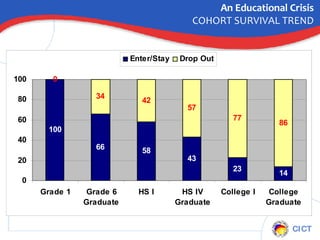
An Educational Crisis COHORT SURVIVAL TREND
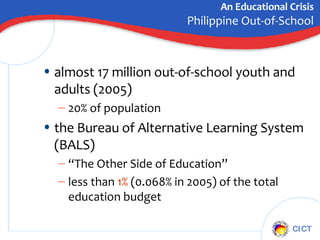
An Educational Crisis Philippine Out-of-School almost 17 million out-of-school youth and adults (2005) 20% of population the Bureau of Alternative Learning System (BALS) “The Other Side of Education” less than  1%  (0.068% in 2005) of the total education budget
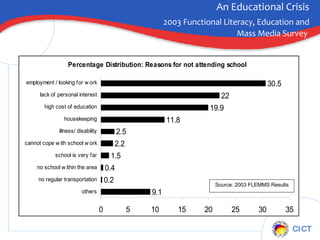
An Educational Crisis   2003 Functional Literacy, Education and Mass Media Survey  Source: 2003 FLEMMS Results
National Policies  LITERACY / NON-FORMAL EDUCATION R.A. 7165 : highest priority to the total eradication of illiteracy  1987 Philippine Constitution : nonformal, informal and indigenous learning system and self-learning independent, and out-of-school study programmes Education for All Philippine Plan of Action (EFA-PPA) : nonformal literacy and education programmes for poor and underserved communities  AO # 116 : support for the Nonformal Education Accreditation and Equivalency (NFE A&E) System
Alternative Learning System Programs Basic Literacy Accreditation & Equivalency Elementary Secondary Advanced Level – Bridge Program (pilot stage) ideal: life skills approach + self-paced uses print modules limited number of ALS Implementers simply not enough!!
A Flattening World massive investments in technology  = levelling of global playing field intellectual work & capital: delivered from anywhere @ incredible speeds and with great accuracy individuals & small groups    initiate, engage, participate, collaborate, and innovate Friedman, Thomas.  The World is Flat: A Brief History of the 21 st  Century  ( Release 3.0)
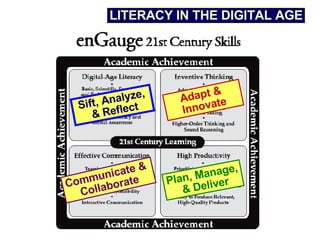
LITERACY IN THE DIGITAL AGE Communicate &  Collaborate Sift, Analyze, & Reflect Plan, Manage, & Deliver Adapt &  Innovate
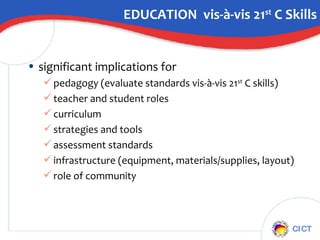
EDUCATION  vis-à-vis 21 st  C Skills significant implications for pedagogy (evaluate standards vis-à-vis 21 st  C skills) teacher and student roles curriculum strategies and tools assessment standards infrastructure (equipment, materials/supplies, layout) role of community
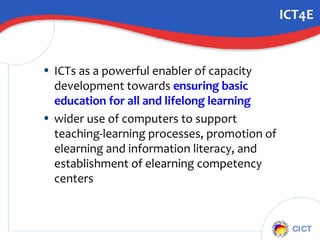
ICT4E ICTs as a powerful enabler of capacity development towards  ensuring basic education for all and lifelong learning wider use of computers to support teaching-learning processes, promotion of elearning and information literacy, and establishment of elearning competency centers
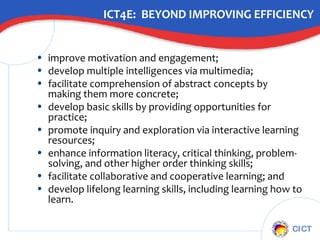
ICT4E:  BEYOND IMPROVING EFFICIENCY improve motivation and engagement; develop multiple intelligences via multimedia; facilitate comprehension of abstract concepts by making them more concrete; develop basic skills by providing opportunities for practice; promote inquiry and exploration via interactive learning resources; enhance information literacy, critical thinking, problem-solving, and other higher order thinking skills; facilitate collaborative and cooperative learning; and develop lifelong learning skills, including learning how to learn.
ICT4E Support in the Philippines Medium Term Philippine Development Plan (MTPDP) 2004-2010 the National Framework Plan for ICTs in Basic Education (2005-2010) the 2002 Basic Education Curriculum (BEC) DepEd’s Strategic Framework on ICT4E (2006) DepEd’s ICT4E Master Plan
CICT – EO269 The CICT shall be the primary policy, planning, coordinating, implementing, regulating, and administrative entity of the executive branch of Govt that will promote, develop, & regulate integrated & strategic ICT systems and reliable & cost-efficient communication facilities & services
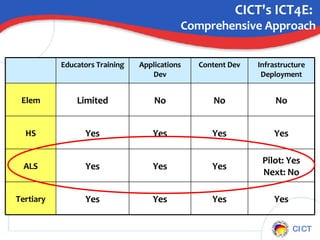
CICT's ICT4E:  Comprehensive Approach Yes Yes Yes Yes Tertiary Pilot: Yes Next: No Yes Yes Yes ALS Yes Yes Yes Yes HS No No No Limited Elem Infrastructure Deployment Content Dev Applications Dev Educators Training
 
eSkwela Project Community eLearning Centers dedicated to serve the learning needs of out-of-school youth and adults through ICT
eSkwela Project CICT-HCDG project  pioneering effort with DepEd-Bureau of Alternative Learning System (BALS) to provide ICT-enabled learning opportunities for out-of-school youth (OSY) and adults
Strategic Planning Output Vision:  The eSkwela Program will be widely available across the Philippines to empower out-of-school youth and adults to be globally competitive through the effective use of ICTs in alternative learning. Mission Statement:  In partnership with various groups, eSkwela provides out-of-school youth and adults with opportunities towards attaining basic education competence and life skills through the use of an ICT-enabled environment.
Objectives To support the efforts of DepEd to  integrate ICT  in the teaching-and-learning process To help BALS  broaden access  to basic education To help BALS produce and use interactive  multimedia learning materials  for out-of-school youth and adults To reduce the digital divide by providing disadvantaged youth and adults with  access to ICT
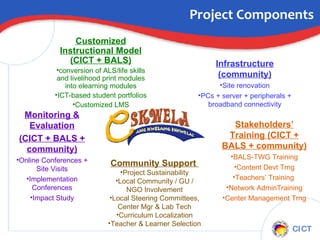
Project Components Customized Instructional Model (CICT + BALS) conversion of ALS/life skills and livelihood print modules into elearning modules ICT-based student portfolios Customized LMS Stakeholders’ Training (CICT + BALS + community) BALS-TWG Training Content Devt Trng Teachers’ Training  Network AdminTraining Center Management Trng Community Support  Project Sustainability Local Community / GU / NGO Involvement Local Steering Committees, Center Mgr & Lab Tech Curriculum Localization Teacher & Learner Selection Infrastructure (community) Site renovation PCs + server + peripherals + broadband connectivity Monitoring & Evaluation (CICT + BALS + community) Online Conferences + Site Visits Implementation Conferences Impact Study
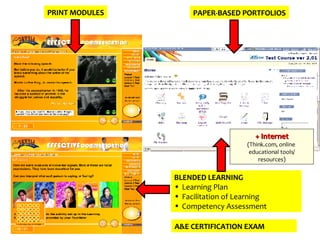
PRINT MODULES PAPER-BASED PORTFOLIOS BLENDED LEARNING Learning Plan Facilitation of Learning Competency Assessment A&E CERTIFICATION EXAM + Internet (Think.com, online  educational tools/ resources)
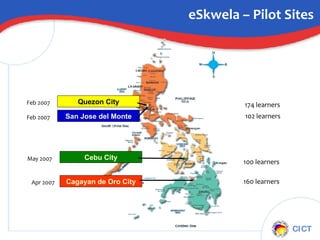
eSkwela – Pilot Sites Quezon City Feb 2007 174 learners San Jose del Monte Feb 2007 102 learners Cebu City May 2007 100 learners Cagayan de Oro City Apr 2007 160 learners
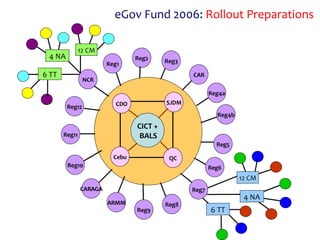
eGov Fund 2006:  Rollout Preparations CICT + BALS QC SJDM CDO Cebu 6 TT 4 NA 12 CM 4 NA 12 CM 6 TT Reg10 Reg11 Reg7 Reg5 Reg4a CAR Reg3 NCR CARAGA Reg6 Reg4b Reg2 Reg1 Reg12 ARMM Reg9 Reg8
Current: Roll-out Preparations tapping local communities to invest on Center set-up, management, sustainability CICT Assistance Franchise Manual Technical assistance on initial set-up Referral to the eSkwela Regional Trainers Access to the wide network of eSkwela partners 35 modules to start; additional modules to follow (120 within 2008)
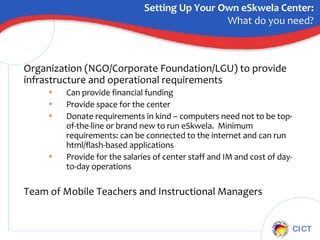
Organization (NGO/Corporate Foundation/LGU) to provide infrastructure and operational requirements Can provide financial funding Provide space for the center Donate requirements in kind – computers need not to be top-of-the-line or brand new to run eSkwela.  Minimum requirements: can be connected to the internet and can run html/flash-based applications Provide for the salaries of center staff and IM and cost of day-to-day operations Team of Mobile Teachers and Instructional Managers Setting Up Your Own eSkwela Center: What do you need?
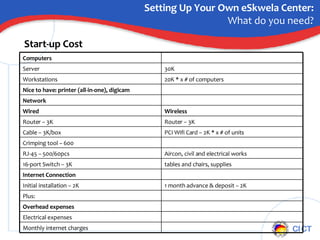
Setting Up Your Own eSkwela Center:   What do you need? Start-up Cost Nice to have: printer (all-in-one), digicam Monthly internet charges Electrical expenses Overhead expenses  Plus: 1 month advance & deposit – 2K Initial installation – 2K Internet Connection tables and chairs, supplies 16-port Switch – 3K Aircon, civil and electrical works RJ-45 – 500/60pcs Crimping tool – 600 PCI Wifi Card – 2K * x # of units Cable – 3K/box Router – 3K Router – 3K Wireless Wired Network 20K * x # of computers Workstations 30K Server Computers
Teacher Training  Coverage: eSkwela Instructional Model  Main Objective: to orient and train the participants on the effective use of ICT to improve the learning process in the context of alternative education
Teacher Training Participants Mobile Teachers and Instructional Managers (paid & volunteers) mixed levels of understanding and practice of educational theories and practices Proficient in spoken & written English Committed to use and integrate ICT in admin and teaching  Willing to participate in regular M&E activities Willing & capable to conduct re-echo sessions with co-teachers
Required Outputs from the Participants Exercises Sample learning plan with corresponding LMS materials & Student Portfolio options Commitment to implement eSkwela
Network Administration Coverage: Linux, Networking, LMS admin  Main Objective: to train the participants on setting up an eSkwela Laboratory
Network Admin Participants assigned technical support group by eSkwela partners Proficient in spoken & written English Committed to provide technical services to eSkwela labs Willing to participate in regular M&E activities Willing & capable to conduct re-echo sessions
Required Outputs from the Participants Exercises Laboratory’s technical design LMS set-up Commitment to implement eSkwela
Center Management Coverage: eSkwela Set-up, Operations, and Sustainability  Main Objective: to train the participants on setting up, operating, and sustaining an eSkwela Center
Center Mgt Participants assigned/potential Center Managers and Steering Committee representatives by eSkwela partners Proficient in spoken & written English Committed to set up, operate, and sustain an eSkwela Center Willing to participate in regular M&E activities Willing & capable to conduct re-echo sessions
Required Outputs from the Participants Exercises eSkwela Center Business / Operations Plan Commitment to implement eSkwela
Selection Criteria for Regional Trainers to be Trained Teachers’ Training Course  regular plantilla holder of DepEd (ALS Implementers) Computer Literate – must know word processing, spreadsheet and slide presentation Age limit: not more than 50 years old must pass qualifying exam set by the group Network Administration must have an affiliation with an LGU/SUC/DepEd Office/NGOs has background in IT or experience in setting up of networks, basic trouble  shooting  must be comfortable working with different platforms (Windows/Linux) Center Management Per division - ALS Supervisor OR Coordinators  Computer Literate – must know word processing, spreadsheet and slide presentation (ICT for Executives)
CONTACT DETAILS URLs :  www.cict.gov.ph http://eskwela.wikispaces.com http://balsontheweb.wikispaces.com http://eskwela-APC-NSTP.wikispaces.com http://cict- hcdg.wikispaces.com Email : [email_address] [email_address]
End of Presentation

Roadshow Presentation Final

  • 1.
    Regional Roadshow RegionXII 14 December 2007 Phelagrand Hotel, General Santos City
  • 2.
    Status of PhilippineEducation “ The poor performance of students across the country in national and international achievement tests, and the consistently high dropout rates at both elementary and secondary school levels, underscore the deterioration of the quality of the Philippine schools system.” - National Framework Plan for ICTs in Basic Education, 2005
  • 3.
    An Educational CrisisCOHORT SURVIVAL TREND
  • 4.
    An Educational CrisisPhilippine Out-of-School almost 17 million out-of-school youth and adults (2005) 20% of population the Bureau of Alternative Learning System (BALS) “The Other Side of Education” less than 1% (0.068% in 2005) of the total education budget
  • 5.
    An Educational Crisis 2003 Functional Literacy, Education and Mass Media Survey Source: 2003 FLEMMS Results
  • 6.
    National Policies LITERACY / NON-FORMAL EDUCATION R.A. 7165 : highest priority to the total eradication of illiteracy 1987 Philippine Constitution : nonformal, informal and indigenous learning system and self-learning independent, and out-of-school study programmes Education for All Philippine Plan of Action (EFA-PPA) : nonformal literacy and education programmes for poor and underserved communities AO # 116 : support for the Nonformal Education Accreditation and Equivalency (NFE A&E) System
  • 7.
    Alternative Learning SystemPrograms Basic Literacy Accreditation & Equivalency Elementary Secondary Advanced Level – Bridge Program (pilot stage) ideal: life skills approach + self-paced uses print modules limited number of ALS Implementers simply not enough!!
  • 8.
    A Flattening Worldmassive investments in technology = levelling of global playing field intellectual work & capital: delivered from anywhere @ incredible speeds and with great accuracy individuals & small groups  initiate, engage, participate, collaborate, and innovate Friedman, Thomas. The World is Flat: A Brief History of the 21 st Century ( Release 3.0)
  • 9.
    LITERACY IN THEDIGITAL AGE Communicate & Collaborate Sift, Analyze, & Reflect Plan, Manage, & Deliver Adapt & Innovate
  • 10.
    EDUCATION vis-à-vis21 st C Skills significant implications for pedagogy (evaluate standards vis-à-vis 21 st C skills) teacher and student roles curriculum strategies and tools assessment standards infrastructure (equipment, materials/supplies, layout) role of community
  • 11.
    ICT4E ICTs asa powerful enabler of capacity development towards ensuring basic education for all and lifelong learning wider use of computers to support teaching-learning processes, promotion of elearning and information literacy, and establishment of elearning competency centers
  • 12.
    ICT4E: BEYONDIMPROVING EFFICIENCY improve motivation and engagement; develop multiple intelligences via multimedia; facilitate comprehension of abstract concepts by making them more concrete; develop basic skills by providing opportunities for practice; promote inquiry and exploration via interactive learning resources; enhance information literacy, critical thinking, problem-solving, and other higher order thinking skills; facilitate collaborative and cooperative learning; and develop lifelong learning skills, including learning how to learn.
  • 13.
    ICT4E Support inthe Philippines Medium Term Philippine Development Plan (MTPDP) 2004-2010 the National Framework Plan for ICTs in Basic Education (2005-2010) the 2002 Basic Education Curriculum (BEC) DepEd’s Strategic Framework on ICT4E (2006) DepEd’s ICT4E Master Plan
  • 14.
    CICT – EO269The CICT shall be the primary policy, planning, coordinating, implementing, regulating, and administrative entity of the executive branch of Govt that will promote, develop, & regulate integrated & strategic ICT systems and reliable & cost-efficient communication facilities & services
  • 15.
    CICT's ICT4E: Comprehensive Approach Yes Yes Yes Yes Tertiary Pilot: Yes Next: No Yes Yes Yes ALS Yes Yes Yes Yes HS No No No Limited Elem Infrastructure Deployment Content Dev Applications Dev Educators Training
  • 16.
  • 17.
    eSkwela Project CommunityeLearning Centers dedicated to serve the learning needs of out-of-school youth and adults through ICT
  • 18.
    eSkwela Project CICT-HCDGproject pioneering effort with DepEd-Bureau of Alternative Learning System (BALS) to provide ICT-enabled learning opportunities for out-of-school youth (OSY) and adults
  • 19.
    Strategic Planning OutputVision: The eSkwela Program will be widely available across the Philippines to empower out-of-school youth and adults to be globally competitive through the effective use of ICTs in alternative learning. Mission Statement: In partnership with various groups, eSkwela provides out-of-school youth and adults with opportunities towards attaining basic education competence and life skills through the use of an ICT-enabled environment.
  • 20.
    Objectives To supportthe efforts of DepEd to integrate ICT in the teaching-and-learning process To help BALS broaden access to basic education To help BALS produce and use interactive multimedia learning materials for out-of-school youth and adults To reduce the digital divide by providing disadvantaged youth and adults with access to ICT
  • 21.
    Project Components CustomizedInstructional Model (CICT + BALS) conversion of ALS/life skills and livelihood print modules into elearning modules ICT-based student portfolios Customized LMS Stakeholders’ Training (CICT + BALS + community) BALS-TWG Training Content Devt Trng Teachers’ Training Network AdminTraining Center Management Trng Community Support Project Sustainability Local Community / GU / NGO Involvement Local Steering Committees, Center Mgr & Lab Tech Curriculum Localization Teacher & Learner Selection Infrastructure (community) Site renovation PCs + server + peripherals + broadband connectivity Monitoring & Evaluation (CICT + BALS + community) Online Conferences + Site Visits Implementation Conferences Impact Study
  • 22.
    PRINT MODULES PAPER-BASEDPORTFOLIOS BLENDED LEARNING Learning Plan Facilitation of Learning Competency Assessment A&E CERTIFICATION EXAM + Internet (Think.com, online educational tools/ resources)
  • 23.
    eSkwela – PilotSites Quezon City Feb 2007 174 learners San Jose del Monte Feb 2007 102 learners Cebu City May 2007 100 learners Cagayan de Oro City Apr 2007 160 learners
  • 24.
    eGov Fund 2006: Rollout Preparations CICT + BALS QC SJDM CDO Cebu 6 TT 4 NA 12 CM 4 NA 12 CM 6 TT Reg10 Reg11 Reg7 Reg5 Reg4a CAR Reg3 NCR CARAGA Reg6 Reg4b Reg2 Reg1 Reg12 ARMM Reg9 Reg8
  • 25.
    Current: Roll-out Preparationstapping local communities to invest on Center set-up, management, sustainability CICT Assistance Franchise Manual Technical assistance on initial set-up Referral to the eSkwela Regional Trainers Access to the wide network of eSkwela partners 35 modules to start; additional modules to follow (120 within 2008)
  • 26.
    Organization (NGO/Corporate Foundation/LGU)to provide infrastructure and operational requirements Can provide financial funding Provide space for the center Donate requirements in kind – computers need not to be top-of-the-line or brand new to run eSkwela. Minimum requirements: can be connected to the internet and can run html/flash-based applications Provide for the salaries of center staff and IM and cost of day-to-day operations Team of Mobile Teachers and Instructional Managers Setting Up Your Own eSkwela Center: What do you need?
  • 27.
    Setting Up YourOwn eSkwela Center: What do you need? Start-up Cost Nice to have: printer (all-in-one), digicam Monthly internet charges Electrical expenses Overhead expenses Plus: 1 month advance & deposit – 2K Initial installation – 2K Internet Connection tables and chairs, supplies 16-port Switch – 3K Aircon, civil and electrical works RJ-45 – 500/60pcs Crimping tool – 600 PCI Wifi Card – 2K * x # of units Cable – 3K/box Router – 3K Router – 3K Wireless Wired Network 20K * x # of computers Workstations 30K Server Computers
  • 28.
    Teacher Training Coverage: eSkwela Instructional Model Main Objective: to orient and train the participants on the effective use of ICT to improve the learning process in the context of alternative education
  • 29.
    Teacher Training ParticipantsMobile Teachers and Instructional Managers (paid & volunteers) mixed levels of understanding and practice of educational theories and practices Proficient in spoken & written English Committed to use and integrate ICT in admin and teaching Willing to participate in regular M&E activities Willing & capable to conduct re-echo sessions with co-teachers
  • 30.
    Required Outputs fromthe Participants Exercises Sample learning plan with corresponding LMS materials & Student Portfolio options Commitment to implement eSkwela
  • 31.
    Network Administration Coverage:Linux, Networking, LMS admin Main Objective: to train the participants on setting up an eSkwela Laboratory
  • 32.
    Network Admin Participantsassigned technical support group by eSkwela partners Proficient in spoken & written English Committed to provide technical services to eSkwela labs Willing to participate in regular M&E activities Willing & capable to conduct re-echo sessions
  • 33.
    Required Outputs fromthe Participants Exercises Laboratory’s technical design LMS set-up Commitment to implement eSkwela
  • 34.
    Center Management Coverage:eSkwela Set-up, Operations, and Sustainability Main Objective: to train the participants on setting up, operating, and sustaining an eSkwela Center
  • 35.
    Center Mgt Participantsassigned/potential Center Managers and Steering Committee representatives by eSkwela partners Proficient in spoken & written English Committed to set up, operate, and sustain an eSkwela Center Willing to participate in regular M&E activities Willing & capable to conduct re-echo sessions
  • 36.
    Required Outputs fromthe Participants Exercises eSkwela Center Business / Operations Plan Commitment to implement eSkwela
  • 37.
    Selection Criteria forRegional Trainers to be Trained Teachers’ Training Course regular plantilla holder of DepEd (ALS Implementers) Computer Literate – must know word processing, spreadsheet and slide presentation Age limit: not more than 50 years old must pass qualifying exam set by the group Network Administration must have an affiliation with an LGU/SUC/DepEd Office/NGOs has background in IT or experience in setting up of networks, basic trouble shooting must be comfortable working with different platforms (Windows/Linux) Center Management Per division - ALS Supervisor OR Coordinators Computer Literate – must know word processing, spreadsheet and slide presentation (ICT for Executives)
  • 38.
    CONTACT DETAILS URLs: www.cict.gov.ph http://eskwela.wikispaces.com http://balsontheweb.wikispaces.com http://eskwela-APC-NSTP.wikispaces.com http://cict- hcdg.wikispaces.com Email : [email_address] [email_address]
  • 39.

Editor's Notes

  • #2 Do your introductions here Recognize all participants by groups/mention the names of higher-ups Thank the host/organizers