Modelling the
ICHK Student
Introducing the 5 Strands + 1 Model
Neil Gershenfeld, Physicist, MIT
Taken from This will make you smarter ed. John Brockman, New York 2012
“The most common misunderstanding about
science is that scientists seek and find truth.
They don‘t – they make and test models.
Building models is very different from
proclaiming truths. It‘s a never ending process
of discovery and refinement, not a war to win
or a destination to reach.
Making sense of anything means making
models that can predict outcomes and
accommodate observations. Truth is a model.‖
Modelling the ICHK Student
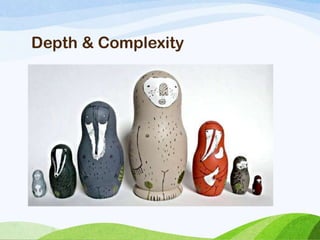
Depth & Complexity
Depth & Complexity
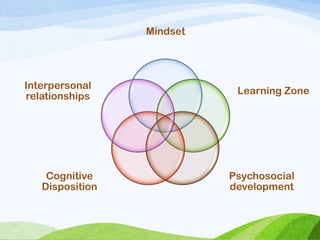
Mindset
Learning Zone
Psychosocial
development
Cognitive
Disposition
Interpersonal
relationships
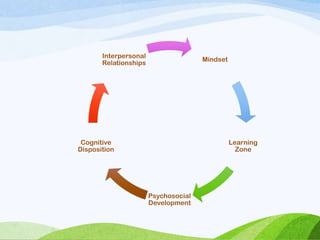
Mindset
Learning
Zone
Psychosocial
Development
Cognitive
Disposition
Interpersonal
Relationships
Carol Dweck: Mindsets
• Fixed Mindset: Intelligence/ability is a fixed or
stable trait, and unevenly distributed among
individuals
• You-either-have-it-or-you-don‘t and ―it‖ can be
accurately judged by others and ―it‖ can‘t be
improved or increased much
• Student‘s goal: to perform well and look smart,
even if sacrificing learning (since negative
evaluations are signs that I am not smart
enough to succeed and there‘s only a fixed
amount of smartness).
Carol Dweck: Mindsets
• Growth Mindset: Belief is that
intelligence/ability consists of an ever
expanding repertoire of skills and knowledge
that can be increased through effort and
figuring out successful strategies
• Ability is time and task specific and is
developed through study and practice — effort
is all
• Student goal: not to look smart but to be smart
by increasing their skill/knowledge levels.
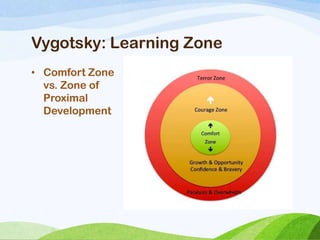
Vygotsky: Learning Zone
• Comfort Zone
vs. Zone of
Proximal
Development
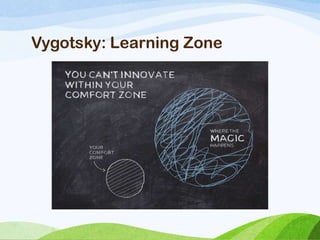
Vygotsky: Learning Zone
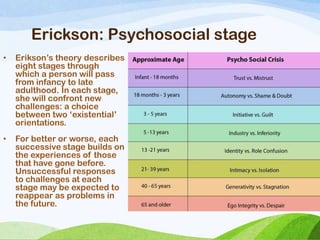
Erickson: Psychosocial stage
• Erikson‘s theory describes
eight stages through
which a person will pass
from infancy to late
adulthood. In each stage,
she will confront new
challenges: a choice
between two ‗existential‘
orientations.
• For better or worse, each
successive stage builds on
the experiences of those
that have gone before.
Unsuccessful responses
to challenges at each
stage may be expected to
reappear as problems in
the future.
Erickson: Psychosocial stage
• Children will tend to join secondary school
deep into the 4th of Erikson‘s stages:
Competence – concerned with industryand
inferiority. It is a dilemma summed up by the
question: can I make it in the world of people
and things?
• By year 9 or 10, we can expect students to be
entering the 5th stage of their developmental
journey: Fidelity – concerned with identityand
role confusion. Here, the critical question is:
who am I and what can I be?
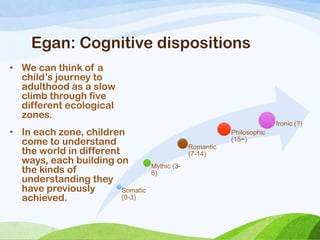
Egan: Cognitive dispositions
• We can think of a
child‘s journey to
adulthood as a slow
climb through five
different ecological
zones.
• In each zone, children
come to understand
the world in different
ways, each building on
the kinds of
understanding they
have previously
achieved.
Somatic
(0-3)
Mythic (3-
6)
Romantic
(7-14)
Philosophic
(15+)
Ironic (?)
Egan: Cognitive dispositions
• RomanticUnderstandinghelps us organize our
experience through an exploration of the extremes of
experience and the limits of reality. It is the personifying
or humanizing tendency. Allied to it is children‘s growing
realization of the complexity and strangeness of the
world, and their own marginality within it.
• Philosophic Understanding coalesces with the
investment in written language as a means of developing
a systematic understanding of the world. The
Philosophic mind focuses on the connections among
things, seeing laws, theories, and larger purpose as tying
together the previously disconnected phenomena and
experiences. Generalization is central to Philosophic
understanding: the search for new organizing principles
to make sense of the multitude of experiences in the
adolescent‘s expanding horizons.
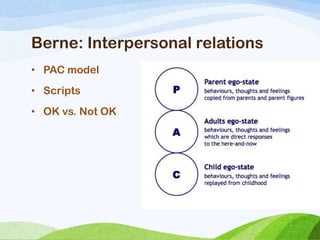
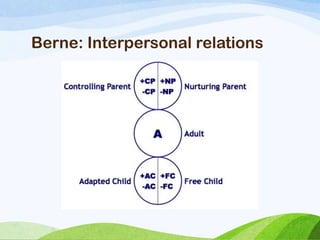
Berne: Interpersonal relations
• PAC model
• Scripts
• OK vs. Not OK
Berne: Interpersonal relations
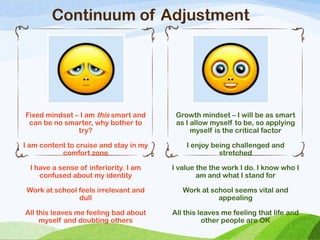
Fixed mindset – I am this smart and
can be no smarter, why bother to
try?
I am content to cruise and stay in my
comfort zone
I have a sense of inferiority. I am
confused about my identity
Work at school feels irrelevant and
dull
All this leaves me feeling bad about
myself and doubting others
Growth mindset – I will be as smart
as I allow myself to be, so applying
myself is the critical factor
I enjoy being challenged and
stretched
I value the the work I do. I know who I
am and what I stand for
Work at school seems vital and
appealing
All this leaves me feeling that life and
other people are OK
Continuum of Adjustment

Roadshow

  • 1.
  • 2.
    Neil Gershenfeld, Physicist,MIT Taken from This will make you smarter ed. John Brockman, New York 2012 “The most common misunderstanding about science is that scientists seek and find truth. They don‘t – they make and test models. Building models is very different from proclaiming truths. It‘s a never ending process of discovery and refinement, not a war to win or a destination to reach. Making sense of anything means making models that can predict outcomes and accommodate observations. Truth is a model.‖
  • 3.
  • 4.
  • 5.
  • 6.
  • 7.
  • 8.
    Carol Dweck: Mindsets •Fixed Mindset: Intelligence/ability is a fixed or stable trait, and unevenly distributed among individuals • You-either-have-it-or-you-don‘t and ―it‖ can be accurately judged by others and ―it‖ can‘t be improved or increased much • Student‘s goal: to perform well and look smart, even if sacrificing learning (since negative evaluations are signs that I am not smart enough to succeed and there‘s only a fixed amount of smartness).
  • 9.
    Carol Dweck: Mindsets •Growth Mindset: Belief is that intelligence/ability consists of an ever expanding repertoire of skills and knowledge that can be increased through effort and figuring out successful strategies • Ability is time and task specific and is developed through study and practice — effort is all • Student goal: not to look smart but to be smart by increasing their skill/knowledge levels.
  • 10.
    Vygotsky: Learning Zone •Comfort Zone vs. Zone of Proximal Development
  • 11.
  • 12.
    Erickson: Psychosocial stage •Erikson‘s theory describes eight stages through which a person will pass from infancy to late adulthood. In each stage, she will confront new challenges: a choice between two ‗existential‘ orientations. • For better or worse, each successive stage builds on the experiences of those that have gone before. Unsuccessful responses to challenges at each stage may be expected to reappear as problems in the future.
  • 13.
    Erickson: Psychosocial stage •Children will tend to join secondary school deep into the 4th of Erikson‘s stages: Competence – concerned with industryand inferiority. It is a dilemma summed up by the question: can I make it in the world of people and things? • By year 9 or 10, we can expect students to be entering the 5th stage of their developmental journey: Fidelity – concerned with identityand role confusion. Here, the critical question is: who am I and what can I be?
  • 14.
    Egan: Cognitive dispositions •We can think of a child‘s journey to adulthood as a slow climb through five different ecological zones. • In each zone, children come to understand the world in different ways, each building on the kinds of understanding they have previously achieved. Somatic (0-3) Mythic (3- 6) Romantic (7-14) Philosophic (15+) Ironic (?)
  • 15.
    Egan: Cognitive dispositions •RomanticUnderstandinghelps us organize our experience through an exploration of the extremes of experience and the limits of reality. It is the personifying or humanizing tendency. Allied to it is children‘s growing realization of the complexity and strangeness of the world, and their own marginality within it. • Philosophic Understanding coalesces with the investment in written language as a means of developing a systematic understanding of the world. The Philosophic mind focuses on the connections among things, seeing laws, theories, and larger purpose as tying together the previously disconnected phenomena and experiences. Generalization is central to Philosophic understanding: the search for new organizing principles to make sense of the multitude of experiences in the adolescent‘s expanding horizons.
  • 16.
    Berne: Interpersonal relations •PAC model • Scripts • OK vs. Not OK
  • 17.
  • 18.
    Fixed mindset –I am this smart and can be no smarter, why bother to try? I am content to cruise and stay in my comfort zone I have a sense of inferiority. I am confused about my identity Work at school feels irrelevant and dull All this leaves me feeling bad about myself and doubting others Growth mindset – I will be as smart as I allow myself to be, so applying myself is the critical factor I enjoy being challenged and stretched I value the the work I do. I know who I am and what I stand for Work at school seems vital and appealing All this leaves me feeling that life and other people are OK Continuum of Adjustment