Risk Management 
In Video Game Production 
Dino Dini 2014
Cevat Yerli - Founder & CEO of Crytek 
The way Yerli talks about discovering programming feels well-practiced, as do 
most of his stories. It takes place around 1990, when he was only 12 years old 
"I was playing a game called Kick Off, from a programmer called Dino Dini," Yerli 
says, pronouncing his name carefully, almost reverently. "It combined my two 
passions [soccer and games]. ... I played so long at this friend's place that I forgot 
about time. It got [to be] late, late [in the] afternoon. The sun was going down and I 
was supposed to be at home. 
"I took my [bicycle], drove downhill and [was lost in] a daydream. And I just 
snapped and the next thing I remember I was in a hospital." 
Yerli was so consumed by thoughts of Kick Off that he smashed headlong into a 
brick wall. He has no memory of the crash. 
-Polygon interview 11/07/2013 
Dino Dini 2014
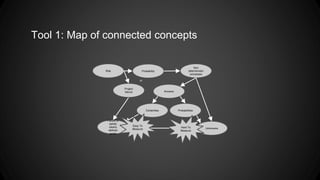
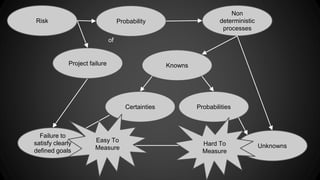
Tool 1: Map of connected concepts 
Risk Probability 
Failure to 
satisfy 
clearly 
defined 
goals 
Non 
deterministic 
processes 
Project 
failure 
of 
Unknowns 
Knowns 
Certainties Probabilities 
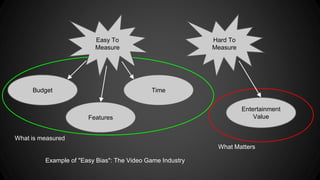
Hard To 
Measure 
Easy To 
Measure
Risk Probability 
Failure to 
satisfy clearly 
defined goals 
Non 
deterministic 
processes 
Project failure 
of 
Unknowns 
Knowns 
Certainties Probabilities 
Hard To 
Measure 
Easy To 
Measure
Hard To 
Measure 
Easy To 
Measure 
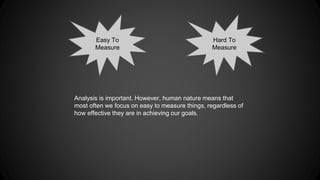
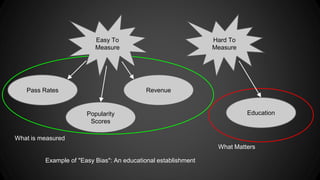
Analysis is important. However, human nature means that 
most often we focus on easy to measure things, regardless of 
how effective they are in achieving our goals.
Hard To 
Measure 
Easy To 
Measure 
Pass Rates 
Popularity 
Scores 
Revenue 
Example of "Easy Bias": An educational establishment 
Education 
What is measured 
What Matters
Hard To 
Measure 
Easy To 
Measure 
Budget 
Features 
Time 
Example of "Easy Bias": The Video Game Industry 
Entertainment 
Value 
What is measured 
What Matters
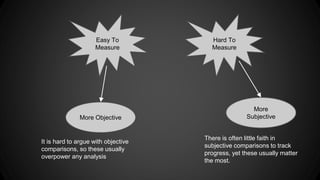
Hard To 
Measure 
Easy To 
Measure 
More Objective 
More 
Subjective 
There is often little faith in 
subjective comparisons to track 
progress, yet these usually matter 
the most. 
It is hard to argue with objective 
comparisons, so these usually 
overpower any analysis
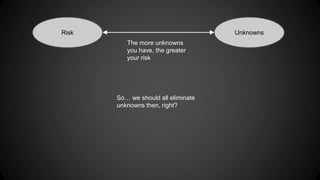
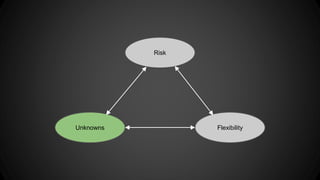
Risk Unknowns 
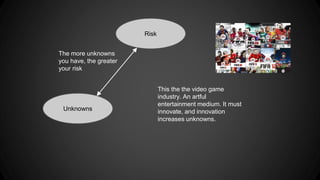
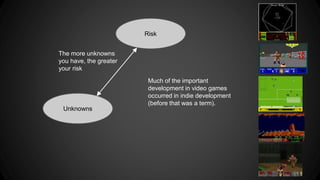
The more unknowns 
you have, the greater 
your risk 
So… we should all eliminate 
unknowns then, right?
Risk Unknowns 
The more unknowns 
you have, the greater 
your risk 
So… we should all eliminate 
unknowns then, right?
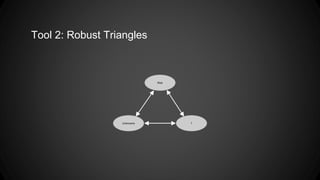
Tool 2: Robust Triangles 
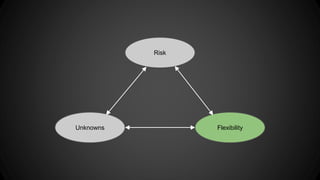
Risk 
Unknowns ?
Risk 
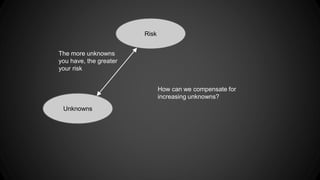
The more unknowns 
you have, the greater 
your risk 
Unknowns 
This the the video game 
industry. An artful 
entertainment medium. It must 
innovate, and innovation 
increases unknowns.
Risk 
The more unknowns 
you have, the greater 
your risk 
Unknowns 
Much of the important 
development in video games 
occurred in indie development 
(before that was a term).
Risk 
The more unknowns 
you have, the greater 
your risk 
Unknowns 
How can we compensate for 
increasing unknowns?
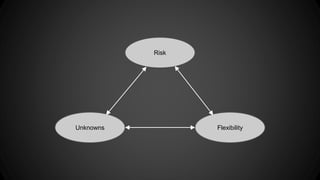
Risk 
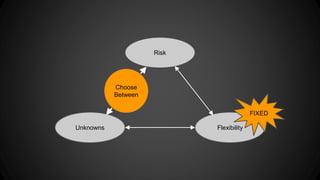
Unknowns Flexibility
Risk 
Unknowns Flexibility 
FIXED 
Choose 
Between
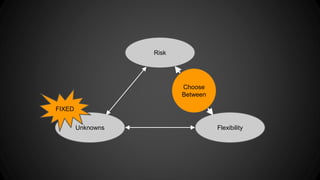
Risk 
Unknowns Flexibility 
FIXED 
Choose 
Between
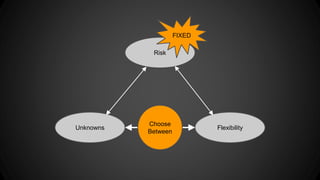
Risk 
FIXED 
Choose 
Between 
Unknowns Flexibility
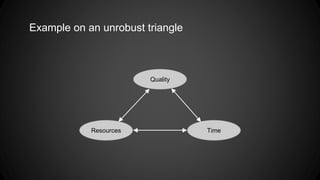
Example on an unrobust triangle 
Quality 
Resources Time
Risk 
Unknowns Flexibility
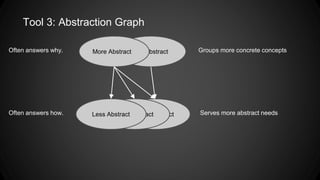
Often answers why. Groups more concrete concepts 
More Abstract 
More Abstract 
Less AbsLterascst AbLsetrsasc At bstract 
Often answers how. 
Serves more abstract needs 
Tool 3: Abstraction Graph
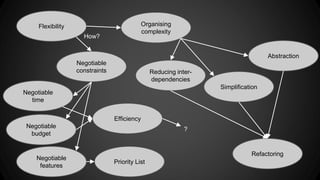
Flexibility Organising 
complexity 
How? 
Negotiable 
constraints 
Abstraction 
Simplification 
Negotiable 
time 
Negotiable 
budget 
Negotiable 
features 
Reducing inter-dependencies 
Priority List 
Refactoring 
Efficiency 
?
Risk 
Unknowns Flexibility
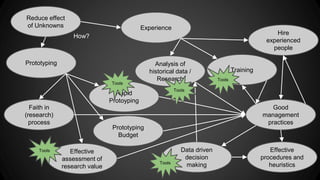
Reduce effect 
of Unknowns Experience 
How? 
Prototyping 
Hire 
experienced 
people 
Training 
Rapid 
Protoyping 
Prototyping 
Budget 
Analysis of 
historical data / 
Research 
Faith in 
(research) 
process 
Good 
management 
practices 
Effective 
assessment of 
research value 
Data driven 
decision 
making 
Effective 
procedures and 
heuristics 
Tools 
Tools 
Tools 
Tools 
Tools
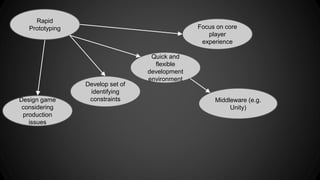
Rapid 
Prototyping Focus on core 
player 
experience 
Quick and 
flexible 
development 
environment 
Develop set of 
identifying 
constraints Middleware (e.g. 
Unity) 
Design game 
considering 
production 
issues
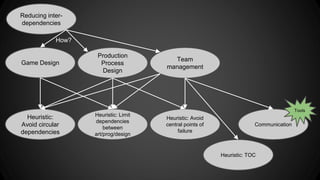
Reducing inter-dependencies 
Game Design 
Production 
Process 
Design 
How? 
Team 
management 
Heuristic: 
Avoid circular 
dependencies 
Heuristic: Limit 
dependencies 
between 
art/prog/design 
Communication 
Tools 
Heuristic: Avoid 
central points of 
failure 
Heuristic: TOC
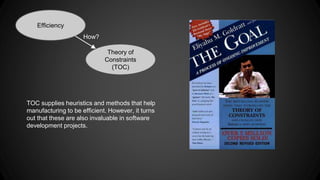
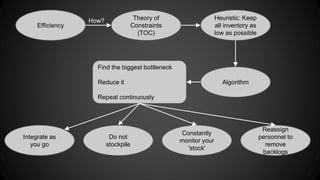
Efficiency 
Theory of 
Constraints 
(TOC) 
How? 
TOC supplies heuristics and methods that help 
manufacturing to be efficient. However, it turns 
out that these are also invaluable in software 
development projects.
Efficiency 
How? Heuristic: Keep 
Theory of 
Constraints 
(TOC) 
all inventory as 
low as possible 
Algorithm 
Find the biggest bottleneck 
Reduce it 
Repeat continuously 
Integrate as 
you go 
Do not 
stockpile 
Constantly 
monitor your 
'stock' 
Reassign 
personnel to 
remove 
backlogs
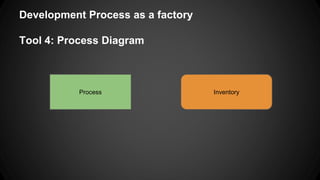
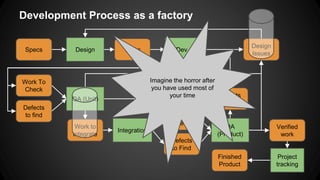
Development Process as a factory 
Tool 4: Process Diagram 
Process Inventory
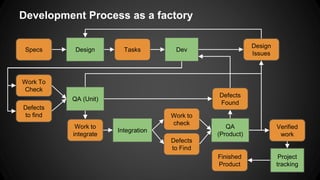
Development Process as a factory 
Specs Design Tasks Dev 
Work To 
Check 
Finished 
Product 
Project 
tracking 
QA (Unit) 
Verified 
work 
Work to 
integrate 
Work to 
check 
Defects 
to find 
Defects 
Found 
Integration 
QA 
(Product) 
Defects 
to Find 
Design 
Issues
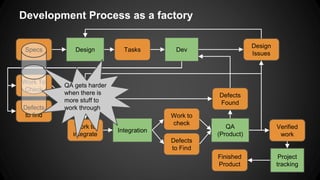
Development Process as a factory 
Specs Design Tasks Dev 
Work To 
Check 
Finished 
Product 
Project 
tracking 
QA (Unit) 
Verified 
work 
Work to 
integrate 
Work to 
check 
Defects 
to find 
Defects 
Found 
Integration 
QA 
(Product) 
Defects 
to Find 
Design 
Issues 
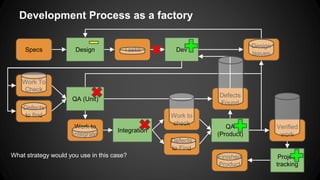
QA gets harder 
when there is 
more stuff to 
work through
Development Process as a factory 
Specs Design Tasks Dev 
Work To 
Check 
Finished 
Product 
Project 
tracking 
QA (Unit) 
Verified 
work 
Work to 
integrate 
Work to 
check 
Defects 
to find 
Defects 
Found 
Integration 
QA 
(Product) 
Defects 
to Find 
Design 
Issues 
Imagine the horror after 
you have used most of 
your time
Development Process as a factory 
Specs Design Tasks Dev 
Work To 
Check 
Finished 
Product 
Project 
tracking 
QA (Unit) 
Verified 
work 
Work to 
integrate 
Work to 
check 
Defects 
to find 
Defects 
Found 
Integration 
QA 
(Product) 
Defects 
to Find 
Design 
Issues 
What strategy would you use in this case?
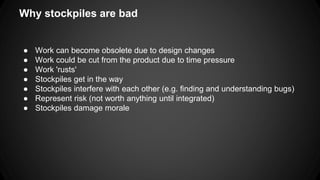
Why stockpiles are bad 
● Work can become obsolete due to design changes 
● Work could be cut from the product due to time pressure 
● Work 'rusts' 
● Stockpiles get in the way 
● Stockpiles interfere with each other (e.g. finding and understanding bugs) 
● Represent risk (not worth anything until integrated) 
● Stockpiles damage morale
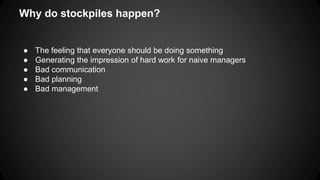
Why do stockpiles happen? 
● The feeling that everyone should be doing something 
● Generating the impression of hard work for naive managers 
● Bad communication 
● Bad planning 
● Bad management
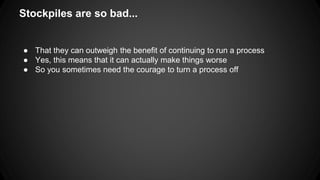
Stockpiles are so bad... 
● That they can outweigh the benefit of continuing to run a process 
● Yes, this means that it can actually make things worse 
● So you sometimes need the courage to turn a process off
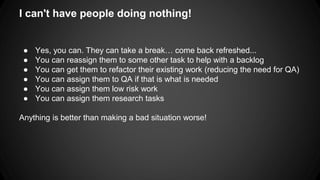
I can't have people doing nothing! 
● Yes, you can. They can take a break… come back refreshed... 
● You can reassign them to some other task to help with a backlog 
● You can get them to refactor their existing work (reducing the need for QA) 
● You can assign them to QA if that is what is needed 
● You can assign them low risk work 
● You can assign them research tasks 
Anything is better than making a bad situation worse!
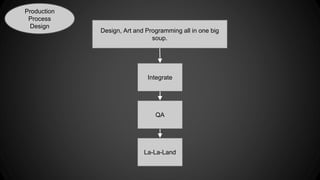
Production 
Process 
Design 
Design, Art and Programming all in one big 
soup. 
Integrate 
QA 
La-La-Land
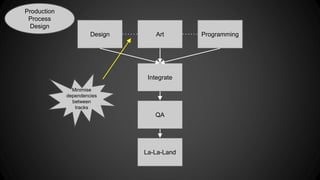
Production 
Process 
Design 
Design Art Programming 
Integrate 
QA 
La-La-Land 
Minimise 
dependencies 
between 
tracks
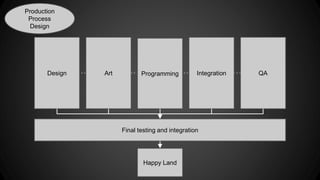
Production 
Process 
Design 
Design Art Programming Integration QA 
Final testing and integration 
Happy Land
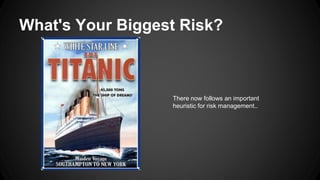
What's Your Biggest Risk? 
There now follows an important 
heuristic for risk management..
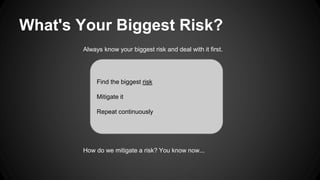
What's Your Biggest Risk? 
Always know your biggest risk and deal with it first. 
Find the biggest risk 
Mitigate it 
Repeat continuously 
How do we mitigate a risk? You know now...
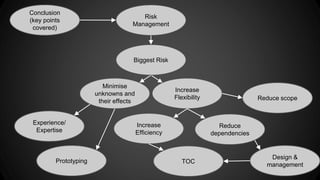
Conclusion 
(key points 
covered) 
Risk 
Management 
Minimise 
unknowns and 
their effects 
Increase 
Flexibility 
Reduce 
dependencies 
Increase 
Efficiency 
Design & 
management 
TOC 
Experience/ 
Expertise 
Prototyping 
Biggest Risk 
Reduce scope
Thank you

Risk management

  • 1.
    Risk Management InVideo Game Production Dino Dini 2014
  • 2.
    Cevat Yerli -Founder & CEO of Crytek The way Yerli talks about discovering programming feels well-practiced, as do most of his stories. It takes place around 1990, when he was only 12 years old "I was playing a game called Kick Off, from a programmer called Dino Dini," Yerli says, pronouncing his name carefully, almost reverently. "It combined my two passions [soccer and games]. ... I played so long at this friend's place that I forgot about time. It got [to be] late, late [in the] afternoon. The sun was going down and I was supposed to be at home. "I took my [bicycle], drove downhill and [was lost in] a daydream. And I just snapped and the next thing I remember I was in a hospital." Yerli was so consumed by thoughts of Kick Off that he smashed headlong into a brick wall. He has no memory of the crash. -Polygon interview 11/07/2013 Dino Dini 2014
  • 3.
    Tool 1: Mapof connected concepts Risk Probability Failure to satisfy clearly defined goals Non deterministic processes Project failure of Unknowns Knowns Certainties Probabilities Hard To Measure Easy To Measure
  • 4.
    Risk Probability Failureto satisfy clearly defined goals Non deterministic processes Project failure of Unknowns Knowns Certainties Probabilities Hard To Measure Easy To Measure
  • 5.
    Hard To Measure Easy To Measure Analysis is important. However, human nature means that most often we focus on easy to measure things, regardless of how effective they are in achieving our goals.
  • 6.
    Hard To Measure Easy To Measure Pass Rates Popularity Scores Revenue Example of "Easy Bias": An educational establishment Education What is measured What Matters
  • 7.
    Hard To Measure Easy To Measure Budget Features Time Example of "Easy Bias": The Video Game Industry Entertainment Value What is measured What Matters
  • 8.
    Hard To Measure Easy To Measure More Objective More Subjective There is often little faith in subjective comparisons to track progress, yet these usually matter the most. It is hard to argue with objective comparisons, so these usually overpower any analysis
  • 9.
    Risk Unknowns Themore unknowns you have, the greater your risk So… we should all eliminate unknowns then, right?
  • 10.
    Risk Unknowns Themore unknowns you have, the greater your risk So… we should all eliminate unknowns then, right?
  • 11.
    Tool 2: RobustTriangles Risk Unknowns ?
  • 12.
    Risk The moreunknowns you have, the greater your risk Unknowns This the the video game industry. An artful entertainment medium. It must innovate, and innovation increases unknowns.
  • 13.
    Risk The moreunknowns you have, the greater your risk Unknowns Much of the important development in video games occurred in indie development (before that was a term).
  • 14.
    Risk The moreunknowns you have, the greater your risk Unknowns How can we compensate for increasing unknowns?
  • 15.
  • 16.
    Risk Unknowns Flexibility FIXED Choose Between
  • 17.
    Risk Unknowns Flexibility FIXED Choose Between
  • 18.
    Risk FIXED Choose Between Unknowns Flexibility
  • 19.
    Example on anunrobust triangle Quality Resources Time
  • 20.
  • 21.
    Often answers why.Groups more concrete concepts More Abstract More Abstract Less AbsLterascst AbLsetrsasc At bstract Often answers how. Serves more abstract needs Tool 3: Abstraction Graph
  • 22.
    Flexibility Organising complexity How? Negotiable constraints Abstraction Simplification Negotiable time Negotiable budget Negotiable features Reducing inter-dependencies Priority List Refactoring Efficiency ?
  • 23.
  • 24.
    Reduce effect ofUnknowns Experience How? Prototyping Hire experienced people Training Rapid Protoyping Prototyping Budget Analysis of historical data / Research Faith in (research) process Good management practices Effective assessment of research value Data driven decision making Effective procedures and heuristics Tools Tools Tools Tools Tools
  • 25.
    Rapid Prototyping Focuson core player experience Quick and flexible development environment Develop set of identifying constraints Middleware (e.g. Unity) Design game considering production issues
  • 26.
    Reducing inter-dependencies GameDesign Production Process Design How? Team management Heuristic: Avoid circular dependencies Heuristic: Limit dependencies between art/prog/design Communication Tools Heuristic: Avoid central points of failure Heuristic: TOC
  • 27.
    Efficiency Theory of Constraints (TOC) How? TOC supplies heuristics and methods that help manufacturing to be efficient. However, it turns out that these are also invaluable in software development projects.
  • 28.
    Efficiency How? Heuristic:Keep Theory of Constraints (TOC) all inventory as low as possible Algorithm Find the biggest bottleneck Reduce it Repeat continuously Integrate as you go Do not stockpile Constantly monitor your 'stock' Reassign personnel to remove backlogs
  • 29.
    Development Process asa factory Tool 4: Process Diagram Process Inventory
  • 30.
    Development Process asa factory Specs Design Tasks Dev Work To Check Finished Product Project tracking QA (Unit) Verified work Work to integrate Work to check Defects to find Defects Found Integration QA (Product) Defects to Find Design Issues
  • 31.
    Development Process asa factory Specs Design Tasks Dev Work To Check Finished Product Project tracking QA (Unit) Verified work Work to integrate Work to check Defects to find Defects Found Integration QA (Product) Defects to Find Design Issues QA gets harder when there is more stuff to work through
  • 32.
    Development Process asa factory Specs Design Tasks Dev Work To Check Finished Product Project tracking QA (Unit) Verified work Work to integrate Work to check Defects to find Defects Found Integration QA (Product) Defects to Find Design Issues Imagine the horror after you have used most of your time
  • 33.
    Development Process asa factory Specs Design Tasks Dev Work To Check Finished Product Project tracking QA (Unit) Verified work Work to integrate Work to check Defects to find Defects Found Integration QA (Product) Defects to Find Design Issues What strategy would you use in this case?
  • 34.
    Why stockpiles arebad ● Work can become obsolete due to design changes ● Work could be cut from the product due to time pressure ● Work 'rusts' ● Stockpiles get in the way ● Stockpiles interfere with each other (e.g. finding and understanding bugs) ● Represent risk (not worth anything until integrated) ● Stockpiles damage morale
  • 35.
    Why do stockpileshappen? ● The feeling that everyone should be doing something ● Generating the impression of hard work for naive managers ● Bad communication ● Bad planning ● Bad management
  • 36.
    Stockpiles are sobad... ● That they can outweigh the benefit of continuing to run a process ● Yes, this means that it can actually make things worse ● So you sometimes need the courage to turn a process off
  • 37.
    I can't havepeople doing nothing! ● Yes, you can. They can take a break… come back refreshed... ● You can reassign them to some other task to help with a backlog ● You can get them to refactor their existing work (reducing the need for QA) ● You can assign them to QA if that is what is needed ● You can assign them low risk work ● You can assign them research tasks Anything is better than making a bad situation worse!
  • 38.
    Production Process Design Design, Art and Programming all in one big soup. Integrate QA La-La-Land
  • 39.
    Production Process Design Design Art Programming Integrate QA La-La-Land Minimise dependencies between tracks
  • 40.
    Production Process Design Design Art Programming Integration QA Final testing and integration Happy Land
  • 41.
    What's Your BiggestRisk? There now follows an important heuristic for risk management..
  • 42.
    What's Your BiggestRisk? Always know your biggest risk and deal with it first. Find the biggest risk Mitigate it Repeat continuously How do we mitigate a risk? You know now...
  • 43.
    Conclusion (key points covered) Risk Management Minimise unknowns and their effects Increase Flexibility Reduce dependencies Increase Efficiency Design & management TOC Experience/ Expertise Prototyping Biggest Risk Reduce scope
  • 44.