Risk Analysis
Sensitivity Analysis
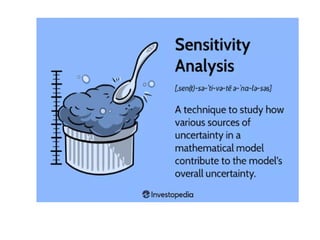
• Sensitivity analysis shows how different values
of an independent variable affect a dependent
variable under a given set of assumptions.
Companies use sensitivity analysis to identify
opportunities, mitigate risk, and communicate
decisions to upper management.
How Sensitivity Analysis Works
• Sensitivity analysis is a financial model that
determines how target variables are affected
based on changes in input variables. By
creating a given set of variables, an analyst can
determine how changes in one variable affect
the outcome.
• Sensitivity analysis allows for forecasting using
historical, true data. By studying all the
variables and the possible outcomes,
important decisions can be made about
businesses, the economy, and making
investments.
USES
• Make predictions about the share prices of
public companies. Some variables that affect stock
prices include company earnings, the number of
shares outstanding, the debt-to-equity ratios (D/E),
and the number of competitors in the industry.
• Determine the effect that changes in interest rates
have on bond prices. In this case, the interest rates
are the independent variable, while bond prices
are the dependent variable.
Pros
• May help management target specific inputs
to achieve more specific results
• May easily communicate areas to focus on or
greatest risks to control
• May identify mistakes in the original
benchmark
• Generally reduces the uncertainty and
unpredictability of a given undertaking
Cons
• Heavily relies on assumptions that may not
become true in the future
• May burden computer systems with complex,
intensive models
• May become overly complicated which distorts
an analysts ability to
• May not accurately integrate independent
variables as one variable may not accurately the
impact of another variable
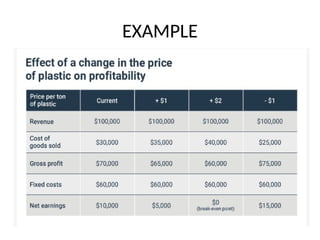
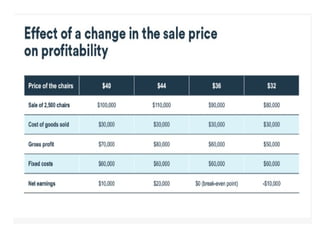
EXAMPLE
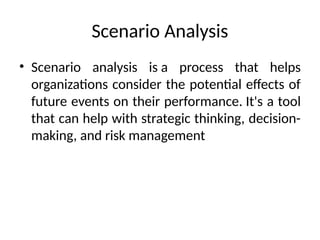
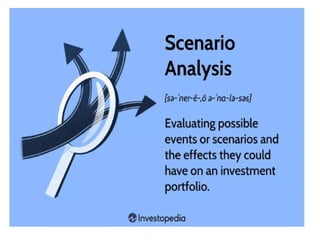
Scenario Analysis
• Scenario analysis is a process that helps
organizations consider the potential effects of
future events on their performance. It's a tool
that can help with strategic thinking, decision-
making, and risk management
Applications for scenario analysis
• Risk management
• Investment strategy
• Competitive strategy
• Strategic proposals
EXAMPLE
• Howard Ben Enterprises is considering whether to open a new
office building in downtown Austin next year. They conduct a
scenario analysis to see what may occur if the cost of raw
materials went up. They also examine the business demand for
more office space in Austin.
• In one of their scenarios, the demand for office space decreases
due to more people working from home, which would be a
worst-case scenario.
• In a best-case scenario, the price for raw materials may fall due
to a partnership with a supplier. After reviewing some more
scenarios, Howard Ben Enterprises decides to build a new office.
Scenario vs Sensitivity analysis
Scenario analysis
Analyzes the impact of changing all variables at once to assess
a wide range of potential outcomes. The goal is to prepare for
multiple possible futures.
Sensitivity analysis
Analyzes the impact of changing one variable at a time to
identify which variables have the most impact on
outcomes. The goal is to help with risk assessment and
decision-making.
Risk Analysis.pptx risk analysis risk an

Risk Analysis.pptx risk analysis risk an

  • 1.
  • 2.
    Sensitivity Analysis • Sensitivityanalysis shows how different values of an independent variable affect a dependent variable under a given set of assumptions. Companies use sensitivity analysis to identify opportunities, mitigate risk, and communicate decisions to upper management.
  • 4.
    How Sensitivity AnalysisWorks • Sensitivity analysis is a financial model that determines how target variables are affected based on changes in input variables. By creating a given set of variables, an analyst can determine how changes in one variable affect the outcome.
  • 5.
    • Sensitivity analysisallows for forecasting using historical, true data. By studying all the variables and the possible outcomes, important decisions can be made about businesses, the economy, and making investments.
  • 6.
    USES • Make predictionsabout the share prices of public companies. Some variables that affect stock prices include company earnings, the number of shares outstanding, the debt-to-equity ratios (D/E), and the number of competitors in the industry. • Determine the effect that changes in interest rates have on bond prices. In this case, the interest rates are the independent variable, while bond prices are the dependent variable.
  • 7.
    Pros • May helpmanagement target specific inputs to achieve more specific results • May easily communicate areas to focus on or greatest risks to control • May identify mistakes in the original benchmark • Generally reduces the uncertainty and unpredictability of a given undertaking
  • 8.
    Cons • Heavily relieson assumptions that may not become true in the future • May burden computer systems with complex, intensive models • May become overly complicated which distorts an analysts ability to • May not accurately integrate independent variables as one variable may not accurately the impact of another variable
  • 9.
  • 11.
    Scenario Analysis • Scenarioanalysis is a process that helps organizations consider the potential effects of future events on their performance. It's a tool that can help with strategic thinking, decision- making, and risk management
  • 13.
    Applications for scenarioanalysis • Risk management • Investment strategy • Competitive strategy • Strategic proposals
  • 14.
    EXAMPLE • Howard BenEnterprises is considering whether to open a new office building in downtown Austin next year. They conduct a scenario analysis to see what may occur if the cost of raw materials went up. They also examine the business demand for more office space in Austin. • In one of their scenarios, the demand for office space decreases due to more people working from home, which would be a worst-case scenario. • In a best-case scenario, the price for raw materials may fall due to a partnership with a supplier. After reviewing some more scenarios, Howard Ben Enterprises decides to build a new office.
  • 15.
    Scenario vs Sensitivityanalysis Scenario analysis Analyzes the impact of changing all variables at once to assess a wide range of potential outcomes. The goal is to prepare for multiple possible futures. Sensitivity analysis Analyzes the impact of changing one variable at a time to identify which variables have the most impact on outcomes. The goal is to help with risk assessment and decision-making.