Ring-O Activity	Sunni Allen
Education 356
1st grade
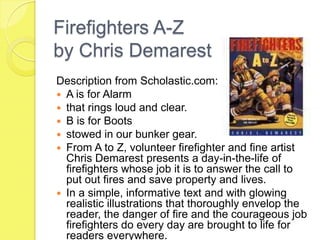
 The books all range from reading levels of 1.5-2.5Firefighters A-Z by Chris Demarest	Description from Scholastic.com:A is for Alarm that rings loud and clear. B is for Boots stowed in our bunker gear. From A to Z, volunteer firefighter and fine artist Chris Demarest presents a day-in-the-life of firefighters whose job it is to answer the call to put out fires and save property and lives. In a simple, informative text and with glowing realistic illustrations that thoroughly envelop the reader, the danger of fire and the courageous job firefighters do every day are brought to life for readers everywhere.
ActivityWhen reading book, make sure that students state the letterDiscuss the roles of firefighters and police officersDiscuss safety tips to be prepared for a fireHave students make up a fire escape plan for their own houses Have students share their escape plans with the classCome up with a fire escape plan for the classroomDiscuss the steps that you are supposed to take when there is a fireCrawlStop, drop, and rollCheck door knobs before opening the doorDiscuss ways to prevent fires at homeUnplug electronics when not in useKeep trash and fabrics away from heatDo not play with matches or lighters
Cont…Practice the stop, drop, and roll techniquePractice staying underneath the “smoke”Reread the bookStandards Used:English 1.1.2 Identify letters, words, and sentences.Science 1.1.1 Observe, describe, draw, and sort objects carefully to learn about them. Gardner’sIntrapersonalInterpersonalVerbal LinguisticsBodily KinestheticVisual-Spatial
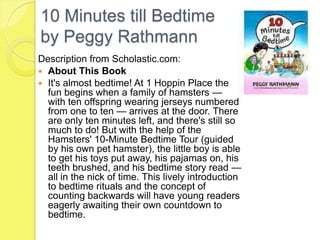
10 Minutes till Bedtime by Peggy RathmannDescription from Scholastic.com:About This BookIt's almost bedtime! At 1 Hoppin Place the fun begins when a family of hamsters — with ten offspring wearing jerseys numbered from one to ten — arrives at the door. There are only ten minutes left, and there's still so much to do! But with the help of the Hamsters' 10-Minute Bedtime Tour (guided by his own pet hamster), the little boy is able to get his toys put away, his pajamas on, his teeth brushed, and his bedtime story read — all in the nick of time. This lively introduction to bedtime rituals and the concept of counting backwards will have young readers eagerly awaiting their own countdown to bedtime.
ActivitiesRead storyReview what students already know about timeDiscuss what time within the school settingWhat time lunch?What time is recess?What time does school let out?Is lunch before or after math?How much longer until recess?Have students take turns to come up to the board and drawing “hands” on a clock that you have already drawn on the boardDiscuss bedtime routinesPutting toys and books awayBrushing teethPajamasBedtime story readingDiscuss the correct way to brush teeth
Cont…Standards used:Math 1.5.6 Tell time to the nearest half-hour and relate time to events (before/after, shorter/longer). English 1.7.8 Relate an important life event or personal experience in a simple sequence. Gardner’s:InterpersonalIntrapersonalMathematical-LogicalVerbal Linguistics
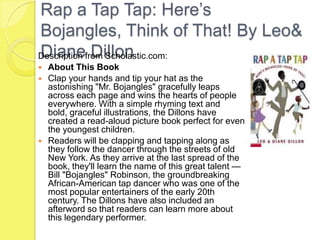
Rap a Tap Tap: Here’s Bojangles, Think of That! By Leo& Diane DillonDescription from Scholastic.com:About This BookClap your hands and tip your hat as the astonishing "Mr. Bojangles" gracefully leaps across each page and wins the hearts of people everywhere. With a simple rhyming text and bold, graceful illustrations, the Dillons have created a read-aloud picture book perfect for even the youngest children. Readers will be clapping and tapping along as they follow the dancer through the streets of old New York. As they arrive at the last spread of the book, they'll learn the name of this great talent — Bill "Bojangles" Robinson, the groundbreaking African-American tap dancer who was one of the most popular entertainers of the early 20th century. The Dillons have also included an afterword so that readers can learn more about this legendary performer.
ActivitiesRead storyHave students clap or stomp their hands and feet to the rhythm of the storyHow many claps/ stomps are in the phrase “Rap a Tap Tap, think about that?”Have students say “Rap a Tap Tap, think about that” when ever it is stated in the storyShow students the clip from the “Little Colonel” of Shirley Temple and Bill Robinson tap dancing on the stairsDiscuss other types of dancingDo any of the students know a certain kind of dance?Move desks for space in the center of the room, pair students up, teach them a simple square dance (or simply allow students to make up their own dance moves to the music being played.)
Cont…Standards:Dance1.1.1 Isolate various body parts through movement. Science 1.2.1 Use whole numbers, up to 100, in counting, identifying, measuring, and describing objects and experiences.Gardner:Bodily- KinestheticInterpersonalMusicalVerbal- Linguistic
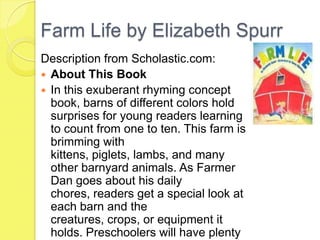
Farm Life by Elizabeth SpurrDescription from Scholastic.com:About This BookIn this exuberant rhyming concept book, barns of different colors hold surprises for young readers learning to count from one to ten. This farm is brimming with kittens, piglets, lambs, and many other barnyard animals. As Farmer Dan goes about his daily chores, readers get a special look at each barn and the creatures, crops, or equipment it holds. Preschoolers will have plenty of fun while learning numbers, colors, and animals.
ActivitiesRead storyHave students identify animals in illustrations while reading or after readingCount the animals that are shown throughout the bookDiscuss different animals that might live on a farmHave students draw a picture of a farm animal of their own choiceAsk students if they have ever seen certain farm animalsBefore class begins, find a video clip(s) of various farm animals to show to studentsDiscuss how to take care and feed certain farm animalsSing the “Farmer in the Dale”
Cont…	Standards:Science1.1.1 Observe, describe, draw, and sort objects carefully to learn about them. Math 1.2.1 Use whole numbers, up to 100, in counting, identifying, measuring, and describing objects and experiences. Gardner’s:Verbal- LinguisticsVisual- SpatialLogical-Mathematical
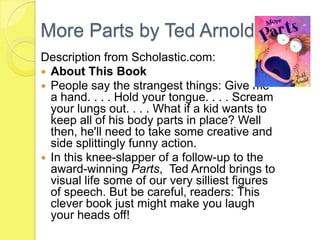
More Parts by Ted ArnoldDescription from Scholastic.com:About This BookPeople say the strangest things: Give me a hand. . . . Hold your tongue. . . . Scream your lungs out. . . . What if a kid wants to keep all of his body parts in place? Well then, he'll need to take some creative and side splittingly funny action.In this knee-slapper of a follow-up to the award-winning Parts,  Ted Arnold brings to visual life some of our very silliest figures of speech. But be careful, readers: This clever book just might make you laugh your heads off!
Activity	Read storyDiscuss the different parts of the bodySing and dance to the “Hokie Pokie”Before class collect one long paper for every two students, allow them to work together in pairs to trace half of their bodies to make them into one figure. Draw a line down the middle of the figure and let them draw half of themselves  labeling each body part.Have them measure their legs and arms and then the height of their figures.
Cont…Standards:Math 1.5.1 Measure the length of objects by repeating a nonstandard unit or a standard unit. Gardner’s:Visual- SpatialLogical-MathematicalInterpersonalVerbal-LinguisticsMusicalBodily-Kinesthetic
Painting the Wind by Patricia MacLachlanDescription from Scholastic.com:About This BookWhat I have waited for all year long happens. Summer is here. On an island, surrounded by water and light, a young boy waits for the sun to shine, and for his friends, the painters, to return: The landscape painter and the painter of flowers. The painter of still lifes and the painter of faces. They all come to the island to paint when the days are long and their dogs can run free. The young boy watches and learns. This summer he will try to do what he has never done before. He will try to paint the wind. Newbery Medal-winning and bestselling author Patricia MacLachlan teams up with her daughter Emily for their first collaboration. Their delicate yet evocative prose is brought to life by the exquisite paintings of artist Katy Schneider. "Painting the Wind" is a beautiful story about holding on to those perfect moments that only summer in a place that you love can offer.
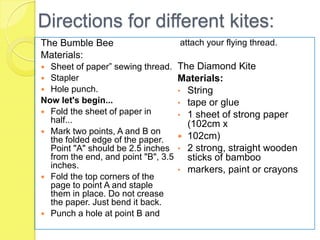
Activities	Read book.Teach students the song “Let’s go fly a kite” from Mary Poppins.Allow students to paint “the wind” on their own sheet of paper.Discuss how the wind is seen, felt, and heardTalk about kites.Build a kite. One per student. Allow students to build the kite however they wish, but show them examples/ pictures of kites so that they have an idea.Play the song “Let’s go fly a kite” in the background.Take students outside to fly their kites.(Directions to different paper kites on next few slides)
Directions for different kites:The Bumble BeeMaterials:Sheet of paper” sewing thread.StaplerHole punch.Now let's begin...Fold the sheet of paper in half...Mark two points, A and B on the folded edge of the paper. Point "A" should be 2.5 inches from the end, and point "B", 3.5 inches.Fold the top corners of the page to point A and staple them in place. Do not crease the paper. Just bend it back.Punch a hole at point B andattach your flying thread.The Diamond KiteMaterials:String
tape or glue
1 sheet of strong paper (102cm x102cm)2 strong, straight wooden sticks of bamboo
markers, paint or crayons Cont…The Diamond KiteMaterials:String
tape or glue
1 sheet of strong paper (102cm x102cm)2 strong, straight wooden sticks of bamboo
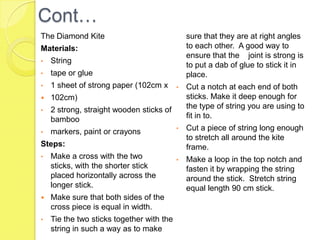
markers, paint or crayons Steps:Make a cross with the two sticks, with the shorter stick placed horizontally across the longer stick.Make sure that both sides of the cross piece is equal in width.Tie the two sticks together with the string in such a way as to make sure that they are at right angles to each other.  A good way to ensure that the    joint is strong is to put a dab of glue to stick it in place.
Cut a notch at each end of both sticks. Make it deep enough for the type of string you are using to fit in to.
Cut a piece of string long enough to stretch all around the kite frame.
Make a loop in the top notch and fasten it by wrapping the string around the stick.  Stretch string equal length 90 cm stick.Cont…String the string through the notch at one end of the cross-piece, and make another loop at the bottom.
Stretch the string through the notch atone end of the loop at the bottom.
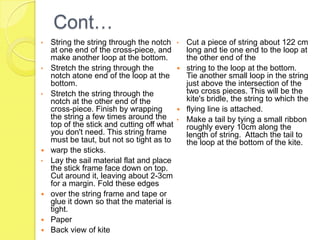
Stretch the string through the notch at the other end of the cross-piece. Finish by wrapping the string a few times around the top of the stick and cutting off what you don't need. This string frame must be taut, but not so tight as towarp the sticks.Lay the sail material flat and place the stick frame face down on top. Cut around it, leaving about 2-3cm for a margin. Fold these edgesover the string frame and tape or glue it down so that the material is tight.PaperBack view of kiteCut a piece of string about 122 cm long and tie one end to the loop at the other end of thestring to the loop at the bottom. Tie another small loop in the string just above the intersection of the two cross pieces. This will be the kite's bridle, the string to which theflying line is attached.Make a tail by tying a small ribbon roughly every 10cm along the length of string.  Attach the tail to the loop at the bottom of the kite.Cont…StandardsMath1.6.1 Choose the approach, materials, and strategies to use in solving problems. Gardner’sVerbal- LinguisticsVisual- SpatialBodily- KinestheticIntrapersonalLogical- Mathematical
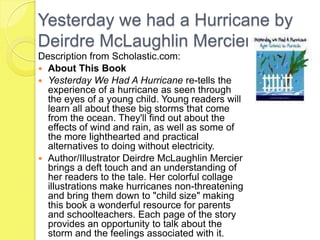
Yesterday we had a Hurricane by Deirdre McLaughlin MercierDescription from Scholastic.com:About This BookYesterday We Had A Hurricane re-tells the experience of a hurricane as seen through the eyes of a young child. Young readers will learn all about these big storms that come from the ocean. They'll find out about the effects of wind and rain, as well as some of the more lighthearted and practical alternatives to doing without electricity.Author/Illustrator Deirdre McLaughlin Mercier brings a deft touch and an understanding of her readers to the tale. Her colorful collage illustrations make hurricanes non-threatening and bring them down to "child size" making this book a wonderful resource for parents and schoolteachers. Each page of the story provides an opportunity to talk about the storm and the feelings associated with it.
ActivitiesRead storyDiscuss how the students think that the boy felt throughout the storyDiscuss the wind and its affects on the weatherDiscuss the hurricane that occurred in New Orleans, LO Discuss how a hurricane happensDiscuss what to do to stay safe during a hurricaneDiscuss the various things that the boy did without electricityHave students write a story about what they would do if they had to go without electricity for a while.

Ring-O Activity

  • 1.
  • 2.
  • 3.
  • 4.
    The booksall range from reading levels of 1.5-2.5Firefighters A-Z by Chris Demarest Description from Scholastic.com:A is for Alarm that rings loud and clear. B is for Boots stowed in our bunker gear. From A to Z, volunteer firefighter and fine artist Chris Demarest presents a day-in-the-life of firefighters whose job it is to answer the call to put out fires and save property and lives. In a simple, informative text and with glowing realistic illustrations that thoroughly envelop the reader, the danger of fire and the courageous job firefighters do every day are brought to life for readers everywhere.
  • 5.
    ActivityWhen reading book,make sure that students state the letterDiscuss the roles of firefighters and police officersDiscuss safety tips to be prepared for a fireHave students make up a fire escape plan for their own houses Have students share their escape plans with the classCome up with a fire escape plan for the classroomDiscuss the steps that you are supposed to take when there is a fireCrawlStop, drop, and rollCheck door knobs before opening the doorDiscuss ways to prevent fires at homeUnplug electronics when not in useKeep trash and fabrics away from heatDo not play with matches or lighters
  • 6.
    Cont…Practice the stop,drop, and roll techniquePractice staying underneath the “smoke”Reread the bookStandards Used:English 1.1.2 Identify letters, words, and sentences.Science 1.1.1 Observe, describe, draw, and sort objects carefully to learn about them. Gardner’sIntrapersonalInterpersonalVerbal LinguisticsBodily KinestheticVisual-Spatial
  • 7.
    10 Minutes tillBedtime by Peggy RathmannDescription from Scholastic.com:About This BookIt's almost bedtime! At 1 Hoppin Place the fun begins when a family of hamsters — with ten offspring wearing jerseys numbered from one to ten — arrives at the door. There are only ten minutes left, and there's still so much to do! But with the help of the Hamsters' 10-Minute Bedtime Tour (guided by his own pet hamster), the little boy is able to get his toys put away, his pajamas on, his teeth brushed, and his bedtime story read — all in the nick of time. This lively introduction to bedtime rituals and the concept of counting backwards will have young readers eagerly awaiting their own countdown to bedtime.
  • 8.
    ActivitiesRead storyReview whatstudents already know about timeDiscuss what time within the school settingWhat time lunch?What time is recess?What time does school let out?Is lunch before or after math?How much longer until recess?Have students take turns to come up to the board and drawing “hands” on a clock that you have already drawn on the boardDiscuss bedtime routinesPutting toys and books awayBrushing teethPajamasBedtime story readingDiscuss the correct way to brush teeth
  • 9.
    Cont…Standards used:Math 1.5.6Tell time to the nearest half-hour and relate time to events (before/after, shorter/longer). English 1.7.8 Relate an important life event or personal experience in a simple sequence. Gardner’s:InterpersonalIntrapersonalMathematical-LogicalVerbal Linguistics
  • 10.
    Rap a TapTap: Here’s Bojangles, Think of That! By Leo& Diane DillonDescription from Scholastic.com:About This BookClap your hands and tip your hat as the astonishing "Mr. Bojangles" gracefully leaps across each page and wins the hearts of people everywhere. With a simple rhyming text and bold, graceful illustrations, the Dillons have created a read-aloud picture book perfect for even the youngest children. Readers will be clapping and tapping along as they follow the dancer through the streets of old New York. As they arrive at the last spread of the book, they'll learn the name of this great talent — Bill "Bojangles" Robinson, the groundbreaking African-American tap dancer who was one of the most popular entertainers of the early 20th century. The Dillons have also included an afterword so that readers can learn more about this legendary performer.
  • 11.
    ActivitiesRead storyHave studentsclap or stomp their hands and feet to the rhythm of the storyHow many claps/ stomps are in the phrase “Rap a Tap Tap, think about that?”Have students say “Rap a Tap Tap, think about that” when ever it is stated in the storyShow students the clip from the “Little Colonel” of Shirley Temple and Bill Robinson tap dancing on the stairsDiscuss other types of dancingDo any of the students know a certain kind of dance?Move desks for space in the center of the room, pair students up, teach them a simple square dance (or simply allow students to make up their own dance moves to the music being played.)
  • 12.
    Cont…Standards:Dance1.1.1 Isolate variousbody parts through movement. Science 1.2.1 Use whole numbers, up to 100, in counting, identifying, measuring, and describing objects and experiences.Gardner:Bodily- KinestheticInterpersonalMusicalVerbal- Linguistic
  • 13.
    Farm Life byElizabeth SpurrDescription from Scholastic.com:About This BookIn this exuberant rhyming concept book, barns of different colors hold surprises for young readers learning to count from one to ten. This farm is brimming with kittens, piglets, lambs, and many other barnyard animals. As Farmer Dan goes about his daily chores, readers get a special look at each barn and the creatures, crops, or equipment it holds. Preschoolers will have plenty of fun while learning numbers, colors, and animals.
  • 14.
    ActivitiesRead storyHave studentsidentify animals in illustrations while reading or after readingCount the animals that are shown throughout the bookDiscuss different animals that might live on a farmHave students draw a picture of a farm animal of their own choiceAsk students if they have ever seen certain farm animalsBefore class begins, find a video clip(s) of various farm animals to show to studentsDiscuss how to take care and feed certain farm animalsSing the “Farmer in the Dale”
  • 15.
    Cont… Standards:Science1.1.1 Observe, describe,draw, and sort objects carefully to learn about them. Math 1.2.1 Use whole numbers, up to 100, in counting, identifying, measuring, and describing objects and experiences. Gardner’s:Verbal- LinguisticsVisual- SpatialLogical-Mathematical
  • 16.
    More Parts byTed ArnoldDescription from Scholastic.com:About This BookPeople say the strangest things: Give me a hand. . . . Hold your tongue. . . . Scream your lungs out. . . . What if a kid wants to keep all of his body parts in place? Well then, he'll need to take some creative and side splittingly funny action.In this knee-slapper of a follow-up to the award-winning Parts, Ted Arnold brings to visual life some of our very silliest figures of speech. But be careful, readers: This clever book just might make you laugh your heads off!
  • 17.
    Activity Read storyDiscuss thedifferent parts of the bodySing and dance to the “Hokie Pokie”Before class collect one long paper for every two students, allow them to work together in pairs to trace half of their bodies to make them into one figure. Draw a line down the middle of the figure and let them draw half of themselves labeling each body part.Have them measure their legs and arms and then the height of their figures.
  • 18.
    Cont…Standards:Math 1.5.1 Measurethe length of objects by repeating a nonstandard unit or a standard unit. Gardner’s:Visual- SpatialLogical-MathematicalInterpersonalVerbal-LinguisticsMusicalBodily-Kinesthetic
  • 19.
    Painting the Windby Patricia MacLachlanDescription from Scholastic.com:About This BookWhat I have waited for all year long happens. Summer is here. On an island, surrounded by water and light, a young boy waits for the sun to shine, and for his friends, the painters, to return: The landscape painter and the painter of flowers. The painter of still lifes and the painter of faces. They all come to the island to paint when the days are long and their dogs can run free. The young boy watches and learns. This summer he will try to do what he has never done before. He will try to paint the wind. Newbery Medal-winning and bestselling author Patricia MacLachlan teams up with her daughter Emily for their first collaboration. Their delicate yet evocative prose is brought to life by the exquisite paintings of artist Katy Schneider. "Painting the Wind" is a beautiful story about holding on to those perfect moments that only summer in a place that you love can offer.
  • 20.
    Activities Read book.Teach studentsthe song “Let’s go fly a kite” from Mary Poppins.Allow students to paint “the wind” on their own sheet of paper.Discuss how the wind is seen, felt, and heardTalk about kites.Build a kite. One per student. Allow students to build the kite however they wish, but show them examples/ pictures of kites so that they have an idea.Play the song “Let’s go fly a kite” in the background.Take students outside to fly their kites.(Directions to different paper kites on next few slides)
  • 21.
    Directions for differentkites:The Bumble BeeMaterials:Sheet of paper” sewing thread.StaplerHole punch.Now let's begin...Fold the sheet of paper in half...Mark two points, A and B on the folded edge of the paper. Point "A" should be 2.5 inches from the end, and point "B", 3.5 inches.Fold the top corners of the page to point A and staple them in place. Do not crease the paper. Just bend it back.Punch a hole at point B andattach your flying thread.The Diamond KiteMaterials:String
  • 22.
  • 23.
    1 sheet ofstrong paper (102cm x102cm)2 strong, straight wooden sticks of bamboo
  • 24.
    markers, paint orcrayons Cont…The Diamond KiteMaterials:String
  • 25.
  • 26.
    1 sheet ofstrong paper (102cm x102cm)2 strong, straight wooden sticks of bamboo
  • 27.
    markers, paint orcrayons Steps:Make a cross with the two sticks, with the shorter stick placed horizontally across the longer stick.Make sure that both sides of the cross piece is equal in width.Tie the two sticks together with the string in such a way as to make sure that they are at right angles to each other. A good way to ensure that the joint is strong is to put a dab of glue to stick it in place.
  • 28.
    Cut a notchat each end of both sticks. Make it deep enough for the type of string you are using to fit in to.
  • 29.
    Cut a pieceof string long enough to stretch all around the kite frame.
  • 30.
    Make a loopin the top notch and fasten it by wrapping the string around the stick. Stretch string equal length 90 cm stick.Cont…String the string through the notch at one end of the cross-piece, and make another loop at the bottom.
  • 31.
    Stretch the stringthrough the notch atone end of the loop at the bottom.
  • 32.
    Stretch the stringthrough the notch at the other end of the cross-piece. Finish by wrapping the string a few times around the top of the stick and cutting off what you don't need. This string frame must be taut, but not so tight as towarp the sticks.Lay the sail material flat and place the stick frame face down on top. Cut around it, leaving about 2-3cm for a margin. Fold these edgesover the string frame and tape or glue it down so that the material is tight.PaperBack view of kiteCut a piece of string about 122 cm long and tie one end to the loop at the other end of thestring to the loop at the bottom. Tie another small loop in the string just above the intersection of the two cross pieces. This will be the kite's bridle, the string to which theflying line is attached.Make a tail by tying a small ribbon roughly every 10cm along the length of string. Attach the tail to the loop at the bottom of the kite.Cont…StandardsMath1.6.1 Choose the approach, materials, and strategies to use in solving problems. Gardner’sVerbal- LinguisticsVisual- SpatialBodily- KinestheticIntrapersonalLogical- Mathematical
  • 33.
    Yesterday we hada Hurricane by Deirdre McLaughlin MercierDescription from Scholastic.com:About This BookYesterday We Had A Hurricane re-tells the experience of a hurricane as seen through the eyes of a young child. Young readers will learn all about these big storms that come from the ocean. They'll find out about the effects of wind and rain, as well as some of the more lighthearted and practical alternatives to doing without electricity.Author/Illustrator Deirdre McLaughlin Mercier brings a deft touch and an understanding of her readers to the tale. Her colorful collage illustrations make hurricanes non-threatening and bring them down to "child size" making this book a wonderful resource for parents and schoolteachers. Each page of the story provides an opportunity to talk about the storm and the feelings associated with it.
  • 34.
    ActivitiesRead storyDiscuss howthe students think that the boy felt throughout the storyDiscuss the wind and its affects on the weatherDiscuss the hurricane that occurred in New Orleans, LO Discuss how a hurricane happensDiscuss what to do to stay safe during a hurricaneDiscuss the various things that the boy did without electricityHave students write a story about what they would do if they had to go without electricity for a while.