OBJECTIVES
• Lifting Operations And LOLER 1998 (LOLER).
• Definitions And Terminologies In Lifting Operation.
• Types Of Lifts And Their Classification
• Types Of Hitches And Angle Factors
• Planning A Lift
• Weight Load Calculation
• Common Types Of Slings, Rigging Gear And Their
Inspection
• Lifting a Load
• Load Charts And Tables
• Crane Terminologies And Basic Load Chart
Understanding
DEFINITIONS
• Lifting Equipment
• Work equipment for lifting or lowering loads and
including its attachments used for anchoring, fixing
or supporting it.
• Ex: chain hoist, cranes, fork trucks etc
• Lifting Accessory (Lifting Gear)
• work equipment used for attaching loads to
machinery for lifting.
• Ex: wire rope slings, shackles, webbing slings,
eyebolts, swivels etc..
DEFINITIONS
• Operative
– An operative is a trained person actually using the
equipment.
• Responsible Person
– A Responsible Person is a person who has sufficient
knowledge and training to enable him/her to recognise
obvious defects and is responsible to his/her employer
for the 'in-service' inspection of equipment.
DEFINITIONS
• Competent Person
– A Competent Person is the person concerned with the
testing, examination and certification of lifting equipment.
– He/she should have such practical and theoretical
knowledge and experience of the equipment which is to be
tested, examined and certified that will enable him/her to
detect defects or weaknesses which it is the purpose of
the examination to discover and to assess their
importance to the safety of the equipment. (Third party
lifting Inspector)
DEFINITIONS
• In-service Inspection
– In-service inspection is a visual inspection
carried out by a Responsible Person to check
for obvious signs of damage or wear which
might affect the equipment's fitness for use.
DEFINITIONS
• Thorough Examination
– A Thorough Examination is an examination carried out by a
Competent Person carefully and critically, and where necessary
supplemented by other means such as measurement and non-
destructive testing, in order to detect damage or deterioration.
– The period between thorough examinations shall be established
by management on the basis of statutory requirements for the
equipment, severity of service conditions, nature of the lifts,
prior experience and the recommendation of the Competent
Person.
– In no case shall the period between thorough examinations
exceed the statutory period.
DEFINITIONS
• Proof or Test Load
– A load (mass or force) applied by the manufacturer or
Competent Person for the purpose of a test. This load
appears on test certificates.
• Minimum Breaking (or Failure) Load (MBL)
– The specified load (mass or force) below which the item of
equipment does not fail either by fracture or distorting to such an
extent that the load is released.
• Mass Units are usually tonnes (t)
• Force units are usually Newton (N)
DEFINITIONS
• Working Load Limit (WLL)
– The maximum load (mass) that an item of lifting
equipment is designed to raise, lower or suspend. In
some standards and documents the WLL is referred
to as the 'maximum safe working load'.
• Factor of Safety
– The ratio between MBL and WLL identified on the
test certificate as the Coefficient of Utilisation.
– E.G. MBL = 5t, WLL = 1t F.O.S. = 5:1
DEFINITIONS
• Safe Working Load (SWL)
– The maximum load (mass), as assessed by a
Competent Person, which an item of lifting equipment
may raise, lower or suspend under the particular
service conditions. The SWL will normally be the
same as the working load limit or the maximum safe
working load, where the term is used but it may be
less. The SWL appears in statutory records.
DEFINITIONS
• Test Certificate
– A certificate issued by the Competent Person giving
details of tests, conducted on an item of lifting
equipment.
DEFINITIONS
• Examination Report
– A certificate issued by a Competent Person
giving the results of the thorough examination
including testing if appropriate. This will detail
the defects found or include a statement that
the item is fit safe to operate.
Crane
Certificate
Lifting
accessory
certificate
Lifting
equipment
certificate
Inspection
certificate
UAE LAW
Law governing INDUSTRIAL SAFETY
AND LIFTING OPERATIONS enacted
in 1982 in form of Ministerial Decree No.
32 for that year.
Article (20) Cranes & Lifting Equipment
• Following to be noted regarding lifting &
pulling machines & tools:
a. Cranes & lifts for men & materials shall be of
sound construction & manufacture, regularly
maintained & checked by a qualified
technician at once ever 12 months.
b. Area where lifts fitted shall be fenced in such
way as to prevent access or egress while
moving.
c. Chains, ropes, wire ropes & other lifting
equipment shall be continuously & completely
maintained & checked by a qualified
technician at least once every 6 months.
d. The maximum capacity of machine / lift shall
be displayed in a prominent position.
e. An employee may not be asked to carry loads
above his capacity, & in any case no load
shall exceed 50kg per man & 20kg per
woman, & where possible mechanical lifting
equipment shall be used.
 Section (a): Qualified inspector defined by
Ministry of Labour issuing approvals to
carry out inspection & testing to certain
organisations & personnel within it.
 (Before using crane, loose lifting gear &
points, ensure it is certified.)
Periodicity of Examinations (LOLER)
• Under LOLER, all lifting equipment &
accessories examined & tested (where
appropriate):
before it is put to service for first time (unless it
hasn’t been used before &/or it has an EC
declaration of conformity less than 12 months
old)
after installation / assembly at new site (if safety
of equipment is dependent on installation
conditions)
at specified intervals dependent on
operational circumstances as follows:
• lifting equipment used for lifting persons – at
least every 6 months
• lifting accessories – at least every 6 months
• any other lifting equipment – at least every 12
months
each time exceptional circumstances which
are liable to jeopardise safety of lifting
equipment has occurred.
Planning
• Lifting / cargo handling operations – each
job is different & for safety all have to be
planned
• Depth of planning increases with complexity
of job
• Numerous factors to be considered:
weight of load
position / height of centre of gravity
stability of load
size & shape of load
availability of dedicated lifting points on load
availability of suitable rigging
protection of rigging against sharp edges
capacity of crane / hoisting equipment
availability of certified anchor points / support
steelwork
available headroom
route to be travelled
obstructions
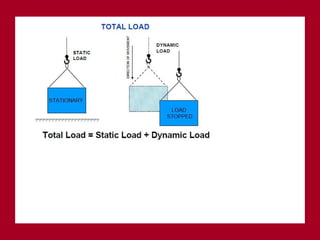
maximum height load has to be lifted
any dynamic factors
hazards to other personnel
number of banksmen required
communication
deck / floor capacity for landing load
need for tag lines
available light
experience / competence of personnel
Types of Lifts
 Routine Lifts: performed on regular
basis – involves basic slinging
practices – e.g. containers, etc.
Planning: use of generic plans &/or
toolbox talks usually adequate for this
level of lifting operation
• Simple Lifts: involve use of basic hoisting
equipment directly above the head (e.g. –
crane / manual hoist suspended from
dedicated lifting structures such as pad
eyes / runway beams). Load required to
have certified lifting points / easy to sling
Planning: use of generic plans &/or
toolbox talks usually adequate for this
level of lifting operation
 Complicated Lifts: difficult due to nature of
load (e.g. awkward shape, offset / high
centre of gravity, fragility, containing liquids,
no lifting attachments / difficulty to sling,
etc.)
actual lifting operation / handling of lift may
be difficult (e.g. may require to be rotated /
cross-hauled involving two / more sets of
rigging &/or tandem lifting with cranes).
Planning: written plan with toolbox talks
required
• Complex Lifts: could be any of the above
categories – additional hazards, i.e. lifting
operations / conditions which would merit
additional engg. input (e.g. extremely
heavy loads, confined spaces, restricted
headroom, lifting over unprotected plant /
equipment & lifts involving divers / floating
cranes, etc).
Planning: written plan / job pack with
toolbox talks required
Activity 1.
• Give examples of simple, routine,
complicated and complex lifts.
• Questions on LOLER 1998.
• Case study on different loads and
conditions.
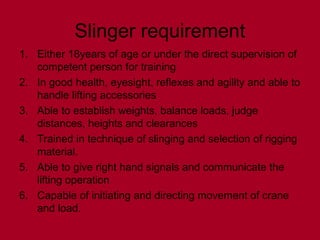
Slinger requirement
1. Either 18years of age or under the direct supervision of
competent person for training
2. In good health, eyesight, reflexes and agility and able to
handle lifting accessories
3. Able to establish weights, balance loads, judge
distances, heights and clearances
4. Trained in technique of slinging and selection of rigging
material.
5. Able to give right hand signals and communicate the
lifting operation
6. Capable of initiating and directing movement of crane
and load.
Exercise
10 Tonne 10 Tonne
10 Tonne 10 Tonne
Load on single leg??
• Answer=10t
10 Tonne
Capacity of the sling on choker
10 Tonne
Answer =12.5t per leg
Choke hitches
With choke hitches the
capacity of the sling is
reduced to 80% its rated
capacity
Example: if the single leg
sling capacity is 10t you
can lift 8t on a choker with
proper packing at the
sharp corners.
CHOCKER HITCH
• Ensure proper packing
to avoid kinks
• Use shackle pin in the
eye and not against
the body of the sling.
• Reduce the SWL
appropriately
• Don't increase the
angle above 120deg
by tightening the sling
Double wrap chocker hitch
Single leg hitches
Straight pull
Straight pull
M = 1.0
M = 1.0
Chocker hitch
Chocker hitch
M = 0.8
M = 0.8
BASKET HITCH
BASKET HITCH
MAX 90 DEG
MAX 90 DEG
M = 1.4
M = 1.4
BASKET HITCH
BASKET HITCH
MAX 90 DEG
MAX 90 DEG
M = 2.0
M = 2.0
Load on each leg??
Answer=5t per leg
10 Tonne
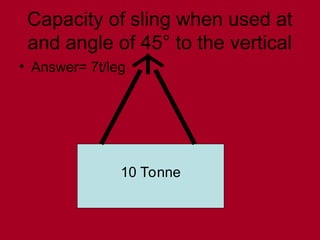
Capacity of sling when used at
and angle of 45° to the vertical
• Answer= 7t/leg
10 Tonne
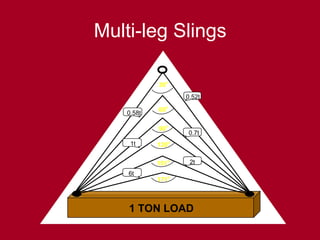
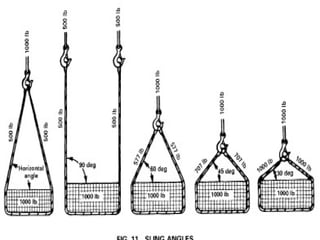
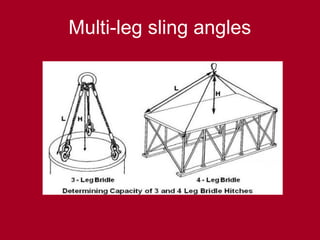
Multi-leg Slings
171o
151
o
120
o
90o
60o
30o
1 TON LOAD
0.52t
0.7t
0.58t
1t
2t
6t
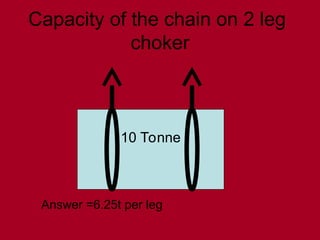
Capacity of the chain on 2 leg
choker
10 Tonne
Answer =6.25t per leg
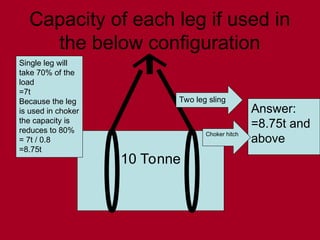
Capacity of each leg if used in
the below configuration
10 Tonne
Answer:
=8.75t and
above
Choker hitch
Two leg sling
Single leg will
take 70% of the
load
=7t
Because the leg
is used in choker
the capacity is
reduces to 80%
= 7t / 0.8
=8.75t
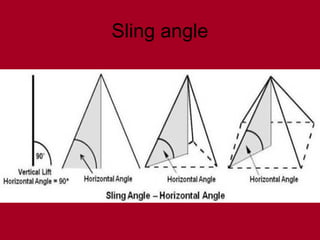
Sling angle
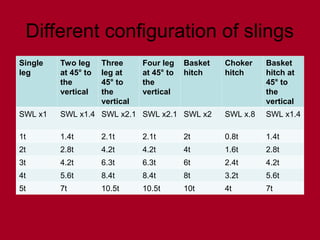
Different configuration of slings
Single
leg
Two leg
at 45° to
the
vertical
Three
leg at
45° to
the
vertical
Four leg
at 45° to
the
vertical
Basket
hitch
Choker
hitch
Basket
hitch at
45° to
the
vertical
SWL x1 SWL x1.4 SWL x2.1 SWL x2.1 SWL x2 SWL x.8 SWL x1.4
1t 1.4t 2.1t 2.1t 2t 0.8t 1.4t
2t 2.8t 4.2t 4.2t 4t 1.6t 2.8t
3t 4.2t 6.3t 6.3t 6t 2.4t 4.2t
4t 5.6t 8.4t 8.4t 8t 3.2t 5.6t
5t 7t 10.5t 10.5t 10t 4t 7t
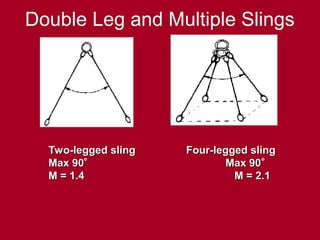
Double Leg and Multiple Slings
Two-legged sling
Two-legged sling Four-legged sling
Four-legged sling
Max 90
Max 90
 Max 90
Max 90

M = 1.4
M = 1.4 M = 2.1
M = 2.1
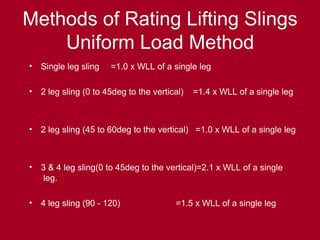
Methods of Rating Lifting Slings
Uniform Load Method
• Single leg sling =1.0 x WLL of a single leg
• 2 leg sling (0 to 45deg to the vertical) =1.4 x WLL of a single leg
• 2 leg sling (45 to 60deg to the vertical) =1.0 x WLL of a single leg
• 3 & 4 leg sling(0 to 45deg to the vertical)=2.1 x WLL of a single
leg.
• 4 leg sling (90 - 120) =1.5 x WLL of a single leg
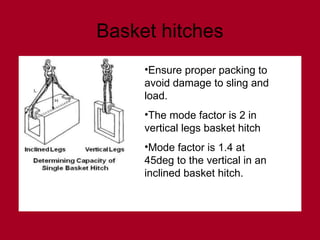
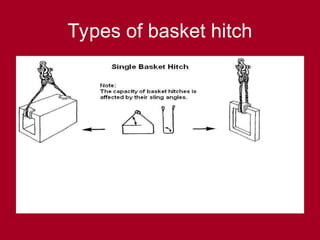
Basket hitches
•Ensure proper packing to
avoid damage to sling and
load.
•The mode factor is 2 in
vertical legs basket hitch
•Mode factor is 1.4 at
45deg to the vertical in an
inclined basket hitch.
Types of basket hitch
Multi-leg sling angles
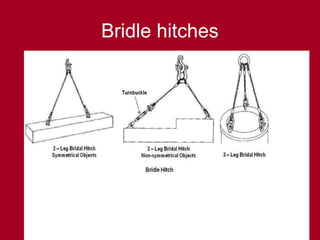
Bridle hitches
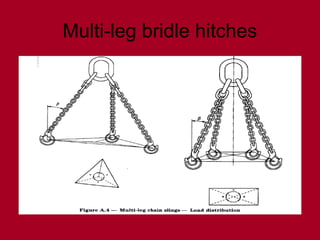
Multi-leg bridle hitches
Activity 2
• Calculations of sling angles and sling
usage.
Chapter 2
Lifting Points
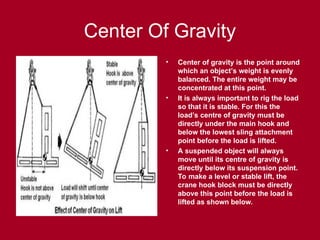
Center Of Gravity
• Center of gravity is the point around
which an object’s weight is evenly
balanced. The entire weight may be
concentrated at this point.
• It is always important to rig the load
so that it is stable. For this the
load’s centre of gravity must be
directly under the main hook and
below the lowest sling attachment
point before the load is lifted.
• A suspended object will always
move until its centre of gravity is
directly below its suspension point.
To make a level or stable lift, the
crane hook block must be directly
above this point before the load is
lifted as shown below.
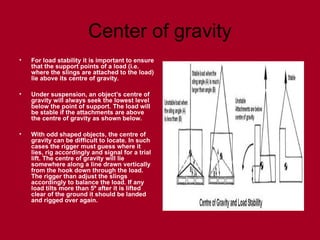
Center of gravity
• For load stability it is important to ensure
that the support points of a load (i.e.
where the slings are attached to the load)
lie above its centre of gravity.
• Under suspension, an object’s centre of
gravity will always seek the lowest level
below the point of support. The load will
be stable if the attachments are above
the centre of gravity as shown below.
• With odd shaped objects, the centre of
gravity can be difficult to locate. In such
cases the rigger must guess where it
lies, rig accordingly and signal for a trial
lift. The centre of gravity will lie
somewhere along a line drawn vertically
from the hook down through the load.
The rigger than adjust the slings
accordingly to balance the load. If any
load tilts more than 5º after it is lifted
clear of the ground it should be landed
and rigged over again.
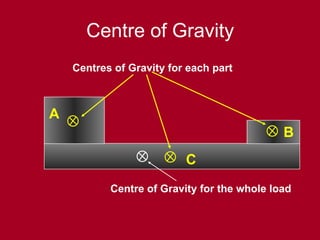
Centre of Gravity
A
B
C
Centres of Gravity for each part
Centre of Gravity for the whole load
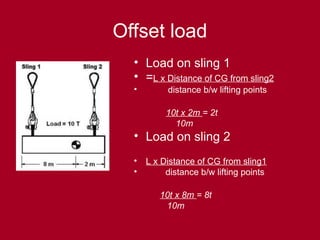
Offset load
• Load on sling 1
• =L x Distance of CG from sling2
• distance b/w lifting points
10t x 2m = 2t
10m
• Load on sling 2
• L x Distance of CG from sling1
• distance b/w lifting points
10t x 8m = 8t
10m
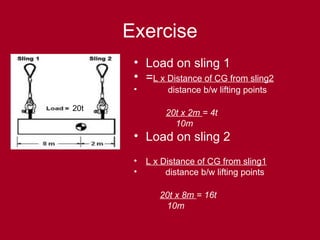
Exercise
20t
• Load on sling 1
• =L x Distance of CG from sling2
• distance b/w lifting points
20t x 2m = 4t
10m
• Load on sling 2
• L x Distance of CG from sling1
• distance b/w lifting points
20t x 8m = 16t
10m
Lifting Points
• In practice, unlikely that total load will be
evenly distributed amongst all lifting points.
• Actual load distribution will depend on a
number of factors including construction of
plant (e.g. flexibility of structure, sling
length, tolerances etc.).
• It is recommended to assume that in a 4
point lift situation, 75% of the load is
distributed between two diagonally opposite
legs, the third leg supports 25% of the load
& the fourth leg is redundant.
• This equates to a possible increase in load
on each lifting point of 50%.
• Hence each lifting point shall have a rated
load of not less than 1.5 times the share of
the load which it is intended to take when
the load is applied vertically.
Moving a Load
• Centre the hook over the CG of the load.
Ensure correct spooling of rope, prevent
load from swinging when it is lifted.
• Use a tag line when loads must traverse
long distances or must otherwise be
controlled. Manila rope may be used for
tag lines.
• Plan & check the travel path to avoid
personnel & obstructions.
• Lift the load only high enough to clear the
tallest obstruction in the travel path.
• Start and stop slowly.
• Land the load when the move is finished.
Choose a safe landing.
• NEVER leave suspended loads
unattended. In an emergency where the
crane / hoist has become inoperative & if a
load must be left suspended, barricade &
post signs in the surrounding area, under
the load & on all four sides. Lock open &
tag the crane / hoist's main electrical
disconnect switch.
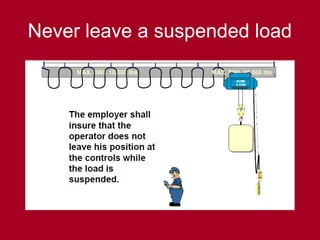
Never leave a suspended load
67
Weight Estimation
• It is the responsibility of the slinger /Operator to
check the established weight of the load to be
lifted, or if it has not been established, to evaluate
it himself.
• It is on the basis of this estimate that the
appropriate tackle is chosen.
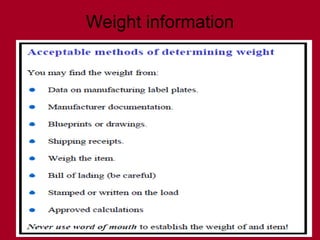
Weight information
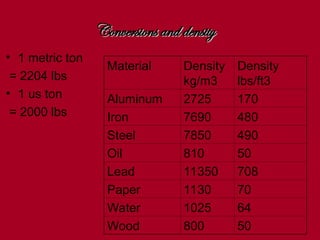
• 1 metric ton
= 2204 lbs
• 1 us ton
= 2000 lbs
Material Density
kg/m3
Density
lbs/ft3
Aluminum 2725 170
Iron 7690 480
Steel 7850 490
Oil 810 50
Lead 11350 708
Paper 1130 70
Water 1025 64
Wood 800 50
Conversions and density
70
Weight Estimation
• Guidance as follows:-
– Look to see if the weight is marked on the load. If it is, check to
ensure that it is the weight of all parts of the load.
– Check the weight stated on any documentation.
– If the load is still on a trailer or truck, weigh it.
– Estimate the weight of the load using a table of weights.
– When dealing with a hollow body, check whether it contains
anything.
71
Weight Estimation
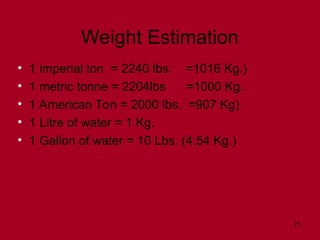
• 1 imperial ton = 2240 lbs. =1016 Kg.)
• 1 metric tonne = 2204lbs =1000 Kg.
• 1 American Ton = 2000 lbs. =907 Kg)
• 1 Litre of water = 1 Kg.
• 1 Gallon of water = 10 Lbs. (4.54 Kg.)
72
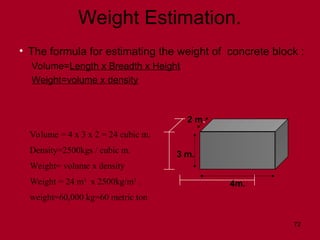
2 m.
3 m.
4m.
Weight Estimation.
• The formula for estimating the weight of concrete block :
Volume=Length x Breadth x Height
Weight=volume x density
Volume = 4 x 3 x 2 = 24 cubic m.
Density=2500kgs / cubic m.
Weight= volume x density
Weight = 24 m3
x 2500kg/m3
.
weight=60,000 kg=60 metric ton
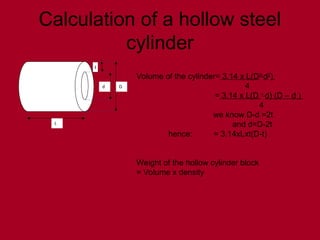
Calculation of a hollow steel
cylinder
D
t
d
L
Volume of the cylinder= 3.14 x L(D2-
d2
)
4
= 3.14 x L(D +
d) (D – d )
4
we know D-d =2t
and d=D-2t
hence: = 3.14xLxt(D-t)
Weight of the hollow cylinder block
= Volume x density
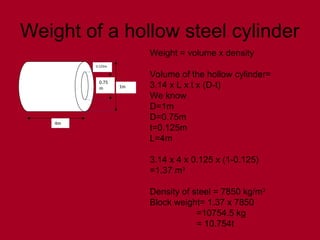
Weight of a hollow steel cylinder
1m
0.125m
0.75
m
4m
Weight = volume x density
Volume of the hollow cylinder=
3.14 x L x t x (D-t)
We know
D=1m
D=0.75m
t=0.125m
L=4m
3.14 x 4 x 0.125 x (1-0.125)
=1.37 m3
Density of steel = 7850 kg/m3
Block weight= 1.37 x 7850
=10754.5 kg
= 10.754t
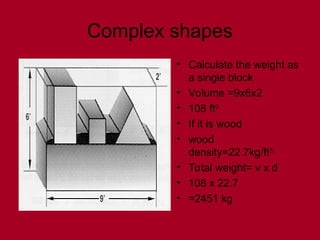
Complex shapes
• Calculate the weight as
a single block
• Volume =9x6x2
• 108 ft3
• If it is wood
• wood
density=22.7kg/ft3.
• Total weight= v x d
• 108 x 22.7
• =2451 kg
Activity 3
• Calculation of a 3 steel plates lifted
together.
• Container crash unit inspection.
End of day 1
Different kinds of lifting
accessories
• Steel wire rope sling
• Chain sling
• Webbing sling
• Nylon endless sling
• Shackles
• Eyebolts
• Lifting beams
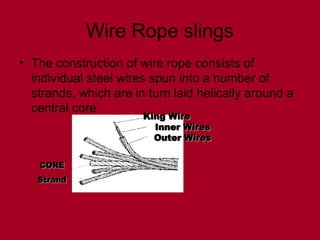
Wire Rope slings
• The construction of wire rope consists of
individual steel wires spun into a number of
strands, which are in turn laid helically around a
central core
King Wire
King Wire
Inner Wires
Inner Wires
Outer Wires
Outer Wires
CORE
CORE
Strand
Strand
There are two types of core,
1.FIBRE CORE
2.STEEL ROPE,
Fibre cores can be constructed from natural or man-
made fibre such as polypropylene, have the
advantage that they neither absorb nor retain
moisture.
Steel cores usually comprise, an independent wire
rope core (IWRC) around which the outer strands are
laid.
A rope with a steel core is stronger than a rope with a
fibre core and is much more resistant to
deformation, crushing and stretch.
The fibre core releases lubricant internally when
stretched
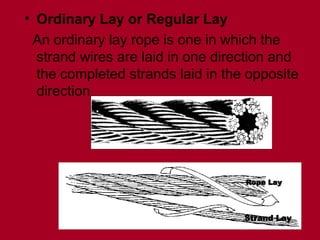
• Ordinary Lay or Regular Lay
An ordinary lay rope is one in which the
strand wires are laid in one direction and
the completed strands laid in the opposite
direction
Rope Lay
Rope Lay
Strand Lay
Strand Lay
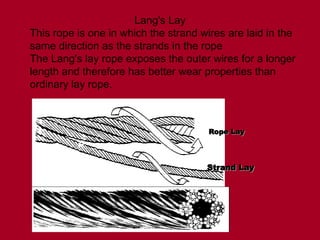
Lang's Lay
This rope is one in which the strand wires are laid in the
same direction as the strands in the rope
The Lang's lay rope exposes the outer wires for a longer
length and therefore has better wear properties than
ordinary lay rope.
Rope Lay
Rope Lay
Strand Lay
Strand Lay
The ordinary lay rope is easier to handle,
more resistant to crushing and distortion
and is the more commonly used.
The majority of ropes are of right-hand lay,
although occasionally left-hand lay ropes
can be supplied. The direction of rope lay
is important, to ensure correct coiling and
spooling of the rope .
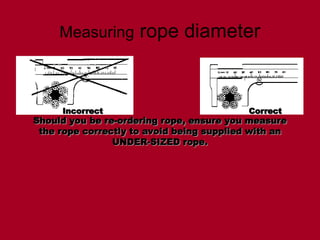
Measuring rope diameter
Correct
Correct
Incorrect
Incorrect
Should you be re-ordering rope, ensure you measure
the rope correctly to avoid being supplied with an
UNDER-SIZED rope.
UNDER-SIZED rope.
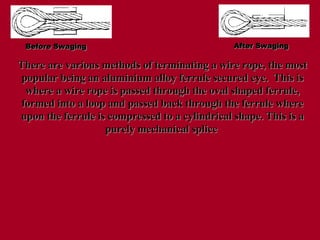
Before Swaging
Before Swaging After Swaging
After Swaging
There are various methods of terminating a wire rope, the most
popular being an aluminium alloy ferrule secured eye. This is
where a wire rope is passed through the oval shaped ferrule,
formed into a loop and passed back through the ferrule where
upon the ferrule is compressed to a cylindrical shape. This is a
purely mechanical splice
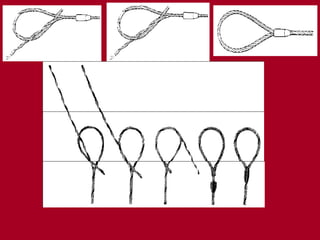
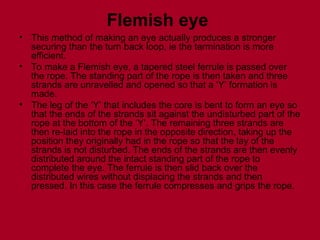
Flemish eye
• This method of making an eye actually produces a stronger
securing than the turn back loop, ie the termination is more
efficient.
• To make a Flemish eye, a tapered steel ferrule is passed over
the rope. The standing part of the rope is then taken and three
strands are unravelled and opened so that a ‘Y’ formation is
made.
• The leg of the ‘Y’ that includes the core is bent to form an eye so
that the ends of the strands sit against the undisturbed part of the
rope at the bottom of the ‘Y’. The remaining three strands are
then re-laid into the rope in the opposite direction, taking up the
position they originally had in the rope so that the lay of the
strands is not disturbed. The ends of the strands are then evenly
distributed around the intact standing part of the rope to
complete the eye. The ferrule is then slid back over the
distributed wires without displacing the strands and then
pressed. In this case the ferrule compresses and grips the rope.
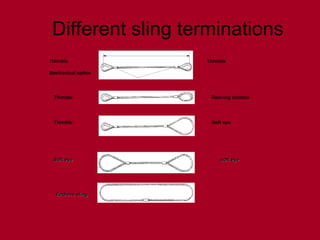
Different sling terminations
Thimble Thimble
Mechanical splice
Thimble Reeving thimble
Thimble Soft eye
Soft eye soft eye
Soft eye soft eye
Endless sling
Endless sling
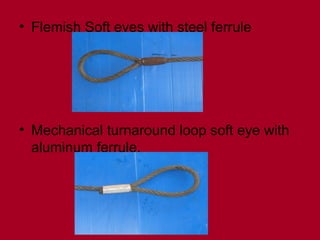
• Flemish Soft eyes with steel ferrule
• Mechanical turnaround loop soft eye with
aluminum ferrule.
Thimble eye with aluminum
ferrule
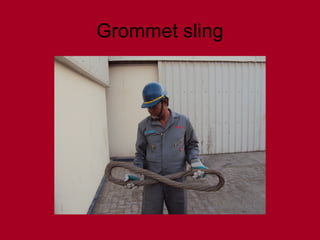
Grommet sling
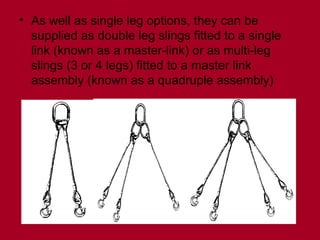
• As well as single leg options, they can be
supplied as double leg slings fitted to a single
link (known as a master-link) or as multi-leg
slings (3 or 4 legs) fitted to a master link
assembly (known as a quadruple assembly)
• Slings must not be used to lift loads greater than the
marked SWL, taking account of the slinging mode and
resultant loads that may be imposed.
• The sling should be compatible with the lifting
appliance, it must also be compatible with the load and
any other lifting accessories in the lifting arrangement,
both in capacity and physical size. Master links and
eyes should seat correctly in the hook of the appliance
and articulate freely to avoid deforming the link or eye.
In the same way, the load, or its attachments, must
seat in the eyes or terminal fittings, eg sling hooks.
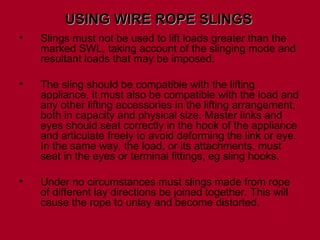
• Under no circumstances must slings made from rope
of different lay directions be joined together. This will
cause the rope to unlay and become distorted.
USING WIRE ROPE SLINGS
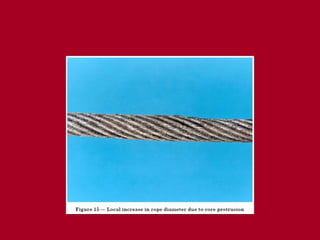
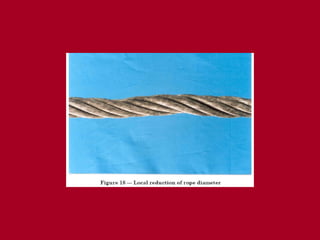
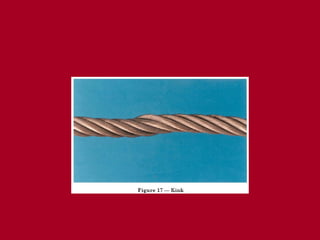
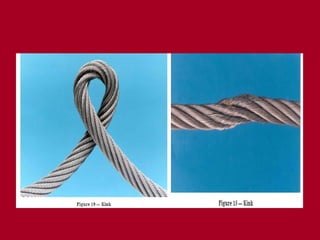
• Under no circumstances should the radius formed be
less than four times the rope diameter. Suitable packing
should also be used. If this is not done the rope will be
permanently kinked, crushed or, at worst, cut. In any
event a sling that is repeatedly taken around corners and
than loaded will take on a set, this may make the sling
difficult to handle but will only be harmful if other damage
is done to the rope.
• Shock loading must be avoided otherwise the core or
inner wires will become damaged.
EXAMINATION
• THE SWL IS ADEQUATE FOR THE LOAD
• COLOR CODING AND ID ARE CLEAR.
• EXAMINE EACH INDIVIDUAL LEG,CHECK FOR CORROSION,
WEAR, ABRASION AND MECH DAMAGE AND BROKEN WIRES
• EXAMINE EACH FERRULE FOR CRACKS AND DAMAGE.
CHECK THE END OF ROPE PROTUDES SLIGHTLY NOT MORE
THAN HALF THE DIA
• CHECK THIMBLES FOR DAMAGE AND ELONGATION ,
CORRECT FITTING.(STRECHTED THIMBLES COULD INDICATE
OVERLOAD)
• WIRE ROPE WEAR ESPECIALLY AROUND THIMBLES
• CHECK TERMINATIONS LIKE MASTER LINKS AND HOOKS
FOR DAMAGE, CRACKS, NICKS, CORROSION AND SAFETY
CATCH.
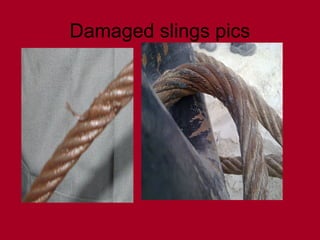
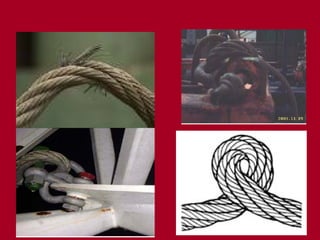
Damaged slings pics
Chain Slings and Fittings
• Alloy grade 80 chain slings were
developed to replace the older mild steel
and high tensile chain slings
• Grade 80 chain slings are constructed
from individual components which can be
assembled in numerous configurations to
suit the task in hand.
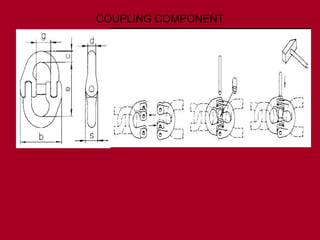
COUPLING COMPONENT
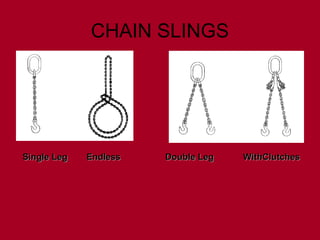
CHAIN SLINGS
Single Leg
Single Leg Endless
Endless Double Leg WithClutches
Double Leg WithClutches
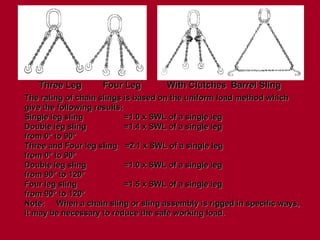
Three Leg
Three Leg Four Leg
Four Leg With Clutches
With Clutches Barrel Sling
Barrel Sling
The rating of chain slings is based on the uniform load method which
give the following results:
Single leg sling
Single leg sling =1.0 x SWL of a single leg
=1.0 x SWL of a single leg
Double leg sling
Double leg sling =1.4 x SWL of a single leg
=1.4 x SWL of a single leg
from 0° to 90°
from 0° to 90°
Three and Four leg sling
Three and Four leg sling =2.1 x SWL of a single leg
=2.1 x SWL of a single leg
from 0° to 90°
from 0° to 90°
Double leg sling
Double leg sling =1.0 x SWL of a single leg
=1.0 x SWL of a single leg
from 90° to 120°
from 90° to 120°
Four leg sling
Four leg sling =1.5 x SWL of a single leg
=1.5 x SWL of a single leg
from 90° to 120°
from 90° to 120°
Note:
Note: When a chain sling or sling assembly is rigged in specific ways,
When a chain sling or sling assembly is rigged in specific ways,
it may be necessary to reduce the safe working load.
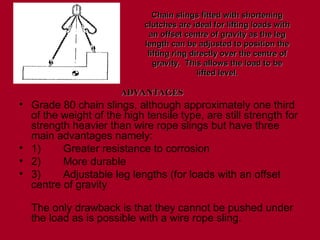
• Grade 80 chain slings, although approximately one third
of the weight of the high tensile type, are still strength for
strength heavier than wire rope slings but have three
main advantages namely:
• 1) Greater resistance to corrosion
• 2) More durable
• 3) Adjustable leg lengths (for loads with an offset
centre of gravity
The only drawback is that they cannot be pushed under
the load as is possible with a wire rope sling.
Chain slings fitted with shortening
clutches are ideal for lifting loads with
an offset centre of gravity as the leg
length can be adjusted to position the
lifting ring directly over the centre of
gravity. This allows the load to be
lifted level.
lifted level.
ADVANTAGES
ADVANTAGES
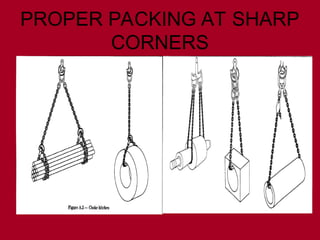
PROPER PACKING AT SHARP
CORNERS
Use of chain slings
• The sling MUST be compatible with the lifting
appliance, it must also be compatible with the
load and any other lifting accessories in the
lifting arrangement, both in capacity and
physical size.
• The master link should seat correctly in the
hook of the appliance and articulate freely to
avoid deforming the link. In the same way, the
load, or its attachments, must seat in the sling
hooks, never on the point, and allow the hook
to align to avoid opening the throat or
deforming the hook.
• Where chain is tensioned across an edge or corner it must be
suitably packed. If these simple measures are ignored the chain
will be over stressed locally, resulting in stretched, bent or
broken links.
• Hooks of multi-leg slings must be positioned to face outwards or
the load will sit on the point, which will lead to overloading the
hook and opening the throat.
• If placing the hooks back onto the master link to form a basket
hitch, the link must be large enough to accept the hook without
overcrowding fittings and components as this will lead to
distortion and/or bruising and gouging.
• If a sling is to be used in choke hitch, the parts of the sling
should be placed in the natural 120º angle, or they will slide to
that position. Neither must the sling bight be tightened by
hammering into position. This will cause stretched or bent links
and, in the worse case, cracked welds.
• Shock loading must be avoided otherwise the sling, or parts of
the sling, will be grossly overloaded causing stretch or distortion.
• Care must be taken when landing the load to ensure it does not
sit or trap the chain. This can cause stretched, bent or otherwise
damaged links.
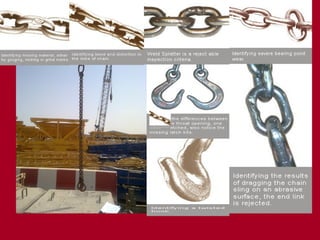
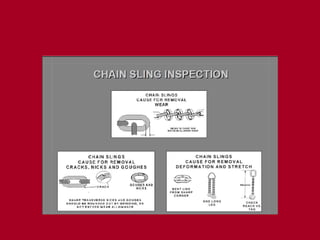
EXAMINATION OF CHAIN SLINGS
• THE SWL IS ADEQUATE FOR THE LOAD
• COLOR CODING AND ID ARE CLEAR.
• LAY OUT CHAIN SLINGS & REMOVE ALL TWISTS FROM
THE LEGS AND CHECK DEFORMATION AND
ELONGATION TO CONFIRM BY MATCHING THE LEGS.
• EXAMINE EACH INDIVIDUAL LEG CHECK FOR
DISTORSION, CORROSION, WEAR, ELONGATION AND
NICKS.
• CHECK FOR WEAR BETWEEN CHAIN LINKS AND
BETWEEN LOAD PINS AND SECURITY.
• CHECK FOR HEAT DAMAGE AND CHEMICAL ATTACKS.
• EXAMINE TERMINATIONS.EG HOOKS AND
CONNECTORS AND CHECK FOR WEAR, STRETCH AND
DISTORTION
• ENSURE SAFETY CATCHES FUNTION.
GRABIQ VIDEO
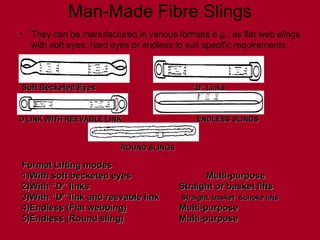
Man-Made Fibre Slings
• They can be manufactured in various formats e.g.: as flat web slings
with soft eyes, hard eyes or endless to suit specific requirements.
Soft Becketed Eyes
Soft Becketed Eyes “D” Links
“D” Links
D LINK WITH REEVABLE LINK
D LINK WITH REEVABLE LINK ENDLESS SLINGS
ENDLESS SLINGS
Format
Format Lifting modes
Lifting modes
1)With soft becketed eyes
1)With soft becketed eyes Multi-purpose
Multi-purpose
2)With “D” links
2)With “D” links Straight or basket lifts
Straight or basket lifts
3)With “D” link and reevable link
3)With “D” link and reevable link Straight, basket &choke lifts
Straight, basket &choke lifts
4)Endless (Flat webbing)
4)Endless (Flat webbing) Multi-purpose
Multi-purpose
5)Endless (Round sling)
5)Endless (Round sling) Multi-purpose
Multi-purpose
ROUND SLINGS
ROUND SLINGS
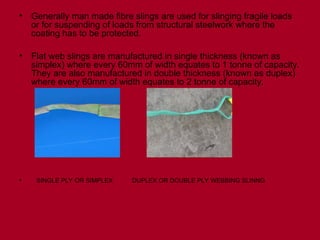
• Generally man made fibre slings are used for slinging fragile loads
or for suspending of loads from structural steelwork where the
coating has to be protected.
• Flat web slings are manufactured in single thickness (known as
simplex) where every 60mm of width equates to 1 tonne of capacity.
They are also manufactured in double thickness (known as duplex)
where every 60mm of width equates to 2 tonne of capacity.
• SINGLE PLY OR SIMPLEX DUPLEX OR DOUBLE PLY WEBBING SLINNG
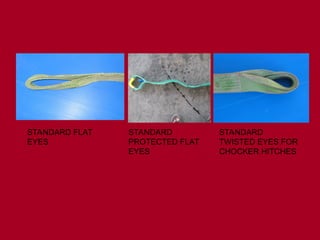
STANDARD FLAT
EYES
STANDARD
PROTECTED FLAT
EYES
STANDARD
TWISTED EYES FOR
CHOCKER HITCHES
• When describing your requirement for man made fibre slings, the
length of flat web slings is always taken as bearing point to bearing
point. However, when describing endless sling 'length', you must
always quote the circumference
• The majority of man made fibre slings are made from polyester.
Here follows a guide to their resistance to various chemicals and
conditions liable to be found in a hostile environment:
Agent Resistance
• acid :good
• alkali :poor
• water / steam :good
• long term exposure to dry heat :excellent
• oxidising agents :excellent
• reducing agents :excellent
• solvents :good
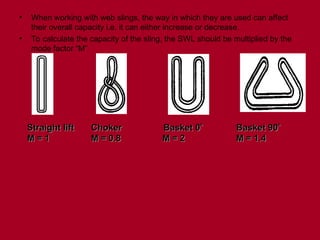
• When working with web slings, the way in which they are used can affect
their overall capacity i.e. it can either increase or decrease.
• To calculate the capacity of the sling, the SWL should be multiplied by the
mode factor “M”
Straight lift
Straight lift Choker Basket 0
Choker Basket 0
 Basket 90
Basket 90

M = 1
M = 1 M = 0.8
M = 0.8 M = 2
M = 2 M = 1.4
M = 1.4
USES OF WEBBING AND ROUND
SLINGS
• Flat woven webbing slings, sometimes referred to belt
slings, are soft to handle, pliable longitudinally whilst offering
rigidity across their width. These qualities make them ideal
for handling loads that require some support when being
lifted as the load is spread across their full width, unlike
ropes and chains that tend to have point contact with the
load. They are less robust and more easily damaged than
the equivalent capacity wire rope and chain slings.
• Roundslings are soft to handle and are completely pliable.
This makes them ideal for lifting delicate loads or loads with
polished surfaces. They are less robust and more easily
damaged than the equivalent capacity wire rope and chain
slings.
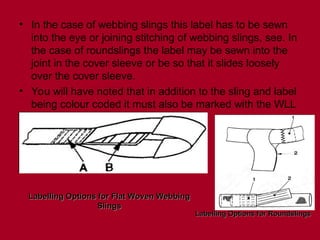
• In the case of webbing slings this label has to be sewn
into the eye or joining stitching of webbing slings, see. In
the case of roundslings the label may be sewn into the
joint in the cover sleeve or be so that it slides loosely
over the cover sleeve.
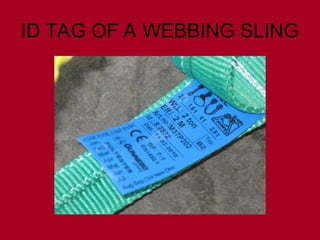
• You will have noted that in addition to the sling and label
being colour coded it must also be marked with the WLL
and the material.
Labelling Options for Flat Woven Webbing
Slings
Slings
Labelling Options for Roundslings
ID TAG OF A WEBBING SLING
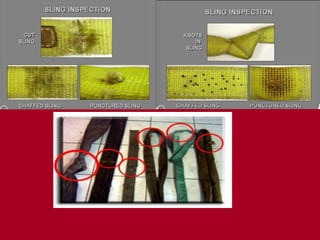
PRE USE EXAMINATION
• THE SWL IS ADEQUATE FOR THE LOAD
• COLOR CODING AND ID ARE CLEAR.
• CUTS, TEARS OR CHAFING
• BURST STICTCHING ESPECIALLY AROUND THE EYES.
• CHEMICAL DAMAGE
• ULTRAVIOLET DEGREDATION
• HEAT DAMAGE
• INGRESS OF FOREIGN BODIES INTO THE FIBRES LIKE
METAL PIECES ETC
• DISTORTION OR WEAR IN METAL EYES IF FITTED
WARNINGS
• ENSURE PACKING IS USED IN LIFTING
AROUND SHARP CORNERS
• DONOT STORE WEBBING SLINGS IN
OPEN SUN
• DONOT USE WEBBING SLINGS IF THE
TAG IS MISSING
• ANY CUTS ON ROUND SLINGS SLEEVES
SHOULD BE REMOVED FROM SERVICE
Video on slings
• Rigging video
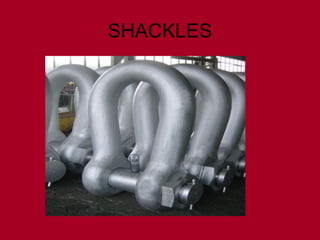
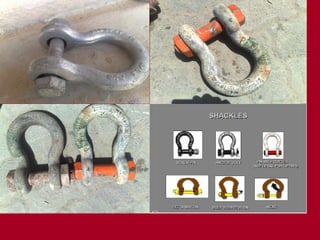
SHACKLES
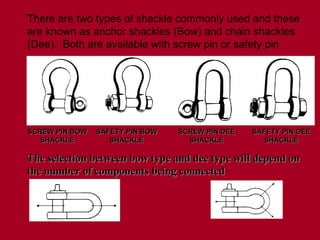
There are two types of shackle commonly used and these
are known as anchor shackles (Bow) and chain shackles
(Dee). Both are available with screw pin or safety pin
SCREW PIN BOW
SCREW PIN BOW
SHACKLE
SHACKLE
SAFETY PIN BOW
SAFETY PIN BOW
SHACKLE
SHACKLE
SCREW PIN DEE
SCREW PIN DEE
SHACKLE
SHACKLE
SAFETY PIN DEE
SAFETY PIN DEE
SHACKLE
SHACKLE
The selection between bow type and dee type will depend on
the number of components being connected
• The correct shackle body and pin must be used and they must be
of the same grade. Accidents have occurred where the user has
put a mild steel pin in an alloy steel body or replaced a screw pin
with a nut and bolt.
• The shackle must be compatible with all of the other fittings in the
slinging arrangement.
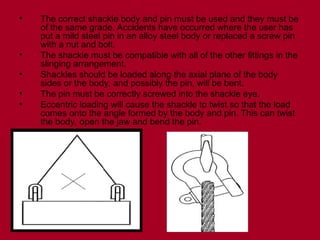
• Shackles should be loaded along the axial plane of the body
sides or the body, and possibly the pin, will be bent.
• The pin must be correctly screwed into the shackle eye.
• Eccentric loading will cause the shackle to twist so that the load
comes onto the angle formed by the body and pin. This can twist
the body, open the jaw and bend the pin.
PRE USE EXAMINATION
• THE SWL IS ADEQUATE FOR THE LOAD
• COLOR CODING AND ID ARE CLEAR.
• REMOVE SHACKLE PIN AND EXAMINE FOR WEAR
DEFORMATION AND CRACKING
• ENSURE THE PIN IS RIGHT FOR THE SHACKLE( Ie., NOT
A HIGHER TENSILE PIN IN AN ALLOY SHACKLE)
• CHECK PIN THREADS FOR WEAR AND DEFORMATION.
• EXAMINE SHACKLE BODY FOR DEFORMATION AND
CRACKING AND CHECK FOR WEAR IN CROWN AND PIN
HOLES
• ENSURE PIN FITS WELL
• ENSURE SPLIT PINS ARE FITTED FOR SAFETY PIN
SHACKLES
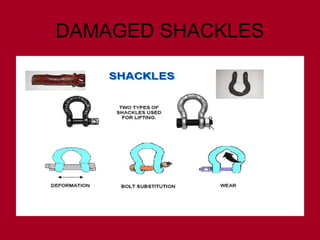
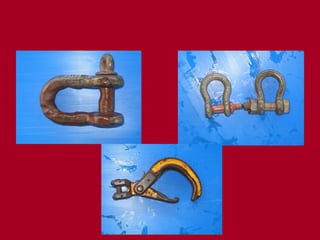
DAMAGED SHACKLES
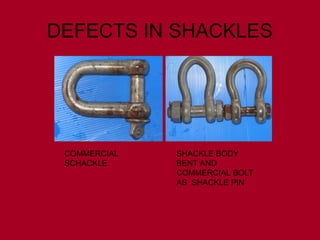
DEFECTS IN SHACKLES
COMMERCIAL
SCHACKLE
SHACKLE BODY
BENT AND
COMMERCIAL BOLT
AS SHACKLE PIN
EYEBOLT
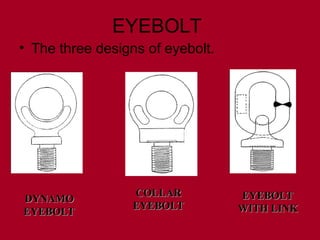
• The three designs of eyebolt.
DYNAMO
DYNAMO
EYEBOLT
EYEBOLT
COLLAR
COLLAR
EYEBOLT
EYEBOLT
EYEBOLT
EYEBOLT
WITH LINK
WITH LINK
• The Dynamo Eyebolt is the most basic in
design and the most limited in use, being
suitable for axial lifting only. Effectively it is
a ring sitting on top of the shank and has
only a small collar. Although it is limited to
axial loads, the eye is large enough to
accept a hook of the same capacity.
• Dynamo Eyebolts get their name from the
historical use to which they are put, being
fitted by electric motor manufacturers to the
tapped hole over the balanced lifting point
of the motor.
• Collar Eyebolts were for many years considered to be the general purpose
eyebolt and indeed they remain so for many thread diameters. The eye is
larger than that of the Dynamo pattern and is blended to the collar in one
plane. However, the eye is not large enough for direct connection to a hook
and it is necessary to use a shackle for connection to other components.
• When used in pairs of the same capacity, the plane of the eye of each
eyebolt must not be inclined to the plane containing the axis of the two
eyebolts by more than 5°. In order not to over stress the shank, this
alignment may be achieved by use of shims up to a maximum of half of one
thread in thickness. A reduction in the maximum load that may be lifted is
necessary due to the angular loading. This is far more drastic than is
required with the Eyebolt with Link so that, although in axial loading size for
size Collar Eyebolts have a higher SWL, the capacity when subject to
angular loads is far lower.
• EYEBOLT WITH LINK have a small, squat, eye which is blended
into the collar in all directions and a link is fitted to allow articulation
and connection with other lifting components. The link is designed to
accept a hook of the same capacity.
• Compared size for size with Collar Eyebolts, the SWL for axial load
is lower, in all other arrangements the SWL are relatively greater
than those of Collar Eyebolts when used in the same conditions.
Unlike the Collar Eyebolt, the load can be applied away from the
plane of the eye, as the link will articulate to align and the collar has
equal strength in all directions, making correct fitting easier.
• Provided that the angle of the load to the axis of the screw thread
does not exceed 15°, they may be loaded in any direction to the full
SWL rating. For greater angles, the load will decrease, however this
reduction is less drastic than with a Collar Eyebolt. In all respects
Eyebolts with Links can be considered the general purpose pattern
of eyebolt, to be used for lifting whenever the loading cannot be
confined to a single plane. They are however only produced in a
limited range of thread diameters, so limiting their application.
Eyebolts
• All eyebolts for lifting purposes should have collars.
• The face of the collar must be smooth, flat and at right
angles to the axis of the thread.
• Holes used for lifting should be used.
• Eyebolts must never be tightened other than by finger
pressure and no attempt must be made to ‘nip’ them
tight. Shims and washers are necessary to ensure
these conditions are met. Never use tommy bar to
tighten the eyebolt.
• If a single eyebolt is to be used for vertical lifting where
the load is liable to revolve or twist, the lifting appliance
must be fitted with a swivel type hook to prevent the
eyebolt unscrewing.
Pre use examination
• THE SWL IS ADEQUATE FOR THE LOAD
• COLOR CODING AND ID ARE CLEAR.
• CHECK THREADS FOR WEAR, STRETCH, IMPACT
DAMAGE.
• THREADS SHOULD BE CONCENTRIC AND MESH WELL
• CHECK FOR DISTORTION, WEAR, CRACKS IN THE EYE
• CHECK SHANK AGAINST THE COLLAR FOR
STRAIGHTNESS.
• EXAMINE TAPPED HOLE.
WARNINGS
• NEVER USE IN AXIAL LOADING ALONG
THE PLANE
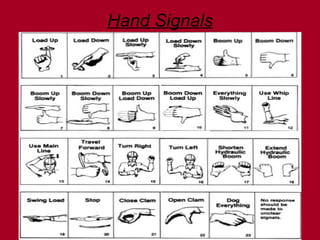
Hand Signals
Points to remember before
lifting
• 1 All lifts shall be planned and risk assessed by a
competent person
• 2 All lifts will be supervised
• 3 All lifts will be carried out safely
• 4 Weight of load / cargo to be established and
appropriate equipment chosen prior to any lift
commencing
• 5 All personnel must keep out of any area where
they may be injured by a falling or shifting load
• 6 No personnel may stand below, return below, or
stand on top of a suspended load
• 7 All personnel involved in the lifting operation must
ensure a route of escape and never stand between a
load and a wall / container / barrier etc.
• 8 Prior to any lift, a toolbox talk must be undertaken
with all personnel involved
• 9 No lift will be undertaken without a plan being in
place, (either generic or unique plan depending on lifting /
handling operation)
• 10 Immediately a lift deviates from the plan or an
unexpected complication arises, the lifting operation must
be stopped, made safe and reassessed. All personnel
must remain clear of the lift until reassessment / re-
planning of the lift has been carried out
• 11 Lifting / handling operations must be undertaken
by a minimum of three competent people. A crane
operator, a banksman / signaller and a load handler /
slinger. Additional personnel may be used as required
• 12 The banksman / signaller must be easily identifiable to
the crane operator from other personnel involved in the lifting
operation
• 13 The banksman / signaller must not touch the load. He
must ensure he has an unobstructed view of the load at all
times
• 14 The banksman / signaller must remain in
communication with the load handler / slinger and the crane
operator at all times
• 15 The banksman / signaller must keep the load handler /
slinger in sight during the lifting operation
• 16 The load handler / slinger must stand clear of a load
as it is lifted clear of the deck or ground, while it is being
landed, while slack is taken up and must confirm to the
banksman / slinger that he is clear
• 17 The load handler / slinger must not touch a load until
it is below his waist height as it is landed and must stand
clear of the load as it passes waist height during raising
• 18 The load handler / slinger must never attempt to
manually stop a swinging load
• 19 The load handler must be easily identifiable from the
banksman / signaller
• 20 For complicated and complex lifts a rigger must be
present as the competent supervisor of the lift
• 21 For complicated and complex lifts a written lift plan
and full risk assessment must be in place
• 22 Tandem lifts are automatically classed at least as a
complicated lift
• 23 Standard lifting equipment must not be used for man-
riding purposes except in exceptional circumstances
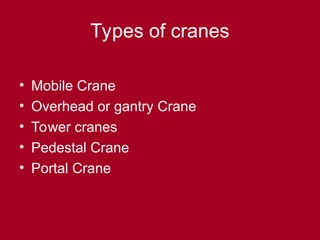
Types of cranes
• Mobile Crane
• Overhead or gantry Crane
• Tower cranes
• Pedestal Crane
• Portal Crane
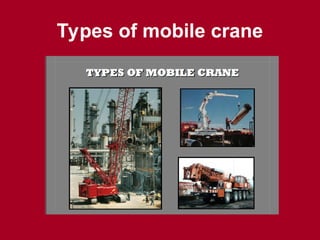
Types of mobile crane
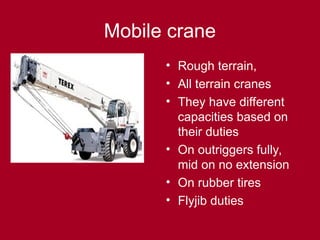
Mobile crane
• Rough terrain,
• All terrain cranes
• They have different
capacities based on
their duties
• On outriggers fully,
mid on no extension
• On rubber tires
• Flyjib duties
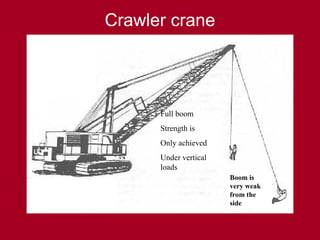
Crawler crane
Full boom
Strength is
Only achieved
Under vertical
loads
Boom is
very weak
from the
side
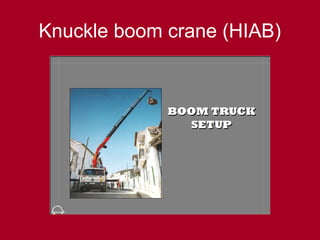
Knuckle boom crane (HIAB)
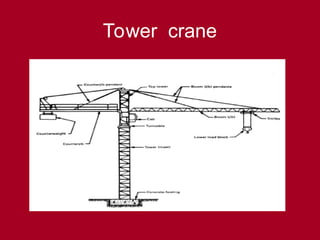
Tower crane
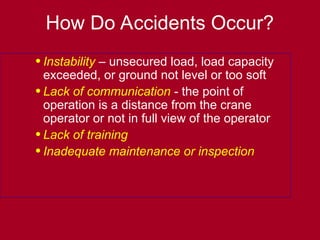
•Instability – unsecured load, load capacity
exceeded, or ground not level or too soft
•Lack of communication - the point of
operation is a distance from the crane
operator or not in full view of the operator
•Lack of training
•Inadequate maintenance or inspection
How Do Accidents Occur?
Definitions (crane model)
• Crane – Consists of a rotating structure for lifting and lowering
horizontally on rubber tires or crawler treads
• Hoist - Used to lift and lower load.
• Boom – An inclined spar, strut, or other long member supporting
the hoisting tackle
• Boom stops – A device used to limit the angle of the boom at its
highest position
• Brake – To slow or stop motion by friction or power
• Hook Block – Sheaves or grooved pulleys in a frame with hook,
eye and strap
• Radius –horizontal distance b/w center of slew and hook block.
• Boom angle-angle formed by the boom to the horizontal (ground
level)
• Jib – Extension attached to the boom point to provide added boom
length for lifting specified loads.
• Partlines / falls- no of ropes that the hook block is hanging off
from the boom tip.
Definitions
Rated capacity: Maximum load that can be safely handled by a
crane at a specified position and under specified conditions
NOTE The rated capacity is the "safe working load".
Rated capacity indicator: A device that automatically provides,
within a specified tolerance, warning that the load is
approaching rated capacity, and another warning when rated
capacity is exceeded
NOTE Rated capacity indicators are also known as automatic
safe load indicators.
Rated capacity limiter: device that automatically prevents, within a
specified tolerance, motions that could increase risks, if the
Rated capacity is exceeded.
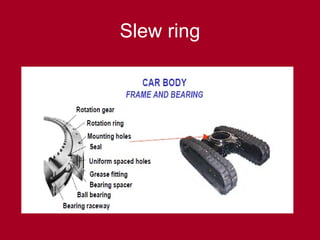
Slew ring
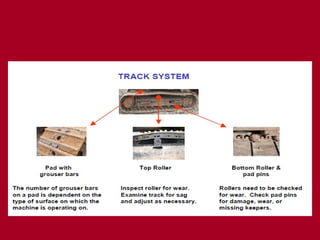
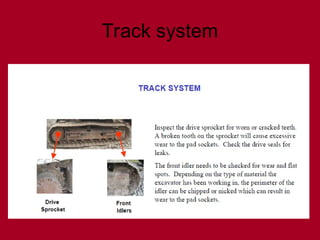
Track system
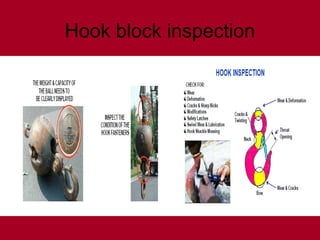
Hook block inspection
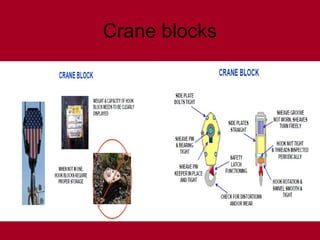
Crane blocks
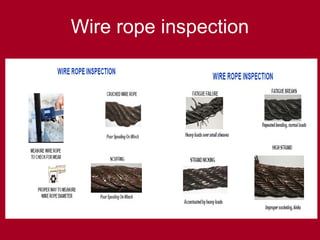
Wire rope inspection
Eccentric hook
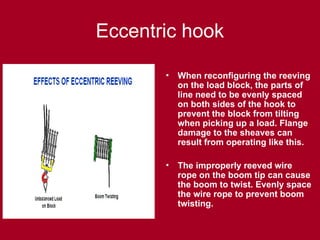
• When reconfiguring the reeving
on the load block, the parts of
line need to be evenly spaced
on both sides of the hook to
prevent the block from tilting
when picking up a load. Flange
damage to the sheaves can
result from operating like this.
• The improperly reeved wire
rope on the boom tip can cause
the boom to twist. Evenly space
the wire rope to prevent boom
twisting.
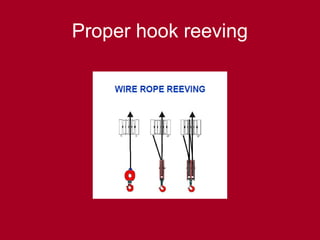
Proper hook reeving
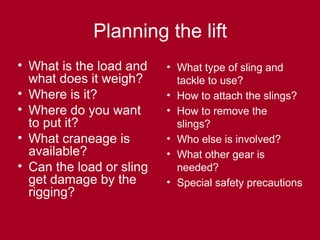
Planning the lift
• What is the load and
what does it weigh?
• Where is it?
• Where do you want
to put it?
• What craneage is
available?
• Can the load or sling
get damage by the
rigging?
• What type of sling and
tackle to use?
• How to attach the slings?
• How to remove the
slings?
• Who else is involved?
• What other gear is
needed?
• Special safety precautions
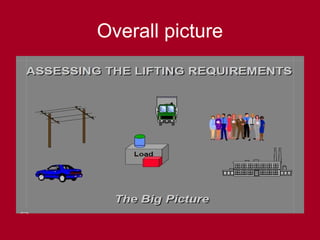
Overall picture
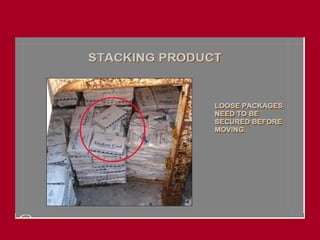
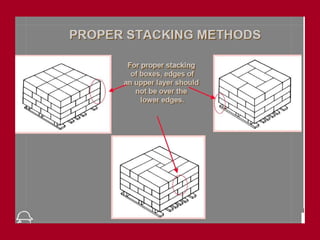
Load integrity
Accident video
• Dog and the crane
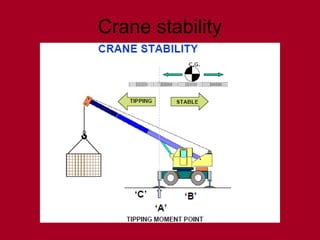
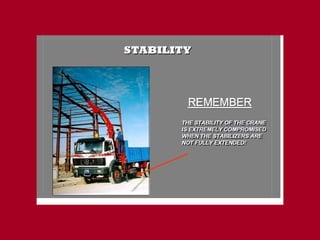
Crane stability
Crane stability
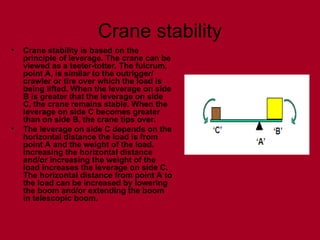
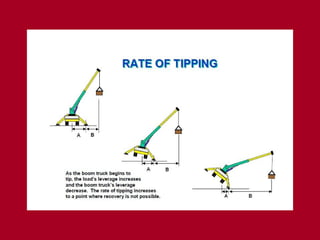
• Crane stability is based on the
principle of leverage. The crane can be
viewed as a teeter-totter. The fulcrum,
point A, is similar to the outrigger/
crawler or tire over which the load is
being lifted. When the leverage on side
B is greater that the leverage on side
C, the crane remains stable. When the
leverage on side C becomes greater
than on side B, the crane tips over.
• The leverage on side C depends on the
horizontal distance the load is from
point A and the weight of the load.
Increasing the horizontal distance
and/or increasing the weight of the
load increases the leverage on side C.
The horizontal distance from point A to
the load can be increased by lowering
the boom and/or extending the boom
in telescopic boom.
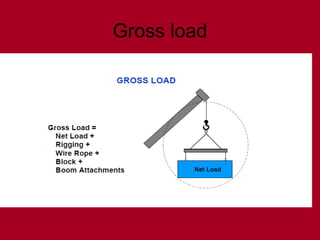
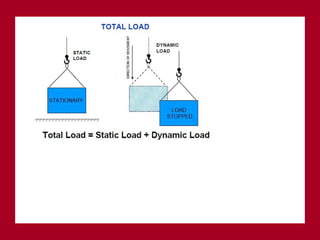
Gross load
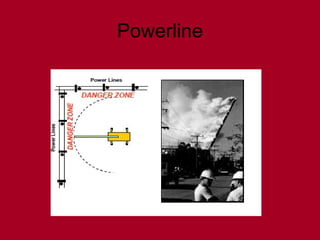
Powerline
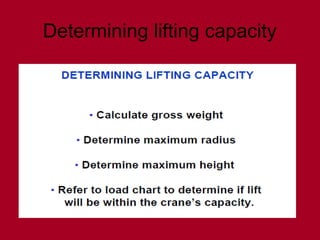
Determining lifting capacity
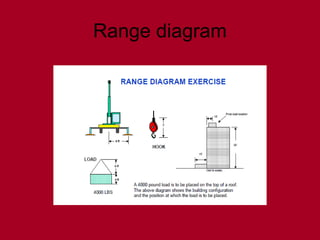
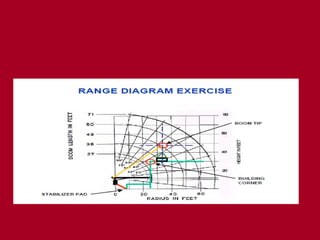
Range diagram
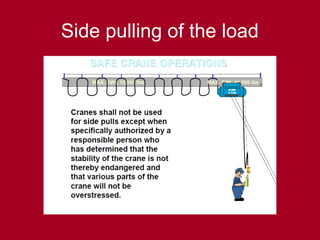
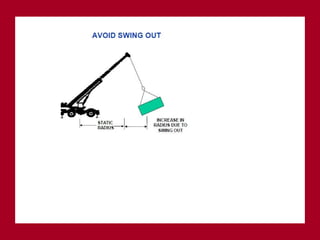
Side pulling of the load
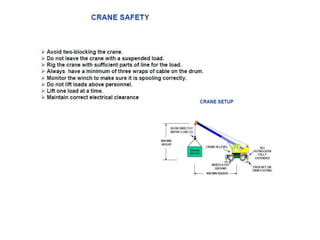
Crane safety
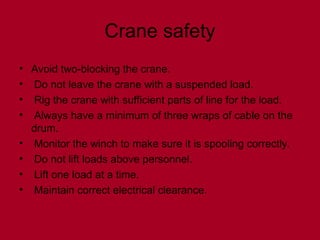
• Avoid two-blocking the crane.
• Do not leave the crane with a suspended load.
• Rig the crane with sufficient parts of line for the load.
• Always have a minimum of three wraps of cable on the
drum.
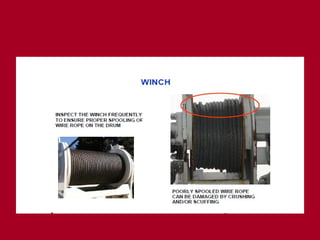
• Monitor the winch to make sure it is spooling correctly.
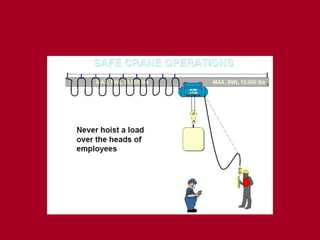
• Do not lift loads above personnel.
• Lift one load at a time.
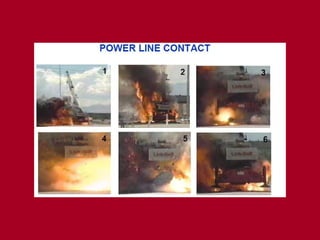
• Maintain correct electrical clearance.
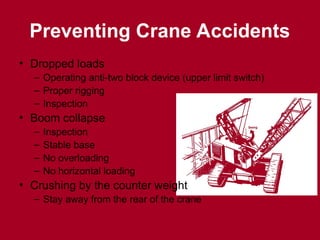
Preventing Crane Accidents
• Dropped loads
– Operating anti-two block device (upper limit switch)
– Proper rigging
– Inspection
• Boom collapse
– Inspection
– Stable base
– No overloading
– No horizontal loading
• Crushing by the counter weight
– Stay away from the rear of the crane
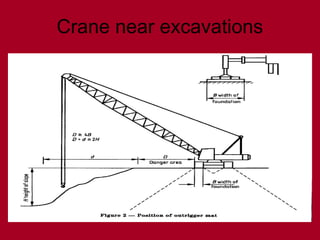
Crane near excavations
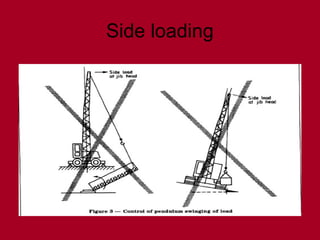
Side loading
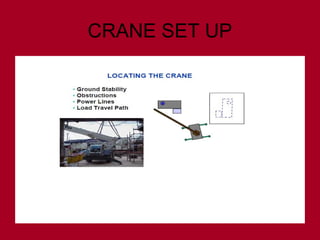
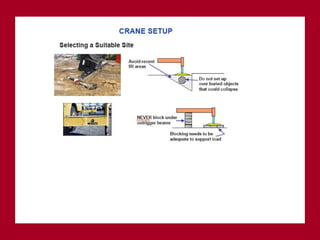
CRANE SET UP
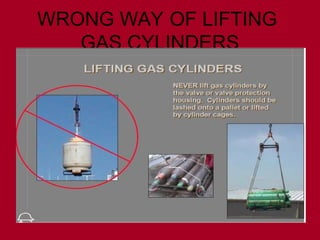
WRONG WAY OF LIFTING
GAS CYLINDERS
Crane load chart
• Grove load chart
ANY QUESTION
• THANK YOU

Rigging & Slinging. Lifting safety. Lifting operations

  • 1.
    OBJECTIVES • Lifting OperationsAnd LOLER 1998 (LOLER). • Definitions And Terminologies In Lifting Operation. • Types Of Lifts And Their Classification • Types Of Hitches And Angle Factors • Planning A Lift • Weight Load Calculation • Common Types Of Slings, Rigging Gear And Their Inspection • Lifting a Load • Load Charts And Tables • Crane Terminologies And Basic Load Chart Understanding
  • 2.
    DEFINITIONS • Lifting Equipment •Work equipment for lifting or lowering loads and including its attachments used for anchoring, fixing or supporting it. • Ex: chain hoist, cranes, fork trucks etc • Lifting Accessory (Lifting Gear) • work equipment used for attaching loads to machinery for lifting. • Ex: wire rope slings, shackles, webbing slings, eyebolts, swivels etc..
  • 3.
    DEFINITIONS • Operative – Anoperative is a trained person actually using the equipment. • Responsible Person – A Responsible Person is a person who has sufficient knowledge and training to enable him/her to recognise obvious defects and is responsible to his/her employer for the 'in-service' inspection of equipment.
  • 4.
    DEFINITIONS • Competent Person –A Competent Person is the person concerned with the testing, examination and certification of lifting equipment. – He/she should have such practical and theoretical knowledge and experience of the equipment which is to be tested, examined and certified that will enable him/her to detect defects or weaknesses which it is the purpose of the examination to discover and to assess their importance to the safety of the equipment. (Third party lifting Inspector)
  • 5.
    DEFINITIONS • In-service Inspection –In-service inspection is a visual inspection carried out by a Responsible Person to check for obvious signs of damage or wear which might affect the equipment's fitness for use.
  • 6.
    DEFINITIONS • Thorough Examination –A Thorough Examination is an examination carried out by a Competent Person carefully and critically, and where necessary supplemented by other means such as measurement and non- destructive testing, in order to detect damage or deterioration. – The period between thorough examinations shall be established by management on the basis of statutory requirements for the equipment, severity of service conditions, nature of the lifts, prior experience and the recommendation of the Competent Person. – In no case shall the period between thorough examinations exceed the statutory period.
  • 7.
    DEFINITIONS • Proof orTest Load – A load (mass or force) applied by the manufacturer or Competent Person for the purpose of a test. This load appears on test certificates. • Minimum Breaking (or Failure) Load (MBL) – The specified load (mass or force) below which the item of equipment does not fail either by fracture or distorting to such an extent that the load is released. • Mass Units are usually tonnes (t) • Force units are usually Newton (N)
  • 8.
    DEFINITIONS • Working LoadLimit (WLL) – The maximum load (mass) that an item of lifting equipment is designed to raise, lower or suspend. In some standards and documents the WLL is referred to as the 'maximum safe working load'. • Factor of Safety – The ratio between MBL and WLL identified on the test certificate as the Coefficient of Utilisation. – E.G. MBL = 5t, WLL = 1t F.O.S. = 5:1
  • 9.
    DEFINITIONS • Safe WorkingLoad (SWL) – The maximum load (mass), as assessed by a Competent Person, which an item of lifting equipment may raise, lower or suspend under the particular service conditions. The SWL will normally be the same as the working load limit or the maximum safe working load, where the term is used but it may be less. The SWL appears in statutory records.
  • 10.
    DEFINITIONS • Test Certificate –A certificate issued by the Competent Person giving details of tests, conducted on an item of lifting equipment.
  • 11.
    DEFINITIONS • Examination Report –A certificate issued by a Competent Person giving the results of the thorough examination including testing if appropriate. This will detail the defects found or include a statement that the item is fit safe to operate.
  • 12.
  • 13.
  • 14.
  • 15.
  • 16.
    UAE LAW Law governingINDUSTRIAL SAFETY AND LIFTING OPERATIONS enacted in 1982 in form of Ministerial Decree No. 32 for that year.
  • 17.
    Article (20) Cranes& Lifting Equipment • Following to be noted regarding lifting & pulling machines & tools: a. Cranes & lifts for men & materials shall be of sound construction & manufacture, regularly maintained & checked by a qualified technician at once ever 12 months. b. Area where lifts fitted shall be fenced in such way as to prevent access or egress while moving.
  • 18.
    c. Chains, ropes,wire ropes & other lifting equipment shall be continuously & completely maintained & checked by a qualified technician at least once every 6 months. d. The maximum capacity of machine / lift shall be displayed in a prominent position. e. An employee may not be asked to carry loads above his capacity, & in any case no load shall exceed 50kg per man & 20kg per woman, & where possible mechanical lifting equipment shall be used.
  • 19.
     Section (a):Qualified inspector defined by Ministry of Labour issuing approvals to carry out inspection & testing to certain organisations & personnel within it.  (Before using crane, loose lifting gear & points, ensure it is certified.)
  • 20.
    Periodicity of Examinations(LOLER) • Under LOLER, all lifting equipment & accessories examined & tested (where appropriate): before it is put to service for first time (unless it hasn’t been used before &/or it has an EC declaration of conformity less than 12 months old) after installation / assembly at new site (if safety of equipment is dependent on installation conditions)
  • 21.
    at specified intervalsdependent on operational circumstances as follows: • lifting equipment used for lifting persons – at least every 6 months • lifting accessories – at least every 6 months • any other lifting equipment – at least every 12 months each time exceptional circumstances which are liable to jeopardise safety of lifting equipment has occurred.
  • 22.
    Planning • Lifting /cargo handling operations – each job is different & for safety all have to be planned • Depth of planning increases with complexity of job • Numerous factors to be considered: weight of load position / height of centre of gravity stability of load
  • 23.
    size & shapeof load availability of dedicated lifting points on load availability of suitable rigging protection of rigging against sharp edges capacity of crane / hoisting equipment availability of certified anchor points / support steelwork available headroom route to be travelled obstructions
  • 24.
    maximum height loadhas to be lifted any dynamic factors hazards to other personnel number of banksmen required communication deck / floor capacity for landing load need for tag lines available light experience / competence of personnel
  • 25.
    Types of Lifts Routine Lifts: performed on regular basis – involves basic slinging practices – e.g. containers, etc. Planning: use of generic plans &/or toolbox talks usually adequate for this level of lifting operation
  • 26.
    • Simple Lifts:involve use of basic hoisting equipment directly above the head (e.g. – crane / manual hoist suspended from dedicated lifting structures such as pad eyes / runway beams). Load required to have certified lifting points / easy to sling Planning: use of generic plans &/or toolbox talks usually adequate for this level of lifting operation
  • 27.
     Complicated Lifts:difficult due to nature of load (e.g. awkward shape, offset / high centre of gravity, fragility, containing liquids, no lifting attachments / difficulty to sling, etc.) actual lifting operation / handling of lift may be difficult (e.g. may require to be rotated / cross-hauled involving two / more sets of rigging &/or tandem lifting with cranes). Planning: written plan with toolbox talks required
  • 28.
    • Complex Lifts:could be any of the above categories – additional hazards, i.e. lifting operations / conditions which would merit additional engg. input (e.g. extremely heavy loads, confined spaces, restricted headroom, lifting over unprotected plant / equipment & lifts involving divers / floating cranes, etc). Planning: written plan / job pack with toolbox talks required
  • 29.
    Activity 1. • Giveexamples of simple, routine, complicated and complex lifts. • Questions on LOLER 1998. • Case study on different loads and conditions.
  • 30.
    Slinger requirement 1. Either18years of age or under the direct supervision of competent person for training 2. In good health, eyesight, reflexes and agility and able to handle lifting accessories 3. Able to establish weights, balance loads, judge distances, heights and clearances 4. Trained in technique of slinging and selection of rigging material. 5. Able to give right hand signals and communicate the lifting operation 6. Capable of initiating and directing movement of crane and load.
  • 31.
    Exercise 10 Tonne 10Tonne 10 Tonne 10 Tonne
  • 32.
    Load on singleleg?? • Answer=10t 10 Tonne
  • 33.
    Capacity of thesling on choker 10 Tonne Answer =12.5t per leg
  • 34.
    Choke hitches With chokehitches the capacity of the sling is reduced to 80% its rated capacity Example: if the single leg sling capacity is 10t you can lift 8t on a choker with proper packing at the sharp corners.
  • 35.
    CHOCKER HITCH • Ensureproper packing to avoid kinks • Use shackle pin in the eye and not against the body of the sling. • Reduce the SWL appropriately • Don't increase the angle above 120deg by tightening the sling
  • 36.
  • 37.
    Single leg hitches Straightpull Straight pull M = 1.0 M = 1.0 Chocker hitch Chocker hitch M = 0.8 M = 0.8 BASKET HITCH BASKET HITCH MAX 90 DEG MAX 90 DEG M = 1.4 M = 1.4 BASKET HITCH BASKET HITCH MAX 90 DEG MAX 90 DEG M = 2.0 M = 2.0
  • 38.
    Load on eachleg?? Answer=5t per leg 10 Tonne
  • 39.
    Capacity of slingwhen used at and angle of 45° to the vertical • Answer= 7t/leg 10 Tonne
  • 40.
  • 42.
    Capacity of thechain on 2 leg choker 10 Tonne Answer =6.25t per leg
  • 43.
    Capacity of eachleg if used in the below configuration 10 Tonne Answer: =8.75t and above Choker hitch Two leg sling Single leg will take 70% of the load =7t Because the leg is used in choker the capacity is reduces to 80% = 7t / 0.8 =8.75t
  • 45.
  • 46.
    Different configuration ofslings Single leg Two leg at 45° to the vertical Three leg at 45° to the vertical Four leg at 45° to the vertical Basket hitch Choker hitch Basket hitch at 45° to the vertical SWL x1 SWL x1.4 SWL x2.1 SWL x2.1 SWL x2 SWL x.8 SWL x1.4 1t 1.4t 2.1t 2.1t 2t 0.8t 1.4t 2t 2.8t 4.2t 4.2t 4t 1.6t 2.8t 3t 4.2t 6.3t 6.3t 6t 2.4t 4.2t 4t 5.6t 8.4t 8.4t 8t 3.2t 5.6t 5t 7t 10.5t 10.5t 10t 4t 7t
  • 47.
    Double Leg andMultiple Slings Two-legged sling Two-legged sling Four-legged sling Four-legged sling Max 90 Max 90  Max 90 Max 90  M = 1.4 M = 1.4 M = 2.1 M = 2.1
  • 48.
    Methods of RatingLifting Slings Uniform Load Method • Single leg sling =1.0 x WLL of a single leg • 2 leg sling (0 to 45deg to the vertical) =1.4 x WLL of a single leg • 2 leg sling (45 to 60deg to the vertical) =1.0 x WLL of a single leg • 3 & 4 leg sling(0 to 45deg to the vertical)=2.1 x WLL of a single leg. • 4 leg sling (90 - 120) =1.5 x WLL of a single leg
  • 49.
    Basket hitches •Ensure properpacking to avoid damage to sling and load. •The mode factor is 2 in vertical legs basket hitch •Mode factor is 1.4 at 45deg to the vertical in an inclined basket hitch.
  • 50.
  • 51.
  • 52.
  • 53.
  • 54.
    Activity 2 • Calculationsof sling angles and sling usage.
  • 55.
  • 56.
    Center Of Gravity •Center of gravity is the point around which an object’s weight is evenly balanced. The entire weight may be concentrated at this point. • It is always important to rig the load so that it is stable. For this the load’s centre of gravity must be directly under the main hook and below the lowest sling attachment point before the load is lifted. • A suspended object will always move until its centre of gravity is directly below its suspension point. To make a level or stable lift, the crane hook block must be directly above this point before the load is lifted as shown below.
  • 57.
    Center of gravity •For load stability it is important to ensure that the support points of a load (i.e. where the slings are attached to the load) lie above its centre of gravity. • Under suspension, an object’s centre of gravity will always seek the lowest level below the point of support. The load will be stable if the attachments are above the centre of gravity as shown below. • With odd shaped objects, the centre of gravity can be difficult to locate. In such cases the rigger must guess where it lies, rig accordingly and signal for a trial lift. The centre of gravity will lie somewhere along a line drawn vertically from the hook down through the load. The rigger than adjust the slings accordingly to balance the load. If any load tilts more than 5º after it is lifted clear of the ground it should be landed and rigged over again.
  • 58.
    Centre of Gravity A B C Centresof Gravity for each part Centre of Gravity for the whole load
  • 59.
    Offset load • Loadon sling 1 • =L x Distance of CG from sling2 • distance b/w lifting points 10t x 2m = 2t 10m • Load on sling 2 • L x Distance of CG from sling1 • distance b/w lifting points 10t x 8m = 8t 10m
  • 60.
    Exercise 20t • Load onsling 1 • =L x Distance of CG from sling2 • distance b/w lifting points 20t x 2m = 4t 10m • Load on sling 2 • L x Distance of CG from sling1 • distance b/w lifting points 20t x 8m = 16t 10m
  • 61.
    Lifting Points • Inpractice, unlikely that total load will be evenly distributed amongst all lifting points. • Actual load distribution will depend on a number of factors including construction of plant (e.g. flexibility of structure, sling length, tolerances etc.).
  • 62.
    • It isrecommended to assume that in a 4 point lift situation, 75% of the load is distributed between two diagonally opposite legs, the third leg supports 25% of the load & the fourth leg is redundant. • This equates to a possible increase in load on each lifting point of 50%. • Hence each lifting point shall have a rated load of not less than 1.5 times the share of the load which it is intended to take when the load is applied vertically.
  • 63.
    Moving a Load •Centre the hook over the CG of the load. Ensure correct spooling of rope, prevent load from swinging when it is lifted. • Use a tag line when loads must traverse long distances or must otherwise be controlled. Manila rope may be used for tag lines.
  • 64.
    • Plan &check the travel path to avoid personnel & obstructions. • Lift the load only high enough to clear the tallest obstruction in the travel path. • Start and stop slowly. • Land the load when the move is finished. Choose a safe landing.
  • 65.
    • NEVER leavesuspended loads unattended. In an emergency where the crane / hoist has become inoperative & if a load must be left suspended, barricade & post signs in the surrounding area, under the load & on all four sides. Lock open & tag the crane / hoist's main electrical disconnect switch.
  • 66.
    Never leave asuspended load
  • 67.
    67 Weight Estimation • Itis the responsibility of the slinger /Operator to check the established weight of the load to be lifted, or if it has not been established, to evaluate it himself. • It is on the basis of this estimate that the appropriate tackle is chosen.
  • 68.
  • 69.
    • 1 metricton = 2204 lbs • 1 us ton = 2000 lbs Material Density kg/m3 Density lbs/ft3 Aluminum 2725 170 Iron 7690 480 Steel 7850 490 Oil 810 50 Lead 11350 708 Paper 1130 70 Water 1025 64 Wood 800 50 Conversions and density Conversions and density
  • 70.
    70 Weight Estimation • Guidanceas follows:- – Look to see if the weight is marked on the load. If it is, check to ensure that it is the weight of all parts of the load. – Check the weight stated on any documentation. – If the load is still on a trailer or truck, weigh it. – Estimate the weight of the load using a table of weights. – When dealing with a hollow body, check whether it contains anything.
  • 71.
    71 Weight Estimation • 1imperial ton = 2240 lbs. =1016 Kg.) • 1 metric tonne = 2204lbs =1000 Kg. • 1 American Ton = 2000 lbs. =907 Kg) • 1 Litre of water = 1 Kg. • 1 Gallon of water = 10 Lbs. (4.54 Kg.)
  • 72.
    72 2 m. 3 m. 4m. WeightEstimation. • The formula for estimating the weight of concrete block : Volume=Length x Breadth x Height Weight=volume x density Volume = 4 x 3 x 2 = 24 cubic m. Density=2500kgs / cubic m. Weight= volume x density Weight = 24 m3 x 2500kg/m3 . weight=60,000 kg=60 metric ton
  • 73.
    Calculation of ahollow steel cylinder D t d L Volume of the cylinder= 3.14 x L(D2- d2 ) 4 = 3.14 x L(D + d) (D – d ) 4 we know D-d =2t and d=D-2t hence: = 3.14xLxt(D-t) Weight of the hollow cylinder block = Volume x density
  • 74.
    Weight of ahollow steel cylinder 1m 0.125m 0.75 m 4m Weight = volume x density Volume of the hollow cylinder= 3.14 x L x t x (D-t) We know D=1m D=0.75m t=0.125m L=4m 3.14 x 4 x 0.125 x (1-0.125) =1.37 m3 Density of steel = 7850 kg/m3 Block weight= 1.37 x 7850 =10754.5 kg = 10.754t
  • 75.
    Complex shapes • Calculatethe weight as a single block • Volume =9x6x2 • 108 ft3 • If it is wood • wood density=22.7kg/ft3. • Total weight= v x d • 108 x 22.7 • =2451 kg
  • 76.
    Activity 3 • Calculationof a 3 steel plates lifted together. • Container crash unit inspection.
  • 77.
  • 78.
    Different kinds oflifting accessories • Steel wire rope sling • Chain sling • Webbing sling • Nylon endless sling • Shackles • Eyebolts • Lifting beams
  • 79.
    Wire Rope slings •The construction of wire rope consists of individual steel wires spun into a number of strands, which are in turn laid helically around a central core King Wire King Wire Inner Wires Inner Wires Outer Wires Outer Wires CORE CORE Strand Strand
  • 80.
    There are twotypes of core, 1.FIBRE CORE 2.STEEL ROPE, Fibre cores can be constructed from natural or man- made fibre such as polypropylene, have the advantage that they neither absorb nor retain moisture. Steel cores usually comprise, an independent wire rope core (IWRC) around which the outer strands are laid. A rope with a steel core is stronger than a rope with a fibre core and is much more resistant to deformation, crushing and stretch. The fibre core releases lubricant internally when stretched
  • 81.
    • Ordinary Layor Regular Lay An ordinary lay rope is one in which the strand wires are laid in one direction and the completed strands laid in the opposite direction Rope Lay Rope Lay Strand Lay Strand Lay
  • 82.
    Lang's Lay This ropeis one in which the strand wires are laid in the same direction as the strands in the rope The Lang's lay rope exposes the outer wires for a longer length and therefore has better wear properties than ordinary lay rope. Rope Lay Rope Lay Strand Lay Strand Lay
  • 83.
    The ordinary layrope is easier to handle, more resistant to crushing and distortion and is the more commonly used. The majority of ropes are of right-hand lay, although occasionally left-hand lay ropes can be supplied. The direction of rope lay is important, to ensure correct coiling and spooling of the rope .
  • 84.
    Measuring rope diameter Correct Correct Incorrect Incorrect Shouldyou be re-ordering rope, ensure you measure Should you be re-ordering rope, ensure you measure the rope correctly to avoid being supplied with an the rope correctly to avoid being supplied with an UNDER-SIZED rope. UNDER-SIZED rope.
  • 85.
    Before Swaging Before SwagingAfter Swaging After Swaging There are various methods of terminating a wire rope, the most There are various methods of terminating a wire rope, the most popular being an aluminium alloy ferrule secured eye. This is popular being an aluminium alloy ferrule secured eye. This is where a wire rope is passed through the oval shaped ferrule, where a wire rope is passed through the oval shaped ferrule, formed into a loop and passed back through the ferrule where formed into a loop and passed back through the ferrule where upon the ferrule is compressed to a cylindrical shape. This is a upon the ferrule is compressed to a cylindrical shape. This is a purely mechanical splice purely mechanical splice
  • 87.
    Flemish eye • Thismethod of making an eye actually produces a stronger securing than the turn back loop, ie the termination is more efficient. • To make a Flemish eye, a tapered steel ferrule is passed over the rope. The standing part of the rope is then taken and three strands are unravelled and opened so that a ‘Y’ formation is made. • The leg of the ‘Y’ that includes the core is bent to form an eye so that the ends of the strands sit against the undisturbed part of the rope at the bottom of the ‘Y’. The remaining three strands are then re-laid into the rope in the opposite direction, taking up the position they originally had in the rope so that the lay of the strands is not disturbed. The ends of the strands are then evenly distributed around the intact standing part of the rope to complete the eye. The ferrule is then slid back over the distributed wires without displacing the strands and then pressed. In this case the ferrule compresses and grips the rope.
  • 88.
    Different sling terminations ThimbleThimble Mechanical splice Thimble Reeving thimble Thimble Soft eye Soft eye soft eye Soft eye soft eye Endless sling Endless sling
  • 89.
    • Flemish Softeyes with steel ferrule • Mechanical turnaround loop soft eye with aluminum ferrule.
  • 90.
    Thimble eye withaluminum ferrule
  • 91.
  • 92.
    • As wellas single leg options, they can be supplied as double leg slings fitted to a single link (known as a master-link) or as multi-leg slings (3 or 4 legs) fitted to a master link assembly (known as a quadruple assembly)
  • 93.
    • Slings mustnot be used to lift loads greater than the marked SWL, taking account of the slinging mode and resultant loads that may be imposed. • The sling should be compatible with the lifting appliance, it must also be compatible with the load and any other lifting accessories in the lifting arrangement, both in capacity and physical size. Master links and eyes should seat correctly in the hook of the appliance and articulate freely to avoid deforming the link or eye. In the same way, the load, or its attachments, must seat in the eyes or terminal fittings, eg sling hooks. • Under no circumstances must slings made from rope of different lay directions be joined together. This will cause the rope to unlay and become distorted. USING WIRE ROPE SLINGS USING WIRE ROPE SLINGS
  • 94.
    • Under nocircumstances should the radius formed be less than four times the rope diameter. Suitable packing should also be used. If this is not done the rope will be permanently kinked, crushed or, at worst, cut. In any event a sling that is repeatedly taken around corners and than loaded will take on a set, this may make the sling difficult to handle but will only be harmful if other damage is done to the rope. • Shock loading must be avoided otherwise the core or inner wires will become damaged.
  • 95.
    EXAMINATION • THE SWLIS ADEQUATE FOR THE LOAD • COLOR CODING AND ID ARE CLEAR. • EXAMINE EACH INDIVIDUAL LEG,CHECK FOR CORROSION, WEAR, ABRASION AND MECH DAMAGE AND BROKEN WIRES • EXAMINE EACH FERRULE FOR CRACKS AND DAMAGE. CHECK THE END OF ROPE PROTUDES SLIGHTLY NOT MORE THAN HALF THE DIA • CHECK THIMBLES FOR DAMAGE AND ELONGATION , CORRECT FITTING.(STRECHTED THIMBLES COULD INDICATE OVERLOAD) • WIRE ROPE WEAR ESPECIALLY AROUND THIMBLES • CHECK TERMINATIONS LIKE MASTER LINKS AND HOOKS FOR DAMAGE, CRACKS, NICKS, CORROSION AND SAFETY CATCH.
  • 96.
  • 111.
    Chain Slings andFittings • Alloy grade 80 chain slings were developed to replace the older mild steel and high tensile chain slings • Grade 80 chain slings are constructed from individual components which can be assembled in numerous configurations to suit the task in hand.
  • 112.
  • 113.
    CHAIN SLINGS Single Leg SingleLeg Endless Endless Double Leg WithClutches Double Leg WithClutches
  • 114.
    Three Leg Three LegFour Leg Four Leg With Clutches With Clutches Barrel Sling Barrel Sling The rating of chain slings is based on the uniform load method which The rating of chain slings is based on the uniform load method which give the following results: give the following results: Single leg sling Single leg sling =1.0 x SWL of a single leg =1.0 x SWL of a single leg Double leg sling Double leg sling =1.4 x SWL of a single leg =1.4 x SWL of a single leg from 0° to 90° from 0° to 90° Three and Four leg sling Three and Four leg sling =2.1 x SWL of a single leg =2.1 x SWL of a single leg from 0° to 90° from 0° to 90° Double leg sling Double leg sling =1.0 x SWL of a single leg =1.0 x SWL of a single leg from 90° to 120° from 90° to 120° Four leg sling Four leg sling =1.5 x SWL of a single leg =1.5 x SWL of a single leg from 90° to 120° from 90° to 120° Note: Note: When a chain sling or sling assembly is rigged in specific ways, When a chain sling or sling assembly is rigged in specific ways, it may be necessary to reduce the safe working load. it may be necessary to reduce the safe working load.
  • 115.
    • Grade 80chain slings, although approximately one third of the weight of the high tensile type, are still strength for strength heavier than wire rope slings but have three main advantages namely: • 1) Greater resistance to corrosion • 2) More durable • 3) Adjustable leg lengths (for loads with an offset centre of gravity The only drawback is that they cannot be pushed under the load as is possible with a wire rope sling. Chain slings fitted with shortening Chain slings fitted with shortening clutches are ideal for lifting loads with clutches are ideal for lifting loads with an offset centre of gravity as the leg an offset centre of gravity as the leg length can be adjusted to position the length can be adjusted to position the lifting ring directly over the centre of lifting ring directly over the centre of gravity. This allows the load to be gravity. This allows the load to be lifted level. lifted level. ADVANTAGES ADVANTAGES
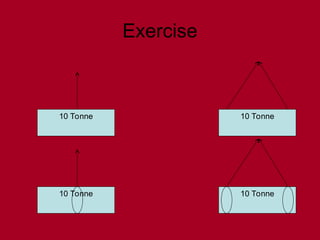
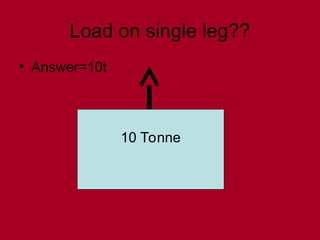
  • 116.
    PROPER PACKING ATSHARP CORNERS
  • 117.
    Use of chainslings • The sling MUST be compatible with the lifting appliance, it must also be compatible with the load and any other lifting accessories in the lifting arrangement, both in capacity and physical size. • The master link should seat correctly in the hook of the appliance and articulate freely to avoid deforming the link. In the same way, the load, or its attachments, must seat in the sling hooks, never on the point, and allow the hook to align to avoid opening the throat or deforming the hook.
  • 118.
    • Where chainis tensioned across an edge or corner it must be suitably packed. If these simple measures are ignored the chain will be over stressed locally, resulting in stretched, bent or broken links. • Hooks of multi-leg slings must be positioned to face outwards or the load will sit on the point, which will lead to overloading the hook and opening the throat. • If placing the hooks back onto the master link to form a basket hitch, the link must be large enough to accept the hook without overcrowding fittings and components as this will lead to distortion and/or bruising and gouging. • If a sling is to be used in choke hitch, the parts of the sling should be placed in the natural 120º angle, or they will slide to that position. Neither must the sling bight be tightened by hammering into position. This will cause stretched or bent links and, in the worse case, cracked welds. • Shock loading must be avoided otherwise the sling, or parts of the sling, will be grossly overloaded causing stretch or distortion. • Care must be taken when landing the load to ensure it does not sit or trap the chain. This can cause stretched, bent or otherwise damaged links.
  • 119.
    EXAMINATION OF CHAINSLINGS • THE SWL IS ADEQUATE FOR THE LOAD • COLOR CODING AND ID ARE CLEAR. • LAY OUT CHAIN SLINGS & REMOVE ALL TWISTS FROM THE LEGS AND CHECK DEFORMATION AND ELONGATION TO CONFIRM BY MATCHING THE LEGS. • EXAMINE EACH INDIVIDUAL LEG CHECK FOR DISTORSION, CORROSION, WEAR, ELONGATION AND NICKS. • CHECK FOR WEAR BETWEEN CHAIN LINKS AND BETWEEN LOAD PINS AND SECURITY. • CHECK FOR HEAT DAMAGE AND CHEMICAL ATTACKS. • EXAMINE TERMINATIONS.EG HOOKS AND CONNECTORS AND CHECK FOR WEAR, STRETCH AND DISTORTION • ENSURE SAFETY CATCHES FUNTION.
  • 122.
  • 123.
    Man-Made Fibre Slings •They can be manufactured in various formats e.g.: as flat web slings with soft eyes, hard eyes or endless to suit specific requirements. Soft Becketed Eyes Soft Becketed Eyes “D” Links “D” Links D LINK WITH REEVABLE LINK D LINK WITH REEVABLE LINK ENDLESS SLINGS ENDLESS SLINGS Format Format Lifting modes Lifting modes 1)With soft becketed eyes 1)With soft becketed eyes Multi-purpose Multi-purpose 2)With “D” links 2)With “D” links Straight or basket lifts Straight or basket lifts 3)With “D” link and reevable link 3)With “D” link and reevable link Straight, basket &choke lifts Straight, basket &choke lifts 4)Endless (Flat webbing) 4)Endless (Flat webbing) Multi-purpose Multi-purpose 5)Endless (Round sling) 5)Endless (Round sling) Multi-purpose Multi-purpose ROUND SLINGS ROUND SLINGS
  • 124.
    • Generally manmade fibre slings are used for slinging fragile loads or for suspending of loads from structural steelwork where the coating has to be protected. • Flat web slings are manufactured in single thickness (known as simplex) where every 60mm of width equates to 1 tonne of capacity. They are also manufactured in double thickness (known as duplex) where every 60mm of width equates to 2 tonne of capacity. • SINGLE PLY OR SIMPLEX DUPLEX OR DOUBLE PLY WEBBING SLINNG
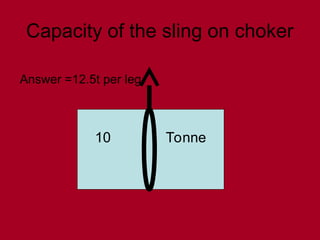
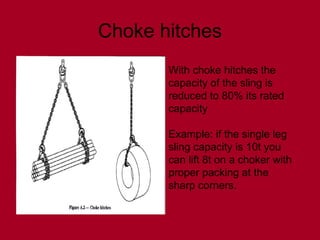
  • 125.
  • 126.
    • When describingyour requirement for man made fibre slings, the length of flat web slings is always taken as bearing point to bearing point. However, when describing endless sling 'length', you must always quote the circumference • The majority of man made fibre slings are made from polyester. Here follows a guide to their resistance to various chemicals and conditions liable to be found in a hostile environment: Agent Resistance • acid :good • alkali :poor • water / steam :good • long term exposure to dry heat :excellent • oxidising agents :excellent • reducing agents :excellent • solvents :good
  • 127.
    • When workingwith web slings, the way in which they are used can affect their overall capacity i.e. it can either increase or decrease. • To calculate the capacity of the sling, the SWL should be multiplied by the mode factor “M” Straight lift Straight lift Choker Basket 0 Choker Basket 0  Basket 90 Basket 90  M = 1 M = 1 M = 0.8 M = 0.8 M = 2 M = 2 M = 1.4 M = 1.4
  • 128.
    USES OF WEBBINGAND ROUND SLINGS • Flat woven webbing slings, sometimes referred to belt slings, are soft to handle, pliable longitudinally whilst offering rigidity across their width. These qualities make them ideal for handling loads that require some support when being lifted as the load is spread across their full width, unlike ropes and chains that tend to have point contact with the load. They are less robust and more easily damaged than the equivalent capacity wire rope and chain slings. • Roundslings are soft to handle and are completely pliable. This makes them ideal for lifting delicate loads or loads with polished surfaces. They are less robust and more easily damaged than the equivalent capacity wire rope and chain slings.
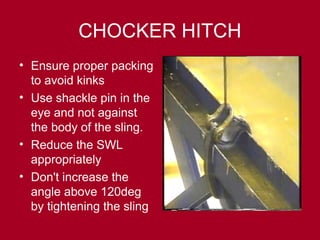
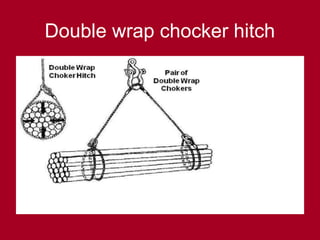
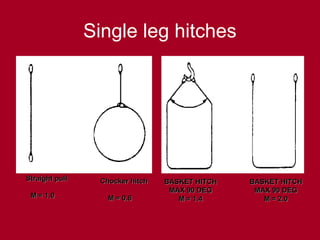
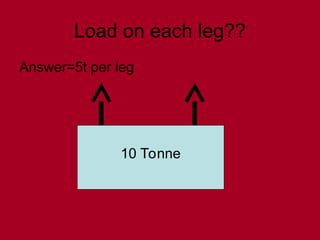
  • 129.
    • In thecase of webbing slings this label has to be sewn into the eye or joining stitching of webbing slings, see. In the case of roundslings the label may be sewn into the joint in the cover sleeve or be so that it slides loosely over the cover sleeve. • You will have noted that in addition to the sling and label being colour coded it must also be marked with the WLL and the material. Labelling Options for Flat Woven Webbing Labelling Options for Flat Woven Webbing Slings Slings Labelling Options for Roundslings Labelling Options for Roundslings
  • 130.
    ID TAG OFA WEBBING SLING
  • 131.
    PRE USE EXAMINATION •THE SWL IS ADEQUATE FOR THE LOAD • COLOR CODING AND ID ARE CLEAR. • CUTS, TEARS OR CHAFING • BURST STICTCHING ESPECIALLY AROUND THE EYES. • CHEMICAL DAMAGE • ULTRAVIOLET DEGREDATION • HEAT DAMAGE • INGRESS OF FOREIGN BODIES INTO THE FIBRES LIKE METAL PIECES ETC • DISTORTION OR WEAR IN METAL EYES IF FITTED
  • 132.
    WARNINGS • ENSURE PACKINGIS USED IN LIFTING AROUND SHARP CORNERS • DONOT STORE WEBBING SLINGS IN OPEN SUN • DONOT USE WEBBING SLINGS IF THE TAG IS MISSING • ANY CUTS ON ROUND SLINGS SLEEVES SHOULD BE REMOVED FROM SERVICE
  • 134.
    Video on slings •Rigging video
  • 135.
  • 136.
    There are twotypes of shackle commonly used and these are known as anchor shackles (Bow) and chain shackles (Dee). Both are available with screw pin or safety pin SCREW PIN BOW SCREW PIN BOW SHACKLE SHACKLE SAFETY PIN BOW SAFETY PIN BOW SHACKLE SHACKLE SCREW PIN DEE SCREW PIN DEE SHACKLE SHACKLE SAFETY PIN DEE SAFETY PIN DEE SHACKLE SHACKLE The selection between bow type and dee type will depend on The selection between bow type and dee type will depend on the number of components being connected the number of components being connected
  • 137.
    • The correctshackle body and pin must be used and they must be of the same grade. Accidents have occurred where the user has put a mild steel pin in an alloy steel body or replaced a screw pin with a nut and bolt. • The shackle must be compatible with all of the other fittings in the slinging arrangement. • Shackles should be loaded along the axial plane of the body sides or the body, and possibly the pin, will be bent. • The pin must be correctly screwed into the shackle eye. • Eccentric loading will cause the shackle to twist so that the load comes onto the angle formed by the body and pin. This can twist the body, open the jaw and bend the pin.
  • 138.
    PRE USE EXAMINATION •THE SWL IS ADEQUATE FOR THE LOAD • COLOR CODING AND ID ARE CLEAR. • REMOVE SHACKLE PIN AND EXAMINE FOR WEAR DEFORMATION AND CRACKING • ENSURE THE PIN IS RIGHT FOR THE SHACKLE( Ie., NOT A HIGHER TENSILE PIN IN AN ALLOY SHACKLE) • CHECK PIN THREADS FOR WEAR AND DEFORMATION. • EXAMINE SHACKLE BODY FOR DEFORMATION AND CRACKING AND CHECK FOR WEAR IN CROWN AND PIN HOLES • ENSURE PIN FITS WELL • ENSURE SPLIT PINS ARE FITTED FOR SAFETY PIN SHACKLES
  • 140.
  • 141.
    DEFECTS IN SHACKLES COMMERCIAL SCHACKLE SHACKLEBODY BENT AND COMMERCIAL BOLT AS SHACKLE PIN
  • 143.
    EYEBOLT • The threedesigns of eyebolt. DYNAMO DYNAMO EYEBOLT EYEBOLT COLLAR COLLAR EYEBOLT EYEBOLT EYEBOLT EYEBOLT WITH LINK WITH LINK
  • 144.
    • The DynamoEyebolt is the most basic in design and the most limited in use, being suitable for axial lifting only. Effectively it is a ring sitting on top of the shank and has only a small collar. Although it is limited to axial loads, the eye is large enough to accept a hook of the same capacity. • Dynamo Eyebolts get their name from the historical use to which they are put, being fitted by electric motor manufacturers to the tapped hole over the balanced lifting point of the motor.
  • 145.
    • Collar Eyeboltswere for many years considered to be the general purpose eyebolt and indeed they remain so for many thread diameters. The eye is larger than that of the Dynamo pattern and is blended to the collar in one plane. However, the eye is not large enough for direct connection to a hook and it is necessary to use a shackle for connection to other components. • When used in pairs of the same capacity, the plane of the eye of each eyebolt must not be inclined to the plane containing the axis of the two eyebolts by more than 5°. In order not to over stress the shank, this alignment may be achieved by use of shims up to a maximum of half of one thread in thickness. A reduction in the maximum load that may be lifted is necessary due to the angular loading. This is far more drastic than is required with the Eyebolt with Link so that, although in axial loading size for size Collar Eyebolts have a higher SWL, the capacity when subject to angular loads is far lower.
  • 146.
    • EYEBOLT WITHLINK have a small, squat, eye which is blended into the collar in all directions and a link is fitted to allow articulation and connection with other lifting components. The link is designed to accept a hook of the same capacity. • Compared size for size with Collar Eyebolts, the SWL for axial load is lower, in all other arrangements the SWL are relatively greater than those of Collar Eyebolts when used in the same conditions. Unlike the Collar Eyebolt, the load can be applied away from the plane of the eye, as the link will articulate to align and the collar has equal strength in all directions, making correct fitting easier. • Provided that the angle of the load to the axis of the screw thread does not exceed 15°, they may be loaded in any direction to the full SWL rating. For greater angles, the load will decrease, however this reduction is less drastic than with a Collar Eyebolt. In all respects Eyebolts with Links can be considered the general purpose pattern of eyebolt, to be used for lifting whenever the loading cannot be confined to a single plane. They are however only produced in a limited range of thread diameters, so limiting their application.
  • 147.
    Eyebolts • All eyeboltsfor lifting purposes should have collars. • The face of the collar must be smooth, flat and at right angles to the axis of the thread. • Holes used for lifting should be used. • Eyebolts must never be tightened other than by finger pressure and no attempt must be made to ‘nip’ them tight. Shims and washers are necessary to ensure these conditions are met. Never use tommy bar to tighten the eyebolt. • If a single eyebolt is to be used for vertical lifting where the load is liable to revolve or twist, the lifting appliance must be fitted with a swivel type hook to prevent the eyebolt unscrewing.
  • 148.
    Pre use examination •THE SWL IS ADEQUATE FOR THE LOAD • COLOR CODING AND ID ARE CLEAR. • CHECK THREADS FOR WEAR, STRETCH, IMPACT DAMAGE. • THREADS SHOULD BE CONCENTRIC AND MESH WELL • CHECK FOR DISTORTION, WEAR, CRACKS IN THE EYE • CHECK SHANK AGAINST THE COLLAR FOR STRAIGHTNESS. • EXAMINE TAPPED HOLE.
  • 149.
    WARNINGS • NEVER USEIN AXIAL LOADING ALONG THE PLANE
  • 150.
  • 151.
    Points to rememberbefore lifting • 1 All lifts shall be planned and risk assessed by a competent person • 2 All lifts will be supervised • 3 All lifts will be carried out safely • 4 Weight of load / cargo to be established and appropriate equipment chosen prior to any lift commencing • 5 All personnel must keep out of any area where they may be injured by a falling or shifting load • 6 No personnel may stand below, return below, or stand on top of a suspended load
  • 152.
    • 7 Allpersonnel involved in the lifting operation must ensure a route of escape and never stand between a load and a wall / container / barrier etc. • 8 Prior to any lift, a toolbox talk must be undertaken with all personnel involved • 9 No lift will be undertaken without a plan being in place, (either generic or unique plan depending on lifting / handling operation) • 10 Immediately a lift deviates from the plan or an unexpected complication arises, the lifting operation must be stopped, made safe and reassessed. All personnel must remain clear of the lift until reassessment / re- planning of the lift has been carried out • 11 Lifting / handling operations must be undertaken by a minimum of three competent people. A crane operator, a banksman / signaller and a load handler / slinger. Additional personnel may be used as required
  • 153.
    • 12 Thebanksman / signaller must be easily identifiable to the crane operator from other personnel involved in the lifting operation • 13 The banksman / signaller must not touch the load. He must ensure he has an unobstructed view of the load at all times • 14 The banksman / signaller must remain in communication with the load handler / slinger and the crane operator at all times • 15 The banksman / signaller must keep the load handler / slinger in sight during the lifting operation • 16 The load handler / slinger must stand clear of a load as it is lifted clear of the deck or ground, while it is being landed, while slack is taken up and must confirm to the banksman / slinger that he is clear
  • 154.
    • 17 Theload handler / slinger must not touch a load until it is below his waist height as it is landed and must stand clear of the load as it passes waist height during raising • 18 The load handler / slinger must never attempt to manually stop a swinging load • 19 The load handler must be easily identifiable from the banksman / signaller • 20 For complicated and complex lifts a rigger must be present as the competent supervisor of the lift • 21 For complicated and complex lifts a written lift plan and full risk assessment must be in place • 22 Tandem lifts are automatically classed at least as a complicated lift • 23 Standard lifting equipment must not be used for man- riding purposes except in exceptional circumstances
  • 155.
    Types of cranes •Mobile Crane • Overhead or gantry Crane • Tower cranes • Pedestal Crane • Portal Crane
  • 156.
  • 157.
    Mobile crane • Roughterrain, • All terrain cranes • They have different capacities based on their duties • On outriggers fully, mid on no extension • On rubber tires • Flyjib duties
  • 158.
    Crawler crane Full boom Strengthis Only achieved Under vertical loads Boom is very weak from the side
  • 159.
  • 160.
  • 161.
    •Instability – unsecuredload, load capacity exceeded, or ground not level or too soft •Lack of communication - the point of operation is a distance from the crane operator or not in full view of the operator •Lack of training •Inadequate maintenance or inspection How Do Accidents Occur?
  • 162.
    Definitions (crane model) •Crane – Consists of a rotating structure for lifting and lowering horizontally on rubber tires or crawler treads • Hoist - Used to lift and lower load. • Boom – An inclined spar, strut, or other long member supporting the hoisting tackle • Boom stops – A device used to limit the angle of the boom at its highest position • Brake – To slow or stop motion by friction or power • Hook Block – Sheaves or grooved pulleys in a frame with hook, eye and strap • Radius –horizontal distance b/w center of slew and hook block. • Boom angle-angle formed by the boom to the horizontal (ground level) • Jib – Extension attached to the boom point to provide added boom length for lifting specified loads. • Partlines / falls- no of ropes that the hook block is hanging off from the boom tip.
  • 163.
    Definitions Rated capacity: Maximumload that can be safely handled by a crane at a specified position and under specified conditions NOTE The rated capacity is the "safe working load". Rated capacity indicator: A device that automatically provides, within a specified tolerance, warning that the load is approaching rated capacity, and another warning when rated capacity is exceeded NOTE Rated capacity indicators are also known as automatic safe load indicators. Rated capacity limiter: device that automatically prevents, within a specified tolerance, motions that could increase risks, if the Rated capacity is exceeded.
  • 164.
  • 166.
  • 167.
  • 168.
  • 172.
  • 173.
    Eccentric hook • Whenreconfiguring the reeving on the load block, the parts of line need to be evenly spaced on both sides of the hook to prevent the block from tilting when picking up a load. Flange damage to the sheaves can result from operating like this. • The improperly reeved wire rope on the boom tip can cause the boom to twist. Evenly space the wire rope to prevent boom twisting.
  • 174.
  • 175.
    Planning the lift •What is the load and what does it weigh? • Where is it? • Where do you want to put it? • What craneage is available? • Can the load or sling get damage by the rigging? • What type of sling and tackle to use? • How to attach the slings? • How to remove the slings? • Who else is involved? • What other gear is needed? • Special safety precautions
  • 176.
  • 178.
  • 181.
  • 182.
  • 183.
    Crane stability • Cranestability is based on the principle of leverage. The crane can be viewed as a teeter-totter. The fulcrum, point A, is similar to the outrigger/ crawler or tire over which the load is being lifted. When the leverage on side B is greater that the leverage on side C, the crane remains stable. When the leverage on side C becomes greater than on side B, the crane tips over. • The leverage on side C depends on the horizontal distance the load is from point A and the weight of the load. Increasing the horizontal distance and/or increasing the weight of the load increases the leverage on side C. The horizontal distance from point A to the load can be increased by lowering the boom and/or extending the boom in telescopic boom.
  • 184.
  • 185.
  • 187.
  • 188.
  • 190.
  • 192.
    Crane safety • Avoidtwo-blocking the crane. • Do not leave the crane with a suspended load. • Rig the crane with sufficient parts of line for the load. • Always have a minimum of three wraps of cable on the drum. • Monitor the winch to make sure it is spooling correctly. • Do not lift loads above personnel. • Lift one load at a time. • Maintain correct electrical clearance.
  • 193.
    Preventing Crane Accidents •Dropped loads – Operating anti-two block device (upper limit switch) – Proper rigging – Inspection • Boom collapse – Inspection – Stable base – No overloading – No horizontal loading • Crushing by the counter weight – Stay away from the rear of the crane
  • 194.
  • 195.
  • 196.
  • 201.
    WRONG WAY OFLIFTING GAS CYLINDERS
  • 206.
    Crane load chart •Grove load chart
  • 210.
  • 211.

Editor's Notes

  • #161 In addition to instability factors, communication, and training, some cranes are not maintained properly nor inspected regularly to ensure safe operation.
  • #162  OTHER DEFINITIONS Boom angle indicator – An accessory device that measures the angle of boom base section centerline to horizontal Load – The weight of the object being lifted including: Load block and hook Wire rope Rigging Boom attachments Ancillary attachment Outrigger – Support members attached to the crane’s carrier frame which are used to level the crane Pendants – Stationary wire ropes used to support the boom Radius – The horizontal distance from the axis of the rotation of the crane’s superstructure to the center of the suspended load Superstructure – The rotating frame, gantry and boom or other operating equipment Counter weight – Weights used for balancing loads and the weight of the crane in providing stability Deck – The revolving superstructure or turntable bed. Drum – The spool or cylindrical member around which cables are wound for raising and lowering loads