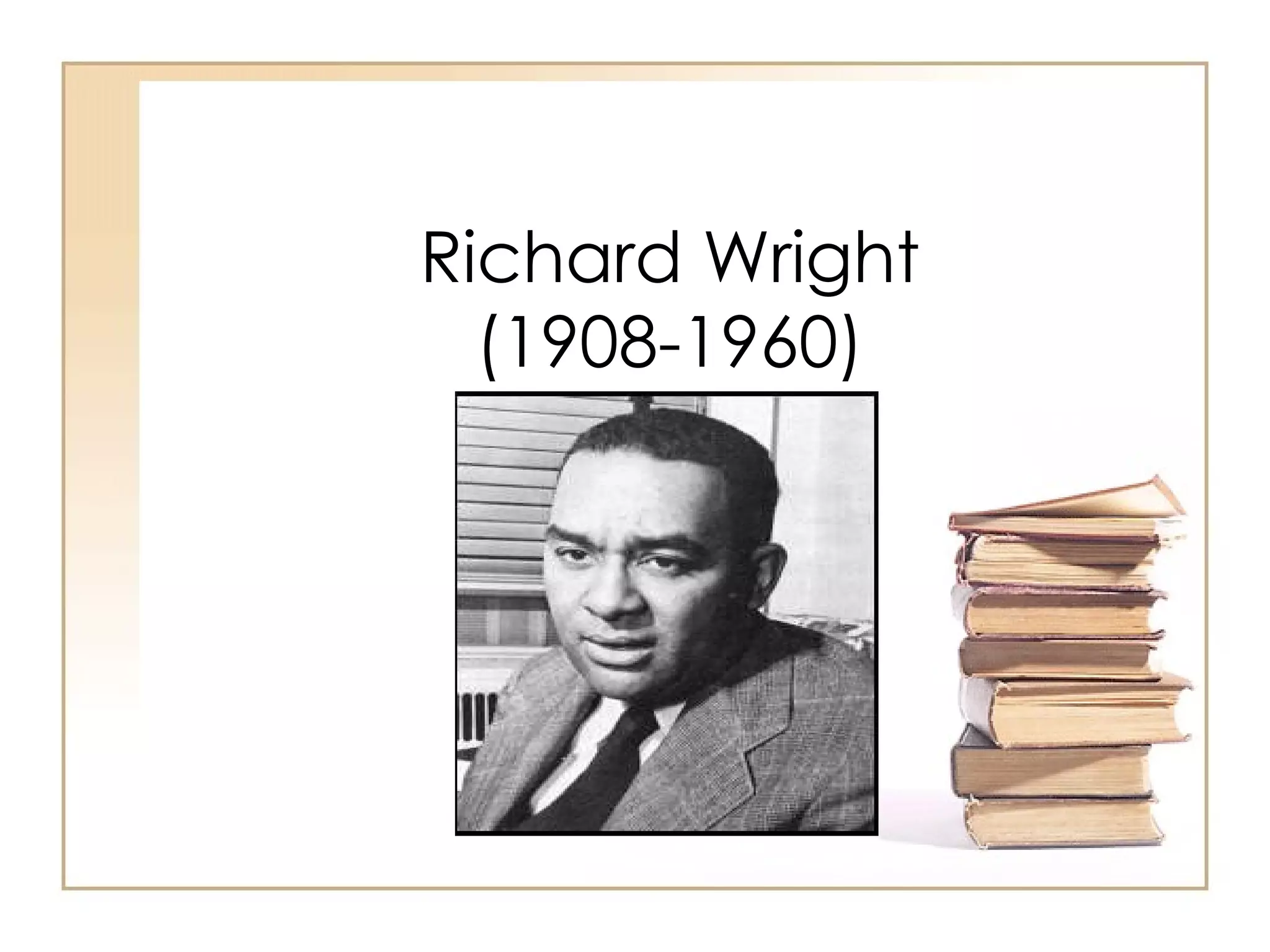
Richard Wright (1908-1960)
Early Years Born on September 4, 1908 on a plantation located near Natchez, Mississippi. His father left when he was six so his mother had to work multiple jobs to support her children. He developed a fascination for literature at a very young age. His Classmates at Jackson, Mississippi’s Smith-Robertson School always witnessed him in the books.
Early Adulthood In 1927, he moved Chicago and became a post office clerk until the Great Depression. He survived through the depression by working as a street-sweeper and working various postal jobs until he found encouragement to write from the Communist Party.
Adulthood Shortly after he chose to write for the Communist Party he became the leader of the “school for social protest” in Chicago, a literary movement which gave rise to a wealth of progressive literature. In 1938 he published his first book, Uncle Tom’s Children which got great reviews. However his second book Native Son, really earned Wright public acclaim.
Adulthood Continue… Overtime he studies Marxist theory. (Karl Marx—significant Communist Political Figure).  Wrights fascination in Marxist doctrine gave him ideas for representing society as divided into antagonistic classes.  In each of is works he portrays individuals despite any short comings in physical appearance or by oppression retain a sense of themselves.  Wright was a Communist Activist until the late 1940’s.
Wright’s publications Fiction:  Uncle Tom’s Children: Four Novellas . New York: Harper, 1938.  Uncle Tom’s Children: Five Long Stories . New York: Harper, 1938.  Bright and Morning Star  (story). New York: International Publishers, 1938.  Native Son . New York: Harper, 1940.  The Outsider . New York: Harper, 1953.  Savage Holiday . New York: Avon, 1954.  The Long Dream . Garden City, New York: Doubleday, 1958.  Eight Men  (stories). Cleveland and New York: World, 1961.  Lawd Today . New York: Walker, 1963.  Nonfiction:  How “Bigger” Was Born; the Story of Native Son.  New York: Harper, 1940.  12 Million Black Voices: A Folk History of the Negro in the United States.  New York: Viking, 1941.  Black Boy: A Record of Childhood and Youth.  New York: Harper, 1945.  Black Power: A Record of Reactions in a Land of Pathos.  New York: Harper, 1954.  The Color Curtain: A Report on the Bandung Conference.  Cleveland and New York: World, 1956.  Pagan Spain.  New York: Harper, 1957.  White Man, Listen!  Garden City, New York: Doubleday, 1957.  Letters to Joe C. Brown.  Edited by Thomas Knipp. Kent, Ohio: Kent State University Libraries, 1968.  American Hunger.  (Continuation of  Black Boy .) New York: Harper & Row, 1977.
Bright And Morning Star Bright and Morning Star was first published in 1938 in the “The Masses,” a socialist monthly journal, then again in the republished “Uncle Tom’s Children” in 1940. It is a story of a woman named Aunt Sue and her son Johnny-Boy The story starts with Johnny being late to return home from informing members of the location upcoming communist meeting. Sue is staring out the window looking at the rain Soon after Johnny’s girlfriend, Reva, shows up to warn Johnny that the location of the meeting, her house, has been revealed to the Sheriff.
Bright and Morning Star Continue… This further worries Sue because her other son, Sug, was caught by the Sheriff and has been in jail for a year for doing the same thing Johnny is doing. Reva then leaves and shortly after Johnny returns but Sue tells him he has to go back out in the rain to warn the members of the Party. After Johnny leaves the Sheriff shows up and beats Sue to get information out of her, but she doesn’t talk. Then a man named Booker, who is expected to be the traitor, shows up to help Sue and tells her that Johnny has been caught and is being tortured for information. Booker convinces Sue to tell him the names of the Members so he can warn them of the Sheriff.
Bright And Morning Star Continue… Being woozy from the beating Sue tells him the names and he rushes off. Reva again shows up because her father felt it safer for her to be there then at her house. She tells Sue that Booker is the traitor, then goes to sleep. Feeling guilty Sue sets out with a gun hidden under a blanket to find Booker and kill him. She tricks a couple of white men into taking her to where her son is being tortured and when Booker shows up she shoots and kills him before he can reveal any of the members. She is then killed by the Sheriff and his men.
Final Years Wright eventually left the Communist Party because he became disillusioned and skeptical in 1944. Moved to France in 1946.  Died on November 28, 1960 in Paris, France. He was cremated along with a copy of “Black Boy.” His ashes still remain in Paris.
Work Cited &quot;Bright and Morning Star | Introduction.&quot;  Enotes . Enotes, 2009. Web. 5 Oct. 2009. <http://www.enotes.com/bright-morning/summary>.  Duffus, Matthew. &quot;Richard Wright.&quot;  The Mississippi Writers Page . Olemiss, 26 Jan. 1999. Web. 5 Oct. 2009. <http://www.olemiss.edu/mwp/dir/wright_richard/>.  Hancuff, Richard. &quot;Richard Wright - A Webpage.&quot;  Home.gwu . 13 Feb. 2001. Web. 5 Oct. 2009. <http://home.gwu.edu/~cuff/wright/index.htm>.  Loeffelholz, Mary, ed.  Richard Wright . New York: W.W. Nortan and Company Inc., 2007. Print.

Richard Wright

  • 1.
  • 2.
    Early Years Bornon September 4, 1908 on a plantation located near Natchez, Mississippi. His father left when he was six so his mother had to work multiple jobs to support her children. He developed a fascination for literature at a very young age. His Classmates at Jackson, Mississippi’s Smith-Robertson School always witnessed him in the books.
  • 3.
    Early Adulthood In1927, he moved Chicago and became a post office clerk until the Great Depression. He survived through the depression by working as a street-sweeper and working various postal jobs until he found encouragement to write from the Communist Party.
  • 4.
    Adulthood Shortly afterhe chose to write for the Communist Party he became the leader of the “school for social protest” in Chicago, a literary movement which gave rise to a wealth of progressive literature. In 1938 he published his first book, Uncle Tom’s Children which got great reviews. However his second book Native Son, really earned Wright public acclaim.
  • 5.
    Adulthood Continue… Overtimehe studies Marxist theory. (Karl Marx—significant Communist Political Figure). Wrights fascination in Marxist doctrine gave him ideas for representing society as divided into antagonistic classes. In each of is works he portrays individuals despite any short comings in physical appearance or by oppression retain a sense of themselves. Wright was a Communist Activist until the late 1940’s.
  • 6.
    Wright’s publications Fiction: Uncle Tom’s Children: Four Novellas . New York: Harper, 1938. Uncle Tom’s Children: Five Long Stories . New York: Harper, 1938. Bright and Morning Star (story). New York: International Publishers, 1938. Native Son . New York: Harper, 1940. The Outsider . New York: Harper, 1953. Savage Holiday . New York: Avon, 1954. The Long Dream . Garden City, New York: Doubleday, 1958. Eight Men (stories). Cleveland and New York: World, 1961. Lawd Today . New York: Walker, 1963. Nonfiction: How “Bigger” Was Born; the Story of Native Son. New York: Harper, 1940. 12 Million Black Voices: A Folk History of the Negro in the United States. New York: Viking, 1941. Black Boy: A Record of Childhood and Youth. New York: Harper, 1945. Black Power: A Record of Reactions in a Land of Pathos. New York: Harper, 1954. The Color Curtain: A Report on the Bandung Conference. Cleveland and New York: World, 1956. Pagan Spain. New York: Harper, 1957. White Man, Listen! Garden City, New York: Doubleday, 1957. Letters to Joe C. Brown. Edited by Thomas Knipp. Kent, Ohio: Kent State University Libraries, 1968. American Hunger. (Continuation of Black Boy .) New York: Harper & Row, 1977.
  • 7.
    Bright And MorningStar Bright and Morning Star was first published in 1938 in the “The Masses,” a socialist monthly journal, then again in the republished “Uncle Tom’s Children” in 1940. It is a story of a woman named Aunt Sue and her son Johnny-Boy The story starts with Johnny being late to return home from informing members of the location upcoming communist meeting. Sue is staring out the window looking at the rain Soon after Johnny’s girlfriend, Reva, shows up to warn Johnny that the location of the meeting, her house, has been revealed to the Sheriff.
  • 8.
    Bright and MorningStar Continue… This further worries Sue because her other son, Sug, was caught by the Sheriff and has been in jail for a year for doing the same thing Johnny is doing. Reva then leaves and shortly after Johnny returns but Sue tells him he has to go back out in the rain to warn the members of the Party. After Johnny leaves the Sheriff shows up and beats Sue to get information out of her, but she doesn’t talk. Then a man named Booker, who is expected to be the traitor, shows up to help Sue and tells her that Johnny has been caught and is being tortured for information. Booker convinces Sue to tell him the names of the Members so he can warn them of the Sheriff.
  • 9.
    Bright And MorningStar Continue… Being woozy from the beating Sue tells him the names and he rushes off. Reva again shows up because her father felt it safer for her to be there then at her house. She tells Sue that Booker is the traitor, then goes to sleep. Feeling guilty Sue sets out with a gun hidden under a blanket to find Booker and kill him. She tricks a couple of white men into taking her to where her son is being tortured and when Booker shows up she shoots and kills him before he can reveal any of the members. She is then killed by the Sheriff and his men.
  • 10.
    Final Years Wrighteventually left the Communist Party because he became disillusioned and skeptical in 1944. Moved to France in 1946. Died on November 28, 1960 in Paris, France. He was cremated along with a copy of “Black Boy.” His ashes still remain in Paris.
  • 11.
    Work Cited &quot;Brightand Morning Star | Introduction.&quot; Enotes . Enotes, 2009. Web. 5 Oct. 2009. <http://www.enotes.com/bright-morning/summary>. Duffus, Matthew. &quot;Richard Wright.&quot; The Mississippi Writers Page . Olemiss, 26 Jan. 1999. Web. 5 Oct. 2009. <http://www.olemiss.edu/mwp/dir/wright_richard/>. Hancuff, Richard. &quot;Richard Wright - A Webpage.&quot; Home.gwu . 13 Feb. 2001. Web. 5 Oct. 2009. <http://home.gwu.edu/~cuff/wright/index.htm>. Loeffelholz, Mary, ed. Richard Wright . New York: W.W. Nortan and Company Inc., 2007. Print.