Rhythms Of TheBrain 1st Edition Gyorgy Buzsaki
download
https://ebookbell.com/product/rhythms-of-the-brain-1st-edition-
gyorgy-buzsaki-872760
Explore and download more ebooks at ebookbell.com
2.
Here are somerecommended products that we believe you will be
interested in. You can click the link to download.
Rhythms Of The Brain Illustrated Gyorgy Buzsaki
https://ebookbell.com/product/rhythms-of-the-brain-illustrated-gyorgy-
buzsaki-230234664
Rhythms Of The Pachakuti Indigenous Uprising And State Power In
Bolivia Raquel Gutirrez Aguilar Stacey Alba D Skar
https://ebookbell.com/product/rhythms-of-the-pachakuti-indigenous-
uprising-and-state-power-in-bolivia-raquel-gutirrez-aguilar-stacey-
alba-d-skar-51887738
Rhythms Of The Afroatlantic World Rituals And Remembrances Edited By
Mamadou Diouf And Ifeoma Kiddoe Nwankwo
https://ebookbell.com/product/rhythms-of-the-afroatlantic-world-
rituals-and-remembrances-edited-by-mamadou-diouf-and-ifeoma-kiddoe-
nwankwo-2485418
Rhythms Of The Pachakuti Indigenous Uprising And State Power In
Bolivia Raquel Gutirrez Aguilar
https://ebookbell.com/product/rhythms-of-the-pachakuti-indigenous-
uprising-and-state-power-in-bolivia-raquel-gutirrez-aguilar-10928946
3.
Raw Spirituality TheRhythms Of The Jesus Life 1st Edition Tom Smith
https://ebookbell.com/product/raw-spirituality-the-rhythms-of-the-
jesus-life-1st-edition-tom-smith-51332172
Remaking The Rhythms Of Life German Communities In The Age Of The
Nationstate Zimmer
https://ebookbell.com/product/remaking-the-rhythms-of-life-german-
communities-in-the-age-of-the-nationstate-zimmer-5893712
Paris Africain Rhythms Of The African Diaspora James A Winders Auth
https://ebookbell.com/product/paris-africain-rhythms-of-the-african-
diaspora-james-a-winders-auth-5334086
Paris Africain Rhythms Of The African Diaspora First Edition James A
Winders
https://ebookbell.com/product/paris-africain-rhythms-of-the-african-
diaspora-first-edition-james-a-winders-1903272
Celtic Pattern Visual Rhythms Of The Ancient Mind Adam Tetlow
https://ebookbell.com/product/celtic-pattern-visual-rhythms-of-the-
ancient-mind-adam-tetlow-46245370
5.
Rhythms of theBrain
György Buzsáki
OXFORD UNIVERSITY PRESS
The short punchline of this book is that brains are foretelling devices and their
predictive powers emerge from the various rhythms they perpetually generate. At
the same time, brain activity can be tuned to become an ideal observer of the en-
vironment, due to an organized system of rhythms. The specific physiological
functions of brain rhythms vary from the obvious to the utterly impenetrable. A
simple but persuasive example is walking. Bipedal walking is a periodic series of
forward falls interrupted regularly by alternate extensions of each leg. It is almost
as natural to us as breathing. This effortless exercise is made possible by the pre-
dictive nature of spinal cord oscillators. On smooth terrain, the alternation of leg
movements can take us any distance. Perturbation of the clocking, on the other
hand, signals a change in the terrain. This general mechanism is the same in all
animals, including eight-legged scorpions and centipedes. The notion that oscilla-
tors or “central pattern generators”1
are responsible for the coordination of motor
If the brain were simple enough for us to understand it, we would be too sim-
ple to understand it.
—Ken Hill
Prelude
1. Neural circuits that produce self-sustaining patterns of behavior are called central pattern gen-
erators. The most studied central pattern generator is an intraspinal network of neurons responsible for
locomotion. Grillner (1985) summarizes the pros and cons of the pacemaker view of central pattern
generators in the spinal cord and brain. Stein et al. (1997) and Burke (2001) are nice updates on the
topic. Central pattern generators are also responsible for many other types of rhythmic movements,
e.g., peristaltic motor patterns of legless animals, rhythmic movement of the wings of crickets during
song production, respiration, heart control, movements of the stomach, and other parts of the digestive
system. My favorite review on this topic is Marder and Calabrese (1996).
13.
patterns, such asbreathing and walking, is old and well accepted in neuroscience.
But the tantalizing conjecture that neuronal oscillators can be exploited for a
plethora of other brain-generated functions, including cognition, is quite new and
controversial. And it is the latter topic, the contribution of oscillations to the in-
visible, inferred operations of the brain, that this book is mostly about.
Exposing the mechanisms that allow complicated things to happen in a coordi-
nated fashion in the brain has produced some of the most spectacular discoveries
of neuroscience. However, I do not want to mislead you from the outset. Clocks
are not thinking but ticking devices, no matter how precisely they can predict
time. Time needs to be filled with content, provided by the appropriate firing pat-
terns of neurons, whose assembly activity, in turn, is regulated by brain oscilla-
tions. Interestingly, the neuronal assemblies that generate the content are often
the same as those that give rise to the time metric of oscillations that in turn orga-
nize the cell assembly pattern. This peculiar reciprocal causation, brought about
by the self-organized features of brain activity, begs for an explanation. A good
part of the volume is devoted to discussing experiments that attempt to elucidate
these emerging properties of neuronal networks.
At the physiological level, oscillators do a great service for the brain: they co-
ordinate or “synchronize” various operations within and across neuronal net-
works. Syn (meaning same) and chronos (meaning time) together make sure that
everyone is up to the job and no one is left behind, the way the conductor creates
temporal order among the large number of instruments in an orchestra. A close
view of Seiji Ozawa at the end of a concert, sweat falling from his face, is proof
that conducting an orchestra is a physically and mentally demanding job. In con-
trast, coupled oscillators perform the job of synchronization virtually effortlessly.
This feature is built into their nature. In fact, oscillators do not do much else. They
synchronize and predict. Yet, take away these features, and our brains will no
longer work. Compromise them, and we will be treated for epilepsy, Parkinson’s
disease, sleep disorders, and other rhythm-based cognitive maladies. As I point
out repeatedly in Cycles 1–13 of this volume, virtually no nervous function exists
without a time metric, be it the simplest motor or the most complex cognitive act.
While we know quite a bit about neurons, the building blocks of the brain, and
have extensive knowledge about their connectivity, we still know very little how
the modules and systems of modules work together. This is where oscillations of-
fer their invaluable services.
My connection with brain rhythms began in April 1970, during a physiology
lecture given by Endre Grastyán in the beautiful town of Pécs, on the sunny slopes
of the Mecsek mountains in Hungary. The University of Pécs, or Universitas
Quinque Ecclesiensis, as it was called when founded in 1367, has produced a re-
markable set of neuroscientists, including János Szentágothai, the legendary neu-
roanatomist; Béla Flerkó and Béla Halász, pioneers of neuroendocrinology;
György Székely, the renowned spinal cord physiologist; and Ferenc Gallyas, the
creator of the silver impregnation methods widely used for neuronal labeling.
Like many of us at a young age, in his twenties Grastyán could not quite make
up his mind about his future. Finding nothing too interesting or challenging initially,
viii Prelude
14.
he decided totrain for the priesthood to get some orientation in philosophy. But
his mind, far too curious and questioning, prevented him from becoming a
preacher. He ended up in medical school during the stormy years after World War
II and became the assistant of Professor Kálmán Lissák. Lissák, a student of Otto
Loewi in Graz, Austria, and subsequently Walter Cannon’s assistant at Harvard,
had returned to Hungary to become Chair of Physiology just before the war.
Grastyán’s pairing with Lissák was fortunate because Lissák, of course, knew
quite a bit about rhythms from his years with Loewi, who provided the first evi-
dence that a chemical—a neurotransmitter—is released at the junction (synapse)
between the vagus nerve and the heart muscle.2
Although Grastyán was perhaps
Lissák’s closest friend, the two were as different as can be. Lissák was a reserved
man, and his lectures were scarcely attended. In contrast, Grastyán was a per-
forming artist whose seminars were carefully composed and choreographed. The
huge lecture room in the medical school was always packed, and even students
from the neighboring law school came over to listen to his mesmerizing lectures.
He generated so much enthusiasm that we students became convinced that the
topics he discussed were among the most important in the whole universe.
In that particular lecture of April 1970, he talked about how the brain outputs,
such as movement and cognition, control its inputs, rather than the other way
around. His key idea was that control in living systems begins with the output. This
is the seed for further evolution of the brain. Even in the most complex animals,
the goal of cognition is the guidance of action. Indeed, the first simple biological
systems did not have any inputs; they did not need them. They simply used an eco-
nomical motor output, a rhythmic contraction of muscles. This is, of course, is suf-
ficient only when food is abundant in the sea environment. More complex forms of
life evolved form this simple solution by modifying the simple rhythmic output.
Sensation of direction and distance developed only after the “invention” of move-
ment through space. The idea of output control and feedback is a profound thought
even today. Back then, when Pavlovian sensory–sensory association was the dom-
inant ideology in the East and the stimulus–decision–response paradigm domi-
nated Western thinking, Grastyán’s teachings were unusual, to say the least.
After his lecture, I rushed home to read the relevant chapters in our official
Prelude ix
2. Loewi called the chemical “Vagusstoff,” which Henry Hallett Dale from Cambridge, England,
identified later as acetylcholine, the first neurotransmitter. They received the Nobel Prize for their dis-
coveries in 1936. I have heard various versions of the story behind the Vagustoff experiment from Lis-
sák. Here is one from Loewi’s own pen:
The night before Easter Sunday of that year I awoke, turned on the light, and jotted down a few
notes on a tiny slip of thin paper. Then I felt asleep again. It occurred to me at six o’clock in the
morning that I had written down something most important, but I was unable to decipher the scrawl.
The next night, at three o’clock, the idea returned. It was the experiment to determine whether or
not the hypothesis of chemical transmission that I had thought about years ago was correct. I got up
immediately, went to the laboratory, and performed a simple experiment on a frog heart according
to the nocturnal design. (Loewi, 1960, 15)
Dale became better known about his “principle”: if a chemical is released in one synapse, the same
chemical is released in all the other synapses made by the same neuron.
15.
textbook only torealize that there was not a single word there about what I had
heard that morning.3
Nevertheless, beginning with Grastyán’s introductory lec-
ture on the organization of the brain, my life in medical school acquired new
meaning. My original high school plan to become an electrical engineer was ve-
toed by my parents, who offered me the choice between medical school and law
school. While my friends were having fun at the School of Engineering in Bu-
dapest, learning exciting stories about radio transmission and electronic oscilla-
tors, I spent most of my time studying the unending details of bones and
ligaments. But in his physiology lecture, Grastyán was talking about some truly
intriguing questions that sparked my interest. I applied to become his apprentice
and spent most of my student life in his lab.
The best training in Grastyán’s laboratory occurred through my participation
in the regular lunch discussions that could go on for several hours, where topics
meandered chaotically from homeostatic regulations of the brain to complex
philosophical topics. It was during these lunch lessons where I first learned about
the hippocampal “theta” rhythm, the oscillation that has become my obsession
ever since. My first assignment in the Grastyán school, under the supervision of
György Karmos, was to examine the variability of the evoked responses in the
hippocampus and auditory cortex in response to sound stimuli as a function of be-
havior. In a nutshell, our main finding was that the most important factor in pre-
dicting the variability of the evoked brain responses was the variability of the
background brain activity. This was the first time I faced the fascinating issues of
“state,” “context,” and “spontaneous” activity, problems that remained with me
forever.
As I have repeatedly discovered in my career, the informal lunch-seminar ap-
proach to science is hard to substitute with formal lectures or the reading of dense
scientific papers. Seminars are tailored for an average group of people with the
naive assumption that the audience retains all the details and follows and accepts
the fundamental logic of the lecturer. In contrast, the essence of lunch conversa-
tions is to question the fundamental logic, a quest for clarification and simplifica-
tion, a search for explanations and answers without a rigid agenda, where the
focus is not on covering large chunks of material but on fully understanding even
the smallest details. Of course, one can follow up a lecture by finding and reading
the relevant published papers on the topic. However, most of the exciting findings
in neuroscience are hidden in the small print of specialty journals, often written in
a specialized and arcane language comprehensible to, at most, a handful of spe-
cialists. Overwhelmed with new and important discoveries in the various sub-
subspecialties, the practicing neuroscientist, such as myself, tends to forget that
x Prelude
3. The idea that the brain’s main goal is to control movement has been repeatedly emphasized by
several outstanding individuals. Indeed, the brain’s only means of interacting with the world is via the
motor system, whether foraging for food or communicating by speech, gestures, writing a paper, or
sending an e-mail. The outstanding books by Gallistel (1980) and Llinás (2001) discuss this point elo-
quently. The “primacy” of movement has been emphasized by Hamburger et al. (1966) and Bullock
and Horridge (1965). For recent reviews on this topic, I suggest Hall and Oppenheim (1987), Wolpert
and Ghahramani (2000), and Robinson and Kleven (2005).
16.
neuroscience is ofstartling relevance to a contemporary society wrestling with
complex issues such as social behavior, depression, and brain aging. It is hard to
predict which of the numerous fundamental discoveries could alter the face of
such large issues, and unless they are conveyed to others, they might be over-
looked without making an impact. This is mainly so because the explanations we
provide in papers to the superspecialists may be impenetrable to the uninitiated.
Without attempting to place our work into a larger context from time to time, we
deprive ourselves of the chance to be able connect to the more macroscopic and
microscopic levels of research. Yet, discoveries and insights realize their power
only when understood by others. Understanding this important connection is
what mostly motivated me to write this volume.
Neuroscience has provided us some astonishing breakthroughs, from noninva-
sive imaging of the human brain to uncovering the molecular mechanisms of
some complex processes and disease states. Nevertheless, what makes the brain
so special and fundamentally different from all other living tissue is its organized
action in time. This temporal domain is where the importance of research on neu-
ronal oscillators is indispensable, and it is this temporal domain that connects the
work discussed in this volume to all other areas of neuroscience.
Parallel with the amazing progress in neuroscience, another discipline has
emerged: complex systems, a new science that cuts across many fields. During the
past decade, I have learned as much about the brain by reading about novel
branches of physics, engineering, mathematics, and computer science as I did
from studying papers directly dealing with the nervous tissue. Rest assured, the
human brain is the most complicated machinery ever created by nature. Never-
theless, it is truly exciting looking for concepts, mechanisms, and explanations
that are common among many different systems and cut across the living/nonliv-
ing dichotomy. Seemingly unlikely sources such as fractals and Internet commu-
nication have provided novel clues for understanding neuronal networks. My goal
is to illustrate how this new knowledge is being incorporated into neuroscience at
a breathtakingly high speed and to convey fascinating discoveries to neuroscien-
tists, psychiatrists, neurologists, and the growing group of computational scien-
tists, physicists, engineers, and mathematicians interested in complex systems. A
covert agenda is that, along the way, describing these new discoveries will en-
courage outsiders to become brain rhythm enthusiasts.
Deciphering the code of the brain will have a lasting impact on our society. It
is not simply an intellectual exercise for a handful of esoteric individuals any-
more. It is also more than a “just” a brain-health–related issue, which affects mil-
lions in the United States and many more worldwide. As Robert Noyce, the
co-inventor of the integrated circuit, once put it: “In order to understand the brain,
we have used the computer as a model for it. Perhaps it is time to reverse this rea-
soning. To understand where we should go with the computer, we should look to
the brain for some clues.” Now that our economy, financial institutions, education
system, research programs, distribution systems, human interactions, politics, and
defense have all become computer and Internet dependent, this quest is more
acute than ever. The hope is that the new knowledge about the brain will not only
Prelude xi
17.
inspire novel designsfor computer architectures and a more efficient and safer
electronic communication but also, at the same time, provide a better understand-
ing of ourselves. Books, computers, and Internet communication have external-
ized brain functions and provided virtually unlimited storage space for the
accumulated knowledge of humankind. However, this externalized information is
only as useful as its accessibility. Currently existing search engines, such as
Google andYahoo, that provide access to this externalized knowledge are very in-
efficient (even though they are the best available at present) compared to the
brain’s ability to retrieve episodic information, because neuronal networks utilize
fundamentally different strategies for the reconstruction of events and stories
from fragments than do search engines. Understanding the brain’s search strate-
gies may allow us individuals to have better access to the cumulative knowledge
of humankind.
Writing to a general audience interested in neuroscience is a much more ardu-
ous exercise than writing scientific papers. Scientists, rather than just the science
they have produced, and metaphors that are deliberately absent in specialty jour-
nals come to the fore. This process inevitably implies oversimplification from the
experts’ viewpoint, occasional redundancies, and some rugged transitions for the
novice. To alleviate the inevitable, I have written a simplified main story, which I
hope to be a relatively easy read in most Cycles. Each Cycle ends with a brief
summary, which highlights the primary message of the Cycle. The main story is
supplemented by extensive footnotes, which serve partly to define novel terms. In
most cases, however, they provide further critical information for the more so-
phisticated reader, along with links to the appropriate literature. I have deliber-
ately chosen this format because it allowed me to interweave the main story and
its more complex ramifications without breaking the flow of thought. The addi-
tional comments and citations in the footnotes give rise to an ever-growing tree
with intertwined branches of arguments, hypotheses, and discovery.
A couple of years ago, we hosted a painter in our house for the summer. His
determined goal was to survey and conquer the NewYork City art market.Yet, af-
ter a month or so, he plainly declared to us that every painting has already been
painted and the art dealers are aware of all potential innovators in case the market
is in need of such redundancy. He returned to Europe the next day. This is how I
felt while writing this book. Clarity, critical details, and giving proper credit com-
pete for space, and achieving the appropriate balance is the most difficult thing in
writing a book. The more I explored the mysteries of brain oscillators and neu-
ronal functions, the more I realized that the fundamental ideas (some which I
thought were genuinely mine) have already been expressed, often repeatedly.
Many times the ideas have come up in studying systems other than the brain, or
they were expressed in a different context. But they existed. The deeper I ventured
into the problems, the further back in time I had to travel to discover the origin of
thoughts.
An oft-heard marketing slogan these days is that we have learned more about
the brain during the past decade that during the previous history of humankind.
This may be true regarding the volume of factual knowledge. But discoveries are
xii Prelude
18.
not ( just)facts. They are ideas that simplify large bags of factual knowledge.
Such fundamental ideas rarely pop up suddenly. Typically, they slowly emerge af-
ter appropriately long incubation periods and are shaped by numerous proponents
and critics. Fundamental ideas are rare, and probably as many have been con-
ceived prior to modern neuroscience as in the past few decades. One just has to
recognize and adapt the old thoughts to the new lingo and the findings we have re-
cently generated. My dear mentor advised me in my student days, “do not publish
when you have only data but when you have a novel idea.” If I followed his advice
strictly, I would perhaps still be writing my first paper and this volume would not
exist. Although I honestly attempted to reach a balance between summarizing
large chunks of work by many, and crediting the deserved ones, I am aware that I
did not always succeed. I apologize for those whose works I unintentionally ig-
nored or missed. To claim innocence, I shall simply shift the responsibility onto
those who kindly read some parts of the manuscript at various stages and did not
complain (enough). These generous colleagues include Kamran Diba, Caroline
Geisler , Robert L. Isaacson, Kai Kaila, Christof Koch, Nancy Kopell, Rodolfo
Llinás, Stephan Marguet, Edvard Moser, Denis Paré, Marc Raichle, Wolf Singer,
Anton Sirota, Paula Tallal, Jim Tepper, and Roger Traub. My dear friend Mircea
Steriade took the trouble of reading the entire manuscript and provided invaluable
feedback. My special thanks to Mary Lynn Gage for her attempts to transpose my
Hungarian-Zombi idioms into comprehensible English. This may not have al-
ways succeeded, and I would like to publicly apologize for humiliating Shake-
speare’s beautiful language here and there.
At a more general level, I would like to express my gratitude to a number of
people whose examples, support, and encouragement sustained me in difficult
times and whose collaborations, inspiring discussions, and criticism have served
as constant reminders of the wonderful collegiality of our profession—David
Amaral, Per Andersen, Albert-László Barabási, Reginald Bickford,Yehezkel Ben-
Ari, Anders Björklund, Brian Bland, Alex Borbely, Ted Bullock, Jan Bures, Gábor
Czéh, János Czopf, Eduardo Eidelberg, Jerome (Pete) Engel, Steve Fox, Walter
Freeman, Fred (Rusty) Gage, Mel Goodale, Charlie Gray, James McGaugh,
Michale Fee, Tamás Freund, Helmut Haas, Michael Häusser, Walter Heiligenberg,
Bob Isaacson, Michael Kahana, George Karmos, Nancy Kopell, Lóránd Kellényi,
Gilles Laurent, Joe LeDoux, Stan Leung, John Lisman, Rodolfo Llinás, Nikos Lo-
gothetis, Fernando Lopes da Silva, Jeff Magee, Joe Martinez, Bruce McEwen,
Bruce McNaughton, Richard Miles, István Mody, Robert Muller, John O’Keefe,
Marc Raichle, Jim Ranck, Menahem Segal, Terry Sejnowski, Larry Squire, Wolf
Singer, David Smith, Peter Somogyi, Mircea Steriade, Steve Strogatz, Karel Svo-
boda, David Tank, Jim Tepper, Alex Thomson, Giulio Tononi, Roger Traub, Cor-
nelius (Case) Vanderwolf, Olga Vinogradova, Ken Wise, Xiao-Jing Wang, and
Bob Wong. Over the years, some of these outstanding colleagues—Bob, Bruce,
David, Gábor, Helmut, István, Karel, Mircea, Peter, Rodolfo, Roger, Rusty, Ted,
Tamás, and Wolf—became my trusted, close friends. Most importantly, I would
like to thank my students and post-doctoral fellows without whose dedication and
hard work the many experiments discussed in this volume would not exist.
Prelude xiii
19.
Being a scientistis a dedication. Writing a book is a bit more. Oh yes, it is a lot
of fun, but it takes time, precious time that I had to steal from somewhere, mostly
from my family. My dear wife, Veronika, and my sweet daughters, Lili and
Hanna, forgive me for the many weekends you had to spend without me and for
my frequent mental absences at dinners and family events when only my body
was present. How fortunate I am to have you as my supporters. Without your un-
derstanding and encouragement, this venture would have been worthless.
Dear reader. Do not stop here! The rhythm begins only now.
xiv Prelude
20.
Contents
CYCLE 1: Introduction3
CYCLE 2: Structure Defines Function 29
CYCLE 3: Diversity of Cortical Functions Is Provided by Inhibition 61
CYCLE 4: Windows on the Brain 80
CYCLE 5: A System of Rhythms: From Simple to Complex Dynamics 111
CYCLE 6: Synchronization by Oscillation 136
CYCLE 7: The Brain’s Default State: Self-Organized Oscillations
in Rest and Sleep 175
CYCLE 8: Perturbation of the Default Patterns by Experience 206
CYCLE 9: The Gamma Buzz: Gluing by Oscillations in the
Waking Brain 231
CYCLE 10: Perceptions and Actions Are Brain-State Dependent 262
CYCLE 11: Oscillations in the “Other Cortex”: Navigation in Real
and Memory Space 277
CYCLE 12: Coupling of Systems by Oscillations 334
CYCLE 13: Tough Problems 357
References 373
Index 433
Cycle 1
1
Introduction
There isno good reason to assume that the brain is organized in accordance
with the concepts of folk psychology.
—Cornelius H. Vanderwolf
3
1. Telepathy (or the related terms precognition and clairvoyance) is the supposed ability to transfer
thoughts, feelings, desires, or images directly from the mind of one person to the mind of another by
extrasensory channels and without using known physical means.
It all began with a dream. A young officer in the Prussian Army received a letter
from his sister. In it she wrote about a dream in which her beloved brother fell off
his horse and broke his leg. As it happened, the young officer indeed fell off his
horse at about the time the letter was sent by his sister. The officer, Herr Doktor
Hans Berger, already an established researcher on cerebral blood circulation at
the University Clinic for Psychiatry in Jena, Germany, thought that such coinci-
dence could only have happened through some mysterious communication be-
tween brains, via telepathy,1
as such alleged communications between brains are
better known.
After returning to Jena from active military duty, Berger was promoted to the
Chair of the Department of Psychiatry and Neurology in 1919 and devoted the
rest of his career to the study of the brain’s electrical activity. Berger reasoned
that the electromagnetic forces generated by the human brain could be the carrier
waves of telepathy, his true interest. Since even in that day telepathy was regarded
as an “occult” subject, his experiments were conducted in utter secrecy in a labo-
ratory located in a small building on the grounds of the clinic. Most of his initial
recordings were done on himself, his son Klaus, and patients with skull defects.
25.
4 RHYTHMS OFTHE BRAIN
2. Berger (1929). Berger was already familiar with the work of Richard Caton, a Liverpool sur-
geon who studied the electricity generated by the brains of rabbits and monkeys (Caton, 1875).
Berger’s international fame was boosted when his work was confirmed and endorsed in by Edgar Dou-
glas Adrian and Bryan Harold Cabot Mathews of the Cambridge Physiological Laboratory. They sug-
gested calling the alpha waves the Berger rhythm, but Hans Berger modestly rejected the offer (Adrian
and Mathews, 1934).
3. It is tough to be first in any field of science, and the discovery of the electroencephalogram
(EEG) was no different. In addition to Caton’s work, Berger also knew about the published works of
the physiologists Adolf Beck of Poland and Vladimir Pravdich-Neminski (or W. W. Prawdicz-
Neminski in his native Ukrainian) of Russia. Neminski’s observations are perhaps most relevant since
his “electrocerebrogram” was obtained from the intact surface of dogs’ skulls (Neminski 1913). How-
ever, he was not the first Russian in this area of research. VasiliYakovlevich Danilevsky had described
observations similar to Caton’s in his doctoral thesis, and Nikolai Y. Wedensky had used a telephone
circuit to listen to electrical waves in the brains of cats and dogs. Fleischel von Marxow was also
among the first discoverers of electrical fields of the brain. However, he placed his results in a sealed
letter in 1883 and revealed them only after he learned about Beck’s published results. What made
Berger’s observations stand out from the others were the numerous control experiments he provided
along with his observations. Brazier’s (1959) chapter is the best summary of the exciting early days in
the study of brain electricity and is a source for numerous references. Borck (2005) is another useful
source of historical materials.
He performed numerous experiments and, importantly, eliminated the possibility
that the voltage changes measured by his string galvanometer were an artifactual
consequence of blood pressure changes; nor did they arise from the scalp skin.
After five years of experimentation, he concluded that the most prominent elec-
trical activity could be recorded from the occipital (lower rear) part of the skull
when the subject’s eyes were closed. In his groundbreaking 1929 paper he wrote,
“The electroencephalogram represents a continuous curve with continuous oscil-
lations in which . . . one can distinguish larger first order waves with an average
duration of 90 milliseconds and smaller second order waves of an average dura-
tion of 35 milliseconds. The larger deflections measure at most 150 to 200 micro-
volts. . . .”2
In other words, the electrical field generated by millions of
discharging neurons in the cerebral cortex is 10,000 times smaller than that pro-
vided by an AA battery.
Berger called the large-amplitude rhythm (approximately 10 waves per sec-
ond, or 10 hertz), which was induced by eye closure in the awake, calm subject,
the “alpha” rhythm because he observed this rhythm first. He named the faster,
smaller amplitude waves, present when the eyes were open, “beta” waves. Para-
doxically, Berger’s recordings provided firm physical evidence against his idea
that waves generated by one brain could somehow be detected by another brain.
The voltage changes that emerge from the cooperative activity of neurons in
the mammalian brain are just too small, and current propagation requires a low-
resistance conductor, so it cannot cross air, for example. Although he failed to
prove his hypothesis of telepathic communication between brains, his research
created a powerful scientific and clinical method for investigating quickly chang-
ing brain activity.3
Discovering a dynamic brain phenomenon is one thing. Understanding its
meaning and its role in behavior and cognition is quite another. Ever since Berger’s
26.
Introduction 5
4. Nature,of course, has no laws, desires, goals, or drives. It simply generates certain regularities
that we conveniently assume are governed by some outside forces and use a third-person perspective
to refer to these regularities.
early observations, three questions have haunted neuroscientists: how are EEG
patterns generated, why are they oscillatory, and what is their content? Providing
answers to these questions is a major goal of this volume. I introduce the topic in
Cycles 2 and 3 by discussing the important issue of how the speed of communi-
cation in the cerebral cortex can be preserved despite the great size differences of
the brains of small and large mammals. Cycle 4 can be skipped by those who have
had an introductory class on methods in neurophysiology. It discusses the major
methods currently available for investigating brain activity patterns in living tis-
sue and the mechanisms that give rise to the field EEG. Cycles 5 and 6 serve as an
introduction to the different types of oscillators and discuss the large family of
oscillations in the mammalian cortex. Cycles 7 and 8 are devoted to the “default”
states of the brain: sleep and early brain development. Tying the macroscopic fea-
tures of oscillations to neuronal mechanisms requires large-scale recordings of
numerous single neurons. Such techniques allow us to gain some insight into the
content of oscillations, which is described in Cycles 9–12. In Cycle 13 I examine
the structural and functional requirements of awareness by contrasting brain
structures that can and cannot support self-generated patterns and long-range
communication through global oscillations.
Periodic Phenomena in Nature
Nature is both periodic and perpetual. One of the most basic laws of the universe
is the law of periodicity.4
This law governs all manifestations of living and non-
living. In its broadest definition, periodicity refers to the quality, state, or fact of
being regularly recurrent: a repeating pattern or structure in time or space. What
goes up must come down. The sun rises and sets, and the days wax and wane.
Without periodicity, there is no time; without time, there is no past, present, or fu-
ture. In living systems, the periodicity of individual lives gives rise to the conti-
nuity of life on Earth. Our existence has meaning only when experienced in time.
The essence of music and dancing is rhythm. An important part of human culture
is the celebration of the periodicity of life. The Jewish and Muslim religions are
attuned to the lunar cycle. Christians adopted a solar calendar. Periodicity can be
seen in the monthly windows of opportunity for conception of human life.
Periodicity, oscillation, rhythm (from Latin meaning to flow), and cyclic pro-
cess are synonyms that refer to the same physical phenomenon. Historically, dif-
ferent academic disciplines have adopted a preferred term to describe these
related phenomena. Periodicity is the term of choice in social and earth sciences.
Oscillation is the preferred term in physics, and engineers talk about cyclic or pe-
riod generators. Until recently, neurologists and neuroscientists used the term
“brain rhythms” almost exclusively when referring to the various brain patterns.
27.
6 RHYTHMS OFTHE BRAIN
5. It was the review by Steriade and Deschênes (1984) that popularized the term “neuronal oscil-
lator” in the mammalian nervous system. See also Steriade and Llinás (1988).
6. Hawking (1992) is an excellent introduction to this difficult topic. Hall (1983) is another easy
read. A radically different definition of time is proposed by Leyton (1999). Leyton derives time from
spatial symmetry and its broken version: time is essentially symmetry breaking (e.g., asymmetric
representation of plane symmetry by oscillatory phase; see Cycle 11).
7. In physics, standard time interval (a second) is defined by an oscillator: 9,192,631,770 hyperfine
transitions in the 133
Cs atom.
Reference to oscillations is quite recent.5
The avoidance of the term “oscillator”
in brain research for so long perhaps reflected the tacit view that brain rhythms
may be qualitatively different from the oscillators discussed in physics textbooks.
Assuredly, neuronal oscillators are quite complex. Nevertheless, the principles
that govern their operation are not fundamentally different from those of oscilla-
tors in other physical systems. Today, it is widely recognized that the brain’s abil-
ity to generate and sense temporal information is a prerequisite for both action
and cognition. This temporal information is embedded in oscillations that exist at
many different time scales. Our creativity, mental experiences and motor perfor-
mance are modulated periodically both at short and long time scales. But how are
oscillatory states brought about, especially if they occur in the absence of external
influences? In Cycles 5 and 6 I propose some answers with illustrations from
physics and engineering.
Time and Periodicity
Neuroscientists work with time every day but rarely ask what it is. We take for
granted that time is “real” and that brains have mechanisms for tracking it. Since
time is a major concept in this book, I attempt to provide a working definition
without getting lost at the nebulous boundary between physics and philosophy.6
Newton held that time flows in absolute intervals, independent of the physical
universe. According to Immanuel Kant, space and time are irreducible categories
through which reality is perceived by our brains. Albert Einstein combined space
and time into “spacetime.” According to him, time is a measure of motion and, as
such, is part of the physical universe and thus could be interpreted as its “prop-
erty”; space and time disappear along with the things. An opposite view is that
time is a subjective abstraction and does not exist in any physical substrate and
has no more reality than a mathematical axiom. In a broad sense, time is a mea-
sure of change, a metric of succession, a parameter that distinguishes separate
events. One practical definition is that “time is that which is measured by a clock,”
a pragmatic description adequate for most branches of physics and neuroscience.7
How we approach the problem of time largely determines our view of the out-
side world around us. First, we need to distinguish two aspects of time. Absolute
time is clock time, referring to a particular point in a time series, for example, your
birth date. Absolute time is a fundamental element of existence since everything
28.
Introduction 7
8. Thedifferent types of oscillators are defined and discussed in Cycle 6.
9. The quote is from the book of Ecclesiastes (chapter 1, verse 9, Revised Standard Version). The
concept of recurrence is prominent in Hinduism and Buddhism, among others. The spoked wheel of
life (dharma) is an endless cycle of birth, life, and death. The concept of recurrence is also prominent
in Friedrich Nietzsche’s philosophy (best expressed in Also Sprach Zarathustra. Ein Buch für Alle und
Keinen). A picture of nature as being in “balance” often prevails in both biological and religious dis-
cussions. Although a general equilibrium theory has never been explicitly formulated, environmental-
ists and conservationists tacitly assume that nature is in an eternally stable equilibrium; therefore, we
should keep it that way. However, if this were the case, how did we get here in the first place?
exists in time. Duration refers to the change of time, the interval between two
points in time. Elapsed time is therefore relative, and it has an interval span (e.g.,
hour), whereas absolute time does not have a span (e.g., date). We make a similar
absolute versus relative distinction in space as well, when we talk about position
and distance. However, while distance can refer to many directions (vector) in
space, time has only one direction (scalar).
The intimate relationship between space and time is packaged into the concept
of “spacetime” (x, y, z, t dimensions). Oscillations can be conceived of and dis-
played in terms of either space or time. The phase-plane of a sinusoid harmonic
oscillator8
is a circle. We can walk the perimeter of the circle once, twice, or bil-
lion of times and yet we always get back to our starting point. “What has been is
what will be, and what has been done is what will be done; and there is nothing
new under the sun”9
This is the “circle of life,” and our walk on its perimeter is
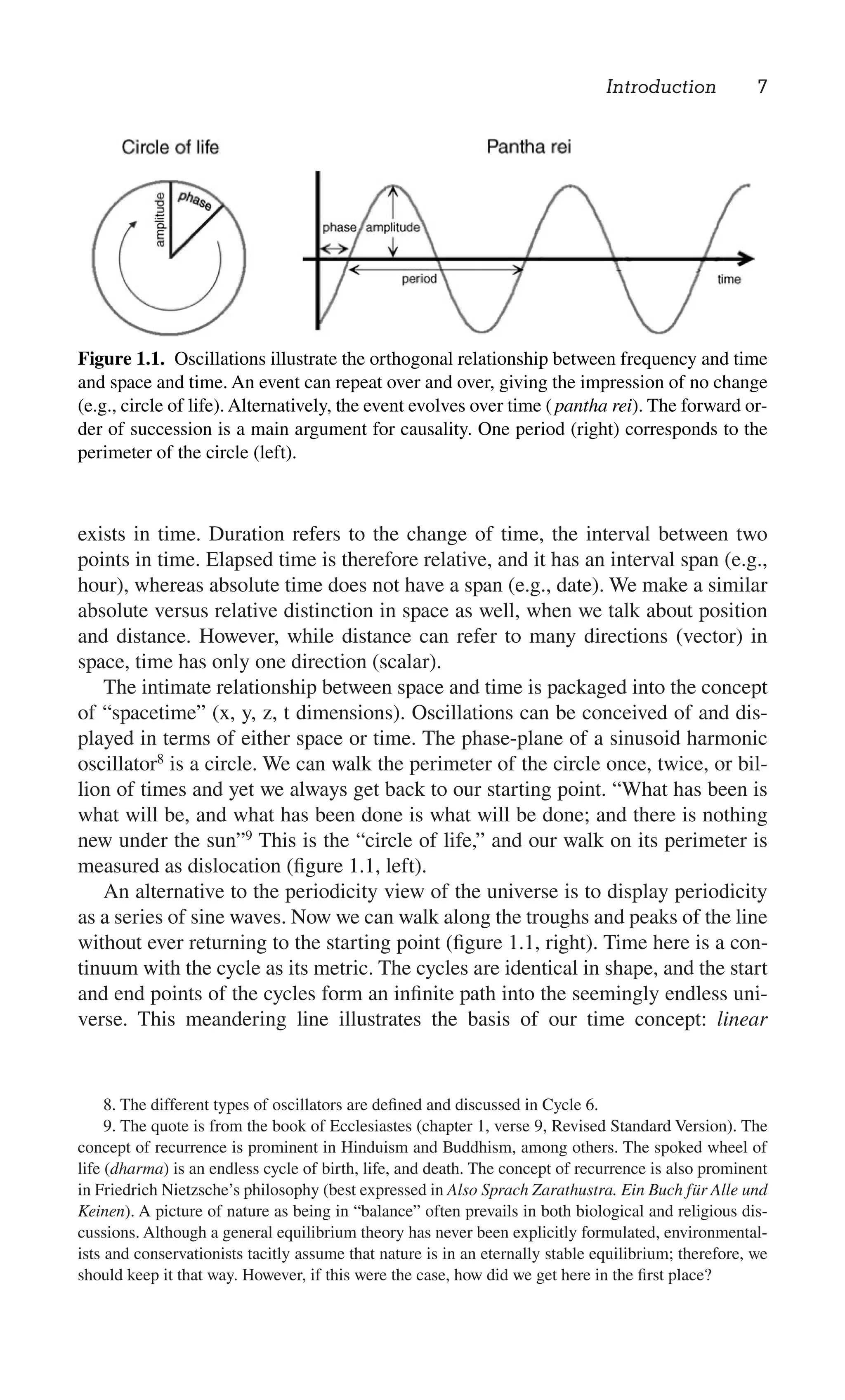
measured as dislocation (figure 1.1, left).
An alternative to the periodicity view of the universe is to display periodicity
as a series of sine waves. Now we can walk along the troughs and peaks of the line
without ever returning to the starting point (figure 1.1, right). Time here is a con-
tinuum with the cycle as its metric. The cycles are identical in shape, and the start
and end points of the cycles form an infinite path into the seemingly endless uni-
verse. This meandering line illustrates the basis of our time concept: linear
Figure 1.1. Oscillations illustrate the orthogonal relationship between frequency and time
and space and time. An event can repeat over and over, giving the impression of no change
(e.g., circle of life). Alternatively, the event evolves over time (pantha rei). The forward or-
der of succession is a main argument for causality. One period (right) corresponds to the
perimeter of the circle (left).
29.
8 RHYTHMS OFTHE BRAIN
10. The quote is attributed to Heracleitus of Ephesus (540 to circa 475 b.c.).
11. The average duration of syllables, the fundamental segmentation of speech in all languages, is
approximately 250 milliseconds. Syllables cannot be stretched or sped up at will in spoken language
beyond certain limits. Slowing down speech can be achieved only by introducing long pauses between
syllables. This is the reason why it is so difficult to understand the text of arias.
12. Jacob (1994), p. 32.
13. Freeman (2000) explains that time exists in the material world but causality does not. Along
with physicists, he argues that time is a measure of motion, living and nonliving; therefore, it is an ob-
jective dimension. In contrast, cause is a measure of intent, and, according to Freeman, only humans
have intent.
change and a forward order of succession, features that are often used in argu-
ments of causality. A moment never repeats itself. Pantha rei—everything
flows—according to the ancient Greek saying. “Upon those who step into the
same rivers, different and ever different waters flow down.”10
Whichever model
we choose, the circle or the meandering line, in periodically changing systems the
past can predict the future (position or moment).
The hard problem to solve is whether time and space are situated in our minds
only or whether they in fact exist independently of us. Fortunately, most brain op-
erations, including predictions by brain rhythms, can be understood without ad-
dressing this hard problem. Clock time is sometimes referred to as objective time,
an absolute physical reality, independent of conscious brains and beyond our con-
trol. Clock time is what we use to calibrate our subjective experience of the pas-
sage of time and coordinate our thoughts and activities. Passage of time, that is,
its duration, is felt as a linear event, slipping from one moment to another. The
feeling of time is confined to a relatively short span from tens of milliseconds to
tens of minutes. As shown in Cycle 5, this time span corresponds to the temporal
range of brain oscillators, which may serve as an internal metric for time calibra-
tion. Nobody can feel micro- and nanoseconds, and tracking time durations be-
yond the hour range requires body references such as hunger or feedback from the
environment. Our best temporal resolution is in the subsecond range, correspon-
ding to the duration of our typical motor actions, the tempo of music and
speech.11
Linear time is a major feature of our Western cultural world-view, and the ex-
perience of time flowing between past, present, and future is intricately tied to
everyday logic, predictions, and linear causation. According to the great French
molecular biologist Francois Jacob, “one of the deepest, one of the most general
functions of living organisms is to look ahead, to produce future.”12
What I am
proposing in this volume is that neuronal oscillations are essential for these deep-
est and most general functions.
Time, Prediction, and Causation
Causality among world events is linked to our perception of time.13
Prediction, in-
ference, forecast, and deduction are used as synonyms in the context of proposed
30.
Introduction 9
14. Themost influential theory on prediction was put forward by Thomas Bayes (1763/1958). His
probability theory examines the possible outcomes of events in terms of their relative likelihoods and
distributions (Bernardo and Smith 1994). A “brain computation-relevant” treatment of the Bayesian
theory is discussed by Changizi (2003).
15. The second law also nicely illustrates the reductionistic nature of prediction: knowing all past
(upstream) events, the future probabilities can be calculated; no goals, desires, or teleology is in-
volved.
16. This is a classic experiment by Shallice (1964). See related arguments in Eagleman and Se-
jnowski (2000) and VanRullen and Koch (2003).
causality. They refer to an inductive process, which integrates information about
the past and present to calculate the following most probable outcome.14
Brains
help their owners to survive and prosper by predicting and deciphering events in
the world, including consequences of their own actions. Predictions and relation-
ships are constructed by ordering the succession of events according to elapsed
subjective time. We are usually able to say which of two events happened before
the other, with decreasing precision as time elapses. Causal-explanatory relation-
ships are usually considered a one-way process because such relationships are
embedded in the context of time and time is asymmetric and unidimensional. The
cause precedes the effect in time. If the discharge of neuron a consistently and re-
liably precedes the discharge of neuron b, and after destruction of neuron a neu-
ron b ceases to discharge, a causal relationship is suspected. Linear causation
works most of the time, and it is the foundation of many essential operations from
catching a ball to solving a mysterious murder case. Causation can also fail. For
example, in an oscillatory system, most or all neurons with reciprocal, one-way
connections or no direct connections may discharge with a zero time lag (i.e., si-
multaneously), making linear causation impossible, as illustrated in several sub-
sequent Cycles. Oftentimes, the reason for causation failing can be explained by
the discrepancy between objective or external time and subjective time registered
by the brain.
According to the second law of Newtonian mechanics, a body tends to re-
main in its state of rest or motion unless acted upon by an external force.15
The
force is the cause, an agent responsible for the motion of the body. When a mov-
ing billiard ball hits a stationary one, the latter begins to move. This happens be-
cause the kinetic energy of the moving ball exerts force on the stationary ball,
causing it to move. Now consider the following psychophysical experiment. A
ball is moving toward another one, this time not on a pool table but on a com-
puter screen. If the second ball starts moving in the same direction after the ar-
rival of the first ball, we conclude from the timing of the events that the first ball
caused the second one to move. However, derivation of such a conclusion de-
pends critically on the exact timing of the events. We make the inference of
causality only if the second ball begins to move within 70 milliseconds after the
first ball reaches it. If at least 140 milliseconds elapse between the halting of the
first ball and movement of the second ball, no causality is suspected. Between
70 and 140 milliseconds of delay, the two disks appear to stick together but
some indirect causality is still deducted.16
Thus, temporal context is critical for
31.
10 RHYTHMS OFTHE BRAIN
17. Libet (2004) gives an extensive analysis of “mind time,” a neuronal process evolving over
time, needed for conscious experience (see also Libet, 1973). Other experiments show that events reg-
istered by the brain shortly after the stimulus (<100 milliseconds) may be used to update motor pro-
grams even though the person does not subjectively experience them (Goodale et al., 1986).
perception, including the perception of causation. The brain “chunks” or segre-
gates perceived events according to its ability to package information in time,
and such packaging, I propose, can be achieved by neuronal oscillators (Cycles
9 and 11).
Here is another illustration of a “logical illusion” in which the brain falsely re-
constructs the order of events.You are driving on a highway and a deer crosses the
road. You slam on the brakes and avoid a collision. The mental reconstruction of
the events is as follows. You noticed a deer (cause) and realized that it would be
dangerous to hit the animal. So you decide to avoid it, push the brakes, and turn
the steering wheel (effects). Laboratory replication of such real-world actions of-
fers a different explanation. A deer appeared (first event), you braked (second
event), and then you recognize the animal (third event). This sequence is proposed
because reaction time to an unexpected event is less than half a second, whereas
conscious recognition requires the recruitment of a large number of neurons in a
large, distributed complex brain circuit, which takes longer than half a second.17
The false logic emerges from the difference between external time and brain-
reconstructed time.
Although in this case a simple cause–effect (unexpected object–braking) rela-
tionship exists, mental reconstruction offers a different cause. The brain takes
into consideration the conduction velocities of its own hardware and compen-
sates for it. For example, touching your nose and toe at the same physical time
(or touching your nose with your toe) feels simultaneous even though neuronal
events in the cerebrum, representing the touch of two body parts, are delayed by
several tens of milliseconds. The conclusion that follows from this discussion is
that our time reconstruction is a consequence of an accumulation of past experi-
ence rather than a truthful representation of real time. Nevertheless, despite the
difficulty in deducting causality, the above examples are simple because they in-
volve a single well-defined cause. In many cases, the causes are multiple and so
pointing to a single cause or agent is not possible. Deducing causality is particu-
larly difficult when the cause involves a reciprocal relationship between parts
and wholes, as is often the case for neuronal oscillations and other properties of
complex systems.
Self-Organization Is a Fundamental Brain Operation
The brain is perpetually active, even in the absence of environmental and body-
derived stimuli. In fact, a main argument put forward in this book is that most of
the brain’s activity is generated from within, and perturbation of this default pattern
32.
Introduction 11
18. Similarviews have been repeatedly expressed by both philosophers and neuroscientists. Per-
haps the most explicit discussion on this issue is a comprehensive review by Llinás and Paré (1991).
However, I do not believe that any useful function would spontaneously emerge in an isolated brain.
As discussed in Cycle 8, environmental inputs are an absolute requirement for creating useful brain
activity.
19. It is not always easy to distinguish between “internal” and “external” operators. The brain, the
body, and the environment form a highly coupled dynamical system. They are mutually embedded
rather than internally and externally located with respect to one another. This embeddedness must
have a profound influence on all aspects of brain activity (Chiel and Beer, 1997).
20. An excellent introductory book on self-organization is Kampis (1991). The primary reference
on autopoiesis and autopoietic theory, with reference to the brain, is Maturana and Varela (1980).
by external inputs at any given time often causes only a minor departure from its
robust, internally controlled program.18
Yet, these perturbations are absolutely es-
sential for adapting the brain’s internal operations to perform useful computa-
tions. Without adjusting internal connectivity and computations to the spatial and
temporal metrics of the external world, no constructive, “real-world” functions
can be generated by the brain.19
In engineering terms, this process can be referred
to as “calibration.” The self-reliance of brain circuits increases as we move to
higher levels in the brain, ones that have less and less contact with sensory inputs.
Due to its ability to give rise to spontaneous activity, the brain does not simply
process information but also generates information. As a result, the world outside
is not simply “coded” by meaningless “bits” of neuronal spikes but gets embed-
ded into a context, an important part of which is time. “Representation” of exter-
nal reality is therefore a continual adjustment of the brain’s self-generated
patterns by outside influences, a process called “experience” by psychologists.
From the above perspective, therefore, the engineering term “calibration” is syn-
onymous with “experience.”
Paradoxically, such a view is quite recent in neuroscience research and is, of
course, hard to defend if one subscribes to Aristotle’s thesis that nothing moves or
changes itself. The novel idea of a “self-cause”–governed principle has emerged
in several disciplines and is referred to by numerous synonyms, such as sponta-
neous, endogenous, autogenous, autochthonous, autopoietic, autocatakinetic,
self-organized, self-generated, self-assembled, and emergent. Systems with such
features are often called complex.20
The term “complex” does not simply mean
complicated but implies a nonlinear relationship between constituent components,
history dependence, fuzzy boundaries, and the presence of amplifying–damping
feedback loops. As a result, very small perturbations can cause large effects or no
effect at all. Systems in balance are simple and hard to perturb. Complex systems
are open, and information can be constantly exchanged across boundaries. De-
spite the appearance of tranquility and stability over long periods, perpetual
change is a defining feature of complex systems. Oftentimes, not only does com-
plexity characterize the system as a whole, but also its constituents (e.g., neurons)
are complex adaptive systems themselves, forming hierarchies at multiple levels.
All these features are present in the brain’s dynamics because the brain is also a
complex system.
33.
12 RHYTHMS OFTHE BRAIN
21. For a concise exposition of Aquinas’s account of free choice, read MacDonald (1998).
22. In later Cycles I show that the waking brain is rich in rhythms. The “flat” EEG is most often
composed of fast, low-amplitude gamma oscillations.
23. Ashby (1947). Implicitly, the idea of increasing order in nature can be traced back to Charles
Darwin, but the explicit concept of self-organization matured within physics.
24. The concepts of entropy and information are deeply related. Schrödinger’s negentropy (nega-
tive entropy) “is identical to information” declared Szilárd (1929/1990). In information theory, en-
tropy reflects the amount of randomness in the signal (Shannon, 1948).
Ever since electrical activity has been recorded in the brain without evidence
of an inducing external agent, it has been referred to as “spontaneous.” Sponta-
neous activity has proven to be a difficult concept to tackle because the system
that generates it appears to act independently of outside influences, as if there
were an element of choice, directed goal, intention, or free will. Although the ob-
servation of spontaneous brain activity, in principle, offers a substitute for
Thomas Aquinas’s philosophical freedom of the self, two major obstacles have
remained.21
First, spontaneous activity is present in all brains, not only those of
humans, yet, according to Aquinas, only humans can choose between good and
bad. Second, the largest amplitude and most regular spontaneous oscillations in
the cerebral cortex occur at the “wrong” time, that is, during sleep or when the
brain is otherwise disengaged from the environment and body. In contrast, when
decisions are made by the human subject, brain activity often does not show
large-amplitude rhythms but instead appears “desynchronized” or “flat” in con-
ventional scalp recordings.22
As a result of these considerations, neurophysiolo-
gists downgraded the significance of spontaneous brain activity to “noise” and
“idling.” Ironically, although the term “self-organization” was introduced by the
British psychiatrist W. Ross Ashby,23
genuine interest in spontaneous brain activ-
ity was kindled by research and thinking that occurred in disciplines other than
neuroscience.
Emergence, Self-Causation, and Adaptation
The fundamental assumption of classical thermodynamics is destruction of struc-
ture, an inevitable temporal progression from organized to disorganized, charac-
terized by the monotonic increase of entropy.24
In the framework of classical
physics, order in nature must be created through external forces. When designing
a car, many rational considerations, such as power, size, appearance, cost, and
other goals, are first evaluated. Prior to the car’s physical existence, its designers
can envision many of its characteristics. Such top-down effort requires an ex-
traordinary a priori knowledge of math, physics, engineering, computer graphics,
esthetics, marketing, and other complicated stuff. Can order as complex as the
brain’s emerge without a “designer” and explicit goals?
While nothing contradicts the second law of thermodynamics within the realm
of stable, closed systems, things are different in open, complex systems that exist
34.
Introduction 13
25. Mathematically,chaos is defined as the exponentially sensitive dependence of a system on its
initial conditions, implying that there is a fundamental limit on the predictability of the system. The
predictability of the system (or the lack of it) is quantified by the entropy, reflecting the rate at which
past history is lost. It is equal to the sum of all positive Lyapunov exponents. The positive value of the
Lyapunov exponent is the proof for the chaotic behavior of the system. A concise and excellent intro-
duction of nonlinear dynamics to neurobiology is Freeman (1992). For more in-depth treatment, con-
sult Prigogine and Stengers (1984), Glass and Mackey (1988), or James Gleick’s bestseller on chaos
(Gleick, 1987).
far from a state of equilibrium. In complex systems, the direction is typically
from disorganized to better organized, according to physicists. Indeed, extremely
complicated protein structures with multiple uses can be built by following stun-
ningly simple algorithmic steps dictated by the variation of just four nucleic acids
that form DNA. Could the “smartness” of brain organization and performance be
traced back to similarly simple algorithms? Cycles 5–8 discuss arguments in fa-
vor of such “minimalism.”
The new story in physics begins with the postulate of open systems, which op-
erate far from thermodynamic equilibrium, so that the system can exchange en-
ergy, matter, or entropy with its environment. Typical examples include
avalanches, earthquakes, galaxies, and, in fact, the evolution of the whole universe.
The Belgian-American chemist Ilya Prigogine introduced the term “dissipative
structures,” which refers to patterns that self-organize in far-from-equilibrium states.
The expression “far from equilibrium” means that the system cannot be described
by standard linear mathematical methods. Characterization of dissipative systems
requires nonlinear differential equations because there are no universal solutions.
These complex systems live by the rules of nonlinear dynamics, better known as
chaos theory.25
The immediate link between problems of neuronal communica-
tion and dynamical theory is that both are concerned with the fundamental as-
pects of change and the time context within which the change occurs. In complex
systems, the evolution of the system is described as a motion vector in a multidi-
mensional space. The sequentially visited points in the multidimensional state
space are called a “trajectory.” Applying this idea, for example, to visual percep-
tion, the trajectory corresponds to the ordered assemblies of neurons set into mo-
tion, from the retina to higher visual and memory systems. The spatiotemporal
trajectory of neuronal activity depends not only on the constellation of light im-
pinging on the retina but also on the perceiver’s brain state and past experience
with similar physical inputs. Hence, each time the same stimulus is presented, it
generates a somewhat different and unique trajectory in the neuronal space.
Complexity can be formally defined as nonlinearity, and from nonlinear equa-
tions, unexpected solutions emerge. This is because the complex behavior of a
dynamic system cannot easily be predicted or deduced from the behavior of indi-
vidual lower level entities. The outcome is not simply caused by the summation of
some agents. The emergent order and structure arise from the manifold interac-
tions of the numerous constituents. At the same time, the emergent self-organized
dynamic, for example, a rhythm, imposes contextual constraints on its con-
stituents, thereby restricting their degrees of freedom. Because the constituents
35.
14 RHYTHMS OFTHE BRAIN
26. Haken (1984). Circular causation is an argument for causes directed both up and down. It is
neither paradoxical nor vicious. Democratic election of a governing body (the “order parameter”)
guarantees the majority rule (“enslavement” of the minority). The best exposure to the role of circular
causality in neuroscience is gained from Kelso (1995), an abbreviated version of which is Bressler and
Kelso (2001). Freeman (1999) goes even further and describes consciousness as an order parameter,
“a state variable-operator” (p. 12) in the brain that mediates the relations among neurons and, there-
fore, must play a crucial role in intentional behavior.
27. General system theory was first articulated by the biologist Ludwig von Bertalanffy (1968) as
a response to the one-way, mechanistic cause–effect approach in living systems, including brain re-
search. His main claim was that living things do not exist in isolation but are embedded in an orderly
environment, and it is the interaction between the context and the organism that generates novel prop-
erties. A system’s organization is determined primarily by the predictable relations among its con-
stituents (e.g., synaptic connections) but can also be influenced by the components’ properties (e.g.,
intrinsic features of neurons).
are interdependent at many levels, the evolution of complex systems is not pre-
dictable by the sum of local interactions. The whole is based upon cooperation
and competition among its parts, and in the process certain constituents gain
dominance over the others. This dominance, or attractor property, as it is called
in chaos theory, can affect other constituents such that the degrees of freedom in
the system decrease. Such compression of the degrees of freedom of a complex
system, that is, the increase of its entropy, can be expressed as a collective vari-
able. These ideas have a profound effect on the interpretation of spontaneously
organized brain patterns (as discussed in Cycles 5–7).
Hermann Haken, a German laser physicist, refers to the relationship between
the elements and the collective variable as synergy (he also calls it the “order pa-
rameter”), the simultaneous action of emergence and downward causation. In
Haken’s system of synergetics, emergence through self-organization has two di-
rections. The upward direction is the local-to-global causation, through which
novel dynamics emerge. The downward direction is a global-to-local determina-
tion, whereby a global order parameter “enslaves” the constituents and effectively
governs local interactions. There is no supervisor or agent that causes order; the
system is self-organized. The spooky thing here, of course, is that while the parts
do cause the behavior of the whole, the behavior of the whole also constrains the
behavior of its parts according to a majority rule; it is a case of circular causation.
Crucially, the cause is not one or the other but is embedded in the configuration of
relations. In fact, Haken argues that in synergetic systems the cause is always cir-
cular. Perhaps a better term would be “nonsymmetrical reciprocal causality.”26
Putting the philosophical issues aside for a moment, nonlinear dynamics
brought with it a novel kind of thinking about systems—not as mere aggregates of
parts but as a bidirectional interaction between parts and the whole.27
Systems
that can be perturbed from outside and incorporate external influences in their fu-
ture behavior possess a remarkable capacity for learning and growth even though
they live within boundaries defined by simple rules. By adhering to these low-
level rules, something greater than the sum of parts can emerge. The emergent
level is thus qualitatively different from the level it springs from. If the compo-
nent relationships within the system become optimized for a particular task as a
36.
Introduction 15
28. “Adaptation,”of course, inevitably invokes the philosophically charged terms “goal directed-
ness” and teleology. Here the causes are backward in time because actions are guided by downstream
goals, motivational targets, or desires (Edelman 1987).
result of external perturbations, the system is called adaptive. The brain is such an
adaptive complex system.28
Today’s systems neuroscience is an offspring of general systems theory, a sort
of modernized Gestalt concept in a quantitative disguise. Instead of looking at
discrete moments in time, the systems methodology allows us to see change as a
continuous process, embedded in a temporal context. Systems thinking and espe-
cially explorations in chaos have quickly identified an important application in
neuroscience by investigating the bioelectrical activity in the brain and have
claimed (premature) victory by stating that brain activity, and at times behavior,
reflects chaos. How does this claim relate to our introductory discussion that the
brain operates in an oscillatory mode, whose main task is prediction? Cycle 5
covers this important topic, followed by further discussion in subsequent Cycles
about the relationship between the internal complexity of neuronal networks and
the reliable predictions they can make about events external to the brain.
Where Does the Brain’s Smartness Come From?
Even though spontaneous brain activity emerges without an external force, for a
brain to be useful it should adapt to the outside world. The brain has to be cali-
brated to the metrics of the environment it lives in, and its internal connections
should be modified accordingly. If the statistical features of the environment re-
flect one particular constellation, the evolving brain should be able to adapt its in-
ternal structure so that its dynamics can predict most effectively the consequences
of the external perturbation forces. A great deal of this adaptive modification for
each individual brain (i.e., its “smartness”) comes from interactions with con-
specifics, that is, other brains. In other words, the functional connectivity of the
brain and the algorithms generated by such continuous modifications are derived
from interactions with the body, the physical environment, and to a great extent,
other beings.
One can ask a similar question at the single-component level of the brain, as
well: how smart is a neuron? The answer depends on the baseline of the com-
parison and on the size of the brain the neuron is embedded in, because smart-
ness is a relative judgment. In a very small neuronal network, each neuron is
critical, and discernible functions can be assigned to each. In larger brains, the
complexity of single neurons tends to be underestimated largely because the
relative contribution of a single cell to the complex operation of the network ap-
pears small. The ratio of individual and collective “intelligence” decreases rad-
ically as the brain size grows. But it is not simply the number of neurons that
matters. Instead, it is the connectivity and the connectivity-confined communica-
tion that largely determines the share single neurons have in brain computations.
37.
16 RHYTHMS OFTHE BRAIN
It is much like the smartness issue with us humans. Prior to our cultural evolu-
tion, as is the case in other animals, there was not much difference between in-
dividual and species knowledge. However, with the invention of books,
computers, and the Internet, an ever-increasing portion of knowledge has be-
come externalized from individual brains. As a result, the primary carrier of
species knowledge is no longer the individual or the collective wisdom of tribe
elders (i.e., their brains). Because of technology-enhanced externalization of in-
formation, the cumulative knowledge of humankind is constantly growing,
whereas the relative share of the average individual, sadly enough, is steadily
decreasing. Similarly, the relative smartness of individual neurons decreases
with brain growth, despite their preserved or even improved biophysical proper-
ties. The reason is that single neurons develop their smartness through their in-
teractions with local peers. With growing brain size, single cells get less and
less informed about system level and global decisions. In a strongly intercon-
nected system, such as the mammalian cerebral cortex, changes in a single neu-
ron or neuronal assembly can ripple throughout the entire cortex. However, the
impact of the distant effects decreases rapidly as brain size grows due to the ex-
pense of maintaining distant connections. The selective and specific response of
a single cell, that is, the degree of its “explicit” representation, is not a function
of its biophysical or morphological properties but depends largely on its func-
tional connectivity in the network. Thus, there are no smart neurons; their ex-
plicitness derives simply from being at the right place at the right time. A
special challenge, therefore, is to explain how brain complexity scales with the
size of growing networks while still preserving the useful functions of simpler
brains. Cycles 2 and 3 dealing with the anatomical architecture of the brain and
Cycles 5–11 addressing the statistical features of its global activity attempt to
illuminate these issues.
Causation and Deduction
An objection can be raised that the entire project of “dynamical systems” is guilty
of vicious circularity. It just explains away the real problem, the cause–effect
relationship. Self-emergence of spontaneous activity is indeed a difficult con-
ception because there is always an element of a “goal” or “will.” One can adopt
the practical view that this implication is primarily verbal rather than philo-
sophical and perhaps need not be taken very seriously. Nevertheless, everyday
experience dictates that logic should follow the path of linear causation and
avoid circularity. But linear causation is not foolproof, either, as is amply illus-
trated by the fundamental deductive error made by the great master of logic
himself, Aristotle. He flatly denied that the brain has anything to do with cogni-
tive and motor functions: “The seat of the soul and the control of voluntary
movement—in fact of nervous functions in general—are to be sought in the
38.
Introduction 17
29. Thequote from Aristotle is cited in Nussbaum (1986; p. 233). The quote from Hippocrates is
cited from Jones (1923, p. 331), Hippocrates (400 b.c.).
30. For further readings on the topic, I recommend Changeux (1985) and Vanderwolf (2003).
31. Marvin Minsky’s oft-cited quote “Logic does not apply to the real world” illustrates the para-
dox of Aristotelian logic and causation.
32. Several prophetic manifestos have been attempted in this direction (Walter, 1952; Amari,
1982; Freeman, 1991, 1992; Haken, 1984; McKenna et., 1994; Kelso, 1995). However, a substantive
experimental research effort is needed for real progress on the complexity problems of the brain.
heart. The brain is an organ of minor importance, perhaps necessary to cool the
blood.” This declaration was a major attack on the correct view, expressed al-
most a century earlier by Hippocrates: “Men ought to know that from the brain
and from the brain only arise our pleasures, joys, laughter and jests, as well as
our sorrows, pains, griefs and tears. Through it, we think, see, hear and distin-
guish the ugly from the good, the pleasant from the unpleasant. . . . To con-
sciousness the brain is messenger.”29
Aristotle’s linear causation managed to
suppress the correct view for more than a millennium. His revisions were based
on several deductive arguments. The heart is affected by emotion (the brain
does not react). All animals have a heart, and blood is necessary for sensation
(he thought the brain was bloodless). The heart is warm (he thought the brain
was cold). The heart communicates with all parts of the body (he was ignorant
of the cranial nerves). The heart is essential for life (the brain is not essential, he
thought). The heart is the first organ to start working and last to stop (the brain
develops later—this is somewhat true). The heart is sensitive (the brain is not).
The heart is in the middle of the body and is well protected (the brain is ex-
posed). However, Aristotle was not unique in his views. The kings of Egypt
were prepared for the afterlife with virtually all body parts preserved, but the
brain was scooped out and tossed away. The Bible never mentions the brain and
relates emotional and moral behaviors foremost to the heart, the bowels, and the
kidneys. Interestingly, similar ideas about the importance of various organs oc-
curred in other cultures, as well. According to the Talmud, one kidney prompts
man to do good, and the other to do evil. “We red men think with the heart,”
claimed the Pueblo Indians.30
How can we argue against overwhelming intuitive “evidence,” such as the
“logical” examples cited above?31
Surely facts are needed, but facts are always in-
terpreted in context. Is the proper context linear time, brain-reconstructed time, or
something else? Of course, similar skepticism can be expressed within the frame-
work of dynamic complex systems. What does it mean to conjecture that the brain
is a pattern-forming, self-organized, nonequilibrium system governed by nonlin-
ear dynamical laws, and how should we prove or disprove this? The intuitively
simple concept of self-organization or spontaneous activity has proven notori-
ously difficult to pin down formally.32
It has remained a challenging task for sys-
tems neuroscience to go beyond the most general types of explanations and
elucidate the brain-specific mechanisms. General systems theory and nonlinear
39.
18 RHYTHMS OFTHE BRAIN
33. It is important to distinguish between concepts and mechanisms. Concepts are substrate inde-
pendent, whereas particular mechanisms always depend on some kind of a substrate. Although con-
cepts borrowed from other disciplines can assist in addressing a problem or gaining a new insight,
understanding mechanisms always requires experiments on the relevant substrate (the brain, in our
case). Concepts can be developed by introspection, but their validity can be confirmed or rejected only
by confronting them with mechanisms. A general problem in neuroscience is that the same terms are
often used interchangeably as concepts or mechanisms (e.g., inhibition of memory as a concept and
inhibition as a mechanism).
34. According to one of his students, János Komlós (personal communication), Erdös was not
happy with just any solution, and he did realize that there might be multiple solutions to the same
problems, just as a multitude of models can mimic various brain functions. Erdös believed that only
one, the simplest and most elegant, solution for each problem was in the “Book.”
dynamics have provided useful concepts and novel paths for thinking, but the
mechanism-level research is left for neuroscience.33
Adopting the systems view poses difficulties for an experimentalist; it is al-
ready a daunting task to understand the neurons and neural circuits in isolation.
Examining the relationship between the collective-order parameters and activity
of individual neurons in sufficiently large numbers, and taking into account their
past patterns—and doing it all at the same time—make the problem even harder.
Nevertheless, spectacular progress has been made on this front, which is reported
in Cycles 9–12. Unfortunately, it is not always practical to attempt to monitor and
interpret everything at once. Even if we are aware that interactions at multiple
levels subserve a physiological function, oftentimes progress can be made only
after simplifying either the hardware (by looking at small pieces of the brain) or
the operations (by anesthetizing the brain or keeping its environment constant).
The paramount importance of nonlinear dynamics notwithstanding, it is fair to
say that, to date, most of what we know about the brain in general, and about its
physiological operation in particular, has been discovered using simplified prepa-
rations and linear methods. Not surprisingly, the relationship between the parts
and the whole has been a much-debated topic in neuroscience, as well. Because
most studies in the past were carried out within either a top-down or bottom-up
framework, we should first examine the merits of these approaches before declar-
ing them obsolete.
Scientific Vocabulary and the Direction of Logic
The ever-traveling great mathematician Paul Erdös fantasized that God was an ar-
chitect. Erdös contended that the architectural plan of God’s creation is detailed
in a hidden “Book,” whose teachings we have to discover using mathematics.
Every single problem mathematicians would ever encounter is detailed in the
“Book.” Thus, according to Erdös, and mathematicians siding with him, the sci-
ence of mathematics is not a human-invented universe of axiom-based relation-
ships but a “reality” that exists a priori and is independent of mathematicians.34
We just have to discover this reality. The alternative view, of course, is that math
40.
Introduction 19
35. Vanderwolf(1969, 1988). The neurosurgeon John Hughlings Jackson distinguished voluntary
and automatic-reflexive movements. Voluntary is supposed to have a fully internal cause. For Plato
and St. Augustine, voluntary behavior is free in the sense of being totally unrelated to anything in the
external world. One can argue, however, that even the free choice of desire can be activated by exter-
nal objects, since the brain is embedded in the body–environmental context.
is simply invented by the human mind. We may ask a similar question within the
framework of neuroscience. Are our top-down concepts, such as thinking, con-
sciousness, motivation, emotions, and similar terms, “real,” and therefore can be
mapped onto corresponding brain mechanisms with similar boundaries as in our
language? Alternatively, do brain mechanisms generate relationships and quali-
ties different from these terms, which could be described properly only with new
words whose meanings have yet to be determined? Only the latter approach can
address the issue of whether the existing concepts are just introspective inventions
of philosophers and psychologists without any expected ties with brain mecha-
nisms. I believe that the issue of discovery versus invention is important enough
to merit illustration with a piece of neuroscience history.
If brain rhythms are important order parameters of large-scale neuronal be-
havior, it is tempting to relate them to cognitive processes. The first rhythm that
acquired this distinguished role was the hippocampal “theta” oscillation (4–10
hertz in rodents). This large-amplitude, prominent rhythm was first described in
the rabbit under anesthesia, but it became the focus of attention only after Endre
Grastyán demonstrated a relationship between theta oscillation and the orienting
reflex in behaving cats. His finding marked the beginning of five decades of
search for the correct term that unequivocally describes the behavioral correlate
of theta oscillations. By the time I became a postdoctoral fellow in Cornelius
(Case) Vanderwolf ’s laboratory at the University of Western Ontario, Canada, in
1981, virtually every conceivable overt and covert behavior had been advocated
as the best behavioral correlate, often followed by passionate debates among the
contenders. Following Grastyán’s pioneering work, many related terms and con-
cepts, such as attention, selective attention, arousal, information processing, vi-
sual search, and decision making, have been added to the ever-growing list. All
these studies shared the view that the hippocampal theta oscillation is associated
with some high-level processing of environmental inputs. At the other extreme of
the list were hypotheses suggesting an “output” or motor control role of hip-
pocampal theta. The most influential of these hypotheses has been the “voluntary
movement” hypothesis of Vanderwolf. His contention was that theta oscillations
occur during intentional or voluntary movement, as opposed to immobility and
“involuntary” movement, that is, stereotypic activity.35
The many postulated func-
tions of theta, across the spectrum from processing to production, included some
exotic functions, such as hypnosis, brain pulsation, temperature change, and sex-
ual behavior or, more precisely, mounting and copulation (figure 1.2). My best
hope of a claim to fame as a postdoctoral fellow seemed coming up with yet an-
other term that would be distinct from all the previous ones while remaining com-
patible in spirit to those introduced by my graduate and postdoctoral mentors.
41.
20 RHYTHMS OFTHE BRAIN
36. Grastyán dedicated the last decade of his life to understanding the neurophysiological sub-
strates of play behavior and concluded that theta is an invariant correlate of play. According to
Huizinga (1955), Grastyán’s favorite philosopher, play is “a voluntary activity or occupation executed
within certain limits of time and place.”
37. The long list of alleged cognitive and behavioral correlates of theta oscillations are discussed
in Miller (1991) and Buzsáki (2005b).
I soon realized the impossibility of such a task. Grastyán passionately opposed
the term “voluntary” because of its subjective nature, yet he could not avoid its
connotations.36
Vanderwolf used sophisticated ethological, fine-grain analysis of
behavior and also tried to distance himself from subjective terms.37
Paradoxically,
with his introduction of the term “voluntary,” theta oscillation research uninten-
Figure 1.2. The temporal evolution of hypothesis building: time line of the hypotheses of
the behavioral correlates of hippocampal theta oscillations. Most ideas can be lumped as
reflecting an “input function,” such as Grastyán’s (left) “orienting response” hypothesis.
The most influential “output” hypothesis of theta oscillation has remained the “voluntary
movement” correlate by Cornelius (Case) H. Vanderwolf (right). Reprinted, with permis-
sion, from Buzsáki (2005b).
42.
Introduction 21
38. Thescholastic concept of intentionality contrasts the relationship between mental acts (“psy-
chical phenomena”) and the external world (“physical phenomena”). Accordingly, intention is the
defining feature of several mental phenomena because physical phenomena lack intentionality alto-
gether (see, e.g., Dennett, 1987). Intentions, desires, motivation, and beliefs are intentional states with
direction (vector), whereas anxiety, depression, and emotions do not have direction (scalar). To be fair,
correlating electrical activity with overt movement was not Vanderwolf ’s ultimate program (Vander-
wolf, 1988, 2003). What we owe him for most is the important teaching that before declaring an ab-
stract cognitive correlate, one should make sure that overt behavior or an intermediate variable is not
an adequate descriptor of brain activity. E.g., if as a result of learning an eyeblink response develops,
neurons controlling eye movements show a perfect correlation with the learning process but without
contributing to it. The current field of human brain imaging could benefit a lot from his teachings.
39. William James’s Principles of Psychology (James, 1890) is a great monument in American
psychology. This two-volume encyclopedic work is as much psychology as it is philosophy.
40. James (1890), p. 403.
41. The most frequently used nominal definition method in Western cultures is the standard dic-
tionary definition (Definitio per genus proximum et differentia specifica), going from general (hyper-
nym) to specific (hyponym). Circular definition, in contrast, always requires a context and proceeds by
exclusion of co-hyponyms and enumeration of hyponyms. Its circularity comes from the assumption
of a prior understanding of the defined set. Using metaphors and especially models can be effective
when other definition methods fail (e.g., Cruse, 1986), but they do not always work, either. “The mind
is like a . . .”—unfortunately, it is hard to continue from here.
tionally entered the territory of “intentionality” and free will. Intention and voli-
tion, of course, are also part of orienting, attention, and other subjective acts.38
Despite seven decades of hard work on rabbits, rats, mice, gerbils, guinea pigs,
sheep, cats, dogs, Old World monkeys, chimpanzees, and humans by outstanding col-
leagues, to date, there is still no agreed term that would unequivocally describe behav-
ioral correlate(s) of hippocampal theta rhythms. Ironically, an inescapable conclusion
is that “will” plays a critical role in theta generation. An alternative, and perhaps more
sober, conclusion is that our behavioral-cognitive terms are simply working hypotheti-
cal constructs that do not necessarily correspond to any particular brain mechanism.
Where do the behavioral-cognitive concepts that contemporary cognitive neu-
roscience operates with come from? The answer is from Aristotle and his heart-
centered philosophy, not brain mechanisms. Aristotle’s terms were adopted by the
Christian philosophers and were extensively used by both Descartes and the
British empiricists John Locke and David Hume. To their credit, they used many
of the cognitive expressions only as hypothetical constructs. Concepts such as at-
tention, conception, association, memory, perception, reasoning, instinct, emo-
tions, and the will, better known as William James’s list of the mind, became
“real” only after James codified them in his famous Principles of Psychology.39
Today’s cognitive neuroscience lives more or less with James’s list as its ax-
iomatic system and also follows his top-down strategy. “Everybody knows what
attention is,” declared James in his attempt to define the shape and form of the
concept. To sound more precise and scholarly, he even added the necessary
“genus proximum,” as required by good old Aristotelian logic: “it is taking pos-
session by the mind.”40
Sure enough, this deductive general-to-specific approach
works well as long as the more general term (hypernym), the mind, in our case, is
defined a priori.41
Precise knowledge and a definition of the conscious mind
43.
22 RHYTHMS OFTHE BRAIN
42. A recent honest and respectable attempt to define the neuronal correlates of consciousness is
Koch (2004). An argument in favor of the utility of such a top-down approach is molecular biology.
Imagine the Babel of vocabulary in biology without the discovery of DNA. Once the “code of the
mind” is defined, the taxonomy of cognitive functions can be vastly simplified, and all cognitive fac-
ulties can be derived. I suspect the great success of the molecular biology model is the driving force
behind the “consciousness” program advocated by the two Nobel Laureates Gerald Edelman and the
late Sir Francis Crick.
would surely be helpful for working out strategies to understand the other alleged
cognitive faculties of the brain, including attention.42
James’s top-down program,
applied to contemporary cognitive neuroscience research, would proceed in the
following steps. The first step involves finding neuronal correlates of conscious-
ness. The next step requires the identification of the necessary and sufficient neu-
ronal events and the mechanisms responsible for causing the mind’s derivatives
(i.e., James’s short list and other terms). The final step is a mental rotation that in-
volves the assumption that the identified brain processes in fact give rise to the
perceived experience of the brain’s owner. After all, without brain there is no
mind. To me, this program appears to be applied, rather than fundamental,
research. This strategy assumes that philosophy and psychology have already
identified and defined the independent variables (e.g., concepts of perception, vo-
lition), and thus, the major mission of neuroscience is to reveal brain mechanisms
(dependent variables) that generate them. This constitutes a paradox if we believe
that it is the brain (independent variable) that generates cognitive behavior (de-
pendent variable).
One would expect that the discovery versus invention question would have be-
come a cornerstone issue since the birth of neuroscience. Every new discipline,
from molecular biology to computational biology, just to name the most recent
ones, gained independence by creating its own vocabulary. Why is neuroscience,
especially cognitive neuroscience, so different? If James’s list was invented by
our historical mentors, what are our chances of figuring out how these dreamt-up
concepts can map onto neuronal substrates and mechanisms? I suspect the reason
why such a debate has not yet erupted on a large scale is because brain-centered
research in the cognitive field is nascent and the plain truth is that, to date, brain-
derived functions are too scarce for use in a major assault on the traditional ap-
proach. There is nothing wrong, of course, with using terms inherited from
philosophy and psychology, as long as we do not forget that these are hypotheti-
cal constructs. After all, it is the verbal terms that allow for conversations among
members of a discipline and that convey messages across the various scientific
fields. However, this communication works best if we are able to create a struc-
tured vocabulary that restricts terms to unambiguous meaning that can be objec-
tively communicated across laboratories, languages, and cultures without prior
philosophical connotations. Concepts can be verified or rejected only by studying
mechanisms. This is a difficult task, given the historically charged terms we have
inherited from the inventors. Nevertheless, before declaring James’s program to
be a failure, let us see what else has been offered.
44.
Introduction 23
43. Today’svisionaries talk about the emergence of a “global brain” for processing and storing in-
formation (e.g., Barabási, 2002). Kurzweil (1999) goes even further by giving a timetable for the
Worldwide Web to become self-aware. The discussion about the hippocampal “search engine” in Cy-
cle 12 should make it clear why such claims remain ludicrous for a good while. HTML-based web
communication is strictly feedforward, and without feedback connections neither oscillations nor
higher order phenomena can emerge. For further pro and contra arguments of “Internet’s mind,” read,
e.g., Johnson (2001).
44. Turing (1936). In neuroscience, David Marr was perhaps by far the most explicit follower of
Turing’s program. For Marr, computer implementation of a problem was a reasonable proof for a sim-
ilar algorithm in the brain (Marr, 1982). The fallacy of the Turing program, in my mind, is the failure
to distinguish between substrate-free concepts and substrate-dependent mechanisms.
45. The term “artificial intelligence” (AI) was coined by John McCarthy at the Massachusetts In-
stitute of Technology in 1956. In AI, the programs “live” independent of their realization in brain or
machines, somewhat analogously to the Hegelian spirit or Cartesian soul. Today, AI research is fo-
cused on more pragmatic issues, e.g., voice and pattern recognition, expert systems, robotics, neural
networks, and computer games. A great victory for AI research occurred in May 1997, when IBM’s
supercomputer Deep Blue defeated world chess champion Gary Kasparov. Of course, one might argue
that the computer was not “playing” chess but simply obeyed the algorithmic steps programmed by its
designers.
More Top-Down
Alan Turing was a fine mathematician and a professional code breaker. But the
world remembers this eccentric young Cambridge don for his imaginary machine
that, according to him, could replicate logical human thought.43
Turing confi-
dently claimed in 1950 that machines could match wits with humans by the end
of millennium. His top-down strategy was straightforward: comprehension of the
mind could be achieved by purely computational theories, without concern for the
details of their implementation details. This approach is even simpler and more
straightforward than the philosophy–psychology–neuroscience lineage. It offers a
seductive shortcut by avoiding the very difficult task of deciphering the brain
hardware. To understand the brain, claimed Turing, all we have to do is to simu-
late its numerous functions by just writing enough code.44
To emphasize his seriousness about machine intelligence, Turing offered a
test: a machine is intelligent if, in conversing with it, one is unable to tell whether
one is talking to a human or a machine. Turing’s followers, the artificial intelli-
gence community, produced fancy and important results, such as chess-playing
programs that beat the best masters of the art and useful speech and character
recognition systems. Nevertheless, these remain in the domain of carefully
crafted algorithmic programs that perform a specific task. Human-made ma-
chines and the algorithms used to run them are designed for obedience rather than
originality. They never come up with an entertaining joke. Neither the ever-more
powerful computers nor increased software sophistication has yielded anything
resembling a thinking machine. The disillusionment with the “artificial intelli-
gence” approach to the mind is reflected not only by technical criticisms but also
by the epistemological dispute that has emerged in parallel.45
Jerry Fodor of Rut-
gers University, the most influential philosopher related to Turing’s computational
45.
24 RHYTHMS OFTHE BRAIN
46. Fodor (2000). pp. 36 and 125.
47. The philosophical claim of this practical reductionism is that the whole cannot be understood
completely without understanding its parts and the nature of their sum.
48. András Lörincz, personal communication.
49. Forward engineering begins with the requirements and goals, followed by the design and im-
plementation stages. Most computer networks are designed this way, with a clear function to be im-
plemented, using existing principles and formulas learned previously from other fields. In reverse
engineering, the process begins with the end product (e.g., the brain), and the task is to figure out how
the components and their relationships gives rise to its function. The major difficulty with reverse en-
gineering is that the implementation of the device’s programs may contain unknown principles that
must be discovered first. Understanding the Egyptian hieroglyphs was done using the principles of re-
verse engineering.
theory of mind, noted recently that “so far, what our cognitive science has found
out about the mind is mostly that we don’t know how it works.” To add insult to
injury, he added, “the main achievement of cognitive science has been to “‘throw
light on how much dark there is.’”46
Disregarding the nuts and bolts of the sub-
strate often leaves us with so many alternatives that testing all options becomes
impractical. I think it is safe to conclude that even the über-enthusiasts who re-
peatedly make hubristic claims about soon conquering the “last frontiers of hu-
man understanding” agree that the top-down approach alone is unlikely to crack
the mysteries of brain algorithms. Nevertheless, Turing’s program added a novel
aspect to our thinking about the brain: how complex patterns, in our case sponta-
neous brain activity, may come into being by following simple algorithmic rules
(Cycle 5).
Bottom-Up Progress and Reverse Engineering
Despite the obstacles to understanding the brain, today’s neuroscientists have
reached a general consensus on the strategies to pursue. To grasp the complexities
of brain operations, we need a detailed and systematic understanding of at least
three main ingredients: the dynamic structural organization of the brain, the phys-
iological workings of its constituents, and the computational mode of operation
that enables its neurons in the given anatomical hardware to execute behavior.47
If
the top-down approach advocated by James and Turing is not adequate, let us try
to build up function from the bottom.
An alternative or, more precisely, complementary strategy to get an insight
into the operations of a system begins with the substrate from which it emanates.
Albert Szent-Györgyi formulated this approach plainly: “If structure does not tell
us anything about function, it only means we have not looked at it correctly.”48
The technical term characterizing such a working philosophy is reverse engineer-
ing.49
In practice, reverse engineering is taking apart an object to see how it works
in order to duplicate the object, often changing the parts but without altering their
46.
Introduction 25
50. Thecar is a complicated but not complex system by definition. The car is a linear combination
of many components, which are combined and used in a predictable way, according to its blueprint
design.
true function. Continuing with our car analogy mentioned earlier, one can disas-
semble a Lotus Elise and examine its engine, brakes, steering, transmission, and
other components for the purpose of manufacturing a similarly performing sports
car. To be successful, in the process of reverse engineering one has to understand
how the components work separately and as part of the car.50
Applying this phi-
losophy to neuroscience research, deciphering the functions of the nuts and bolts
of the brain holds great promise for the ultimate understanding the whole brain.
Detailed knowledge of anatomical connections, biophysical properties of neu-
rons, pharmacological features of their connections, and the rules that govern
their operations can be built up systematically. The eventual synthesis of all this
knowledge is expected to explain the workings of the brain and the consequent
subjective experience that springs from it.
The political-military wisdom divide et impera is an effective tactic in science
as well. When confronted with a very complex problem, a sensible way to crack it
is to divide the complexity into manageable subproblems and defeat each of them
individually. One practical area where reverse engineering has been exploited re-
peatedly is the interpretation of brain waves and rhythm. As alluded to above,
brain waves are the large-scale representations of the interactions among myriads
of neurons, a collective-order parameter. Although they do show a predictable re-
lationship with overt and covert behaviors, without an explicit demonstration that
they are necessary for the brain’s performance, skeptics may dismiss their impor-
tance by claiming that they are just the epiphenomenal wiggling of the jelly brain.
Such a challenge can be dismissed only by examining the neuronal content of
brain waves within the framework of reverse engineering, an important topic ad-
dressed in Cycles 10 and 12. How far can we get with the bottom-up strategy of
examining neurons first in isolation, local networks in small slices of the brain,
and then interactions between networks in conveniently anesthetized prepara-
tions, constantly building on knowledge gained at a lower level and moving up?
This approach provides comfort because causal explanations may be reached at
every level—separately. And this is the crux of the problem. It is almost certain
that the bottom-up strategy alone will never provide a full explanation for the
most complex operations of the brain. The reason, as the reader might predict by
now, is that the brain is a nonlinear device: break it up into its components and
you will never be able to put them back together again into a functional whole.
The full behavior of each component is not contained within the component but
derives from its interactions with the whole brain. Global network operations can-
not emerge from uncoordinated algorithms. We need to be in possession of the
overall algorithm, the “brain plan,” to understand the meaning of local pro-
cessing. This leads us back to William James. If we knew the “big plan,” the mind,
in the first place, the rest would be easier.
47.
26 RHYTHMS OFTHE BRAIN
Outside-In and Inside-Out Strategies
A successful program in neuroscience has been probing the brain with sensory in-
puts and examining the reaction of its neurons one at a time, known as single-cell
physiology. David Hubel, Thorsten Wiesel, and Vernon Mountcastle applied the
single-neuron recording technique to the neocortex of cats and monkeys with
stunning results. With their elegant experiments, a new era of sensory cortex re-
search was ushered in. The greatest appeal of such an approach is its simplicity
and the ability of the experimenter to control the inputs. By recording the neu-
ronal responses to controlled inputs, one can begin to develop ideas about how the
presented stimuli are transformed into a neuronal representation.
Nevertheless, there are two fundamental problems with this outside-in feedfor-
ward strategy. First, such input-output analysis of neuronal networks is compli-
cated because the brain does not simply represent the environment in a different
format. Features of the physical world do not inherently convey whether, for a
brain, a situation is familiar or novel or whether a stimulus is pleasant or repellent.
What we may call unaccounted-for variability is perhaps in fact these very attrib-
utes embedding themselves in the neuronal responses to sensory input (Cycle 9).
Viewing it differently, the reason for this variability is that single neurons are not
independent elements in a feedforward stream but are embedded in networks
whose state exerts a strong and varying influence on its neurons. In other words,
the brain constantly feeds “information” to the recorded single neuron in the form
of spontaneous activity, and this variability cannot be accounted for by the input-
output analysis of stimulus–single-unit relationships. Ignoring such brain-derived
variability would be a great loss since this spontaneous coordinated variability
may be the essence of cognition, as I argue in several Cycles of this book. The en-
semble activity of neurons reflects the combination of some selected physical fea-
tures of the world and the brain’s interpretation of those features. Even if the
stimulus is invariant, the brain’s state is not (Cycle 10).
Another problem with the outside-in approach is the uncertain provenance of
biologically relevant stimuli. The “simple” stimulus is an abstraction, and the
stimulus configuration presented to the brain in research laboratories may be re-
mote from what neuronal circuits are optimized for. Again, this problem becomes
increasingly more serious as one attempts to interpret neuronal responses several
steps removed from sensory inputs. Oftentimes, neural activity is shaped entirely
by the past experiences of the brain. Inspection of a wedding ring may bring up
memories of the pleasures of a wedding or the sorrows of a funeral, depending on
one’s past associations.
An alternative to the outside-in approach is to begin the explorations with the
“default,” relatively unperturbed brain states and with structures that possess high
levels of autonomy. This inside-out strategy does not require a priori knowledge
of the relevant stimuli because the focus of the inquiry is on the relationship be-
tween the single neuron constituents and the emergent functions generated by
their network-level interactions. In the process of exploration, once correlations
48.
Introduction 27
are established,it is possible to perturb them in an attempt to discover the hints of
causality. I follow this inside-out approach in this volume not because it is the best
or only good method but because I have the most experience with it. Furthermore,
self-generated behavior and emergent large-scale oscillations tend to occur in the
unperturbed brain; therefore, this approach is also more didactic. Accordingly, in
Cycles 7 and 8 I discuss the ultimate self-organized brain behavior, sleep, and its
possible functions, followed by Cycles 9–12, which are dedicated to the waking
brain and its interactions with environmental inputs. The agenda of Cycle 13 is to
illustrate the intimate relationship between structural connectivity and global
function.
Scope and Coverage
A quick glance through the Cycles makes it clear that the title Rhythms of the
Brain is a bit grandiose relative to the modest content of the book. Many impor-
tant topics are omitted or glossed over. The vital oscillations generated by the
spinal cord and brainstem are completely ignored, and the bulk of the discussion
is centered on cortical systems of the mammalian brain. Circadian and other long-
period oscillations are discussed only as they pertain to the faster neuronal events.
Until recently, most other brain oscillations have had a bad reputation, associated
with such ailments as epilepsy, Parkinson’s disease, Huntington’s disease, essen-
tial and cerebellar tremors, coma, and psychiatric diseases. Each of these topics
would deserve a separate volume. Even after all these exclusions, however, there
is still a lot to talk about. Rhythms are an essential part of normal brain opera-
tions, and my goal is to convince the reader that neuronal oscillations are a funda-
mental physiological brain function. In turn, I hope that these foundations will
serve future progress in understanding pathological rhythms and drug-induced
changes on brain oscillations, both beneficial and deleterious.
The Best Strategy
The discovery versus creation question of cognitive neuroscience does not have
an easy solution. When I criticize the shortcomings of introspection, philoso-
phy, and psychology, on the one hand, and reverse engineering and reduction-
ism, on the other, I do so not to condemn them but to emphasize the point that
there is no single good strategy to solve all complex problems. The “best” ap-
proach for progress always depends on the techniques available and the testabil-
ity of the concepts developed. The methods used, in turn, largely determine
what types of questions are asked for further inquiry. It is fair to state upfront
that a unifying theory of the brain or the mind that could lead the way is not on
the horizon yet. This does not mean that we should not strive to build one. The
topics discussed in this book—emergence of spontaneous order, oscillations,
49.
28 RHYTHMS OFTHE BRAIN
synchrony, structure–function relationships, and representation and storage by
cooperating cell assemblies—represent the middle grounds of brain activities be-
tween the microscopic mindless neurons and the wise, performing brain. My goal
is to disclose how the brain gains its smartness from the organized complexity of
its constituents. What follows is a progress report on the fascinating endeavors of
neuroscience, a tour of fields that are usually not linked together in a single piece
of scientific writing.
50.
Cycle 2
2
Structure DefinesFunction
If we could document all the connections and wiring patterns in the brain of an in-
dividual, would we understand how they give rise to her behaviors?1
This is a
teasing question physiologists love to pose to hard-working morphologists. The
answer, of course, is no, with some qualification: we can never discover brain
computation without revealing its basic connectivity. Understanding the perfor-
mance of the brain requires a two-pronged approach. First, we need to know the
basic “design” of its circuitry at both microscopic and macroscopic levels. Sec-
ond, we must decipher the rules governing interactions among neurons and neu-
ronal systems that give rise to overt and covert behaviors. The complexity and
precision of brain wiring make an experimental approach absolutely necessary.
No amount of introspection or algorithmic modeling can help without parallel
empirical exploration. Understanding the principles of neuronal connectivity is
important because this knowledge can guide our thinking about implementation
of function. Wiring a small number of neurons is relatively straightforward,
whereas the task of cabling the human brain is comparable to connecting all stars
in the universe. If the brains of all species were uniquely connected in fundamen-
tally different ways, the task would be hopeless. On the other hand, if connections
Architecture is the will of an epoch translated into space.
—Ludwig Mies van der Rohe
29
1. The term “wiring” is used synonymously with axonal connections but with the important quali-
fication that the fine connectivity in the brain is flexible and perpetually changing. As a result, no two
brains have identical connectivity, in contrast to the rigid, blueprint-determined wiring of machines.
51.
30 RHYTHMS OFTHE BRAIN
2. This Cycle is not meant to be an exhaustive description of the organization of the different cor-
tical regions but concentrates on the fundamental rules of local vs. long-range connections. The archi-
tecture of the neocortex is contrasted to the “random space” of the hippocampus in Cycle 11 and the
strictly local connectivity of the basal ganglia and cerebellum in Cycle 13.
3. Such capabilities are also present in single-cell organisms, e.g., Paramecium caudatum or
mammalian sperm cells.
4. Fractals are usually defined in statistical or qualitative terms, loosely including anything that
“looks like itself ” when magnified in space or time. According to Benoit Mandelbrot, who coined the
term “fractal geometry,” it is the geometry of deterministic chaos. Fractal graphics are excellent ex-
amples of reverse engineering translating the shapes of irregular objects into mathematical formulas,
from which the entire image can be reconstructed. Because, by definition, any piece of the fractal geo-
metric design contains a miniature of the entire design, fractals can be completely described by one
piece of the design and a rule that determines how the contiguous pieces fit together. The scale invari-
ance of fractals implies that knowledge of the properties of a model system at any scale can be used to
predict the structure of the real system at larger or smaller scales (Vicsek, 1992; Mandelbrot, 1999;
Barabási and Stanley, 1995). Applying this knowledge to neuroscience, knowing the fundamental
properties of the organization of the cerebral cortex in any mammalian species and the rules of net-
work growth, the principal structural organization of smaller and larger brains can be predicted.
among neurons follow the same general algorithmic rules across species,
progress and understanding may be possible. Once in possession of such rules,
we can begin to understand how functions established in small brains can be pre-
served or exploited for other uses over the course of evolution as brain size
grows. This is the scaling problem of neuronal wiring, the main topic of this Cy-
cle. Here, I focus on the general problem of large-scale connectivity, as it applies
to the mammalian cerebral cortex.2
The architectural rules and constraints pre-
sented are believed to determine the local and global computation of the cerebral
cortex.
The Basic Circuit: Hierarchy of Multiple Parallel Loops
A universal function possessed by all brains is to move the body. Moving specific
body parts or the whole body can be useful even in the absence of sensory infor-
mation of biologic importance. Living in seawater with abundant food around, a
simple rhythmic movement was sufficient to feed the simplest animals. Once
movement control was in place, these simple organisms began to develop sensors
that more efficiently guided movements for finding food, avoiding harmful stim-
uli and adjusting activity patterns to the day/night changes of light so as to maxi-
mize survival.3
The basic circuit capable of the aforementioned control functions is recogniz-
able in all vertebrate brains, small and large. During the course of evolution, the
basic circuit is not fundamentally modified, but instead, multiple parallel cir-
cuits, consisting of intermediate and longer chains of neurons, are superimposed
on the existing wiring. No matter what fraction of the brain web we are investi-
gating, neuronal loops are the principal organization at nearly all levels. A physi-
cist would call this multilevel, self-similar organization a fractal of loops.4
In
52.
Structure Defines Function31
Figure 2.1. The brain is organized in a hierarchy of multiple parallel loops. Intermediate-
and long-range connections link the various loops in the cerebral cortex. Sensory informa-
tion passes through the thalamus, which is under the control of neocortical feedback. The
hippocampus provides a relatively random synaptic space. The strictly parallel loops in the
basal ganglia and cerebellum are mainly inhibitory. The main pathways are genetically de-
termined, but fine-tuning of connections (“calibration” by the output–input match) is under
the supervision of the body, environment, and interactions with other brains.
addition to the multiple parallel loops, links between lower and higher layers are
formed, generating a hierarchical form of organization among the parallel loops
(figure 2.1).
Building a house from scratch is often easier than expanding it. In principle,
this truism would apply to the brain, as well, if brains were to be built by some
a priori design. However, no blueprint is available for the brain of any newly
evolved species. “New” brains are modified versions of older ones, and the new
brain carries the major features of all previous versions. Much like the various
layers of an archeological site, the oldest circuits of the brain are located at the
53.
32 RHYTHMS OFTHE BRAIN
5. Startle reflex is an involuntary reaction to a sudden unexpected stimulus, which involves flexion
of most skeletal muscles, a blink, and a variety of visceral reactions due to activation of the midbrain
paleocircuits. The latency of the acoustic startle reflex in the rat is a mere 8 milliseconds, measured
from tone onset to the beginning of the electromyographic response in the hind leg. This extremely
short-latency response involves the auditory nerve, ventral cochlear nucleus, nuclei of the lateral lem-
niscus, nucleus reticularis pontis caudalis, spinal interneurons, lower motor neurons, and muscles, all
connected by fast-conducting fibers (see Swerdlow et al., 1999). An even simpler reflex is the patellar
reflex, which involves just one synapse in the spinal cord between the dorsal root ganglion sensory
neurons and the large motor neurons of the ventral horn of the cord. Activity in the superimposed
loops can often suppress the effectiveness of the patella reflex, e.g., by attending to it. In amphibians,
reptiles, and birds, sensory-motor switch time is brief, depending on one or two synapses, and the re-
sponses are more predictable (Bullock and Horridge, 1965) because there are only a few longer su-
perimposed loops that can interfere with the stereotypic, species-specific responses.
bottom. Subsequently developed levels rest in an intermediate position, while
the most recently developed structures are situated on top. These parallel layers
or loops interact with each other. The evolutionarily more recent layer can
suppress the progression of neuronal impulses in the short (older) loops and
reroute the traffic to the longer, higher level loops. From this evolutionary per-
spective, the main difference between the brains of simple and complex animals
is merely the number of neuronal loops that link the outputs to the inputs. In
simple brains, there are few neuronal steps between sensation and action,
whereas in complex brains, the number of neuronal steps through which activ-
ity passes can vary from short through intermediate to long loops. Such simple
quantitative details of neuronal organization can largely account for the differ-
ent responses of phylogenetically older and younger organisms to the same
physical world.
Take the example of an unexpected loud noise that produces a startle reflex,
which involves the sudden contraction of many of your muscles. The neuronal
circuit responsible for such an ancient but important reflex, present in all mam-
malian species, is simple and well understood.5
However, the same kind of loud
sound embedded in a different context, for example, the timpani in Handel’s Mes-
siah, may induce a totally different reaction in the human brain. First of all, no
startle is elicited. Instead, the sound waves in your ears may trigger neuronal
representations of previous memorable performances. The circuitry involved in
the latter process is quite elaborate and not well understood. In short, the same
physical input can evoke very different outputs in complex brains, depending on
the context in which the stimulus is presented. It is important to emphasize again
that there is nothing in the physical world by itself that would predict a priori the
response of the brain to a stimulus. It is often largely the state of the brain that de-
termines the behavioral outcome. We all know this. What we do not know, how-
ever, are the neuronal processes underlying the word “state.” A part of this
volume is devoted to the exploration of this term.
Before proceeding further, we need to take another look at the loop organiza-
tion. The loops are not closed by brain wiring, but there is a “gap” between the
neuronal connections controlling the outputs and inputs that transmit information
54.
Structure Defines Function33
6. The central long-range loops between motor and sensory areas (serving the reafferenz prinzip or
corollary discharge) are likely formed under environmental supervision (see also Cycles 7 and 8).
These motor to sensory projections serve to distinguish, for example, movements of the visual world
from self-controlled movement of the eyes or head.
7. Estimates for the total number of neurons in the human brain vary between 10 billion and 1 tril-
lion (Williams and Herrup, 1988). Of these, the number of neocortical neurons ranges from 15 to 31
billion. Other forebrain structures, including the hippocampal region, basal ganglia, and thalamus,
contain an additional 5–8 billion, and fewer than 1 billion are in the brainstem and spinal cord com-
bined (Shariff, 1953; Lange, 1975; Pakkenberg and Gundersen, 1997). The largest variability in the
total number estimate involves the uncertainty about the number of granule cells in the cerebellum,
ranging from a few billion to 70 billion (Braitenberg and Atwood, 1958; Lange, 1975). Some other
species have more neurons than we do. The 6,000-gram brain of the elephant may have two to three
times as many neurons as does a 1,350-gram human brain (Jerison, 1985; Martin and Harvey, 1985).
For the distribution of neurons in various structures and other quantitative anatomic data, an excellent
source is Blinkov and Glezer (1968).
8. Synapses are the structural links between neurons that allow for unidirectional communication
between neurons (Peters et al., 1991).
9. For example, Ramón y Cajal (1909–1911), Nauta and Feirtag (1979), Szentágothai (1978),
Braitenberg and Schütz (1998), Allman (1999). In addition, more than 20,000 anatomical papers have
been published on the problem of brain connections.
from the sensors.6
The gap may be closed by actions exerted by the brain on the
body and the environment, a process that “calibrates” neuronal circuits to the
metric of the physical world and allows the brain to learn to sense. As a result of
this supervised teaching by the actions, the sensors can be directed meaningfully
and effectively. The ultimate outcome of this calibration-teaching process is that
from past experience the brain can calculate the potential outcomes and convey
this prediction to the effectors (e.g., the skeletal muscles). The consequences of
this action–brain–sensors arrangement on brain development is discussed in Cy-
cles 8 and 11.
Large-Scale Organization of the Brain Web
In any freshman course on the gross anatomy of the brain, one learns that the
human brain has about 100 billion (1011
) neurons with an estimated 200 trillion
(2×10¹⁴
) contacts between them.7
We also learn that, although neurons are
sparsely connected, they are within a few synaptic steps from all other neurons.8
What one does not learn is the general principles of organization that govern this
complex connectivity.
Although brain structure has been studied by generations of brilliant minds,9
the interconnection issue and especially its relation to function have remained an
unsolved mystery. Let me briefly outline the heart of the problem and then exam-
ine it in some detail. Suppose that nature introduced a useful nervous function, for
example, a mechanism for controlling muscles. Because the contraction speed of
vertebrate muscles is determined by the properties of myosin, a contractile pro-
tein similar in all mammals, the speed of muscle coordination should be largely
stupid groom, toshow, I suppose, that he had some brains, declared
he could cure him with some nostrum of his own; the effect of it being
that the poor puppy's hair nearly all came off. His skin was burned in
several places, and he was made so ill that for several weeks a
veterinary surgeon did not think he could recover. He did though, at
length, but his constitution had received such a shock that he was
always subject to skin disease, and yet he could not stand the least
medicine. He was a very curious animal, never showing much
attachment to anyone; he would bite his best friends on the least
provocation. Nothing, though, offended him so much as being laughed
at,—that was an insult he never forgave. If you began to laugh at him,
he would growl in a very ominous manner, and, if you persisted in it,
would snap at you and give you such a bite, that you would not care
to try again. If you wished to please him, you had to get a lot of old
birds' nests, and give them to him one by one; he would carry them
about for some time, and then he would sit down and tear them to
pieces. He was not particularly fond of going for a walk with anyone;
but if you got some nests and gave him one occasionally, he would
trot along with you as happily as possible. Another curious habit of his
was, that he would never get out of the way for anyone. When he was
trotting along he never moved from his line if he saw anyone coming;
but if he saw they did not intend to move, would begin to growl and
look so savage that people usually made haste out of his way. When
he happened to be running down a hill, he did not growl, but merely
ran against people if they did not clear out—his great weight usually
upsetting them, of which he took not the slightest notice. A great
friendship arose between this dog and a fine cat we had, and it was
very amusing to see them together. He would walk up to the cat and
begin to lick her all over, and then she would rub all round him,
purring, and seeming to be very fond of him—when all of a sudden
she would stop, look up in his face and spit at him, at the same time
giving him two or three sharp scratches, the only notice of which that
he took was to close his eyes, so that they might not be hurt. Poor
dog, as I said before, he suffered from skin disease, and the medicine
that you could give another dog with impunity would nearly kill him,
57.
and it wasthe same with any outward application. At length when, on
one occasion, he was suffering very much, I took him to the huntsman
of a pack of foxhounds, and asked if he could recommend anything,
and he told me of some stuff he dressed the puppies with, that never
hurt them, and gave me some. I had it applied to some other dogs,
and it did not do them the least harm, so I ordered this dog to be
dressed with it. It did not seem to affect him at first, but on the next
morning he was found dead in his kennel. In spite of his unamiable
character, which I put down to his bad health, I was very sorry to lose
him, for he had more regard for me, I think, than almost anyone, and
was a first-class dog for cover shooting, with me at least, for he would
not pay any attention out shooting to anyone else.
I have met with two cases of decided idiocy in dogs—one occurred
fully thirty years ago. It was just about the time that Pomeranian dogs
were first brought into England. An old lady saw several of them
abroad, and, admiring them very much, brought several home and
gave them away as presents to her friends. She gave one to an uncle
of mine; it was a white one, with a splendid coat, and altogether
looked a model of the breed, and everyone who saw it remarked on its
beauty; it had, however, very curious-looking blue eyes, and its habits
were very strange. It would lie curled up on the hearth-rug in the
dining-room the whole day, taking no notice of anyone or anything,
except twice a day, when regularly, about half-past eleven in the
morning and at four in the afternoon, it would get up, and, if the
French windows were open, would go out on to the lawn. If they were
closed, it waited till the door was opened, and then going out, went
each day to the same exact spot, and commenced running round and
round in a circle from right to left. Having done this for some minutes,
he would stop, rear up on his hind legs, and giving his head a most
peculiar twist, much like the way parrots and owls twist their necks, he
would then drop down again, and run the circle from left to right.
Having done this, he came indoors, and lay down on the rug. He never
showed the least affection for anyone, or appeared to know them. If
you called out to him, he would sometimes look up in a vague sort of
58.
way, as ifhe wondered what the noise was; and the foot-man had to
lead him out to meals each day, as the dog never made the least
attempt to stir in search of food. The man used to say he had more
trouble to make this dog feed than to keep any others from devouring
whatever they could get at. Altogether, the dog did not seem to have
the least sense in the world, and was, I think, an undoubted idiot.
The second case of the sort I met with was in a large sort of retriever
that a friend of mine had. He asked me to come and see a dog that
had been given him, as it was a "very odd sort of beast," and so it
was. It had the most curious coat I ever saw on a dog—very long and
iron-grey, with black markings, a huge bushy tail, so big and so long
that it gave one the idea that the dog's hind legs were in the wrong
place, and, instead of being at the extremity of its body, were put on
somewhere about the middle of its stomach. To add to everything, the
dog squinted, a thing I never heard of or saw in any other dog before
or since. It was not that one of the eyes was blind and did not move
properly, but the eyes actually crossed one another; his head, too, was
the shape of a solid parallelogram, and very narrow between the ears.
The dog was fastened to a kennel, and was walking backwards and
forwards in front of it, very much in the way a caged hyena does. On
being loosed, it bundled off in a clumsy gallop, and soon ran right into
a barrow that had been left on one of the paths. On being brought up
by this obstacle, instead of jumping over it, as any other dog would
have done, he moved round it, and when he found his head clear,
galloped off again on the same straight line, which this time landed
him in a laurel bush, through which he scrambled, and again went on
in the same direction, and this I heard was his regular habit. He had
another very awkward trick, and that was, if he was walking behind
you, he would come up and lay hold of your leg, not apparently with
any vicious design, for if you stopped and looked down at him, there
he was with his eyes half shut, holding on to your leg with his teeth,
as if it was necessary to support himself by such means. After a time
he would drop his jaws off your leg and go maundering along as he
had done before; but it was not altogether a pleasant trick. My last
59.
interview with thebrute was not an agreeable one. We were to go out
duck shooting on the river, and my friend proposed taking the dog
with us in the punt to retrieve the ducks. This I decidedly objected to,
as a wet dog in a boat is an unpleasant companion, so he was left on
the bank to follow as best he might. The dog trotted along quietly for
some way, until at length we fired at some ducks, when he jumped
into the river to get them, as we thought; instead of which he swam
up to the punt and seizing the pole in his mouth began to bite and
tear at it in the most furious way. He then tried to scramble into the
boat, and getting his fore-paws on the gunwale, began to tear at the
sides in the most determined manner, snapping furiously at anyone
who went near him. The only thing we could do was to try and duck
him by means of the punt pole, but directly he came up again he
attacked the boat afresh, so that my friend thought the best thing to
do was to shoot him, which accordingly was done. I shall never forget
the expression of ferocity in the dog's face or the mad way in which he
tore at the sides of the boat and the punt pole.
The dog I am now about to mention was, I consider, an instance of
the action of over-instruction working on naturally weak powers. When
out shooting at the Cape, in the Swehamsdam district, something in
the bush attracted my notice, and on riding up I found it was a pointer
in the last stage of starvation. Pitying the poor deserted animal, I told
one of my attendants to take it up and bring it to the waggon, which
he did, and after forcing some broth down its throat, the dog seemed
to revive, and with care it ultimately recovered, and turned out a very
handsome animal. When it had got up its strength again, I took it out
to try it. The dog ranged fairly and soon got on the scent of game, as
I imagined. Seeing him drawing on very fast, I though he had got a
Korhoram in front of him, and as these birds run tremendously, I made
a circle to head the supposed game; but on looking back at the dog,
saw he was standing dead at a small bush. I went back to him and
tried all round it in every direction, but in vain. I then looked on the
ground to see if there was one of the small land tortoises, which
abound there, and which dogs will always point, but found there was
60.
not; so dismounting,I went up to the bush and then found he was
standing at a small striped mouse, so I scolded him and made him
come off. His next exploit was to make a splendid point at a pair of
cast-off Hottentot "crackers" which were lying in the bush, bringing up
in his gallop in really magnificent style. On rating him for this, he fixed
all his attention on me, and though he ranged well, kept his eye
whenever possible on me, and if I stopped pointed at once, or even if
I held out my arm. His last grand feat was a dead point at something
that I thought was a piece of dead stick lying on the ground, and I
was just on the point of taking it up to give him a cut with it for being
such a fool when I discovered that it was a puff adder; so calling the
dog off, I blew it to pieces with a shot, but my escape was a narrow
one. After this, I gave the dog away to a lady who took a fancy to him,
as he was so handsome, and it was most ludicrous to see him in her
drawing-room pointing steadily at footstools or work-boxes, or
anything that was shewn him. The dog had evidently been well
broken, but its brain could not take the impression that he was only to
point at game. He had a confused idea that he ought to point at
anything with a scent to it, or anything he imagined his master wished
him to.
NOVEMBER SHOOTING
Nearly three months have already passed away since the shooting
season began. I won't say the three best months, because snipe and
woodcock are coming in, and the cream of the pheasant shooting is
yet to come.
61.
For myself, muchas I like knocking over grouse and partridges, give
me snipe shooting before all. It is the fox-hunting of shooting.
I know of nothing more exciting than getting on to a good snipe bog,
when they lay well and there are plenty of them. When they rise in
whisps, that is, several at a time, you may make up your mind they
are wild and difficult to approach. In snipe shooting always have the
wind on your back.
The snipe ever flies against the wind; therefore you have a much
better shot than you would have if he were to dart away down wind.
If you take a dog, let it be a cautious, knowing old pointer or setter;
the latter is the animal for this sport, because he stands the cold and
water better than the thin-skinned pointer; but I rarely take any dog
but my retriever.
As regards your dress, you are almost sure to get wet; therefore I
never think of putting on long waterproof boots; they are heavy and
tiring to walk in; and if you do get in over them, you are obliged to
turn yourself up to let the water out; but your misery does not end
here, the wet generally brings your worsted stockings down at heel,
and your heavy saturated boots rub the skin of your heels, or ankle
bones, which cripples you for days.
Put on a pair of thick worsted stockings, and a pair of your oldest and
easiest lace-up boots; if there is a hole or two in them so much the
better, they will let the water out all the quicker.
I never use gaiters, they only get wet and make you cold and
uncomfortable. I wear a pair of old trousers; but generally shoot in
nothing but knickerbockers and stockings.
If you have a long way to drive home, a change of stockings and
trousers is advisable, and instead of shoes or slippers, I put on a pair
of sabots and chaussettes: these can be procured at any French
62.
depôt. They aremost comfortable and warm, and no trouble to put
on.
If you are shooting on heath, brown should be the colour of your
dress; this, indeed, is the best colour for all work.
Many places that were famous for snipe when I was a lad, are now
drained or built on. And a few years hence the snipe and woodcock
will be rare birds with us. There is still a land within easy reach where
they are to be found—Ireland—and there I go every year for a couple
of months, to a very wild part of the country, certainly, and where you
must rough it; but still I enjoy it intensely: and when I am sitting by
my turf fire, with my glass of potheen beside me, my old black clay
between my lips, and my tired setters stretched at their ease by my
feet, I feel thoroughly happy.
There is one thing I always take with me on these Irish excursions,
and that is a comfortable arm-chair. I have had it carried eleven miles
over the mountains for me, to the cabin or farm, or wherever I may
be. This is the only luxury I allow myself.
If you go farther afield than Ireland, and are in for nothing but snipe
shooting, then be off to America; South Carolina is your mark, and
where you may blaze away to your heart's content.
The woodcock flies exactly the same as the snipe; but it is not
necessary to be particular about the wind in his case. In beating large
covers or forests, never go far in, but try the edges. These birds are
also getting much scarcer, for they now take the eggs in Norway and
Sweden, and eat them as we do plovers' eggs.
In looking for woodcock in cold, wet weather, if you do not find them
in their usual haunts, try the sunny side of the wood or hill, where it is
sheltered from the wind; they are remarkably fond of being where
there are holly bushes.
63.
In shooting forestsor large covers use spaniels; but these dogs must
be perfectly broken and never go out of gun range. It is a very
common practice in France to have bells round their dogs' necks, so
that you may know where they are; but I do not like it, it frightens the
birds; and there is danger attached to it. The dogs are sometimes
hung up by the collars. I once remember a very good dog, belonging
to a friend of mine, being killed in this way—he was hung up in some
thick underwood, and when we found him, he was dead. No hunting
dog should ever wear a collar when out, under any circumstances.
November shooting is good shooting, and coverts should not, as a
rule, be beaten before then, as the leaves are not off enough; a
quantity of game is wounded and never found, and is left to linger and
die. In November, too, the walking is much better; it is cooler and the
scent lies stronger; birds may be wilder but they are in finer condition,
and remain so till the frosts come; but even then, unless it is very
hard, they keep their condition. It is snow that destroys all birds'
condition. A few days' snow, and birds not only fall miserably away,
but they get much tamer, and immense numbers are killed by
poachers, as well as rabbits and hares, which are easily tracked; and
as they are not able to go at any pace, a dog with a very moderate
turn of speed will run into them.
The best bit of shooting I ever had was a forest in France which I
hired; it was five thousand acres, famous bottom covert in it, and
noted for woodcock; there was a capital shooting lodge, furnished,
four large bed-rooms, two sitting-rooms, kitchen, back-kitchen, wood-
houses, &c.; cow-house, piggery, stable for fourteen or fifteen horses,
orchard of three acres, kitchen-garden, and small field, a
gamekeeper's house, and dog-kennel; in fact, as a shooting-box it was
complete; for all this I paid four hundred francs a year (£16).
The house stood in the centre of the forest; there was a good road to
it, and there was a village a mile off at which you could get anything. I
had it for some years, and I never enjoyed covert shooting so much;
there was fine partridge ground all round the forest, which I had leave
64.
to go over;part of it was mine. There were a few roebuck in the
forest, foxes, and plenty of badgers; with these last we occasionally
had great fun. There was some very fair trout fishing, as well as duck
shooting, any quantity of rabbits; and I never went out without
bringing home a hare or two; there were quail in the season, and
snipe too, and the woodcock shooting was capital.
For a few days in November, thousands and thousands of wood
pigeons made their appearance, and were very tame from a long
flight; these were killed in great numbers. When they first arrived they
were miserably poor, but after a few days they picked up, and were
difficult to get at. I never enjoyed anything more than this bit of rough
shooting; everything was so convenient and comfortable; by the bright
wood fire of an evening we used to smoke, tell our stories, and spin
our yarns.
The game I killed, even at the small price it fetched, paid the rent and
my English keeper. I do not mean to say I sold it, but I exchanged it
away for other things wanted in the house.
November, although one of the dreariest months of the year, is one of
the best shooting months—certainly for general rough shooting.
I have had capital sport in Ireland in this month, especially with the
woodcock on the mountains, as well as with duck and snipe. I always
carried there a ten-bore gun, because I never knew what would get
up, as most of my shooting lay on the borders of Lough Corrib;
sometimes a duck or a goose would give me a shot, so I found a large
gun better. The golden plover are capital fun in November. I once
killed twenty-one at one shot. I was coming down Lough Corrib in my
yacht, and discovered an immense number of plover on one of the
small stony flat islands. I got the dingy out, and was sculled quietly
down by one of the men. I got within forty yards of them, when they
rose, and I gave them both barrels of No. 6 shot. I picked up one-and-
twenty, but I think there were one or two more I could not find. I have
had very good duck-shooting on the lake, in November, which is
65.
twenty-eight miles long,and in one place ten miles wide. My shooting
yacht was one of the most comfortable ones I ever saw, only ten tons;
but there was every convenience in it and plenty of room. I used to go
away for a week, and the quantities of snipe, cock, and wild fowl I
brought back astonished the natives. I would run up some little creek
or river of an evening and anchor occasionally; we cooked on shore
when the weather was fine; we set the night lines, and had always
plenty of pike, trout, and eels, and in summer any quantity of perch,
from three-quarters to three pounds weight each.
I am very fond of wild pheasant shooting in November; the birds are
then strong, in good plumage, and worth killing.
Rabbiting, either shooting or ferreting, is capital sport; by November
the fern and under cover are generally dead, and you can see the little
grey rascals scudding along.
For some years I, in cover shooting,—in fact, all my shooting, have
used nothing but Schultze's wood powder; perhaps it may not be quite
so strong as the ordinary powder, but I am by no means assured of
that; it is quite strong enough for any purpose, and has these
advantages over the ordinary powder:
There is not nearly so much recoil, and in a heavy day's shooting you
do not give up with your head spinning and your shoulder tender.
The report is not so loud either.
The company say, "It shoots with greater force and precision;" this
may or may not be; but I am satisfied of this that it shoots well, and
certainly does not soil the gun nearly so much as other powders.
But there is one thing that alone recommends it to me; that is, the
smoke never hangs, and you can always use your second barrel. How
often in covert shooting, or in the open, on a mild or foggy day, when
there has been no breeze, has the smoke hung, and prevented you
putting in your second barrel? Hundreds of times to me! But with
66.
Schultze's powder thereis only a thin white smoke, which is no
detriment or blind to the shooter. And there is also another great
advantage it possesses, if it gets damp it can be dried without losing
any of its strength. It suits all guns and climates.
67.
SPORTING ADVENTURES OFCHARLES
CARRINGTON, ESQ.
RECORDED BY "OLD CALABAR"
Reader, must I confess it? I am a Cockney, born and bred in the "little
village." Though I passed some eight or ten years in a Government
office, yet my heart was not in the work. I had frequent illnesses,
which kept me away; those days—must I own it?—were generally
spent in a punt at Weybridge with one of the Keens. At Walton or
Halliford I was great in a Thames punt; and I then imagined few could
hold a candle to me in a gudgeon or roach swim; that I was the
fisherman of England, par excellence. I am wiser now.
At last my absences from office were so frequent that I had quiet
intimation to go; but, having friends who were pretty high in office, I
got an annuity in the shape of ninety pounds a year. A fresh berth was
procured for me at four hundred per annum, where I had a good deal
of running about. This suited me much better, as it enabled me to
indulge in my proclivities. I now took to shooting, and rather gave
fishing the go-by.
I believe I tormented every gunmaker in the West End to death. I was
continually chopping and changing, inventing fresh heel-plates to the
"stocks." I would have a thick one of horn for a thin coat, and a thin
one of metal for a thick coat. Then I had them made with springs to
diminish the recoil. I was laughed at by every one who knew anything
about the matter; but I was so eaten up by self-conceit that I
imagined no one was au fait at guns but myself, and would take no
68.
advice. My shootingwas not what a sportsman would call "good
form"; but this I did not believe.
"Dash it, Muster Carrington," said an old Somersetshire farmer to me
one day; "always a-firing into the brown on 'em, and mizzing the lot. It
can't be the gun, or because you wear gig-lamps. You're no shot, zur,
and never will be;" but I laughed at the old fellow's ignorance. Rather
rich that. I, with one of Grant's best guns, not a shot—rubbish! But I
determined I would make myself a shot; so I went over to Ireland to
an old friend of mine, who lived in a wild, remote part of Galway. He
was a first-class sportsman in every way; took great pains with me,
and taught me a good deal. I learnt to ride to hounds with him, not
well certainly, but in my vanity I soon imagined I not only rode, but
shot better than my instructor. One day, after shooting at twenty-three
snipes, and only killing one, and the next missing thirteen rabbits
turned out from the keeper's pockets, I was fain to admit I was not
the shot I thought myself; so I betook myself back to London—a
sadder, but not a wiser man. I then entered one of the pigeon clubs.
Pigeon club? it was one. I won't say anything about that. If I had gone
on with it I should soon have had pockets to let. I was terribly laughed
at by every one, for I could neither shoot nor make anything by
betting.
I then determined to try hunting, and wrote to my old friend in Ireland
to procure me a couple of horses. This he did, and sent me a couple of
good ones. I enjoyed the hunting more than I did the shooting,
because I could ride a little, and got on better.
Sending my horses down to the country one fine morning, the next I
followed them to ——, where I had taken a little box for the season.
Many were my mishaps during the few months I was there, which was
not to be wondered at.
I was in the famous run I am about to relate, and one of the
unfortunate victims who came to grief on that occasion.
69.
In the countyof Croppershire, and not far from the little post town of
Craneford, a pack of fox-hounds was kennelled: they were under the
joint mastership of two gentlemen, Samuel Head, Esq., commonly
called Soft Head, and Henry Over, Esq., who was usually designated Hi
Over; the secretary was George Heels: he went by the name of Greasy
Heels.
A local wag had nicknamed it the "Head-over-heels Hunt;" but another
aristocratic gentleman and a public-school man said that a much more
distingué and appropriate title would be the classical one of the
Sternum-super-caput Hunt. This it was ever afterwards called; and
certainly no hunt deserved the name better, for hardly a man amongst
the whole lot could ride; they were ever being grassed, or "coming to
grief."
Men from the next county used to say to each other, "Old fellow, I am
in for a lark to-morrow. I'm going to see the 'Sternum' dogs;" or, "I am
going to drive the ladies over next week, when the Sternum hounds
meet at the cross-roads; they want a laugh, and to see a few falls."
The huntsman to these hounds was John Slowman. He was not a
brilliant huntsman, but he could ride; he had no voice; could not blow
the horn well, which was, perhaps, a lucky thing.
Somehow or other the Sternum hounds generally killed, and had a
great many more noses nailed to their kennel-door than most of the
neighbouring packs. The great secret of their success was that the
hounds were let alone; they never looked for halloas or lifting, and if
they did they very seldom got it. They were great lumbering, throaty,
slack-loined, flat-sided animals; but they could hunt if let alone, and
often carried a good head, and went along at a pretty good bat too;
and as they had but few men who rode up to them, they were not as
a rule pressed or over-ridden.
The Sternum gentlemen were great at roads, though now and then
they would take it into their heads to ride like mad, especially when
there was anyone from a neighbouring hunt to watch their
70.
proceedings. Then therewere riderless horses in all directions, for the
country was a stiff one, and took a deal of doing.
"Ah, gentlemen," Slowman would exclaim, as the field came
thundering up ten minutes after a fox had been broken up, "you
should have been here a little sooner; you should indeed. Mag—
nificent from find to finish. Don't talk to me of the Dook's, or the
Belvoir, or the Pytchley either, nor none of them hunts as have three
packs to keep 'em agoing. Give me two days a week, and such a lot of
dogs as these. I dessay the Markis will make a huntsman in time.
Frank Gillard ain't a bad man, and Captain Anstruther is pretty tidy;
but there's too much hollerin', too much horn, too much lifting and
flashing over the line. They mobs their foxes to death; I kills mine."
Slowman was magnificent at these times, and felt more than gratified
when compliments were showered on him on all sides.
"Right you are, Slowman." "You know how to do the trick, old fellow."
"Best huntsman in Europe." "There's half-a-sovereign to drink my
health."
Then Slowman would collect his hounds, nod to the whips, and return
home a proud and happy man.
The Sternum hounds hunted a week later than their neighbours, and
at the two meets that took place during that period they generally had
large fields, and always on the last day of the season, because Messrs.
Head and Over gave a grand breakfast.
On the occasion I am about to speak of, the last day of the season, a
breakfast was to be given of more than usual magnificence. The
hounds had had a good season, and the masters determined that they
would be even more lavish than usual.
Great were the preparations made when it was known that the
neighbouring hunts were coming in force to see them, and have one
more gallop before they put their beloved pinks away in lavender.
71.
Slowman, the huntsman,the evening before the eventful day, had
gone through the kennels, made his draft for the following morning,
looked to the stables, and given orders about the horses and other
little matters pertaining to his craft.
He was seated by his cosy fire, and in a cosy arm-chair, puffing
meditatively at a churchwarden, and now and then taking a sip from a
glass of hot gin-and-water that stood at his elbow. "Bell's Life" was at
his feet, and before the fire lay a couple of varmint-looking fox-
terriers. Slowman was thoroughly enjoying himself, and wondering if
the six-acred oak spinny which they were to draw first the next
morning would hold a good stout fox.
"John," said his wife, bustling into the room, "Captain Martaingail
wishes to know if he can see you an instant: he is on his horse at the
door."
"Lord bless me, Mary! surely," sticking his feet into his slippers and
rushing to the front door. The Captain was a favourite of his. The gin
he was drinking was a present to him from the Captain; the "Bell's
Life" was the Captain's. The Captain always came of a Sunday for a
chat and look through the kennels; and the Captain was one of the
very few of the hunt who could ride. He always gave Slowman a fiver
at the end of the season, and many good tips besides; so he was a
prime favourite with the huntsman.
"Good evening, good evening, Captain," said Slowman, going to the
door. "Come in, sir. Here, Thumas—Bill—Jim—some of you come here
and take the Captain's horse. Throw a couple of rugs over him and put
him in the four-stall stable, take his bridle off, and give him a feed of
corn."
"Now, sir, come in," as the Captain descended from his hack and gave
it to one of the lads. "I was just having a smoke, sir, and a glass of
gin-and-water—your gin, sir; and good it is, too."
72.
"That's right, Slowman.And I don't care if I take one with you. It's
devilish cold, but no frost. I want to have a talk with you about to-
morrow."
Taking the arm-chair, he mixed himself a glass of liquor, and lit a cigar.
"Slowman," he commenced, "there's the devil's own lot of people
coming to-morrow. There's Jack Spraggon, from Lord Scamperdale's
hunt. He's sent on Daddy Longlegs, his Lordship's best horse, and
another; so he means going. Jealous devil he is, too. Soapy Sponge
will be here with Hercules and Multum in Parvo; old Jawleyford, and a
host of others of that lot. Then there's Lord Wildrace, Sir Harry
Clearall, and God knows who besides. There's more than forty horses
in Craneford now—every stall and stable engaged; and there will be
twice as many in the morning.
"Ah! sir, it's the breakfast as brings 'em—at least, a great many of
'em."
"Well, I daresay that has something to do with it," replied the Captain;
"but a great many come to have a laugh at us. The fact is, most of our
men can't ride a d——. Then look at Head and Over, they are always
coming to grief and falling off. No wonder they get laughed at. And
most of the others, too. There will be no end of ladies out, too, and all
to have a grin at us. Oh! by-the-way, Slowman, here is your tip. I may
just as well give it to you to-night as later. I've made it ten instead of
five this year, because you've shewn us such prime sport."
"Very much obliged to you, Captain, indeed," thrusting the note into
his pocket; "and for your kind opinion too. I try to show what sport I
can, and always will. So they're coming to have a laugh at us, are
they! I wish we may find a good stout fox, and choke all the jealous
beggars off. I'd give this ten-pound note to do it," slapping his pocket.
"It may be done, Slowman," replied the Captain cautiously; "in fact, I
may say I have done it. But you must back me up; and, mind, never a
word."
73.
"I'm mum, sir.Mum as a gravestone."
"Well, you see, Slowman, having found out what they are coming for,
I've a pill for them. You draw the six-acre oak spinny first. Well, there
will be a drag from that over the stiffest country to Bolton Mill. That's
eight miles as the crow flies. There, under the lee of a hedge, will be
old Towler with a fresh-caught fox from their own country. As he hears
the hounds coming up he will let him loose. He's not one of your
three-legged ones, but a fresh one, caught only this afternoon. I've
seen him—such a trimmer! He'll lead them straight away for their own
country. And if the strangers, and old Spraggon, and Jawleyford, and
all the rest of them can see it through, they are better men than I take
them to be. I shall have my second horse ready for me at the mill. And
so had you better. I'll take the conceit out of the beggars."
"By the living Harry!" exclaimed the huntsman, "a grand idea. I must
draft Conqueror, Madcap, and Rasselas. They are dead on drags. But,
Captain, if the governors twig it?"
"Not a bit, Slowman. They, as you know, won't go four miles."
"Yes, sir, yes. I know all that. But if they should twig? They have the
coin, you know." The huntsman had his eye to the main chance.
"But they will not, Slowman. Now, I will tell you a secret; but, mind,
it's between ourselves. Honour, you know."
"Honour bright, Captain," replied the huntsman, laying his hand on his
heart.
"Well, then, to-morrow at breakfast, Head and Over will announce
their intention of resigning."
"No, sir; you don't mean it?" said the huntsman hastily.
"I do," replied the Captain, "And I am going to take them on, and you
too. I am to be your M.F.H. It's all cut and dried. So you see you
should run no risk. But not a word of this."
74.
The huntsman satwith his mouth open, and at last uttered, "Dash my
boots and tops, Captain, but you are a trimmer! But," he continued, "if
we find a fox before we come on the drag?"
"But you will not, Slowman. The cover is mine, and has been well
hunted through to-day, and will be to-morrow morning again. No fox
will be found there."
The two sat for an hour and more talking and arranging matters, so
that there might be no failure on the morrow. And all having been
satisfactorily arranged, the Captain mounted his horse and rode home.
The following morning—the last of the season—was all that could be
desired. A grey day with a southerly breeze. It was mild for the time of
year. Great were the preparations at Mr Head's house. He gave the
breakfast one year, Over the next. It was turn and turn about.
As it was the last breakfast he was to give as an M.F.H., Head
determined it should be a good one. Mrs Head was great before her
massive silver tea set; and she had her daughter on her right to assist
her.
At the time appointed Lord Wildrace, who had driven over in his mail
phaeton, put in an appearance in his No. 1 pink, closely followed by
Spraggon, who determined to have ample time for his breakfast. Then
old Jawleyford entered, and rushing up to the lady, declared it was too
bad of her not to have come over and seen them. At any rate, they
would come and spend a week with them soon at Jawleyford Court,
would they not? Then Soapy Sponge turned up, looking as smart and
spruce as ever.
We cannot go through the breakfast—or the speech of Mr Head, and
the other by Mr Over, or the regrets of the company on their resigning
the joint mastership, or the cheers on the announcement that Captain
Martaingail had consented to keep them on.
75.
"Devilish good feed,"growled Jack Spraggon to Sponge, who was
drawing on his buckskin gloves. Jack was a little elevated; for he had
not spared the cherry-brandy or the milk punch.
"It was that," replied his friend. "Feel as if you could ride this morning,
don't you?"
"Yes, I can—always do; but no chance of it with such dogs as these."
"Don't know about that," returned Sponge. "They generally find, and
kill too."
Such a field had been rarely seen with the Sternum hounds—
horsemen, carriages, mounted ladies, all eager.
"Let the whips be with you, or rather at the outside of the cover, to
keep the people back," whispered Captain Martaingail to the
huntsman. "I will go to the top of the cover when I give the view
halloa. You know what to do."
"Certain of a fox, I suppose, Martaingail?" asked Lord Wildrace, as
they were smoking their cigars close to the hounds, who were drawn
up on a bit of greensward, giving the ten minutes' law for the late
comers.
"It has never yet been drawn blank," returned the Captain. "Ah! there
goes Slowman with the hounds. Time's up."
Cigar ends were now thrown away, girths tightened, stirrup-leathers
shortened or let down.
The Captain stole into cover, and then galloped away to the far end.
Presently a ringing tally-ho was heard.
"Found quickly," growled Jack Spraggon, as he bustled along on Daddy
Longlegs to get a good place.
76.
"That's your sort,old cock!" ejaculated Sponge, as he dashed past him
on Hercules, throwing a lot of mud on Jack's spectacles from his
horse's hoofs.
"Oh, you unrighteous snob!—you rusty-booted Cockney!" exclaimed
Spraggon, rubbing at his spectacles with the back of his gloved hand,
thereby daubing the mud all over the glasses, and making it worse.
"Just like you, you docked-tail humbug!"
Too-too went Slowman's horn. "Give 'em time, gentlemen—give 'em
time!" he screamed, as he took the wattled fence from the spinny into
the fallow beyond. The hounds took up the drag at once, and raced
away.
"Yonder he goes!" exclaimed the captain, pointing with his whip to
some imaginary object, and, digging the latchfords into his horse, was
away.
The first fence was a flight of sheep-hurdles, stretching the whole way
across a large turnip field. Here Jawleyford on his old cob came to
grief, being sent flying right through his ears.
"Sarve you right!" muttered Spraggon, as Daddy Longlegs took it in his
stride. "You would not do a bit of paper for me last week. May you lie
there for a month!"
"Pick up the bits," roared Sponge to him as he galloped past, "and lay
in a fresh stock of that famous port of yours."
But the hounds were carrying too good a head for much chaff. The
gentlemen of the Sternum hunt were riding like mad. Already horses
began to sob; for the pace was a rattler, and the country heavy. The
celebrated Rushpool brook was before them—that brook that so many
have plumbed the depth of. It wants a deal of doing.
Lord Wildrace charged it, so did Spraggon; but both were in. Sponge,
on Hercules flew over. Slowman and the Captain did it a little lower
77.
down. Head, Over,and a host of others galloped for a ford half a mile
away.
Out of a large field only eight or ten cleared the Rushpool brook. His
lordship and Spraggon were soon out and going; and their horses
having a fine turn of speed enabled them to come up with the hounds
again; and their checking for a few minutes, in consequence of some
sheep having stained the ground, let up the rest of the field on their
now nearly beaten horses.
"Fastish thing, my Lord, is it not?" said Over to Lord Wildrace, who
was mopping his head with a scarlet silk pocket-handkerchief.
"Yes," said the nobleman, turning his horse's head to the wind,
"devilish sharp. I'm cold, too. I wish I could see my second horse. I'm
pumped out."
"Have a nip of brandy, Wildrace," said Captain Martaingail, offering his
silver flask. "Been in the water, I see—and a good many more, too,"
casting his eyes on half a score of dripping objects. "It's a very
distressing jump to a horse, is that Rushpool brook. By gad, they have
hit off again!"
Slowman knew well the line to cast his hounds, and they soon hit it
off, and went racing away again, heads up and sterns down.
At last Bolton Mill was in sight, and here many got their second
horses, the head grooms from the other hunt having followed the
Captain's, and the joint masters' servants were there already.
Spraggon was quickly on the back of The Dandy; but he was hardly up
before a view halloa was given in a field below them, and a hat held
up proclaimed their fox was ahead of them.
"It's all right, Slowman," said Captain Martaingail, as the hounds
feathered on the line and took it up.
78.
"He's right awayacross the Tornops," shouted a keeper-looking man
(this was Towler, who had shaken the fox out) as the field came up,
"an' a-going like blue murder."
The hunting was now not quite so fast, but they got on better terms
with their fox after a little, and settled well to him.
A good stout fox he was too, and deserved a better fate. He led them
right into his own country, but before he could reach a friendly earth,
seven or eight miles from where he was shook out, the hounds ran
into him in the open.
Some eight or ten of the field were in at the finish, and others came
up at intervals.
"Here, gentlemen," exclaimed Slowman triumphantly, to the strangers
from a distance, "this is one of your foxes. I guess we sent him back
to you faster a precious deal than ever you sent him to us. Sorry we've
killed him, though, your dogs want blood, poor things. You've seen
what the Sternum hounds can do now! We're not to be laughed at, are
we?"
This impudent speech had not much effect generally, but several
gentlemen turned away disgusted.
The run was quoted in every sporting paper; and it was years and
years before people forgot the great Rushpool Brook run, the last of
the season.
The hounds had achieved a reputation, and Captain Martaingail took
care they should not lose it. He carried the horn himself after he took
to them, Slowman acting as first whip; he drafted most of the hounds,
and got together a fresh pack, that were not only good-looking, but
could go too. But the dogs never lost the name of the "Sternum-super-
caput" hounds.
79.
Whilst I amon the subject of hunting, I may as well tell you a funny
story which happened to a friend of mine; this took place near
London, and although I did not come so badly off as my friend, yet I
was nowhere at the finish.
It is of a thorough cockney that I am about to write; of one who
made the City his home; did a little in Stocks and on 'Change: he
had done so well on it that he had four hunters standing not a
hundred miles from the Angel at Islington. Thither he used to go of
an evening on the 'bus to his snug little chambers, to which was
attached a capital stable with four loose boxes, and in these four
boxes stood four decentish nags. I don't know that they were
reliable fencers, but they could gallop; they were bang up to the
mark—well done, well groomed, and well clothed.
Frank Cropper was proud of his horses, and his stud-groom, Dick,
was his right hand in all matters. Dick, though he professed to have
a profound knowledge of horses, in reality knew nothing about
them, and had to thank his strappers for the condition and fettle
they were in.
But Dick was great at getting up leathers and top boots, was
extremely fond of dress, turned out well, and though he could not
ride a yard, led every one to believe he was invincible in the saddle.
He was grand when he used to dodge about in the lanes after the
Puddleton currant-jelly dogs, riding his master's second horse.
Cropper thought it the correct thing to have out a second horse with
the harriers. No one ever saw Cropper or his man take a fence; they
used to gallop through places or fences that had been smashed by
some one before them, or creep through gaps made in hedges.
Occasionally he used to honour the Queen's with his presence; there
he did it in grand style, sent his horses down by rail, or drove down
in his cart, with his brown-holland overalls on, covering his boots
80.
and spotless buckskinsfrom the smallest particle of dust or dirt; the
overalls he would have taken off with a grand flourish just before the
hounds moved away, and mounted his horse with the grandest
possible air, telling Dick to ride to points, and to be sure to be handy
with his second horse; but, somehow or other, he never got his
second horse; Dick always mistook the line of country.
Once or twice Cropper had been known to grace the Epping Forest
Hunt on an Easter Monday; but, somehow or other, Frank did not
speak much of this: why, I know not.
"Dick," said his master one morning as he sat at breakfast, "the day
after to-morrow is the last of the season—at least, the last day of
any hounds I can get to; so I mean to have a turn with the ——
staghounds."
"Do you, sir? I wouldn't if I were you, sir; hate that calf-hunting. The
Queen's ain't up to my ideas of huntin'; no staghounds are; but
these hounds are duffers; the master's a duffer, the huntsman is a
duffer, the whips are duffers, and so are the hounds. No, sir, be
Cardinal Wiseman, and go with the —— pack."
"No, Dick, I have made up my mind to see these hounds; it's a
certain find; open the door of the cart and out pops your stag. It's
the last day of the season, and I mean to have a good gallop."
"Very well, sir. You will go down by rail, I suppose?"
"Yes, Dick, yes; by rail. You will go on by the eight o'clock train. I
shall follow by the ten."
"All right, sir." And they separated, the man to look to his stable and
things, the master to do a little on 'Change.
Frank Cropper went in for a good breakfast on the morning of the
last of the season, took plenty of jumping powder in the shape of
Kentish cherry brandy, and topped it up with some curaçoa.
81.
"I feel," saysCropper, as he got into the train, and was talking to
some City friends who were bound on the same errand as myself; "I
feel, my boys, that I shall take the lead to-day, and keep it, too. Ha,
ha! What do you think of that? A church would not stop me. Temple
Bar I should take in my stride, if my horse could jump it. I'm
chockful of go this morning; I shall distinguish myself."
"Or extinguish yourself," remarked one.
Cigars and an occasional nip at their pocket pistols whiled away the
time till the train arrived at its destination; there, Cropper and
another took a fly, and drove the three miles they had to go. They
were quite determined they would not dirt their boots or spotless
leathers by a three miles' ride; they would appear at the meet as
bright as their No. 1 pinks, Day & Martin, and Probert's paste could
make them.
"There they are!" exclaimed Cropper's friend, as he caught sight of
the hounds drawn up on a small common. "By Jupiter, but there's a
lot out! it's the last day of the season."
Cropper descended from the fly in all the glories of his ulster coat
and overalls; his horses were there under the charge of spicy-looking
Master Dick.
The overalls were slipped off, and, with the ulster, consigned to the
driver to leave at the station; and our hero mounted his horse and
was ready for the fray.
Now, this meet not being far from town, and a large number of the
London division being present, the worthy master, having a proper
regard for his hounds, thought a few jumps might choke off a good
many who would press upon the hounds. So he had the deer
uncarted some three-quarters of a mile from where they were, the
van containing him was backed not very far from a flight of sheep-
hurdles, and a double line of foot people being formed, the door of
82.
the cart openedand out leapt the stag. Looking around him for an
instant, he started away at a quick trot, and then, as the shouting
became louder, commenced to canter, cleared the hurdles, and was
away.
"Lot of these London cads down here to-day," remarked young Lord
Reckless to his friend Sir Henry Careful. "Don't know, 'pon my soul,
what they come here for."
"For about the same reason you do—to see the hounds, and get a
fall or two."
"Ah, that's all very fine," retorted his Lordship, "for you to say so.
You never ride at anything, therefore you are pretty safe. I ride at
everything."
"But never by any chance get over," interrupted the baronet, "except
through your horse's ears."
What more they said was cut short by the hounds coming up on the
line of the stag, and racing away.
I got over the hurdles all right, and so did most of the field; but at
the second fence I was down. And I saw Cropper unseated at the
same instant, and his horse galloping wildly away at the third fence.
Dick was shot through his horse's ears into the next field.
I was rushing about for mine, over my ankles in mud, when I
encountered Frank Cropper and his man Dick in the middle of the
slough.
"Where the deuce is my second horse?" roared Cropper to his
servant. "I thought I told you to ride him to the points."
"So I was going to, sir; but he stumbled, and unshipped me."
83.
"Good heavens! whatis to be done?" exclaimed Cropper. "I shall lose
the run. Here, you fellows," to a lot of countrymen about, "catch the
horses—half-a-crown each for them."
But the nags were not so easily caught, and it was half an hour
before they were secured. Both I and Cropper were wet and cold;
so, leaving Dick to go on with the horses by train to London, and get
the coats at the station, Cropper and I started on foot to walk there.
He was too bruised and cold to ride; so was I.
You may suppose that the remarks we heard going along were not
complimentary: "Two gents in scarlet as has been throwed from
their 'orses, and a-stumping of it home," etc.
At last I was getting nearly beat, and so was my friend, when we
espied a fly coming along the road. In it was seated Warner of the
Welsh Harp at Hendon. Taking pity on us, he gave us a lift, and
drove us to the nearest station, and we reached London in due time.
This was the last of my hunting experiences. I got disgusted with it,
and sold my horses. Having read flaming accounts from Cook's
tourists, some of whom had been round the world in ninety days, I
packed up my guns and some clothes, and started for America.
I did not remain long in New York, as I was anxious to commence
shooting. So I was not long in getting to the small town of ——, and,
putting up at the best hotel the place afforded, which was not a very
good one, sent for the landlord.
"Wall, Britisher, I'm glad to see yeu," commenced the American
Boniface, coolly seating himself on the table, and commencing
spitting at a bluebottle fly on the floor. "So yeu've come here to see
our glorious American Constitootion. Wall, I guess yeu'll be pretty
considerable surprised—tarnation surprised, doggoned if you won't.
We're an almighty nation, we air. Going a-shooting, air yeu? Wall, I
calkerlate we've got more game hereabouts than would fill all
84.
London, and enoughships in our little river the Mississi-pi to tow
your little island across the broad Atlantic—we hev, indeed, stranger.
There's lots of grouse; but nary a buffeler, bar, nor alligater about
here. But I s'pose yeu means to take up yer fixins here in this
feather-bed bully hotel afore yeu makes tracks?"
I assured him such was my intention.
"Wall, then, stranger, what will yeu like?—cocktail, mint julip, brandy
smash, or cobbler? I've a few festive cusses in the bar as will tell yeu
all about the shooting. Let's hev a licker-up with them."
To this I assented, and walked into another room with him, where
there were Yankees of all descriptions.
I determined to make myself popular, and stood drinks to any
amount.
"Bust my gizzard, but yeu air a ripper!" exclaimed my tall friend. "He
air, ain't he, bully boys?"
What more they said was drowned in a terrific row which took place
at the other end of the apartment.
"Hillo!" shouted my tall friend. "Come on, stranger, if yeu want to
see our pertikelur customs of this hemisphere. Bet my boots it's
Bully Larkins and that old 'oss from Calerforney. Go it, my cockeys!"
he screamed out as he mounted on a table, "go it, old coon!"
alluding to one of the combatants; "go it! Billy's a-gaining on yeu,
and if yeu don't look out he'll riz yer har with his bowie knife, gouge
yer eye, and fetch yeu out of yer boots—he will, by——!"
Such a fearful row I never heard. All were in a state of frenzied
excitement—knives glittered in the hands of many. Whilst all this was
going on I made my way out of the apartment, and locked and
bolted myself in my own.
85.
Welcome to ourwebsite – the perfect destination for book lovers and
knowledge seekers. We believe that every book holds a new world,
offering opportunities for learning, discovery, and personal growth.
That’s why we are dedicated to bringing you a diverse collection of
books, ranging from classic literature and specialized publications to
self-development guides and children's books.
More than just a book-buying platform, we strive to be a bridge
connecting you with timeless cultural and intellectual values. With an
elegant, user-friendly interface and a smart search system, you can
quickly find the books that best suit your interests. Additionally,
our special promotions and home delivery services help you save time
and fully enjoy the joy of reading.
Join us on a journey of knowledge exploration, passion nurturing, and
personal growth every day!
ebookbell.com


![3
Oxford University Press, Inc., publishes works that further
Oxford University’s objective of excellence
in research, scholarship, and education.
Oxford New York
Auckland Cape Town Dar es Salaam Hong Kong Karachi
Kuala Lumpur Madrid Melbourne Mexico City Nairobi
New Delhi Shanghai Taipei Toronto
With offices in
Argentina Austria Brazil Chile Czech Republic France Greece
Guatemala Hungary Italy Japan Poland Portugal Singapore
South Korea Switzerland Thailand Turkey Ukraine Vietnam
Copyright © 2006 by Oxford University Press, Inc.
Published by Oxford University Press, Inc.
198 Madison Avenue, New York, New York 10016
www.oup.com
Oxford is a registered trademark of Oxford University Press
All rights reserved. No part of this publication may be reproduced,
stored in a retrieval system, or transmitted, in any form or by any means,
electronic, mechanical, photocopying, recording, or otherwise,
without the prior permission of Oxford University Press.
Library of Congress Cataloging-in-Publication Data
Buzsáki, G.
Rhythms of the brain / György Buzsáki.
p. cm.
Includes bibliographical references and index.
ISBN-13 978-0-19-530106-9
ISBN 0-19-530106-4
1. Brain—Physiology. 2. Oscillations. 3. Biological rhythms.
[DNLM: 1. Brain—physiology. 2. Cortical Synchronization.
3. Periodicity. WL 300 B992r 2006] I. Title.
QP376.B88 2006
612.8'2—dc22 2006003082
9 8 7 6 5 4 3 2 1
Printed in the United States of America
on acid-free paper](https://image.slidesharecdn.com/436380-250518101152-7d30298c/75/Rhythms-Of-The-Brain-1st-Edition-Gyorgy-Buzsaki-9-2048.jpg)