1834
1943
1946
Introduction
The evolution ofcomputers can be
traced through five distinct
generations. Each generation was
defined by major technological
advancements in hardware and
software, which made computers
progressively faster, smaller, and
more powerful..
Pre-Computer
5.
more powerful..
Pre-Computer
Devices
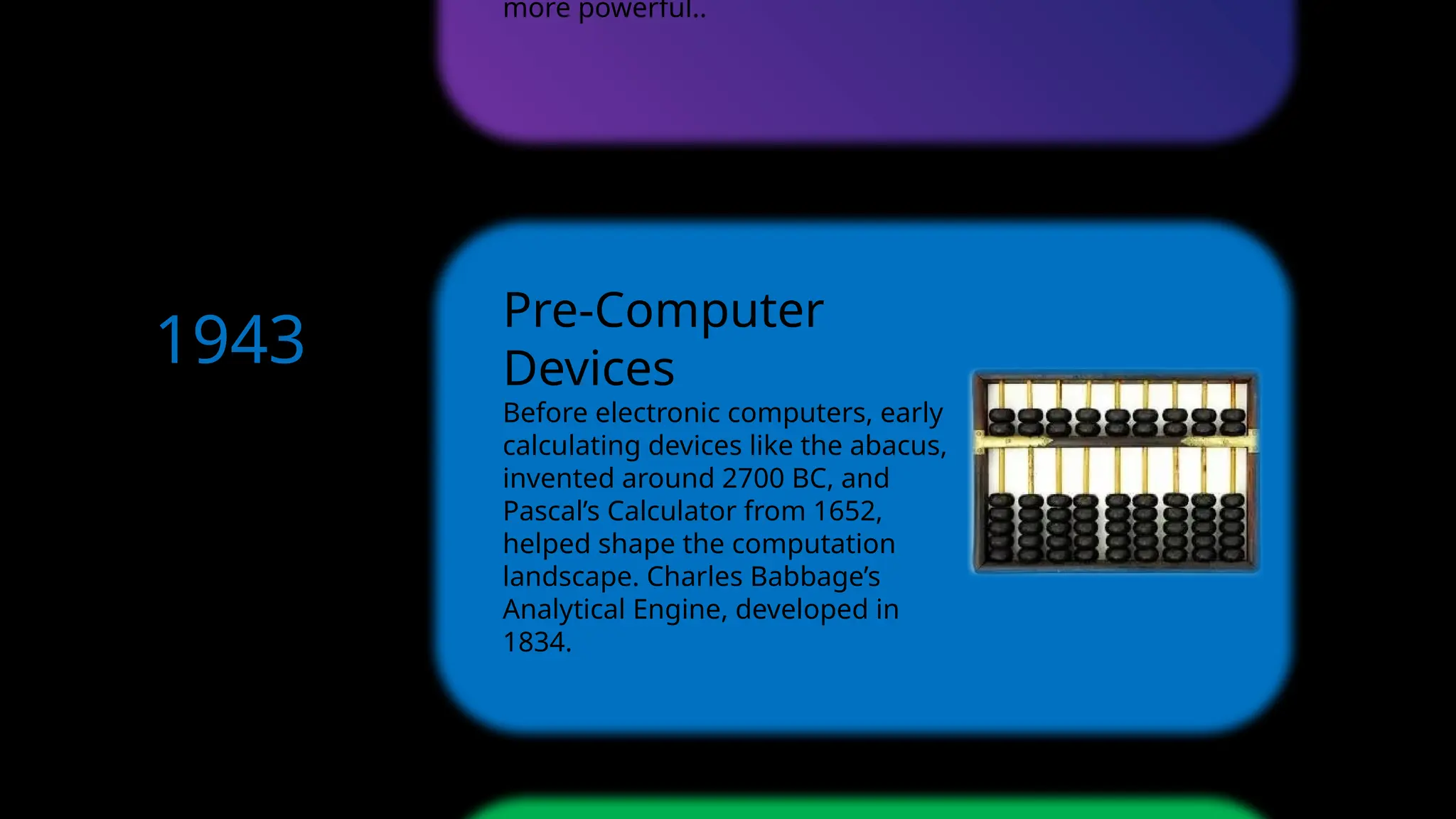
Before electroniccomputers, early
calculating devices like the abacus,
invented around 2700 BC, and
Pascal’s Calculator from 1652,
helped shape the computation
landscape. Charles Babbage’s
Analytical Engine, developed in
1834.
1834
1943
1946
1959
6.
1834.
First Generation
(1946–1959)
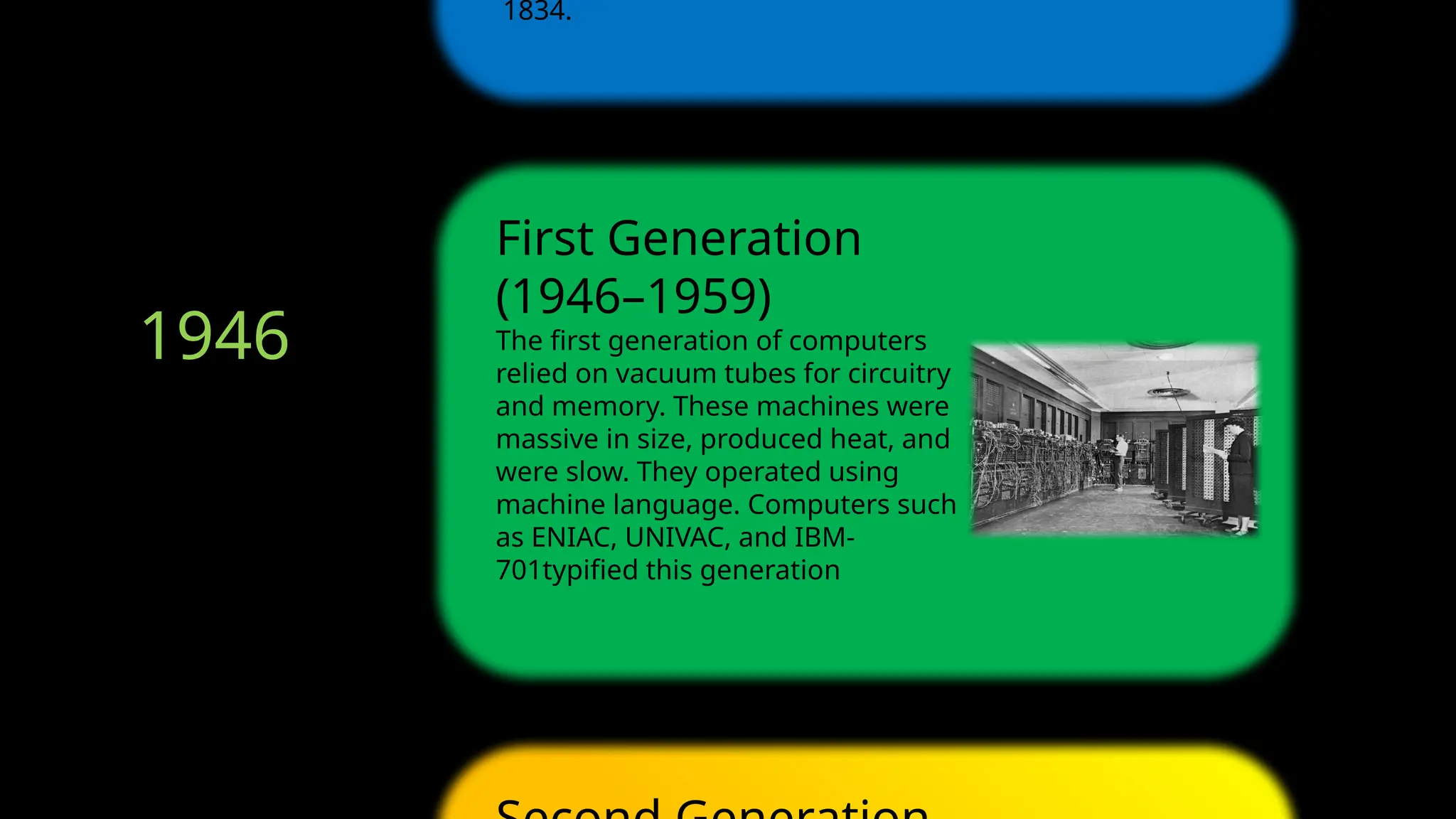
The firstgeneration of computers
relied on vacuum tubes for circuitry
and memory. These machines were
massive in size, produced heat, and
were slow. They operated using
machine language. Computers such
as ENIAC, UNIVAC, and IBM-
701typified this generation
1834
1943
1946
1959
1965
7.
Second Generation
(1959–1965)
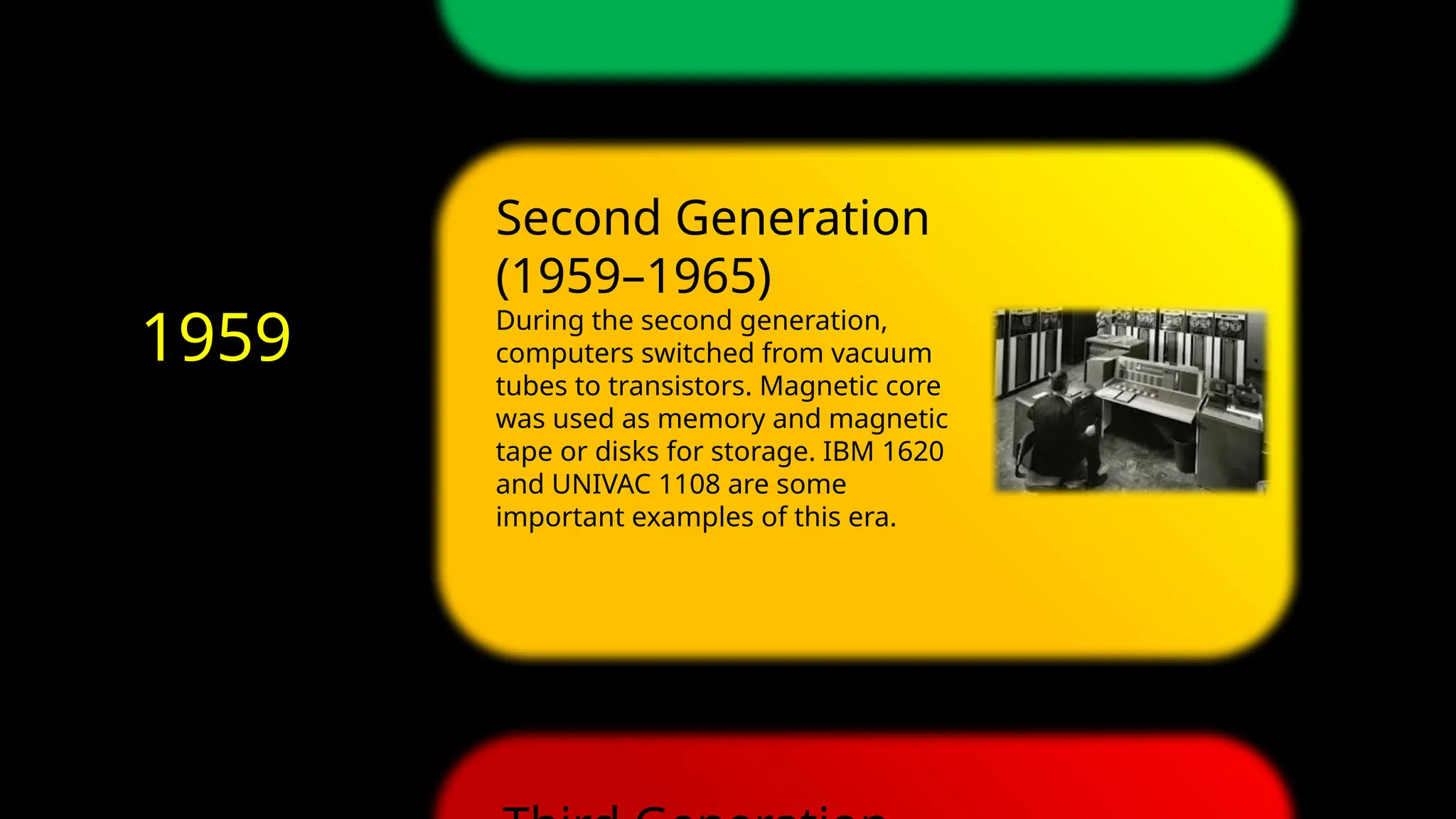
During thesecond generation,
computers switched from vacuum
tubes to transistors. Magnetic core
was used as memory and magnetic
tape or disks for storage. IBM 1620
and UNIVAC 1108 are some
important examples of this era.
1943
1946
1959
1965
1971
8.
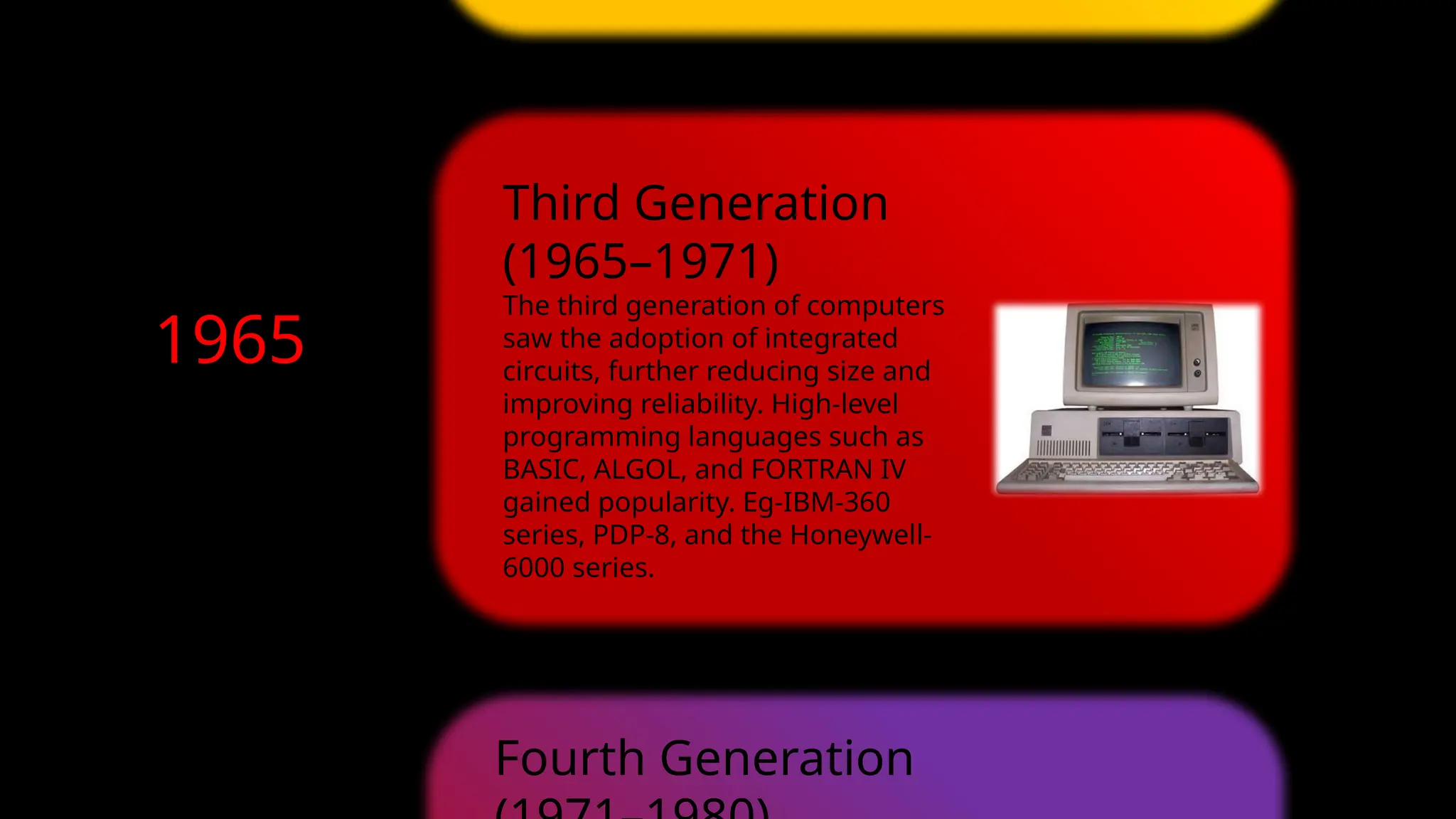
Third Generation
(1965–1971)
The thirdgeneration of computers
saw the adoption of integrated
circuits, further reducing size and
improving reliability. High-level
programming languages such as
BASIC, ALGOL, and FORTRAN IV
gained popularity. Eg-IBM-360
series, PDP-8, and the Honeywell-
6000 series.
Fourth Generation
1946
1959
1965
1971
1980
9.
6000 series.
Fifth Generation
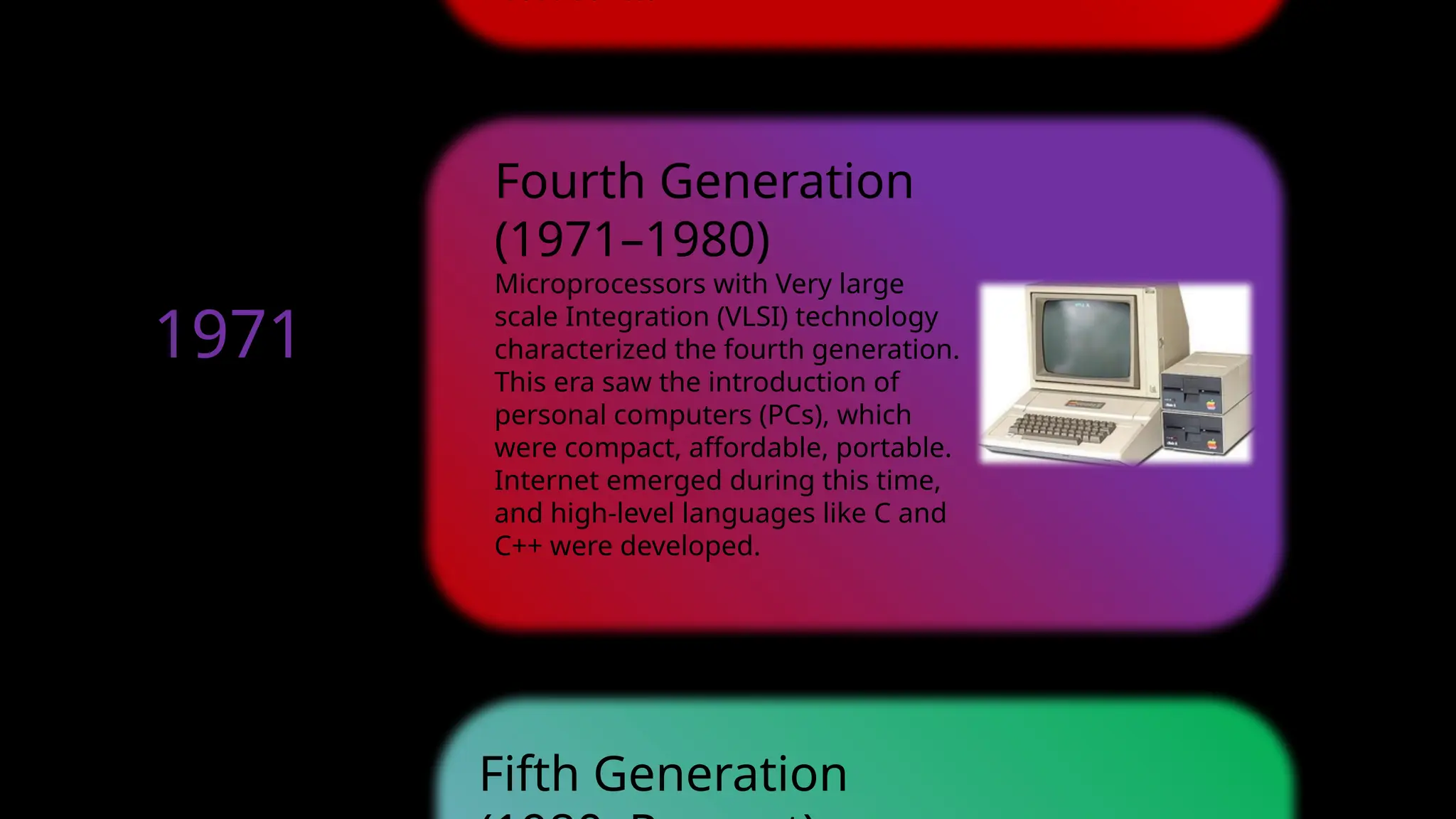
FourthGeneration
(1971–1980)
Microprocessors with Very large
scale Integration (VLSI) technology
characterized the fourth generation.
This era saw the introduction of
personal computers (PCs), which
were compact, affordable, portable.
Internet emerged during this time,
and high-level languages like C and
C++ were developed.
1959
1965
1971
1980
2025
10.
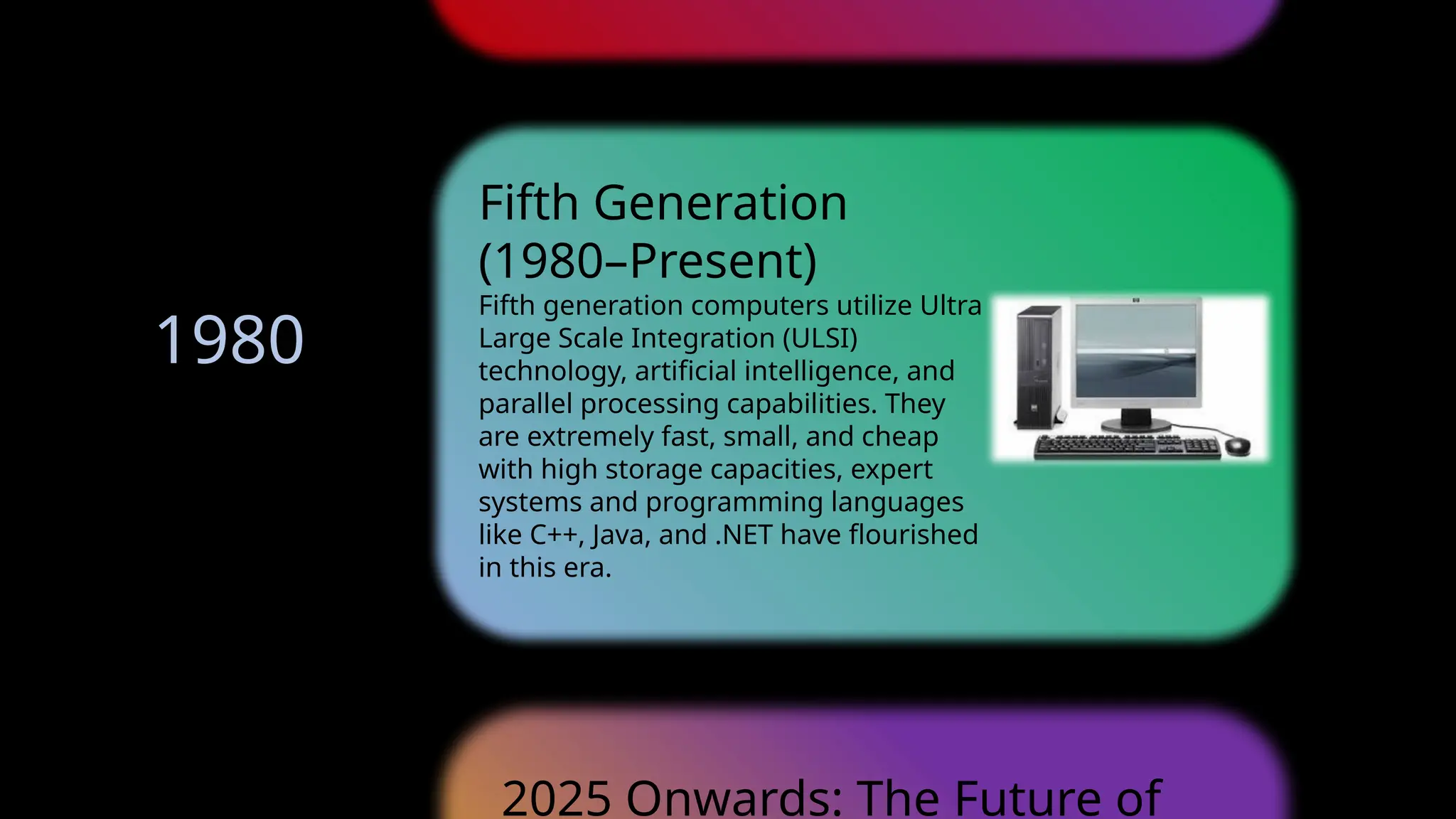
Fifth Generation
(1980–Present)
Fifth generationcomputers utilize Ultra
Large Scale Integration (ULSI)
technology, artificial intelligence, and
parallel processing capabilities. They
are extremely fast, small, and cheap
with high storage capacities, expert
systems and programming languages
like C++, Java, and .NET have flourished
in this era.
2025 Onwards: The Future of
1965
1971
1980
2025
Future
11.
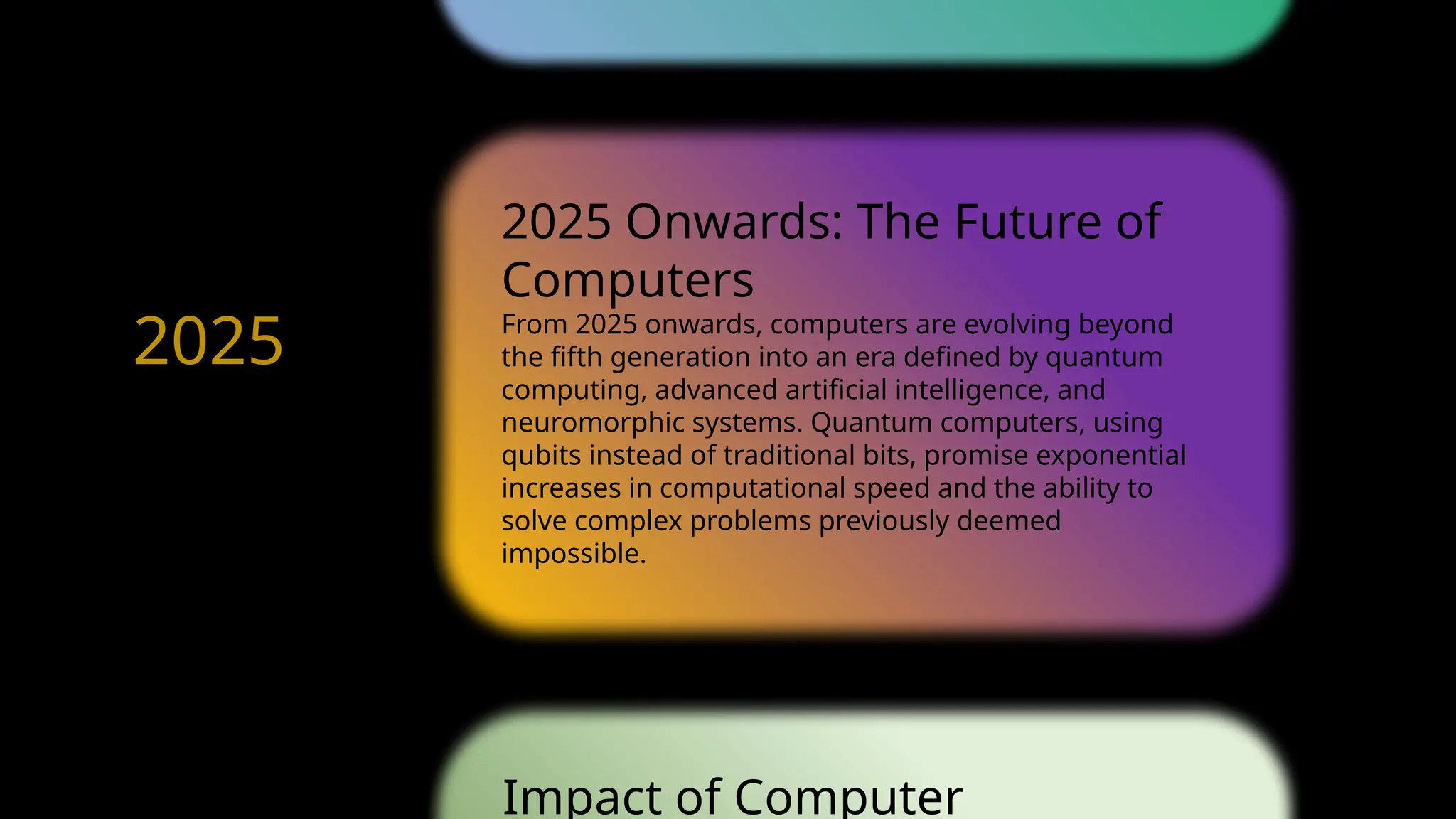
2025 Onwards: TheFuture of
Computers
From 2025 onwards, computers are evolving beyond
the fifth generation into an era defined by quantum
computing, advanced artificial intelligence, and
neuromorphic systems. Quantum computers, using
qubits instead of traditional bits, promise exponential
increases in computational speed and the ability to
solve complex problems previously deemed
impossible.
Impact of Computer
1971
1980
2025
Future
12.
Impact of Computer
Generations
Eachtransition brought improvements in:
• Speed and efficiency
• Size and portability
• Cost and accessibility
• Software capabilities.
• Energy consumption and environmental impact.
• Connectivity and communication.
Impact of Computer
Generations
Each transition brought improvements in:
• Speed and efficiency
• Size and portability
• Cost and accessibility
• Software capabilities.
• Energy consumption and environmental impact.
• Connectivity and communication.
1980
2025
Future
13.
Computers with ArtificialIntelligence
(AI)
From the late 20th century onwards, computers have
increasingly integrated artificial intelligence, allowing
them to perform tasks that require human-like reasoning,
learning, and decision-making. AI-powered computers
can recognize speech, process natural language, analyze
big data, and make predictions in real time. Modern
applications include smart assistants (like Siri and Alexa),
self-driving vehicles, and advanced robotics.
1980
2025
Future