DOCTRINES OF CY PRES
AND EQUITABLE
DEVIATION
Rachel Ziegler, Esq., Kaiser Law Group
Nicholas M. O’Donnell, Esq., Sullivan & Worcester
Restricted Charitable Gifts
• Donors often make restricted charitable gifts to charitable
trusts or non-profits.
• Charitable gifts made in Wills, Trusts, or other donative
instruments established by the Donor.
• Gift restrictions as to purpose or time.
• Purpose – Restriction about how the gift should be used.
• Time – Restriction about when the gift can be used.
• Often charitable gifts are made “in perpetuity” (i.e., an
endowment fund). Use of gift is limited to income only.
The Problem of Restricted
Charitable Gifts
• Over time, circumstances change, in some cases very long
after the gift was made.
• Gift restrictions become outdated, impractical or incompatible
with the charity’s goals/mission. The charity may cease to
exist or substantially change its form.
• A charitable gift may even become unusable.
• Donor is deceased and the donor’s intent may not be clear.
• BUT charities and trustees are bound by the duty to carry out
the terms of the donative gift instrument. Thus, the gift
restrictions cannot be ignored or modified by the charity.
The Solution
• Doctrines of Cy Pres (See Pray) and Equitable Deviation
• Legal doctrines that permit modification of gift restrictions under
certain circumstances and (usually*) only with court approval.
• Doctrines are related, but different.
• If donor is alive and can be located, donor may (in some cases)
consent to modification of restriction, and doctrines become
unnecessary. Right to consent to modification does not pass to
spouse/descendants unless instrument says it does.
Legal Authority
• Historically, Doctrines of Cy Pres and Equitable Deviation were
common law doctrines.
• Massachusetts UTC codified the Doctrine of Equitable
Deviation for charitable trusts.
• Section 412 of MUTC.
• UTC included section on Cy Pres, but Massachusetts did not enact
this section.
• Doctrine of Cy Pres remains a common law doctrine in
Massachusetts.
Doctrine of Cy Pres
• Norman French expression “cy pres comme possible” meaning
“as near as possible.”
• How does it work?
• Charity/charitable trust petitions court to apply doctrine of cy
pres. Attorney General named as defendant in action in capacity
as representative of public interest in administration of charitable
funds.
• Charity/charitable trust must show -
• (1) Gift has become “impossible, impracticable, or illegal”.
• (2) Gift was made with a “public charitable purpose” or “general
charitable intention”.
• (3) Gift instrument does not provide for alternative disposition.
Doctrine of Cy Pres – Cont’d
• If court finds (1), (2), and (3), court applies Doctrine to modify
gift.
• Modification must be “as near as possible” to donor’s intent.
• Donor’s intent (to the extent it can be discerned) must guide
court in ordering a modification.
• An example – Jackson v. Phillips
Doctrine of Equitable Deviation
• Close cousin of cy pres.
• Doctrine of equitable deviation permits a court to make
changes to an administrative or procedural restriction on use.
• Standard under MUTC 412 – Court can modify administrative
terms of trust if continuation would be “impracticable or
wasteful or impair the trust’s administration.” Modification
“in accordance with settlor’s probable intent.”
• An example – Isabella Stewart Gardner Museum, Inc. v.
Attorney General
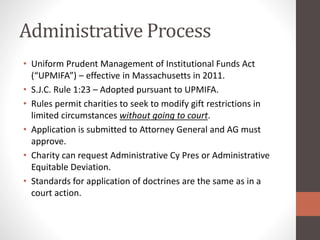
Administrative Process
• Uniform Prudent Management of Institutional Funds Act
(“UPMIFA”) – effective in Massachusetts in 2011.
• S.J.C. Rule 1:23 – Adopted pursuant to UPMIFA.
• Rules permit charities to seek to modify gift restrictions in
limited circumstances without going to court.
• Application is submitted to Attorney General and AG must
approve.
• Charity can request Administrative Cy Pres or Administrative
Equitable Deviation.
• Standards for application of doctrines are the same as in a
court action.
Administrative Process
• Only “institutions” can apply.
• Public charities or public charitable trusts (provided no non-
charitable interests remain and trustee is a public charity).
• Only for “institutional funds”.
• Held for charitable purposes and investment purposes. Not
program related assets.
• Donor (not board) restricted.
• Not wholly expendable (e.g., use limited to income only).
• Made pursuant to a “gift instrument” (broadly defined).
• Older that 20 years.
• Smaller than $75,000 (per fund).
Administrative Process
• Avoids court!
• Quicker and much less costly.
• Smaller funds that are being held and not used by charities
may become useable.
• Charities will better honor donor’s intentions.
• Charities may be less reluctant to take smaller, restricted gifts
in the future.
Case Study 1
Case Study 2
How to Avoid
• Encourage clients to make charitable gifts for charity’s “general
charitable purposes” and state specifically in instrument.
• Use precatory language only for donor imposed “restrictions”.
• Include specific “gift overs”.
• Add “cy pres” language to Wills and Trusts. Language which
specifically provides for an alternative disposition.
• Give Personal Representative/Trustee discretion to modify gift or
restrictions.
• Keep in mind the types of restrictions likely to become outdated.
• Keep in mind the types of charities likely to change.
• Always include language allowing gift to be paid to successor charity.
Entities change!
• Check charitable organizations. Clients are wrong all the time!
Sample Strategies
1. Lapse
$ to charity to establish [______] Foundation, “provided,
however, if in the Trustees’ conclusive judgment such
organization is then no longer in existence in its present name or
form or for its present purposes, the Trustees shall pay over the
amount designated for such organization to the organization or
organizations which in the Trustees’ conclusive judgment is the
successor to the work and purposes of such organization, or, if in
the Trustees’ conclusive judgment there is no such successor,
such gift shall lapse.”
Sample Strategies
2. Trustee Discretion
$ to charity to establish [______] Foundation “provided,
however, if in the Trustees’ conclusive judgment such
organization is then no longer in existence in its present name or
form or for its present purposes, the Trustees shall pay over the
amount designated for such organization to the organization or
organizations which in the Trustees’ conclusive judgment is the
successor to the work and purposes of such organization, or, if in
the Trustees’ conclusive judgment there is no such successor, to
another charitable organization or organizations with a similar
mission or purpose contributions to which are deductible under
Section 2055 of the Code to be selected by the Trustees in their
sole discretion.”
Sample Strategies
3. Contingent Remainder Charity
$ to “St. Mary’s Church in Randolph, Massachusetts, provided
that [______] is the pastor at the time of my death, otherwise if
[______] is not the pastor of St. Mary’s Church, in his honor or
memory, as the case may be, to St. Patrick’s Seminary and
University, located in Menlo Park, California….”
*Consider tax implications if there is non-charitable remainder.
Sample Strategies
4. Broaden Restriction
$ to “the Dana Farber Cancer Institute located in Boston,
Massachusetts, in memory of my Husband and me, to fund
lymphoma and leukemia research and to be used at the
direction of [_____], M.D., or if he is no longer working at Dana
Farber Cancer Institute, to be used at the direction of a
successor physician who oversees lymphoma and leukemia
research.”
Advice on Restrictions
• Some clients may insist on gift restrictions. If so:
• Include a clear statement of the donor’s intent in the instrument.
• Build in flexibility.
• Avoid overly stringent restrictions.
• Encourage donor and charity to work together.
• In gift instrument, give charity ability to modify with consent of
family members.
• Keep costs in mind! Restrictions will lead to administration costs,
legal fees, etc.
• Consider a Donor Advised Fund or Private Foundation for large
gifts.
Contact us
Rachel Ziegler
Kaiser Law Group
(617) 641-0000
rachel@kaiserlawgroup.com
http://www.kaiserlawgroup.com/
blog/
@kaiserlawgroup
Nicholas M. O’Donnell
Sullivan & Worcester
(617) 338-2814
nodonnell@sandw.com
http://www.artlawreport.com/
@NicholasMOD

Doctrines of Cy Pres and Equitable Deviation

  • 1.
    DOCTRINES OF CYPRES AND EQUITABLE DEVIATION Rachel Ziegler, Esq., Kaiser Law Group Nicholas M. O’Donnell, Esq., Sullivan & Worcester
  • 2.
    Restricted Charitable Gifts •Donors often make restricted charitable gifts to charitable trusts or non-profits. • Charitable gifts made in Wills, Trusts, or other donative instruments established by the Donor. • Gift restrictions as to purpose or time. • Purpose – Restriction about how the gift should be used. • Time – Restriction about when the gift can be used. • Often charitable gifts are made “in perpetuity” (i.e., an endowment fund). Use of gift is limited to income only.
  • 3.
    The Problem ofRestricted Charitable Gifts • Over time, circumstances change, in some cases very long after the gift was made. • Gift restrictions become outdated, impractical or incompatible with the charity’s goals/mission. The charity may cease to exist or substantially change its form. • A charitable gift may even become unusable. • Donor is deceased and the donor’s intent may not be clear. • BUT charities and trustees are bound by the duty to carry out the terms of the donative gift instrument. Thus, the gift restrictions cannot be ignored or modified by the charity.
  • 4.
    The Solution • Doctrinesof Cy Pres (See Pray) and Equitable Deviation • Legal doctrines that permit modification of gift restrictions under certain circumstances and (usually*) only with court approval. • Doctrines are related, but different. • If donor is alive and can be located, donor may (in some cases) consent to modification of restriction, and doctrines become unnecessary. Right to consent to modification does not pass to spouse/descendants unless instrument says it does.
  • 5.
    Legal Authority • Historically,Doctrines of Cy Pres and Equitable Deviation were common law doctrines. • Massachusetts UTC codified the Doctrine of Equitable Deviation for charitable trusts. • Section 412 of MUTC. • UTC included section on Cy Pres, but Massachusetts did not enact this section. • Doctrine of Cy Pres remains a common law doctrine in Massachusetts.
  • 6.
    Doctrine of CyPres • Norman French expression “cy pres comme possible” meaning “as near as possible.” • How does it work? • Charity/charitable trust petitions court to apply doctrine of cy pres. Attorney General named as defendant in action in capacity as representative of public interest in administration of charitable funds. • Charity/charitable trust must show - • (1) Gift has become “impossible, impracticable, or illegal”. • (2) Gift was made with a “public charitable purpose” or “general charitable intention”. • (3) Gift instrument does not provide for alternative disposition.
  • 7.
    Doctrine of CyPres – Cont’d • If court finds (1), (2), and (3), court applies Doctrine to modify gift. • Modification must be “as near as possible” to donor’s intent. • Donor’s intent (to the extent it can be discerned) must guide court in ordering a modification. • An example – Jackson v. Phillips
  • 8.
    Doctrine of EquitableDeviation • Close cousin of cy pres. • Doctrine of equitable deviation permits a court to make changes to an administrative or procedural restriction on use. • Standard under MUTC 412 – Court can modify administrative terms of trust if continuation would be “impracticable or wasteful or impair the trust’s administration.” Modification “in accordance with settlor’s probable intent.” • An example – Isabella Stewart Gardner Museum, Inc. v. Attorney General
  • 9.
    Administrative Process • UniformPrudent Management of Institutional Funds Act (“UPMIFA”) – effective in Massachusetts in 2011. • S.J.C. Rule 1:23 – Adopted pursuant to UPMIFA. • Rules permit charities to seek to modify gift restrictions in limited circumstances without going to court. • Application is submitted to Attorney General and AG must approve. • Charity can request Administrative Cy Pres or Administrative Equitable Deviation. • Standards for application of doctrines are the same as in a court action.
  • 10.
    Administrative Process • Only“institutions” can apply. • Public charities or public charitable trusts (provided no non- charitable interests remain and trustee is a public charity). • Only for “institutional funds”. • Held for charitable purposes and investment purposes. Not program related assets. • Donor (not board) restricted. • Not wholly expendable (e.g., use limited to income only). • Made pursuant to a “gift instrument” (broadly defined). • Older that 20 years. • Smaller than $75,000 (per fund).
  • 11.
    Administrative Process • Avoidscourt! • Quicker and much less costly. • Smaller funds that are being held and not used by charities may become useable. • Charities will better honor donor’s intentions. • Charities may be less reluctant to take smaller, restricted gifts in the future.
  • 12.
  • 13.
  • 14.
    How to Avoid •Encourage clients to make charitable gifts for charity’s “general charitable purposes” and state specifically in instrument. • Use precatory language only for donor imposed “restrictions”. • Include specific “gift overs”. • Add “cy pres” language to Wills and Trusts. Language which specifically provides for an alternative disposition. • Give Personal Representative/Trustee discretion to modify gift or restrictions. • Keep in mind the types of restrictions likely to become outdated. • Keep in mind the types of charities likely to change. • Always include language allowing gift to be paid to successor charity. Entities change! • Check charitable organizations. Clients are wrong all the time!
  • 15.
    Sample Strategies 1. Lapse $to charity to establish [______] Foundation, “provided, however, if in the Trustees’ conclusive judgment such organization is then no longer in existence in its present name or form or for its present purposes, the Trustees shall pay over the amount designated for such organization to the organization or organizations which in the Trustees’ conclusive judgment is the successor to the work and purposes of such organization, or, if in the Trustees’ conclusive judgment there is no such successor, such gift shall lapse.”
  • 16.
    Sample Strategies 2. TrusteeDiscretion $ to charity to establish [______] Foundation “provided, however, if in the Trustees’ conclusive judgment such organization is then no longer in existence in its present name or form or for its present purposes, the Trustees shall pay over the amount designated for such organization to the organization or organizations which in the Trustees’ conclusive judgment is the successor to the work and purposes of such organization, or, if in the Trustees’ conclusive judgment there is no such successor, to another charitable organization or organizations with a similar mission or purpose contributions to which are deductible under Section 2055 of the Code to be selected by the Trustees in their sole discretion.”
  • 17.
    Sample Strategies 3. ContingentRemainder Charity $ to “St. Mary’s Church in Randolph, Massachusetts, provided that [______] is the pastor at the time of my death, otherwise if [______] is not the pastor of St. Mary’s Church, in his honor or memory, as the case may be, to St. Patrick’s Seminary and University, located in Menlo Park, California….” *Consider tax implications if there is non-charitable remainder.
  • 18.
    Sample Strategies 4. BroadenRestriction $ to “the Dana Farber Cancer Institute located in Boston, Massachusetts, in memory of my Husband and me, to fund lymphoma and leukemia research and to be used at the direction of [_____], M.D., or if he is no longer working at Dana Farber Cancer Institute, to be used at the direction of a successor physician who oversees lymphoma and leukemia research.”
  • 19.
    Advice on Restrictions •Some clients may insist on gift restrictions. If so: • Include a clear statement of the donor’s intent in the instrument. • Build in flexibility. • Avoid overly stringent restrictions. • Encourage donor and charity to work together. • In gift instrument, give charity ability to modify with consent of family members. • Keep costs in mind! Restrictions will lead to administration costs, legal fees, etc. • Consider a Donor Advised Fund or Private Foundation for large gifts.
  • 20.
    Contact us Rachel Ziegler KaiserLaw Group (617) 641-0000 rachel@kaiserlawgroup.com http://www.kaiserlawgroup.com/ blog/ @kaiserlawgroup Nicholas M. O’Donnell Sullivan & Worcester (617) 338-2814 nodonnell@sandw.com http://www.artlawreport.com/ @NicholasMOD